Light Emitting Diode Therapy (LEDT) Applied
Pre-Exercise Inhibits Lipid Peroxidation in
Athletes After High-Intensity Exercise. A
Preliminary Study
Ernesto Cesar Pinto Leal Junior1,2
Bruno Manfredini Baroni3
Rafael Paolo Rossi4
Vanessa de Godoi4
Thiago De Marchi5,6
Shaiane Silva Tomazoni4
Patrícia de Almeida2,4
Mirian Salvador5
Douglas Grosselli6
Rafael Abeche Generosi3
Maira Basso6
José Luis Mancalossi6
Rodrigo Álvaro Brandão Lopes-Martins1,2,4
1. Centro de Pesquisa e Inovação em Laser, Universidade Nove de Julho (Uninove), São Paulo, SP – Brasil. 2. Programa de Pós-Graduação em Ciências da Reabilitação, Universidade Nove de Julho (Uninove), São Paulo, SP – Brasil. 3. Laboratório de Pesquisa em Exercício, Universidade Federal do Rio Grande do Sul (UFRGS), Porto Alegre, RS – Brasil.
4. Laboratório de Farmacologia e Terapêutica Experimental, Departamento de Farmacologia, Instituto de Ciências Biomédicas, Universidade de São Paulo (USP), São Paulo, SP – Brasil.
5. Laboratório de Estresse Oxidativo, Universidade de Caxias do Sul (UCS), Caxias do Sul, RS – Brasil.
6. Laboratório do Movimento Humano (LMH), Instituto de Medicina do Esporte (IME), Universidade de Caxias do Sul (UCS), Caxias do Sul, RS – Brasil.
Correspondence address: Centro de Pesquisa e Inovação em Laser. Universidade Nove de Julho – Uninove – Rua Vergueiro, 235 – 01504-001 – São Paulo, SP – Brasil E-mail: [email protected]
ABSTRACT
Oxidative stress is the term generally used to describe the damage caused by imbalance between pro-oxidants and antipro-oxidants in the organism. The increase in the O2 consumption induced by physical exercise is associated with the increase of reactive oxygen species (ROS) being these species inducers of oxidative stress. Although the evidence indicates a probable inhibitory effect of the light emitting diode therapy (LEDT) on the production of ROS, there are no studies observing this effect in humans. This preliminary study has the aim to verify the effects of LEDT applied before high-intensity exercise on lipid peroxidation, measured through blood levels of ThioBarbituric Acid Reactive Substances (TBARS). Six male volleyball athletes were submitted to two situations: active LEDT and placebo LEDT. Performance in the exercise protocol showed no difference (p> 0.05) between the two situations in peak power, average power and fatigue index. The results related to lipid peroxidation were: at active LEDT situation, it was not possible to observe statistically significant difference (p>0.05) between pre and post exercise levels (6.98 ± 0.81 and 7.02 ± 0.47 nmol/ mL); at placebo LEDT situation, statistically significant difference (p=0.05) was observed between pre and post exercise levels (7.09 ± 1.28 and 8.43 ± 0.71 nmol/mL). These results show that active LEDT seems to be effective in controlling lipid peroxidation in athletes submitted to intense exercise.
Keywords: phototherapy, lipid peroxidation, sport
INTRODUCTION
Oxidative stress is the term generally used to describe the damage caused by imbalance between pro-oxidants and the antioxidant defense. Such fact may occur both by increase in the formation of reactive oxygen species (ROSs) and by decrease of capacity of cellular antioxidant defense. This damage includes increase of lipid peroxidation levels (oxidation of the lipid layer of the cell mem-brane), increase in the carbonylation of proteins and even damage in the intracellular DNA, which affects the intracellular metabolism and can cause apoptosis (cell death)(1-4).
Physical exercise promotes increase in the energetic demand of up to 35 times compared to rest(5).
Knowing that about 2% to 5% of the O2 consumed gives origin to ROS in the mitochondria(2,6), the
increase in O2 consumption induced by physical exercise is associated with the increase of the ROS
being these inducers of oxidative stress. Dillard et al.(7) were the pioneers in demonstrating that
physical exercise induces increase of lipid peroxidation. After 1982, when Davies et al.(8)
demon-strated the oxidative damage caused by exhaustive exercise, considerable amount of experimental evidence has come out indicating thus a cause-effect correlation between oxidative stress and muscle fatigue(9). However, it has not been established yet whether lipid peroxidation is the cause
or the consequence of tissue damage caused by exercise(1).
Some authors believe that oxidative stress can be harmful to sports performance(9,10), although
there is still an evidence gap which supports such hypothesis. Studies performed with animals and isolate fibers indicate that increase of the ROSs induced by exogenous sources can harm muscle performance(11). Nevertheless, some authors suggest that the main effect of the oxidative
stress occurs in the long run, in the overreaching induction, an example of metabolic imbalance related to the initial status of overtraining(12,13). Although antioxidant supplementation has proved
to be efficient in reducing oxidative stress induced by physical exercise in humans(14), there is no
cohesive evidence which supports that sports performance improves as a response to lower level of oxidative stress(15).
In a recent study involving electrical stimulation in culture of muscle cells of rats, Xu et al.(16) have
verified that the treatment with phototherapy significantly decreased the production of the ROSs CLÍNICA MÉDICA DO EXERCÍCIO E DO ESPORTE
and restored the mitochondrial function. The authors suggest that phototherapy is an original and non-invasive therapy in the treatment of muscle fatigue induced by exercise, tissue injury and other processes in which the mitochondrial function plays a key-role. Phototherapy has also demonstrated to be efficient in preventing oxidative stress after muscle injury induced by me-chanical trauma in animal models(17,18). In the pioneer study on
phototherapy and muscle fatigue, Lopes-Martins et al.(19) have
observed the protective effect of phototherapy on the muscle damage in rats submitted to a protocol of muscle contractions generated by electrical stimulation. In humans, Leal Junior et al.(20,21) have demonstrated that phototherapy using low level
laser therapy (LLLT) can present positive effects in muscle fatigue attenuation as well as in post-exercise muscle recovery(22) when
the therapy is applied prior to the exercise performance. More-over, Leal Junior et al.(23,24) have also observed that phototherapy
with light emitting diode therapy (LEDT) has effects similar to the LLLT concerning the attenuation of muscle fatigue and improve-ment of post-exercise recovery.
Although evidence indicates a probable inhibiting effect of pho-totherapy on the production of Ross, and consequently a pro-tective effect against oxidative stress, until the present moment there are no studies which observe such possibility in athletes. Therefore, this preliminary study has the aim to verify the effect of LEDT on the lipid peroxidation, measured through the blood levels of ThioBarbituric Acid Reactive Substances (TBARS), in ath-letes submitted to a high-intensity exercise protocol.
METHODOLOGY
A random clinical, placebo-controlled, double blind and crossed assay was performed. The study was approved by the Research Ethics Committee (REC) of the University of the Paraíba Valley and all participants signed the Free and Clarified Consent Form. The volunteers were recruited among young male volleyball athletes (n = 6) members of the youth team of the University of Caxias do Sul, having the following exclusion criteria been adopted: age below 17 years; time of practice below five years; any previous musculoskeletal injury in the hip, knee or ankle regions; participa-tion below 80% of the team activities; payers using any kind of nutritional supplement or pharmacological agent.
All athletes went twice to the laboratory and were submitted to two situations: active LEDT application and placebo LEDT ap-plication. In both sessions, the following protocol was followed: initially, basal blood collection of the athlete was performed; afterwards, a standardized a muscle stretching protocol; sub-sequently, active or placebo LEDT application according to the previous randomization; three minutes after the end of the LEDT, application of the muscle fatigue inducing protocol (MFIP); three minutes after the end of MFIP, a new blood sample was collected, finalizing the protocol. Further details on the used procedures are presented in the following sessions.
Randomization
The LEDT application was defined through randomization in which the subjects were separated in two groups (A and B), which determined the order of application of the LEDT modali-ties. Concerning group A members, on the first session the active LEDT application was performed and on the second session, the
placebo LEDT was applied. Concerning group B members, on the first session placebo LEDT was applied and active LEDT was applied on the second session. Randomization was full respon-sibility of a technician who also in charge of programming the LEDT equipment, where he determined the kinds of applica-tion (active or placebo) for each athlete, according to previous randomization. This technician also received instructions not to communicate the kind of treatment used to the researcher re-sponsible for the LEDT application, to the volunteers and to the researchers responsible for the MFIP and for the blood collections and analyses.
Assessment period
The procedures were carried out exactly the same way on the two exercise sessions, which occurred with a one-week interval between them, on the same weekday (Monday), at the same time of the day (between 18:30h and 21:30h), and any high-intensity physical activity was prohibited during the weekends prior the tests. We can mention the exercises performance at approximately the same time the day (for control of the circadian rhythm), besides the recommendations to the athletes concern-ing the kind of suitable meals for the day of the procedures and interval between the last meal and the moment of the assess-ment are some careful measures taken for standardization in the exercise protocol performance.
LEDT application protocol
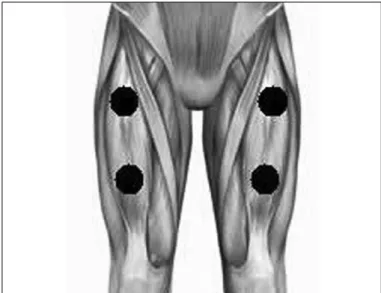
On both exercise sessions (tests), the participants received LEDT application (active or placebo) through an equipment brand name THOR (London, United Kingdom) using a cluster with 34 LED diodes of 660nm and 35 LED diodes of 850nm, also manu-factured by THOR (London, United Kingdom), according to the randomization result. The active or placebo LEDT application was performed after a randomized stretching set and three minutes before the MFIP. Both active and placebo LEDT applications were administered by one of the researchers in isolate environ-ment, and only the volunteer and the researcher were present. Eye protection (matte goggles) was used by the participants to avoid visualization or perception if they were receiving active or placebo LEDT application, since it does not cause any thermal sensation to the volunteer. The therapy was administered on the knee extensor musculature of the volunteers, the application points were selected the same way as in the study by Leal Junior et al.(23), according to illustration in (figure 1).
Active LEDT application was performed by direct contact of the cluster with the skin, which was placed still with light pressure, at a 90 degree angle on each of the irradiation points. The active LEDT parameters are the same used by Leal Junior et al.(23), and
are summarized on table 1. The placebo LEDT application was performed exactly like the active one; however, with the equip-ment on placebo mode (without active irradiation).
Muscle fatigue inducing protocol (MFIP)
Blood samples
Antiseptic cleansing of the ventral region of the dominant arm was performed before each blood collection from which a quali-fied nursing professional collected 10ml of blood (using dispos-able gloves, syringes and needles). Each athlete was submitted to two collections in each session, one before the stretching and the LEDT application (active or placebo) and the other exactly three minutes after the end of the MFIP. The collected material was transferred to non-heparinized tubes and was subsequently centrifuged and frozen for further analysis of the level of Thio-Barbituric Acid Reactive Substances (TBARS).
ThioBarbituric Acid Reactive Substances (TBARS)
As indication of lipid peroxidation, formation of ThioBarbitiruc Acid Reactive Substances (TBARS) was used during a heating reaction of the acid, which is widely adopted as a method fairly sensitive of measurement of oxidative stress(25). In summary, the
blood samples were mixed with the 10% trichloroacetic acid Figure 1. Point used in the LEDT application (active or placebo).
subjects responsible for the application of the Wingate test were not aware of the modality received by the athletes before the beginning of the test (active or placebo LEDT application).
12
10
8
6
4
2
0
TBARS (nmol/ml)
LEDT efetiva
LEDT placebo
*
Pré Pós Pré Pós
Figure 2. Comparison between the TBARS levels before (PRE) and after (POST) exercise at the active LEDT and placebo LEDT situations (*p = 0.05).
and to the 0.67% thiobarbituric acid, and then heated in boiling water bath for 15 minutes. The ThioBarbituric Acid Reactive Sub-stances were determined by absorbance at 535nm. The results were expressed in nmol/ml.
Statistical Analysis
The means of the groups and their respective standard deviations were expressed in the results. A paired and two-tailed t test was used to verify whether there was statistically significant difference in the pre and post-exercise oxidative stress levels for the active and placebo LEDT application. The significance level adopted was of 5% (p < 0.05).
RESULTS
Six male healthy and young adult volleyball athletes who were within the inclusion criteria participated in this study. Mean age of the athletes was 18.57 years (± 0.98), mean body mass 82.03kg (± 3.11) and mean stature 188.71cm (± 11.83).
Performance of athletes in the Wingate test did not reveal sta-tistically significant difference in the peak power or mean power between active LEDT (12.22W.kg-1 ± 0.82; 9.54W.kg-1 ± 0.60) and
placebo LEDT (12.29W.kg-1 ± 0.60; 9.65W.kg-1 ± 0.42) (p > 0.05).
Concerning the fatigue index (an indirect variable measured through minimal and maximal performance reached during the test) statistically significant differences have not been found ei-ther (p > 0.05) between active LEDT (39.64% ± 6.36) and placebo LEDT (39.88% ± 4.38).
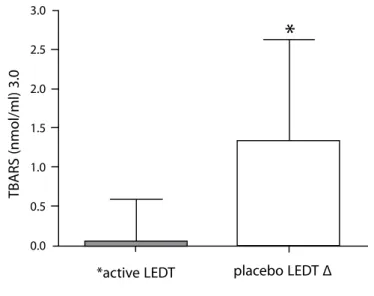
The results related to oxidative stress, measured by the TBARS levels, are demonstrated in figure 2. In the active LEDT situation, statistically significant difference was not observed (p > 0.05) between the pre and post-exercise levels (6.98 ± 0.81 and 7.02 ± 0.47nmol/ml). Nevertheless, the placebo LEDT situation demon-strated statistically significant difference (p = 0.05) between the pre and post-exercise levels (7.09 ± 1.28 and 8.43 ± 0.71nmol/ml). When the variation of the TBARS concentrations in the pre and post-exercise assessments was considered, statistically significant difference was observed (p = 0.02) between active LEDT (1.34 ± 1.29nmol/ml) and placebo LEDT (0.06 ± 0.53nmol/ml), according to what was illustrated in figure 3.
Table 1. Parameters for active LEDT.
Number of diodes: 69 (34 red diodes and 35 infrared diodes) Wave length: 660nm (red diodes) and 850nm (infrared diodes) LEDT frequency: continuous
Exit power: 10mW (red diodes) and 30mW (infrared diodes) LED size: 0.2cm2 (for both – red and infrared diodes)
Power density: 0.05W/cm2 (for red diodes) and 0.15W/cm2
(for infrared diodes)
Irradiated energy: 41.7 Joules on each point (0.3J for each red diode and 0.9J for each infrared diode)
Energy density: 1.5 J/cm2 on each point (for red diodes) and 4.5J/cm2 on
each point (for infrared diodes)
Treatment time: 30 seconds on each point Number of irradiation points per muscle: 2 Total energy transmitted per muscle: 83.4 Joules
Application manner: still on contact with skin at a 90-degree angle with light pressure
TBARS
(nmol/ml)12
Pre Post Pre Post*
the literature, these can be considered a first step for studies on this new knowledge field.
Considering that this research was carried out as a preliminary study, some limitations should be mentioned, the first one re-garding the sample size. The limited number of participants does not allow further statements on the results and makes it difficult to apply a more suitable statistical analysis. Additionally, we believe that athletes may not be the optimum population for the assessment of oxidative stress, since the systematic prac-tice of physical exercises, especially of aerobic nature, increases the antioxidant capacity of an individual, and consequently, inhibits the installation of the phenomenon known as oxida-tive stress(26,27). Therefore, further studies involving untrained
or sedentary subjects will probably promote more significant increase in the oxidative stress compared to our findings, as the ones observed by Chang et al.(28), who have also used TBARS
as an assessment parameter.
The second limitation includes the exercise protocol used in the study. The Wingate test has a predominantly aerobic charac-teristic, being hence a test of maximum power and short time duration(29). In predominantly aerobic exercises, the increase
in the oxygen supply to the mitochondria provides increase in the production of EROs(30). Although predominantly aerobic
exercises are performed with limited oxygen participation, ex-cessive production of ROSs can be also observed(31), probably
by other mechanisms such as activation of xanthine oxidase, acidosis and oxidation of catecholamines(32). However, since the
literature presents controversial results, we understand long-duration exercises are more suitable when the aim is to induce oxidative stress, especially in trained individuals.
Moreover, as the assessment of the oxidative stress in humans is a complex procedure, added to the fact that there is no bio-logical marker considered gold standard, we emphasize the importance of using more than one biochemical analysis to determine oxidative stress(33). We suggest the observation of the
antioxidant enzymes behavior – such as superoxide dismutase (SOD), catalase (CAT), glutathione peroxidase (GPX) and glu-tathione redutase (GR) – which should be united with TBARS. Such observation seems appropriate since many researches believe that phototherapy increases the antioxidant activity through a photochemical process which accelerates the re-lease of ROSs(17,34). Thus, the explanation for our findings may
be related to the stimulating effect of phototherapy on the activity of antioxidant enzymes.
Finally, it is stated that despite the methodological limitations of the present study in proposing more concrete conclusions, our results demonstrate a protective effect of LEDT on the oxi-dative stress induced by exercise, besides being a pioneer in performing such verification in athletes. Further studies should be developed, since LEDT can become a new and non-phar-macological antioxidant agent as well as a prevention method to oxidative stress.
All authors have declared there is not any potential conflict of interests concerning this article.
3.0
2.5
2.0
1.5
1.0
0.5
0.0
Δ
TBARS (nmol/ml)
LEDT efetiva LEDT placebo
*
Figure 3. Comparison between the variation in the TBARS levels at the active LEDT and placebo LEDT situations (*p = 0.02)..
DISCUSSION
In this preliminary study, we assessed the effect of LEDT applied before high-intensity exercise performed on cycle ergometer on the variation in the TBARS concentration. Despite having presented some limitations which will be approached later on, our work found positive results concerning LEDT as a pre-vention modality to oxidative stress induced by exercise. Such speculation is based on the increase in the TBARS levels in the situation at which the athletes received placebo LEDT applica-tion, contrasting with the balance observed in the situation at which the athletes received active LEDT application.
Positive results of the phototherapy on the oxidative stress have been reported in studies in which the LLLT was applied on the muscles of rats submitted to mechanical trauma(17,18). Fillipin et
al.(17), using gallium arsenide laser (904nm, 45mW and 5J/cm2),
found reduction of histological abnormalities as well as inflam-matory response, besides increase in the collagen concentra-tion in the group irradiated with LLLT. The authors also observed significant effects of LLLT in the reduction of oxidative stress, represented by the decrease in the TBARS levels compared to the group which did not receive laser. Moreover, increase in the enzymatic activity of the superoxide dismutase (SOD), an important antioxidant agent, was also observed.
Rizzi et al.(18) corroborate the previous evidence mentioned in a
study using similar LLLT parameters on the mechanical trauma in muscles of rats. The authors observed considerable decrease of histological abnormalities, inflammatory response as well as TBARS levels, besides a blocking effect in the expression of the synthesis of nitric oxide (iNos) and in the activation of the nuclear factor Kb (NF-kB). The authors concluded that LLLT reduces the inflammatory response induced by trauma being able to block the negative effects of the release of ROSs. Although the evidence in the literature has already mentioned the positive effect of phototherapy on oxidative stress preven-tion, it must be stressed that this study is a pioneer on assessing the LEDT effects previously applied to exercise in athletes with the aim to prevent lipid peroxidation induced by this kind of activity. Thus, although our findings cannot be compared with
TBARS
(nmol/ml)
3.0
REFERENCES
Alessio H.M. Exercise-induce oxidative stress. Med Sci Sports Exerc 1993;25:218-24. 1.
Halliwell B, Gutteridge JMC. Free radicals in biology and medicine. 3rd ed. New York: Oxford, 1999. 2.
Radak Z, Kaneko T, Tahara S, Nakamoto H, Pucsok J, Sasvari M, et al. The effect of exercise training on 3.
oxidative damage of lipids, proteins, and DNA in rat skeletal muscle: evidence for beneficial outcomes. Free Radic Biol Med 1999;27:69-74.
Urso ML, Clarkson PM. Oxidative stress, exercise, and antioxidant supplementation. Toxicol
2003;189:41-4. 54.
Astrand PO, Rodhal K, Dahl HA, StrØmme SB. Textbook of work physiology. Physiological basis of 5.
exercise. 4th ed. Champaign: Human Kinetics, 2003.
Jenkins RR, Goldfarb A. Introduction: oxidant stress, aging and exercise. Med Sci Sports Exerc 6.
1993;25:210-2.
Dillard CJ, Litov RE, Savin WM, Dumelin EE, Trappel AL. Effects of exercise, vitamin E, and ozone on 7.
pulmonary function and lipid peroxidation. J Appl Physiol 1978;45:927-32.
Davies KJA, Quintanilha AT, Brook GA, Packer L. Free radicals and tissue damage produced by exercise.. 8.
Biochem Biophys Res Commun 1982;107:1198-205.
Essig DA, Nosek TM. Muscle fatigue and induction of stress protein genes: A dual function of reactive 9.
oxygen species. Can J Appl Physiol 1997;22:409-28.
Alessio HM, Hagerman AE, Fulkerson BK, Ambrose J, Rice RE, Wiley RL. Generation of reactive oxygen 10.
species after exhaustive aerobic and isometric exercise. Med Sci Sports Exerc 2000;32:1576-81.
Brotto MA, Nosek TM. Hydrogen peroxide disrupts Ca2+ release from the sarcoplasmic reticulum of 11.
rat skeletal muscle fibres. J Appl Physiol 1996;81:731-7.
Barclay JK, Hansel M. Free radicals may contribute to oxidative skeletal muscle fatigue. Can J Physiol 12.
Pharmacol 1991;69:279-84.
Kuipers H. Training and overtraining: an introduction. Med Sci Sports Exerc 1998;30:1137-9. 13.
Itoh H, Ohkuwa T, Yamazaki Y, Shimoda T, Wakayama A, Tamura S, et al. Vitamin E supplementation 14.
attenuates leakage of enzymes following 6 successive days of running training. Int J Sports Med 2000;21:369-74.
Ashton T, Rowlands CC, Jones E, Young IS, Jackson SK, Davies B, et al. Electron spin resonance spec-15.
troscopic detection of oxygen-centred radicals in human serum following exhaustive exercise. Eur J Appl Physiol Occup Physiol 1998;77:498-502.
Xu X, Zhao X, Liu TC, Pan H. Low-intensity laser irradiation improves the mitochondrial dysfunction of 16.
C2C12 induced by electrical stimulation. Photomed Laser Surg 2008;26:197-202.
Fillipin LI, Mauriz JL, Vedovelli K, Moreira AJ, Zettler CG, Lech O, et al. Low-level laser therapy (LLLT) 17.
prevents oxidative stress and reduces fibrosis in rat traumatized Achilles tendon. Lasers Surg Med 2005;37:293-300.
Rizzi CF, Mauriz JL, Freitas Corrêa DS, Moreira AJ, Zettler CG, Filippin LI, et al. Effects of low-level laser 18.
therapy (LLLT) on the nuclear factor (NF)-kappaB signaling pathway in traumatized muscle. Lasers Surg Med 2006;38:704-13.
Lopes-Martins RA, Marcos RL, Leonardo PS, Prianti AC Jr, Muscará MN, Aimbire F, et al. Effect of low-19.
level laser (Ga-Al-As 655 nm) on skeletal muscle fatigue induced by electrical stimulation in rats. J Appl Physiol 2006;101:283-8.
Leal Junior EC, Lopes-Martins RA, Dalan F, Ferrari M, Sbabo FM, Generosi RA, et al. Effect of 655-nm 20.
low-level laser therapy (LLLT) on exercise-induced skeletal muscle fatigue in humans. Photomed Laser Surg 2008;26:419-24.
Leal Junior EC, Lopes-Martins RA, Vanin AA, Baroni BM, Grosselli D, De Marchi T, et al. Effect of 830 21.
nm low-level laser therapy (LLLT) in exercise-induced skeletal muscle fatigue in humans. Lasers Med Sci 2009;24:425-31.
Leal Junior EC, Lopes-Martins RA, Frigo L, De Marchi T, Rossi RP, de Godoi V, et al. Effects of low-level 22.
laser therapy (LLLT) in the development of exercise-induced skeletal muscle fatigue and changes in biochemical markers related to post-exercise recovery. J Orthop Sports Phys Ther 2010;40:524-32.
Leal Junior EC, Lopes-Martins RA, Baroni BM, De Marchi T, Rossi RP, Grosselli D, et al. Comparison 23.
between single-diode low-level laser therapy (LLLT) and LED multi-diode (cluster) therapy (LEDT) applications before high-intensity exercise. Photomed Laser Surg 2009;27:617-23.
Leal Junior EC, Lopes-Martins RA, Rossi RP, De Marchi T, Baroni BM, de Godoi V, et al. Effect of cluster 24.
multi-diode light emitting diode therapy (LEDT) on exercise-induced skeletal muscle fatigue and skeletal muscle recovery in humans. Lasers Surg Med 2009;41:572-7.
Wills ED. Mechanism of lipid peroxide formation in animal tissues. Biochem J 1966;99:667-76. 25.
Powers SK, Ji LL, Leeuwenburgh C. Exercise training-induced alterations in skeletal muscle antioxidant 26.
capacity: a brief review. Med Sci Sports Exerc 1999;31:987-97.
Ji LL. Antioxidants and oxidative stress in exercise. Proc Soc Exp Biol Med 1999;222:283-92. 27.
Chang CK, Tseng HF, Hsuuw YD, Chan WH, Shieh LC. Higher LDL oxidation at rest and after a Rugby 28.
game in weekend warriors. Ann Nutr Metab 2002;46:103-7.
Inbar O, Bar-Or O, Skinner JS. The Wingate anaerobic test. Champaign, IL. Human Kinetics, 1996. 29.
Sjödin B, Westing YH, Apple FS. Biochemical mechanisms for oxygen free radical formation during 30.
exercise. Sports Med 1990;10:236-54.
Childs A, Jacobs C, Kaminski T, Halliwell B, Leeuwenburgh C. Supplementation with vitamin C and N-31.
acetyl-cysteine increases oxidative stress in humans after an acute muscle injury induced by eccentric exercise. Free Rad Biol Med 2001;31:745-53.
McCord JM. Oxygen-derived free radicals in postischemic tissue injury. N Engl J Med
1985;17:159-32. 63.
Clarkson PM, Thompson HS. Antioxidants: what role do they play in physical activity and health? Am 33.
J Clin Nutr 2000;72:637S-46S.
Yang ZF, Yang JG, Gao GH, Hu ZR, Chen HX, Qian HW. Mechanism of bio-effects of low intensity laser 34.