ABSTRACT
http://dx.doi.org/10.1590/1678-775720150054
Surface properties of multilayered, acrylic
beverages
Karin Hermana NEPPELENBROEK1, Eduardo KUROISHI1, Juliana HOTTA1, Vinicius Rizzo MARQUES1, Eduardo
Buozi MOFFA2, Simone SOARES1, Vanessa Migliorini URBAN3
1- Department of Prosthodontics, Bauru School of Dentistry, University of São Paulo, Bauru, SP, Brazil.
2- Department of Pediatric Dentistry, Orthodontics and Community Health, Bauru School of Dentistry, Bauru, SP, Brazil. 3- Department of Dentistry, State University of Ponta Grossa, Ponta Grossa, PR, Brazil.
Corresponding address: Karin Hermana Neppelenbroek - Departamento de Prótese - Faculdade de Odontologia de Bauru - Universidade de São Paulo - Al. Octávio Pinheiro Brisola, 9-75 - Bauru - SP - 17012-901 - Brazil - Phone: +55 14 3235 8245 - Fax: +55 14 3235 8277 - e-mail: [email protected]
O
bjective: To evaluate the effect of staining beverages (coffee, orange juice, and red wine) on the Vickers hardness and surface roughness of the base (BL) and enamel (EL) (n=8) were stored in distilled water at 37°C for 24 h and then submitted to the tests. Afterwards, specimens were immersed in one of the staining solutions or distilled water (control) at 37°C, and the tests were also performed after 15 and 30 days of immersion. Data were analyzed using 3-way ANOVA and Tukey’s test (D=0.05). Results: Vivodent! "####$! %# days of immersion in all solutions. For Trilux teeth, similar results were found for the EL "###&' *+/ 6$"##6 9 %#' / !/ ;#6$'! /< "####&>/ '/!<''/ "###?@ /!! ' !;##?GH of the two brands of acrylic teeth was reduced by all staining beverages, mainly for red wine. Roughness of both layers of the teeth was not affected by long-term immersion in the beverages.
Keywords:G H 9
INTRODUCTION
! available and differ in material, like vacuum-sintered porcelain, conventional acrylic resin, and
9,15 9
widely used in oral rehabilitation since they have advantages over porcelain, such as greater fracture resistance, better absorption of masticatory forces, J ' adjustment, and they also present higher bond strength to denture base acrylic resin9,10. However,
they present low resistance to abrasion and ! !
formation5,26, which can lead to occlusal unbalance
and aesthetic problems26.
With the incorporation of cross-linking agents, there has been an increase in mechanical strength and a reduction in both water sorption and solubility of acrylic teeth17. Other structural improvements
IPN technology with ultra-high molecular weight polyethylene, a synthetic polymer based on PMMA with DCL polymer and matrix, which reportedly is solvent resistant, or even with an inorganic X /Y>Z[6.
In order to promote a natural appearance of healthy ' !! with a pearly effect to have a blue iridescence.
Some factors, such as masticatory load, occlusal coverage of antagonist teeth, and abrasive chemicals, have been reported to explain the wear 5,17,26.
In this context, it is important to consider that the outer/enamel layer of these teeth is more susceptible to the effects of wear, assuming that the inherent masticatory cycle and occlusal adjustment procedures can lead to the exposure of the inner/ base layers15.
] ' exposed to saliva, beverages, and cleaning agents, and such materials are prone to the absorption and adsorption processes12,26. Moreover, it has been
shown that certain foods can promote discoloration, surface degradation, and changes in other 4,8,26.
Surface properties of the layers of acrylic resin ' ' have not been investigated15. Also, there are no
reports about the potential effects of food dyes on the surface properties of the different layers of Y is used for evaluating the hardness and viscoelastic responses of polymers14, and some studies have
used Vickers hardness to test denture base acrylic resin13 and acrylic resin denture teeth10,20. The
evaluation of roughness is important to ensure the clinical longevity of acrylic teeth since this property is directly or indirectly associated with various factors, such as staining resistance, microbial adherence, health of the oral tissues, and patient comfort23.
The present study evaluated the effect of potentially staining beverages on the Vickers hardness and surface roughness of the inner and /! The null hypothesis was considered that the surface ' teeth would not be affected by liquid foods.
MATERIAL AND METHODS
Thirty-two modified, acrylic artificial teeth (maxillary right central incisors, color A2) of two Y / > Z^ Z9_ Ivoclar Vivadent, Schaan, VA, Liechtenstein) and Trilux, IPN resin (PMMA/ethylene glycol _] + 'Z'
SP, Brazil). The potentially staining beverages /!@`{|_@ ` Brasil Ltda., Araras, SP, Brazil), orange juice (Suco ]+<_GG}~ + '| Z'Z'*X'/G! _ Santa Helena, Helene, Vina Santa Helena, Santiago, Chile), and distilled water (control).
9 // / _Z }G+ ' São Paulo, SP, Brazil) and embedded with their mesial surface upwards in transparent acrylic resin G_ ] + ' Z' Z' Brazil) in polyvinylchloride tubes (10x17 mm). After polymerization of the acrylic resin, PVC tubes were cut in the cervical-incisal direction using a precision }^ 6## Z /_ Buehler Ltd., Lake Buff, IL, USA) with a double-face +6#$_^ G'^'G' USA) at 300 rpm with the aim of exposing both the teeth layers (base - BL and enamel - EL). The specimens were subjected to a smoothing procedure with 320-grit silicon carbide sandpaper (Norton S.A., São Paulo, SP, Brazil) coupled to a 9Z+[_ 9 S.A. Ind. e Com., Cotia, SP, Brazil) under water cooling. Afterwards, the embedded teeth were removed from the PVC tube and were polished using 600-, 800-, 1000-, and 1200-grit silicon carbide papers, discs, and felt wheels impregnated with +_> !H'HX' BE, Germany). The specimens were then stored in dark containers of distilled water at 37°C (MA #%&_ ^ +! + ' Piracicaba, SP, Brazil) for 24 h22 and subsequently
subjected to initial measurements of hardness and roughness.
The exposed and polished layers (BL and EL) of the specimens were marked with a scalpel blade on their incisal, middle, and cervical thirds. For ' / the three sections on each layer, and the mean Vickers hardness (VHN) value was then calculated. The measurements were made (Shimadzu HMV-###_ X G' ' ' 100-g load for 15 s, and the data were obtained ! /G[_@/9} '}' Southampton, PA, USA).
The roughness was measured (Hommel Tester *6###_H/Y!H'/' BE, Germany) with a cutoff of 0.8 mm and speed of 0.5 mm/s, adding up to a measurement path of 2.4 mm. Three measurements of surface roughness were performed on each section of both layers, and the mean value (Ra) represented each specimen.
After the initial readings, eight samples of each brand were randomly immersed in 200 mL of the staining beverages or distilled water28. During
a device to avoid contact with the bottom of the containers. The specimens were stored at 37°C for 30 days11,16, and to prevent precipitation of
particles from the beverages, the containers were shaken once a day and the solutions replaced weekly throughout the experimental period. The coffee solution was prepared according to the manufacturer’s recommendations and used immediately after cooling. The surface analyses were performed again at 15 and 30 days of immersion in the beverages. Before the tests, each specimen was washed in distilled water and dried with absorbent paper4,11,28.
Both layers’ hardness and roughness values were statistically analyzed by a repeated measure 3-way ANOVA (“teeth brand,” “solution,” and /!Y ##$ same specimens were analyzed before and after immersion in different beverages and also after each storage period. Post hoc power analysis was
/Z6_ SPSS Inc., IBM Company, Armonk, NY, USA).
RESULTS
For the number of specimens used (n=8), the study was adequately powered for all factors (over 98%, D=0.05) regarding hardness and roughness
analyses for both layers (BL and EL).
! ' ' /!
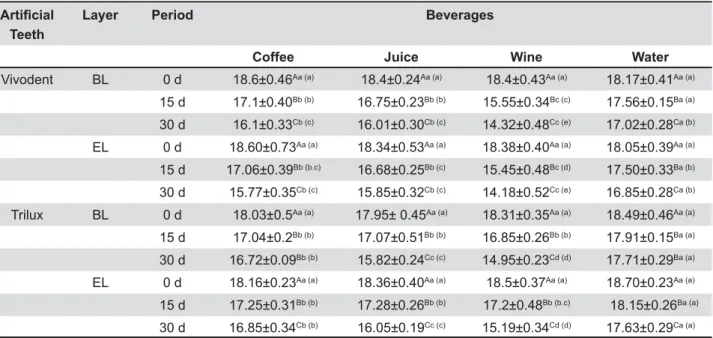
! /*+^+ #;##$ ! 6 / reduction in the hardness of both layers (BL and EL) over the 30-day evaluation period after immersion ! "####$ Similar results were found after the immersion of EL specimens from Trilux teeth in all solutions "###&*+ ' / 30 days of immersion in orange juice and red / "####& / soluble coffee and distilled water, the hardness of *+ 6$"##6_/' change was observed between 15 and 30 days of ;#6$!6
For Vivodent teeth in both layers (BL and EL) at days 15 and 30, the red wine was the solution that most affected the hardness (p=0.0001), followed respectively by orange juice and coffee, which showed no difference between each other ;#%?? the immersion in distilled water resulted in the / "####69 the 15-day evaluation period, the water resulted in ! layers for Trilux teeth (p=0.0001) compared to the other tested beverages that were statistically similar ;#$# *+^+ ' / in hardness at 30 days (p=0.0001), followed, '!<"####6'!
Teeth
Layer Period Beverages
Coffee Juice Wine Water
Vivodent BL 0 d 18.6±0.46Aa (a) 18.4±0.24Aa (a) 18.4±0.43Aa (a) 18.17±0.41Aa (a)
15 d 17.1±0.40Bb (b) 16.75±0.23Bb (b) 15.55±0.34Bc (c) 17.56±0.15Ba (a)
30 d 16.1±0.33Cb (c) 16.01±0.30Cb (c) 14.32±0.48Cc (e) 17.02±0.28Ca (b)
EL 0 d 18.60±0.73Aa (a) 18.34±0.53Aa (a) 18.38±0.40Aa (a) 18.05±0.39Aa (a)
15 d 17.06±0.39Bb (b.c) 16.68±0.25Bb (c) 15.45±0.48Bc (d) 17.50±0.33Ba (b)
30 d 15.77±0.35Cb (c) 15.85±0.32Cb (c) 14.18±0.52Cc (e) 16.85±0.28Ca (b)
Trilux BL 0 d 18.03±0.5Aa (a) 17.95± 0.45Aa (a) 18.31±0.35Aa (a) 18.49±0.46Aa (a)
15 d 17.04±0.2Bb (b) 17.07±0.51Bb (b) 16.85±0.26Bb (b) 17.91±0.15Ba (a)
30 d 16.72±0.09Bb (b) 15.82±0.24Cc (c) 14.95±0.23Cd (d) 17.71±0.29Ba (a)
EL 0 d 18.16±0.23Aa (a) 18.36±0.40Aa (a) 18.5±0.37Aa (a) 18.70±0.23Aa (a)
15 d 17.25±0.31Bb (b) 17.28±0.26Bb (b) 17.2±0.48Bb (b.c) 18.15±0.26Ba (a)
30 d 16.85±0.34Cb (b) 16.05±0.19Cc (c) 15.19±0.34Cd (d) 17.63±0.29Ca (a)
!" # (p<0.05).
"####$' / "#### ! 6 / ' *+' difference was observed between the hardness of Vivodent and Trilux teeth prior to immersion (day # ! ;##? / observed in the teeth brands for the EL hardness # ;#&$ (Table 1). At day 15, the red wine statistically resulted in major changes in the mean hardness of the BL experimental groups (p=0.0001), followed by Vivodent in juice, Trilux in wine, Trilux in coffee, Vivodent in coffee, and Trilux in juice, / / ! / ;#&?# / average BL hardness values for both teeth brands were observed with the immersion in water at the 15-day evaluation period (p=0.0001). At day 15, Vivodent teeth immersed in wine demonstrated the lowest hardness mean values of the EL experimental groups (p=0.0001), followed by Vivodent in juice, Vivodent in coffee, and Trilux in wine, which / ! / ;#%?? ^+ teeth in coffee and Trilux in wine was also not ' Trilux in juice, and Vivodent in water at day 15 ;#%??} ' / average EL hardness values for both teeth were observed for Trilux immersed in water (p=0.0001). Vivodent teeth immersed in wine demonstrated at day 30 the lowest hardness mean values of EL and
BL experimental groups (p=0.0001), followed by /"##? coffee, Vivodent in juice, and Trilux in juice, which / ;#%}' ^+*+ were observed for specimens of Vivodent immersed in distilled water and those of Trilux immersed in coffee (p=0.0001), which had no difference between them at the 30-day evaluation period (p=1.0000). The hardness of Trilux teeth specimens immersed in distilled water demonstrated the highest hardness mean values between the EL and BL experimental groups (p=0.0001) (Table 1).
! ' /!! / *+^+ #;##$
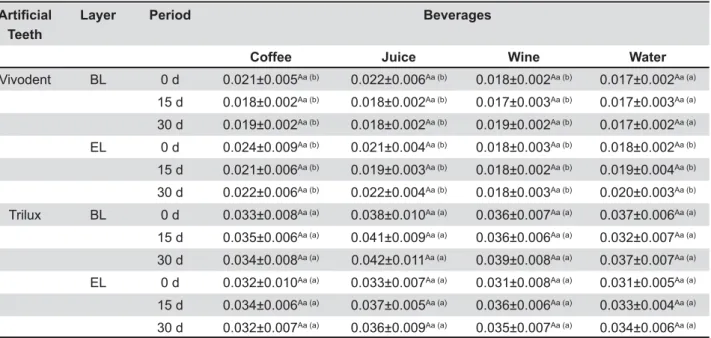
Table 2 displays that immersion in different solutions did not significantly affect the EL ;##?6 *+ ;##$ for the two brands of teeth over the 30-day evaluation period. For each immersion period, no /!! / roughness mean values of the tested solutions in *+;#6$&&^+! ;#&
' / observed between the initial BL and EL roughness prior to immersion (day 0) in all tested beverages ;##$ /! of Trilux teeth before the immersion (day 0) in all ;##?!
The average BL roughness of Trilux teeth was
Teeth
Layer Period Beverages
Coffee Juice Wine Water
Vivodent BL 0 d 0.021±0.005Aa (b) 0.022±0.006Aa (b) 0.018±0.002Aa (b) 0.017±0.002Aa (a)
15 d 0.018±0.002Aa (b) 0.018±0.002Aa (b) 0.017±0.003Aa (b) 0.017±0.003Aa (a)
30 d 0.019±0.002Aa (b) 0.018±0.002Aa (b) 0.019±0.002Aa (b) 0.017±0.002Aa (a)
EL 0 d 0.024±0.009Aa (b) 0.021±0.004Aa (b) 0.018±0.003Aa (b) 0.018±0.002Aa (b)
15 d 0.021±0.006Aa (b) 0.019±0.003Aa (b) 0.018±0.002Aa (b) 0.019±0.004Aa (b)
30 d 0.022±0.006Aa (b) 0.022±0.004Aa (b) 0.018±0.003Aa (b) 0.020±0.003Aa (b)
Trilux BL 0 d 0.033±0.008Aa (a) 0.038±0.010Aa (a) 0.036±0.007Aa (a) 0.037±0.006Aa (a)
15 d 0.035±0.006Aa (a) 0.041±0.009Aa (a) 0.036±0.006Aa (a) 0.032±0.007Aa (a)
30 d 0.034±0.008Aa (a) 0.042±0.011Aa (a) 0.039±0.008Aa (a) 0.037±0.007Aa (a)
EL 0 d 0.032±0.010Aa (a) 0.033±0.007Aa (a) 0.031±0.008Aa (a) 0.031±0.005Aa (a)
15 d 0.034±0.006Aa (a) 0.037±0.005Aa (a) 0.036±0.006Aa (a) 0.033±0.004Aa (a)
30 d 0.032±0.007Aa (a) 0.036±0.009Aa (a) 0.035±0.007Aa (a) 0.034±0.006Aa (a)
!" # (p<0.05).
' regardless of the test solution and the time period "##### *+' roughness values for the EL of Trilux teeth (Table / teeth for all tested beverages and time points "#####
DISCUSSION
This study evaluated the effects of staining beverages on the surface properties of different / null hypothesis was partially accepted, given that beverages affected the hardness but did not interfere with the roughness of both types of
According to the manufacturer, Vivodent teeth are composed of cross-linked PMMA chains with high / @ ' progressive reduction in hardness of both layers was observed after storing in all solutions, including water. The average hardness ranged from 18.60 VHN (day 0) to 14.18 VHN (day 30) (Table 1), with an average reduction of 24%.
According to the manufacturer, Trilux teeth are composed of cross-linked PMMA chains with high molecular weight, which are crossed within another three-dimensional network occupied by a second cross-linked polymer (IPN resin). Along with the increase in the molecular weight of linear polymeric chains, the possibility of double cross-linking (DCL), meaning the highest amount of cross-linking within the material and not the exact number or types of covalent chemical bonds present in the polymer network, proportionally grows. The two systems (DCL and IPN) coexist in these teeth, producing polymers with individual and inseparable polymeric chains, which may result in lower solubility and greater mechanical strength to these materials17.
However, in this study, the hardness values of both layers of Trilux were decreased within 30 days of immersion in all solutions, with the exception of coffee and water, in which the hardness of BL remained constant after 15 days until the end of the experiment. The average hardness ranged from 18.70 VHN (day 0) to 14.95 VHN (day 30) (Table 1), with an average reduction of 20%, similar to that observed for Vivodent.
Although the distilled water caused the least change in the hardness of the layers of both teeth, it progressively decreased the mean values throughout the immersion time. These results are in agreement with those obtained by Pavarina, et al.20 (2003) and Campanha, et al.3 (2005). It is
known that acrylic polymers absorb water1, which
acts as a plasticizer, reducing the hardness by the formation of microcracks, resulting from the
absorption/adsorption process and by hydrolysis of ester bonds and gradual deterioration of its structure over time30. According to Braden1 (1964),
the absorption/adsorption of water by the polymers ! ! of concentration. The absorbed water can be found in two ways: “free,” meaning it occupies free volume between the polymer chains or pores created during the polymerization, or “bound,” attached to the polymer chain by hydrogen bonds, leading to the formation of primary and secondary hydration capsules around hydrophilic ionic terminations of the matrix resin30. The plasticizing effect and
hydrolytic degradation could explain the reduction in hardness of the acrylic teeth after immersion in water observed in the present study.
The tested staining beverages caused further reduction in the hardness of both layers of the two to the plasticizing effect of these aqueous solutions, other effects might be related to the greater reduction in hardness of the teeth. Both factors, 'J absorption/adsorption process. It is known that the composition, pH, and polarity of the liquid, as well as the immersion time, are factors that can change the polymer solubility and cause surface degradation18. In this study, we used beverages
with natural dyes: the coffee had caramel coloring, orange juice contained annatto, and the red wine contained anthocyanin from grapes. The presence of these dyes probably had an additional effect on the /
For both layers of the evaluated teeth, red wine caused the highest reduction in hardness values over 30 days of immersion. There are no reports available in the literature that evaluated the effect of the staining beverages tested in the present ' indirect comparisons can be established. Satoh, et al.266% /
higher hardness (containing cross-linking agents) showed lower susceptibility to staining (red wine, coffee, and turmeric) than conventional acrylic resin teeth. It has been demonstrated that wine was the solution that promoted the greatest color change in resins when compared to other solutions, such as coffee, tea, and cola7,18,19,27. The polymer’s
surfaces are susceptible to alcohol degradation by softening19 after prolonged immersion18. In
addition, food liquids with acidic pH can damage the surface integrity of the material8. Red wine has
a low pH (around 3.5), which may potentiate the effect of alcohol on the degradation of the polymer surface19,27. This can explain the major variation
orange juice can also be associated with its low pH, and the reduction was lower than after immersion in wine, probably because of its alcohol content.
According to Ruyter, et al.25 (1987), the degree
of polarity of a pigment agent determines the degree of penetration into the polymer. Less polar dyes, such as yellow presented in coffee29,
can be absorbed more easily25. In this study, the
hardness change caused by coffee was similar to that observed for juice and intermediate between / / ! color change in acrylic resins2
teeth16 after prolonged immersion in coffee. The
tannic acid presented in solutions like tea and coffee can also promote deleterious effects on the polymer surface2,7. Thus, the hardness reduction of
the acrylic teeth after immersion in coffee can be attributed to the low polarity of the solution, its high ' / dye and tannic acid in its composition.
According to Guler, et al.7 (2005), 24 h of
immersion in coffee represents 30 days of daily consumption of this beverage. Thus, a 30-day immersion period would correspond to 2.5 years of coffee consumption. Using this average calculation and based on previous data about color stability of polymers4,11,16, a 30-day period of immersion was
used in the present study. This period interfered with the results since, in general, the hardness of / H/' the percentage of reduction after immersion in the beverages are comparable to those observed by Pavarina, et al.20 (2003) after chemical disinfection
and by Campanha, et al.3 (2005) after microwave
irradiation. Further studies should be conducted to assess whether this reduction is clinically relevant.
Loyaga-Rendon, et al.15 (2007) showed that the
Vickers hardness of the inner layers of reinforced ! / / ' with a difference of up to 29.2 VHN between them. Conversely, in this research, it was not observed. This suggests that the surface properties of the evaluated teeth can be maintained if their internal !/H/' this hypothesis, in vitro studies using dynamic wear
tests and in vivo clinical studies are necessary.
' greater the possibility of accumulation of plaque, which leads to loss of brightness and surface degradation of the polymer24. Therefore, it is
essential to polish the outer surface of the dentures and artificial teeth carefully after adjustment procedures. There are also no studies available in the literature that evaluated the effect of immersion in beverages on the roughness of acrylic teeth. Pisani, et al.21 (2012) found that the roughness of
three different brands of acrylic denture teeth was increased after prolonged immersion in 2% Ricinus communis and reduced after immersion in distilled
water and sodium hypochlorite. Conversely, in the present study, the surface roughness of the tested acrylic teeth was not changed after immersion in beverages, regardless of the assessed layer. These differences may be attributed to the different immersion solutions used in this study (staining beverages) and in the study of Pisani, et al.21 (2012)
(denture cleansers).
The present study suggests that commonly consumed staining beverages can decrease the / compromising their roughness. However, these results should be interpreted with caution since J not assessed by the in vitro methodology used
in this research. In clinical situations, dynamic conditions such as saliva, cleaning procedures, food consistency and feeding behavior, frequency of intake of staining and/or acidic foods, parafunctional ! ' ' ' occlusal condition affect the surface properties of
CONCLUSION
Within the methodological limitations of this in vitro study and according to the results obtained,
it was concluded that:
(1) Both layers of Vivodent teeth and the outer layer of Trilux teeth exhibited a continuous decrease in hardness for up to 30 days of immersion in all tested beverages. This was also observed for the inner layer of Trilux teeth after 15 days of immersion in the solutions.
(2) For both brands of multilayered, acrylic resin ! ' // the solution that caused the greatest reduction in Vickers hardness, followed by orange juice, coffee, and water.
(3) The roughness of the inner and outer layers of /! / affected by the tested beverages up to 30 days.
&! ' difference in Vickers hardness and roughness mean values was observed between the inner and outer layers prior to immersion in the staining beverages.
ACKNOWLEDGEMENTS
REFERENCES
1- Braden M. The absorption of water by acrylic resins and other Z ] 6?&_6&%#[6?
2- Buyukyilmaz S, Ruyter IE. Color stability of denture base } Z 6&_%[
3- Campanha NH, Pavarina AC, Vergani CE, Machado AL. Effect of microwave sterilization and water storage on the Vickers hardness Z ] ##$_%&%[ 4- Ghahramanloo A, Madani AS, Sohrabi K, Sabzevari S. An evaluation of color stability of reinforced composite resin compared with dental porcelain in commonly consumed beverages. J Calif ] 9##_%??%[#
$[X'9!' Z ] ##_6##&&6[
6- Gregorius WC, Kattadiyil MT, Goodacre CJ, Roggenkamp CL, Powers JM, Paravina RD. Effects of ageing and staining on color ] #6_&#&[$&
7- Guler AU, Yilmaz F, Kulunk T, Guler E, Kurt S. Effects of different drinks on stainability of resin composite provisional restorative Z ] ##$_&66[&
8- Gupta R, Parkash H, Shah N, Jam V. A spectrophotometric evaluation of color changes of various tooth colored veneering materials after exposure to commonly consumed beverages. J }Z ##$_$
9- Hirano S, May KB, Wagner WC, Hacker CH. In vitro wear of Z ] 6_6$[$
10- Kawano F, Ohguri T, Ichikawa T, Mizuno I, Hasegawa A. Shock absorbability and hardness of commercially available denture } Z ##_6$&%[
11- Koksal T, Dikbas I. Color stability of different denture teeth materials against various staining agents. Dent Mater J. ##_6%[&&
12- Kurtulmus-Yilmaz S, Deniz ST. Evaluation of staining ! 9 #6&_66[ 13- Lai CP, Tsai MH, Chen M, Chang HS, Tay HH. Morphology and properties of denture acrylic resins cured by microwave energy / ! ] ##&_#6%%[&6 14- Low I. Effects of load and time on the hardness of a viscoelastic >*6_%%6$%[
15- Loyaga-Rendon PG, Takahashi H, Hayakawa I, Iwasaki N. Compositional characteristics and hardness of acrylic and Z ] ##_6&6[
16- Mutlu-Sagesen L, Ergün G, Ozkan Y, Bek B. Color stability of different denture teeth materials: an in vitro study. J Oral Sci. ##6_&%6%[#$
17- Ogle RE, David LJ, Ortman HR. Clinical wear study of a new Z }}Z ] 6$_$&?[$ 18- Omata Y, Uno S, Nakaoki Y, Tanaka T, Sano H, Yoshida S, et al. Staining of hybrid composites with coffee, oolong tea, or red /] ##?_$6$[%6
19- Patel SB, Gordan VV, Barrett AA, Shen C. The effect of surface ! [! 9] 9##&_6%$$[&
20- Pavarina AC, Vergani CE, Machado AL, Giampaolo ET, Teraoka MT. The effect of disinfectant solutions on the hardness of acrylic >!##%_%#&[$
21- Pisani MX, Macedo AP, Paranhos HF, Silva CH. Effect of experimental Ricinus communis solution for denture cleaning on *X] #6_%6$[6 22- Polyzois GL, Yannikakis SA, Zissis AJ, Demetriou PP. Color changes of denture base materials after disinfection and X } Z 6_6#%[ %['*GJ surface-free energy on supra- and subgingival plaque formation in 9/ GZ 6$_6[6& 24- Rahal JS, Mesquita MF, Henriques GE, Nóbilo MA. Surface roughness of acrylic resins submitted to mechanical and chemical >!##&_%66#$[
25- Ruyter IE, Nilner K, Moller B. Color stability of dental composite resin materials for crown and bridge veneers. Dent 6_%&?[$6
26- Satoh Y, Nagai E, Azaki M, Morikawa M, Ohyama T, Toyoma H, et al. Study on high-strength plastic teeth. Tooth discoloration. @] 6%_%$6[
[~[@'9[G*^'*GZ' JH, Urban VM, Campanha NH. Color stability of resins and nylon as denture base material in beverages. J Prosthodont. #66_#?%[
28- Topcu FT, Sahinkesen G, Yamanel K, Erdemir U, Oktay EA, ^}J Y ! ^] ##_%$#[?