
ABSTRACT:Introduction: The investigation of clinical and neurological impactations associated with exposure
to mercury levels in exposed populations is necessary in the Amazon. Objective: To analyze emotional and motor symptoms of riverside dwellers exposed by diet in the municipalities of Itaituba and Acará, in Pará, Brazil. Methods: Hair samples were collected to assess the total mercury (HgT). Demographic data as well as emotional (depression, anxiety and insomnia) and motor (paresthesia, muscle weakness, loss of balance when walking, tremors, limb pain and dysarthria) symptomatology data were obtained. Results: Mean levels of HgT in Itaituba were signiicantly higher (p < 0.0001) than in Acará. Emotional symptoms were identiied in 26 (26.5%) participants from Itaituba and in 24 (52.2%) from Acará. Speciic motor complaints in Itaituba occurred in 63 (64.3%) volunteers; the most frequently mentioned alictions were limb pain (36.7%), paresthesia (32.6%) and muscle weakness (27.5%). In Acará, 33 (71.7%) participants had motor symptoms, the majority of which complained of paresthesia (54.3%), limb pain (52.2%) and tremors (34.8%). Average HgT levels in Itaituba in those with emotional and motor symptoms were above the tolerable levels (6 μg/g) determined by the World Health Organization. Conclusion: Results showed that mercury levels in emotional and motor symptoms in Itaituba are higher than in riverside dwellers in Acará. Further studies, including the application of speciic qualitative and/or quantitative standard tests, as well as the investigation of other clinical signs are necessary.
Keywords: Mercury. Amazon ecosystem. Environmental exposure. Toxicity. Mercury poisoning.
Emotional and motor symptoms in riverside
dwellers exposed to mercury in the Amazon
Manifestações emocionais e motoras de ribeirinhos expostos ao mercúrio na Amazônia
José Maria Farah Costa JuniorI, Abner Ariel da Silva LimaI, Dario Rodrigues JuniorI, Eliana Dirce Torres KhouryI, Givago da Silva SouzaI, Luiz Carlos de Lima SilveiraI, Maria da Conceição Nascimento PinheiroI
IGraduate Program in Tropical Diseases, Center for Tropical Medicine, Universidade Federal do Pará – Belém, Pará (PA), Brazil.
Corresponding author: José Maria Farah Costa Junior. Laboratório de Toxicologia Humana e Ambiental. Avenida Generalíssimo Deodoro, 92, Nazaré, CEP: 66055-240, Belém, Pará, PA, Brasil. E-mail: [email protected].
Conlict of interests: nothing to declare – Financial support: National Council for Scientiic and Technological Development (CNPq), Universal Project, Public Notice No. 14/2012, Process No. 79624/2012-7.
INTRODUCTION
The incident in Minamata Bay, in Japan, in the 1960s, which had major international repercussions, establishes the toxic potential of mercury as a ish contaminant. The dump-ing of by-products from chemical factory directly into the bay1 caused environmental
contamination. The case provided an important body of information on the clinical symptoms and epidemiological characteristics of mercury poisoning, serving as a mile-stone for the mobilization of organized segments of civil society in diferent parts of the world, including Brazil2.
In the Amazon region, several studies monitor the levels of mercury exposure in the population3-11 and the ish 12-14, as the region presents a consequent contamination
result-ing from mineral prospectresult-ing, forest ires, the presence of large natural reservoirs and the implantation of hydroelectric plants that cause looding, transferring mercury from the soil to the water column15.
Mercury (Hg) as a ish contaminant is a form of non-occupational exposure; its concen-tration occurs in the organic form of methylmercury (MeHg). The toxicity of this com-pound especially afects the nervous system, causing muscular and nervous dysfunctions that may lead to irreversible damages or death, as stated by Carta et al.16. Therefore, the
World Health Organization (WHO) determines that Hg levels above 50 µg/g in a person’s hair is a risk to the adult nervous system17.
RESUMO:Introdução: A investigação dos impactos clínico-neurológicos associados às concentrações de exposição ao mercúrio em populações expostas é necessária na Amazônia. Objetivo: Analisar as manifestações emocionais e motoras de ribeirinhos expostos pela dieta nos municípios de Itaituba e Acará, ambos no Pará.
Método: Foram coletadas amostras de cabelo para a determinação de mercúrio total (HgT), obtidos dados demográicos e sintomatológicos emocionais (depressão, ansiedade e insônia) e motores (parestesia, fraqueza muscular, desequilíbrio ao andar, tremor, dor nos membros e disartria). Resultados:A concentração mediana de HgT em Itaituba foi signiicativamente superior (p < 0,0001) àquela em Acará. As manifestações emocionais foram identiicadas em 26 (26,5%) participantes de Itaituba e em 24 (52,2%) em Acará. Com relação às queixas motoras especiicas, em Itaituba ocorreram em 63 (64,3%) voluntários, sendo mais referidas a dor nos membros (36,7%), a parestesia (32,6%) e a fraqueza muscular (27,5%). No Acará, 33 (71,7%) participantes apresentaram manifestações motoras, com o maior número queixando de parestesia (54,3%), dor nos membros (52,2%) e tremor (34,8%). As concentrações médias de HgT em Itaituba naqueles com manifestações emocionais e com manifestações motoras estiveram acima do considerado tolerável (6 µg/g) pela Organização Mundial de Saúde.
Conclusão: Os resultados revelaram que a concentração de mercúrio nas manifestações emocionais e motoras de Itaituba são maiores do que nos ribeirinhos do Acará. Novos estudos são necessários com a aplicação de testes convencionais qualitativos e/ou quantitativos especíicos, assim como também a investigação de outros sinais clínicos.
Studies have shown that acute exposure to MeHg may cause weakness, fatigue, weight loss, emotional instability, mental confusion, psychiatric disorders, concentration prob-lems, amnesia, tachycardia, delirium, dizziness, motor incoordination, paresthesia, ataxia, deafness, muscle tremors, visual ield constriction, coma and even death18,19. Chronic
tox-icity is characterized by sensory loss in the extremities, dysarthria, muscle weakness, irri-tability, decreased attention and memory, anxiety, depression, insomnia, coordination and balance disorders, all motor signs that simulate amyotrophic lateral sclerosis and seem to increase the risk for cardiovascular diseases20-22.
In the Amazon region, the riverside-dwelling communities that are exposed to Hg through ingestion of contaminated food are unaware of any negative health impacts that this exposure may cause. There is evidence that communities which regularly have fish as part of the diet display levels of Hg exposure that pose health hazards23.
With that, investigations into clinical symptoms associated with exposure levels have been the subject of research in exposed populations4,6,24. The Hg poisoning
diagno-sis should be based not only on the epidemiological findings and the high Hg levels in blood or hair samples, but also on clinical findings as stated by Harada et al.25 and
Pinheiro et al.26.
This study aimed at analyzing emotional and motor symptoms of individuals exposed to MeHg through their diet, contributing to the beginning of the epidemiological, tox-icological and clinical monitoring of this special group.
METHODS
STUDY LOCATION
The study included riverside dwellers from communities known as Barreiras and São Luiz dos Tapajós, in the municipality of Itaituba, Pará, and Furo do Maracujá, in the munic-ipality of Acará, Pará.
Located in the southwest region of the state of the Pará, the municipality of Itaituba is on the left bank of the Tapajós River, bordering the state of Amazonas. Its geographical coordinates are 04º 16’ 34’’S and 55º 59’ 06’’W. Its estimated popu-lation, according to the Brazilian Institute of Geography and Statistics (IBGE)27, has
98,493 inhabitants, including the population that is part of the city and the commu-nities distributed on the banks of the river. Historically, the municipality is influenced by gold prospecting.
STUDY POPULATION
Men and women between the ages of 13 and 53 who have permanently resided in the community for more than 1 year participated in the study. Individuals who had acute mus-culoskeletal disorders in the upper and/or lower limbs with previously diagnosed neuro-logical diseases and those who had recent exposure to Hg vapor were excluded from it.
TOTAL MERCURY DETERMINATION
To determine total mercury (HgT), approximately 10 to 20 mg of hair were collected from each volunteer, which were then placed in a paper envelope with identiication and sent to the Human & Environmental Toxicology Laboratory of the Center for Tropical Medicine (NMT) of the Federal University of the Pará (UFPA)28 for analysis.
In the laboratory, the hair samples were rinsed with neutral detergent, washed intensely with deionized water to remove the detergent and inally washed with 3 mL of acetone and dried at room temperature. Afterwards, the samples were cut so powder micro frag-ments were obtained28. About 10 mg were used between layers of calcium carbonate,
cal-cium hydroxide and aluminum hydroxide to be analyzed by atomic absorption spectropho-tometry with gold foil amalgamation using an automatic mercury meter called Mercury Analyzer (MA), SP-3D model by Nippon Corporation Japan28.
The accuracy of the HgT analyses was determined by means of the duplicate quan-tiication and the accuracy established by International Reference Standard IAEA 085. Reproducibility was demonstrated by linearity r = 1 through a calibration curve consisting of 5 points (0, 10, 20, 50 and 100). Results were expressed as µg/g28.
All these steps followed the recommendations of the analytical instrument manufac-turer (NIC Corporation)28 and are also used by Milhomem Filho29, Corvelo et al.9, Pinheiro
et al.23, Costa Junior et al.10 and Lima et al.11.
DEMOGRAPHIC DATA AND SUBJECTIVE SYMPTOMATOLOGY
STATISTICAL ANALYSIS
The information was catalogued in a protocol form to enable the creation of charts and graphs. Using the Bio Estat 5.0 statistical packet30, the data were analyzed
adopt-ing α = 0.05 or 5% with a 95% confidence interval (95% CI) for statistical significance analysis. The results of the HgT levels, being continuous quantitative variables, were expressed by measures of central tendency (arithmetic mean and median) and disper-sal (standard deviation). Demographic data and symptomatology were adjusted by fre-quency and percentage because variables were classified as qualitative nominal variables. The Mann-Whitney U test, a non-parametric test, was used to compare the median HgT levels between municipalities. To analyze the measure of association as an odds ratio of the emotional and motor symptomatological findings between municipalities, the odds ratio (OR) was used.
ETHICAL ASPECTS
The study was developed according to Resolution No. 466/2012 of the National Health Council (CNS), Ministry of Health, Brazil, and approved by the Research Ethics Committee (CEP) of the NMT of the Federal University of Pará through Protocol No. 002/2011.
RESULTS
A total of 144 riverside dwellers participated in the study, of which 98 were volunteers from Itaituba and 46 from Acará.
In Itaituba, most riverside dwellers were female (76.5%). As for age, the highest fre-quency (34 riverside dwellers) was observed in the 24 to 35 year-old group (34.7%). Sixty-one (62.3%) riverside dwellers had been living in the area for at least 15 years; most of these par-ticipants were homemakers (42.9%). In Acará, males were less present (39.1%); 30 (65.2%) represented an age group older than 24 years; 17 (36.9%) had a length of residence of 15 to 28 years; and of the 46 riverside dwellers, 17 (37.0%) were homemakers, followed by 15 (32.6%) farmers and only one (2.2%) isherman (Table 1).
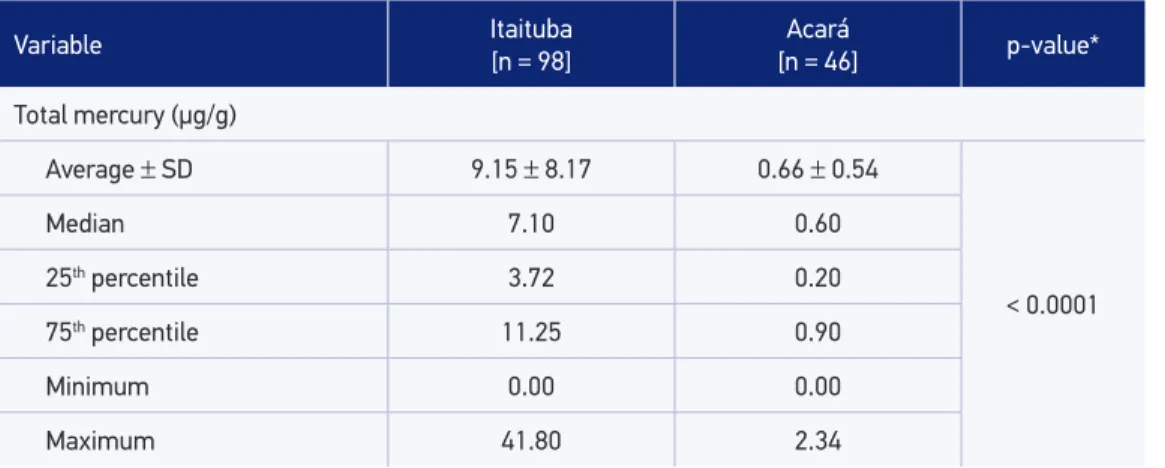
The average HgT concentrations in the municipalities is shown in Table 2. HgT levels in Itaituba varied from 0 to 41.8 µg/g, with an average of 9.15 ± 8.17 µg/g. In Acará, the variation ranged from 0 to 2.34 µg/g in hair samples, with an average of 0.67 ± 0.54 µg/g. When comparing HgT levels in riverside-dwelling communities, there was a highly signii-cant diference (p < 0.0001) among the assessed municipalities (Table 2).
Table 1. Distribution of the population by sex, age group, length of residence and occupation, according to each location.
Demographic data Itaituba
[n = 98 (%)]
Acará [n = 46 (%)]
Sex
Male 23 (23.5) 18 (39.1)
Female 75 (76.5) 28 (60.9)
Age group (years)
13 ˫-- 24 22 (22.4) 16 (34.8)
24 ˫-- 35 34 (34.7) 13 (28.3)
35 ˫-- 46 23 (23.5) 10 (21.7)
46 ˫-- 57 19 (19.4) 7 (15.2)
Length of residence (years)
02 ˫-- 15 37 (37.7) 13 (28.3)
15 ˫-- 28 23 (23.5) 17 (36.9)
28 ˫-- 41 25 (25.5) 11 (23.9)
41 ˫-- 54 13 (13.3) 5 (10.9)
Occupation
Homemaker 42 (42.9) 17 (37.0)
Fisherman 11 (11.2) 1 (2.2)
Farmer 7 (7.1) 15 (32.6)
Student 16 (16.3) 7 (15.2)
Other 22 (22.5) 6 (13.0)
Table 2. Total mercury levels in hair (µg/g) presented by the riverside-dwelling communities in each municipality.
Variable Itaituba
[n = 98]
Acará
[n = 46] p-value*
Total mercury (µg/g)
Average ± SD 9.15 ± 8.17 0.66 ± 0.54
< 0.0001
Median 7.10 0.60
25th percentile 3.72 0.20
75th percentile 11.25 0.90
Minimum 0.00 0.00
Maximum 41.80 2.34
Table 3. Frequency of emotional symptoms according to each location.
Symptom Itaituba
[n = 26(%)]
Acará [n = 24(%)]
OR
(95% CI) p-value
Only insomnia 9 (34.6) 4 (16.7) 1.06
(0.31 – 3.64) 0.83
Only depression 2 (7.7) 0 (0.0) – –
Only anxiety 5 (19.2) 9 (37.5) 0.22
(0.07 – 0.70) 0.01
Insomnia + depression 1 (3.9) 1 (4.2) – –
Insomnia + anxiety 5 (19.2) 8 (33.3) 0.25
(0.08 – 0.83) 0.04
Depression + anxiety 2 (7.7) 2 (8.3) 0.46
(0.06 – 3.36) 0.81
Insomnia + depression + anxiety 2 (7.7) 0 (0.0) – –
OR: odds ratio; 95% CI: 95% conidence interval.
from Acará. The group with only insomnia (nine riverside dwellers) was the most repre-sentative (34.6 %) in Itaituba; there was only one case of insomnia and depression (3.9 %). In Acará, the largest representativeness (37.5 %) was observed in the group with only anxiety (nine riverside dwellers); no riverside dwellers were found only with depression. Two river-side dwellers (7.7 %) from Itaituba complained of the three symptoms, while in Acará, this fact was not found. In the comparison of groups, there was a signiicant diference between those only with anxiety and those with insomnia and anxiety (p < 0.05), with higher odds in Acará. Among those only with insomnia (OR = 1.06; 95% CI 0.31 – 3.64), there was a strong association with similar odds of symptoms in riverside dwellers from Itaituba and Acará (p = 0.83).
In Itaituba, specific motor complaints (Table 4) occurred in 63 (64.3%) riverside dwellers; the most mentioned were limb pain, paresthesia and muscle weakness. Of the 32 (32.6%) cases observed with paresthesia, 15 (15.3%) had upper- and lower-limb pain; muscle weakness was more connected to the lower limbs. In Acará, paresthesia, limb pain and tremors were the most frequent, in 33 (71.7 %) riverside dwellers. Loss of bal-ance when walking, in both municipalities, was the less frequent complaint, and the presence of dysarthria was not observed in any riverside dwellers. Comparing the two municipalities with regard to subjective complaints, there was statistical significance for paresthesia, loss of balance when walking and tremors (p < 0.05), with a higher probability in Acará.
Table 4. Frequency of motor symptoms according to each location.
Symptom Itaituba
[n = 98(%)]
Acará [n = 46(%)]
OR
(95% CI) p-value
Paresthesia 32 (32.6) 25 (54.3) 0.41
(0.20 – 0.83) 0.02
UL paresthesia 13 (13.3) 10 (21.7) – –
LL paresthesia 4 (4.1) 5 (10.9) – –
UL + LL paresthesia 15 (15.3) 10 (21.7) – –
Muscle weakness 27 (27.5) 15 (32.6) 0.78
(0.37 – 1.68) 0.67
UL weakness 9 (9.2) 3 (6.5) – –
LL weakness 10 (10.2) 5 (10.9) – –
UL + LL weaknesses 8 (8.2) 7 (15.2) – –
Loss of balance when walking 3 (3.1) 6 (13.0) 0.21
(0.05 – 0.88) 0.05
Tremors 17 (17.3) 16 (34.8) 0.39
(0.18 – 0.88) 0.03
Limb pain 36 (36.7) 24 (52.2) 0.53
(0.26 – 1.08) 0.12
Dysarthria 0 (0.0) 0 (0.0) – –
OR: odds ratio; 95% CI: 95% conidence interval; UL: upper limbs; LL: lower limbs.
Table 5. Mercury levels (µg/g) of those with emotional and motor symptoms in each location. Itaituba
[n = 98]
Acará
[n = 46] p-value*
Total mercury (µg/g) – emotional symptom
Average ± SD 7.38 ± 4.70 0.66 ± 0.57
< 0.0001
Median 6.65 0.60
25th percentile 4.07 0.18
75th percentile 9.15 0.89
Minimum 0.90 0.01
Maximum 23.60 2.34
Total mercury (µg/g) – motor symptom
Average ± SD 8.84 ± 7.11 0.64 ± 0.58
< 0.0001
Median 7.40 0.59
25th percentile 3.65 0.13
75th percentile 11.61 0.78
Minimum 0.02 0.00
Maximum 32.50 2.34
DISCUSSION
One of the routes of exposure to Hg in the Amazon region is the ingestion of contam-inated food, more precisely the ish riverside-dwelling and ishing communities use as food menu option. The Hg levels in hair samples is considered the best bioindicator of exposure to Hg from ingestion of contaminated food 17 and is commonly used by several authors5,7-11,23,29
to measure long-term exposure.
Through the diferent hydrographic locations it is possible to identify Hg exposure vari-ations in each region. In these studies, the Hg levels in Itaituba were signiicantly higher (p < 0.0001) than those in Acará. The riverside-dwelling communities in the Tapajós region have a history of long-term exposure, for approximately two decades, and are known for uncontrolled mineral exploration5-8,26. Riverside dwellers in Acará had low HgT levels, which
can be explained by the location, which is far from mineral prospecting, and by ish con-sumption with low HgT levels.
There was a prevalence of female participants in relation to men in both municipali-ties as well as a larger number of riverside dwellers in a reproductive age group, suggesting that, in the Tapajós region, exposures to HgT present a risk due to the relationship between mother and fetus. Based on the maternal and infant risk associated to exposure to Hg, a maximum safety limit of 10 µg/g in hair samples17 is set.
In Itaituba, mercury levels ranged from 0 to 41.8 µg/g with an average of 9.15 ± 8.17 µg/g, which is above the established safety limit for regular ish consumption31. Recent
studies have revealed a similar reality. Vieira et al.32, in the riverside-dwelling communities
of the Madeira River, Amazonas, found average concentrations of 8.02 µg/g. Lima et al.11
identiied average concentrations of 7.98 µg/g in riverside dwellers living in villages in the Tapajós. Costa Junior et al.10, assessing the exposure evolution in riverside-dwelling
com-munities in the Tapajós region, found average concentrations below 10 µg/g in 2012 and 2013. Pinheiro et al.23, assessing the frequency of neurological signs and symptoms in the
riverside-dwelling population in the Tapajós River Basin, observed variations of mercury levels ranging from 0.87 to 44.59 µg/g.
Concentration averages higher than those found in this study have already been reported by other authors3-6,26,33, but in periods when mineral prospecting was intense
and the preventive educational activities were gaining strength. High Hg levels may be connected to the population’s amount and type of ish consumption and to the lack of variation in their diet. Passos et al.33, when assessing the efects of fruit consumption on
the relationship between ish consumption and mercury bioindicators, concluded that fruit consumption may provide a protective efect for exposure to Hg in riverside dwell-ers in the Amazon region.
Insomnia, depression and anxiety are characteristic signs and symptoms of Hg intoxi-cation and are reported by Chuu21 and Chang22. Emotional symptoms were identiied in 26
the statistical diference (p < 0.05) was found among those only with anxiety and among those with anxiety and insomnia. The frequency of individuals with such results was higher in Acará, suggesting that the exposure to Hg is not the causal factor, since Hg levels were not elevated in this municipality.
Psychic changes typical of erethism mercurialis, such as insomnia, depression and anxiety, were present in communities exposed to Hg. However, other clinical signs such as irritability, melancholy, shyness, indecision, concentration problems, intellectual dull-ing and changes of character and personality should be investigated to justify these clin-ical syndromes.
Regarding motor complaints, neurological symptoms similar to those in the Minamata disease, in Japan, were found in this study. In Itaituba, an area exposed to Hg, the three most frequent complaints were paresthesia, limb pain and muscle weak-ness. Carta et al.16 also they described the same symptoms in riverside dwellers in the
Tapajós River Basin, which had HgT levels above 20 µg/g in the hair. Muscle fatigue was also identified by Lebel3 when investigating exposed populations in the Amazon,
concluding that there is a positive correlation between exposure to methylmercury and neurological abnormalities.
In this study, the tremors found in 17 riverside dwellers in the Tapajós region was found by Auger24 in adult Cree aborigines in northern Quebec, especially young adults;
these tremors are associated with high methylmercury levels, but below 50 µg/g. Dysarthria was not noticed in any of the group; however, it was present in the results of Harada et al.6 when observing fishing villages in the Tapajós River Basin, in the
Itaituba municipality.
Two major environmental disasters recorded numerous cases of methylmercury poi-soning, which took place in Iraq and in the city of Minamata, in Japan. In both tragedies, cases of muscle weakness, paresthesia, generalized pain and tremors were recorded34. In Iraq
and Japan, exposure was predominantly acute, resulting from high methylmercury levels. In this study, motor complaints in Itaituba occur in communities where exposure has been occurring in the long term and Hg levels are below the risk value for the adult nervous sys-tem established by WHO17. Therefore, the low frequency of neuromuscular symptoms
among riverside dwellers in the Tapajós may be explained by exposure intensity, which was still not enough to cause motor damage. The highest frequency of motor complaints in Acará suggests that there is no relation to Hg, and these may be related to other factors not assessed in this study.
The average concentrations of Hg were higher in Itaituba, especially in participants with motor complaints. A similar fact was found by Dolbec4 when studying the efects of
methylmercury on the motor functions of Amazonian populations, observing the associ-ation of neurobehavioral symptoms with exposure. Lebel3, when evaluating the efects of
The results of this study contribute to the identiication of possible clinical symptoms related to exposure, since little is known about the impacts and efects of long-term expo-sure to low doses of methylmercury in adults in exposed riverside-dweller populations, as stated by Auger24. They also provide new relevant information about the emotional and
physical condition of the participating population, since clinical indings are important for the poisoning diagnosis.
CONCLUSION
Results showed that Hg levels in emotional and motor symptoms of riverside dwell-ers in Itaituba, an area with indications of contamination, especially by gold mining, is higher than in riverside dwellers in Acará. The identification of clinical findings with a higher frequency of motor complaints than emotional complaints in Itaituba reiter-ate methylmercury toxicity in relation to the central nervous system. However, further follow-up studies are necessary, making the monitoring of concentrations critical and including the investigation of other clinical signs, since the exposure to Hg can affect several other systems.
Assessments using subjective methods are positive tools for the initial identiication of symptoms due to Hg poisoning and may be an alternative form of clinical follow-up. Nevertheless, objective quantitative or qualitative methods are necessary and essential for the conirmation of clinical indings.
The search for Hg levels, epidemiological aspects and the clinical condition is crucial to strengthen preventive, assessing and educational measures in areas with an environmental pollution impact so that consequences such as those seen in the Minamata tragedy in Japan do not afect the health of the Amazon population.
1. Azevedo FA. Toxicologia do mercúrio. São Carlos: Rima; 2003.
2. Gonçalves A, Ferrari I, Barbosa A, Serra O, Padovani CR, Brasileiro I, et al. Contaminação do mercúrio em populações de garimpos de ouro em área da Amazônia Legal: apurando o diagnóstico de realidade Kayapó. Salusvita 1999; 18(1): 37-52.
3. Lebel J, Roulet M, Mergler D, Lucotte M, Larribe F. Fish diet and mercury exposure in a riparian Amazonian population. Water, Air, and Soil Pollution 1997; 97(1-2): 31-44. 4. Dolbec J, Mergler D, Passos CJS, De Morais SS, Lebel
J. Methylmercury exposure afects motor performance of a riverine population of the Tapajos river, Brazilian
Amazon. Int Arch Occup Environ Health 2000; 73(3): 195-203.
5. Pinheiro MCN, Guimarães GA, Nakanishi J, Oikawa T, Vieira JL, Quaresma M, et al. Avaliação da contaminação mercurial mediante análise do teor de Hg total em amostras de cabelo em comunidades ribeirinhas do Tapajós, Pará, Brasil. Rev Soc Bras Med Trop 2000; 33(2): 181-4.
6. Harada M, Nakanishi J, Yasoda E, Pinheiro MCN, Oikawa T, Guimaraes GA, et al. Mercury pollution in the Tapajós river basin, Amazon. Mercury level of head hair aind health efects. Environ Int 2001; 27(4): 285-90.
7. Pinheiro MCN. Exposição mercurial e defesas antioxidantes em mulheres ribeirinhas da Amazônia. [Tese de Doutorado]. Belém: Universidade Federal do Pará; 2005.
8. Pinheiro MCN, Farripas SSM, Oikawa T, Costa CA, Amoras WW, Vieira JLF, et al. Temporal Evolution of exposure to mercury in riverside communities in the Tapajós Basin, from 1994 to 2010. Bull Environ Contam Toxicol 2012; 89(1): 119-24.
9. Corvelo TCO, Oliveira EAF, Parijós AM, Oliveira CSB, Loiola RSP, Araújo AA, et al. Monitoring mercury exposure in reproductive aged women inhabiting the Tapajós river basin, Amazon. Bull Environ Contam Toxicol 2014; 93(1): 42-6.
10. Costa Junior JMF, Lima AAS, Rodrigues Junior D, Silva MCF, Souza GS, Silveira LCL, et al. Avaliação dos níveis de exposição ao mercúrio em comunidades ribeirinhas da região do Tapajós, no período de 2012-2014. Rev Pesq Saúde 2015; 14: 29-34.
11. Lima ASS, Santos GFS, Silva MCF, Neto EFMP, Costa Junior JMF, Souza GS, et al. Exposição ao mercúrio por meio de dieta de pescado em comunidades ribeirinhas do estado do Pará. Rev Pesq Saúde 2015; 14: 22-28.
12. Dorea J, Barbosa A, Ferrari Í, De Souza J. Mercury in hair and ish consumed by riparian women of the Rio Negro, Brazil. Int J Environ Health Res 2003; 13: 239-48.
13. Oliveira RC, Dórea JG, Bernardi JV, Bastos WR, Almeida R, Manzatto ÂG. Fish consumption by traditional subsistence villagers of the Rio Madeira (Amazon): impact on hair mercury. Ann Hum Biol 2010; 37(5): 629-42.
14. da Silva Rabitto I, Bastos WR, Almeida R, Anjos A, de Holanda ÍBB, Galvão RCF, et al. Mercury and DDT exposure risk to ish-eating human populations in Amazon. Environ Int 2011; 37(1): 56-65.
15. Veiga MM, Hinton J, Lilly C. Mercury in the Amazon: a comprehensive review with special emphasis on bioaccumulation and bioindicators. Proc NIMD (National Institute for Minamata Disease) Forum/99 1999; 19-39.
16. Carta P, Flore C, Alinovi R, Ibba A, Tocco MG, Aru G, et al. Sub-clinical neurobehavioral abnormalities associated with low level of mercury exposure through ish consumption. Neurotoxicology 2003; 24(4-5): 617-23.
17. World Health Organization. IPCS Environ Health Criteria 101: Methylmercury. Geneva: International Programme on Chemical Safety; 1990.
18. Ek ino S, Ninomiya T, Imamura K, Susa M. Methylmercury causes diffuse damage to the somatosensory cortex: how to diagnose Minamata
disease. Seishin Shinkeigaku Zasshi 2007; 109(5): 420-37.
19. Murata K, Dakeishi M, Shimada M, Satoh H. Assessment of intrauterine methylmercury exposure afecting child development: messages from the newborn. Tohoku J Exp Med 2007; 213(3): 187-202.
20. World Health Organization. Recommendend health – based limits in occupational exposure to heavy metals. Geneva: WHO; 1980.
21. Chuu YY, Liu SH, Lin-shiau S. Diferential neurotoxic efects of methylmercury and mercuric sulide in rats. Toxicology Lett 2007; 169(2): 109-20.
22. Chang JW, Pai MC, Chen HL, Guo HR, Su HJ, Lee CC. Cognitive function and blood methylmercury in adults living near a deserted chloralkali factory. Environ Res 2008; 108(3): 334-9.
23. Pinheiro MCN, Costa CA, Amoras WW, Silva MCF, Costa Junior JMF, Domingues MM, et al. Manifestações neurológicas em ribeirinhos expostos ao mercúrio na bacia do Tapajós. Rev Pesq Saúde 2015; 14: 7-13.
24. Auger N, Kofman O, Kosatsky T, Armstrong B. Low-level methylmercury exposure as a risk factor for neurologic abnormalities in adults. Neurotoxicology 2005; 26(2): 149-57.
25. Harada M, Fujino T, Oorui T, Nakachi S, Nou T, Kizaki T, et al. Follow up study of mercury pollution in indigenous tribe reservations in the Province of Ontario, Canada, 1975–2002. Bull Environ Contam Toxicol 2005; 74(4); 689-97.
26. Pinheiro MCN, Oikawa T, Vieira JLF, Gomes MSV, Guimarães GDA, Crespo-López ME, et al. Comparative study of human exposure to mercury in riverside communities in the Amazon region. Braz J Med Biol Res 2006; 39(3): 411-4.
27. Instituto Brasileiro de Geograia e Estatística. Cidades@. Disponível em: http://www.cidades.ibge.gov.br/xtras/ home.php (Acessado em: 4 de outubro de 2015). 28. Nippon Instruments Corporation. Instruction Manual
for Mercury SP-3D. Japan: Nippon; 1997.
29. Milhomem Filho EO. Avaliação da exposição ao mercúrio em famílias de pescadores em Imperatriz, Maranhão. [Dissertação de Mestrado]. Belém: Universidade Federal do Pará; 2012.
30. Ayres M, Ayres MJ, Ayres DL, Santos ASS. Biostat 3.0: Aplicações Estatísticas nas Áreas das Ciências Biológicas e Médicas. Sociedade Civil Mamirauá: Conselho Nacional de Desenvolvimento Cientiico e Tecnológico; 2003.
32. Vieira SM, de Almeida R, Holanda IB, Mussy MH, Galvão RC, Crispim PT, et al. Total and methyl-mercury in hair and milk of mothers living in the city of Porto Velho and in villages along the Rio Madeira, Amazon, Brazil. Int J Hyg Environ Health 2013; 216(6): 682-9.
33. Passos CJS, Mergler D, Fillion M, Lemire M, Mertens F, Guimarães JRD, et al. Epidemiologic conirmation that fruit consumption inluences mercury exposure
in riparian communities in the Brazilian Amazon. Environ Res 2007; 105(2): 183-93.
34. Harada M. Minamata disease. Tokyo: Kumamoto Nichinichi Shinbun Culture & Information Center; 2004.
Received on: 03/06/2016
![Table 3. Frequency of emotional symptoms according to each location. Symptom Itaituba [n = 26(%)] Acará [n = 24(%)] OR (95% CI) p-value Only insomnia 9 (34.6) 4 (16.7) 1.06 (0.31 – 3.64) 0.83 Only depression 2 (7.7) 0 (0.0) – – Only anxiety 5 (19.2) 9 (37](https://thumb-eu.123doks.com/thumbv2/123dok_br/14937188.502494/7.829.128.705.666.962/frequency-emotional-symptoms-according-location-symptom-itaituba-depression.webp)
![Table 4. Frequency of motor symptoms according to each location. Symptom Itaituba [n = 98(%)] Acará [n = 46(%)] OR (95% CI) p-value Paresthesia 32 (32.6) 25 (54.3) 0.41 (0.20 – 0.83) 0.02 UL paresthesia 13 (13.3) 10 (21.7) – – LL paresthesia 4 (4.1) 5 (10.](https://thumb-eu.123doks.com/thumbv2/123dok_br/14937188.502494/8.829.127.697.124.519/frequency-symptoms-according-location-itaituba-paresthesia-paresthesia-paresthesia.webp)
