A Work Project, presented as part of the requirements for the Award of a Masters Degree in Management from the NOVA – School of Business and Economics
S
UNLOVER AND ITS INTERNATIONALIZATION TO
B
RAZIL
A
NAL
UÍSAC
ORREIAB
ARRETO#
841
A Project carried out on the Field Lab of SME Competitiveness: Internationalization Strategy course, with the supervision of:
Professor Sonia Dahab
2 Abstract:
The goal of this work project is to study Sunlover and its internationalization process to
Brazil. As a first step, it was necessary to collect information, using primary data provided by Sunlover and secondary data from several sources, including articles, books and websites cited in the references. After the data was collected, the company was
analyzed by conducting an internal and external scanning.
The second step was to focus on the internationalization to Brazil based on a PESTEL
analysis of the country and more specifically, on the competitive characteristics of the market for functional drinks.
The third and last step was to analyze the possible entry modes and respective implementation plans, using the 4M model. After selecting the best entry mode, recommendations were drawn, regarding the potential partners for Sunlover in Brazil, as
well as the marketing guidelines to be followed in the recommended entry mode.
Keywords:
3 Index
1. Description of the firm ... 4
2. Mission & Strategic Objectives... 5
3. Internal Scanning of the Company ... 5
3.1. Industry Map ... 5
3.2. Value Chain ... 7
3.3. VRIO Analysis ... 8
4. External Scanning of the Domestic Market ... 9
4.1. PESTEL Analysis of Portugal ... 9
4.2. Analysis of the Portuguese Functional Drinks Market ... 9
4.3. Competitors ... 10
5. Criteria of Country Selection ... 11
6. Analysis of Brazil ... 12
7. Analysis of the Brazilian Functional Drinks Market ... 13
8. Competitors ... 14
9. Porter’s Five Forces in Brazil ... 15
10. SWOT Analysis for Brazil ... 16
11. Entry in Brazil ... 17
12. Modes of Entry and Implementation Plan ... 17
12.1. Direct Exporting ... 18
12.2. Licensing ... 20
12.3. Strategic Alliance ... 21
13. Partners ... 23
14. Marketing Guidelines ... 26
15. Conclusion ... 28
References ... 29
Glossary... 34
4 1. Description of the firm
Sunlover, S.A. is a Portuguese SME founded in 2011 by Artur Tavares. The company
currently has a share capital of €750.000 and the capital structure is distributed between Joaquim Lico, from Arco e Tecto S.A. (48.75%); Carlos Vasconcellos Cruz, from NNS S.A. (28.75%); Pedro Baltazar, from Nova Expressão S.A. (9.5%); Rui Alegre (9.5%);
João Vaz Frade, from My Brand S.A. (2%) and Diogo Saraiva e Sousa (1.5%)1. Sunlover’s executive team is formed by Graça Medina (CEO); Hugo Fonseca (CFO);
Rui Ventura (CMO); a marketing assistant and a sales manager.
The objective of the firm is to commercialize the first nutricosmetic drink that promotes the tanning and the nourishment of the skin. The drink, which also carries the same
name of the firm, is orange-carrot flavored, has zero calories, and contains betacarotene and other vitamins in large amounts, limiting the intake of the drink to 2 cans per day2.
The product is sold in Portugal and is positioned in a premium segment with a recommended price of 1.90€ for each 250ml can and sold mainly in HoReCa channels
(6000 points of sale), but also in supermarkets (750 points of sale) and gas stations (400
points of sale)1. The practiced price varies from €1.4 in supermarkets and €2.5 in bars3. Sunlover, S.A. has sold over 140.000 cans of the drink in over a month of market
testing in 2011. In 2012, the company has sold over 500.000 cans. Sunlover’s major costs arise mainly from marketing, since the company announced that it had invested in a campaign with an announced price of €1 million, spent in TV ads, outdoors, website,
facebook, parties, surf championships and fashion events. The firm has not reached the break-even point yet and it expects an EBITDA of €-200.000 this year1.
5 takes care of the skin without being a pharmaceutical product can appeal to many consumers in countries where tanned skin is valued culturally. Due to the international
interest in the drink, the company is negotiating its internationalization with partners around the world and it is already closing a distribution contract in Mexico5.
2. Mission & Strategic Objectives
The company’smission statement is “to provide the functional beverages customer with
drinks that have vitamins, antioxidants and minerals which help to hydrate and nourish
the skin, positioned as self-image enhancement and fashionable products”. Sunlover’s
vision is “to be the leading brand of nutricosmetic drinks in the world in 2017”. Its
target are women between 15 to 50 years old, who like to have a trendy lifestyle and
value their body image and the slogan of the drink is “feel it on your skin”2.
In terms of strategic objectives, the brand aims to: sell 500.000 cans in Portugal in
2012, which it has already accomplished; develop a new product with collagen and coenzyme Q10 in 2013, as well as to reach break-even in that same year; and internationalize to Spain, Italy, Brazil, and United Arab Emirates in the next two years5.
3. Internal Scanning of the Company
3.1. Industry Map
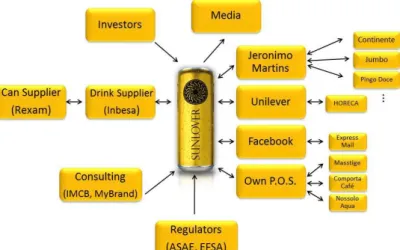
The figure below shows Sunlover’s relationships with other entities.
6
Suppliers: Sunlover has two main suppliers: Inbesa and Rexam. Inbesa is a Spanish
company that operates in the development and marketing of soft drinks and mineral
water. It offers Sunlover its services in the production of the drink, as well as quality control, stock management and operational logistics6. Rexam is a British multinational consumer packaging company. It is the largest manufacturer of beverage cans in the
world and it has around 70 plants in 25 countries, across Asia, Europe, North and South America7. It is one of the few manufacturers of slim cans, first used by Red Bull, which
Sunlover chose to import from Rexam’s factory in Germany.
Distributors: In the beginning, Sunlover worked with a small distributor, Solbel. Since
June 2011, it is represented by Jerónimo Martins Distribuição, the largest national
distributor, which places the product in Pingo Doce, Continente, Jumbo, Intermarché, E.Leclerc, Minipreço and El Corte Inglés8. For the HoReCa channel, Sunlover works
with Unilever, using the Olá icecreams’ sales team to sell one pack of 24 cans for €33.36. Sunlover also sells the product through facebook and had its own point of sales
in the summer, in Masstige, Comporta Café and Nossolo Aqua.
Consulting: Sunlover has consulted with My Brand to develop the concept and design
of the brand9 and with IMCB consulting, to develop the technical guides of the drink10.
Regulators: Health authorities, such as EFSA and FDA had to approve Sunlover’s
technical documents to insure the drink could be considered safe for consumption.
Investors: Sunlover belongs to Quantico holding company, whose board is formed by
Carlos Vasconcellos, António Verças, Joaquim Lico, Graça Medina and Miguel Gomes.
Media: Sunlover has direct relationships with the media, through interviews and
7 3.2. Value Chain
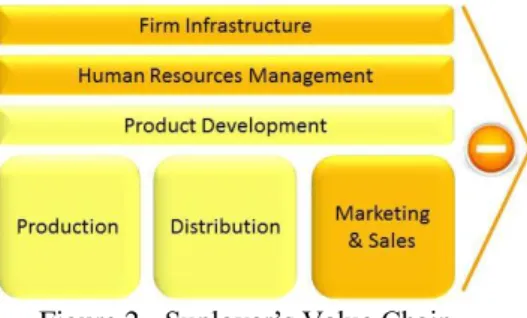
In Porter’s Value Chain model11, the purpose is to identify what are the activities that
create more value to the firm, its core competences. In figure 2, it can be seen that the primary activities of the firm are production, distribution and marketing & sales; while its secondary activities are firm infrastructure (finance and investor relations), human
resources management (recruitment and compensation) and product development (by a biotechnology company). The outsourced activities are identified in light yellow.
Figure 2 - Sunlover’s Value Chain
Regarding the firm’s primary activities, the current strategy to outsource production to
Rexam (€84/1.000 cans) and Inbesa, also outsourcing most of the distribution to JMD,
which has a margin of 50% over the price of the sold product. The outsourcing to these companies is necessary once Sunlover does not have the resources to handle these
activities on its own. However, this option creates an imbalance in power, once Sunlover is dependent on the expertise of their partners to achieve high quality
standards and penetrate the Portuguese market, which can lead to a cost disadvantage. Given this, Sunlover is essentially a marketing company. Sunlover produces their own communication, by hiring a movie director for commercials, after having worked with
Grey Group advertising agency in the past. The firm invests heavily in advertising in TV and outdoors; in their website and facebook page, which includes an online store;
8 brand awareness and build a good brand image within the consumers. Besides marketing, the secondary activity of product development, made by a company who
belongs to one of Sunlover’s shareholders, is also a value driver, once it creates
innovation that allows the firm to have a differentiation advantage.
The margin created from this value chain is, at the moment, negative, which is not
surprising given that the company is new and operates in an industry which requires heavy marketing expenses in order to build its position in the market. In order to
become more efficient, the company could implement several changes, such as: shorten its supply chain, by producing the whole product in Spain and eliminating the cans’ transportation costs from Germany; hire a sales team in order to increase their on-trade
presence, reducing the dependency of the supermarket sales, where the distributor keeps most of the margin; focus the marketing communications on the healthy aspect of the
drink to sell it in the winter; and implement customer service.
3.3. VRIO Analysis
According to the VRIO framework12, the product presents all the characteristics of a
sustained competitive advantage for the firm, since it is: valuable, because it represents the opportunity to explore a new niche market that is growing; rare, because there are
no current products with the same characteristics; costly to imitate, because it is protected by the Industrial Property Code in Portugal as a trade secret13, offering a broader protection than the patent, once it does not require the public disclosure of the
formula and protects it without limitation in time14; organized, because the company has demonstrated its efficiency in penetrating the Portuguese market and coordinating
9 4. External Scanning of the Domestic Market
4.1. PESTEL Analysis of Portugal
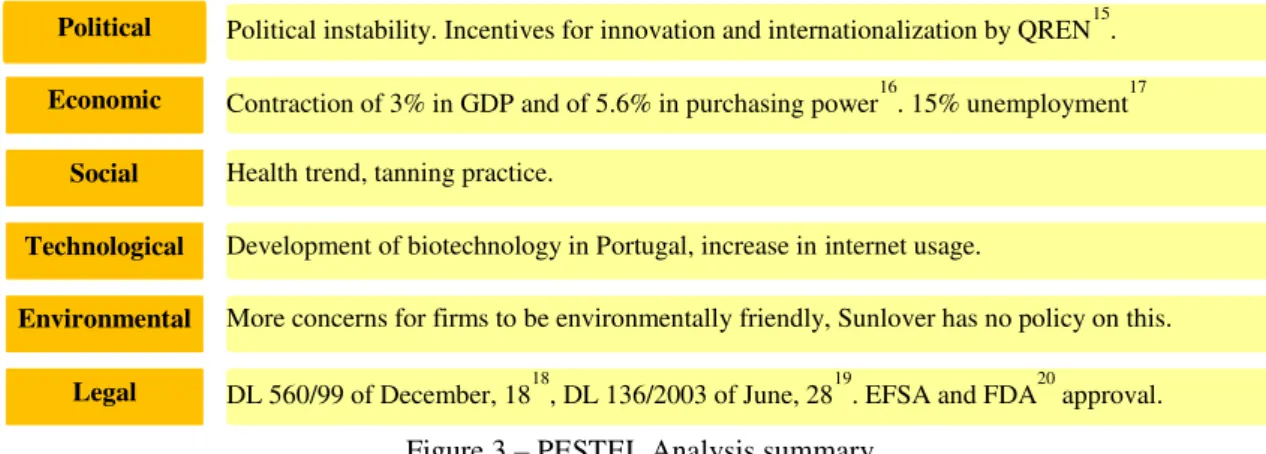
The following table presents a summary of the PESTEL Analysis contained in Appendix 1, presented in order to have a perspective of the macro-environment where the firm operates.
Figure 3 – PESTEL Analysis summary
4.2. Analysis of the Portuguese Functional Drinks Market
The Portuguese consumers have bought 2025.9 million liters of soft drinks in 2010, at an estimated market value of € 1852.9 million. The compound annual growth rate of
this sector between 2006 and 2010 was 0.6%. In Portugal, the main distribution channels for the soft drink market are the on-trade distribution (30.8%), supermarkets/hypermarkets (27%) and independent retailers (22.8%)21. Sunlover
belongs to a segment of the soft drinks - functional drinks. These can be defined as non-alcoholic drinks that include ingredients that provide health benefits, including sports
drinks, energy drinks, enhanced fruit drinks or waters22. The market of functional drinks in Portugal has generated €63.7 million in 2010 and had a CAGR of 3.3% between 2006 and 2010. However, in 2009 and 2010, this market has contracted by 3.4% and 1.7%,
respectively. Despite this, functional drinks are expected to have a 3% CAGR between 2010 and 201523.
Political
Economic
Social
Technological
Environmental
Legal
Political instability. Incentives for innovation and internationalization by QREN15. Contraction of 3% in GDP and of 5.6% in purchasing power16. 15% unemployment17 Health trend, tanning practice.
Development of biotechnology in Portugal, increase in internet usage.
10 The major players of this market are Red Bull (13% of market share), Coca Cola (7.2% of market share and Nutrition & Santé (5% of the market share). Given this, the market
is relatively fragmented, with 74.8% of the market being shared by smaller firms23. Within the functional drinks, the most lucrative segment in Portugal is the energy drinks, which account for 68.4% of the market’s total value. The other two segments
within functional drinks are sport drinks (12.6%) and nutraceutical drinks (19%)23. Nutraceutical drinks, a portmanteau between nutrition and pharmaceutical, designate
drinks which have health benefits and represented a €12.1 million segment of the market in Portugal23. Inside the nutraceutical drinks, we can define the niche where Sunlover belongs: the nutricosmetic drinks. This is a new niche, also called “beauty from within”, still in its infancy. These drinks have to compete with products with the
same functionality, such as supplements, by offering convenience and cheaper prices.
4.3. Competitors
Using the function of tanning by ingesting a substance as a criterion to divide direct from indirect competitors, the following direct competitors have been defined: natural
carrot juices; and tanning pills, such as Inneov Solar Sensibility (L’Oreal+Nestlé) or Oenobiol Solaire (Sanofi Pharmaceuticals). These products are sold in pharmacies, with
prices of €22,45 and€28,9524, respectively, for a package with 30 capsules.
Some indirect competitors were also identified and classified in four groups: lifestyle drinks, healthy drinks, functional waters and external tanning products. Lifestyle drinks
are formed by energy drinks (Redbull and Burn) and relaxation drinks (Slow Cow). Redbull, the Portuguese market leader, is sold in bars and supermarkets (€1,48)25 and
11 MonaVie and Compal Vital. Monavie distributes its products using direct sales (€50 for 24 cans)27 and Compal Vital is sold in supermarkets and coffee shops (€0,66 for 33
cl)25. Functional waters, such as Formas Luso and Ritmo Luso, are sold in supermarkets for €2,99 for each 4 pack of 0,5l bottles25. Finally, external tanning products, which
include tanning oils and self-tanners, like Piz Buin (€15.39) and L’Oreal(€11.60)28, are
sold in beauty shops and pharmacies. This category also includes spray tanning in spas. Sunlover has advantages over its direct competitors, since it has more types of vitamins
and fewer calories than carrot drinks and more user friendly than pills. From the indirect competitors, the only one that provides the tanning function are external tanning products, to apply directly on the skin, which don’t provide a natural result.
5. Criteria of Country Selection
As Portugal is a small country and the macroeconomic conditions are not favorable at
the moment, the best scenario for Sunlover is to internationalize itself, once it will lead to acquiring more customers and increase sales. When considering the countries that are more promising to respond to Sunlover’s value proposition of nourishing and tanning
the skin, one has to consider where the sun tanning practice is valued (Appendix 5), which are mainly western countries. Between those countries, there is one which
reunites the ideal conditions, Brazil, for several reasons.
Firstly, because it is an emerging economy, which is important once the analysis of the functional drinks market in Portugal suggested that this is a product whose demand
might be affected by the recession, once the market retracted in 2009 and 201022. Secondly, because Brazil has a large population, 190 million people, 80% of them
12
in cosmetics’ sales during 201130. For Brazilians, vanity does not have a negative
connotation and body image is so valued that Brazil is the second largest market for
plastic surgeries, with 1.592.106 surgical procedures performed in 201031. Fourthly, because of the capacity of counteracting the seasonality of sales expected in Portugal, once Portugal and Brazil have summers in opposite times during the year. Fifthly,
because it can provide an open door to Mercosur, once setting the operations in Brazil will eliminate barriers to internationalize to the rest of Latin America. Lastly, Brazil is
culturally linked with Portugal, so the psychic and cultural distance is lower.
6. Analysis of Brazil
Brazil is the sixth largest economy in the world, with a GDP of US $2,493 trillion32. In
2010, GDP growth reached 7.5%, the highest growth rate in the past 25 years, which has decreased to 2.7%, in 201133. The inflation for 2011 was 6.5%34 and the
unemployment rate was 6%. Brazil is regarded as the engine that leads South American trade and as the leading democracy in South America33. Brazil is a member of several economic organizations, such as Mercosur, G20 and WTO; and the TRIPS agreement
on intellectual property rights35. It also has a Double Taxation Agreement with Portugal. Despite being Latin America’s largest country and also having the largest population,
over 190 million inhabitants, these are mainly concentrated along the Atlantic coast, with the two largest cities, São Paulo and Rio de Janeiro, accounting for 17% of the national population27. The median age of the population is 29.6 years old32. The results
of the last census, conducted in 2010, indicated 47.7% of the Brazilians are white36, thus indicating that at least 91 million people may be receptive to the concept of Sunlover.
13 represents a major shift from 2003, when this class only represented 37.6% of the population. The rest of the population is considered wealthy (11.8% in A and B classes)
and there was still a large group who lived in poverty (33.2% in D and E classes) 37. As incomes have increased, the consumption of food has raised among all income groups. Brazilian consumer interest in the relationship between diet and health has increased the
demand for information about functional foods33.
Despite being an attractive country due to all reasons described above, Brazil also has
its problems for foreign investors. First of all, it is protectionist nation, which has high import taxes, which vary between product categories. Also, investing in Brazil involves a country risk (OECD classes Brazil as 3 in a 0-7 scale) 38 and currency risk (given the
Real has fluctuated significantly against the dollar). At the moment of this study, the exchange rate is US$ 1 = R$ 2.0339.
Regarding the laws of the country with respect to the industry in analysis, ANVISA40 is the agency responsible for food safety. There are three laws that Sunlover should take into account: labeling on packaged foods – ANVISA resolution nº 136/06; authorized
additives and its quantities on non-alcoholic drinks – ANVISA resolution nº 5 of 15/01/2007; registry of functional foods – ANVISA resolution 18/99 and 19/99.
7. Analysis of the Brazilian Functional Drinks Market
Brazil is the fourth largest market of soft drinks in the world, after the USA, China and Mexico41. The Brazilian consumers have bought 23420.5 million liters of soft drinks in 2010, at an estimated market value of €21642.5 million42. The compound annual growth
rate of this sector between 2006 and 2010 was 5.1%. In Brazil, the main distribution
14 share, Coca-cola is the leader, with 45.7%, followed by PepsiCo (17.9%) and Ambev (12.9%)37. The flavour which dominates this market is cola (51%), followed by guaraná
(24.5%), orange (10.8%) and lemon (5.9%)43. The regions which consumes more non-alcoholic drinks per capita are Rio de Janeiro (306.10 l per capita/year) and São Paulo (301.19 l per capita/year)44. Rio de Janeiro also leads as the region which consumes
more still drinks, ice tea, guaraná, coconut water, energy and sports drinks, while São Paulo leads in the consumption of carbonated drinks, bottled water, powder juices,
nectars and concentrated juices44.
The functional drinks make up 3% of the market in Brazil42. This segment represents 3% of the total soft drinks market42 and had a CAGR of 20.6% between 2004 and
200945. The leading player is PepsiCo45. Within the functional drinks, energy drinks lead, with a share of 58.3%45, headed by Redbull (49.6%), Burn (11.7%) and Flash
Power (4.8%)46. In 2010, energy drinks were the fastest growing category in Brazil, with 33% growth in value46. Euromonitor predicts that multinational manufacturers will start to invest more in the country to offset the slowdown in other markets, once Brazil
could be one of the top five markets worldwide for energy drinks46.
Regarding nutricosmetics in Brazil, there are good perspectives for this market, once
79% of Brazilian consumers agree with the statement “I am conscious of the link between diet and appearance”, when compared to 66% in the USA47 and also that nearly
two-thirds of Brazilians find the concept of nutricosmetic products appealing, when
compared to just over one-third in Europe48.
8. Competitors
15 in Brazil is much higher because, besides the existence of healthy, isotonic and energy drinks, there are also: beauty drinks, such as Beauty’in Drink - a flavored water with
vitamins and without preservatives, with 8 flavors, in a 340 ml bottle sold for R$7 in drugstores and in online stores – whose company is owned in 40% by Brazil Pharma49; functional juices, such as Juxx, a small entrepreneurial firm that produces a line of
functional juices based on the cranberry fruit, with anti-oxidants and properties that prevent urinary tract infection, sold in cans of 248 ml for R$3,99, in supermarkets50;
functional waters, such as H2OH! (from Pepsi), a flavored water sold in 500ml bottles, in supermarkets, for R$2,1350 and which became leader in the diet soft drinks category in less than 7 months over its launch51; guaraná soft drinks, such as Antarctica - a brand
of Ambev, one of the biggest beer and soft drinks companies operating in Brazil - sold mainly in supermarkets for R$1,49 for each 350 ml can50; coconut water, sold in
beaches in its natural form, or sold in supermarkets, in packages, like Ducoco 330ml, for R$3,1550; and natural juices, sold in bars and beaches.
9. Porter’s Five Forces in Brazil
The Porter Five Forces is a technique to analyze the attractiveness of an industry52. The
threat of new entrants for the industry is moderate, once the functional drinks market
is growing and it allows premium prices, so it is attractive for new entrants; although, for smaller companies, there are barriers to entry such as a high investment in advertising and innovation, difficult access to suppliers and distributors and lack of
economies of scale, so the new entrant is likely to be a soft drinks firm. The threat of
substitutes for the industry is high, once the number of competitors in the market is
high, there are no switching costs and consumers search for lower price alternatives.
16 retailers is high, considering the importance of independent retailers in Brazil, although they can switch brands at zero cost. This point is a major difference from Portugal,
where this power is high, once here are fewer retailers. In the case of Sunlover in Portugal, this was exacerbated by the dependence of one large buyer (JMD). The
bargaining power of suppliers for the industry is low, once there is: a large number of
suppliers for cans and ingredients, who provide mainly commodities; a low cost of switching to alternative sources; and no possibility for forward integration. This is the
same in Portugal, industry wise. However, in the case of Sunlover, this power is high, once the firm relies in two suppliers who control the whole production. Finally, the
intensity of competitive rivalry of the industry is moderate/high, once that, although
the functional drink market is relatively fragmented, we have to consider that the existence of other competitors, ranging from Coca-Cola to pharmaceutical companies.
Other factors that contribute to this scenario are high fixed costs and exit barriers.
10. SWOT Analysis for Brazil
The main strengths of the company are the same found in the Portuguese market (seen
in Appendix 2), such as having created an innovative drink, protected by trade secret; and investing strongly in marketing. The exceptions are the partnerships with distributors and the shareholder’s networks, which cannot be used in Brazil. The
weaknesses remain the same as well, once Sunlover only has a seasonal product, with
lack of brand awareness. The firm can explore opportunities in Brazil, such as: being a
first mover in the nutraceutical drinks industry in Brazil, establishing partnerships with local producers and distributors, and selling to a large coastal population who like to be
17 11. Entry in Brazil
Sunlover’s objective in Brazil is market development, once this country offers size and
growth opportunities53. The timing of the entry is dependent on the window of opportunity and the risk that the company accepts to take44. The company’s lack of resources is a barrier to internationalization, but there are advantages of being a
first-mover: pre-empt resources (location, suppliers, distribution, contacts), establish the brand and learn about customers53. Despite this, Sunlover should also consider the
disadvantages of being a first mover, such as taking risks due to the market immaturity, product being unfitted and the lack of infrastructure53.
Rio de Janeiro (RJ) should be the first entry point, followed by São Paulo (SP). As
seen in the analysis of the market, RJ and SP are the states with the most consumption of soft drinks44. RJ is a state with a similar size of population to Portugal (16 million), in
which the population density is higher, with 365 inhabitants per km2,54 compared to 115 in Portugal.55 The city of Rio de Janeiro is also the southern hemisphere’s most visited city and will receive the World Cup in 2014 and the Olympics in 201656.
12. Modes of Entry and Implementation Plan
Regarding the choice of an entry mode, it will depend on two dimensions: the
ownership and investment intensity53. Due to the high investment required for Sunlover to have full ownership of operations in Brazil, entering the market through a wholly owned subsidiary is not feasible, once the company lacks financial resources and
knowledge of the market. There are three entry modes that Sunlover can choose from, depending on balancing risk with opportunity: exporting, licensing and strategic
18
Figure 4 – Memo
12.1. Direct Exporting
Under direct exporting, the firm sets up its own exporting department and sells its products via a middleman located in the foreign market57. This is the most direct way to enter a country, while retaining full ownership. However, there are disadvantages to this
mode of entry, because it is risky for a company who has no exporting experience and no knowledge of the market. In the case of Brazil, a major disadvantage is the existence
of trade barriers in the form of high import taxes.
12.1.1. Minutes
Sunlover should start to prepare its internationalization as soon as possible. In order to
achieve this, the company should engage in contacts and prepare a business trip in the first quarter of 2013, where it can visit the Vitafoods58 trade fair in the 26th and 27th of
March to meet suppliers, manufacturers and distributors of the nutraceutical industry. This visit to Brazil should accomplish two more objectives: registering the brand and hiring a local lawyer. After the contracts are signed in a second business trip in the 3rd
quarter of 2013, the mode of entry takes relevance. Financial Customer Internal Learning Objectives Increase sales Create awareness and loyalty
Increase staff, focus on product development
Understand the local market and contingencies Measurement Sales volume Customer surveys and repeat purchases Number of employees, number of products developed Sales segmentation, consumer receptiveness Target
Over 3 million cans in 2015
80% awareness and 50% repeat purchases in 3 years
Hire one employee and develop one new flavor until
2015 Take over the marketing and sales
role in case it is necessary
Initiative
Use the marketing and distribution
network of the chosen partner Advertising, PR, events, social networks and sampling Recruitment, investment in R&D
Implement a sales management
19 Once exporting is one of the quickest modes of entry, recruiting should be done right away, while promotion and distribution should start in the following quarter. In the
following two years, two business trips per year are scheduled to supervise the process of exporting/licensing and solve possible problems that may arise (see appendix 6 for the timeline comparison between entry modes).
12.1.2. Men
As a first step, Sunlover should use its current staff in Portugal to take care of the first
steps of the internationalization to Brazil, such as establishing the first contacts in the country, visiting sales representatives and registering the brand through Brazilian INPI. Sunlover should also hire a lawyer in Brazil, under a time retainer contract, to draft the
contracts to be signed between Sunlover and a local partner for distribution. After that, Sunlover should hire a new account manager to manage the Brazilian sales.
12.1.3. Money
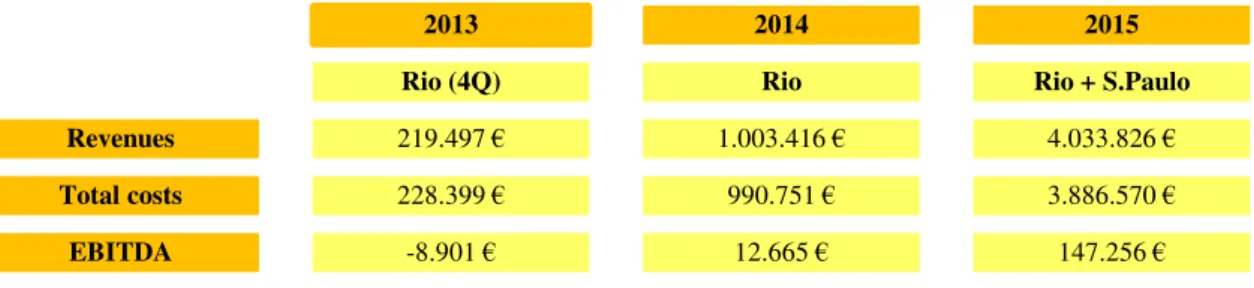
The figure below represents the forecasted revenues and costs of exporting.
Figure 5 – Summary of the forecasted revenues and costs of exporting seen in Appendix 7 In exporting, we have to consider major costs that increase Sunlover’s Cost of Goods
Sold – insurance (1%), transportation (2.4%) and several import taxes (Import Duty of
14%, ICMS of 18%, COFINS of 7.60%, PIS of 1.65%)59 – which increases the landed cost of products in 54.57%. Additional costs necessary to market the product include 15% for distribution and for 35% promotion. Besides this, it is necessary to account for
the cost of trips and accommodation (€2000 for each round-trip ticket60 and €1000 per Revenues
Total costs
EBITDA
2013
Rio (4Q)
219.497 € 228.399 € -8.901 €
2014
Rio
1.003.416 € 990.751 €
12.665 €
2015
Rio + S.Paulo
20 week of accommodation in a 4 star hotel61), the brand registry (€50062), lawyer’s time retainer contract (€700 per month63) and the sales manager salary (€1250 per month).
This mode of entry is not attractive due to the tax burden.
12.2. Licensing
Licensing is a contract where the firm offers some proprietary assets (formula) to a
foreign company in exchange of royalty fees57. This can be a profitable means to enter the market, quickly expanding without much risk, not requiring a large capital
investment and avoiding import barriers57. However, there are disadvantages to this mode of entry, because there is a risk of obtaining a lower income than in other entry modes, to lose control of the production and marketing of the licensee, to risk the trade
secret and to have the partner become a competitor later57.
12.2.1. Minutes
The entry to Brazil through licensing will occur in the same timeframe as exporting.
12.2.2. Men
The human resources required will be the same as exporting.
12.2.3. Money
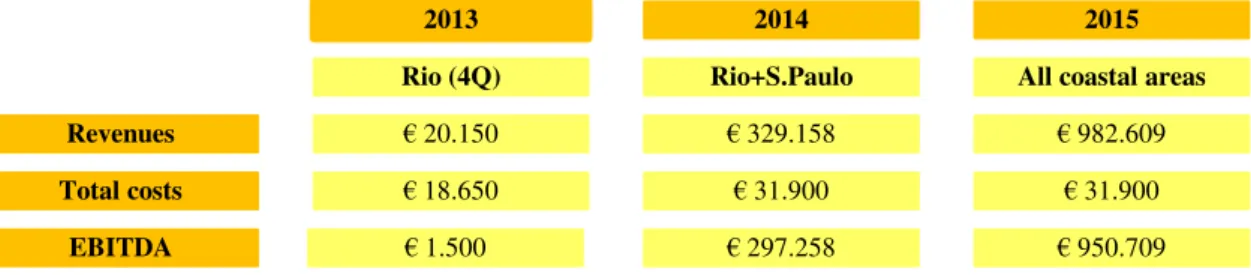
The figure below represents the forecasted revenues and costs of licensing.
Figure 6 – Summary of the forecasted revenues and costs of licensing seen in Appendix 7
In licensing, an experienced company in the sector of soft drinks will control the product introduction in the Brazilian market. Therefore, the coverage of the Brazilian
territory will be quicker, when compared to exporting. There will also be lower costs for Revenues
Total costs
EBITDA
2013
Rio (4Q)
€ 20.150 € 18.650 € 1.500
2014
Rio+S.Paulo
€ 329.158 € 31.900 € 297.258
2015
All coastal areas
21 Sunlover, since this company will only have to take into account the costs such as: trips and accommodation, brand registration, lawyers’ time retainer and the account manager
salary. However, the revenues are restricted to only 10% of revenues paid in royalties. Despite this setback, this mode of entry is still a better option than exporting, leading to an EBITDA of €950.709 in 2015, when all the coast of Brazil sells the product.
12.3. Strategic Alliance
A strategic alliance can be described as a coalition of two or more organizations to
achieve strategically significant goals that are mutually beneficial57. This mode of entry could suit Sunlover, once it could join forces with an established company who could have a minority stake in the equity, helping Sunlover with local market expertise,
financial resources and access to suppliers and distribution. Sunlover could contribute to this partnership with its marketing expertise and product development knowledge in the
area of nutricosmetics. The ideal partner would be a small firm with a good fit with Sunlover. However, there are also disadvantages to this mode of entry, once it is riskier than licensing and there is a greater potential for conflicts with the partner.
12.3.1. Minutes
The entry with a strategic alliance will start later than in the other entry modes, once
Sunlover is not yet financially stable and it needs to assess if its 2013 results achieve the break-even, before starting to invest in Brazil. In the first quarter of 2014, Sunlover will recruit its marketing & sales team and to find an office to install them, in order for the
22 12.3.2. Men
Even though Sunlover will rely on the resources of the partner in terms of production,
distribution and sales force, more human resources will be necessary, such as two managers (one of them Brazilian) in 2014 and two sales people in 2015.
12.3.3. Money
The figure below represents the forecasted revenues and costs of a strategic alliance.
Figure 7 – Summary of the forecasted revenues and costs of a strategic alliance seen in Appendix 7
In the strategic alliance with a minority partner, the entry of Sunlover will be delayed regarding the two other modes of entry, once Sunlover needs to have more financial stability in Portugal before investing in Brazil. The partnership with an experienced
company in the sector of soft drinks, will provide benefits such as efficiency gains, reducing the cost per can in 3 cents and the cost of distribution in 1%. However,
Sunlover has to be present in the country and have additional costs with an office rent of €1900 per month for a 50m2 space in Barra da Tijuca64 and salary of two managers
(€1250 per month) plus the apartment rent for the expatriate. In 2015, the cost with
salaries will increase due to the recruitment of two new sales people (€900 per month). This mode of entry has a slower penetration of the market and is riskier than licensing,
but it will achieve better results in the long term, once the EBITDA for Sunlover in RJ and SP is €297.258 in licensing and €448.417 in the strategic alliance with 70% stake.
Revenues
Costs
EBITDA (70%)
2013
Rio (4Q)
€ 0 € 14.900 €-14.900
2014
Rio
€ 604.492 € 558.140 € 32.446
2015
Rio + S.Paulo
23
Figure 8 – Comparison of the three entry modes
After analyzing the three options available, I recommend Sunlover to choose licensing as a mode of entry to Brazil, as this solution is the quickest, less risky and which
provides the best return in the short term. The licensing contract should last for three years and include an option for the partner to buy a stake in the company, allowing
Sunlover to switch mode to strategic alliance in the end of the contract. This change of mode will increase revenues for Sunlover and the purchase of part of the company by the partner will bring an additional inflow of cash.
13. Partners
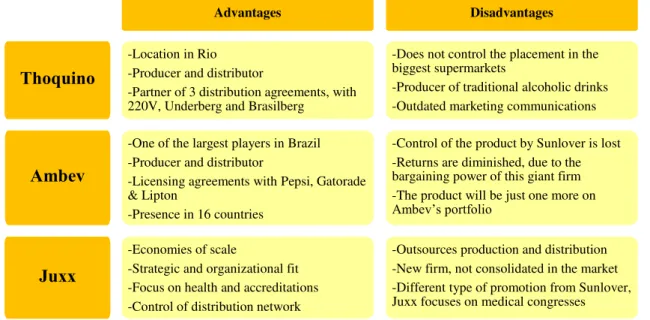
There are several partners from whom Sunlover can choose from, such as Grupo Thoquino, Ambev and Juxx. Grupo Thoquino is a family owned company which is a
manufacturer and distributor of drinks, ISO 9001 and ISO 14000 certified65, founded in 1906 in Rio de Janeiro. The group had revenues of R$120 million in 200766. It produces
mainly traditional alcoholic beverages, such as Conhaque de Alcatrão, but it also has launched products for younger targets, like Vodka Kovak and Voltage energy drink.
The company also distributes products for other companies: 220 Volts energy drink, Brasilberg and Underberg66. This firm is advantageous because it is vertically integrated53, reuniting both the production and distribution. Sunlover’s expertise in
innovation and marketing would still be used, once they complement Thoquino’s Exporting
Licensing
Strategic Alliance (Sunlover 70% stake)
Minutes
Sales start in the 4Q of 2013
Sales start in the 4Q of 2013
Sales start in the 2Q of 2014
Men
1 account manager 1 lawyer
1 account manager 1 lawyer
2 managers, 2 sales people, 1 lawyer
Money
€147.256 in 2015
€950.709 in 2015
24 capabilities. As disadvantages, this firm would have a high bargaining power and Sunlover would have to work with more distributors, once Thoquino does not cover the
biggest retailers in Brazil. Another issue lies in the fact that Sunlover, a healthy drink, may not want to be associated with an alcoholic drinks manufacturer.
Ambev is a publicly traded company, formed by the merger of two breweries, Brahma
and Antarctica, in 2000. The company had revenues of US$15.2 billion in 2011. It is the biggest brewery in Latin America and the fifth in the world, operating in 16 countries
(Latin America and Canada)67. Besides beer, it produces soft drinks like Guaraná Antarctica and Fusion Energy Drink, besides representing Lipton and PepsiCo (Pepsi, H2OH and Gatorade)68. Sunlover fits within Ambev’s product range, once it already
operates in the functional drinks segment with its energy drink, but not in the nutraceutical segment. This entry would be managed by one of the largest firms in this
industry in Brazil, which means that their expertise could mean a quick, low risk entry in the market and high growth in sales. This partner would also facilitate further expansion into Latin America. As a disadvantage, Ambev would have all the control of
the operations and Sunlover returns would be diminished.
Juxx is a private company of functional juices, founded in 2006 in São Paulo. It had
revenues of R$ 6 million in 2010 and expected revenues R$ 13.2 million in 201169. Its production is outsourced to Beba Brasil factory and its distribution is also outsourced to 20 different distributors69. It invested R$ 1.5 million in marketing69 and has nationwide
distribution, including the largest retailers in Brazil, such as Pão de Açúcar and Walmart. This firm would be a good choice because: both companies could benefit from
25
company’s location in São Paulo is useful for the entry of Sunlover in Brazil; Juxx has
experience in coordinating a large network of distributors; the company already has
some accreditations, such as National Association of Diabetics, the Brazilian Society of Urology and Kosher certification71, so it could be easier to Sunlover to access these certifications or others; Juxx is a small company to which Sunlover would not lose
completely the control of the product, due to lack of power; and, nonetheless it is small, it already has some financial resources that guarantee its sustainability to Sunlover. A
disadvantage of this firm is it uses the same configuration of the supply chain as Sunlover with all stages of production and distribution outsourced with the exception of marketing, so there is a risk of more people knowing the trade secret of Sunlover.
Sunlover may also provide synergies to Juxx, once it has a complementary product and more innovative - the nutricosmetic side of healthy drinks - and may provide an entry
point to Europe, through Portugal. This firm is a good partner due to the strategic fit with Sunlover, sharing the same long-term objectives; and due to their organizational fit, being two small entrepreneurial firms who conduct their operations similarly.
Figure 9 – Comparison of the three potential partners Thoquino
Ambev
Juxx
Advantages
-Location in Rio -Producer and distributor
-Partner of 3 distribution agreements, with 220V, Underberg and Brasilberg
-One of the largest players in Brazil -Producer and distributor
-Licensing agreements with Pepsi, Gatorade & Lipton
-Presence in 16 countries -Economies of scale
-Strategic and organizational fit -Focus on health and accreditations -Control of distribution network
Disadvantages
-Does not control the placement in the biggest supermarkets
-Producer of traditional alcoholic drinks -Outdated marketing communications -Control of the product by Sunlover is lost -Returns are diminished, due to the bargaining power of this giant firm -The product will be just one more on Ambev’s portfolio
26 Of the three partners analyzed, the best partner for a licensing agreement is Ambev, once this company is an expert in marketing and distribution in this market and once it
operates in more Latin American countries, facilitating a future expansion.
14. Marketing Guidelines
Regarding the Marketing Strategy for Brasil, the target for Sunlover should be focused
on a younger population (15-35), given the differences on the median age of Brazil (29.6 years)32 and Portugal (40.4 years)72. Regarding the Marketing-Mix, it is
necessary to define the 4P’s: product, price, promotion and placement. The product can be sold using a product standardization approach, once orange is the third most consumed flavor in this country43. This is in line with the results of the survey presented
in Appendix 8, where the orange flavor was picked 35 times. The same survey revealed that 78% of the respondents would be interested in buying the product and 67% of them
would be interested in the new product that Sunlover is developing (81% when considering just female respondents). This standardization approach allows for simplicity in the process and costs savings, since only minimum changes would be
required, such as adapting the language of the labels to Brazilian Portuguese. Later on, if the product proves successful, more flavors can be developed, such as passion fruit
(picked 23 times in the survey). The price should be a point of parity with Red Bull, as it is in Portugal, in order to maintain the premium pricing. Red Bull costs between R$5.49 off-trade (Pão de Açúcar)50 and R$10.5 on-trade. However, considering that
Burn costs R$3.99 in Brasil50, this represents a difference in price that is twice the value of the one found in the Portuguese market (€0.22)25, which maybe explained due to the
27 the survey show that the majority of the respondents (53%) said that they would be willing to pay over R$4. However, as Sunlover will be produced in Brazil, there is a
margin for the price to be adjusted to the market conditions, if necessary. The
promotion is a fundamental step in this product. Redbull, in its early days, spent 65%
of their revenues in marketing and it still spends 30% since 200573. Sunlover should
focus on targeting trendy clubs and beach bars to promote sunset parties (most voted by the survey respondents) and promote cocktails of the drink, acknowledging it as a
mixer, to gain influencers of the brand. Other events promoted by the brand already done in Portugal should be continued, such as surf championships (like Billabong Rio Pro) and Vogue fashion night out. Also, there are events like beach football that can
captivate the male audience, which should not be disregarded. Sunlover should also invest in sampling in the points of sale, once it increases the likelihood of brand
recognition in addition to increased sales, once a study conducted by Arbitron revealed that one-third of consumers that sampled a product bought it in the same day74. The brand should also invest in certifications from the Brazilian Society of Dermatology and
Brazilian Society of Functional Foods, to improve its credibility regarding functionality. Regarding Public Relations, Sunlover can get free press from interviews in TV and
newspapers online and it should also update their website and facebook page to support Portuguese Brazilian as a way to connect with the consumers. Later on, if Sunlover is successful, there should be an investment in TV advertising and product placement in
Globo, gathering the support of celebrities. TV advertising in Brazil has one advantage: it can be segmented by state, so the prices are more affordable. For example, a 30
28 retailers and on-trade distribution, since they represent the majority of the sales in Brazil42. Therefore, clubs, beach bars, restaurants and independent retailers should be
the primary focus for sales. Additionally, for visibility purposes, it is important to sell it at the three largest hypermarkets of Brazil: Pão de Açúcar, Carrefour and Walmart.
15. Conclusion
Considering the Brazil’s characteristics – the third largest beauty market in the world30
and the fourth largest soft drinks market in the world41; 190 million people27, mainly
concentrated along the coast29; the economic growth of the country and rise of its middle class, it seems like an excellent option for the internationalization of Sunlover. Sunlover can establish itself in this market for a residual cost –18.650€ - and attract a
partner to reach a licensing agreement, such as Ambev, which is present in 16 countries, has a large experience in marketing in Brazil and is both a producer and a distributor, minimizing the risk of entry and potentially earning 950.709€ in 2015. At this time,
Sunlover should have a good coverage of the coastal areas and knowledge of the market through the information provided from its partner, so it could turn the licensing
agreement into a strategic alliance by proposing to the partner an acquisition of a stake in the company; or it can maintain the agreement and start expanding to the neighboring
countries. The time is ripe for Sunlover to enter Brazil and establish its new category there, benefitting of a first-mover advantage. A delayed entry might allow the establishment of competitors in this new segment of drinks – nutricosmetic – which
29 References
1Dinheiro Vivo (2012).
http://www.dinheirovivo.pt/Empresas/Artigo/CIECO046996.html 2Sunlover (2012).
http://www.drinksunlover.com/ 3Financial Times (2012).
http://blogs.ft.com/beyond-brics/2011/07/01/tan-in-a-can-group-eyes-glory-in-portugal-and-brazil/#axzz26e4YYxNw
4Produto do Ano (2012). http://www.produtodoano.com/
5You Tube (2012) –Pedro Baltazar’s interview to Marca Registada (Económico TV). http://www.youtube.com/watch?v=y7-xCyfk8-o&feature=g-wl
6Inbesa (2012).
http://www.inbesa.net/ 7Rexam (2012).
http://www.rexam.com/index.asp?pageid=1 8Jerónimo Martins Distribuição (2012). http://www.jmd.pt
9My Brand (2012).
http://www.mybrandconsultants.com/public/media/casestudies/Case_SUNLOVER_P1. pdf
10IMCB Consulting (2012).
http://www.imcb-consulting.com/sunlover/sunlover.pdf 11Porter, M. (1985).
Competitive Advantage: Creating and Sustaining Superior Performance. Free Press, New York.
12Barney, J. B., & Hesterly, W. S. (2011).
Strategic Management and Competitive Advantage. Pearson, New Jersey. 13European Comission (2012).
http://ec.europa.eu/internal_market/iprenforcement/docs/trade/201201-study_en.pdf 14IPR 2 (2012).
http://www.ipr2.org/storage/EU-Trade_Secrets_in_Europe-EN1003.pdf 15QREN (2012).
30 16Banco de Portugal (2012).
http://www.bportugal.pt/pt-PT/EstudosEconomicos/Publicacoes/BoletimEconomico/Publicacoes/projecoes_p.pdf 17INE (2012).
http://www.ine.pt/
18Diário da República – DL 560/99 (2012).
http://dre.pt/pdf1sdip/1999/12/293A00/90499059.pdf 19Diário da República – DL 136/2003 (2012).
http://dre.pt/pdf1s/2003/06/147A00/37243728.pdf 20U.S. Food and Drug Administration (2012). http://www.fda.gov/
21Data Monitor (2011).
Industry Profile: Soft Drinks in Portugal. 22Wikipedia (2012).
http://en.wikipedia.org/wiki/Functional_beverage#cite_note-0 23Data Monitor (2011).
Industry Profile: Functional Drinks in Portugal. 24Farmais (2012).
http://farmais.net/oenobiol-solaire-p-1663.html 25Jumbo (2012).
http://www.jumbo.pt/ 26Slow Cow (2012).
http://slowcowportugal.com/index.php/compraonline 27Monavie (2012).
http://pt.monavie.com/pt/products/energy-blends 28Revista Máxima (2012).
http://www.maxima.xl.pt/rosto-corpo/199-bronzear-sem-sol.html 29Ministry of Education in Brazil (2012).
http://portal.mec.gov.br/seb/arquivos/pdf/EnsMed/expensgeo_1e2.pdf 30Cosmetics Design (2012).
http://www.cosmeticsdesign.com/Market-Trends/Brazil-market-for-cosmetics-continues-to-shine
31International Society of Aesthetic Plastic Surgery (2012).
31 https://www.cia.gov/library/publications/the-world-factbook/geos/br.html
33Government of Canada (2012).
http://www.gov.mb.ca/agriculture/statistics/agri-food/brazil_health_wellness_en.pdf 34Banco do Brasil.
http://www.bcb.gov.br/pt-br/paginas/default.aspx 35World Trade Organization (2012).
http://www.wto.org/english/tratop_e/trips_e/pharma_ato186_e.htm 36World Population Review (2012).
http://worldpopulationreview.com/population-of-brazil-2012/ 37Folha de S.Paulo (2012).
http://www1.folha.uol.com.br/poder/935502-classe-c-e-a-unica-que-continua-a-crescer-aponta-fgv.shtml
38OECD (2012).
http://www.oecd.org/tad/exportcredits/arrangementonexportcredits/countryriskclassifica tion.htm
39Bloomberg (2012).
http://www.bloomberg.com/quote/USDBRL:CUR/ 40Anvisa (2012).
http://portal.anvisa.gov.br/wps/portal/anvisa/home 41New Hope 360 (2012).
http://m.newhope360.com/beverage/latin-america-worlds-next-functional-beverage-hotspot
42Data Monitor (2011).
Industry Profile: Soft Drinks in Brazil. 43Ambev (2012).
http://www.ambev.com.br/pt-br/investidores
44Associação Brasileira das Indústrias de Refrigerantes (2012). http://abir.org.br/categoria/o-setor/
45Market Research (2012).
http://www.marketresearch.com/Datamonitor-v72/Functional-Drinks-Brazil-Soft-6372510/
46Just Drinks (2012).
http://www.just-drinks.com/news/just-the-facts-sports-and-energy-drinks-in-brazil_id106152.aspx?d=1
32 http://www.canvas8.com/public/2009/11/11/the-nutricosmetics-market.html
48Schawk (2012).
http://www.schawk.com/blog/nutraceuticals-nutricosmetics-cosmeceuticals-medical-foods-marketing
49Beauty In (2012).
http://www.beautyin.net.br/ 50Pão de Açúcar (2012).
http://www.paodeacucar.com.br 51O Globo (2012).
http://oglobo.globo.com/economia/h2oh-surpreende-mercado-coca-cola-lanca-concorrente-4189322
52Porter, M. (1980).
Competitive Strategy: Techniques for Analyzing Industries and Competitors. Free Press, New York.
53Lasserre, P. (2003).
Global Strategic Management. Palmgrave Macmillan, Bristol. 54Instituto Brasileiro de Geografia e Estatística (2012).
http://www.ibge.gov.br/estadosat/perfil.php?sigla=rj 55Wikipedia - Portugal (2012).
http://en.wikipedia.org/wiki/Portugal 56Wikipedia – Rio de Janeiro (2012).
http://en.wikipedia.org/wiki/Rio_de_Janeiro 57Kotabe, M. & Hensen, K. (2011).
Global Marketing Management. Wiley, New Jersey. 58 Vitafoods South America (2012).
http://www.vitafoodssouthamerica.com/ 59Brazil Business – import tax guide (2012).
http://thebrazilbusiness.com/import-tax-guide/fruit-juices-including-grape-must-vegetable-juices-unfermented/sp/20098000-1
60TAP (2012).
http://www.flytap.com/Brasil/PTBR/Homepage 61Booking (2012).
http://www.booking.com/ 62E-marcas (2012).
33 63Miguel Reis & Associados, Sociedade de Advogados (2012).
http://www.lawrei.com/
64Brazil Business – office rents (2012).
http://thebrazilbusiness.com/article/office-rent-in-brazil 65Associação Brasileira de Bebidas (2012).
http://www.abrabe.org.br/associados3.php?id=68 66Revista Fator (2012).
http://www.revistafator.com.br/ver_noticia.php?not=47873 67Ambev (2012).
http://www.mzweb.com.br/ambev2009/web/conteudo_en.asp?idioma=1&tipo=26117& conta=44
68Wikipedia - Ambev (2012). http://en.wikipedia.org/wiki/AmBev 69Supermercado Moderno (2012).
http://www.sm.com.br/publique/cgi/cgilua.exe/sys/start.htm?infoid=12539&sid=5 70Revista Fator Brasil (2012).
http://www.revistafatorbrasil.com.br/ver_noticia.php?not=155688 71Juxx (2012).
http://www.juxx.com.br/
72Central Intelligence Agency – Portugal (2012).
https://www.cia.gov/library/publications/the-world-factbook/geos/po.html 73Red Bull case study.
Darden School of Business, University of Virginia. 74Arbitron (2012).
http://www.arbitron.com/downloads/product_sampling_study.pdf 75TV Globo price list (2008).
http://www.ebah.com.br/content/ABAAAAeVYAJ/lista-precos-rede-globo-propagandas
76Census of Brazil (2010).
34 Glossary
ANVISA– Agência Nacional de Vigilância Sanitária
CAGR– Compound Annual Growth Rate
COFINS –Contribuição para o Financiamento da Seguridade Social
COMPETE– Programa Operacional Factores de Competitividade
EBITDA– Earnings Before Interest, Taxes, Depreciation and Amortization
EFSA– European Food Safety Authority EU– European Union
FDA– Food and Drug Administration GDP– Gross Domestic Product
HoReCa – Hotels, Restaurants and Cafés
ICMS – Imposto sobre Circulação de Mercadorias e Serviços
IMF – International Monetary Fund
INPI - Instituto Nacional da Propriedade Industrial
JMD– Jerónimo Martins Distribuição RJ– Rio de Janeiro
SP– São Paulo
OECD– Organization for Economic Cooperation and Development PIS – Programa de Integração Social
Q – Quarter
QREN – Quadro de Referência Estratégico Nacional
TRIPS Agreement– Trade Related aspects of Intellectual Property Rights Agreement
35
36 Appendix 1 - PESTEL Analysis for Portugal
Political context: The political context of Portugal in 2012 is characterized by political
instability, due to the austerity measures applied to control the public debt. Despite this, there are opportunities for SME through COMPETE program, a part of QREN that has incentives for innovation and internationalization of companies15.
Economic context: The Portuguese economy is characterized by being in a recession
and receiving financial assistance from EU and IMF. Banco de Portugal estimates a contraction of 3% in GDP and of 5.6% in purchasing power16. Furthermore, there is a high level of unemployment (15%)17 and great uncertainty regarding the stability of the tax rates, when VAT is already standing at 23% for products like Sunlover.
Social context: The health and wellness trend is present in Portugal and is revealed
through the increase in products which use natural ingredients or are fortified with vitamins. Also, Portuguese people like to be tanned in the summer.
Technological context: Advances in biotechnology knowledge allowed the
development of the innovative formula of Sunlover in Portugal. Also, the increase of internet access in Portuguese households benefits the brand by maintaining a close relationship with its customers through social networks and by creating a possibility to sell directly to them through Sunlover’s online store.
Environmental context: In today’s culture it is very important for organizations to be
seen as environmentally friendly and ethical with the manufacturing, due to the effect on global warming. Sunlover does not have any environmental responsibility program and, although its cans are totally recyclable, it has an impact on the environment in what concerns the transportation of the cans, made by truck over large distances.
Legal context: All food and beverages are under the supervision of the Ministry of
37 Appendix 2 - SWOT Analysis for Portugal
Appendix 3 - TOWS Analysis for Portugal
Strenghts
- Attractive design of the can
- Zero calories vitamined drink for tanning - Formula is a trade secret
- Strong investment in marketing - Shareholder's networks
- Partnerships with suppliers and distributors
Opportunities
- Nutraceutical drinks market growth
- Beauty and Healthy trend in consumer goods - Emerging markets (BRIC) economic growth - First mover in a new drink category - Emergence of new flavor profiles like Açai - Cultural value of tanned skin on western countries
Weaknesses
- No distinctive taste - Credibility problems - Lack of brand awareness - Seasonality of the product - Size of the company - Single product company
Threats
- Contraction of the portuguese market for functional drinks
- Recession in Portugal and most EU countries - Entrance of new competitors in the market - Shortened product life cycles, requiring faster innovation
S-O Strategies
- Use the current suppliers and distributors to expand to EU, USA and Brazil
- Use the company's know-how to develop product line on healthy drinks
- Increase marketing capabilities to the upscale market
S-T Strategies
- Use marketing to differentiate the product from competitors in the drinks market
- Engage in promotions within the portuguese market, especially in the winter
W-O Strategies
- Improve the flavor profile and develop new flavors
- Educate the consumer about the health benefits of the drink through marketing
- Enter a market which counteracts the seasonality of the product
W-T Strategies
- Internationalize the company to growing countries
- Increase brand awareness and brand image to defend the product drom other entrants
38 Appendix 4 - Porter Five forces – Functional Drinks Industry in Portugal
Threat of New Entrants: Moderate
Factor
Investment cost
Economies of scale
Access to suppliers and distribution channels
Industry profitability
Notes
High capital requirements
Lower unit costs make it difficult for smaller newcomers to break into the market
Difficult for newcomers to access, unless they are already in the soft drinks industry
Premium prices are practiced
Impact on Entrance
Low
Low
Moderate
High
Threat of Substitute Products: High
Factor
Number of substitutes
Buyer switching costs
Product differentiation (including branding)
Price sensitivity
Notes
High
Each customer can replace the drink at zero cost.
Large differences in product characteristics and advertising Although it is a premium segment, buyers seek the best price
Impact on the Threat
High
High
Low
High
Bargaining power of buyers: High
Factor
Number of buyers
Buyer switching costs
Price sensitivity
Potential for backward integration
Notes
Low, consisting mainly of
supermarkets and HoReCa channel Each buyer can replace the drink at zero cost.
Although it is a premium segment, customers seek the best price Supermarkets can launch their own functional drinks
Impact on buyers' power
High
High
High
39 Appendix 5 – Countries where the tanned skin is valued
Bargaining power of suppliers: Low
Factor
Uniqueness of the input supplied
Number and size of the suppliers
Cost of switching for alternative sources
Potential for forward integration
Notes
Commodities
High
Low
No
Impact on suppliers' power
Low
Low
Low
Low
Intensity of Competitive Rivalry: Moderate/High
Factor
Number of competitors
Rate of industry growth
Product differentiation (including branding)
Cost structure
Exit barriers
Notes
Relatively fragmented industry. Still, the bigger players signal the price.
Growing at 6% CAGR from 2006 to 2010
Large differences in product characteristics and advertising High fixed costs, profits are dependent on volume
Depending on the degree of outsourcing of the supply chain
Impact on Rivalry
Moderate/High
Low
Low
High
40
Appendix 6 – Comparison of the Implementation Schedule of the three entry modes
Timetable of the internationalization of Sunlover
Appendix 7 – Comparison of the Revenues and Costs of the three entry modes
Sales were calculated by segmenting the population under the following criteria: population of the state or coastal population of Brazil (80%)29; 47.7% of white people36;
35% of people between 15 and 34 years old76, 66.8% of people belonging to A, B, C social classes37; interest in nutricosmetic for two thirds of the population48; and buying rate of 70%, growing 10% per year. The revenues are based on a retail price of 1.90€
per can (adjusted to exclude ICMS tax), in which the retailer keeps 40% of the margin, for exporting and the strategic alliance. In the case of licensing, 10% of that value was
considered, as payment in royalties.
A ll m o d e s o f e n tr y E x p o rti n g & Li ce n si n g S tr ateg ic A ll ian ce Contacts Business trip Contract draft+sign off Recruiting Promotion Distribution Recruiting Searching Office Promotion Distribution 2013
Q1 Q2 Q3 Q4
2014
Q1 Q2 Q3 Q4
2015
41
Forecasted revenues and costs of exporting
Forecasted revenues and costs of licensing
Forecasted revenues and costs of forming a strategic alliance with a minority partner Sales (nº of cans)
Revenues COGS Insurance +shipping Import taxes Distributor Promotion Trips+Accomodation Brand registry Lawyers Account manager Total costs EBITDA 2013 Rio (4Q) 208.567 € 219.497
€ 62.570 € 2.127 € € 35.302 € 32.925 € 76.824 € 6.000
€ 500 € 8.400 € 3.750 € 228.399
€ -8.901
2014
Rio 953.450 € 1.003.416
€ 286.035 € 9.725 € 161.382
€ 150.512 € 351.196 € 6.000
- € 8.400 € 17.500 € 990.751
€ 12.665
2015
Rio + S.Paulo 3.832.961 € 4.033.826 € 1.149.888 € 39.096 € 648.773 € 605.074 € 1.411.839
€ 6.000 - € 8.400 € 17.500 € 3.886.570
€ 147.256
Sales (nº of cans)
Revenues Trips+Accomodation Brand registry Lawyers Account manager Total costs EBITDA 2013 Rio (4Q) 208.567 € 20.150 € 6.000
€ 500 € 8.400 € 3.750 € 18.650
€ 1.500
2014
Rio+S.Paulo
3.407.076 € 329.158
€ 6.000 - € 8.400 € 17.500 € 31.900 € 297.258
2015
All coastal areas
10.170.861 € 982.609
€ 6.000 - € 8.400 € 17.500 € 31.900 € 950.709
Sales (nº of cans) Revenues COGS Distributor Promotion Trips+Accomodation Brand registry Lawyers Office rent Employees+housing Total costs EBITDA Sunlover (70% stake)
2013 Rio (4Q) - - - - - € 6.000
€ 500 € 8.400
- - € 14.900 €-14.900 €-14.900
2014 Rio (2Q, 3Q, 4Q)
625.702 € 604.492 € 168.939 € 84.629 € 211.572
€ 4.000 - € 8.400 € 22.800 € 57.800 € 558.140
€ 46.351 € 32.446
2015 Rio + S.Paulo
3.407.076 € 3.291.582
€ 919.911 € 460.821 € 1.152.054
€ 4.000 - € 8.400 € 22.800 € 83.000 € 2.650.986
42
Appendix 8 – Survey
Nationality and country of residence (n=55)
Gender (n=55)
Age (n=55)
Education (n=55)
76% 20%
4%
Brazilian living in Brazil Brazilian not living in Brazil Not Brazilian, living in Brazil
35%
65%
Male Female
2% 3%
67% 20%
2% 4% 2%
11 to 15 16 to 20 21 to 25 26 to 30 36 to 40 46 to 50 56 to 60
2%
11%
85% 2%