In silico
identification of coffee genome expressed sequences potentially
associated with resistance to diseases
Samuel Mazzinghy Alvarenga
1, Eveline Teixeira Caixeta
1,2, Bárbara Hufnagel
1, Flávia Thiebaut
1, Eunize
Maciel-Zambolim
1,3, Laércio Zambolim
1,3and Ney Sussumu Sakiyama
1,41
Instituto de Biotecnologia Aplicada à Agropecuária, Universidade Federal de Viçosa, Viçosa, MG, Brazil.
2Empresa Brasileira de Pesquisa Agropecuária, Embrapa Café, Brasília, DF, Brazil.
3
Departamento de Fitopatologia, Universidade Federal de Viçosa, Viçosa, MG, Brazil.
4Departamento de Fitotecnia, Universidade Federal de Viçosa, Viçosa, MG, Brazil.
Abstract
Sequences potentially associated with coffee resistance to diseases were identified by
in silico analyses using the
database of the Brazilian Coffee Genome Project (BCGP). Keywords corresponding to plant resistance mechanisms
to pathogens identified in the literature were used as baits for data mining. Expressed sequence tags (ESTs) related
to each of these keywords were identified with tools available in the BCGP bioinformatics platform. A total of 11,300
ESTs were mined. These ESTs were clustered and formed 979 EST-contigs with similarities to chitinases, kinases,
cytochrome P450 and nucleotide binding site-leucine rich repeat (NBS-LRR) proteins, as well as with proteins
re-lated to disease resistance, pathogenesis, hypersensitivity response (HR) and plant defense responses to diseases.
The 140 EST-contigs identified through the keyword NBS-LRR were classified according to function. This
classifica-tion allowed associaclassifica-tion of the predicted products of EST-contigs with biological processes, including host defense
and apoptosis, and with molecular functions such as nucleotide binding and signal transducer activity. Fisher’s exact
test was used to examine the significance of differences in contig expression between libraries representing the
re-sponses to biotic stress challenges and other libraries from the BCGP. This analysis revealed seven contigs highly
similar to catalase, chitinase, protein with a BURP domain and unknown proteins. The involvement of these coffee
proteins in plant responses to disease is discussed.
Key words: Coffea, data mining, ESTs, genomics,
in silico, bioinformatics.
Received: September 2, 2009; Accepted: July 8, 2010.
Introduction
Coffee (
Coffea
spp.), which is produced in more than
60 countries, is one of the most important exportation
prod-ucts in the world. However, its production is frequently
ad-versely affected by diseases and pests. Plant resistance
genes (
R
genes) are a very important group of genes that
have been used by breeders to develop resistant cultivars as
part of strategies for disease control.
Flor (1942) proposed a highly specific recognition
system between plant
R
gene products and pathogen
elicitor proteins (Avr effectors). In Flor’s gene-for-gene
theory, the plant with a dominant
R
gene recognizes the
pathogen’s corresponding dominant
Avr
gene. The
pres-ence of the
Avr
gene makes the pathogen non-virulent if the
plant has the appropriate
R
gene. If there is no
R
gene in the
plant and/or no
Avr
gene in the pathogen, then there is no
recognition and disease is initiated (Jia
et al.
, 2000;
Deslandes
et al.
, 2003; Belkhadir
et al.
, 2004).
The interaction between the
R
and
Avr
gene product
triggers a signal transduction pathway involving several
proteins that leads to a plant defense response (Caplan and
Dinesh-Kumar, 2006). Some of the proteins induced in
re-sponse to infection by pathogens include thaumatin, a
pathogenesis-related protein, chalcone synthase, a key
en-zyme in the biosynthesis of diverse flavonoids involved in
disease resistance, chitinases and glucanases, which exhibit
antifungal activity by attacking components in fungal cell
walls, and proteins such as polyphenol oxidases, glucosyl
transferases and phytoalexins, known to be involved in
plant defense against pests and pathogens.
Plant
R
gene identification and isolation has increased
in the last decade (Richter and Ronald, 2000) and the
se-quencing of several plant genomes has produced a large
amount of information on the functions of gene products,
and the regulation of biosynthetic and signal transduction
pathways (Staskawicz
et al.
, 1995).
R
genes encode at least
Genetics and Molecular Biology, 33, 4, 795-806 (2010)
Copyright © 2010, Sociedade Brasileira de Genética. Printed in Brazil
www.sbg.org.br
Send correspondence to Eveline Teixeira Caixeta. Laboratório de
Biotecnologia do Cafeeiro, Instituto de Biotecnologia Aplicada à
Agropecuária, Universidade Federal de Viçosa, 36570-001 Viçosa,
MG, Brazil. E-mail: [email protected].
five types of proteins (R proteins) (Dangl and Jones, 2001)
that can be classified according to their structural
character-istics. The first R gene to be cloned was the tomato
Pto
gene, which codes for a serine/threonine kinase protein and
confers resistance to races of
Pseudomonas syringae
carry-ing the
AvrPto
avirulence gene (Martin
et al.
, 1993). This
gene belongs to the first class (class 1) of R proteins.
Class 2 R proteins include the tomato
Cf9
gene, which
confers resistance to
Cladosporium fulvum
and encodes
transmembrane proteins, the extracellular N-terminal
re-gion of which has leucine-rich repeats (LRR) (Jones
et al.
,
1994). However, these proteins have no significant
intra-cellular region that can serve as a signaling component to
activate plant defense mechanisms (Ellis and Jones, 1998).
Class 3, represented by the rice
Xa21
gene (which
confers resistance to
Xanthomonas oryzae
), includes
pro-teins with a classic receptor-kinase, one extracellular LRR
region, one transmembrane region and a cytosolic
seri-ne/threonine kinase domain (Song
et al.
, 1995; Ellis and
Jones, 1998).
Most of the resistance genes code for proteins with a
variable N-terminal domain followed by a tripartite
nucleo-tide binding site (NBS) and an LRR region (Baker
et al.
,
1997; Ellis
et al.
, 2000; Dangl and Jones, 2001). Based in
their N-terminal domain, these proteins can be classified in
two groups. The TIR-NBS-LRR group (class 4) has a
se-quence similar to the Toll protein of
Drosophila
and to the
Interleukin-1 Receptor in mammals (TIR). This group
TIR-NBS-LRR includes the tobacco
N
gene (which confers
resistance to
tobacco mosaic virus -
TMV), the genes
L6
and
M
(resistance to rust) from flax and the genes
RPP5
,
RPP1
(both
conferring
resistance
to
Peronospora
parasitica
)
and
RPS4
(resistance
to
Pseudomonas
syringae
) from
Arabidopsis
(Ellis and Jones, 1998;
Gassmann
et al.
, 1999).
The other group (class 5) includes
non-TIR-NBS-LRR proteins that lack the TIR sequence (Meyers
et al.
,
1999; Pan
et al.
, 2000; Cannon
et al.
, 2002; Richly
et al.
,
2002) and/or contain a leucine zipper domain (LZ) or a
coiled coil (CC) domain in their N-terminal region (Pan
et
al.
, 2000). CCs are structures formed by 2-5 helixes that
display a distinct folding of the amino acid side chains at
the helix-helix interface (Lupas, 1996). The CC structure
has an organized repetition of seven amino acid residues,
two of which have hydrophobic side chains that form an
in-terface for interaction between coils (Young, 2000).
The CC-NBS-LRR class includes the
RPM1
and
RPS2
genes, and the LZ-NBS-LRR class includes the
Arabidopsis RPS5
and tomato
Prf
genes (both confer
resis-tance to
P. syringae
), the
Arabidopsis RPP8
gene
(resis-tance to
P. parasitica
), the tomato
Mi
gene (resistance to
the nematode
Meloidogyne incognita
) and the potato
Rx1
gene (resistance to
potato virus
X – PVX) (Ellis and Jones,
1998; Bendahmane
et al.
, 1999). The tomato
I2
, maize
Rp1-D
, lettuce
RGC2
and pepper
Bs2
genes contain neither
the TIR nor the LZ region (Tai
et al.
, 1999). In addition to
these two regions, some R gene products contain a
con-served domain of unknown function, referred to as
GLPLAL, between the NBS and LRR regions
(Dinesh-Ku-mar
et al.
, 2000).
ESTs similar to the NBS-LRR class of R proteins
have been found in coffee. By using several degenerate
primers for two conserved motifs within the NBS regions
of R genes from different species, Noir
et al.
(2001)
ampli-fied and cloned sequences from nine distinct motifs of NBS
proteins in coffee. These authors identified 18 RGAs
(Re-sistance Gene Analogs) in a single coffee accession, a
find-ing that suggested the presence of a large number of R
genes in the coffee genome.
Fernandez
et al.
(2004) identified two coffee ESTs
highly similar to the proteins DND1 (Defense, No Death)
and NDR1 (Non race-specific Disease Resistance), which
are resistance signaling components in
Arabidopsis
thaliana
. DND1 protein is an ion channel involved in the
hypersensitivity reaction signaling pathway whereas
NDR1 is a key-component in the signaling pathway of
sev-eral CC-NBS-LRR proteins (Silva
et al.
, 2006). Guzzo
(2004) isolated coffee genes with functions related to plant
defense against phytopathogens. These genes are involved
in processes such as the hypersensitivity reaction,
pro-grammed cell death, anti-microbial protein synthesis and
controlled protein degradation. Lin
et al.
(2005) identified
coffee genes with putative functions related to disease
re-sistance (such as TIR-NBS-LRR proteins), pathogenesis
and other activities.
A better understanding of the mechanisms of disease
resistance in coffee plants and the development of
molecu-lar tools for identifying these mechanisms may be useful in
genetic breeding programs for this crop plant. In this
re-gard, genomic analysis can be a powerful ally in
investigat-ing
R
genes and plant-pathogen interactions. The recent
application of genome technology to plants has generated
considerable information and has provided DNA sequence
databases that have allowed the identification of genetic
factors related to plant characteristics of agricultural
inter-est.
The use of technologies such as expressed sequence
tags (ESTs), which are short sub-sequences of transcribed
cDNA sequences, has greatly reduced the time required to
locate and describe plant genes. ESTs can be used to
iden-tify gene transcripts and are instrumental in gene discovery
and gene sequence determination (Adams
et al.
, 1991). Due
to their efficiency, ESTs have been widely in creating
pub-lic databases (Wolfsberg and Landsman, 1997). In plants,
ESTs were initially reported for
Arabidopsis
(Höfte
et al.
,
1993) and rice (Yamamoto and Sasaki, 1997), and this was
rapidly followed by similar projects for corn (Gai
et al.
,
2000), soybean (Shoemaker
et al.
, 2002), wheat (Lazo
et
al.
, 2004), potato (Ronning
et al.
, 2003) and cotton (Udall
et al.
, 2006). The data provided by such studies can be
readily accessed via the EST database (dbEST) of the
Na-tional Center for Biotechnology Information (NCBI), and
has facilitated the identification of genes responsible for
se-lected agronomical traits and their subsequent
manipula-tion by molecular genetic techniques.
In the Brazilian Coffee Genome Project (BCGP),
ap-proximately 33,000 unigenes were identified in 214,964
ESTs obtained from 37 cDNA libraries of
Coffea arabica
,
Coffea canephora
and
Coffea racemosa
under different
physiological conditions. The clustering of these ESTs
yielded 17,982 EST-contigs and 32,155 singlets (Vieira
et
al.
, 2006). In this work, we used
in silico
analysis to screen
the BCGP database for the genes of proteins potentially
in-volved in coffee resistance to diseases.
Material and Methods
Data mining
All of the data from the BCGP, as well as various
bioinformatics tools, were provided by the Laboratório de
Genômica e Expressão (LGE) and by Embrapa Recursos
Genéticos e Biotecnologia (Cenargen).
Initially, we searched the literature to identify
pro-teins related to the mechanisms of plant disease resistance.
These proteins were subsequently used as keywords to
mine the ESTs in the BCGP. Data mining was done using
Gene Projects, a sequence management and manipulation
system that is part of the LGE bioinformatics platform
(Carazzolle
et al.
, 2007). Based on the keywords found, we
ran a search that targeted the annotation of each EST in the
LGE database. The ESTs identified in each keyword-based
search were placed in virtual folders referred to as
“pro-jects”. Each project was identified by a keyword and
con-tained its related ESTs. The projects created were:
Chiti-nase, Cytochrome P450, GlucaChiti-nase, Glucosyltransferase,
HSP (Heat Shock Protein), Hypersensitive, Importin,
NBS-LRR (nucleotide binding site-leucine rich repeat),
Pathogenesis, Polyphenoloxidase, Phytoalexin,
Resis-tance, Thaumatin and Chalconesyntase. The ESTs of each
project were clustered with the CAP3 assembly program
(Huang and Madan, 1999) to form EST-contigs that
corre-sponded to consensus sequences with improved length and
quality. These EST-contigs were compared to the GenBank
nr sequence database (version of August 26, 2002) by
BLAST (BLASTX version 2.2.4) (Altschul
et al.
, 1990)
with the BLOSUM 62 scoring matrix. The EST clustering
and BLAST searches were done through Gene Projects.
Each EST-contig annotation was examined in order to
ob-tain relevant information about the putative disease
resis-tance genes. Only EST-contigs with E-values < e
-20and
scores > 100 were considered for further analysis.
Functional characterization
Functional characterization of the selected
EST-contigs from the NBS-LRR Project was done with the
Blast2GO software (Conesa
et al.
, 2005). This program
finds sequences similar to each EST-contig by Blast
searching against the NCBI nr database. The maximum
E-value from the best blast hit was set to 1e
-10and the
mini-mum alignment size (HSP length) was set to 33. Based on
the BlastX results, the Blast2GO extracted terms from the
Gene Ontology (GO) for each EST-contig. The distribution
of GO terms was analyzed at level 3 of the Directed Acyclic
Graphs (DAGs). The three categories of electronically
de-signed terms were Molecular Function, Biological Process
and Cellular Component. Conserved domains were
identi-fied by screening the EST-contigs with InterProScan from
the EBI (European Bioinformatics Institute). InterPro is a
database that contains information about domains, motifs
and regions that are conserved in protein families. The data
for InterPro are obtained from other databases that include
PROSITE,
PRINTS,
ProDom,
Pfam,
SMART,
TIGRFAMs, PIRSF, UPERFAMILY and PANTHER. The
last step of the program consisted of annotating the ECs
(Enzyme Codes) and searching for KEGG (Kyoto
Encyclo-pedia of Genes and Genomes) metabolic maps for the
EST-contigs.
Fisher’s exact test
Fisher’s exact test (Fisher, 1922), available from the
Cenargen Bioinformatics platform, was used to compare
the levels of contig expression between libraries generated
following exposure to biotic stress and other libraries from
the BCGP. The major libraries generated after biotic stress
were RM1 (leaves infected with leaf miner and coffee leaf
rust), NS1 (roots infected with nematodes) and RX1 (stems
infected with
Xylella
spp.) while the other libraries
con-sisted of the remaining coffee genome libraries (Vieira
et
al.
, 2006). A value of p = 0.05 indicated significance.
Results and Discussion
Data mining
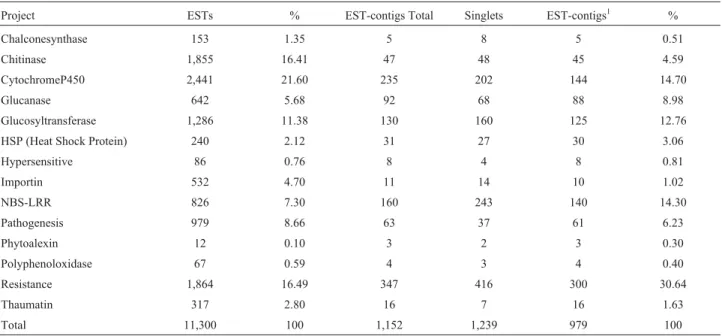
A total of 11,300 ESTs were mined and deposited in
14 projects. The projects CytochromeP450, Resistance and
Chitinase contained the highest number of ESTs, with
2,441 (21.6%), 1,864 (16.5%) and 1,855 (16.4%) ESTs,
re-spectively (Table 1). The projects with the smallest number
of ESTs were Phytoalexin, Polyphenoloxidase and
Hyper-sensitive, with 12 (0.10%), 67 (0.59%) and 86 (0.76%)
ESTs, respectively.
With the keyword NBS-LRR it was possible to form
140 EST-contigs. The LRR (Leucine-Rich Repeat) domain
participates in the interaction of the R protein with its
re-lated Avr gene product (elicitor). Sequence variability
within the interstitial leucine residues can affect ligand
binding and may confer different recognition specificities
to each Avr factor (Parniske
et al.
, 1997).
In several plant-pathogen systems, variation in the
LRR region sequence is responsible for different
tion or resistance specificities (Parniske
et al.
, 1997;
Tho-mas
et al.
, 1997; Botella
et al.
, 1998; Wang
et al.
, 1998;
Ellis
et al.
, 1999). The NBS (nucleotide binding site)
do-main is believed to participate in the activation of signal
transduction compounds, leading to pathogen-specific
re-sistance responses (Aarts
et al.
, 1998; Feys and Parker,
2000; Van Der Biezen
et al.
, 2000). Using the NBS-LRR
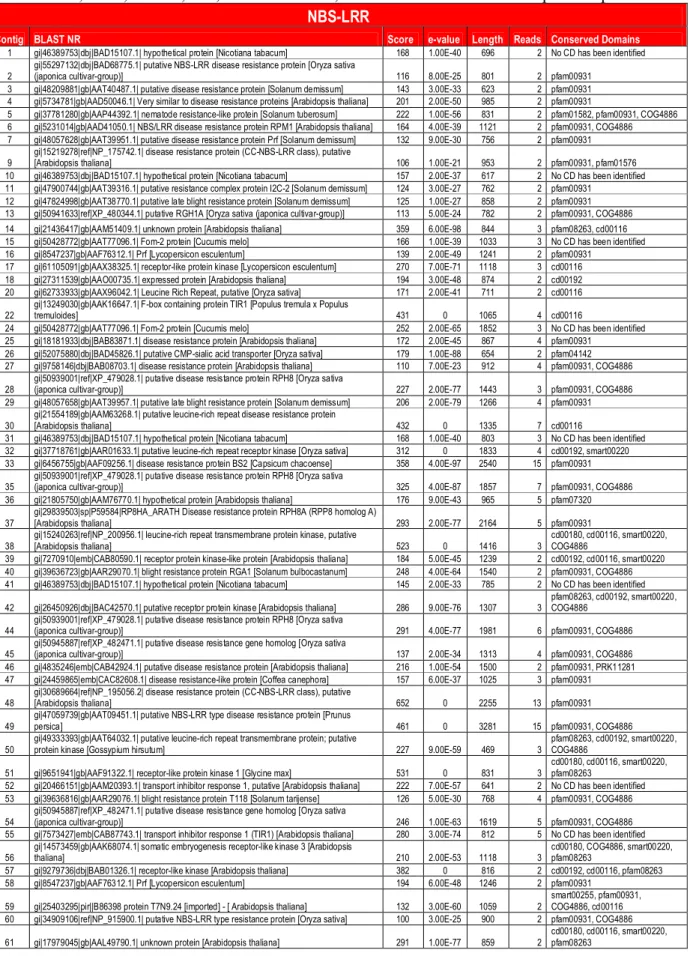
bait, EST-contigs similar to disease resistance proteins,
NBS-LRR proteins, chitinases and other proteins were
identified (Table S1). The conserved domains found in the
EST-contigs included pfam00931 (NB-ARC domain),
COG4886 (LRR protein), cd00116 (LRR_RI, leucine-rich
repeats,
ribonuclease
inhibitor
(RI)-like
subfamily),
smart00220 (S_TKc, serine/threonine protein kinases) and
pfam01582 (TIR domain).
The keyword Resistance was used as a general term
to obtain ESTs related to plant defense mechanisms and
re-sulted in the identification of 300 EST-contigs that
in-cluded several classes of disease resistance proteins, such
as CC-NBS-LRR, TIR-NBS-LRR and nematode and virus
resistance genes (Table S2). The conserved domains
ob-served in the EST-contigs included COG4886 (LRR
pro-tein), pfam00931 (NB-ARC domain) and pfam01582 (TIR
domain).
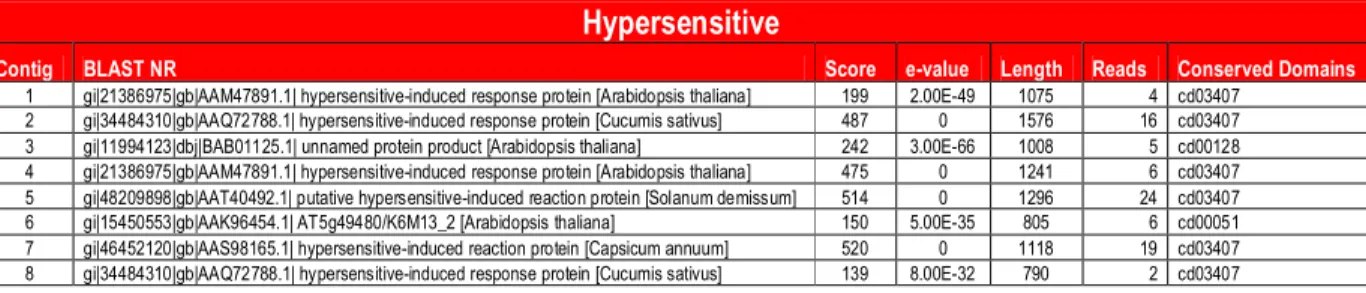
Mining with the term Hypersensitive Reaction (HR)
yielded eight EST-contigs. The HR involves an extreme
cellular response that may cause a high degree of resistance
to disease. The HR is an induced defense response that
re-sults in the death of a limited number of host cells
surround-ing the sites of pathogen infection and culminates with the
interruption of pathogen multiplication and growth on plant
tissues. The HR occurs in response to the recognition of
in-fection by the host, as a consequence of incompatibility
be-tween plant and pathogen (Pascholati and Leite, 1994). Of
the eight EST-contigs identified, six encoded proteins that
were related to the HR (Table S3).
The Pathogenesis project contained 61 EST-contigs
that included proteins related to pathogenesis, chitinases,
thaumatin family proteins and other proteins. The
con-served domains found in the EST-contigs included
cd00035 (chitin binding domain), cd00325 (chitinase glyco
hydro 19 - glycoside hydrolase family 19 chitinase domain)
and pfam00407 (pathogenesis-related protein Bet v I
fam-ily) (Table S4).
45 EST-contigs were identified with the keyword
Chitinase. Chitinases form a large group of enzymes with
diverse structures and functions, some of which are related
to the resistance of several plant species to pathogens
(Sahai and Manocha, 1993; Jackson and Taylor, 1996).
These enzymes are among the most expressed genes in
cof-fee (Lin
et al.
, 2005). In a manner functionally similar to
glucanases (see below), chitinases weaken the fungus cell
wall by hydrolyzing chitin, an N-acetylglucosamine
poly-mer. This hydrolysis results in cell lysis and death (Lin
et
al.
, 2005). Analysis of the EST-contigs identified in the
Chitinase project revealed the presence of chitinases with
several conserved domains, including pfam00704 (glyco
hydro 18), cd00035 (ChtBD1, chitin binding domain),
cd00325 (chitinase glyco hydro 19, Glycoside hydrolase
family 19 chitinase domain) and COG3469 (chitinase)
(Ta-ble S5).
The CytochromeP450 project contained 144
EST-contigs (Table S6). Cytochrome P450 is involved in
cellu-lar oxidation pathways. The proteins encoded by these
798
Mazzinghy Alvarenga
Table 1
- The number of ESTs and their relative percentages obtained by keyword data mining in 14 keyword projects, the number of clusters
(EST-contigs and singlets) formed and the number and percentage of EST-contigs with E-values < e
-20and scores > 100.
Project
ESTs
%
EST-contigs Total
Singlets
EST-contigs
1%
Chalconesynthase
153
1.35
5
8
5
0.51
Chitinase
1,855
16.41
47
48
45
4.59
CytochromeP450
2,441
21.60
235
202
144
14.70
Glucanase
642
5.68
92
68
88
8.98
Glucosyltransferase
1,286
11.38
130
160
125
12.76
HSP (Heat Shock Protein)
240
2.12
31
27
30
3.06
Hypersensitive
86
0.76
8
4
8
0.81
Importin
532
4.70
11
14
10
1.02
NBS-LRR
826
7.30
160
243
140
14.30
Pathogenesis
979
8.66
63
37
61
6.23
Phytoalexin
12
0.10
3
2
3
0.30
Polyphenoloxidase
67
0.59
4
3
4
0.40
Resistance
1,864
16.49
347
416
300
30.64
Thaumatin
317
2.80
16
7
16
1.63
Total
11,300
100
1,152
1,239
979
100
1