Fazilah Haron1,3, Yasser M. Alginahi1, Muhammad N. Kabir1 and Ali I. Mohamed2
1Department of Computer Science 2
Department of Industrial Engineering Taibah University,
Al-Madinah Al-Munawwarah, Kingdom of Saudi Arabia
3
School of Computer Sciences, Universiti Sains Malaysia,
11800 Penang, Malaysia
Abstract
Disaster preparation and management, such as emergency evacuation, is very essential for public places. This is especially true for Al-Masjid An-Nabawi which accommodates millions of Muslims around the world during Umrah and Hajj seasons. This paper describes the evaluation process carried out to determine the most suitable software for the purpose of studying the evacuation process of Al-Masjid An-Nabawi. This process starts by identifying the project requirements such as the scope and nature of the project, information and data available (e.g. floor-plan, total occupancy of the mosque), duration of the project and the budget. This is then followed by the survey on all available crowd simulation software. Assessments were carried out in terms of degree of validation, background nature of the software, the models used and features available. These were among the main criteria used in short-listing the potential software to be purchased. Observations and identifications on congestion-prone areas, as case studies, were also performed.
Keywords: Crowd simulation software, Hajj, Al-Masjid An-Nabawi, evacuation.
1. Introduction
The evacuation of people from crowded areas is a process that could involve risking the lives of people especially during emergency situations. Therefore, planning for an unexpected emergency situation is the key to people’s safety. There have been many incidents of crowd disasters in many areas around the world: in sporting events, religious gatherings, night clubs, shopping malls, festivals, schools, business offices and high-rise buildings [1][2]. For example, in New York City, Bronx, in 1990, at the illegal Happy Land Social Club, 87 people died [2]; in 2001 at Ellis Park Stadium in Johannesburg, South Africa, a stampede resulted in the death of 43 people [4]; in 1999, a fire stampede in a shopping mall in South
Korea resulted in the death of 54 people and injuring 71 [2]; in 2010 more than 349 people perished in a bridge stampede during a water festival in Cambodia [3]. Many crowd disasters have been reported during Hajj seasons in Saudi Arabia; the revolt in the Holy Mosque (Al-Masjid Al-Haram) in Makkah, in 1979, which resulted in the death of 250 people, and the Jamarat Bridge stampede incidents during the Satan stoning rituals which killed over 250 people in 2004 and a similar incident in 2006 resulted in the death of 300 people [1][2][3][4].
As mentioned above, houses of worship are no different from other public places, which could accommodate hundreds of thousands or even millions of people at one time. Al-Masjid An-Nabawi in Madinah, Saudi Arabia, is one example. The mosque (Masjid) could accommodate up to one million people during Hajj season. Hence, disaster preparation for such a place is of utmost important. The objective of this work is to evaluate the suitable crowd simulation software for evacuation purposes of Al-Masjid Al-Nabawi. The software will later be used to estimate the overall evacuation time, identify congested areas and also for corrective actions related to emergency planning.
This paper is organized as follows: section 2 provides the related work, section 3 presents the methodology used in evaluating the project requirements, section 4 discusses the results and recommendations and finally the paper concludes with section 5.
2. Related Work
Evacuation Modeling Portal [5] is one of the popular resources on the subject of evacuation. Hence, the portal has been the main reference and a starting point of this project. At the time of the writing of this paper, there were 5 articles [6-10] available at the portal, and also a table of 55 evacuation software listed in the Evacuation Model Summary Table.
The paper by Kuligowski and Gwyne [6] provided useful guidelines in assessing the general requirements of crowd modeling and simulation projects. It also shed some lights on the importance of the background knowledge of evacuation software. The authors also listed several software features to be used as evaluation criteria. Hence, we used the paper in assessing the requirements of this project. In [7], Kuligowski et al. provided a detail review of the main and special features of evacuation software. Example main features are availability, modeling method, purpose, model grid or structure, the perspective of the occupant, how the model views the entity, behavioral and movement model, fire effects, CAD drawing support, visualization and validation methods. Special features referred to software specific capabilities, for example, counter flow, groups, route choice, obstacles at exits, and others. Castle [8] also provided similar review, however, in our opinion, [7] is more comprehensive. Santos and Aguirre [9] presented a review of simulation models such as flow-based, cellular automata, agent-based and activity-based alongside three software which incorporated social aspects of occupants. However, no simulation comparison carried out on the software. Lord et. al. [10] reported a 3-year study in determining significant parameters that determine the simulation results. They based their study on STEPS and EXIT89 simulation software. However, the results were not conclusive enough. Ronchi and Kinsey [11] presented their online survey. The authors have some reservation since there exist some elements of bias in the survey. Some of the software developers made the initiative to encourage their users to participate in the survey as compared to others. The results may favor them due to the efforts. A relatively recent and useful coverage on crowd modeling and simulation can be found in [12] which provide almost all aspect of crowd study, starting from the fundamental graph of speed-density to the application of evacuation software.
3. Methodology
This section describes the method that was used in the evaluation. Kuligowski and Gwynne [6] recommended the users to look into four different factors which determine the selection of the suitable software; they are (i) project requirements, (ii) background information, (iii) software model characteristics and (iv) future considerations. In the following sections, the first three factors are investigated in the context of this project and a brief mention on the fourth is included at the end.
3.1 Project Requirements
Kuligowski and Gwynne suggested the users to consider the following four points as a guide in the selection of the appropriate software.
1. The nature and scope of the project – whether it is for offices, malls, high-rise building, airport terminals, train stations, stadium, maritime, airplane etc. The Masjid An-Nabawi is a place of worship visited by millions of Muslims from over 100 different countries with high percentage of elderly. Structurally, the mosque is a two-floor rectangular shape building, mostly carpeted, with many pillars and doors. Distinct sections separate the female from the male. However, no work or case study has been found in the literature which is similar to this work.
2. The deliverables of the project are:
(i) A review of existing software, criteria for the chosen and the short-listed software.
(ii) An analysis on the simulation scenarios in terms of required evacuation time and degree of accuracy.
(iii) A comparison in (ii) using at least two different software.
3. Information available, especially those that are needed for the simulation experiments.
o Floor plan of the mosque including details such as placement of obstacles (e.g. Zam-zam containers and Quran shelves) and dividers (e.g. women without children section from the rest). o Detail statistics of visitors - male/female, age,
nationalities, disable (e.g. wheelchair users) – all these are needed for the entity profiles.
o Information on trial evacuation (if any), this is very essential to ascertain the accuracy of the predicted evacuation time.
o Movement speed of pilgrims (which can be extracted from top-view video). We need the support from the authorities of the mosque. 4. Duration and funding of the project, in this case, is a
duration also limits the scenarios that we can actually study.
3.2 Background Research of the Software
A good understanding on the origin of the model helps user to have some idea on the credibility and reliability of the software. There are three factors to be considered:
• Constraint under which the software was developed – funding or time or the needs to improve. It is difficult to get this information, other than through the direct interactions with those in this area.
• Expertise involved in the development of the software – whether it is a PhD product (e.g., Simulex and PedGo), a team with different expertise such as mathematicians, psychologist etc.
• Validation and verification – the extent of the validation determine the confidence on the software. There are four different validation types specified in the Evacuation Model Summary Table;
(1) Validated against fire drill or people movements experiments
(2) Validated against literature (3) Validated against other model (4) Third party validation.
The software have been grouped as follow, according to the level of validation:
(i) Very extensive - Evi, Exodus and Legion have been validated against all of the above types. (ii) Extensive - Simulex and SimWalk (1,2,4),
FDS+EVAC (1,2,3), Pathfinder (1,2,3). The numbers refer to validation types, above.
(iii) Less extensive – ASERI (validation type 1, 2), EPT (1), EVACNET4/EVACNET+ (1), MASSEgress (2,3), PEDFLOW (2), STEPS (1,2), VISSIM/VISWALK (2). It is to be noted that EVACNET4/EVACNET+, MASSEgress and PEDFLOW are publicly available while STEPS can be used for free for the purpose of this project.
Preferences go to those which have gone through very extensive validation such as Evi, Exodus and Legion, followed by those that are one level below that is Simulex, Simwalk, FDS+EVAC and Pathfinder.
3.3 Model Characteristics
In this section, we provide the comparison between software in relation to the specific requirements of the project. Prior to that, the original list of software was first filtered.
3.3.1
Short Listing of the Software
The Evacuation Model Summary Table is a listing of 55 software, with each having 25 columns of general information and model features. The first step was to filter the software with incomplete information (columns that were not filled) and those which were not included in NIST (National Institute of Standards and Technology) review. A total of 28 software were removed from the original list. They are as follow:
AENEAS, BTS (Building Traffic Simulator), BUMMPEE, Cube Avenue, DBES (The Distributed Building Evacuation Simulator), E-Scape, EEscape (Emergency Escape), ELEVATE,
ELVAC, ESM, EVACSIM, EXITT,
F.A.S.T.(Floor-field and Agent-based Simulation Tool), FIRECAM, FIRETECH, Flowtech, Helios, Lisi, Magnetic Model, MASCM (Multi-agent Simulation for Crisis Management), MASSIVE Software, Micro Saint, Nomad, PedSim, SimPed, SMART Move, TSEA: Transient Simplified Egress Analysis, ZET.
The remaining list was then divided into three main categories, based on their availability:
(i) Not available
a. Consultancy use only (5) - ALLSAFE, CRISP, EGRESS, EvacuationNZ, SGEM b. Publicly available and consultation basis (5) –
Gridflow, Mass Motion, Myriad II, Paxport/PedRoute, PedGo
c. Not publicly available (1) – EXIT89
(ii) Publicly or freely available (6) – EVACNET4/EVACNET+, FDS+Evac (Fire Dynamics Simulator with Evacuation), MASSEgress, PEDFLOW, SpaceSensor and STEPS. STEPS is included here since it is available for free.
(iii) Available but require access fees (10) – ASERI, EPT (Evacuation Planning Tool), Evi, EXODUS, Legion, PathFinder, SIMULEX, SimWalk, VISSIM/VISWALK, Wayout.
Those that are accessible are under category (ii) and (iii). Therefore, in total there are 16 software that could be the candidates of this study, out of which six are freely available and ten require close evaluation for purchase. It is to be noted that the seven software in the online survey [10] falls under this 16.
with Evi, no sufficient information could be found on the software (at the time of writing of the paper).
3.3.2
Evaluation of the Main and Special Features
of the Software
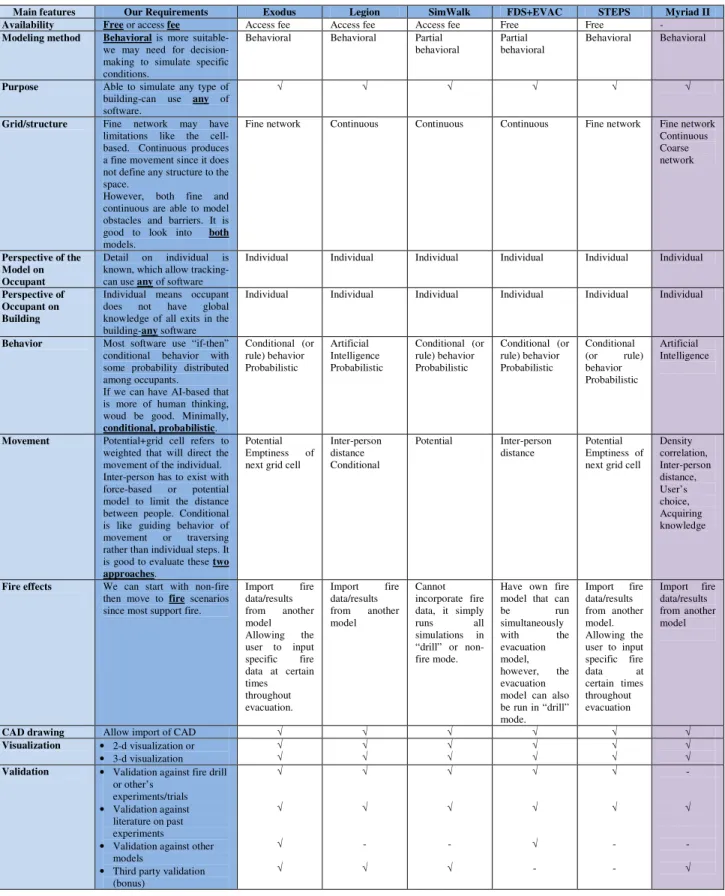
The final list of software was then evaluated; Exodus, Legion, Simwalk, FDS+EVAC and STEPS, based on the features discussed in [7]. The evaluation took into account the specific requirements of the Masjid An-Nabawi (and also Masjid Al-Haram, for future projects). Tables 1 and 2 provide the evaluation results for both, the main and special features, respectively. The second column in both tables shows the specific requirements of the mosque. Note that, Myriad II was included as a benchmark, since it was used extensively by Keith Still for many big events including the Jamarat Bridge [13].
We are interested in the following features since they have a major influence on the evacuation time:
1. Grid/structure and movements – this concern with the modeling of the space and the physical movements of a person. Coarse network for example model movements from one space/location to another, e.g. room to stairs. Fine grid divides the space into cells and individual moves to the next cell if it is empty. Continuous on the other hand make use of forces (or potential) to determine the next point of locations of a person. Some incorporate the 360 degree (a circle) surrounding a person as the minimum inter-person distance. Continuous seems to have smoother movements as compared to cell-based, therefore, as long as the emerging or resulting behaviors are similar – then it does not really matter. More important, both models must be able to simulate the effects of obstacles and barriers.
2. Behavioral vs partial-behavioral – in general human movements are not limited to physical only. As human move they think and decide on the different actions. So, behavioral would be more appealing especially those that are Artificial Intelligence-based.
It is to be noted that the Evacuation Model Summary Table (mentioned in Section 2), is based on the information provided either by NIST (derived from the literature) or developers themselves (which could reflect the software more closely or it can also be just claims). The results from the actual simulations should be the main criteria.
Another aspect is on the output (there are common metrics and also specific to individual software):
• Example metrics which are related to the
“physical” aspect of the crowd are evacuation time, walking time, density map and level of service, space utilization map, throughput map, critical time, total count passing the exits.
• Example behavioral features are inconvenience, discomfort, frustration (which are all quantified). Given time, the plan is to also use the software to simulate selected sections of the Masjid Al-Haram in Makkah, the first holy site of the Muslims. Hence, we included the special requirements of the place as well, as shown in Table 2.
4. Results and Recommendations
The following are the (partial) results based on the assessments that were carried out and also financial constraint of the project.
1. A decision was reached to purchase and use the following software for the project:
(i) BuildingEXODUS – which is a specialized software for evacuation study.
(ii) Simwalk – whose strength is in the human-like movement model and also for future work on non-emergency situations.
(iii) A freely available software such as STEPS and/or FDS+Evac, will be used as comparison.
It is to be noted that, this does not imply the chosen software are more superior. As mentioned above, the financial constraint is one of the influential factors. The final decision will very much depend on the experience gain from the simulation experiments.
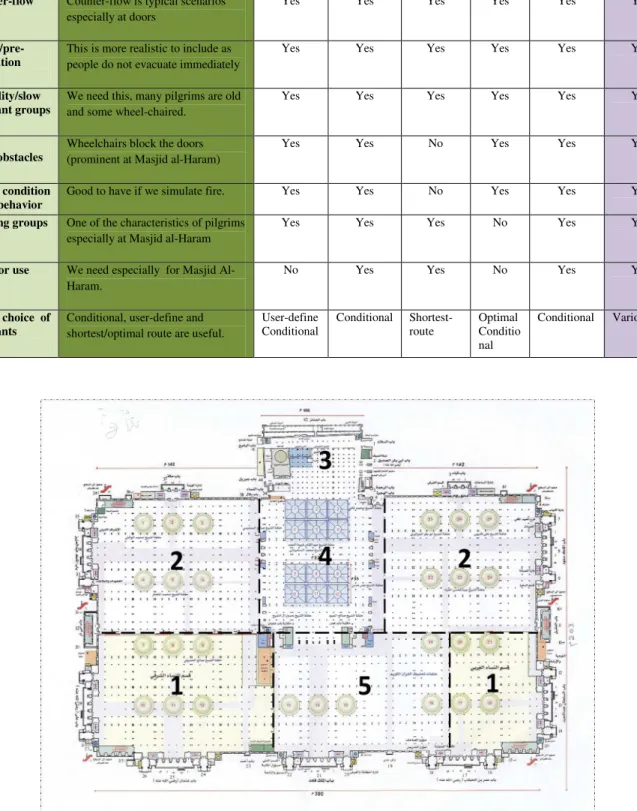
2. As for the specific simulation case studies, the mosque will be divided into 7 different areas or sections (Fig. 1). This will result in 6 different simulation scenarios, as follow:
(i) The two ladies sections (marked as 1 in Fig. 1) of the mosque are not symmetrical and two simulations should be performed.
(ii) Sections number 2 (Fig. 1) are symmetrical and one simulation could be performed.
(iii) The other two sections are the old mosque section and the central umbrella areas (number 3 and 4 in Fig. 1).
Table 1: Evaluation of Main Features of Crowd Software
Main features Our Requirements Exodus Legion SimWalk FDS+EVAC STEPS Myriad II
Availability Free or access fee Access fee Access fee Access fee Free Free -
Modeling method Behavioral is more suitable-we may need for decision-making to simulate specific conditions.
Behavioral Behavioral Partial
behavioral
Partial behavioral
Behavioral Behavioral
Purpose Able to simulate any type of
building-can use any of software.
Grid/structure Fine network may have
limitations like the cell-based. Continuous produces a fine movement since it does not define any structure to the space.
However, both fine and continuous are able to model obstacles and barriers. It is good to look into both
models.
Fine network Continuous Continuous Continuous Fine network Fine network Continuous Coarse network
Perspective of the Model on Occupant
Detail on individual is known, which allow tracking-can use any of software
Individual Individual Individual Individual Individual Individual
Perspective of Occupant on Building
Individual means occupant does not have global knowledge of all exits in the building-any software
Individual Individual Individual Individual Individual Individual
Behavior Most software use “if-then”
conditional behavior with some probability distributed among occupants.
If we can have AI-based that is more of human thinking, woud be good. Minimally,
conditional, probabilistic.
Conditional (or rule) behavior Probabilistic
Artificial Intelligence Probabilistic
Conditional (or rule) behavior Probabilistic
Conditional (or rule) behavior Probabilistic
Conditional (or rule) behavior Probabilistic
Artificial Intelligence
Movement Potential+grid cell refers to
weighted that will direct the movement of the individual. Inter-person has to exist with force-based or potential model to limit the distance between people. Conditional is like guiding behavior of movement or traversing rather than individual steps. It is good to evaluate these two approaches.
Potential Emptiness of next grid cell
Inter-person distance Conditional
Potential Inter-person distance
Potential Emptiness of next grid cell
Density correlation, Inter-person distance, User’s choice, Acquiring knowledge
Fire effects We can start with non-fire
then move to fire scenarios since most support fire.
Import fire data/results from another model Allowing the user to input specific fire data at certain times throughout evacuation.
Import fire data/results from another model
Cannot incorporate fire data, it simply
runs all
simulations in “drill” or non-fire mode.
Have own fire model that can
be run
simultaneously
with the
evacuation model, however, the evacuation model can also be run in “drill” mode.
Import fire data/results from another model. Allowing the user to input specific fire
data at
certain times throughout evacuation
Import fire data/results from another model
CAD drawing Allow import of CAD
Visualization • 2-d visualization or
• 3-d visualization
Validation • Validation against fire drill
or other’s experiments/trials • Validation against literature on past experiments • Validation against other
models
Table 2: Evaluation of Special Features of Crowd Software
Special features Our Requirement Exodus Legion SimWalk FDS+E
VAC
STEPS Myriad II
Counter-flow Counter-flow is typical scenarios especially at doors
Yes Yes Yes Yes Yes Yes
Delays/pre-evacuation times
This is more realistic to include as people do not evacuate immediately
Yes Yes Yes Yes Yes Yes
Disability/slow occupant groups
We need this, many pilgrims are old and some wheel-chaired.
Yes Yes Yes Yes Yes Yes
Exit
block/obstacles
Wheelchairs block the doors (prominent at Masjid al-Haram)
Yes Yes No Yes Yes Yes
Fire condition affect behavior
Good to have if we simulate fire. Yes Yes No Yes Yes Yes
Defining groups One of the characteristics of pilgrims especially at Masjid al-Haram
Yes Yes Yes No Yes Yes
Elevator use We need especially for Masjid Al-Haram.
No Yes Yes No Yes Yes
Route choice of occupants
Conditional, user-define and shortest/optimal route are useful.
User-define Conditional
Conditional Shortest-route
Optimal Conditio nal
Conditional Various
5. Conclusion and Future Work
The detail results of software evaluation of the main and special features of crowd software are shown in Tables 1 and 2. From this evaluation, it has been concluded that the most suitable software to be investigated for the simulation of crowd evacuation at Al-Masjid An-Nabawi are: BuildingEXODUS and SimWalk. In addition, Legion is also suitable; however, due to its high cost it was eliminated, given the limited funding of the project. The STEPS and FDS+EVAC, are free access software, which are also recommended for this case study and time permitting their results will be used to compare to those obtained from BuildingEXODUS and SimWalk.
Acknowledgments
The authors would like to acknowledge the financial support by the Deanship of Scientific Research at Taibah University, KSA, under research reference number 432/469 academic year 2011/2012, to carry out the research project entitled; “Towards More Efficient Evacuation Process at the Grand Mosque of Prophet Mohammed.”
References
[1] Hajj Disasters, Fires and Problems with the Satan Stoning Site, www.factsanddetails.com [accessed on July 15, 2012]
[2] Crowd Disasters,
http://www.safercrowds.com/CrowdDisasters.html -[accessed on July 12, 2012]
[3] CAMBODIAN STAMPEDE WORST CROWD
DISASTER IN 20 YEARS,
HTTP://WWW.TTRWEEKLY.COM/SITE/2010/11/CAM BODIAN-STAMPEDE-WORST-CROWD-DISASTER-IN-20-YEARS/, [accessed on August 1, 2012]
[4] http://mecheil.hubpages.com/hub/21st-Century-Deadliest-Stampedes-Most-Often-in-Pilgrimages-and-Festivals, [accessed on August 1, 2012]
[5] Evacuation Modeling Portal, http://www.evacmod.net/?q=node/5# [accessed on 24th December 2011]
[6] E.D. Kuligowski and S.M.V. Gwynne, "What a User Should Know When Selecting an Evacuation Model", Fire Protection Engineering, No. 3, 2005, pp. 30-40.
[7] E.D Kuligowski, R.D. Peacock and B.L. Hoskins, "A Review of Building Evacuation Models", 2nd Edition, Technical Note 1680, National Institute of Standards and Technology-Fire Research Division, 2010.
[8] C.J.E. Castle, "Guidelines for Assessing Pedestrian Evacuation Software Applications", Working Paper Series, Paper 115, Centre for Advanced Spatial Analysis, University College London, March 2007.
[9] G. Santos and B.E. Aguirre, "A Critical Review of Emergency Evacuation Simulation Models", Proceedings
of the NIST Workshop on Building Occupant Movement During Fire Emergencies, 2004.
[10] J. Lord, B. Meacham and A. Moore, "Guide for Evaluating The Predictive Capabilities of Computer Egress Models", Technical Report NIST GCR 06-886, NIST, December 2005.
[11] E. Ronchi and H.J. Kinsey, "Evacuation Models of the future: insights from an online survey of user’s experiences and needs", Advanced Research Workshop-Evacuation and Human Behaviour in Emergency Situations, Santander, Spain, 2011.
[12] A. Schadschneider, W. Klingsch, H. Klüpfel, T. Kretz, C. Rogsch and A. Seyfried, "Evacuation Dynamics: Empirical Results, Modeling and Applications", Encyclopedia of Complexity and Systems Science, 2009, pp.3142-3176. [13] Modeling the Jamarat Bridge (2001-2005),
http://www.safercrowds.com/Jamarat.html [accessed on 16th April 2012].
Fazilah Haron received her B.Sc. (in Computer Science) from the University of Wisconsin-Madison, U.S.A. and her Ph.D. (in Parallel Computing) from the University of Leeds, U.K. She is an Associate Professor at the School of Computer Sciences, Universiti Sains Malaysia, and currently on secondment at Taibah University, Madinah, Saudi Arabia. Her research interests include modeling and simulation of crowd, parallel and distributed processing, and grid computing. She has published more than 60 papers, nationally and internationally, out of which more than15 are on the research on crowd at the Masjid Al-Haram and Masjid An-Nabawi.
Yasser M. Alginahi, Senior member: IEEE, Senior member IACSIT, earned a Ph.D., in electrical engineering from the University of Windsor, Canada. Currently, he is at the Dept. of Computer Science, College of Computer Science and Engineering, Taibah University. His current research interests are Pattern Recognition (OCR, Face recognition), crowd/traffic management and e-learning technologies. He is a licensed Professional Engineer and a member of Professional Engineers Ontario, Canada (PEO). He has executed several scientific projects in the field of pattern recognition, document analysis and crowd/traffic management. He is an editorial board member of several international referred journals. He has over 30 research publications and technical reports to his credit.
Muhammad Nomani Kabir, received his PhD in Computer Science at the University of Braunschweig, Germany. He is an Assistant Professor at the Department of Computer Science, Taibah University in KSA. His research interests include issues related to numerical methods, crowd/traffic management embedded systems and combustion engines.