2011 Jan-Feb;19(1):26-33
www.eerp.usp.br/rlae
Corresponding Author: Cristiane Chaves de Souza
Universidade Federal de São João del Rei. Curso de Enfermagem. Rua Sebastião Gonçalves Coelho, 400
Bairro Chanadour
CEP: 35501-293 Divinópolis, MG, Brasil E-mail: [email protected]
Risk Classification in an Emergency Room: Agreement Level Between
a Brazilian Institutional and the Manchester Protocol
1Cristiane Chaves de Souza
2Alexandre Duarte Toledo
3Luiza Ferreira Ribeiro Tadeu
4Tânia Couto Machado Chianca
5The aim of this study was to assess the level of agreement between an institutional protocol
and the Manchester protocol for the risk assessment of patients attended in an emergency
room of a public hospital in Belo Horizonte – MG - Brazil. This is a descriptive and comparative
study, in which 382 patients’ reports were evaluated and the risk was classified, using the
institutional protocol and the Manchester protocol. Rates were calculated through weighted
and unweighted kappa, in order to determine the level of agreement between the protocols.
The results showed that the correlation between the protocols is average when considering
that classification errors occurred between neighboring colors (kappa=0.48), and good
when considering that classification errors occurred between extreme colors (kappa=0.61).
The Manchester protocol increased the patients’ level of priority of patients and has been
considered more inclusive.
Descriptors: Nursing; Emergency Medical Services; Triage.
1 Paper extracted from Master’s Dissertation “Grau de concordância da classificação de risco de usuários atendidos em um Pronto
Atendimento utilizando dois diferentes protocolos” presented to Programa de Pós-Graduação em Enfermagem, Escola de Enfermagem, Universidade Federal de Minas Gerais, MG, Brazil.
2 RN, M.Sc. in Nursing, Hospital Municipal Odilon Behrens, Belo Horizonte, MG, Brazil. E-mail: Cristiane - [email protected],
Alexandre – [email protected].
3 Nursing undergraduate student, Escola de Enfermagem, Universidade Federal de Minas Gerais, MG, Brazil. Scholarship
holder, Scholarship holder at the Fundação de Amparo à Pesquisa do Estado de Minas Gerais (FAPEMIG), MG, Brasil. E-mail: [email protected].
4 RN, Ph.D. in Nursing, Associate Professor, Escola de Enfermagem, Universidade Federal de Minas Gerais, MG, Brazil. E-mail:
Classiicação de risco em pronto-socorro: concordância entre um protocolo institucional brasileiro e Manchester
Este estudo teve por objetivo veriicar o grau de concordância entre um protocolo institucional e o protocolo de Manchester, para a classiicação de risco de pacientes
atendidos no pronto-socorro de um hospital público de Belo Horizonte, MG, Brasil. Trata-se de estudo descritivo comparativo, no qual 382 prontuários foram avaliados e realizada
a classiicação de risco, utilizando os protocolos mencionados acima, a partir do registro
realizado pelos enfermeiros. Índices Kappa ponderado e não ponderado foram calculados para determinar o grau de concordância entre os protocolos. Os resultados mostraram que a concordância entre os protocolos é média, quando considerados os erros de
classiicação, ocorridos entre cores vizinhas (Kappa=0,48) e boa, quando considerados os erros de classiicação, ocorridos entre cores extremas (Kappa=0,61). Conclui-se que
o protocolo de Manchester aumentou o nível de prioridade dos pacientes, demonstrando ser protocolo mais inclusivo.
Descritores: Enfermagem; Serviços Médicos de Emergência; Triagem.
Clasiicación de riesgo en primeros auxilios: concordancia entre un protocolo institucional brasileño y el de Manchester
Este estudio tuvo por objetivo veriicar el grado de concordancia entre un protocolo institucional y el protocolo de Manchester para la clasiicación de riesgo de pacientes
atendidos en primeros auxilios de un hospital público de Belo Horizonte – MG - Brasil.
Se trata de estudio descriptivo comparativo en el cual 382 ichas fueron evaluadas y, realizada la clasiicación de riesgo utilizando los protocolos mencionados encima, a partir
del registro realizado por los enfermeros. Índices kappa ponderado y no ponderado fueron calculados para determinar el grado de concordancia entre los protocolos. Los resultados mostraron que la concordancia entre los protocolos es media, cuando
considerados los errores de clasiicación ocurridos entre colores vecinos (kappa=0,48) y buena, cuando considerados los errores de clasiicación ocurridos entre colores extremos
(kappa=0,61). Se concluye que el protocolo de Manchester aumentó el nivel de prioridad de los pacientes, demostrando ser un protocolo que incluye más.
Descriptores: Enfermería; Servicios Médicos de Urgencia; Triaje.
Introduction
Urgency and emergency services represent an important component of Brazilian healthcare. In recent years, the demand for urgency and emergency care has increased, mainly due to the increase in the number of accidents and urban violence. The reality of overloaded Brazilian emergency care units is aggravated by organizational problems, such as attendance in order of arrival without establishing clinical criteria, which can entail severe damage for patients(1).
Aware of existing problems in the urgency area, in 2004, the Brazilian Ministry of Health launched the
National Humanization Policy Folder, in which welcoming
with assessment and risk classiication is appointed as
a device to change health care work and production,
particularly at urgency services. Risk classiication is
a dynamic process of identifying patients who need immediate treatment, according to the potential risk, health problems or degree of suffering. Care should be prioritized in line with the severity of the patient’s clinical condition, instead of the order of arrival at the service(2).
urgency services, and should follow a guiding protocol(3).
In general, the use of scales/protocols has been
recommended which rank risks in ive levels, as these
display better reliability, validity and trustworthiness levels to assess the patient’s clinical condition(4). Among
these scales/protocols, the following can be mentioned: the North American scale - “Emergency Severity Index (ESI)”; the Australian scale – “Australasian Triage Scale (ATS)”; the Canadian protocol –
“
Canadian Triage Acuity Scale (CTAS©)” and the British protocol – “ManchesterTriage System” – Manchester Protocol(5). Besides these,
other protocols have been developed, such as the protocol of Hospital Municipal Odilon Behrens – HOB - Minas Gerais, Brazil(6), which was based on preexisting
scales and protocols, using the Canadian data collection
method. The HOB was the irst hospital in Minas Gerais that put in practice risk classiication and serves as a
Brazilian reference for the use of this device.
Today, the Brazilian Ministry of Health have attempted to standardize the welcoming process with
risk classiication by adopting measures that unify this
process across the national territory(7). In this sense,
in Minas Gerais, technological modernization and the implantation of the computerized Manchester protocol
were chosen to guide risk classiication at all urgency
services in the State. In some institutions, however, especially the HOB, a protocol constructed by the hospital team was already being used.
Some authors afirm that there is no standard
protocol in health measurement(8). Measurement
demands indicators that represent a concept. There is no infallible measurement instrument. Instead, situational and environmental factors, tendentiousness in answers, personal factors and alterations in the data collection method can contribute to measurement errors(9). When
using instruments from another language, cross-cultural adaptation is needed, even when the language is the same, as problems can arise in the cultural adaptation process. In this process, some items can be changed to maintain the same concept, and there is not much clarity as to how much of the original measurement properties are maintained in the adapted instrument(10).
The clinical patient risk classiication criteria
established in both protocols (HOB and Manchester) include the priority levels and color attributed, the waiting time for medical attendance, nursing re-assessment and the method to assess the main complaint, layering the
risk in ive distinct levels which have been indicated by
colors for the sake of easier visualization. Differences
between both protocols exist, however, especially regarding waiting time for medical attendance, time for nursing re-assessment (not included in the Manchester Protocol), the method to assess the main complaint,
layered through lowcharts in the HOB Protocol and
symptoms in the Manchester Protocol. Thus, at this moment of putting in practice a new protocol to replace a preexisting one, a comparative study is needed between
the two protocols for patient classiication at urgency
and emergency units.
It is known that the Manchester Protocol is used in
many countries for patient risk classiication at emergency
and urgency services and that, before deciding on its practice at institutions in Minas Gerais state, a group of Brazilian specialists assessed the feasibility of adapting this protocol to the Brazilian reality. There is no research,
however, on differences in risk classiication results when
using the Manchester Protocol and other local protocols like the HOB. Until date, no publications were found on the validation of the Manchester Protocol in Brazil within criteria established in literature. Hence, this study was designed to verify the agreement level between the HOB
and Manchester Protocols for risk classiication of users
attended at the HOB emergency unit.
Method
This descriptive and comparative study was carried out at the HOB. The hospital is part of the Belo Horizonte municipal health network.
The study population comprised 339,133 care
forms, corresponding to all iles of patients attended
at the HOB emergency unit since Welcoming with Risk
Classiication was put in practice (September 22nd 2005)
until September 22nd 2007. Patient iles were included
when the users went through risk classiication and the iles contained records that identiied the nursing
professional who delivered care and described the
evaluation and the classiication the user received. The sample contained 382 iles. Sampling was based on simple randomization of the iles and an
electronic draft of the patient record numbers. Stat Calc, Epi Info software, version 3.4.1 was used for sample calculations. The expected minimal agreement level between the two protocols was set at 80%, with an
acceptable error margin of 5%, 95% conidence level
and 5% loss rate.
For data collection, documentation in the drafted
iles were subject to content analysis, seeking the
Souza CC, Toledo AD, Tadeu LFR, Chianca TCM.
data, previous history, age and risk classiication at the end of the assessment carried out by the nurse. The complaints were literally transcribed in a Word document, in the form of clinical cases, so that the patients’ risk
classiication could be redone according to the HOB and Manchester Protocols. The patients’ re-classiication
according to the HOB Protocol was done manually. For
the Manchester Protocol, the risk classiication software
was used with the computerized protocol. Criteria were set for comparison between the priority levels and color standard for both protocols. Thus, color red II in the HOB Protocol was considered orange, in view of existing correspondence between the priority levels in both protocols.
For data analysis, SPSS (version 17.0) and R (version 2.7.1) statistical software was used. Descriptive analysis
was carried out, and sensitivity and speciicity measures were calculated for each classiication level. The agreement level between the risk classiication according to the HOB
and Manchester protocol was measured by Cohen’s Kappa ratio. Kappa ratios between 0 and 0.20 were considered bad agreement; between 0.21 and 0.40 weak agreement, between 0.41 and 0.60 average agreement; between 0.61 and 0.80 good agreement; between 0.81 and 1 excellent
agreement. At a 95% conidence interval, the weighted
Kappa ratio was calculated to analyze general agreement between the two protocols, as well Kappa not weighted by color, in order to identify the main points of agreement and disagreement between the protocols(11). In addition,
sensitivity and speciicity ratios were calculated for each classiication level. Sensitivity ratios were calculated to evidence the probability that a user classiied at a given risk according to the HOB protocol would be classiied
at the same priority level according to the Manchester
protocol. Speciicity was used to evidence the probability that users who were not classiied at a given risk level according to the HOB protocol were not classiied at
the same risk level either when using the Manchester protocol.
To check for the existence of correlation and its strength between the patient’s age and the attributed
risk classiication level, Spearman’s non-parametric
correlation test and the linear regression analysis tests
were used, respectively. To analyze the inluence of vital data on risk classiication according to both protocols,
the Mann-Whitney test was used. The variables that
were compared were the risk classiication, using the
two protocols (ordinal categorical variable) between the
two independent groups (patient iles with complete
records of vital data and without complete records of vital data).
This research complied with National Health Council Resolution 196/96 on research involving human beings. Approval was obtained from the Research Ethics Committee at UFMG (COEP-UFMG - Opinion Etic No529/08), from the Superintendence and Research Ethics Committee at Hospital Municipal Odilon Behrens, and from the company ALERT®, which holds the copyright
of the Portuguese Screening Group for the trading and use of the Manchester Protocol.
Results
Out of 204 patients, the majority (53.4%) was female, with a mean age of 39.32 years (minimum 13 and maximum 89; median 36 and SD=17.38 years).
According to the nomenclature of the HOB protocol, a range of patient complaints is perceived, including urgent complaints related to respiratory failure, digestive hemorrhage, acute hemiparesis, severe abstinence from alcohol and drugs, convulsion and cranial trauma,
besides non-urgent complaints (lue symptoms, light
to moderate pain, vomiting and diarrhea without dehydration).
According to the Manchester protocol nomenclature, on the other hand, pain was the main patient complaint, with headache and abdominal pain corresponding to 31.5% of all complaints, followed by malaise in adults (14.0%), thoracic pain (10.8%) and limb problems (7.8%).
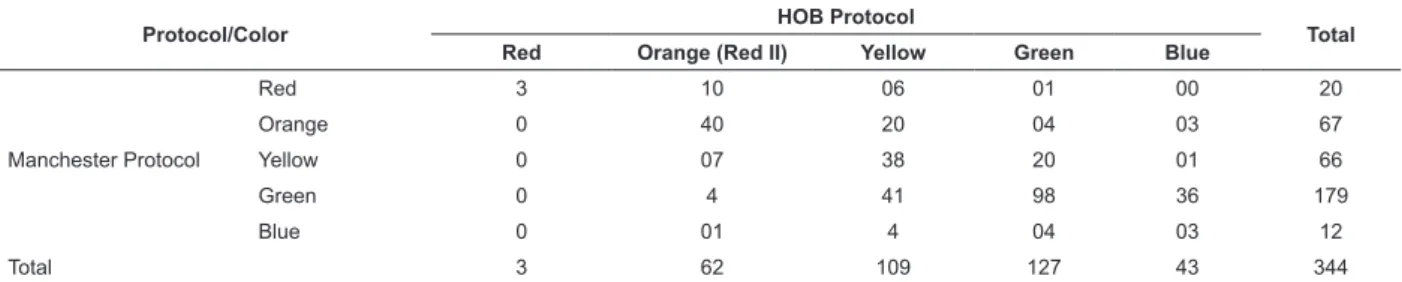
According to the study protocols, risk classiication
per color permitted an analysis of the patients’
distribution in absolute igures (Table 1).
Table 1 – Agreements and disagreements between HOB and Manchester protocols. Belo Horizonte, 2009
Protocol/Color HOB Protocol Total
Red Orange (Red II) Yellow Green Blue
Manchester Protocol
Red 3 10 06 01 00 20
Orange 0 40 20 04 03 67
Yellow 0 07 38 20 01 66
Green 0 4 41 98 36 179
Blue 0 01 4 04 03 12
Total 3 62 109 127 43 344
It should be highlighted that, in 38 cases, the
classiication could not be accomplished by both protocols, as these lowcharts contained no guiding
elements compatible with the main complaints that were described, which is why they were removed from the agreement analysis. In all cases that could not be
reclassiied, the main complaint was not well described,
with a lack of records on the start, intensity and duration of the symptoms.
To assess the general agreement level between the two protocols, the Kappa ratio with linear and squared weighting was calculated. The Kappa ratio with global linear weighting equaled 0.48, against 0.61 with squared weighting, based on which it can be inferred that the agreement level is average when considering disagreements between neighboring colors, and good when considering disagreements between extreme colors.
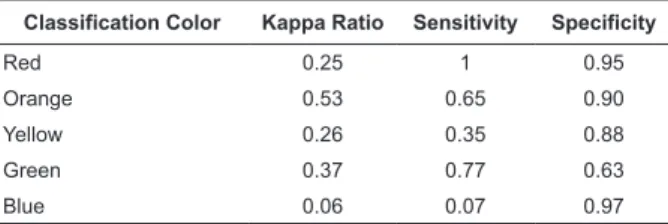
The analysis of agreement level per color (Table 2) revealed average agreement between the protocols
for patients classiied as orange (Kappa=0.53), followed by weak agreement for patients classiied as green
(Kappa=0.37), yellow (Kappa=0.26), red (kappa=0.25) and bad agreement for blue (kappa=0.06).
Classification Color Kappa Ratio Sensitivity Specificity
Red 0.25 1 0.95
Orange 0.53 0.65 0.90
Yellow 0.26 0.35 0.88
Green 0.37 0.77 0.63
Blue 0.06 0.07 0.97
Table 2 – Unweighted Kappa Ratios, sensitivity and
speciicity in each classiication color according to HOB
protocol and Manchester protocol. Belo Horizonte, 2009
Source: Patient iles attended in HOB risk classiication between Sept/05
and Sept/07.
At priority level I, represented by the color red, the agreement level was weak, although sensitivity equaled
1. This guarantees that all patients classiied as red by the HOB protocol would also be classiied as such by the Manchester protocol. In view of a 0.95 speciicity level, it can be afirmed that patients not classiied as red by the HOB protocol would not be classiied as red either by
the Manchester protocol.
In orange, the agreement level between the protocols was medium (kappa=0.53), with 65% of
patients classiied as orange by both protocols. In view of a 0.65 sensitivity level, it can be afirmed that patients classiied as orange by the HOB protocol would
also be classiied as orange by the Manchester protocol,
and that patients not classiied as orange by the HOB protocol would not be classiied as such either by the
Manchester protocol, with sensitivity equaling 0.90.
Among patients classiied as orange by both protocols,
82.5% manifested some type of pain, and “intense pain”
indings were deinitive for agreement levels on the color orange in the patients’ classiication.
In yellow, the agreement level between both protocols was weak, with kappa equaling 0.26. Among
the 109 patients classiied as yellow by the HOB protocol, only 35% were also classiied as such by the
Manchester protocol. At a low sensitivity level of 0.35,
one may say that patients classiied as yellow by the HOB protocol would also be classiied as yellow by the Manchester protocol. At a speciicity level of 0.88, patients not classiied as yellow by the HOB protocol would not be classiied as such either by the Manchester
protocol. Among patients showing agreement between
classiications, the discriminator “warm adult” was the determinant element for classiication under yellow in both protocols. The speciic discriminators “moderate
pain” (5-13.2%), “pleuritic pain” (5-13.2%) and “colic”
(3-7.9%) were also important to determine classiication
at this level.
At priority level IV (green color), the agreement level between the protocols was also weak (kappa=0.37). Out
of 127 patients classiied as green by the HOB protocol, 77% were also classiied as green by the Manchester protocol. It can be afirmed that a patient classiied as green by the HOB protocol would also be classiied as
green by the Manchester protocol (Sensitivity = 0.77)
and that a patient not classiied as green by the HOB protocol would not be classiied at this priority level either by the Manchester protocol (Speciicity = 0.63).
The agreement level on patients classiied as blue
was the lowest of all (Kappa=0.06). Out of 43 patients
classiied as blue by the HOB protocol, only 3 (7%) were classiied as such by the Manchester protocol. Therefore, for the study sample, it can be afirmed that patients not classiied as blue by the HOB protocol would not be classiied as blue by the Manchester protocol (Speciicity = 0.97), and that patients classiied as blue by the HOB protocol are also classiied as such by the Manchester
protocol (Sensitivity = 0.07).
Regarding the analysis of how age inluences risk classiication, Spearman’s non-parametric correlation test showed, at a 5% signiicance level, that age is associated with risk classiication (r=0.1; p=0.04)
Souza CC, Toledo AD, Tadeu LFR, Chianca TCM.
regression analysis showed that the strength of the association between age (predictive variable) and risk
classiication is very small and showed to be insigniicant
to change the risk level attributed in clinical practice. According to Spearman’s non-parametric correlation
test, no signiicant association was found between risk classiication according to the Manchester protocol and
the patients’ age (r=0.09 and p= 0.10).
The results of the Mann-Whitney test indicated no association between the complete recording of vital data
and the risk classiication. P-values corresponded to
0.53 and 0.30 for the HOB and Manchester protocols, respectively.
The results of the Mann-Whitney test demonstrated
a signiicant association between risk classiications according to the HOB protocol for patients whose iles
contained complete records on the main complaint in comparison with those showing incomplete data (p-value=0.002). Priority levels were higher among patients in the group with a complete description of the
main complaint assessment. No statistically signiicant association was found in the attributed risk classiication
between the group with and without complete records on the main complaint (p-value=0.94) in the risk
classiication according to the Manchester protocol.
Discussion
The main complaints the patients in this study
presented during the risk classiication conirm literature indings about emergency hospitals delivering care to
truly urgent as well as non-urgent cases. It should be highlighted, however, that the concept of urgency and emergency can differ in users and health workers’ view. The population in general cannot distinguish between urgency and emergency(12). Health professionals appoint
divergences between the health needs that make users turn to the urgency unit and the work goal at this site, revealing dissatisfaction with patients’ excessive
demands, whose needs can be classiied as urgency or
emergency(13). Thus, some authors highlight the need
for public policy strategies to enhance the eficiency and
quality of urgency services(14).
The Manchester protocol increased the percentage
of patients classiied as red, orange and green by 4.4%,
0.7% and 12%, respectively, and raised the priority
level of those classiied as blue by 10.2% in comparison with the results of the risk classiication according to the
HOB protocol. This demonstrated that the Manchester protocol was more inclusive (Table 1). A study carried
out to verify the association between classiication
according to the Manchester protocol and mortality and hospitalization rates at the urgency service showed that this protocol is a powerful tool to distinguish between patients with high and low mortality risks, as well as to distinguish between patients who will not need hospitalization and who should return home(15)
.
The analysis of the global agreement between the HOB and Manchester protocols shows a greater
probability of classiication “errors” between neighboring
colors than between extreme colors. With a view to investigating nurses’ accuracy for the risk assessment
and classiication according to the HOB protocol, a
low accuracy level was found between service nurses’
classiication and standard protocol. Total agreement or disagreement was not found at any classiication level when comparing the nurses’ classiications with the
institutional protocol(7). Reliability analysis among nurses
was assessed when using the Manchester protocol, showing a kappa ratio between 0.40 and 0.80, with a median ratio of 0.63. The Manchester protocol is a reliable instrument for use at emergency departments(16).
Based on literature indings, it can be inferred
that the intra and inter-rater agreement levels are higher when using the Manchester protocol(17). It should
be highlighted, however, that there are less studies assessing the HOB protocol than those assessing the
Manchester protocol. These indings are attributed to the classiication method inherent in each protocol. The Manchester protocol’s arrangement in guiding lowcharts facilitates nursing assessment, turning the classiication
process more secure and neutral.
The Manchester protocol increases the number of
patients classiied as red, green and blue and decreases the priority of patients classiied as orange and yellow
when compared with each priority level based on the HOB protocol. Hence, when using the Manchester protocol, a decrease is observed in the priority levels of
patients classiied under orange and yellow to green and blue. This ratiies literature indings(17).
The Manchester protocol is considered a sensitive tool to detect, at the entry door of the emergency services, patients who will need critical care. Based
on the risk classiication according to the Manchester
protocol, 67% of patients admitted to critical care areas
were classiied as red or orange. The protocol showed
defects, however, to detect the cases of patients whose clinical condition worsened after going through the
risk classiication(18). This result underlines the need to
until treatment is administered to solve their problems.
Complete records on the main complaint inluence
the risk level patients are attributed when using the HOB protocol, with higher priority levels for patients with complete records on the main complaint. Based on this
inding, it can be inferred that a complete assessment
of the main complain raises the priority level patients are attributed, underlining the importance of nursing skills and competencies for the correct and complete assessment and description of the main complaint the patient presents at the time of welcoming and risk
classiication.
Conclusion
It can be concluded that the agreement between the
protocols is average when considering the classiication
errors that occurred between neighboring colors, and
good when considering classiication errors between
extreme colors. This was proven in the analysis on the
agreement level at each classiication level, in which
most disagreements were related to neighboring higher or lower priority levels. In general, the Manchester protocol increased patients’ priority level when compared with the HOB protocol. This shows that the Manchester protocol is more inclusive.
These study results indicate that the Manchester protocol is well adapted to the HOB reality and, as it has been used in a computerized way, future research on technology use by nurses responsible for risk
classiication and validation studies of the Manchester
protocol should be carried out, as this new technology is being put in practice in Brazil, representing an area with a lack of research.
It is known that risk classiication is a relatively
new activity in Brazilian nursing activities, and that it has increasingly conquered its space. Thus, it is fundamental for schools to invest in the education of skilled professionals who can respond to market needs
in this area. For nurses working with risk classiication, skills for qualiied listening, assessment, correct and
detailed recording of the main complaint, teamwork, clinical reasoning and mental agility for decision making are essential, as well as knowledge on support systems in the care network with a view to responsible patient forwarding when necessary.
It can undoubtedly be afirmed that the use of protocols to support risk classiication offers a legal
framework for safe nursing work. It cannot be ignored, however, that this is a process of welcoming and
classifying. It is important to highlight that listening is the principle and willingness to listen the requisite to start a welcoming relation with the user, as that is the
only way to guarantee a humanized risk classiication
process, enhancing the population’s access to health
services, thus reaching the central goal of qualiied care
delivery to SUS users.
Acknowledgements
Acknowledgements to the company ALERT® for its
collaboration in the development of this study.
References
1. Ministério da Saúde (BR). Política Nacional de Atenção as Urgências. Brasília (DF): Ministério da Saúde; 2006. 2. Ministério da Saúde (BR). HumanizaSUS - acolhimento com avaliação e classificação de risco: um paradigma ético-estético no fazer em saúde. Brasília (DF): Ministério da Saúde; 2004.
3. Conselho Regional de Enfermagem de Minas Gerais. Parecer Técnico nº10, de 22 de fevereiro de 2007. Dispõe sobre a participação do enfermeiro na triagem de pacientes sem a presença de médicos especialistas. Belo Horizonte (MG): Conselho Regional de Enfermagem de Minas Gerais; 2007.
4. Goransson KE, Ehrenberg A, Marklund B, Ehnfors M. Accuracy and concordance of nurses in emergency department triage. Scand J Caring Sci. 2005;19(4):432-8.
5. Grupo de Triagem de Manchester. Triagem do serviço de urgência. 2ª ed. Portugal: BMJ Publishing; 2002. 6. Hospital Odilon Behrens. Protocolo de acolhimento com classificação de risco. Belo Horizonte (MG): Hospital Odilon Behrens; 2006
7. Toledo AD. Acurácia de enfermeiros na classificação de risco em unidade de pronto socorro de um hospital municipal de Belo Horizonte [tese de mestrado]. Belo Horizonte (MG): Escola de Enfermagem /UFMG; 2009. 138 p.
8. Mc Dowell I, Newel C. The theorical and technical foundations of health measurement. In: Mc Dowell I, Newel C. Measuring health: a guide to rating scales and questionnaires. New York (NY): Oxford University Press; 1987. p. 12-35.
9. Polit D, Hungler BP, Beck CT. Fundamentos de pesquisa em enfermagem. 5ª.ed. Porto Alegre: Artmed; 2004. 487 p.
Souza CC, Toledo AD, Tadeu LFR, Chianca TCM.
11. Landis JR, Koch GG. The measurement of observer agreement for categorical data. Biometrics. 1977;33(1):159-74.
12. Rocha AFS. Determinantes da procura de atendimento de urgência pelos usuários nas unidades de pronto atendimento da secretaria municipal de saúde de Belo Horizonte. [Dissertação]. Belo Horizonte (MG): Universidade Federal de Minas Gerais; 2005.
13. Garlet ER, Lima MADS, Santos JLG, Marques GQ. Finalidade do trabalho em urgências e emergências. Rev. Latino-Am. Enfermagem [internet]. 2009 [acesso em: 06 abril 2010];17(4):535-40. Disponível em: http://www. scielo.br/scielo.php?script=sci_arttext&pid=S0104-116 92009000400016&lng=pt&nrm=iso&tlng=pt
14. Ortiz GF, Fernández AR. Utilización del servicio de urgencias en un hospital de especialidades. Cir Cirujanos. 2000;68(4):164-8.
15. Martins HM, Cuña LM, Freitas P. Is Manchester (MTS) more than a triage system? A study of its association with mortality and admission to a large Portuguese hospital. Emerg Med J. 2009;26(3):183-6.
16. Grouse AI, Bishop RO, Bannon AM. The Manchester Triage System provides good reliability in an Australian emergency department. Emerg Med J. 2009;26(7):484-6.
17. Van Der Wulp I, Van Baar ME, Schrijvers AJ. Reliability and validity of the Manchester Triage System in a general emergency department patient population in the Netherlands: results of a simulation study. Emerg Med J. 2008;25(7):431-4.
18. Cooke MW, Jinks S. Does the Manchester triage system detect the critically ill? J Accid Emerg Med. 1999;16(3):179-81.
Received: Mar. 27th 2010