9
ABSTRACT
BACKGROUND AND OBJECTIVES:Cryotherapy is a treat-ment modality with several therapeutic efects, of low cost and easy to apply and access. his study aimed to observing whether there are changes in sensitivity according to cryotherapy applica-tion time, in addiapplica-tion to skin sensitivity behavior after treatment. METHODS: Participated in the study 21 individuals (14 fe-males and 7 fe-males, mean age 23.8±4 years) who were randomly distributed in three groups with 7 individuals each. Groups re-ceived cryotherapy application for 10, 20 or 30 minutes and were called groups C10, C20 and C30, respectively. All partici-pants were previously submitted to skin sensitivity evaluation by Semmes-Weinstein monoilament and were evaluated immedi-ately after cryotherapy application, 5, 10 and 15 minutes after application. Data were analyzed with Friedman’s test comple-mented by multiple comparisons post-test (Dunn’s post hoc). RESULTS:All individuals had hypoesthesia in the evaluation immediately after cryotherapy application. here has been signif-icant diference in sensitivity recovery of group C20 as compared to C10 and C30 10 minutes after the intervention (p=0.0498). For groups C10 and C30, sensitivity has returned 15 minutes after the end of application.
CONCLUSION: here has been lack of tactile sensitivity ive minutes after the end of application, regardless of intervention time. Normal sensitivity recovery was observed after 10 minutes when cold was applied for 20 minutes, and after 15 minutes when cold was applied for 10 or 30 minutes.
Keywords:Cryotherapy, Hypoesthesia, Pain, Tactile perception.
Influence of cryotherapy application time on skin sensitivity*
Influência do tempo de aplicação da crioterapia na sensibilidade cutânea
Odair Aparecido Gregório1, Reywerson Cavalheiro1, Rodrigo Tirelli1, Andersom Ricardo Fréz2, Marinêz Boeing Ruaro3, João
Afonso Ruaro2
*Received from the Clinic-School of Physiotherapy, Anglo-Americano University, Foz do Iguaçu, PR, Brazil.
1. Anglo-Americano University, Foz do Iguaçu, PR, Brazil. 2. State University from the Mid-West, Guarapuava, PR, Brazil. 3. Federal University of Rio Grande do Norte, Santa Cruz, RN, Brazil. Submitted in October 21, 2013.
Accepted for publication in February 10, 2014. Conlict of interests: none – Sponsoring sources: none.
Correspondence to:
João Afonso Ruaro
Rua Simeão Camargo Varela de Sá, 03 85040-080 Guarapuava, PR, Brasil. E-mail: [email protected]
© Sociedade Brasileira para o Estudo da Dor
RESUMO
JUSTIFICATIVA E OBJETIVOS: A crioterapia é uma mo-dalidade de tratamento com inúmeros efeitos terapêuticos, de baixo custo, de fácil aplicação e acesso. Os objetivos deste estudo foram veriicar se existe alteração na sensibilidade de acordo com o tempo de aplicação da crioterapia além do comportamento da sensibilidade cutânea pós-aplicação.
MÉTODOS: Vinte e um sujeitos (14 mulheres e 7 homens, idade média 23,8±4 anos) foram divididos aleatoriamente em 3 grupos, com 7 sujeitos cada, tendo recebido aplicação da criote-rapia por 10, 20 ou 30 minutos, denominados respectivamente grupos C10, C20 e C30. Todos foram previamente submetidos à avaliação da sensibilidade cutânea com monoilamento de Semmes-Weinstein, e avaliados imediatamente ao término da aplicação da crioterapia, 5, 10 e 15 minutos após a aplicação. Para análise dos dados foi utilizado o teste de Friedman comple-mentado pelo pós-teste de comparação múltipla (post hoc de Dunn).
RESULTADOS: Na avaliação imediatamente após a aplicação da crioterapia todos os sujeitos apresentaram hipoestesia. Obs-ervou-se diferença signiicativa no retorno da sensibilidade do grupo C20 em relação aos demais, após 10 minutos da interven-ção (p=0,0498). Para os grupos C10 e C30, o retorno da sensibi-lidade ocorreu após 15 minutos do término da aplicação. CONCLUSÃO:Cinco minutos depois do término da aplicação da crioterapia observou-se ausência de sensibilidade tátil, inde-pendentemente do tempo de intervenção. O retorno da sensi-bilidade normal foi observado depois de 10 minutos quando se aplicou o frio por 20 minutos, e depois de 15 minutos quando aplicado por 10 ou 30 minutos.
Descritores: Crioterapia, Dor, Hipoestesia, Percepção do tato.
INTRODUCTION
Investigating methods for pain relief is critical for the advance of science. Within this context, cryotherapy has been used for several years to treat musculoskeletal injuries for being a low cost, easy to apply and to be accessed therapeutic modality. his tech-nique aims at relieving pain and decreasing edema and sequelae related to the injury process, decreasing the area of secondary injury1-3.
Cold as therapy induces important neuromuscular changes, because cooling increases tissue rigidity, thus decreasing
tis-Rev Dor. São Paulo, 2014 jan-mar;15(1):9-12 ORIGINAL ARTICLE
10
Gregório OA, Cavalheiro R, Tirelli R, Fréz AR, Ruaro MB and Ruaro JA
Rev Dor. São Paulo, 2014 jan-mar;15(1):9-12
sue viscoelasticity4, in addition to the well-known benefits for recovery and treatment of neuromusculoskeletal system injuries5. There is also decrease in nervous impulse trans-mission velocity which gradually decreases as temperature decreases, until the moment when conduction is totally blocked3. There is increase in sensory nerve action potential duration by the increase of absolute and relative refractory periods.
As result of the association of decreased impulse transmis-sion velocity and increased threshold necessary for nervous stimulation, there might be skin sensitivity loss2,6. So, when this therapy is associated with any other needing preserved sensitivity, one may trigger skin injury or even inefficacy of the combined therapy by simple conflict of pathways7. A way to analyze these changes in skin sensitivity is by means of the esthesiometer, which consists in nylon mono-filaments with different thicknesses. Diameter and deforma-tion coefficient are predefined and when adequately applied, represent the pressure supply received by the skin (and may vary from 0.05g to 300g), thus reflecting different levels of sensitivity2.
Since cryotherapy offers the already mentioned numerous benefits, there is the need to quantify sensitization change response after application of this technique, because health professionals use some resources which require decreased sensitivity; however, in some situations, decreased sensitiv-ity exposes patients to risks. So, this study aimed at checking whether there is sensitivity change related to cryotherapy application time, in addition to checking whether time to return to normal sensitivity is related to cryotherapy appli-cation time.
METHODS
This is an experimental research, without control group, carried out in the Clinic-School of Physiotherapy, Anglo-Americano University, Foz do Iguaçu, PR. To recruit vol-unteers, investigators have invited all students of the Phys-iotherapy course of the institution, informing all research procedures.
Thirty students came for the baseline evaluation. All were again informed about research objectives and procedures and have signed the Free and Informed Consent Term accord-ing to Resolution 196/96. This evaluation has investigated whether subjects had some exclusion factors: hypersensitiv-ity to cold, Raynaud syndrome, central or peripheral neuro-logical disorder, diabetes mellitus, hanseniasis, presence of
scar or history of forearm fractures, current pharmacological treatment with analgesics and/or current physiotherapeutic treatment for upper limbs and/or cervical spine disorders. Then, sensitivity was evaluated with the subject in the su-pine position and forearm in the susu-pine position, following recommended guidelines8. Brachial biceps muscle tendon was marked with a dermatographic pencil as reference at the joint line of elbow and long palmar muscle tendon at wrist joint line.
A measuring tape was used to measure the distance between both points, dividing it in three parts. So, forearm was di-vided in three equal parts: proximal, medial and distal. A central point was marked on each of these parts. These three points were considered for sensitivity evaluation performed with Semmes-Weinstein 0.05 grams monofilament, previous gauged in a precision scale. This monofilament was selected because its weight indicates normal sensitivity2.
With the subject blindfolded, the monofilament was per-pendicularly and randomly applied twice to each point. Af-ter each application, volunteers had five seconds to verbally indicate where they felt the pressure.
Subjects with normal sensitivity were submitted to sensitiv-ity to cold test to evaluate the presence of hypersensitivsensitiv-ity. An ice cube was applied to the anterior region of forearm for 30 seconds. After ice removal, subjects were observed for five minutes looking for signs of hives which, if pres-ent, were considered research exclusion factors. In this case, volunteers would remain in observation until the disappear-ance of signs and were excluded from the study.
Six subjects were excluded for presenting reaction to the sensitivity test and three did not show up in the interven-tion day. So, sample was made up of 21 subjects who were randomly distributed in 3 groups of 7 subjects: group C10 received cryotherapy for 10 minutes; group C20 for 20 min-utes; and group C30 for 30 minutes.
The day after evaluation forearm was once more marked ac-cording to already described standards. Soon after marking, cryotherapy was applied using a gel bag, brand Chattanoo-ga, measuring 34.3x36.5 cm, at -5o C, which was applied to the forearm anterior region, according to specific times for each group. Immediately after the end of cryotherapy application, 5, 10 and 15 minutes after application, sensitiv-ity was again evaluated following the same procedure of the baseline evaluation.
For data analysis, Friedman test was used for non parametric variance analysis, complemented by multiple comparisons post-test (Dunn post hoc). Significance level was 5% for all tests. The program GraphPad Instat 3.0 was used.
This study was approved by the Ethics and Research Com-mittee, Assis Gurgacz University (CEP/FAG), opinion 350/2008.
RESULTS
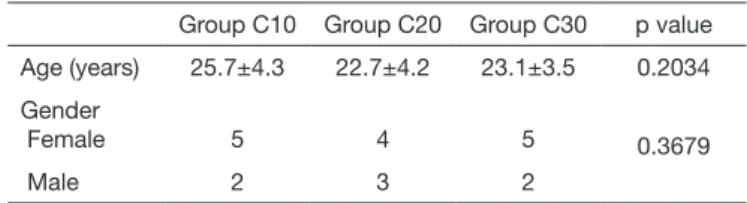
Table 1 shows sample characteristics stratified by group. There were no differences among groups.
Table 1. Sample characteristics
Group C10 Group C20 Group C30 p value Age (years) 25.7±4.3 22.7±4.2 23.1±3.5 0.2034 Gender
Female 5 4 5 0.3679
11
Inluence of cryotherapy application time on skin sensitivity Rev Dor. São Paulo, 2014 jan-mar;15(1):9-12
In the evaluation immediately after cryotherapy application, all subjects had hypoesthesia. All group C20 subjects showed sensitivity recovery 10 minutes after intervention. In groups C10 and C30 normal sensitivity for all subjects was only observed 15 minutes after application. Statistical analysis has shown significant difference (p=0.0498) in intergroup comparison 10 minutes after intervention (Table 2).
Table 2. Number of subjects stratified by group according to time to sensitivity recovery. Intergroup and intragroup analysis after cryotherapy application
Sensory recovery Group C10
Group C20
Group C30
p-value2
Immediate 0 0 0
-5 minutes 1 1 0 0.3679
10 minutes 5 7 3 0.0498*
15 minutes 7 7 7
-p-value1 0.0013* 0.0003* 0.0009*
1p-value for intragroup analysis; 2p-value for intergroup analysis; *
signifi-cant.
According to evaluations, intragroup comparisons were per-formed in the post-test. There has been significant difference in all groups when evaluation 15 minutes after cryotherapy was compared to evaluation immediately after application. Group C20 has also shown difference in the comparison be-tween evaluation 10 minutes after cryotherapy and evalua-tion immediately after, and group C30 between evaluaevalua-tion 15 minutes after cryotherapy and evaluation 5 minutes after cryotherapy (Table 3).
Table 3. Intragroup comparison according to evaluation moment after cryotherapy
Group C10 Group C20 Group C30 5 minutes vs. immediate p>0.05 p>0.05 p>0.05 10 minutes vs. immediate p>0.05 p<0.05* p>0.05
15 minutes vs. immediate p<0.05* p<0.05* p<0.05*
10 minutes vs. 5 minutes p>0.05 p>0.05 p>0.05 15 minutes vs. 5 minutes p>0.05 p>0.05 p<0.05*
15 minutes vs. 10 minutes p>0.05 p>0.05 p>0.05
*significant.
DISCUSSION
All subjects had decreased sensitivity after gel bag applica-tion, thus allowing sensitivity recovery evaluation. It is sug-gested that changes in sensitivity found in this study are consequence of neurological changes triggered by cryother-apy, because its use may lead to increased pain tolerance threshold at application site and also distally to application site9. After cold application, action potential is maintained with increased refractory period, decreasing conduction velocity. So, sensory perception is transmitted in reduced form, being associated to sensitivity changes3, that is, such changes modify pathways which capture, transform and
conduct nervous impulses, thus changing perception of the stimulation applied2.
It was expected that the group receiving cryotherapy for 10 minutes would recover sensitivity earlier as compared to re-maining groups, as well as it was expected that the group receiving intervention for 30 minutes would take longer to recover. However, differently from such assumptions, the group receiving cryotherapy for 20 minutes had the earliest sensitivity recovery, 10 minutes after cryotherapy.
Differently from these results, Carvalho & Chieritch2 state that five minutes after gel bag application one may apply a different technique requiring patients’ preserved sensitivity. Moreover, skin temperature decrease after cryotherapy lasts for at least 10 minutes and, 30 minutes after removal, tem-perature returns to normal levels10.
A factor which may influence sensitivity recovery is gender, because after cooling processes with ice packs, higher skin temperature was observed among males, fact which suggests the participation of sexual hormones in peripheral thermo-regulation control and adjustment processes11. Our study has not performed analysis by gender, however all groups were made up of males and females and have not shown dif-ferences among them (p=0.3679).
It is also known that walking after cryotherapy application accelerates sensory and motor nervous conduction recovery process12; however, in our study subjects have remained at rest after cryotherapy. In addition, cryotherapy improves the level of patients’ satisfaction as compared to other analgesic modalities13.
Our study decided for the gel bag due to practicality and availability in the service. However, according to Enwemeka et al.14, the gel bag after being placed on the skin starts to lose it tissue cooling power because there is no melting point to be overcome before heating.
As limitations to this study one may mention lack of gel bag temperature monitoring during application. In addition, there are few studies regarding tactile sensitivity evaluation after cryotherapy, which makes difficult the comparison of our research results.
CONCLUSION
Considering the experimental conditions described, there is lack of tactile sensitivity up to five minutes after the end of cryotherapy, regardless of intervention time. Normal sen-sitivity recovery can be observed 10 minutes after the end when cold is applied for 20 minutes and 15 minutes after the end of cryotherapy application for 10 or 30 minutes.
REFERENCES
1. Oliveira NM, Gava AD, Salvini TF. O efeito da crioterapia e compressão inter-mitente no músculo lesado de ratos: uma analise morfométrica. Rev Bras Fisioter. 2007;11(5):403-9.
2. Carvalho GA, Chierichetti HS. Avaliação da sensibilidade cutânea palmar nas aplicações de crioterapia por bolsa de gelo e bolsa de gel. Rev Bras Ciên Mov. 2006;14(2):23-32. 3. Knight KL. Crioterapia no tratamento das lesões esportivas. São Paulo: Manole; 2000.
12
Gregório OA, Cavalheiro R, Tirelli R, Fréz AR, Ruaro MB and Ruaro JA
Rev Dor. São Paulo, 2014 jan-mar;15(1):9-12
4. Brasileiro JS, Faria AF, Queiroz LL. Influência do resfriamento e do aqueci-mento local na flexibilidade dos músculos isquiotibiais. Rev Bras Fisioter. 2007;11(1):57-61.
5. Matheus JP, Milani JG, Gomide LB, Volpon JB, Shimano AC. Análise biomecânica dos efeitos da crioterapia no tratamento da lesão muscular aguda. Rev Bras Med Es-porte. 2008;14(4):372-5.
6. Silveira DW, Boery EM, Boery RN. Relexões acerca da crioterapia na fase aguda da atrite reumatóide e suas correlações com a crioglobulinemia. Rev Bras Fisioter. 2006;2(2):153-60.
7. Tonon SC, Souza AT. Avaliação da marcha, sensibilidade do coto e pressão plantar do pé protético na amputação bilateral. Rev Bras Fisioter. 2005;3(3):100-10.
8. Sydney PB, Conti PC. Diretrizes para avaliação somatossensorial em pacientes porta-dores de disfunção temporomandibular e dor orofacial. Rev Dor. 2011;12(4):349-53. 9. Algaly AA, George KP. he efect of cryotherapy on nerve conduction velocity, pain
threshold and pain tolerance. Br J Sports Med. 2007;41(6):365-9.
10. Carvalho AR, Medeiros DL, Souza FT, Paula GF, Barbosa PM, Vasconcellos PR, et al. Variação de temperatura do músculo quadríceps femoral exposto a duas modalidades de crioterapia por meio de termograia. Rev Bras Med Esporte. 2012;18(2):109-11. 11. Rocha WA, Facini MP, Santuzzi CH, Freitas GK, Pareira RR, Araujo MT, et al.
Di-ferenças de gênero no limiar sensitivo para estimulação elétrica nervosa em adultos jovens. Acta Ortop Bras. 2011;19(2):74-8.
12. Herrera E, Sandoval MC, Camargo DM, Salvini TF. Efect of walking and resting after three cryotherapy modalities on the recovery of sensory and motor nerve con-duction velocity in healthy subjects. Rev Bras Fisioter. 2011;15(3):233-40. 13. Abreu EA, Santos JD, Ventura PL. Analgesic efectiveness of the association of
trans-cutaneous electrical nerve stimulation and cryotherapy for chronic low back pain. Rev Dor. 2011;12(1):23-8.