263
ABSTRACT
BACKGROUND AND OBJECTIVES: Physiotherapeutic
re-sources, such as transcutaneous electric nerve stimulation, used in the post-partum period are important to promote relief of pain and discomfort induced by surgical incision, thus decreas-ing hospitalization time and hospital costs with the use of drugs. his study aimed at measuring pain at Cesarean section incision before and after transcutaneous electric nerve stimulation. METHODS: his is a clinical, randomized study with blind evaluator and comparative analysis between groups. Participated in the study 60 mothers in the postpartum period of Cesare-an section, who were equally distributed between intervention group (IG) and control group (CG), where the intervention group has received transcutaneous electric nerve stimulation for 30 minutes, with frequency of 100Hz and pulse width of 100ms. Visual analog scale was used as evaluation tool.
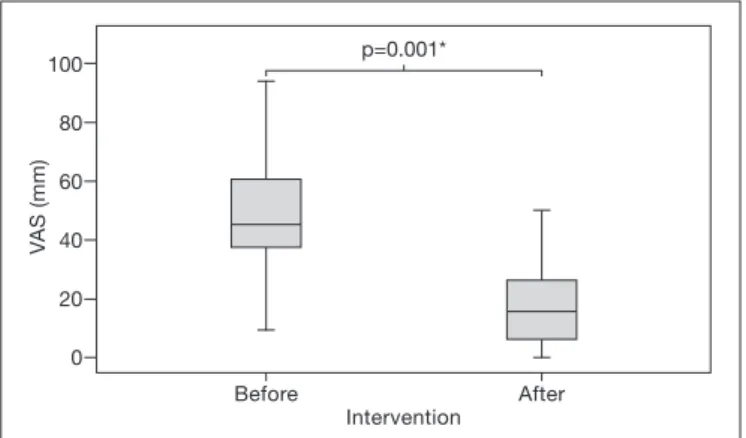
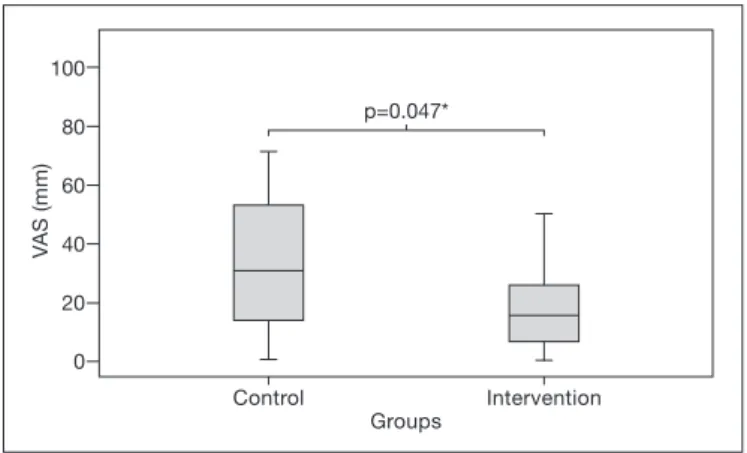
RESULTS: When comparing pain intensity with the visual an-alog scale before and after electric stimulation, there has been statistical diference (p=0.001), since pre-stimulation pain me-dian was 45.00 (36.00-60.00) and post-stimulation meme-dian was 15.50 (5.75-27.50). When comparing groups before interven-tion there has been no diference between them with regard to pain evaluated by the visual analog scale (p=0.948). Mean for CG was 47.70 (25.03) and for IG it was 48.10 (22.33). When comparing inal results between groups did not signiicant difer-ence (p=0.047), where CG median was 30.50 (13.50-53.25) and IG median was 15.50 (5.75-27.50).
CONCLUSION: Transcutaneous electric nerve stimulation is efective to relieve acute pain in the postoperative period of Ce-sarean section, thus making postpartum women more indepen-dent and active to perform their daily life activities.
Keywords: Cesarean section, Pain, Physiotherapy.
Transcutaneous electric nerve stimulation for post-Cesarean section
analgesia
Eletroestimulação nervosa transcutânea para analgesia pós-operatória em cesariana
Elaine Maria Souza Alves1, Tauanny Nazário Rabêlo1,Maria Gabriela Reis Santos1,Isadora Guimarães Souza1, Paulo Autran
Leite Lima1, Licia Santos Santana1
1. Universidade Tiradentes, Aracaju, SE, Brasil. Submitted in June 22, 2015.
Accepted for publication in October 16, 2015. Conlict of interests: none – Sponsoring sources: none.
Correspondence to: Lícia Santos Santana
Av. Bandeirantes, 3900 – Farolândia 49025-100 Aracaju, SE, Brasil. E-mail: [email protected]
© Sociedade Brasileira para o Estudo da Dor
RESUMO
JUSTIFICATIVA E OBJETIVOS: Os recursos isioterapêuti-cos como a eletroestimulação nervosa transcutânea, utilizados no período pós-parto são importantes para promover o alívio da dor e do desconforto provocados pela incisão cirúrgica reduzindo as-sim o tempo de internação e custos hospitalares com utilização de fármacos. O objetivo deste estudo foi mensurar o nível da dor na incisão da cesariana antes e após a utilização da eletroestimu-lação nervosa transcutânea.
MÉTODOS: Trata-se de um ensaio clinico randomizado, enc-oberto e análise comparativa entre os grupos. Foram avaliadas 60 puérperas em pós-cirúrgico decesariana, divididas igual-mente entre grupo intervenção(GI) e controle(GC), onde o grupo intervenção recebeu a eletroestimulação nervosa trans-cutânea durante 30 minutos, com frequência de 100Hz e lar-gura de pulso 100ms.Como forma de avaliação utilizou-se a escala analógica visual.
RESULTADOS: Ao comparar a intensidade da dor com a escala analógica visual antes e após a eletroestimulação, foi encontrada uma diferença estatística (p=0,001), uma vez que a mediana da dor pré-estimulação foi de 45,00 (36,00-60,00) e a mediana pós-estimulação foi de 15,50 (5,75-27,50). Na comparação entre os grupos pré-intervenção, veriicou-se que não havia diferença en-tre eles no que diz respeito à dor, avaliada por meio da escala analógica visual (p=0,948). No GC a média encontrada foi de 47,70 (25,03) e no GI foi de 48,10 (22,33). Ao comparar os resultados inais entre os grupos, não foi veriicada diferença signiicativa (p=0,047), onde a mediana no GC foi de 30,50 (13,50-53,25) e no GI 15,50 (5,75-27,50).
CONCLUSÃO: A eletroestimulação nervosa transcutânea foi eicaz na redução do quadro álgico de dores agudas de pós-operatório de cesariana, tornando dessa forma as puérperas mais independentes e ativas para realização de suas atividades de vida diária.
Descritores: Cesariana, Dor, Fisioterapia.
INTRODUCTION
Immediate puerperium, also called guard or postpartum pe-riod, is a puerperal gravid cycle phase starting after placental expulsion and has as major characteristic several discomforts, such as latulence, pain at C-section site, constipation, ab-dominal colic, urinary incontinence, antalgic postures and abdominal weakness due to abdominal rectum muscle
dias-Rev Dor. São Paulo, 2015 oct-dec;16(4):263-6 ORIGINAL ARTICLE
264
Alves EM, Rabêlo TN, Santos MG, Souza IG, Lima PA and Santana LS
Rev Dor. São Paulo, 2015 oct-dec;16(4):263-6
tasis and pain, being this the most frequently reported symp-tom by mothers subject to C-sections1,2.
Transcutaneous electric nerve stimulation (TENS) is a phys-iotherapeutic resource commonly used to control acute or chronic pain and acts relieving pain, by replacing or comple-menting analgesics. his resource is based on the pain gate theory, proposed by Melzack and Wallen in 1965. Accord-ing to this theory, TENS painful perception modulation is attributed to the recruitment of aferent Aβ ibers in spinal cord dorsal horn, which would prevent or make diicult the activation of thin ibers which conduct pain3,4.
In light of the above, this study is justiied to promote pa-tients’ independence for normal activities, such as changing position in bed, walking, personal hygiene without help, neo-natal care, being necessary to relieve post C-section pain with TENS, aiming at decreasing the use of drugs and consequently hospital costs, because hospitalization time may be decreased with pain improvement, generating further independence to patients. It is also relevant because it points to the need for studies on the subject, due to the scarcity observed in the area, which may contribute by enhancing knowledge about the proposed issue.
his study aimed at measuring C-section incision pain level before and after TENS and at comparing pain improvement between intervention and placebo groups by means of the vi-sual analog scale (VAS).
METHODS
he study was carried out in Maternidade Nossa Senhora de Lourdes, Aracaju, SE. Procedures were experimental, ran-domized, controlled and blind.
Study was carried out from January to March 2015. Partici-pated in the research 60 patients who were distributed in 2 groups: intervention group – IG (n=30) and control group – CG (n=30).
Inclusion criteria were age between 18 and 42 years, being in the postoperative period of C-section from 8 to 24 hours, being patients primiparous and multiparous, with pain at incision site and being admitted to the institution. Exclu-sion criteria were patients with pacemakers, in the immedi-ate postpartum period before the initial 8 hours because they would still be sedated, and those with skin injuries and/or allergies to the electrode used to apply electric stimulation5. he study was carried out by two researchers. he former was responsible for applying the resource for 30 minutes and the latter for evaluating pain before and after the procedure, be-ing the evaluator blind to the procedure. Both groups, after application of the resource, were submitted to conventional physiotherapy (guidance with regard to posture, walking and deep breath respiratory exercise)4,6-8.
Patients included in the study were addressed and invited to participate in the study, in addition to being informed about the research. After accepting and signing the Free and Informed Consent Term (FICT), the study was started with pain evaluation and quantiication by means of VAS before
and after therapy.
After applying the scale, treatment was started with con-ventional current TENS, high frequency (F=100Hz and T=100µs), intensity according to patient’s pain threshold, duration of 30 continuous minutes, 2 cm above and below incision, with electrodes transversally positioned and crossing the incision. Patients were revaluated after the session6,8,9. Materials used for TENS were conductive rubber electrodes (5.5 x 3cm) replaced every three applications, with a shallow teaspoon of aqueous conductive gel in each electrode, anti-allergic adhesive tape, portable, analog and gauged TENS IBRAMED6,10,11.
his study was approved by the Institution’s Ethics Commit-tee under CAAE: 24909813.6.0000.5371/2014.
RESULTS
Sample was made up of 60 puerperal, mean age of 27.23±5.56 years (minimum18 and maximum 42 years). In CG, mean age was 28.70±6.23 years (minimum 18 and maximum 42 years) and in IC it was 25.77±4.43 years (minimum 18 and maximum 34 years). Groups were statistically diferent in mean age (p=0.40).
Mean weight was 78.78±14.05kg for the general group. In CG mean was 76.52±15.68kg and in IG it was 81.12±11.98 kg with no diference between groups (p=0.220).
In comparing pain intensity by VAS before and after elec-tric stimulation (Figure 1) there has been statistical diference (p=0.001), since pain mean before stimulation was 45.00 (36.00-60.00) and pain mean after stimulation was 15.50 (5.75-27.50).
In comparing groups before intervention (Figure 2) there was no diference between them with regard to pain evaluated by VAS (p=0.948). Mean for CG was 47.70 (25.03) and for IG it was 48.10 (22.33). In comparing inal results between groups (Figure 3) there has been no signiicant diference (p=0.047), where CG median was 30.50 (13.50-53.25) and IG median was 15.50 (5.75=27.50).
p=0.001*
V
AS (mm)
Before After
Intervention 100
80
60
40
20
0
Figure 1. Medians and their quartiles before and after intervention VAS = visual analog scale; intervention group = Before (Md=45.00; 1st
quar-tile=36.00 and 3rd quartile=60.00); After (Md=15.50; 1st quartile= 5.75 and 3rd
265
Transcutaneous electric nerve stimulation for post-Cesarean section analgesia
Rev Dor. São Paulo, 2015 oct-dec;16(4):263-6
DISCUSSION
Our study has shown that puerperal submitted to TENS had pain decrease by VAS. Other evaluated variables were not significantly different between groups.
Authors report high perineal pain rates in the postpartum period. A study by East et al.12 has observed that approxi-mately 90% of women refer some perineal pain, being that for 33% of puerperal pain intensity is considered moderate and many patients refer that perineal pain interferes with their daily activities, especially walking or sitting, and may also impair their ability to sleep. Our data are compatible with this study.
It is necessary to control pain, since this prevents distress, provides higher satisfaction and improves quality of life of postpartum women. Within this context, electric therapy (represented by TENS) is a physiotherapeutic resource which may act in different puerperal conditions promoting analgesia, improving local blood flow, fluid drainage, mus-cle toning or relaxation and is being widely used to decrease pain related to C-section and episiotomy incisions. These
data show the importance of TENS for the early return to functionality of these women1,13,14.
A randomized study by Melo de Paula et al.15 has evalu-ated 30 women with abdominal and lower abdomen pain in the immediate postoperative period of C-sections, who were divided in groups A and B, each one with 15 women submitted, respectively, to electric stimulation and placebo (TENS turned-off ). Researchers have used conventional current TENS (F=100Hz and T=50µs) during 50 minutes after the end of the anesthetic effect. Electrode pairs were fixed close to the incision and pain intensity was classified by VAS before and after intervention. There has been signif-icant difference in pain intensity before and after TENS in group A patients (significance level of 5%) (A). These data are slightly different from our study, due to methodological differences, however they show the efficacy of TENS. With regard to TENS positioning, Knobel, Radünz and Carraro16, have evaluated whether there was influence on pain relief depending on the type of electrodes. For such, they have evaluated patients with term gestation, fixing two types of electrodes (Silver Spike Point and Plaque) and fake surface electrodes in their sacral region, since the moment of their hospital admission. Pain was evaluated by VAS before TENS, 10, 30 and 60 minutes after its application and again every 60 minutes. Their results have shown no significant differences in pain intensity when both groups with differ-ent electrodes were compared. On the other hand, there has been significant pain intensity decrease in these groups as compared to the fake electrodes group, thus showing the ef-fectiveness of TENS for pain relief. These data are compat-ible with our study.
According to Pitangui et al.10, in their study with 40 primipa-rous women who were asked about episiotomy pain through the Numeric Categorical Scale (NCS), it was observed that the group receiving TENS had lower pain intensity as com-pared to CG (p<0.01). Data emphasize the importance of evaluating puerperal pain before and after physiotherapeutic procedures, in this case TENS, to make visible the quantiica-tion of this pain relief. hese data conirm our study. According to results, there are clear benefits of high-fre-quency TENS in the postoperative period of C-section with significant pain relief and consequent better quality of life of these patients.
There were few limitations during the study period, how-ever it was difficult to convince patients due to lack of knowledge about the area, which resulted in fear of feeling even more pain, and due to difficulties in clearly and simply understanding the scale, very often caused by the lack of college education.
Further studies are suggested, with variable parameters comparing groups with low frequency and high frequency TENS.
Further studies in the area are needed for it to become a more widely used practice, since it has shown to be impor-tant and relevant for shorter hospitalization time and faster return to daily life of these women.
p=0.948*
V
AS (mm)
Control Intervention
Groups 100
80
60
40
20
0
p=0.047*
V
AS (mm)
Control Intervention
Groups 100
80
60
40
20
0
Figure 2. Medians and their quartiles before intervention
VAS = visual analog scale; control group = (Md=50.50; 1st quartile=27.50 and 3°
quartile=64.75); intervention group (Md=45.00; 1st quartile=36,00 and 3rd
quarti-le=60.00); Mann-Whitney test; *Statistical signiicance (p≤0.05).
Figure 3. Medians and their quartiles after intervention
VAS = visual analog scale; control group = (Md=30.50; 1st quartile=13.50 and 3°
quartile=53.25); intervention group (Md=15.50; 1st quartile=5.75 and 3rd
266
Alves EM, Rabêlo TN, Santos MG, Souza IG, Lima PA and Santana LS
Rev Dor. São Paulo, 2015 oct-dec;16(4):263-6
CONCLUSION
here has been pain scores decrease in both groups, howev-er with more marked decrease in the treatment group, thus showing the eicacy of TENS to decrease acute pain.
REFERENCES
1. Santana LS, Gallo RB, Marcolin AC, Quintana SM. Utilização dos recursos isioter-apêuticos no puerpério: revisão da literatura. Femina. 2011;39(5):245-50. 2. Pereira MC, Gradim CV. Consulta puerperal: a visão do enfermeiro e da puérpera.
Cienc Cuid Saude. 2014;13(1):35-42.
3. Mello LF, Nobrega LF, Lemos A. Estimulação elétrica transcutânea no alivio da dor do trabalho de parto: revisão sistemática e meta-análise. Rev Bras Fisioter. 2011;15(3):175-84.
4. Bittencourt-Shimoya W, Guiné RM, Salicio MA, Salicio VA. Avaliação da intensidade da dor no pós-operatório de pacientes submetidos à cirurgia abdominal antes e após o uso da estimulação elétrica transcutânea. UNICIÊNCIAS.2012;16(1):69-75. 5. Macarthur AJ, Macarthur C. Incidence, severity, and determinants of
peri-neal pain after vaginal delivery: a prospective cohort study. Am J Obst Gynecol.
2004;191(4):1199-204.
6. Pitangui AC, de Sousa L, Gomes FA, Ferreira CH, Nakano AM. High-frequency TENS in post-episiotomy pain relief in primiparous puerpere: a randomized, con-trolled trial. J Obstet Gynaecol Res. 2012;38(7):980-7.
7. Abreu EA, Santos JD, Ventura PL. Eicácia analgésica da associação da
eletro-estimulação nervosa transcutânea e crioterapia na lombalgia crônica. Rev Dor. 2011;12(1):23-8.
8. Beleza AC, Carvalho GP. Atuação da isioterapia no puerpério. Revista Hispeci e Lema. 2009;1:1-6. http://www.unifaibe.com.br/revistasonline/arquivos/hispecielem-aonline/sumario/12/19042010145924.pdf
9. Sell SE, Beresford PC, Dias HH, Garcia OR, Santos EK. Olhares e saberes: vivencias de puérperas e equipes de enfermagem frente à dor pós-cesariana. Texto Contexto Enferm. 2012;21(4):766-74.
10. Pitangui AC, Araújo RC, Bezerra MJ, Ribeiro CO, Nakano MA. Low and high-fre-quency TENS in post-episiotomy pain relief: randomized, double-blind clinical trial. Rev Bras Fisioter. 2014;18(1):72-8.
11. Telles ER, AmaraL VF. Estimulação elétrica transcutânea (TENS) em Ginecologia e Obstetrícia: alternativa nas síndromes dolorosas. Femina. 2007;35(11):697-702. 12. East CE, Sherburn M, Nagle C, Said J, Forster D. Perineal pain following
child-birth: prevalence, efects on postnatal recover and analgesia usage. Midwifery. 2012;28(1):93-7.
13. Oliveira RG, Silva JC, Almeida AF, Araújo RC, Pitangui AC. TENS de alta e baixa frequência para dismenorreia primária: estudo preliminar. ConScientiae Saúde. 2012;11(1):149-58.
14. Ribeiro ED, Fontoura IG, Cordeiro JR, Silva PC, Chaves RG. Hospital Regional Materno Infantil de Imperatriz, Maranhão: via de parto predominante em outubro e novembro de 2013. J Manag Prim Health Care.2014;5(2):195-201.
15. Melo de Paula G, Molinero de Paula VR, Dias RO, Mattei K. Estimulação elétri-ca nervosa transcutânea (TENS) no pós-operatório de cesariana. Rev Bras Fisioter. 2012;10(2):219-24.