Solanaceae composition, pollination and seed dispersal syndromes in
Mexican Mountain Cloud Forest
1Lidiamar Barbosa Albuquerque2,4, Alejandro Velázquez3 and Rafel Mayorga-Saucedo3
Received: February 16, 2005. Accepted: February 2, 2006
RESUMO — (Composição de Solanaceae, polinização e síndromes de dispersão de sementes em Floresta Mesófila de Montanha). Neste trabalho a hipótese é que a composição das espécies de Solanaceae e as síndromes de polinização e dispersão de sementes variam de acordo com o grau de perturbação. Assim o objetivo é analisar como a composição de espécies de Solanaceae e suas síndromes de polini-zação e de dispersão de sementes variam ao longo de um gradiente de perturbação. Este trabalho foi realizado nas Florestas Mesófilas de Hidalgo, México. As Solanaceae foram coletadas ao longo de transectos, dispostos em caminhos ou estradas secundárias. As síndromes de polinização e dispersão de sementes foram caracterizadas a partir das características morfológicas das flores e frutos. Das 500 amos-tras coletadas, 392 continham Solanaceae, pertencentes a 25 espécies. A similaridade entre as amosamos-tras mostrou dois grupos: no grupo I estavam as espécies mais freqüentemente encontradas em áreas menos perturbadas e mais úmidas, enquanto o grupo II apresentava as espécies mais freqüentes em ambientes mais perturbados. A síndrome de melitofilia foi relevante nos dois grupos. No entanto, a ornito-coria (45,8%) prevaleceu sobre a chiropteroornito-coria (37,5%) em áreas menos perturbada e mais úmida do grupo I, enquanto chiropteroornito-coria (50%) foi maior no grupo II.
Palavras-chaves: perturbação florestal, ornitocoria, chiropterocoria, melitofilia, México
ABSTRACT — (Solanaceae composition, pollination and seed dispersal syndromes in Mexican Mountain Cloud Forest). In this work we hypothesised that Solanaceae species composition and pollination and seed dispersal syndromes change according to the degree of disturbance. Hence, the aim of this study is to analyze how the species composition of Solanaceae changes along disturbance gradients of mountain cloud forest, and to establish how Solanaceae pollination and seed dispersal syndromes vary along the same gradients. The study concentrates on the mountain cloud forests in Hidalgo, Mexico. Solanaceae species collection was carried out along transects, laid out alongside paths and secondary roads. Pollination and seed dispersal syndromes for all species were recorded based on floral and fruit morphological traits. From the 500 sample units surveyed, 392 contained 25 Solanaceae species. The (dis)similarity among sample units highlighted a major division: the first group harboured species more commonly found in less disturbed and more humid conditions, whereas the second group contained species more commonly found in contrasting conditions. Melittophily pollination syndromes turned out to be equally relevant in the environmental conditions of both groups. With regard to seed dispersal syndromes, ornithochory (45.8%) prevailed over chiropterochory (37.5%) in group I less disturbed and more humid areas, whereas chiropterochory (50%) prevailed within group II.
Key words: forest disturbance, ornithochory, chiropterochory, melittophily, Mexico
Introduction
The Solanaceae family comprises 90 genera, containing more than 3,500 species (D’Arcy 1986). Its cosmopolitan distribution is best represented in tropical and temperate regions, with Australia and Latin America as major dispersal centres (Barroso et al. 1991). The greatest solanaceous species diversity occurs in South America, and this area is recognised as the family’s centre of origin (Hunziker 1979).
Solanaceous species are represented in most ha-bits: trees, shrubs, herbs and occasionally as climbers, epiphytes (Markea and Juanulloa), rhizomateous herbs (Jaborosa), and thorny (Acnistus, Grabowskia and
Solanum) and thornless (e.g. Cestrum) shrubs (Barroso
et al. 1991). Despite the worldwide distribution and diversity of the group, some taxa are restricted to par-ticular ecological conditions. For example, in Mexico
Lycianthes monziniana is distributed at elevations abo-ve 2000 m in pine-oak forests (Williams 1993), while
1 Part of a PhD thesis of the first Author (Universidade Estadual de Campinas - UNICAMP and Universidad Autonoma de México - UNAM). CAPES scholarship.
2 Universidade Católica Dom Bosco, UCDB, Campo Grande, MS, Brazil
3 Instituto de Geografía, UNAM, Aquiles Serdan, 382, Col. Centro, Morelia, Mich. C. Postal 58000, México
Albuquerque, Velázquez & Mayorga-Saucedo: Solanaceae composition, pollination and seed dispersal...
600
others such as Solanum iopetalum are present only in pine forest (Rzedowski & Rzedowski 1985). Yet others are restricted to specific geographical regions (Physalis tehuacanensis and P. queretaroensis, species endemic to Mexico). Despite the considerable work carried out with this group, little research has been conducted to document its role as a light gap coloniser and colo-niser of disturbed areas such as pastures, clearings, roadsides and forest edges (Bohs 1994; Da Silva et al. 1996; Miriti 1998; Nepstad et al. 1998; Tabarelli et al. 1999). Colonisation in open areas depends largely on pollination and seed dispersal processes (Murray
et al. 2000). These last two processes are crucial to understanding the colonisation role of Solanaceae and, in turn, to comprehending the way colonisation takes place as part of the ecosystem function (Morellato & Leitão Filho 1992; Gorchov et al. 1993; Reis et al.
1996; Medellín & Gaona 1999).
Solanaceae are well known for the large quantities and variety of secondary metabolites, such as alkaloids, flavanoids and terpenes (Evans 1986). Recently, the ecological importance of Solanum alkaloids in limiting frugivory (Cipollini & Levey 1997a; 1997b; 1997c) and as anti-fungal agents (Cipollini & Levey 1997b) has been highlighted. These features, in addition, play a role in herbivory and seed dispersal.
Pollination and seed dispersal processes have been documented within evolutionary (e.g. Herrera 1985; Hegde et al. 1991; Tamboia et al. 1996) and ecological contexts (Vázquez-Yanes et al. 1975; Symon 1979; Howe & Smallwood 1982; Gautier-Hion et al. 1985; Fleming & Sosa 1994; Galindo-González 1998). In the present paper, the pollination and seed dispersal processes of Solanaceae are studied within a matrix of forest patches.
This study was conducted in Mexican moun-tain cloud forest. The vegetation is considered to be transitional, between temperate and tropical forests (Rzedowski 1996). Furthermore, this forest has been drastically disturbed, so forest gaps and openings are common. Colonisation of these forest openings by pio-neer species (such as Solanaceae) may therefore play an important role in mountain cloud forest recovery. It has been well documented that disturbance drastically modifies species composition and community structure (Navarro 1992; Velázquez 1994). With this in mind, it is hypothesised that Solanaceae species composi-tion and, consequently, pollinacomposi-tion and seed dispersal syndromes vary according to the degree of mountain cloud forest disturbance. Among well-conserved forest patches, the diversity of syndromes may be larger and
their proportion more balanced than among disturbed forest patches, where syndromes may differ signifi-cantly. Hence, the aim of this study is to analyze how the species composition of Solanaceae changes along disturbance gradients of mountain cloud forest, and to establish how Solanaceae’s pollination and seed dispersal syndromes vary along the same gradients.
Methods
Study area — In Mexico, mountain cloud forests rea-ch their most septentrional geographical distribution worldwide. A high diversity (over 3,000 vascular plant species, of which many are endemic) and the rema-rkable predominance of vascular epiphytes and lianas (Alcantara et al. 2002) characterise these ecosystems. Their current distributions form an archipelago-like pattern and cover less than 1% of the Mexican surface (Rzedowski 1996; Luna et al. 2001). At such places, heterogeneous ecological conditions prevail (Mayorga
et al. 1998), which is reflected in large floristic and phy-siognomic dissimilarities (Rzedowski 1996). Mexican mountain cloud forests comprise dwarf, short, medium and tall forest communities, as well as evergreen and deciduous. This vegetation is subjected to large hu-man disturbances, which have formed a fragmented distribution pattern divided into a matrix of fragments of different sizes and split by trails, secondary roads, crops and pasture lands. Heliophyllous taxa prevail in early successional stages along edges of fragments, among which Solanaceae are conspicuous. These have been poorly studied since most vegetation surveys are biased to sample pristine conditions, so that Solanace-ae are rarely found. The role of these as successional facilitators, therefore, has not been documented.
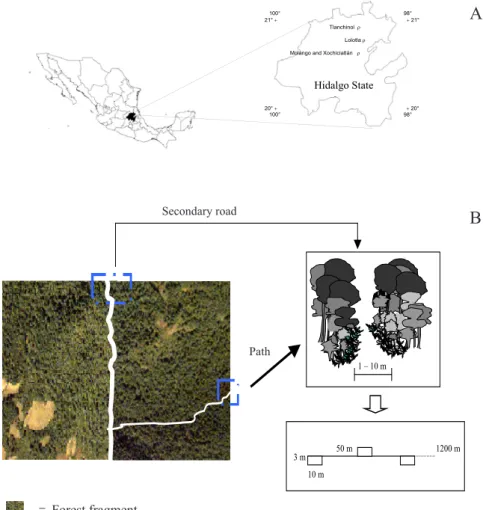
The present research was conducted in nine diffe-rent areas of Mexican mountain cloud forest located in the Sierra Madre Oriental in the state of Hidalgo (Fig. 1A), within the jurisdiction of the municipalities of Molango, Lolotla, Xochicoatlán and Tlanchinol, and surrounding localities. These areas vary in elevation from 1,380 to 1,800 m. The landscapes vary from hilly to mountainous, with large differences between one slope and another in terms of soils, relief, exposure and sunlight incidence. In turn, forest physiognomy and species composition vary too. Climbers and epiphytes and tree fern types occur regularly in some areas. Table 1 synoptically describes the (dis)similarities among the nine forests studied and provides a detailed profile of the degree of disturbance observed in all areas.
= Forest fragment
1 — 10 m
Path Secondary road
50 m 1200 m
10 m 3 m
+20° 98° 98° +21°
20°+ 100° 100° 21°+
Tlanchinolρ
Lolotlaρ
MolangoandXochiciatlánρ
Hidalgo State
A
B
Figure 1. A. Location of study area in Hidalgo State, Mexico. B. Schematic representation of a forest area, layout of transects and sampling units (10×3 m, spaced 50 m apart across sides) along secondary roads and paths.
most precipitation falling from June to September. The major landscapes are predominantly mountainous, with steep straight short slopes. Dominant soil types are Cambisol, Regosol, Acrisol and Pheozem. Apart from the vegetation type studied here, pine and subtropical rainforest fragments occur in the region. Nowadays, however, most pristine vegetation types at low altitudes and on moderately steep slopes have been cleared for cropping, livestock production and timbering (Chal-lenger 1998).
Sampling design — Intensive surveys were conducted in the region between April and November 1999 in order to select the cloud forest areas to be sampled. Two selection criteria were applied: a varying degree of disturbance, ranging from low to high, and the pre-sence of paths and secondary roads at least 2 km long (openings) crossing the areas.
The degree of disturbance was estimated by descri-bing the forest structure under the assumption the more pristine, the less disturbed (sensu Williams-Linera
1993). Species composition was also considered as an indicator of disturbance. Challenger (1998) provides a detailed list of tree species favoured by disturbance. The abundance of these disturbance indicator species, and their development status were reckoned as indirect measurements of the degree of disturbance. Traces of burning, timbering and grazing were also noted as indicators of the degree of disturbance. In addition, the type of secondary roads crossing each forest patch (for instance, those used by cars or those used by local people only) was also considered as an indirect index of the degree of disturbance (see Table 1).
Overall, nine forest areas were chosen (from different localities). Solanaceae species collection took place along transects (each 1200 m long) lying alongside paths and secondary roads. These nine forest areas were grouped into two disturbance classes, so that transect number was evenly sampled in each group. Each transect was divided into 20 sample units (10 m long and 3 m wide) 50 m apart (Fig. 1B). In total, 25
Secondary road
Path
Albuquerque, Velázquez & Mayorga-Saucedo: Solanaceae composition, pollination and seed dispersal...
602
Table 1. Synoptic characteristics of the nine forest areas (localities) surveyed in Mexican mountain cloud forest in the Sierra Madre Oriental, Hidalgo (Mexico). AMT = mean annual temperature; AMP = mean annual precipitation. Sources: 1CONABIO/ESTADIGRAFIA (1997a) and Garcia (1981); 2CONABIO/ESTADIGRAFIA (1997b); 3SSP (1983).
Forest areas (localities) Location Altitude (m) Climate1 AMT1 (ºC) AMP2 (mm) Soil type(s)3
(1) Lontla (road), Highway Pachuca-Tampico. Municipality of Tlanchinol. 21°01’34.2”N 1380 to 1450 Semi-warm humid 18-22 2500 Litosol-Feozem Pristine forest typified by a canopy 40 m high. Pteridophytes reaching up 98°38’24”W (A)C(fm)(i’)gw” Rendzina, loamy texture to 10 m high are abundant. Disturbance: one path used as a walking trail for Slope exposure: East
indigenous people only; no traces of timbering, burning and grazing. The largest area and considered the most conserved.
(2) Road to Apantlazol, Highway Pachuca-Tampico 7 km. Municipality 20°58’55”N 1450 to 1520 Semi-warm humid 18-22 2500 Litosol-Feozem-of Tlanchinol. Dense forest has a canopy 40 m high. Pteridophyte 98°37’1”W (A)C(fm)(i’)gw” Rendzina, loamy texture communities are abundant and short. Disturbance: one secondary road and Slope exposure: East
a path cross the area; traces of timbering, burning and grazing for subsistenc e purposes were observed. The second largest area and considered well conserved.
(3) Molango (road chapel, old iron mine), Highway Pachuca-Tampico 130 km. 20°46’41”N 1710 Temperate subhumid 12-18 1500 Luvisol-Cambisol, Municipality of Molango. Secondary forest characterised by a canopy 98°43’33”W C(w2) loamy texture 20 m high. Disturbance: an abandoned path used for mining purposes 50 Slope exposure: Southwest
years ago; surrounded by open pasturelands; mowing and grazing were / Northeast observed along path. No signs of recent timbering or burning were detected.
Area of relatively small size.
(4) Road to Eloxochitlán. Municipality of Molango. Remnants of secondary 20°45’04”N 1660 Mild humid, with long fresh 5-12 1500 Luvisol-Cambisol, forest with canopy 20 m high Disturbance: a secondary road frequently used 98°45’00”W summer loamy texture by trucks; surrounded by open pasturelands. Area of relatively small size. Cb’(m)(f)(1’)g
Slope exposure: North
(5) Road to Jalamelco. Municipality of Xochicoatlán. Secondary forest with 20°47’46”N 1800 Temperate humid 12-18 2000 Regosol-Cambisol-canopy 20 m high. Disturbance: one secondary road and a path crossing the 98°41’48”W C(m)(f)(e)g Acrisol, deep litic phase, area. Relatively medium-size area, considered little disturbed. Slope exposure: Northeast lime texture (6) Mo-Xo (Molango—Xochicoatlán), Highway Pachuca-Tampico 122 km. 20°44’42”N 1450 Temperate subhumid 12-18 1800 Luvisol-Cambisol, Municipality of Molango. The forest varies from dense to semi-dense, with 98°42’19”W C(w2) loamy texture trees reaching from 20 to 30 m. Disturbance: only small trails were observed; Slope exposure: Southeast
traces of timbering, grazing and burning were recorded. The size of the area is
medium.
(7) Naopa. Municipality of Lolotla. Open secondary forest with trees from 20°51’03”N 1510 Temperate humid 12-18 2000 Regosol-Cambisol-Acrisol, 10 to 20 m. Disturbance: only a secondary road surrounded by pasturelands; 98°43’22”W C(fm)(i’)gw” deep litic phase, loamy texture
traces of mowing, grazing and burning were observed. The size of the area is Slope exposure: Southwest/
relatively small. Northeast
(8) Road to Tianguistengo. Municipality of Xochicoatlán. Secondary forest 20°45’21”N 1380 to 1490 Temperate humid 12-18 1800 Regosol-Cambisol-Acrisol, with trees from 10 to 20 m. Disturbance: a secondary road heavily transited, 98°39’22”W C(m)(f)(e)g deep litic phase, loamy texture
surrounded by pasturelands; mowing, grazing and patches of orchards were Slope exposure: Southeast observed. The size of the area is relatively medium.
transects (including 500 sample units) were surveyed covering the gradient of disturbance. Each sample unit was first characterised on the basis of its environmental condition (degree of disturbance and slope exposure). Then, a complete inventory of all Solanaceae species was carried out at each sample unit. Finally, all indivi-duals per species were counted, their heights measured and their phenological status recorded.
Species composition of Solanaceae — In total, 156 plant specimens were collected in order to verify identifica-tion. All specimens were identified at species level in the Herbarium MEXU (Universidad Nacional Autóno-ma de México) and were deposited in the Herbarium of the Faculty of Sciences (FCME). Bibliographical support from Standley (1924), Standley & Williams (1973), Waterfall (1967), Hunziker (1969), Knapp (1985), Nee (1986; 1993) and Martínez & Hernan-dez (1999) was needed to achieve the identification process.
Characterisation of pollination and seed dispersal syndromes — In this research, all Solanaceae species were grouped in a pollination (sensu Faegri & Van der Pijl 1980) and a seed dispersal syndrome (sensu Van der Pijl 1972), based on morphological traits (colour, shape and size) obtained from field observations and herbarium verification. Fruit size was compiled from Waterfall (1967), Hunziker (1969), Knapp (1985), Nee (1986; 1993) and Martínez & Hernandez (1999) and was completed by field observations. Wilson et al.
(1989) and Akwood et al. (1993) alike have conducted comparative studies in other tropical and subtropical regions.
The pollination syndromes characterised in the present study were defined as follows:
a. melittophily: flowers small; white, pale or green in colour; sweet-scented; floral reward mainly pollen; b. ornithophily: bright reddish-coloured flowers; odour-less and tubular corolla; nectar as floral reward; c. sphingophily: white to pale-yellow colour of flowers; deep corolla tubes; sweet-scented; flowers open late afternoon or just after dark; nectar as floral reward.
The seed dispersal syndromes typified included the following:
d. ornithochory: fruits defined as fleshy berries with bright red, yellow, white, blue and black contrasting colours; usually small and generally without smell; e. chiropterochory: fleshy berries usually pale green, brown, yellow or black; varying in size and chiefly scented; in addition, some fruits weakly protected;
f. mammaliochory (non-flying mammals): in this study fleshy berries (with smell, inconspicuous colours, in general dropping to the ground at maturity) and fruits with seeds that have to be either protected by a hard coat or by bitter taste or toxic substances. Also fruits inaccessible for bats but likely to be consumed by terrestrial mammals such as rodents and marsupials; g. autochory: dry, dehiscent fruits (capsules). Data analysis — Field observations on Solanaceae spe-cies, their abundance and the number of individuals per area were entered in a database. First, a complete inventory was made of the species identified, together with their abundance values per sample unit. The abun-dance value (Ab) was estimated as follows: Abunabun-dance (of species x1 present in locality y1) = (total number of individuals of species x1 present in locality y1/total num-ber of individuals of all species in locality y1)100.
Species were then organised in order to detect sample units with similar species composition and the abundance values of the same species. The species were then sorted in a table to depict groups of taxa sharing similar statistical performance. The first group com-prised differential species, which included exclusive species (defined as those that differentiate one area from the others) and characteristic species (those that show a distinct maximum abundance in certain areas). The second group included constant taxa (defined as those recorded in most sample units; sensu Velázquez 1994). This allowed us to depict preliminary groups of sample units sharing comparable species composition. This suggests that these groups share similar ecological conditions (Waite 2000).
In order to quantify the species performance statistically, we used an algorithm of correspondence (TWINSPAN; Hill 1979). Five cut levels were consi-dered sufficient to detect significant differences among groups of sample units. The results were presented in a dendrogram to show the distribution of species groups. These types of multivariate techniques have been recommended for studies of this kind, in order to evenly assess the weight of all species (Terborgh & Ro-binson 1986). Correspondence analysis (TWINSPAN) performs simultaneously “R” and “Q” classification, giving equal chance to all species and sites to cluster on basis of resemblance index (Waite 2000).
Albuquerque, Velázquez & Mayorga-Saucedo: Solanaceae composition, pollination and seed dispersal...
604
Groups of species (depicting different environ-mental conditions) detected in the previous analysis were also compared on the basis of their pollination and seed dispersal syndromes. Using G tests (Sokal & Rohlf 1998), significance among group differences was measured from a contingency table (number of groups versus pollination and seed dispersal syndro-mes). A level of P<0.05 was considered as significant throughout the analysis.
Results
Species richness — A clear gradient of disturbance (Table 1) was detected among areas and was reflected in the species composition of Solanaceae. A total of 25 species of Solanaceae were identified. The species
Physalis queretaroensis, P. gracilis, P. subrepens, So-lanum rudepannum and Witheringia mexicana were
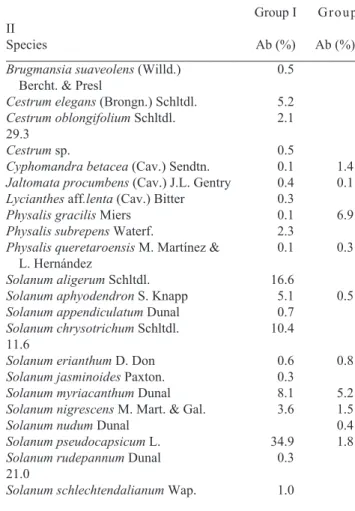
reported in the region for the first time. Abundance values per species per area are shown in Table 2. The most exclusive (stenoecious) species are found at the top (e.g. Solanum erianthum, S. rudepannum and Phy-salis gracilis), whereas constant (euryecious) species are placed at the bottom (e.g. Solanum chrysotrichum
and S. nigrescens). Characteristic species, represented by Solanumaligerum, S. pseudocapsicum and Cestrum oblongifolium, are found between exclusive and cons-tant species groups. From Table 2, we inferred that Lo-lotla and Tianguistengo shared similar environmental conditions, which is reflected in the common exclusive species (e.g. Solanum rudepannum, S. erianthum and
Physalis gracilis). However, these areas differ from Lontla and Apantlazol, where the exclusive species are
Cestrum elegans and Solanum appendiculatum. Other species such as Solanum aligerum, S. pseudocapsicum
and Cestrum oblongifolium occurred within a certain
Table 2. Species of the nine forest areas (localities) surveyed in Hidalgo (Mexico). Abundance (of species x1 present in locality y1) = (total number of individuals of species x1 present in locality y1/total number of individuals of all species in locality y1)100. (Tiangui = Tian-guistengo; Lolotla; Mo-Xo = Molango-Xochicoatlán; Apan = Apantlazol; Lontla; Molan = Molango; Eloxo = Eloxotitlán; Naopa; Jala = Jalamelco). Legend: = exclusive species; = characteristic species; = constant species.
Abundance (%)
Species Spp Tiang Lolotla Mo-Xo Apan Lontla Molan Eloxo Naopa Jala
Solanum nudum Dunal Snu 1.7
Solanum erianthum D. Don Ser 1.1 0.2 4.9
Solanum rudepannum Dunal Sru 5.1 24.4 3.2 0.4
Physalis gracilis Miers Pgr 17.6 2.9 0.7 15.4
Jaltomata procumbens (Cav.) Jal 1.1 1.1 2.6 1.9
J.L. Gentry
Brugmansia suaveolens (Willd.) Bsu 2.8 0.4 0.3 Bercht. & Presl.
Cyphomandra betacea (Cav.) Sendtner Cyb 2.1
Physalis queretaroensis M. Martínez Pqu 0.3 0.7
& Hernández
Cestrum sp. Csp 0.7 17.9
Solanum jasminoides Paxton Sja 0.7
Cestrum elegans (Brongn.) Schltdl. Cel 5.1 12.0 10.6
Solanum appendiculatum Dunal Spe 1.6 0.3
1.2
Physalis subrepens Waterf. Psu 2.6 2.0 26.7
Lycianthes aff. lenta Lyc 1.3
Witheringia mexicana (Rob.) Hunz. Wit 2.0 10.3
Solanum aligerum Schltdl. Sal 28.6 10.7 8.5 8.6
35.3
Solanum schlechtendalianum Wap. Ssc 1.7 16.7 12.0 0.6 0.3 Solanum umbellatum Mill. Sum 1.1 1.8 6.4 0.7 0.3
Cestrum oblongifolium Schltdl Cob 28.4 26.0 4.6 7.2 24.8
7.1
Solanum skutchii Corr. Ssk 5.1 0.2 0.4 5.5 10.5 2.6 3.8
Solanum pseudocapsicum L. Sps 1.7 8.8 40.6 22.7 47.6 72.5 1.0 Solanum myriacanthum Dunal Smy 0.6 9.7 3.9 13.3 0.8 2.6 11.4 4.7
range of environmental conditions, although not grou-ped in a particular set of areas.
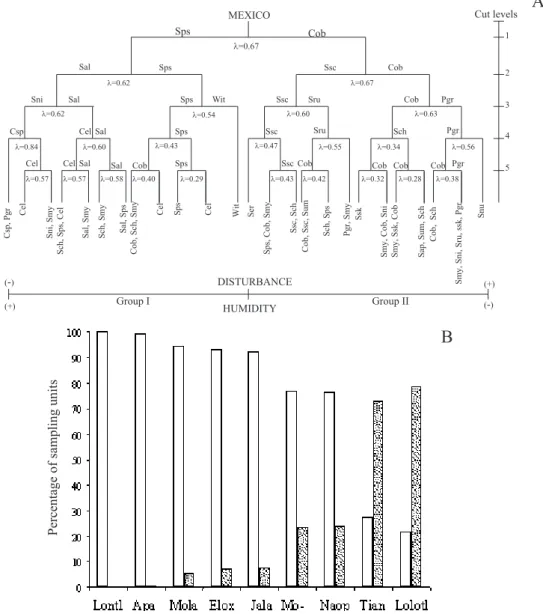
Classification and ordination — Of the 500 sample units, 392 comprised Solanaceae species; these were compared and their (dis)similarity was measured. The dendrogram (Fig. 2A) suggests a gradient from the relatively less disturbed and more humid areas, such as Lontla and Apantlazol, towards the more disturbed and less humid areas, such as Lolotla and Tianguistengo (Fig. 2B). The abundance value per species per group was recalculated in order to depict differential species representative of certain environmental conditions
(Ta-ble 3). The differential species depicting group I were
Solanum pseudocapsicum and S. aligerum, whereas those for group II were S. rudepannum and Cestrum oblongifolium (Fig. 3).
These two groups were further analysed in order to measure their (dis)similarity along environmental gra-dients. These gradients were depicted along ordination axes, which in turn allowed us to infer potential envi-ronmental attributes that best explain the distribution and abundance of Solanaceae species. The DCA results showed that those sample units forming groups I and II split significantly along axis I (l1 = 0.770;
percen-Figure 2. A. Dendrogram (obtained via TWINSPAN) showing the (dis)similarities of the species sampled in the nine Mexican mountain cloud forest fragments. Full names of differential species are given in Table 2 and Figure 4. B. Number of sampling units (expressed in percentage) per area, depicting different environmental conditions represented by group I and/or group II. Group I () = less disturbed and more humid; Group II () = more disturbed and less humid. Lontla; Apan = Apantlazol; Molan = Molango; Eloxo = Eloxotitlán; Jala = Jalamelco; Mo-Xo = Molango-Xochicoatlán; Naopa; Tiangui = Tianguistengo; Lolotla.
A
B
Albuquerque, Velázquez & Mayorga-Saucedo: Solanaceae composition, pollination and seed dispersal...
606
tage of variance explained 48%). The results showed a major division into two groups. Group I harbours species assemblages that are better distributed in less disturbed forest areas with more humid conditions than the species assemblages from group II (Fig. 4). Along axis II (l2 = 0.63; percentage of variance explained 29%), species distribution did not show clearly related environmental attributes.
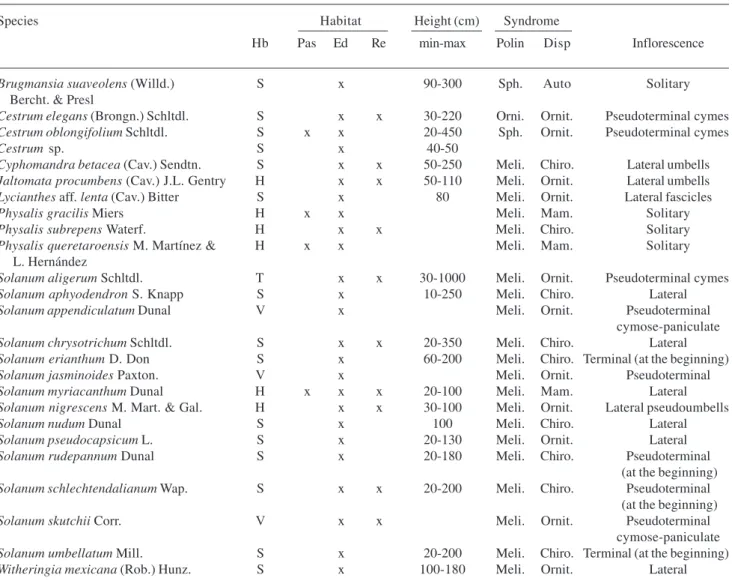
Pollination and seed dispersal — Most types of So-lanaceae habits were represented: shrub-like (60%), herb-like (24%), climber-like (12%, including both succulent and woody types) and tree-like (4%). Of these species, 84% were melittophilous (Table 4). This pollination syndrome was found to be equally impor-tant in both groups detected in the previous analysis and no substantial differences were found between groups (GI = 83.3% and GII = 93.8%), as shown in Fig. 5A. A detailed characterisation of all species into pollination and seed dispersal syndromes is given in Table 4.
Four seed dispersal syndromes were distinguished, Table 3. Relative abundance of Solanaceae species along a gradient of humidity and disturbance as indicated by groups I and II. The names of municipalities from each group are given in Figure 2B.
Group I Group II
Species Ab (%) Ab (%)
Brugmansia suaveolens (Willd.) 0.5 Bercht. & Presl
Cestrum elegans (Brongn.) Schltdl. 5.2 Cestrum oblongifolium Schltdl. 2.1 29.3
Cestrum sp. 0.5
Cyphomandra betacea (Cav.) Sendtn. 0.1 1.4 Jaltomata procumbens (Cav.) J.L. Gentry 0.4 0.1 Lycianthes aff.lenta (Cav.) Bitter 0.3
Physalis gracilis Miers 0.1 6.9 Physalis subrepens Waterf. 2.3
Physalis queretaroensis M. Martínez & 0.1 0.3 L. Hernández
Solanum aligerum Schltdl. 16.6
Solanum aphyodendron S. Knapp 5.1 0.5 Solanum appendiculatum Dunal 0.7
Solanum chrysotrichum Schltdl. 10.4 11.6
Solanum erianthum D. Don 0.6 0.8 Solanum jasminoides Paxton. 0.3
Solanum myriacanthum Dunal 8.1 5.2 Solanum nigrescens M. Mart. & Gal. 3.6 1.5
Solanum nudum Dunal 0.4
Solanum pseudocapsicum L. 34.9 1.8 Solanum rudepannum Dunal 0.3
21.0
Solanum schlechtendalianum Wap. 1.0
0 10 20 30 40
Sps Sal Cel Sap Cob Ssc Sru Pgr
Figure 3. Differential species of contrasting environmental condi-tions typified by group I and group II (Sps = Solanum pseudocap-sicum; Sal = S. aligerum; Cel = Cestrum elegans; Sap = Solanum aphyodendron; Cob = Cestrum oblongifolium; Ssc = Solanum schlechtendalianum; Sru = S. rudepannum; Pgr = Physalis graci-lis). = Group I; = Group II.
Percentage of abundance
Figure 4. Ordination diagram obtained via DCA, where Solanaceae species distribution infers relation with a gradient of disturbance. The eigenvalues suggest significant differences among species scores. The names of species are: Snu = Solanum nudum; Ser = Solanum erianthum; Sru = Solanum rudepannum; Pgr = Physalis gracilis; Jal = Jaltomata procumbens; Bsu = Brugmansia suaveo-lens; Cyb = Cyphomandra betacea; Pqu = Physalis queretaroensis; Csp = Cestrum sp; Sja = Solanum jasminoides; Cel = Cestrum elegans; Spe = Solanum appendiculatum; Psu = Physalis subre-pens; Lyc = Lycianthes aff. lenta; Wit = Witheringia mexicana; Sal = Solanum aligerum; Ssc = Solanum schlechtendalianum; Sum = Solanum umbellatum; Cob = Cestrum oblongifolium; Ssk = Solanum skutchii; Sps = Solanum pseudocapsicum; Smy = Solanum myriacanthum; Sap = Solanum aphyodendron; Sch = Solanum chrysotrichum; Sni = Solanum nigrescens.
clustered into two types: biotic (comprising three types: ornithochory, chiropterochory and mammaliochory) and abiotic one type (autochory). Overall, 44% of the species were categorised as ornithochoric. Fruits were small, varying in size from 7 to 15 mm, and of these 54.5% were red-orange, 27.3% black and 9.1% white. It was not possible to categorise the remaining 9.1%
as regards colour. Concerning the chiropterochoric species (36% of the total), fruit sizes varied from 8 to 35 mm, and 77.8% were green-yellow, 11% black, and the rest were categorised as any colour (Table 4). The mammaliochorous fruits were found at ground level and were usually coriaceous or had an expanded calyx. Comparing these syndromes between groups, it was found that in group I (less disturbed and more humid) ornithochory (45.8%) prevailed over the chi-ropterochory (33.5%) syndrome (Fig. 5B), whereas within group II, chiropterochory (50%) dominated ornithochory (31.3%). In spite of this, no significant differences were found between the syndromes of groups I and II (Gadj = 0.875 < X20,05[3] = 7.815).
Discussion
Solanaceae composition and disturbance — In the present study, the 25 Solanaceae species reported exceeded the number forecast. Other studies recently conducted in the region recorded between 12 and 20 species, representing 3.6 to 4.6% of all vascular plants in the region (Luna et al. 1994; Mayorga et al. 1998). Solanaceae therefore represent 7.5% of the vascular plants in the region, which indicates the need for more detailed inventories covering both well-conserved and disturbed areas.
Most of the Solanaceae species in the study area have predominately shrub-like (60%) and herb-like (24%) habits. These species constitute part of the un-derstory, confirming that these layers in the Mexican cloud forest are of Neotropical origin. This understory is shared with the Acanthaceae, Piperaceae, Rubiaceae, Myrsinaceae, Melastomataceae families, as well as with epiphytes and monocotyledonous taxa, coming from low elevations in the Andean region (Gentry 1982; Rzedowski 1978).
Despite the common origin, clear floristic diffe-rences in Solanaceae species were observed among the mountain cloud forest areas studied. Table 2 and Fig. 2A show that Solanaceae species were significantly split up to cut level 4, as seen from the large eigen-values (l) obtained from the classification analysis. Similar floristic patterns have been observed in other groups, so changes in composition may indicate diffe-rent environmental and ecological conditions (Luna et al. 1994; Mayorga et al. 1998). In addition to floristic differences, physiognomic discrepancies were also found among the areas. To illustrate this further, the Lontla and Apantlazol areas still retain most of their pristine character, comprising tall tree species (up to ca.
40 m in height) of Magnolia schiedeana, Liquidambar macrophylla, Podocarpus reichei, Pinus patula and
Cyathea spp.(Luna et al. 1994). The rest of the areas comprised lower tree layers (up to 30 m in height) of
Liquidambar macrophylla, Cercis canadensis, Pinus patula, Dalbergia palo escrito and Podocarpus reichei
(Mayorga et al. 1998).
Likely environmental attributes to explain So-lanaceae composition differences among areas were sought in this study. Of these, degree of disturbance was hypothesised as the major attribute governing Solanaceae species distribution. In this study, the or-dination diagram (Fig. 4) showed clear distributions of species along axis I; this was inferred to be related to the degree of disturbance. The species Solanum aligerum, S. pseudocapsicum and Cestrum elegans
were placed on the left side of the ordination diagram and are the differential species in the areas considered well conserved (Lontla and Apantlazol). In contrast,
Solanum rudepannum, S. schlechtendalianum and
Cestrum oblongifolium are the differential species in the areas categorised as largely disturbed (Lolotla and Tianguistengo) (Table 1) and these were placed on the right side of axis I. This axis, therefore, represents a clear gradient of disturbance.
It was observed that axis I (degree of disturbance) was closely related to a humidity gradient. As dis-turbance increased, relative humidity decreased, and vice versa. Disturbance (mainly man-made) favours changes in vegetation coverage and species abundance, implying microclimatic changes. Thus, more distur-bed areas receive more sunlight and wind exposure, increasing evapotranspiration (Laurance et al. 1998), so that relatively less humidity remains. This depends on slope exposure since eastern slopes receive subs-tantially more humidity than western slopes (Luna et al. 2001). In brief, both degrees of disturbance and relative humidity explain (48% of variance) the present distribution of Solanaceae in the study area. However, no attribute proved significantly correlated with axis II, so further research is recommended in order to gain insight into the current environmental attributes determining Solanaceae species distribution.
and Table 4). The prevalence of melittophily as the dominant pollination syndrome in this tropically do-minated ecosystem is similar to the results reported in the cloud forests of Michoacán (Hernández & Carreón 1987) and Sierra Madre Oriental (L.M. Godínez, data not published). This corresponds with most tropically dominated environments where 94% of all pollinators are zoophilous (Reis et al. 1996; Murray et al. 2000). In descending order, the pollination syndromes melittophily, sphingophily and ornithophily were pre-sent in all studied areas, among which no differences were observed (Fig. 5A). Similar pollinator assem-blages have been reported elsewhere for Solanaceae (Endress 1994). Pollinators, in general, may influence reproductive success by determining the percentage
of seeds set, and eventually influencing the effective size genetically (Fleming & Sosa 1994). It has been widely accepted that this kind of mutualism plays an important role in maintaining the ecosystem function (Howe & Smallwood 1982; Morellato & Leitão Filho 1992; Murray et al. 2000).
Seed dispersal syndromes — Fruit morphological traits also play an important role in defining the type of potential disperser (Van der Pijl 1972; Gautier-Hion
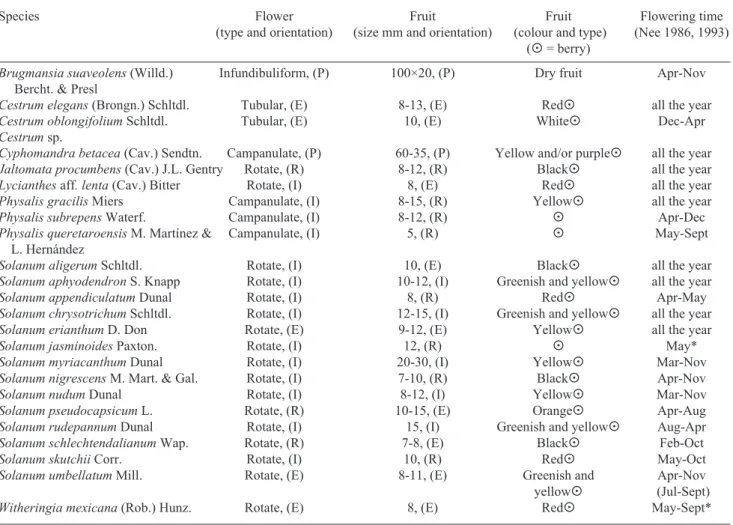
et al. 1985). Solanaceae species in the mountain cloud forest study areas were preferentially characterised as zoochorous (92%). Solanaceae fruits in this study va-ried from pendulous to erect to reflexed types; colour varied from white to red; fruits from fleshy berries to
Albuquerque, Velázquez & Mayorga-Saucedo: Solanaceae composition, pollination and seed dispersal...
608
Table 4. Morphological features of the Solanaceae species recorded in the Mexican mountain cloud forests of Hidalgo, Mexico. Hb = Habit: H = herb; S = shrub; V = vine; T = tree. Pas (pasture) = pasture edge; Ed = forest and road edges; Re = river edge. Syndromes: Meli. = Melittophily; Orni. = Ornithophily; Sph. = Sphingophily; Chiro. = Chiropterochory; Ornit. = Ornithochory; Mam. = Mammaliochory and Auto = Autochory. The asterisk (*) represents the months when the species was collected with flower and fruit during fieldwork. Flower and fruit orientation: erect (E), pendulous (P), reflexed (R), indistinct (I).
Species Habitat Height (cm) Syndrome
Hb Pas Ed Re min-max Polin Disp Inflorescence
Brugmansia suaveolens (Willd.) S x 90-300 Sph. Auto Solitary Bercht. & Presl
Cestrum elegans (Brongn.) Schltdl. S x x 30-220 Orni. Ornit. Pseudoterminal cymes Cestrum oblongifolium Schltdl. S x x 20-450 Sph. Ornit. Pseudoterminal cymes
Cestrum sp. S x 40-50
Cyphomandra betacea (Cav.) Sendtn. S x x 50-250 Meli. Chiro. Lateral umbells Jaltomata procumbens (Cav.) J.L. Gentry H x x 50-110 Meli. Ornit. Lateral umbells Lycianthes aff. lenta (Cav.) Bitter S x 80 Meli. Ornit. Lateral fascicles Physalis gracilis Miers H x x Meli. Mam. Solitary Physalis subrepens Waterf. H x x Meli. Chiro. Solitary Physalis queretaroensis M. Martínez & H x x Meli. Mam. Solitary
L. Hernández
Solanum aligerum Schltdl. T x x 30-1000 Meli. Ornit. Pseudoterminal cymes Solanum aphyodendron S. Knapp S x 10-250 Meli. Chiro. Lateral Solanum appendiculatum Dunal V x Meli. Ornit. Pseudoterminal
cymose-paniculate Solanum chrysotrichum Schltdl. S x x 20-350 Meli. Chiro. Lateral Solanum erianthum D. Don S x 60-200 Meli. Chiro. Terminal (at the beginning) Solanum jasminoides Paxton. V x Meli. Ornit. Pseudoterminal Solanum myriacanthum Dunal H x x x 20-100 Meli. Mam. Lateral Solanum nigrescens M. Mart. & Gal. H x x 30-100 Meli. Ornit. Lateral pseudoumbells Solanum nudum Dunal S x 100 Meli. Chiro. Lateral Solanum pseudocapsicum L. S x 20-130 Meli. Ornit. Lateral Solanum rudepannum Dunal S x 20-180 Meli. Chiro. Pseudoterminal
(at the beginning) Solanum schlechtendalianum Wap. S x x 20-200 Meli. Chiro. Pseudoterminal
(at the beginning) Solanum skutchii Corr. V x x Meli. Ornit. Pseudoterminal
capsules; sizes were generally small (<15 mm), as sho-wn in Table 4. Van der Pijl (1972), Charles-Dominique (1986), Janson (1992) and Korine et al. (1998) have reported similar results.
Ornithochory and chiropterochory were found to be the main seed dispersal syndromes in all areas, where equivalent proportions of each were recorded (Fig. 5B). In general, Solanaceae species (e.g. most species of Cestrum and Solanum) are well known for their strong leaf scents. This has been recognised as a major bat attraction, favouring fruit consumption and in consequence seed dispersal (Nee 1993). In our study, it was frequently observed that bats dispersed green, yellow and black fruits (e.g. Solanum rudepannum, S.
schlechtendalianum and S. aligerum) — colours with strong scents coming from their leaves.
While comparing seed dispersal syndromes among
areas, no significant differences were found (Fig. 5B). Ornithochory, however, was detected as the prevailing syndrome in the less disturbed and more humid areas represented by group I (45.8% ornithochory and 33.3% chiropterochory). Conversely, in the more disturbed and less humid areas of group II chiropterochory (50%) prevailed over ornithochory (31.3%). It has been docu-mented that a larger disturbance may be expressed as a clear dominance of chiropterochory in Solanaceae (e.g. Vázquez-Yanes et al. 1975; Fleming & Sosa 1994; Da Silva et al. 1996; Galindo-González 1998; Medellín & Gaona 1999).
This study showed that birds and bats play an important role in the distribution of Solanaceae, since these are potentially the most likely dispersers. For instance, Da Silva et al. (1996) demonstrated that ca.
40% of bird species moved some 50 to 150 m away Table 4. (continuation) Morphological features of the Solanaceae species recorded in the Mexican mountain cloud forests of Hidalgo, Mexico. Hb = Habit: H = herb; S = shrub; V = vine; T = tree. Pas (pasture) = pasture edge; Ed = forest and road edges; Re = river edge. Syndromes: Meli. = Melittophily; Orni. = Ornithophily; Sph. = Sphingophily; Chiro. = Chiropterochory; Ornit. = Ornithochory; Mam. = Mammaliochory and Auto = Autochory. The asterisk (*) represents the months when the species was collected with flower and fruit during fieldwork. Flower and fruit orientation: erect (E), pendulous (P), reflexed (R), indistinct (I).
Species Flower Fruit Fruit Flowering time
(type and orientation) (size mm and orientation) (colour and type) (Nee 1986, 1993) ( = berry)
Brugmansia suaveolens (Willd.) Infundibuliform, (P) 100×20, (P) Dry fruit Apr-Nov Bercht. & Presl
Cestrum elegans (Brongn.) Schltdl. Tubular, (E) 8-13, (E) Red all the year Cestrum oblongifolium Schltdl. Tubular, (E) 10, (E) White Dec-Apr Cestrum sp.
Cyphomandra betacea (Cav.) Sendtn. Campanulate, (P) 60-35, (P) Yellow and/or purple all the year Jaltomata procumbens (Cav.) J.L. Gentry Rotate, (R) 8-12, (R) Black all the year Lycianthes aff. lenta (Cav.) Bitter Rotate, (I) 8, (E) Red all the year Physalis gracilis Miers Campanulate, (I) 8-15, (R) Yellow all the year
Physalis subrepens Waterf. Campanulate, (I) 8-12, (R) Apr-Dec
Physalis queretaroensis M. Martínez & Campanulate, (I) 5, (R) May-Sept L. Hernández
Solanum aligerum Schltdl. Rotate, (I) 10, (E) Black all the year Solanum aphyodendron S. Knapp Rotate, (I) 10-12, (I) Greenish and yellow all the year
Solanum appendiculatum Dunal Rotate, (I) 8, (R) Red Apr-May
Solanum chrysotrichum Schltdl. Rotate, (I) 12-15, (I) Greenish and yellow all the year Solanum erianthum D. Don Rotate, (E) 9-12, (E) Yellow all the year
Solanum jasminoides Paxton. Rotate, (I) 12, (R) May*
Solanum myriacanthum Dunal Rotate, (I) 20-30, (I) Yellow Mar-Nov Solanum nigrescens M. Mart. & Gal. Rotate, (I) 7-10, (R) Black Apr-Nov
Solanum nudum Dunal Rotate, (I) 8-12, (I) Yellow Mar-Nov
Solanum pseudocapsicum L. Rotate, (R) 10-15, (E) Orange Apr-Aug Solanum rudepannum Dunal Rotate, (I) 15, (I) Greenish and yellow Aug-Apr Solanum schlechtendalianum Wap. Rotate, (R) 7-8, (E) Black Feb-Oct
Solanum skutchii Corr. Rotate, (I) 10, (R) Red May-Oct
Solanum umbellatum Mill. Rotate, (E) 8-11, (E) Greenish and Apr-Nov
yellow (Jul-Sept)
Albuquerque, Velázquez & Mayorga-Saucedo: Solanaceae composition, pollination and seed dispersal...
610
0 10 20 30 40 50 60
Chiropt. Ornitho. Mammal. Autoc. Undet.
from forest edges towards pasturelands. At these edges, a particular syndrome may be favoured and as a con-sequence colonisation may be promoted. Bats too may possibly play an important role in early successional stages, favouring the species establishment of Solana-ceae, among other families, along open areas (Willing & Gannon 1996). This is because bats usually feed on Solanaceae and other ruderal species along paths and forest edges, places considered as feeding routes.
It has been documented that zoochory (chiefly ornithochory and chiropterochory) is fundamental in favouring restoration processes in disturbed open areas such as abandoned pasturelands and roads (Bohs 1994; Da Silva et al. 1996; Miriti 1998; Nepstad et al. 1998). Frugivores diversify their diet by consuming a variety of fruits and, accordingly, spread a pool of seeds over these open areas. In consequence, seed banks are enri-ched and colonisation and regeneration favoured. This shows that Solanaceae, as a pioneer group, may play a relevant role as colonisers and therefore restoration agents, favouring the establishment of other plants and promoting soil fertility (Baider et al. 1999). The large number of habitats and reproductive strategies of Solanaceae observed in the present study confirms their ecological role as colonisers. In this process,
Solanaceae are considered as key taxa in open areas. Furthermore, Solanaceae also favour alternative fruit consumption. Once their fruits have been eaten, secon-dary compounds limit frugivory (Cipollini & Levey 1997a; 1997b; 1997c) and may promote the search for alternative food sources. The medium- and long-term consequences are that consumers eat and disperse a greater diversity of seeds as Solanaceae consumption increases, thus promoting seed-bank enrichment. These effects are yet to be researched in Neotropical solana-ceous species.
Implications for management and conservation — Angiosperms have diversified as a consequence of seed dispersal by animals (zoochory) (Tiffney 1984). It has been proved that, compared with pollination, seed dispersal doubles genetic exchange (Hamrich & Nason 1996). Hence, current landscape patterns, to a large extent determined by vegetation commu-nities (Farina 1998), ought to be influenced by seed dispersal (Sinha & Davidar 1992). To illustrate this further, recent studies highlight the lack of seeds in pasturelands compared with forest edges. Da Silva et al. (1996) mentioned that animals disperse seeds into small clearings, but seed dispersal decreases as clea-ring size increases and this retards plant succession. In addition, Tabarelli et al. (1999) found that in Atlantic forest (similar conditions to those studied here) Com-positae, Euphorbiaceae, Solanaceae and Leguminosae increased as the forest area decreased. When these taxa prevail, a good chance of re-vegetation remains (Rodrigues & Gandolfi 1996). Solanaceae flowers and fruits are available throughout the year, so this family is considered as a trigger group for successional and regeneration processes (Bohs 1994; Da Silva et al. 1996; Tabarelli et al. 1999). This is especially relevant at landscape level, where birds and bats transport So-lanaceae seeds across forest edges.
Birds and bats take an active part in the formation of seed dispersal corridors. Seed dispersal corridor can be defined as a narrow functional belt that limits forest edges, increases connectivity and functions as a route mainly for birds and bats where they spread seed pools within a mosaic. Hence, a seed dispersal corridor allows genetic flow and consequently main-tains forest dynamics. Solanaceae in particular offer floral rewards and fruits throughout the year. In the long run, these species favour landscape stability. The threshold for reaching this stage of stability in Mexi-can mountain cloud forest has yet to be ascertained. In conclusion, disturbance favours changes in vegetation coverage and species abundance, implying
A
B
Figure 5. (A) Pollination and (B) seed dispersal syndromes of So-lanaceae in the Mexican mountain cloud forest fragments studied (Chiropt. = Chiropterochory; Ornitho. = Ornithochory; Mammal. = Mammaliochory). Group I () = less disturbed and more humid; Group II () = more disturbed and less humid.
Abundance of syndromes (%)
microclimatic changes, as when the disturbance in-creased, relative humidity decreased. Therefore, the gradients of Solanaceae species’ distribution are firstly associated to the disturbance degree and, secondarily, to the humidity gradient. Within these conditions, some species can be considered as indicative of less disturbance and more humidity conditions, as Solanum aligerum, S. pseudocapsicum, Cestrum elegans, while others, for instance, Cestrum oblongifolium, Solanum rudepannum, S. schlechtendalianum are indicative of more disturbance and less humidity. However, the Solanaceae pollination syndromes are not related to the disturbance degree, but to the pattern of tropical species pollination (zoophily). In relation to seed dispersal syndromes among areas, no significant differences were found, although, ornithochory was detected as the prevailing syndrome in the less disturbed and more humid areas. On the other hand, chiropterochory prevailed over ornithochory in the more disturbed and less humid areas. Besides, the tendency that larger disturbances may be expressed as a clear dominance of chiropterochory in Solanaceae has already been documented (e.g. Vázquez-Yanes et al. 1975; Fleming & Sosa 1994; Da Silva et al. 1996; Galindo-González 1998; Medellín & Gaona 1999).
To summarise, wild Solanaceae species play a re-levant role by favouring the colonisation of open areas and, consequently, in forest regeneration processes. In addition, this group attracts wildlife by offering floral rewards and fruits throughout the year. Finally, Sola-naceae facilitates connectivity among forest patches by means of seed dispersal corridors. Their conservation is important since a large number of species provide both known and as yet unknown services for human beings. Future research along this line is therefore recommended.
Acknowledgements
We would like to thank to CAPES for the PhD scholarship awarded to the first author. UNAM (Me-xico) and UNICAMP (Brazil) provided logistic and academic support throughout the study. We would also like to acknowledge the contribution of R. Dirzo, M. Cipollini and J. Vasconcellos-Neto in improving an earlier version, as well as the editorial comments of I. Luna.
References
Akwood, M.O.; Jurado, E.; Leishman, M. & Westoby, M. 1993. Geographic ranges of plant species in relation to dispersal
morphology, growth form and diaspore weight. Journal of
Biogeography 20: 563-572.
Alcantara, O.; Luna I. & Velázquez, A. 2002. Distribution patterns of Mexican cloud forests based upon preferential
characteristic genera. Plant Ecology161: 167-174.
Baider, C.; Tabarelli, M. & Mantovani, W. 1999. O banco de sementes de um trecho de floresta atlântica montana
(São Paulo, Brasil). Revista Brasileira de Biología59(2):
319-328.
Barroso, G.M.; Peixoto, A.L.; Ichaso, C.L.F.; Costa, C.G.;
Guimarães, E.F. & Lima, H.C. 1991. Sistemática de
An-giospermas do Brasil. v.3. Viçosa, Universidade Federal
de Viçosa.
Bohs, L. 1994. Flora Neotropica. Monograph 63:
Cypho-mandra (Solanaceae). New York, The New York Botanical
Garden.
Challenger, A. 1998. Utilización y conservación de los
ecosis-temas terrestres de México: pasado, presente y futuro.
Mexico, Comisión Nacional para el Conocimiento y Uso de la Biodiversidad.
Charles-Dominique, P. 1986. Inter-relations between
frugi-vorous vertebrates and pioneer plants: Cecropia, birds
and bats in French Guinea. Pp. 119-135. In: A. Estrada &
T.H. Fleming (eds.). Frugivory and seed dispersal. Junk,
Dordrecht.
Cipollini, M. & Levey, D.J. 1997a. Why are some fruits toxic?
Glycoalkaloids in Solanum and fruit choice by vertebrates.
Ecology78: 782-798.
Cipollini, M. & Levey, D.J. 1997b. Antifungal activity of
So-lanum fruit glycoalkaloids: implications for frugivory and
seed dispersal. Ecology78:799-809.
Cipollini, M. & Levey, D.J. 1997c. Secondary metabolites of fleshy vertebrate-dispersed fruits: adaptive hypotheses
and implications for seed dispersal. American Naturalist
150: 346-372.
Conabio & Estadigrafia. 1997a. Carta de climas México.
Sistema de Köppen modificado por E. García. Escala
1:1,000,000.Mexico, CONABIO/ESTADIGRAFIA.
Conabio & Estadigrafia. 1997b. Mapas de Clima:
precipita-ción total annual México. Escala 1:1,000,000.Mexico,
CONABIO/ESTADIGRAFIA.
Dafni, A. & Kevan, P.G. 1997. Flower size and shape:
impli-cations in polinations. Israel Journal of Plant Scienses
45: 201-211.
D’Arcy, W.G. 1986.Taxonomy and biogeography.
Solana-ceae biology and systematics.W.G. D’Arcy (ed.). New
York, Columbia University Press.
Da Silva, J.M.C.; Uhl, C. & Murray, G. 1996. Plant succession, landscape management, and the ecology of frugivorous
birds in abandoned Amazonian pastures. Conservation
Biology10: 491-503.
Endress, P.K. 1994. Diversity and evolutionary biology of
tropical flowers. UK, Cambridge University Press.
Evans, W.C. 1986. Hybridization and secondary metabolism
in the Solanaceae. Solanaceae biology and systematics.
W.G. D’Arcy (ed.). New York, Columbia University Press.
Faegri, K. & Van der Pijl, L. 1980. The Principles of
Albuquerque, Velázquez & Mayorga-Saucedo: Solanaceae composition, pollination and seed dispersal...
612
Farina, A. 1998. Principles and methods in landscape
eco-logy. London, Chapman & Hall.
Fleming, T.H. & Sosa, V.J. 1994. Effects of nectarivorous and frugivorous mammals on reproductive success of plants.
Journal of Mammalogy75: 847-851.
Galindo-González, J. 1998. Dispersión de semillas por murcié-lagos: su importancia en la conservación y regeneración del
bosque tropical. Acta Zoologica Mexicana73: 57-74.
García, E. 1981. Modificaciones al sistema de clasificación
climática de Köppen. México, D.F., Instituto de Geografía,
Universidad Nacional Autónoma de México.
Gautier-Hion, A.; Duplantier, J.M.; Quris, R.; Feer, F.; Sourd, C.; Decoux, J.P.; Dubost, G.; Emmons, L.; Erard, C.; He-ckestsweiler, P.; Moungazi, A.; Roussilhon, C. & Thiollay, J.M. 1985. Fruit characters as a basis of fruit choice and seed dispersal in a tropical forest vertebrate community.
Oecologia 65: 324-337.
Gentry, A.H. 1982. Neotropical floristic diversity: phytogeo-graphical connections between Central and South America, Pleistocene climatic fluctuations or an accident of the
An-dean Orogeny? Annals of the Missouri Botanical Garden
69: 557-593.
Gorchov, D.L.; Cornejo, F.; Ascorra, C. & Jaramillo, M. 1993. The role of seed dispersal in the natural regeneration of rain
forest after strip-cutting in the Peruvian Amazon. Frugivory
and seed dispersal: ecological and evolutionary aspects.
Pp. 339-349. (T.H. Fleming & A. Estrada, eds.). Belgium, Kluwer Academic Publishers.
Hamrich, J.L. & Nason, J.D. 1996. Consequences of dispersal in plants. In: O.E. Rhodes; R.K. Chesser Jr. & M.H. Smith
(eds.). Population dynamics in ecological space end time.
Chicago, University of Chicago Press.
Hegde, S.G.; Ganeshaiah, K.N. & Shaanker, U. 1991. Fruit preference criteria by avian frugivores: their implications
for the evolution of clutch size in Solanum pubescens.
Oikos60: 20-26.
Hernández, H. & Carreón, Y. 1987. Notas sobre la ecología de árboles en un bosque mesófilo de montaña en Michoacán,
México. Boletin de la Sociedad Botánica de México 47:
5-35.
Herrera, C. 1985. Determinants of plant-animal coevolution: the case of mutualistic dispersal of seeds by vertebrates.
Oikos44: 132-141.
Hill, M.O. 1979. TWINSPAN — a FORTRAN Program for
ar-ranging multivariate data in an ordered two way Table
by classification of the individuals and the attributes.
New York, Cornell University, Department of Ecology and Systematic, Ithaca.
Howe, H.F. & Smallwood, J. 1982. Ecology of seed
disper-sal. Annals Review of Ecology and Systematics 13:
201-228.
Hunziker, A.T. 1969. Estudios sobre Solanaceae. V:
Contribu-cion al conocimiento de Capsicum y géneros afines (
Withe-ringia, Acnistus, Athenaea,Exc.). Kurtziana 5: 101-179.
Hunziker, A.T. 1979. South American Solanaceae: a synoptic
survey. The biology of the Solanaceae (J.G. Hawkes; R.N.
Lester & A.D. Skelding, eds.). London, Linnean Society Symposium Series/Academic Press.
Janson, C.H. 1992. Measuring evolutionary constraints: a Markov model for phylogenetic transitions among seed
dispersal syndromes. Evolution 46(1): 136-158.
Knapp, S. 1985. New species of Solanum section geminata (G.
Don) Walp. (Solanaceae) from South and Central America.
Annals of the Missouri Botanical Garden72: 558-569.
Korine, C.; Izhaki, I. & Arad, Z. 1998. Comparison of fruit
syndromes between the Egyptian fruit-bat (Rousettus
ae-gyptiacus) and birds in East Mediterranean habitats. Acta
Oecologica19(2): 147-153.
Laurance, W.F.; Ferreira, L.V.; Rankin-de-Merona, J.M.; Lau-rance, S.G.; Hutchings, R. & Lovejoy, T. 1998. Effects of forest fragmentation on recruitment patterns in Amazonian
tree communities. Conservation Biology12:460-464.
Luna, I.; Ocegueda, S. & Alcantara, O. 1994. Florística y notas biogeográficas del bosque mesófilo de montaña del
muni-cipio de Tlanchinol, Hidalgo, México. Anales del Istituto
de Biología, Universidad Nacional Autónoma de México,
Serie Botánica65:31-62.
Luna, I.; Velázquez A. & Velázquez E. 2001. Los bosques mesófilos de México. Pp. 183-229. In: M. Kappelle & A.
Brown (eds.). Bosques nublados del Neotrópico. Instituto
Nacional de Biodiversidad (INBio), Fundación Agroforestal del Noroeste de Argentina (FUA), World Conservation Union (IUCN), University of Amsterdam (IBED-UvA), Laboratorio de Investigaciones Ecológicas los Yungas de Argentina (LIEY). Costa Rica, INBio Press. Santo Domingo de Heredia.
Martínez, M. & Hernandez, L. 1999. Una nueva espécie de
Physalis (Solanaceae) de Queretaro, México. Acta
Bota-nica Mexicana46: 77-81.
Mayorga, R.; Luna, I. & Alcantara, O. 1998. Florística del bosque mesófilo de montaña de Molocotlán,
Molango-Xochicoatlán, Hidalgo, México. Boletin de la Sociedad
Botánica de México63:101-119.
McCune, B. & Mefford, M.J. 1995. PC-ORD. Multivariate
Analysis of Ecological Data, Version 2.0. USA, MjM
Software Design, Gleneden Beach, Oregon.
Medellín, R.A. & Gaona, O. 1999. Seed dispersal by bats and birds in forest and disturbed habitats of Chiapas, México.
Biotropica31: 478-485.
Miriti, M.N. 1998. Regeneração florestal em pastagens aban-donadas na Amazônia central: competição, predação e dispersão de sementes. Pp. 179-190. In: C. Gascon &
P. Moutinho (eds.). Floresta Amazônica: dinâmica,
regeneração e manejo. Manaus, Ministério Ciência e
Tecnologia/INPA.
Morellato, P.C. & Leitão Filho, H.F. 1992. A flora arbórea da
Serra do Japi. Pp. 112-141. In: P.C. Morellato (ed.).
His-tória Natural da Serra do Japi: ecologia e preservação
de uma Area Florestal no Sudeste do Brasil.Campinas,
São Paulo, Editora da Unicamp/Fapesp.
Murray, K.G.; Kinsman, S. & Bronstein, J.L. 2000. Plant-ani-mal interactions. Pp. 245-302. In: N.M. Nadkarni & N.T.
Wheelwright (eds.). Monteverde: ecology and
conser-vation of a Tropical Cloud Forest.New York, Oxford
University Press.
Sierra Madre del Sur, Guerrero, Mexico. The Condor94: 29-39.
Nee, M. 1986. Flora de Veracruz: Solanaceae I.Mexico,
Instituto Nacional de Investigaciones sobre Recursos Bi-óticos, Xalapa.
Nee, M. 1993. Flora de Veracruz: Solanaceae II. Riverside,
CA, Instituto de Ecologia, Xalapa, Mexico, and University of California.
Nepstad, D.C.; Uhl, C.; Pereira, C.A. & Silva, J.M.C. 1998. Es-tudo comparativo do estabelecimento de árvores em pastos abandonados e florestas adultas da Amazônia oriental. Pp.
191-218. In: C. Gascon & P. Moutinho (eds.). Floresta
Amazônica: dinâmica, regeneração e manejo.Manaus,
Ministério Ciência e Tecnologia/INPA.
Reis, A.; Nacazono, E.M. & Matos, J.Z. 1996. Utilização da sucessão e das interações planta-animal na recuperação de
áreas florestais degradadas. Pp. 29-36. In: Recuperação
de Áreas Degradadas III Curso de Atualização UFPR.
Curitiba, Fundação de Pesquisas Florestais do Paraná. Rodrigues, R.R. & Gandolfi, S. 1996. Recomposição de
flo-restas nativas. Princípios gerais e subsídios para uma
defi-nição metodológica. Revista Brasileira de Horticultura
Ornamental2: 4-15.
Rzedowski, J. 1978. Vegetación de México. Limusa,
Mexi-co.
Rzedowski, J. 1996. Análisis preliminar de la flora vascular
de los bosques mesófilos de montaña de México. Acta
Botánica Mexicana35: 25-44.
Rzedowski, J. & Rzedowski, G.C. 1985. Flora Fanerogámica
del Valle de México. v. II. Mexico, Instituto de Ecología,
A.C.
Sinha, A. & Davidar, P. 1992. Seed dispersal of a wind
disper-sed rain forest tree in the Western Ghats, India. Biotropica
24: 519-525.
Sokal, R.R. & Rohlf, F.J. 1998. Biometry. New York, W.H.
Freeman.
SPP (Secretaría de Programación y Presupuesto). 1983. Carta
edafológica Pachuca F14-11, Escala 1:250000, México.
Standley, C.P. 1924. Trees and shrubs of Mexico. USA,
Contribution of National Herbarium.
Standley, P.C. & Williams, L.O. 1973. Flora of Guatemala.
Fieldiena, Botany.
Symon, D.E. 1979. Fruit diversity and dispersal in Solanum
in Australia. Journal of the Adelaide Botanical Garden
1: 321-331.
Tabarelli, M.; Mantovani, W. & Peres, C.A. 1999. Effects of habitat fragmentation on plant guild structure in the
montane Atlantic forest of southeastern Brazil. Biological
Conservation 91: 119-127.
Tamboia, T.; Cipollini, M.L. & Levey, D.J. 1996. An evalua-tion of vertebrate seed dispersal syndromes in four species
of black nightshade (Solanum sect. Solanum). Oecologia
107: 522-532.
Terborgh, J. & Robinson, S. 1986. Guilds and their utility in ecology. Pp. 65-90. In: J.E. Kikkawa & D. Anderson (eds.).
Community ecology: pattern and process.London,
Bla-ckwell Scientific Publications.
Tiffney, B.H. 1984. Seed size, dispersal syndromes, and the
rise of angiosperms: evidence and hypothesis. Annals of
the Missouri Botanical Garden71: 551-576.
Van der Pijl, L. 1972. Principles of dispersal in higher plants.
New York, Editora Springer-Verlag.
Vázquez-Yanes, C.; Orozco, A.; François, G. & Trejo, L. 1975. Observations on seed dispersal by bats in a tropical humid
region in Veracruz, Mexico. Biotropica7: 73-76.
Velázquez, A. 1994. Multivariate analysis of the vegetation
of the volcanoes Tláloc and Pelado, Mexico. Journal of
Vegetation Science5:263-270.
Waite, S. 2000. Statistical ecology in practice. A guide to
analysing environmental and ecological field data.
En-gland, Prentice Hall.
Waterfall, U.T. 1967. Physalis in Mexico, Central America and
the West Indies. Rhodora69: 82-329.
Williams, D.E. 1993. Lycianthes monziniana (Solanaceae): an
underutilized Mexican food plant with “new” crop potential.
Economic Botany47: 387-400.
Williams-Linera, G. 1993. Vegetación de bordes de un bosque nublado en el parque ecológico Clavijero, Xalapa, Veracruz,
México. Revista de Biología Tropical41(3): 443-453.
Willing, M.R. & Gannon, M.R. 1996. Mammals. Pp. 398-431.
In: D.P. Reagan & R.B. Waide(eds.). The food web of a
Tropical Rain Forest.Chicago and London, The University
of Chicago Press.
Wilson, M.F.; Irvine, A.K. & Walsh, N. 1989. Vertebrate dispersal syndromes in some Australian and New Zealand
plant communities, with geographic comparisons.
Biotro-pica21: 133-147.