
Printed in Brazil - ©2006 Sociedade Brasileira de Química 0103 - 5053 $6.00+0.00
Article
* e-mail: [email protected]
Me-BTABr Reagent in Cloud Point Extraction for Spectrometric Determination of
Copper in Water Samples
Valfredo A. Lemos,* Juracir S. Santos and Patrícia X. Baliza
Laboratório de Química Analítica (LQA), Universidade Estadual do Sudoeste da Bahia, Campus de Jequié, 45200-000 Jequié-BA, Brazil
Neste trabalho, é proposto um novo método para a determinação de cobre, utilizando extração em ponto-nuvem. O reagente 2-[2´-(6-metil-benzotiazolilazo)]-4-bromofenol (Me-BTABr) foi usado como agente complexante e Triton X-114 foi adicionado como surfactante. Após a separação das fases, foi promovida a diluição da fase rica em surfactante com metanol acidificado, e o teor de cobre medido por Espectrometria de Absorção Atômica com chama. O procedimento proposto viabilizou a determinação de cobre com um limite de detecção de 1,08 μg L-1. O procedimento foi validado por meio da análise de material de referência certificado. O método foi aplicado com sucesso à determinação de cobre, em amostras de água de rio e poço.
A new preconcentration method using cloud point approach is proposed for copper determination. The reagent 2-[2´-(6-methyl-benzothiazolylazo)]-4-bromophenol (Me-BTABr) was used as a complexing agent and Triton X-114 was added as a surfactant. After phase separation, dilution of the surfactant-rich phase with acidified methanol was performed, and the copper content was measured by flame atomic absorption spectrometry. The proposed procedure allowed the determination of copper with detection limit of 1.08 μg L-1. The validation of the procedure was carried out by analysis of certified reference material. The method was successfully applied to copper determination in river and well water samples.
Keywords: Me-BTABr, cloud-point extraction, copper, FAAS
Introduction
Much interest and effort have been devoted on the studies for copper determination in water and biological matrices because it is a good tool for environmental and toxicological monitoring. The removal of copper from aqueous medium such as effluents also is of great interest for environmental and human health purposes.1 Generally, the determination
of extremely low concentration of this element is associated to separation and preconcentration steps due to insufficient sensitivity or matrix interference. The process involving cloud point extraction (CPE) may be adopted as an alternative to conventional solvent extraction due to a number of possible advantages including attainability of large preconcentration factors and reducing of the consumption of a solvent, disposal costs and extraction time.2-4 Moreover, aqueous micellar solutions can replace
the more dangerous and toxic organic solvents, allowing to perform the analysis under mild conditions.5,6
CPE methodology is based on the property of the aqueous solutions of several non-ionic and zwitterionic surfactants, when heated or cooled, to become turbid over a narrow temperature range. This critical temperature, known as the cloud-point temperature (CPT) is based on the surfactant nature and concentration.7 If non-ionic
surfactants are used, the solution separates into two liquid phases above the cloud point. The concentration of the surfactant-rich phase is the critical micellar concentration. The use of CPE in procedures for separation and preconcentration of metal ions has been centered on the extraction of these metallic substances as sparingly water soluble chelate complexes.
Among various substances used in separation procedures,8
extraction of ionic species concerned the separation of Ni(II)-TAN [1-(2-thiazolylazo)-2-naphthol] complexes in Triton X-100 micellar solutions.10 Ligands such as
1-(2-pyridylazo)-2-naphthol (PAN),11-14 4-(2-pyridylazo)resorcinol (PAR),11,14
2-(5-bromo-2-pyridylazo)-5-diethilaminophenol (Br-PADAP)11,15,16 and 1-(2-thiazolylazo)-2-naphthol (TAN)17,18
have been used for cloud point extraction in several procedures.
The present paper describes a new cloud point extraction and preconcentration method for copper by the use of 2-[2´-(6-methyl-benzothiazolylazo)]-4-bromophenol (Me-BTABr) reagent as a complexing agent prior to flame atomic absorption spectrometric determination of this metal. Me-BTABr was firstly synthesised, purified and characterised by our research group and it was used in a flow injection method for zinc determination.19 According our knowledge,
the use of Me-BTABr or any benzothiazolylazo reagent in analytical procedures involving cloud point extraction has not been reported before.
Experimental
Reagents
The laboratory glassware was kept overnight in a 5% (v/v) nitric acid solution. Afterwards, it was rinsed thoroughly with deionized water and dried. Deionized water was used to prepare all solutions. All reagents were of analytical reagent grade. Copper working solutions at μg L -1 level
were prepared daily by diluting a corresponding 1000 μg mL-1 solution (Merck, Darmstadt, Germany). Acetate, borate
and ammoniacal buffers were used to adjust the sample pH in the range of 4.8-6.0, 7.0-8.0 and 9.0, respectively. The non-ionic surfactant Triton X-114 (Sigma-Aldrich, Milwaukee, USA) was used without further purification. Me-BTABr solutions were prepared by dissolving appro-priate amounts of 2-[2´-(6-methylbenzothiazolylazo)]-4-bromophenol laboratory-prepared19 in absolute ethanol
(Merck, Darmstadt, Germany). Nitric acid solution was prepared by direct dilution with deionized water from the concentrated solutions (Merck). Methanol and ethanol (Merck, Darmstadt, Germany) were used to decrease the viscosity of surfactant-rich phase.
Apparatus
A flame atomic absorption spectrometer of the Perkin Elmer Instruments (Shelton, USA) model AAnalyst 200 equipped with air-acetylene flame was used for the analysis. Instrumental conditions used were those suggested by the manufacturer. Also the wavelength had conventional values:
Cu 324.8 nm. Nebulizer flow rate was 5.0 mL min-1. Cloud
point preconcentration experiments were performed using a thermostated bath (Soc. Fabbe LTDA, São Paulo, Brazil), maintained at the desired temperature and phase separation was assisted using a BIO ENG model BE 5000 centrifuge (São Paulo, Brazil) in 20 mL centrifuge tubes. A Digimed DM 20 (Santo Amaro, Brazil) pH meter was also used for pH measurements.
Procedure for cloud point extraction
Aliquots of 10 mL of the standard or sample solution containing copper were placed into calibrated 20 mL cylinders containing 2 mL of a convenient buffer solution. Me-BTABr (7.0 x 10⁻⁵ mol L-1) and Triton X-114 (0.05%,
v/v) solutions were added. This system was placed for 10 min into a thermostated bath at 40 oC. Separation of the
two phases was accomplished by centrifugation for 10 min at 3500 rpm. The phases were cooled down in an ice bath in order to increase the viscosity of the surfactant-rich phase. After the cloud point extraction, the aqueous phase was decanted by inverting the tube. To decrease the viscosity of the surfactant-rich phase and facilitate introduction in FAAS nebulizer, 200 μL of methanol solution containing 1.0 mol L -1 HNO
3 was added. The resultant solution was
directly introduced into the FAAS by conventional aspiration.
Sample preparation
For accuracy studies, a certified reference material (CRM) furnished by the National Institute of Standards and Technology (Gaithersburg, MD, USA), NIST 1515 Apple Leaves was analyzed. For their decomposition,19,20
about 0.1 g of material was treated with 4.0 mL of 1:1 (v/v) nitric acid solution and kept overnight in Teflon vessel. Afterwards the Teflon vessel was closed and put into a pressurized digestion system. The thermal heating was carried out in a stove at 150 oC for 6 hours. After cooling at
room temperature these solutions were adjusted to pH with a 10% (m/v) sodium hydroxide. The solution was made up to required volume with deionized water into a 25 mL volumetric flask.
Results and Discussion
Optimum experimental conditions were determined using a 50.0 μg L -1copper solution and investigating
parameters affecting the proposed reaction and micelle formation.
Effect of pH
The pH was the first parameter evaluated on the determination of copper. For this study, acetate, borate and ammoniacal buffers at different pH values were used. The effect of the sample pH on the copper response was investigated within the range of 4.7 – 9.2. As can be seen in Figure 1, the best interval of pH for Cu (II) maximum extraction efficiency was 7.0 – 8.5. At pH values below 7.0 the response also decreased because the complexation process is more favorable in weakly basic conditions. In posterior experiments, borate buffer pH 7.5, was chosen as the working pH.
.
Effect of Me-BTABr concentration
The effect of the concentrations of the chelating reagent Me-BTABr on the analytical response was studied in the range of 4.7 x 10⁻⁶ to 9.5 x 10⁻⁵ mol L -1. Results are
presented in Figure 2. Higher analytical signals were obtained when used complexing reagent concentrations above or equal 1.9 x 10⁻⁵ mol L -1. At this initial point of
the plateau, a total complexation was attained. Due to consumption of the Me-BTABr caused by its reactivity with other metals, is required the addition of an excess of this chelating reagent. Thus, a 7.0 x 10⁻⁵ mol L -1 Me-BTABr
solution was used in subsequent studies.
Effect of Triton X-114 concentration
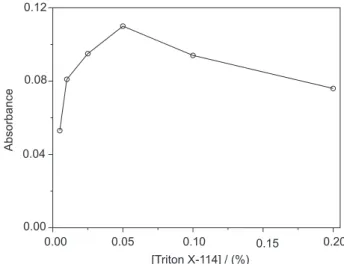
The effect of surfactant concentration was studied within the Triton X-114 concentration range from 5 x 10⁻³ to 2 x
10-1 % (v/v). The surfactant Triton X-114 was chosen due its
commercial availability and low cloud point temperature and high density of the surfactant rich phase, which facilitates phase separation by centrifugation. Figure 3 shows the effect of the surfactant concentration on the analytical signal. The signal is at its maximum when Triton X-114 concentration was 0.05% (v/v). At concentrations higher than 0.05% (v/v), the analytical signal decreased, probably, due to the increase of the surfactant volume, that deteriorate the FAAS signal. At concentrations below this value, the extraction efficiency of complexes was low because there is few molecules of the surfactant to entrap the Cu-Me-BTABr complex quantitatively. Accordingly, a concentration of 0.05% Triton x-114 (v/v) was chosen for use in next experiments.
Figure 1. Effect of pH on the cloud point extraction using Me-BTABr reagent for copper determination.
Figure 3. Effect of Triton X-114 concentration on the cloud point extraction for copper determination.
Effect of incubation temperature and time
The CPE technique is based on the property of most non-ionic surfactants in aqueous solutions to form micelles and become turbid when heated to cloud point temperature. The effect of the equilibration temperature above the cloud point temperature was investigated within a range of 30 to 60 oC. It was found that an equilibration temperature of 40 oC is adequate to obtain quantitative extraction. The
incubation time was a parameter also considered. At 40 oC,
it was observed that an equilibration time of 10 min is sufficient to obtain a good extraction.
Effect of viscosity
In order to facilitate the sample introduction in the FAAS nebulizer, it was necessary to decrease the surfactant-rich viscosity. Several organic solvents and their acid mixtures were investigated, to taking into account that these solvents increase the analytical signal of the FAAS.21
Solvents tested include acetone, ethanol and methanol. Best results were obtained using methanol. A 1.0 mol L -1
nitric acid solution was added to methanol and 200 μL of this solution was used as diluent. In these conditions, the analytical signals were at a maximum.
Analytical features
Characteristic data under the optimum conditions by preconcentrating 10 mL of copper were determined and are given in Table 1. Enrichment factors were calculated as the ratio of the slopes of the calibration graphs with preconcentration and direct aspiration, respectively.21 By
using direct aspiration in FAAS without the preconcen-tration procedure, the linear equation for copper determination was A = 5.0 x 10⁻³ + 1.3 x 10⁻⁴ C, where A is
the absorbance and C is the copper concentration in solution (μg L-1). Other factors that characterize
preconcen-tration systems, such as consumptive index (CI),21 were
also determined. The consumptive index is defined as the sample volume, in millilitres, consumed to reach an unit
of enrichment factor (EF): CI= Vs (mL) / EF, where Vs is the sample volume.
A comparison of the proposed method with other preconcentration procedures for Cu using several regents is given in Table 4. Compared to relevant CPE studies it can be considered as quite poor. However, the preconcentration factors reported by these studies were usually obtained by using larger sample volumes. In point of fact, the proposed method has a consumptive index lower than the most procedures.
Effect of foreign ions
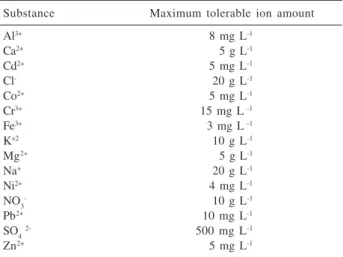
A study of potential interferences in the determi-nation of copper was performed. An error of ± 5% in absorbance reading was considered tolerable. Solutions containing copper (50.0 μg L -1) and other ions were
prepared and the developed procedure was applied. The tolerance limits of various foreign ions are given in Table 2. These results demonstrate that the effects of other ions at given concentrations are negligible. Also, the presence of large amounts of alkali and alkaline earth metals have no significant effect on the preconcen-tration of copper.
Accuracy of the method
In order to study the accuracy of the method, a certified reference material (NIST 1515-Apple Leaves) was analyzed. The copper content obtained (mean ± s, n = 4) is 5.51 ± 0.36 μg g1 and agree with the certified value (5.64 ±
0.24 μg g1). This result indicate the applicability of the
developed procedure in copper determination free of interference.
Table 2. Tolerance limit of foreign ions on copper (50 μg L-1)
determination by proposed procedure
Substance Maximum tolerable ion amount
Al3+ 8 mg L-1
Ca2+ 5 g L-1
Cd2+ 5 mg L-1
Cl- 20 g L-1
Co2+ 5 mg L-1
Cr3+ 15 mg L -1
Fe3+ 3 mg L -1
K+2 10 g L-1
Mg2+ 5 g L-1
Na+ 20 g L-1
Ni2+ 4 mg L-1
NO3- 10 g L-1
Pb2+ 10 mg L-1
SO42- 500 mg L-1
Zn2+ 5 mg L-1
Table 1. Analytical performance of the cloud point extraction method using Me-BTABr reagent for copper determination
Enrichment factor 1 7
Sample volume, mL 1 0
Consumptive index, mL 0.59
Limit of detection, μg L -1 1.08
Limit of quantification, μg L -1 3.60
Precision (Cu 50 μg L -1, n=7),% RSD 2.6
Linear range, μg L -1 1.08-100
Analysis of water samples
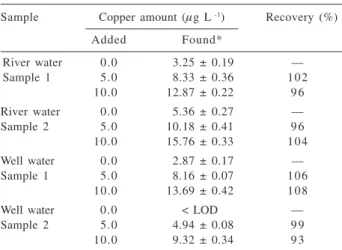
The procedure developed was applied to the extraction and determination of copper content from different water samples in order to test its applicability. The results are described in Table 3. According this table, the added copper ions can be quantitatively recovered from the water samples by the proposed procedure. Recoveries (R) of spike additions (5.0 or 10.0 μg L -1) to water samples were
quantitative. R was calculated as follows: R (%) = {(Cm -Co)/m} x100, where Cm is a value of metal in a spiked sample, Co is a value of metal in a sample and m is the amount of metal spiked. These results demonstrate the applicability of the procedure for copper determination in water samples.
Table 4. Procedures using cloud point extration prior copper determination
Reagent Surfactant EF Sample volume CI (mL) LOD Sample Detection Ref.
(mL) (μg L -1)
TAN Triton X-114 64.3 5 0 0.78 0.27 Standard reference FAAS [17]
material
Monocarboxylic Polyoxyethylated —— 100 ——- 10.0 Water FAAS [22]
aromatic and fatty phenol (OP-10) row acids
O,O-DDTP Triton X-100 33.3 1 0 0.30 0.94 Drinking and rainwater, FAAS [23]
serum and human hair
PAN Triton X-114 16.3 1 0 0.61 0.26 Tap water, snow water, CE [24]
and flavor wines
A-O,O-DDTP Triton X-114 17a16b 4 0 2.35a 2.50b 0.03 Riverine water, ICP-MS [25]
sea water and enriched water reference materials
Me-BTABr Triton X-114 1 7 1 0 0.59 1.08 River and well water FAAS This work
EF: enrichment factor; CI: consumptive index; LOD: limit of detection; TAN: 1-(2-thiazolylazo)-2-naphthol; PAN: 1-(2-pyridylazo)-2-naph-thol; O,O-DDTP: O,O-diethyldithiophosphate; A-O,O-DDTP: ammonium O,O-diethyl-dithiophosphate; Me-BTABr: 2-[2´-(6-methyl-benzothiazolylazo)]-4-bromophenol; a63Cu; b65Cu; FAAS: Flame Atomic Absorption Spectrometry; ICP-MS: Inductively Coupled Plasma Mass
Spectrometry; CE: Capillary Electrophoresis.
Table 3. Results obtained for copper determination in water samples (n=4)
Sample Copper amount (μg L -1) Recovery (%)
Added Found*
River water 0.0 03.25 ± 0.19 —
Sample 1 5.0 08.33 ± 0.36 102
10.0 12.87 ± 0.22 9 6
River water 0.0 05.36 ± 0.27 —
Sample 2 5.0 10.18 ± 0.41 9 6
10.0 15.76 ± 0.33 104
Well water 0.0 02.87 ± 0.17 —
Sample 1 5.0 08.16 ± 0.07 106
10.0 13.69 ± 0.42 108
Well water 0.0 < LOD —
Sample 2 5.0 04.94 ± 0.08 9 9
10.0 09.32 ± 0.34 9 3
* Confidence interval 95%; LOD: Limit of detection.
Conclusions
Me-BTABr reagent was successfully applied to preconcentration and determination of copper employing cloud point extraction. The procedure improved significantly the performance of the FAAS detection. The use of Me-BTABr reagent for preconcentration and determination of copper using CPE shows interesting features. The procedure is very economical, because it consists of much low equipment and running costs and shows also simplicity in apparatus and manipulation. Me-BTABr proved to be promising for application in preconcentration procedures involving different techniques, such as solid-phase extraction, coprecipitation and cloud-point extraction.
Acknowledgments
Authors acknowledge the financial support of the Conselho Nacional de Desenvolvimento Científico e Tecnológico (CNPq) and Fundação de Amparo à Pesquisa do Estado da Bahia (FAPESB).
References
1. Sant´Ana, O. D.; Jesuíno, L. D.; Cassella, R. J.; Carvalho, M. B.; Santelli, R. E.; J. Braz.Chem. Soc. 2003, 14, 728. 2. Safavi, A.; Abdollahi, H.; Nezhad, M. R. H.; Kamali, R.;
Spectrochim. Acta, Part A 2004, 60, 2897.
3. Nascentes, C. C.; Arruda, M. A. Z.; Maniasso, N. ; Quim. Nova
2002, 25, 483.
5. Pramauro, E.; Prevot, A. B.; PureAppl. Chem. 1995, 4, 551. 6. Manzoori, J. L.; Nezhad, G. K.; Anal. Chim. Acta 2004, 521,
173.
7. Rosen, M. J.; Surfactants and Interfacial Phenomena, John Wiley: New York, 1987.
8. Sant´Ana, O. D.; Jesuíno, L. D.; Cassella, R. J.; Carvalho, M. B.; Santelli, R. E.; J. Braz.Chem. Soc. 2004, 15, 96. 9. Cavasino, F. P.; Sbriziolo, C.; Pelizzetti, E.; Pramauro, E.; J.
Phys. Chem. 1989, 93, 469.
10. Watanabe, H.; Tanaka, H.; Talanta 1978, 25, 585.
11. Nascentes, C2. C.; Arruda, M. A. Z.; Talanta 2003, 61, 759. 12. Manzoori, J. L.; Nezhad, G. K.; Anal. Sci. 2003, 19, 579. 13. Eskandari, H.; Kamali, Y.; Anal. Sci. 2004, 20, 1095. 14. Doroschuk, V. O.; Lelyushok, S. O.; Ishchenko V. B.;
Kulichenko, S. A.; Talanta 2004, 64, 853.
15. Bezerra, M. A.; Conceição, A. L. B.; Ferreira, S. L. C.; Anal.
Bioanal. Chem. 2004, 378, 798.
16. Wuilloud, G. M.; Wuilloud, J. C. A.; Wuilloud, R. G.; Silva, M. F.; Olsina, R. A.; Martinez, L. D.; Talanta 2002, 58, 619.
17. Chen, J.; Teo, K. C.; Anal. Chim. Acta 2001, 450, 215. 18. Chen, J.; Teo, K. C.; Anal. Chim. Acta 2001, 434, 325. 19. Lemos, V. A.; Santos, W. N. L.; Santos, J. S.; Carvalho, M. B.;
Anal. Chim. Acta2003, 481, 283.
20. Lemos, V. A.; Baliza, P. X.; Yamaki, R. T.; Rocha, M. E.; Alves, A. P. O.; Talanta2003, 61, 675.
21. Fang, Z.; Flow Injection Separation and Preconcentration, 1st ed., John Wiley: New York, 1993.
22. Kulichenko, S. A.; Doroschuk, V. O.; Lelyushok, S. O.; Talanta
2003, 59, 767.
23. Manzoori, J. L.; Bavili-Tabrizi, A.; Microchem. J. 2002, 72, 1.
24. Tang , A.; Jiang, D.; Yan, X.; Anal. Chim. Acta2004, 507, 203.
25. Silva, M. A. M.; Frescura, V. L. A.; Curtius, A. J.; Spectrochim.
Acta, Part B 2000, 55, 803.
![Cloud point extraction/preconcentration of copper ions exploiting the formation of complexes with DMTI [4,5-dimercapto-1,3-dithyol-2-thionate].](data:image/gif;base64,R0lGODlhAQABAIAAAP///wAAACH5BAEAAAAALAAAAAABAAEAAAICRAEAOw==)