
0103 - 5053 $6.00+0.00
Article
*e-mail: [email protected]
A Novel Oxidative Addition Product from [Pt
2(dba)
3]: Synthesis and Spectroscopic
Characterization of a Bimetallic Pt–
η
η
η
η
η
2-Tetracyanoethylene Complex Containing
2,3,5,6-Tetrakis(
α
α
α
α
α
-pyridyl)pyrazine
Rodrigo S. Bitzer,a Rosane A. S. San Gil b and Carlos A. L. Filgueiras*,a
a
Departamento de Química Inorgânica; bLaboratório de Ressonância Magnética Nuclear, Instituto de Química,
Universidade Federal do Rio de Janeiro, CP 68563, 21945-970 Rio de Janeiro – RJ, Brazil
{[Pt(η2-TCNE)]2(µ-TPP)} (1) foi preparado a partir da reação entre o composto de Pt(0)
[Pt2(dba)3] (dba = dibenzilidenoacetona), tetracianoetileno (TCNE) e 2,3,5,6-tetraquis(α
-piridil)pirazina (TPP) na razão estequiométrica 1:2:1, respectivamente. 1 foi caracterizado por análise elementar, espectroscopia no infravermelho, RMN de 1H em solução e RMN de 13C no estado sólido (CP/MAS). De acordo com os espectros de RMN, o ligante TPP em 1 se coordena a cada centro metálico por dois átomos de nitrogênio piridínicos, segundo um modo de coordenação bis-bidentado já relatado em outros complexos de TPP com PtII. Além dos sinais atribuídos aos átomos de carbono do TPP (δ 128-155) e aos átomos de carbono dos grupos nitrila (δ 115,1), o espectro de RMN de 13C-CP/MAS de 1 exibe na região de menor freqüência um duplo dupleto [δ1 –2,6; 1J(195Pt-13C) = 223 Hz e δ
2 1,6; 1J(195Pt-13C) = 188 Hz]. Estes últimos sinais são atribuídos aos átomos de carbono etilênicos do TCNE ligados a platina e confirmam que a ligação nos fragmentos Pt-η2-TCNE é melhor descrita segundo o modelo
metalaciclopropano.
{[Pt(η2-TCNE)]2(µ-TPP)} (1) has been prepared from the Pt(0) compound [Pt2(dba)3] (dba
= dibenzylideneacetone), tetracyanoethylene (TCNE), and 2,3,5,6-tetrakis(α-pyridyl)pyrazine
(TPP) in the 1:2:1 stoichiometric ratio, respectively. 1 has been characterized by elemental analysis, infrared spectroscopy, solution 1H NMR and solid-state 13C (CP/MAS) NMR spectroscopy. According to the NMR spectra of 1, TPP binds to each metal through two pyridine nitrogen atoms. In addition to the signals assigned to the TPP carbon atoms (δ 128-155) and to the nitrile carbon atoms (δ115.1), the 13C-CP/MAS NMR spectrum of 1 exhibits a double doublet [δ1 –2.6, 1J(195Pt-13C) = 223 Hz and δ2 1.6, 1J(195Pt-13C) = 188 Hz] in the low frequency region. These signals are assigned to the ethylenic TCNE carbon atoms attached to platinum and confirm that the bonding at the Pt-η2-TCNE moieties is best described according to the
metalacyclopropane model.
Keywords: organoplatinum chemistry, bimetallic complexes, nitrogen heterocyclic ligand, 13C-CP/MAS
Introduction
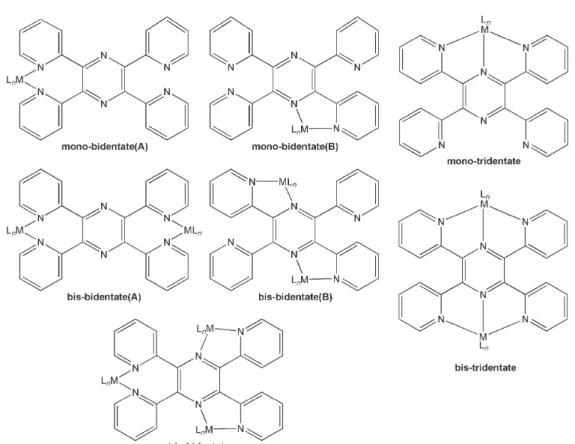
2,3,5,6-Tetrakis(α-pyridyl)pyrazine (TPP) is a heterocyclic ligand containing six potentially coordinating nitrogen sites. The ability of TPP to bind transition and main-group metals has been the subject of a number of studies.1-20 To date, seven different chelating modes have
been described for TPP (Figure 1). Among them, the tridentate modes are by far the most abundant ones. The variety of coordination modes of TPP can be accounted
for by the free rotation about the four pyridine-pyrazine linkages. In effect, recent ab initio calculations at the RHF/
6-31++G(d,p) level have shown the existence of 14 conformers of TPP with low-energy interconversion barriers.21
The few examples of platinum-TPP complexes involve PtII and have revealed that the chelating mode adopted by
TPP depends upon the reacted PtII species.7,10 The reaction
between TPP and trans-[Pt(PEt3)Cl2]2 has afforded the
isolation of the bimetallic cation {[Pt(PEt3)Cl]2(µ-TPP)}2+,
between TPP and cis-[Pt(DMSO)2Cl2] has yielded the
complex salt [{PtCl}2(µ-TPP)][Pt(DMSO)Cl3]2.10 In this
latter case, TPP bridges the PtII centers according to the
bis-tridentate coordination mode. Such interesting examples along with the paucity of studies concerning the reactivity and coordinating behavior of TPP toward organoplatinum reagents have prompted us to undertake the reaction between TPP and the formally Pt(0) reagent [Pt2(dba)3] (dba = dibenzylideneacetone).
A well-known strategy to synthesize Pt-η2-alkene
complexes with N,N donor ligands, such as α-diimines or aromatic nitrogen heterocycles, involves a “one-pot” reaction between a zerovalent platinum reagent {e.g.
[Pt2(dba)3] or [Pt(1,5-cyclooctadiene)2]}, an olefin with electron withdrawing groups, such as tetracyanoethylene (TCNE), and the N,N donor ligand.22-23 Usually, the isolated
products have the general formula [Pt(η2-alkene)(N,N)] and
the bonding at the Pt-η2-alkene moiety is described
according to the metalacyclopropane model.24 Indeed, in
olefin complexes of platinum, the bonding at the Pt-η2
-alkene moiety can be understood in terms of either the classical Dewar-Chatt-Duncanson model24,25 or the
metalacyclopropane model.24 Spectroscopic methods and
single-crystal X-ray diffraction studies have been used to distinguish between these two bonding possibilities in Pt-η2-alkene structures.22-26 In this work we have employed
the aforementioned strategy to prepare a bimetallic Pt-η2
-TCNE complex containing TPP as a bis-bidentate ligand, namely [{Pt(η2-TCNE)}
2(µ-TPP)} (1). Solid-state 13C (CP/
MAS) NMR spectroscopy has been used to examine the bonding at the Pt-η2-TCNE moieties as well as the mode
adopted by TPP upon coordination to the metallic centers.
Experimental
General details
The reaction and the work-up of the reaction mixture were carried out under argon using Schlenk-type glassware and vacuum-inert gas line manipulation techniques. THF was dried over sodium-benzophenone ketyl and deoxygenated according to standard techniques. [Pt2(dba)3] 27 and TPP 28 were synthesized according to
the literature methods. TCNE was purchased from Acros and used as received. CD3CN (Cambridge Isotopes, Inc.) was commercially obtained and stored over 3 Å molecular sieves.
Physical measurements
were recorded on a Magna-IR760 FTIR Nicolet spectrometer. The spectra were obtained using Nujol mulls between CsI windows (4000-200 cm-1) and a resolution
of 4 cm-1. 1H (CD
3CN) and solid-state 13C (CP/MAS) NMR
spectra were acquired from Bruker DPX200 (1H) and
DRX300 (13C) instruments operating at 200.08 MHz (1H)
and at 75.47 MHz (13C), respectively. All NMR studies
were performed at 293 K, and the chemical shift (δ / ppm) values were determined in relation to SiMe4. In the 13
C-CP/MAS NMR spectra the samples were spun at 6-8 kHz in 4 mm diameter ZrO2 rotors with Kel-F caps. A satisfactory 13C-CP/MAS NMR spectrum for 1 was
obtained using a relaxation delay of 20 s and a contact time of 1 ms. A 13C-CP/MAS NMR spectrum of TPP with
good signal to noise ratio was obtained with a contact time of 0.5 ms and a relaxation delay of 60 s.
Preparation of [{Pt(η2-TCNE)}2(µ-TPP)]} (1)
A deep purple solution of [Pt2(dba)3] (0.115 g, 0.10 mmol) and TCNE (0.044 g, 0.34 mmol) in THF (10 mL) was stirred at room temperature (r.t.) for 30 min. Then, solid TPP (0.030 g, 0.08 mmol) was slowly added to this solution with constant magnetic stirring. The resulting mixture was stirred at r.t. for 22 h. After this period, a brown solid was filtered off, washed with CH2Cl2 (4 x 5 mL) and dried under vacuum. Yield: 0.062 g (78%). The product is slightly hygroscopic and sparingly soluble in most organic solvents but readily decomposes in DMF and DMSO.
Data for 1. mp: infusible to 300 oC. Anal. Calc. for
C36H16N14Pt2·2H2O: C, 40.38; H, 1.89; N, 18.32%. Found: C, 40.08; H, 1.81; N, 18.69%. FT-IR (nujol mull)νmax/cm-1:
ν(CH)TPP, 3109 (w), 3078 (w), 3053 (w); ν(CN)TCNE, 2228 (m), 2201 (sh); ν(CC/CN)TPP, 1605 (m), 1568 (w), 1487 (w), 1457 (s), 1388 (m); δ(CH)TPP, 784 (m), 759 (m); ν (Pt-C), 385 (m), 375 (m);ν(Pt-N), 280 (m), 246 (s). 1H NMR (CD3CN), δ/ ppm: 8.97 (4H, dd, H6); 8.11 (4H, m, H4); 7.99 (4H, dd, H3); 7.74 (4H, m, H5). 13C-CP/MAS,
δmax/ppm (isotropic signals): 155.0 (C2pz); 151.2
(C2py+C6); 140.2 (C3); 128.2 (C4+C5); 115.1 (nitrile groups); δ1 –2.6 [d, 1J(195Pt-13C) = 223 Hz] and δ2 1.6 [d, 1J(195Pt-13C) = 188 Hz] (ethylenic carbon atoms attached
to Pt). For these two latter signals, δ1 (νA) and δ2 (νB), ∆ν
= [(ν1-ν4)(ν2-ν3)]1/2 = 317 Hz, which is approximately equal
to 1.6 J, considering J ≅ 200 Hz. The atom numbering is
shown in Figure 3. Here, H3 is the H atom bound to C3
etc. Owing to the low solubility of 1 in most organic solvents, its 13C{1H} NMR spectrum in solution could not
be measured. Attempts to grow suitable single crystals of 1 for X-ray diffraction studies were unsuccessful.
Results and Discussion
Selected FT-IR data for [Pt2(dba)3], TCNE, TPP, and 1 are listed in Table 1. The FT-IR spectrum of 1 does not exhibit bands in the expected carbonyl region, thereby indicating that the dba ligands in the zerovalent platinum reagent were displaced in the reaction conditions. Moreover, the bands assigned to the nitrile groups of 1 were shifted to lower wavenumbers with respect to free TCNE. Table 1 also shows that some TPP internal vibrations were shifted to lower wavenumbers (e.g. 1457
and 1388 cm-1) upon complexation; others, however, were
shifted to higher wavenumber values (e.g. 1605 cm-1),
whereas some other bands remained unchanged (e.g. 1568
and 1487 cm-1). In the low-frequency region of the FT-IR
spectrum of 1, the bands at 385, and 375 cm-1 are assigned to the ν(Pt-C) stretching modes, whereas the bands at 280 and 246 cm-1 are ascribed to the ν(Pt-N) vibration
modes.29
Selected 1H NMR data for TPP and for 1 are
summarized in Table 2. According to the number of 1H
signals and their integration (see Experimental Section), it is possible to suggest that there are no uncoordinated pyridine rings in 1. This result implies that in 1 TPP is coordinated to the platinum centers according to the bis-bidentate(A) chelating mode. The structure proposed for 1 is illustrated in Figure 2. In Table 2 the ∆δ values show
Table 1. Selected FT-IR data (cm-1) for [Pt
2(dba)3], TCNE, TPP, and 1a,b
ν(C=O) ν(CN)nitrile ν(CC/CN) δ(CH)
[Pt2(dba)3] 1711 (m), 1628 (s) - -
-TCNE - 2258 (s), 2220 (s) c
-TPP - - 1587 (s), 1566 (s), 807 (s), 784 (s),
1486 (w), 1476 (m), 753 (s) 1434 (m), 1392 (s)
1 - 2228 (m), 2201 (sh) 1605 (m), 1568 (w), 784 (m), 759 (m)
1487 (w), 1457 (s), 1388 (m)
that the signals for H4, H5, and H6 were shifted to higher frequencies on coordination, whereas the signal for H3 exhibited only a slight shift to lower frequency.
The 13C-CP/MAS NMR spectrum of 1 is depicted
in Figure 3. The signals in the δ 128-155 ppm range are assigned to the TPP carbon atoms. In the 13C-CP/
MAS NMR spectrum of free TPP, these signals appear in the region from 124 to 160 ppm.20 The signal at δ
max
115.1 (Figure 3) is attributed to the nitrile carbon atoms. In the solution (CDCl3) 13C NMR spectrum of free
TCNE, a single nitrile signal can be seen at 117 ppm. Also in the solution 13C NMR spectrum of free TCNE,
the signal for the olefinic carbon atoms lies at δ 101. In the 13C NMR spectrum of 1 (Figure 3) no signals
were observed in the expected alkene C(sp2) region.30
Instead, a double doublet appears at lower frequencies,
e.g. in the alkane C(sp3) region.30 These signals, δ1 –
2.6 [1J(195Pt-13C) = 223 Hz] and δ
2 1.6 [1J(195Pt-13C) =
188 Hz] (Ca in Figure 3), are assigned to the TCNE
carbon atoms bound to platinum. The presence of these two isotropic signals, δ1 and δ2, is likely to indicate
that the asymmetric unit of 1 bears two crystallo-graphically distinct coordinated carbon atoms of TCNE.31 Moreover, the low values for the 1J(195Pt-13C)
coupling constants in 1 are in agreement with literature data for related compounds.26
The very low δ1 and δ2 values (Figure 3) imply that
the TCNE carbon atoms attached to platinum exhibit an approximate sp3 character. This confirms that the bonding
at the Pt-η2-TCNE moieties is best described in terms of
the metalacyclopropane model,24 as illustrated in Figure
2. Hence, to each platinum in 1 one might assign a 2+ formal oxidation state. Indeed, the reaction described
herein can be thought of as resulting from the oxidative addition of the olefinic C=C bond of TCNE to Pt(0) in the presence of TPP.
Conclusions
The reaction between [Pt2(dba)3], TCNE, and TPP, in the 2:2:1 (Pt:TCNE:TPP) stoichiometric ratio, gave the bimetallic heteroleptic product [{Pt(η2-TCNE)}
2
(µ-TPP)]} (1). 1 was characterized by several spectroscopic techniques, including solid-state 13C (CP/MAS) NMR
spectroscopy. The solution 1H NMR spectrum of 1
provided convincing evidence that TPP is bound to the Pt atoms according to the bis-bidentate(A) coordination mode. The 13C-CP/MAS NMR spectrum of 1 confirmed
that the bonding at the Pt-η2-TCNE moieties is described
in terms of the expected metalacyclopropane model.
Acknowledgements
The authors are grateful to CNPq, FAPERJ, and FUJB for sponsorship.
References
1. Vogler, L. M.; Scott, B.; Brewer, K. J.; Inorg. Chem. 1993, 32, 898.
2. Graf, M.; Greaves, B.; Stoeckli-Evans, H.; Inorg. Chim. Acta 1993, 204, 239.
3. Vogler, L. M.; Brewer, K. J.; Inorg. Chem. 1996, 35, 818. 4. Graf, M.; Stoekli-Evans, H.; Escuer, A.; Vicente, R.; Inorg.
Chim. Acta 1997, 257, 89.
5. Lee, J. D.; Vrana, L. M.; Bullock, E. R.; Brewer, K. J.; Inorg. Chem. 1998, 37, 3575.
Table 2. Selected solution 1H NMR data (δ/ ppm) for TPP and for 1a,b
TPP 1 Δδ
H3 8.05 (dd) 7.99 (dd) 0.06
H4 7.80 (m) 8.11 (m) -0.31
H5 7.24 (m) 7.74 (m) -0.50
H6 8.39 (dd) 8.97 (dd) -0.58
aspectra obtained in CD
3CN; bdd = double doublet, m = multiplet.
Figure 2. Structure proposed for 1.
Figure 3. The 13C-CP/MAS NMR spectrum of 1. Spectrum recorded at a
6. Hartshorn, C. M.; Daire, N.; Tondreau, V.; Loeb, B.; Meyer, T. J.; White, P. S.; Inorg. Chem. 1999, 38, 3200.
7. Teles, W. M.; Speziali, N. L.; Filgueiras, C. A. L.; Polyhedron 2000, 19, 739.
8. Chen, X.; Femia, F. J.; Babich, J. W.; Zubieta, J.; Inorg. Chim. Acta 2001, 315, 66.
9. Bera, J. K.; Campos-Fernández, C. S.; Rodolphe, C.; Bunbar, K. R.; Chem. Commun. 2002, 2536.
10. Sakai, K.; Kurashima, M.; Acta Cryst. 2003, E59, m411. 11. Lalrempuia, R.; Govindaswamy, P.; Mozharivskyj, Y. A.;
Kollipara, M. R.; Polyhedron 2004, 23, 1069.
12. Fantacci, S.; de Angelis, F.; Wang, J.; Bernhard, S.; Selloni, A.; J. Am. Chem. Soc. 2004, 126, 9715.
13. Maekawa, M.; Minematsu, T.; Konaka, H.; Sugimoto, K.; Kuroda-Sowa, T.; Suenaga, Y.; Munakata, M.; Inorg. Chim. Acta 2004, 357, 3456.
14. Carranza, J.; Sletten, J.; Brennan, C.; Lloret, F.; Cano, J.; Julve, M.; J. Chem. Soc., Dalton Trans. 2004, 3997.
15. Bitzer, R. S.; Filgueiras, C. A. L.; Lopes, J. G. S.; Santos, P. S.; Herbst, M. H.; Transit. Met. Chem. 2005, 30, 636.
16. Hadadzadeh, H.; Rezvani, A. R.; Yap, G. P. A.; Crutchley, R. J.; Inorg. Chim. Acta 2005, 358, 1289.
17. Bitzer, R. S.; Teles, W. M.; Abras, A.; Ardisson, J. D.; Filgueiras, C. A. L.; J. Braz. Chem. Soc. 2005, 16, 963.
18. Hsu, G. Y.; Chen, C. W.; Cheng, S. C.; Lin, S. H.; Wei, H. H.; Lee, C. J.; Polyhedron 2005, 24, 487.
19. Morsali, A.; Ramazani, A.; Z. Anorg. Allg. Chem. 2005, 631, 1759.
20. Bitzer, R. S.; Pereira, R. P.; Rocco, A. M.; Lopes, J. G. S.; Santos, P. S.; Nascimento, M. A. C.; Filgueiras, C. A. L.; J. Organomet. Chem. 2006, 691, 2005.
21. Padgett, C. W.; Pennington, W. T.; Hanks, T. W.; Cryst. Growth Des. 2005, 5, 737.
22. van Asselt, R.; Elsevier, C. J.; Smeets, W. J. J.; Spek, A. L.; Inorg. Chem. 1994, 33, 1521.
23. Tromp, D. S.; Duin, M. A.; Kluwer, A. M.; Elsevier, C. J.; Inorg. Chim. Acta 2002, 327, 90.
24. Crabtree, R. H.; The Organometallic Chemistry of the Transition Metals; 4th Ed.; Wiley-Interscience: New Jersey, 2005, pp.
125-131.
25. Dewar, M. J. S.; Bull. Soc. Chim. Fr. 1951, 18, 79; Chatt, J.; Duncanson, L. A.; J. Chem. Soc. 1953, 2939.
26. Chisholm, M. H.; Clark, H. C.; Manzer, L. E.; Stothers, J. B.; J. Am. Chem. Soc. 1972, 94, 5087.
27. Moseley, K.; Maitlis, P. M.; J. Chem. Soc. Chem. Commun. 1971, 982.
28. Goodwin, H.A.; Lions, F.; J. Am. Chem. Soc. 1959, 81, 6415. 29. Ferraro, J. R.; Low-Frequency Vibrations of Inorganic and Coordination Compounds, Plenum Press: New York, 1971, ch. 8. 30. Kemp, W.; NMR in Chemistry: A Multinuclear Introduction;
1st ed., MacMillan: London, 1986, pp. 84-107.
31. Gay, I. D.; Young, G. B.; Organometallics 1996, 15, 2264, and references therein.
Received: June 8, 2006
![Table 1. Selected FT-IR data (cm -1 ) for [Pt 2 (dba) 3 ], TCNE, TPP, and 1 a,b](https://thumb-eu.123doks.com/thumbv2/123dok_br/18990935.460622/3.892.68.798.931.1083/table-selected-ft-ir-data-pt-tcne-tpp.webp)

![Palladium(II) complexes with R2edda derived ligands. Part I. Reaction of diisopropyl (S,S)-2,2'-(1,2-ethanediyldiimino)-dipropanoate with K2[PdCl4]](data:image/gif;base64,R0lGODlhAQABAIAAAP///wAAACH5BAEAAAAALAAAAAABAAEAAAICRAEAOw==)