
JSCS–3840 Original scientific paper
doi: 10.2298/JSC0904389K
Palladium(II) complexes with R
2edda derived ligands. Part I.
Reaction of diisopropyl (
S
,
S
)-2,2'-(1,2-ethanediyldiimino)-dipropanoate with K
2[PdCl
4]
BOJANA B. KRAJČINOVIĆ1#, GORAN N. KALUĐEROVIĆ1,2*#, DIRK STEINBORN2,
HARRY SCHMIDT2, CHRISTOPH WAGNER2, KURT MERZWEILER2,
SREĆKO R. TRIFUNOVIĆ3 and TIBOR J. SABO4#
1Department of Chemistry, Institute of Chemistry, Technology and Metallurgy, University of
Belgrade, Studentski trg 14, 11000 Belgrade, Serbia, 2Institut für Chemie, Martin-Luther-
-Universität Halle-Wittenberg, Kurt-Mothes-Straße 2, D-06120 Halle, Germany,
3Department of Chemistry Faculty of Science, University of Kragujevac,
34000 Kragujevac and 4Faculty of Chemistry, University of Belgrade,
P.O. Box 158, 11001 Belgrade, Serbia (Received 24 June, revised 6 October 2008)
Abstract: The reaction of K2[PdCl4] with (S,S)-(i-Pr)2eddip diester (diisopropyl (S,S)-2,2’-(1,2-ethanediyldiimino)dipropanoate) resulted in {PdCl2[(S,S)-(i-
-Pr)2eddip-κ2N,N’]} (1) and {PdCl[(S,S)-(i-Pr)eddip-κ2N,N’,κO]} (2) with one
hydrolyzed ester group. The compounds were characterized by spectroscopic me-thods and it was proved that the reaction is diastereoselective (1H- and 13C-NMR)
in the case of 2 (one diastereoisomer of four possible). The structure of 2 was
determined by X-ray diffraction analysis, indicating that the product is the (R,R)-N,N’ configured isomer. In contrast, the reaction yielding 1 produced two
of three possible diastereoisomers. DFT calculations support the formation of two diastereoisomers of 1 and of one diastereoisomer of 2.
Keywords:palladium complexes; crystal structure; EDDP ligands; DFT calcu-lations.
INTRODUCTION
In a previous study, platinum(IV) complexes with R2edda (esters of
ethyl-enediamine-N,N’-diacetic acid) ligands were prepared (R = Me, Et or n-Pr; Fig.
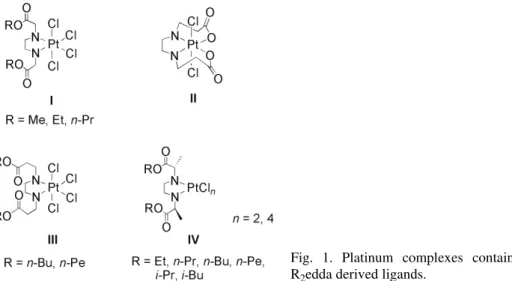
1, I).1 In contrast, reactions between homologous propionate ligands (R2eddp = = ROOCCH2CH2NHCH2CH2NHCH2CH2COOR; R = Me, Et, n-Pr, n-Bu or n-Pe), and potassium hexachloroplatinates(IV) gave different products depending
on the R moiety (Fig. 1, II and III)2,3. For R = Me, Et or n-Pr, these reactions
* Corresponding author. E-mail: [email protected]
proceeded with the hydrolysis of the ester groups yielding [PtCl2(eddp- -κ2N,N’,κ2O,O’)] (Fig. 1, II). Structural analysis gave proof of the trans-dichloro arrangement. When R was n-butyl or n-pentyl, the isolated platinum(IV)
com-plexes [PtCl4(R2eddp-κ2N,N’)] maintained the ester functions of the ligand
in-tact, see III in Fig. 1.2
Fig. 1. Platinum complexes containing R2edda derived ligands.
Furthermore, the work was extended by synthesizing chiral branched-chain esters, (S,S)-R2eddip = ROOCC(S)H(CH3)NHCH2CH2NHC(S)H(CH3)COOR (R = = Et, n-Pr, n-Bu, n-Pe, i-Pr or i-Bu), and the corresponding platinum(II/IV)
complexes, {PtCln[(S,S)-R2eddip]} (n = 2 or 4; Fig. 1, IV).4 Also here, as in the
reaction of R2edda and hexachloroplatinate(IV), the ligands maintained their es-ter functional groups without hydrolyzing in the obtained complexes. Studies on the antitumoral activity of some Pt(IV) complexes with R2edda derived ligands showed higher cytotoxicity than cisplatin and the kinetics of the tumor cell death process induced by these complexes was considerably faster in comparison to that induced by cisplatin.5,6
The coordination mode of palladium(II) and platinum(II) is analogous, but the palladium(II) complexes are kinetically less stable than the platinum(II) complexes.7,8 Due to the similar coordination modes and chemical properties of palladium(II) and platinum(II) compounds, it was also decided to synthesize and characterize complexes of palladium(II) with edta tetraalkyl esters and ethylene-di-ammonium-N,N’-di-3-propanoic acid.9,10 In the light of the increasing interest in
the biological activity of palladium(II) complexes, their antiproliferative activity is also of interest.11–13
The complexes {PdCl2[(S,S)-(i-Pr)2eddip]} (1) and {PdCl[(S,S)-(i-Pr)eddip]}
(2) were prepared and spectroscopically and structurally characterized. In
EXPERIMENTAL General
[(S,S)-H3eddip]Cl and [(S,S)-H2(i-Pr)2eddip]Cl2·H2O were prepared as previously report-ed.4,14-16 K
2[PdCl4] was obtained from Merck and used as received. The infrared spectra were
recorded on a Perkin-Elmer FTIR 31725-X spectrophotometer using the KBr pellet technique (4000–400 cm-1). The 1H- and 13C-NMR spectra were recorded on Varian Gemini 200 (200 MHz)
(1) and Varian Unity 500 (500 MHz) spectrometers (2) in CDCl3 and DMF-d7, respectively.
Elemental analyses for C, H and N were performed on a Vario III CHNOS Elemental Ana-lyzer, Elementar Analysensysteme GmbH.
Synthesis of complexes
K2[PdCl4] (0.158 g, 0.512 mmol) was dissolved in water (20 ml) at 40 °C and [(S,S)- -H2(i-Pr)2eddip]Cl2·H2O (0.194 g, 0.512 mmol) was added. During 2 h of stirring, 10 ml of 0.10 M LiOH was added in small portions to the reaction solution. On cooling to room tempe-rature, a yellow precipitate of 1 was obtained. The precipitate was filtered off and the filtrate
was left for several days at room temperature. The mother liquor produced crystals of 2
suitable for X-ray measurement. X-ray crystallography of 2
Intensity data were collected on a STOE IPDS diffractometer at 220(2) K using graphite monochromatized Mo–Kα radiation ( = 0.71073 Å). A summary of the crystallographic data, the data collection parameters and the refinement parameters are given in Table I. The struc-ture was solved by direct methods with SHELXS-96 and refined using full-matrix
least-squa-TABLE I. Crystallographic data for 2
Empirical formula C11H21ClN2O4Pd
Mr 387.17 g mol-1
Crystal system monoclinic
Space group P 21
a / Å 5.877(1)
b / Å 9.672(2)
c / Å 14.424(3)
β / ° 100.78(2)
V / Å3 805.5(3)
Z 2
Dcalc / g cm–3 1.584
(Mo–Kα) / mm-1 1.328
F(000) 392
θ Range / º 2.55–25.80
Refln. collected 1637
Refln. observed (I > 2σ(I)) 1543
Refln. independent 1637
Data/restraints/parameters 1637/1/177
Goodness-of-fit on F2 1.079
R1, wR2 [I > 2σ(I)] 0.0316, 0.0789
R1, wR2 (all data) 0.0338, 0.0797
res routines against F2 with SHELXS-97.17,18 Non-hydrogen atoms were refined with
aniso-tropic displacement parameters. The hydrogen atoms were refined isoaniso-tropically. They were placed in the calculated positions with fixed displacement parameters (riding model), except for H12 atom, which was found in the electron density map. The large displacement para-meters of atoms C5, C6 and O1 are explained by oscillation in the crystal structure and be-cause these atoms are far away from the palladium atom. The Diamond program was used for the representation of the structure.19
The Cambridge Crystallographic Data Centre, CCDC No. 681419, contains supplemen-tary crystallographic data for this paper.*
Computational details
Geometry optimizations were performed with the Gaussian 03 package.20 All structures
were optimized using the MPW1PW91 functional.21 The SDD basis set for all atoms was
em-ployed in the calculations.22,23 All systems were optimized without symmetry restrictions. The
resulting geometries were characterized as equilibrium structures by the analysis of the force constants of normal vibrations. Supplementary data associated with the quantum chemical calculations can be obtained from the authors upon request.
RESULTS AND DISCUSSION
The addition of an aqueous solution containing the ligand precursor [(S,S)-
-H2(i-Pr)2eddip]Cl2 to a solution of K2[PdCl4] followed by the addition of the stoichiometric amount of base (molar ratio 1:1:2) results in the formation of a yellow precipitate of 1 (56 % yield). The mother liquor was left for several days
at room temperature and crystals of 2 (20 % yield) suitable for X-ray analysis
were obtained (Scheme 1). The κ2N,N’,κO coordination mode of the [(S,S)-(i -Pr)-eddip]– ligand in complex 2 arises from the hydrolysis of one of the two ester groups of the original (S,S)-(i-Pr)2eddip ligand.
Scheme 1. Reaction of K2[PdCl4] with [(S,S)-H2(i-Pr)2eddip]Cl2.
Characterization of the complexes
{PdCl2[(S,S)-(i-Pr)2eddip]} (1). Yield: 0.13 g (56 %). Anal. Calcd. for
C14H28Cl2N2O4Pd: C, 36.11; H, 6.06; N, 6.02. Found: C, 35.79; H, 6.33; N, 5.77 %. IR (KBr, cm–1): 3448, 3153, 2983, 1734, 1380, 1224, 1187, 1143, 1105, 918, 830, 754, 430. 1H-NMR* (200 MHz, CDCl3, δ / ppm): 1.25/1.32 (d/d, 12H, 3JH,H = 6.60/7.80 Hz, C5,6H3), 1.61/2.00 (d/d, 6H, 3JH,H = 7.00/7.60 Hz, C3,9H3), 2.44/3.21 and 2.81/3.68 (m/m, 4H, AA’BB’, C10,11H2), 4.09/4.52 (m/m,
2H, C2,8H), 5.03/5.15 (m/m, 2H, C4H), 6.12–6.26/6.31–6.42 (m/m, 2H, NH).
13C-NMR(50 MHz, CDCl3,δ / ppm):14.6/16.0 (s/s, C3,9), 21.7/21.7 (s/s, C5,6), 48.7/51.9 (s/s, C10,11), 57.4/59.0 (s/s, C2,8), 69.3/69.9 (s/s, C4), 169.4/170.9 (s/s,
C1,7).
{PdCl2[(S,S)-(i-Pr)eddip]}(2). Yield: 0.04 g (20 %). IR (KBr, cm–1): 3441,
3357, 3127, 2985, 1737, 1644, 1389, 1219, 1104, 944, 833, 590, 430. 1H-NMR (500 MHz, DMF-d7, δ / ppm):1.23 (d,6H, 3JH,H = 6.95 Hz, C5,6H3), 1.75 (d,
3H, 3JH,H = 7.21 Hz, C3H3), 1.76 (d, 3H,3JH,H = 7.21 Hz, C9H3), 2.73 and 2.90 (m, 4H, C10,11H2), 3.69 (m, 1H, C8H), 4.05 (m, 1H, C2H), 4.96 (m, 1H, C4H), 6.55–6.65 (m, 1H, N1H), 6.68–6.77 (m, 1H, N2H).13C-NMR(125 MHz, DMF-d7, δ, ppm): 14.8 (s, C3), 15.6 (s, C9), 21.0 (s, C5,6), 49.4 (s, C11), 52.5 (s, C10), 56.4 (s, C2), 62.2 (s, C8), 68.9 (s, C4), 169.6 (s,C1), 181.1 (s, C7).
Spectroscopic properties
The IR spectrum of 1 shows specific absorption bands: ν(C=O) at 1734 cm–1
(strong), (typical absorption for aliphatic esters), ν(C–O) at 1236 cm–1 (strong) and ν(CH3) at 2983 cm–1 (medium). For comparison [(S,S)-H2(i-Pr)2eddip]Cl2 exhibited the corresponding bands at 1734, 1239 and 2982 cm–1, respectively.4 The band for the C=O group is at the same position as in the spectrum of the free ligand, meaning that the oxygen atoms of the COOR moieties are not coordi-nated. In the IR spectrum of 2, there are two absorption bands for ν(C=O) at
1737 and 1644 cm–1, indicating two different C=O groups, which is in corres-pondence with the hydrolysis of one of the isopropyl groups and the coordination of the residual oxygen atom. The ν(N–H) absorption bands at 3153 (for 1) and
3127 cm–1 (for
2) (both typical absorptions for secondary amino groups) may
indicate that the coordination occurred via the nitrogen atoms.2–4
For both complexes 1 and 2, the NMR spectroscopic measurements gave
proof for their constitution. Selected data are given in Table II. The coordination of the N atoms gives rise to the formation of chiral centers, thus in principle, three diastereoisomers can be formed for [PdCl2{(S,S)-(i-Pr)2eddip}] (1) ((R,R),
(R,S≡S,R) and (S,S), Fig. 2). Two sets of signals of about the same intensity (for
each diastereoisomer one set of signals) were found (Table II). Two of these
three possible diastereoisomers (S,S)- and (R,R)-anti-1, will give rise (due to C2 symmetry) to one set of resonances each for their ester branches. The third diastereoisomer, (R,S)-syn-1, is expected to give rise to two sets of signals, since
the ester branches are non-equivalent in symmetry, although these two sets may coincide by chance.
TABLE II. Selected 1H- and 13C-NMR data (δ / ppm)a of {PdCl
2[(S,S)-(i-Pr)2eddip]} (1) and
{PdCl[(S,S)-(i-Pr)eddip]} (2)
Complexes C3,9
H3 C4H C5,6H3 C3,9 C4 C1,7OO C5,6H3
1b 1.61 5.03 1.25 14.6 69.3 169.4 21.7
2.00 5.15 1.32 16.0 69.9 170.9 21.7
2 1.75
1.76
4.96 1.23 14.8 15.6
68.9 169.6 181.1
21.0
aNumbering as in Fig. 3 and analogous for {PdCl
2[(S,S)-(i-Pr)2eddip]}; bdiastereoisomers of 1
In the 1H-NMR spectrum, the signals of the methylene hydrogen atoms from the ethylenediamine moiety show coordination induced shifts of up to 0.9 ppm, which indicates that the coordination occurred via the nitrogen atoms. Chemical
shifts arising from ester carbon atoms are found at the expected position for this class of compounds.1,3,4
Fig. 2. Diastereoisomers of {PdCl2[(S,S)-(i-Pr)2eddip]} (1).
In contrast, four diastereoisomers are possible in 2: (S,S)- and (R,R)-anti-2
and (S,R)- and (R,S)-syn-2, but only one set of signals was found in both the 1H-
and 13C-NMR spectra (Table II). In the 13C-NMR spectrum, it can be seen that two signals assigned to carbon atoms from the COO moieties are at very different shift values. Comparison with [(S,S)-H2(i-Pr)2eddip]Cl2 gave proof that the sig-nal at 169.6 ppm belongs to the ester carbon atom and the sigsig-nal at 181.1 ppm belongs to the carbon atom of the carboxyl group that participates in the coordi-nation via its oxygen atom.
Solid state structure of 2
{PdCl[(S,S)-(i-Pr)eddip]} was found to crystallize in the monoclinic crystal
system in the chiral space group P21. The molecular structure is shown in Fig. 3, and selected bond lengths and angles are listed in Table III.
nitrogen atoms (κ2N,N’,κO coordination mode). The remaining coordination site is occupied by the chloro ligand. The crystal structure represents the (R,R)–N,N’
configured isomer.
Fig. 3. Molecular structure of {PdCl[(S,S)--(i-Pr)eddip]} (2). The dashed lines
repre-sent H-bonds.
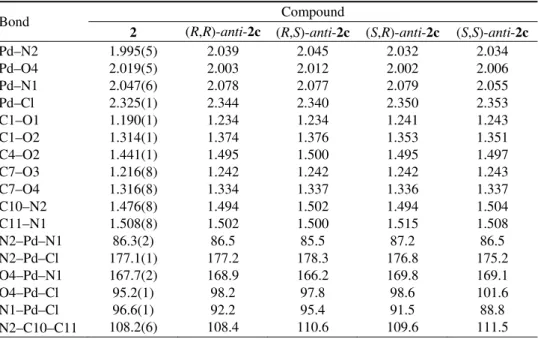
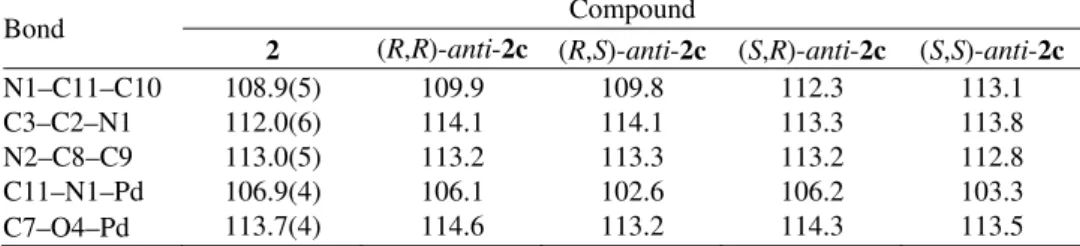
TABLE III. Selected experimentally found bond lengths (Å) and angles (°) in the molecular structure of 2 and the calculated values (2c) for the diastereoisomers of 2
Bond Compound
2 (R,R)-anti-2c (R,S)-anti-2c (S,R)-anti-2c (S,S)-anti-2c
Pd–N2 1.995(5) 2.039 2.045 2.032 2.034
Pd–O4 2.019(5) 2.003 2.012 2.002 2.006
Pd–N1 2.047(6) 2.078 2.077 2.079 2.055
Pd–Cl 2.325(1) 2.344 2.340 2.350 2.353
C1–O1 1.190(1) 1.234 1.234 1.241 1.243
C1–O2 1.314(1) 1.374 1.376 1.353 1.351
C4–O2 1.441(1) 1.495 1.500 1.495 1.497
C7–O3 1.216(8) 1.242 1.242 1.242 1.243
C7–O4 1.316(8) 1.334 1.337 1.336 1.337
C10–N2 1.476(8) 1.494 1.502 1.494 1.504
C11–N1 1.508(8) 1.502 1.500 1.515 1.508
N2–Pd–N1 86.3(2) 86.5 85.5 87.2 86.5
N2–Pd–Cl 177.1(1) 177.2 178.3 176.8 175.2
O4–Pd–N1 167.7(2) 168.9 166.2 169.8 169.1
O4–Pd–Cl 95.2(1) 98.2 97.8 98.6 101.6
N1–Pd–Cl 96.6(1) 92.2 95.4 91.5 88.8
TABLE III. Continued
Bond Compound
2 (R,R)-anti-2c (R,S)-anti-2c (S,R)-anti-2c (S,S)-anti-2c
N1–C11–C10 108.9(5) 109.9 109.8 112.3 113.1
C3–C2–N1 112.0(6) 114.1 114.1 113.3 113.8
N2–C8–C9 113.0(5) 113.2 113.3 113.2 112.8
C11–N1–Pd 106.9(4) 106.1 102.6 106.2 103.3
C7–O4–Pd 113.7(4) 114.6 113.2 114.3 113.5
The Pd–N bond lengths (1.995(5)–2.047(6) Å) are shorter than those found in palladium complexes with edta tetra-alkyl ester ligands (2.098(4)–2.106(7) Å).9,24–26 The Pd–N1 bond length is in the range for Pd(II) complexes with ethylenediamine ligands (2.03–2.09 Å).14,27 The Pd–O bond length of 2.019(5) Å in 2 is consistent with the range of values (1.999(6)–2.105(3) Å) reported for
five- and six-membered chelates containing Pd–O bonds.28,29 The Pd–Cl bond length (2.325(1) Å) is in the same range as those in [PdCl2(R4edta)] and [PdCl2(H4edta)]·xH2O (R = Me or Et; x = 5 or 6; 2.287(2)–2.298(2) and 2.30(1)
Å, respectively).9,25,26
In the structure of 2, intramolecular hydrogen bonds N1–H···O2 (N1···O2 =
= 2.838(9) Å, N1–H···O2 = 102°) and intermolecular N1–H···O3 hydrogen bonds (N1···O3 = 2.997(8) Å, N1–H···O3 = 170°, Fig. 3), which fulfill the geometric parameters given in the literature,30–33 were found. As the H atoms could not be located in the electron density map, the discussion of these hydrogen bonds is restricted to the heavy atoms. It may be possible that the hydrogen on the N1 atom participates in a bifurcated hydrogen bond, giving rise to the formation of one-dimensional chains in the crystals of 2.
Quantum chemical calculations
To investigate the selectivity of the formation of only one of the four possi-ble isomers of 2 and to presume which two isomers were formed in the case of 1,
quantum chemical calculations were employed. DFT calculations were conduc-ted for the isomers arising from the coordination of [(S,S)-(i-Pr)2eddip] and its partly hydrolyzed derivative [(S,S)-(i-Pr)eddip]– to palladium(II). The optimized
structures of the {PdCl2[(S,S)-(i-Pr)2eddip]} (1c) and {PdCl[(S,S)-(i-Pr)eddip]}
(2c) complexes are represented in Figs. 4 and 5, respectively. The structures were
fully optimized without any symmetry constraints and were found to represent equilibria structures.
In the case of complex 1c, the results showed that (R,R)-anti-1c and (R,S )-syn-1c diastereoisomers appear to be structurally and synthetically feasible (Fig. 4).
Namely, the energy difference between the (R,R)-anti-1c and (R,S)-syn-1c
Fig. 4. Calculated structures of {PdCl2{(S,S)-(i-Pr)2eddip]} (1c) (the energies
are relative to the most stable isomer (R,R)-anti-1c).
Fig. 5. Calculated structures of {PdCl[(S,S)-(i-Pr)eddip]} (2c) (the energies
-anti-1c is 4.6 kcal/mol (19.2 kJ/mol) higher in energy than (R,R)-anti-1c and the
formation of this isomer is not to be expected. This indicates that the obtained two isomers of 1, proved by NMR spectroscopy (within the sensitivity limits of
NMR spectroscopy), could be assigned as (R,R)-anti-1c and (R,S)-syn-1c. This is
consistent with a recently reported study on DFT calculations of platinum(II) complexes with the Et2edda ligand.1
Furthermore, from the quantum chemical calculations, it is apparent that three of the four isomers of 2c have more strain and that they are higher in energy
than (R,R)-anti-2c by 2.1–5.3 kcal/mol (8.8–22.2 kJ/mol) (Fig. 5). Thus, this
in-dicates that the (R,R)-anti-2c isomer is thermodynamically more stable than the
other isomers and that the energy differences correlate well with the results from X-ray crystallography and NMR spectroscopic investigations. As can be seen from a comparison of the calculated and experimental bond lengths and angles shown in Table III, the calculated values for (R,R)-anti-2c are in good agreement
with the results obtained from X-ray structural analysis. CONCLUSIONS
The present investigation shows that the [(S,S)-H2(i-Pr)2eddip]Cl2 ligand precursor reacts with K2[PdCl4] yielding the corresponding {PdCl2[(S,S)-(i-
-Pr)2eddip]} complex (1) and the palladium(II) complex with a partly hydrolyzed
ester {PdCl[(S,S)-(i-Pr)eddip]} (2). In case of 1, two from the three possible
iso-mers were detected (1H- and 13C-NMR spectroscopy). In contrast, the reaction yielding 2 is diastereoselective, only one from the four possible diastereoisomers
was formed, (R,R)-anti-2 (1H- and 13C-NMR spectroscopy, X-ray structural
ana-lysis). Quantum chemical calculations for 1 proposed the formation of the (R,R)-
-anti-1 and (S,R)-anti-1 diastereoisomers and confirmed the formation of the
(R,R)-anti-2 diastereoisomer for 2.
Acknowledgement. G. N. Kaluđerović gratefully acknowledges the financial support from the Alexander von Humboldt Foundation. The authors are grateful to the Ministry of Science and Technological Deveplopment of the Republic of Serbia for financial support (Grants No. 142010 and 142008). We thank Sebastian Schwieger (Universität Halle) for helpful discussions.
J (II) R2EDDA . I. Ј
-(S,S)-2,2'-(1,2- A ) K2[PdCl4]
Ј . Ј Ћ1, . Ђ Ћ1,2, DIRK STEINBORN2, HARRY SCHMIDT2, CHRISTOPH
WAGNER2, KURT MERZWEILER2, Ћ . Ћ3 Ј. 4 1Institut za hemiju, tehnologiju i metalurgiju
– Centar za hemiju,Univerzitet u Beogradu, Studentski
trg 14, 11000 Beograd, 2Institut für Chemie, Martin-Luther-Universität Halle-Wittenberg, Kurt-Mothes-Straße
2, D-06120 Halle, Germany, 3Departman za hemiju, PMF, Univerzitet u Kragujevcu, 34000 Kragujevac i 4Hemijski fakultet, Univerzitet u Beogradu, p.pr. 158, 11001 Beograd
K2[PdCl4] (S,S)-(i-Pr)2eddip [ -(S,S)-2,2’-(1,2-
-Pr)eddip-κ2N,N’,κO]} (2) . Ј
(1H- 13C-NMR) 2 ( ).
-2 ђ ђ
(R,R)–N,N’ . , 1
. DFT ђ
1 2.
( 24. , 6. 2008)
REFERENCES
1. G. N. Kaluđerović, H. Schmidt, S. Schwieger, Ch. Wagner, R. Paschke, A. Dietrich, T. Müller, D. Steinborn, Inorg. Chim. Acta 361 (2008) 1395
2. T. J. Sabo, G. N. Kaluđerović, S. R. Grgurić-Šipka F. W. Heinemann, S. R. Trifunović, Inorg. Chem. Commun. 7 (2004) 241
3. G. N. Kaluđerović, V. M. Đinović, Z. D. Juranić, T. P. Stanojković, T. J. Sabo, J. Inorg. Biochem. 99 (2005) 488
4. B. B. Krajčinović, G. N. Kaluđerović, D. Steinborn, H. Schmidt, Ch. Wagner, Ž. Žižak, Z. D. Juranić, S. R. Trifunović, T. J. Sabo, J. Inorg. Biochem. 102 (2008) 892
5. G. N. Kaluđerović, D. Miljković, M. Momčilović, V. M. Ðinović, M. Mostarica-Stoj-ković, T. J. Sabo, V. Trajković, Int. J. Cancer 116 (2005) 479
6. S. Mijatović, D. Maksimović-Ivanić, J. Radovica, D. Miljković, G. N. Kaluđerović, T. J. Sabo, V. Trajković, Cell. Mol. Life Sci. 62 (2005) 1275
7. J. Ruiz, J. Lorenzo, L. Sanglas, N. Cutillas, C. Vicente, M. D. Villa, F. X. Avilés, G. López, V. Moreno, J. Pérez, D. Bautista, Inorg. Chem. 45 (2006) 6347
8. E. R. Jamieson, S. J. Lippard, Chem. Rev. 99 (1999) 2467
9. G. N. Kaluđerović, H. Schmidt, Ch. Wagner, K. Merzweiler, D. Steinborn, Collect. Czech. Chem. Commun. 72 (2007) 560
10. G. N. Kaluđerović, F. W. Heinemann, N. Ž. Knežević, S. R. Trifunović, T. J. Sabo, J. Chem. Crystallogr. 34 (2004) 185
11. I. Brudzińska, Y. Mikata, M. Obata, Ch. Ohtsuki, Sh. Yano, Bioorg. Med. Chem. Lett. 14
(2004) 2533
12. B. T. Khan, J. Bhatt, K. Najmuddin, S. Shamsuddin, K. Annapoorna, J. Inorg. Biochem.
44 (1991) 55
13. C. Navarro-Ranninger, J. M. Pérez, F. Zamora, V. M. González, J. R. Masaguer, C. Alonso, J. Inorg. Biochem. 52 (1993) 37
14. S. Baggio, L. M. Amzel, L. N. Becka, Acta Crystallogr. B 26 (1970) 1698
15. G. N. Kaluđerović, T. J. Sabo, Polyhedron 21 (2002) 2277
16. D. B. Haydock, T. P. C. Mulholland, J. Chem. Soc. C (1971) 2389
17. G. M. Sheldrick, SHELXS-96, Programs for Crystal Structure Solution, University of Göttingen, Göttingen, Germany, 1997
18. G. M. Sheldrick, SHELXS-97, Programs for the Refinement of Crystal Structures, Uni-versity of Göttingen, Göttingen, Germany, 1997
19. K. Branderburg, Diamond, Release 2, Crystal Impact GbR, Bonn, 1997
Nakatsuji, M. Hada, M. Ehara, K. Toyota, R. Fukuda, J. Hasegawa, M. Ishida, T. Nakajima, Y. Honda, O. Kitao, H. Nakai, M. Klene, X. Li, J. E. Knox, H. P. Hratchian, J. B. Cross, V. Bakken, C. Adamo, J. Jaramillo, R. Gomperts, R. E. Stratmann, O. Yazyev, A. J. Austin, R. Cammi, C. Pomelli, J. W. Ochterski, P. Y. Ayala, K. Morokuma, G. A. Voth, P. Salvador, J. J. Dannenberg, V. G. Zakrzewski, S. Dapprich, A. D. Daniels, M. C. Strain, O. Farkas, D. K. Malick, A. D. Rabuck, K. Raghavachari, J. B. Foresman, J. V. Ortiz, Q. Cui, A. G. Baboul, S. Clifford, J. Cioslowski, B. B. Stefanov, G. Liu, A. Liashenko, P. Piskorz, I. Komaromi, R. L. Martin, D. J. Fox, T. Keith, M. A. Al-Laham, C. Y. Peng, A. Nanayakkara, M. Challacombe, P. M. W. Gill, B. Johnson, W. Chen, M. W. Wong, C. Gonzalez, GAUSSIAN 03, Revision C.02, Gaussian, J.A. Pople, Inc., Wallingford, CT, 2004
21. C. Adamo, V. Barone, Chem. Phys. Lett. 274 (1997) 242
22. T. H. Dunning Jr., P. J. Hay, Modern Theoretical Chemistry, 3rd Ed., Vol. 3, Plenum,
New York, 1976, pp. 1–28
23. D. Andrae, U. Häußermann, M. Dolg, H. Stoll, H. Preuß, Theor. Chem. Acc. 77 (1990) 123
24. M. Kaplun, M. Sandström, D. Boström, A. Shchukarev, P. Peresson, Inorg. Chim. Acta
358 (2005) 527
25. D. J. Robinson, C. H. L. Kennard, J. Chem. Soc. A (1970) 1008
26. X.-M. Luo, X.-H. Chen, S. Shanmuga Sundara Raj, H.-K. Fun, L.-G. Zhu, Acta Crystallogr. C 55 (1999) 1220
27. J. R. Wiesner, E. C. Lingafelter, Inorg. Chem. 5 (1966) 1770
28. A. K. Singh, J. Sooriyakumar, S. Husebye, K. W. Tornroos, J. Organomet. Chem. 612
(2000) 46
29. D. R. Billodeaux, F. R. Fronczek, A. Yoneda, G. R. Newkome, Acta Crystallogr. C C54
(1998) 1439
30. C. S. A. Fraser, H. A. Jenkins, M. C. Jennings, R. J. Puddephatt, Organometallics 19
(2000) 1635
31. C. J. Adams, A. Angeloni, A. G. Orpen, T. J. Podesta, B. Shore, Cryst. Growth Des. 6
(2006) 411
32. M. Yamada, H. Hagiwara, H. Torigoe, N. Matsumoto, M. Kojima, F. Dahan, J.-P. Tucha-gues, N. Re, S. Iijima, Chem. Eur. J. 12 (2006) 4536
![Fig. 2. Diastereoisomers of {PdCl 2 [(S,S)-(i-Pr) 2 eddip]} (1).](https://thumb-eu.123doks.com/thumbv2/123dok_br/18188457.332021/6.892.181.711.620.748/fig-diastereoisomers-of-pdcl-s-s-pr-eddip.webp)
![Fig. 4. Calculated structures of {PdCl 2 {(S,S)-(i-Pr) 2 eddip]} (1c) (the energies are relative to the most stable isomer (R,R)-anti-1c)](https://thumb-eu.123doks.com/thumbv2/123dok_br/18188457.332021/9.892.191.703.241.576/calculated-structures-pdcl-eddip-energies-relative-stable-isomer.webp)
