Artigo
*e-mail: [email protected]
SIMULTANEOUS DETERMINATION OF FOUR PHENOLIC COMPOUNDS IN EXTRACTS OF AERIAL PARTS OF Ipomoea pes-caprae (L.) R. Br. (Convolvulaceae) BY HPLC-UV
Daniela Maes Dutra, Cristiane da Silva Barth, Luciana Catia Block, Nara Lins Meira Quintão, Angélica Garcia Couto, Valdir Cechinel Filho and Tania Mari Bellé Bresolin*
Núcleo de Investigações Químico-Farmacêuticas, Programa de Pós-Graduação em Ciências Farmacêuticas, Universidade do Vale do Itajaí, 88302-202 Itajaí – SC, Brasil
Recebido em 10/04/2014; aceito em 27/06/2014; publicado na web em 28/08/2014
Among other applications, Ipomoea pes-caprae is popularly used to treat jellyfish stings, supporting the development of a product for dermatological use. Hydroethanolic spray-dried extract was chosen for the further development of phytomedicines, and a stability-indicative HPLC-UV method was developed and validated for the determination of isoquercitrin and isochlorogenic acids A, B and C. The method was developed using a C18 column (250 x 4.6 mm, 5 µm) with an acetonitrile:water mobile phase at pH 3.0 in a
gradient run. The four constituents and other unidentified components of the extract were appropriately resolved without interference of degradation products after stress tests (acid, alkali, neutral, oxidant, photolysis). The method showed linearity in the isoquercitrin concentration range from 5.0-50.0 µg mL-1, with adequate precision (RSD% < 2.5% for the intra- and inter-day studies), accuracy
(recovery of 100.0 ± 2.0%), and robustness. Both the herbal drug and spray-dried extract of I. pes-caprae were subjected to stability studies in accelerated and long-term conditions over four months. The samples maintained their characteristics and marker contents (< 10% of variation).
Keywords:Ipomoea pes-caprae; HPLC-UV; stability-indicating method; analytical validation; isoquercitrin.
INTRODUCTION
Ipomoea pes-caprae (L.) R. Br. (Convolvulaceae) is distributed in tropical and subtropical regions. It is used in folk and tribal medi-cines, specially by fisherman as an antidote to jellyfish stings, and as an antipruritic agent.1,2 A cream containing 1% of an ether extract from steam distillate of the leaves proved to be clinically effective in treating dermatitis caused by jellyfish.3 The topical anti-inflammatory effect was evidenced4 in pre-clinical studies. Viera et al.5 recently validated the technological conditions of the maceration process to produce an optimized bioactive herb extract of I. pes-caprae using 70 °GL ethanol; the authors showed the antinociceptive and anti-inflammatory effects using pre-clinical models.
The isochlorogenic acids and quinic acid esters present in I. pes-caprae showed collagenase inhibitory activity with no cytotoxicity,6 suggesting its possible use in formulations to prevent skin aging. Krogh and co-workers7 demonstrated that some compounds isolated from this plant such as glochidone, betulinic acid, alpha- and beta-amyrin acetate and isoquercitrin showed pronounced antinociceptive properties. In addition to the large number of compounds isolated from this plant,8 the presence of isoquercitrin, a commercial marker that may be used in the standardization of extracts of I. pes-caprae for the future development of phytomedicines, is of special interest. Although several studies on the chemical composition and phar-macological activity of I. pes-caprae have been published, there are practically no analytical methods for the qualitative and quantitative analyses of its plant extracts. Our research group recently developed a reverse-phase HPLC method that showed six major peaks; of these peaks, the one corresponding to isoquercitrin was chosen as the marker.5 This method, however, did not show a good enough resolu-tion between the peaks to give an overall profile of the extract and allow appropriate standardization of the extract. Therefore, as the pharmacological studies with the ethanolic extract of the aerial parts of
I. pes-caprae indicate its potential use in the treatment of dermatitis, the development and validation of methods for extract quality control and standardization are required. The stability of isoquercitrin and the other components of spray-dried I. pes-caprae extract have also not yet been reported in the literature. Stress testing is necessary in the validation of stability-indicating analytical methods;9 these tests can be used in the stability studies of derivatives and phytomedicines, and may also help to guide the pharmaceutical dosage method (i.e., gastro resistant tablet coating) and packaging.
The present work, therefore, aimed to develop and validate a stability-indicative HPLC-UV method for the determination of isoquer-citrin (ISQ) and isochlorogenic A (ISA), isochlorogenic B (ISB) and isochlorogenic C (ISC) acids. In addition, this study aimed to perform a qualitative analysis (fingerprinting) of the hydroethanolic extractive solutions and spray-dried extracts of the aerial parts of I. pes-caprae. EXPERIMENTAL
Reagents and standards
Methanol and acetonitrile (> 99%) were HPLC grade (Tedia, Fairfield, Ohio, USA) and were degassed by helium gas. The water was purified using a Barnsted Easypure system (Thermo Fisher Scientific, Suwanee, USA). Isoquercitrin and isochlorogenic acids A, B and C (> 95% of purity by HPLC) were purchased from Sigma Aldrich (St. Louis, Missouri, USA). Colloidal silicon dioxide (phar-maceutical grade) was purchased from Attivos Magisttrais (São Paulo, São Paulo, Brazil). Ethanol (99.5%) and sulphuric acid (95%) of analytical grade were purchased from Dinâmica (Diadema, São Paulo Brazil).
Plant material
specimens were authenticated by Prof. Rene Ferreira (UNIVALI). The plant samples were dried at 35 °C in a circulating air oven. A voucher specimen was deposited at the Universidade Estadual de Maringá-HUEM Herbarium (Maringá-PR, Brazil) under number HUEM 23566.
Preparation of extractive solutions and dried extracts
The aerial parts (40% of stems and 60% of leaves) were milled in a hammer mill (sieve mesh size 0.5 mm) and submitted to dynamic maceration with ethanol:water 70:30 (v/v) at plant:solvent 12.5:100 (w/v) followed by stirring for 18 hours at room temperature and filtering through Sontara® paper. The extractive solution (ES) was kept in amber-colored bottles and stored at room temperature.
The ES was evaporated under vacuum at 35 °C, resulting in a reduction of about 70% of the initial volume. To obtain the dried ex-tract (DE), the concentrate was mixed with 20% (w/w total solids of concentrate) of colloidal silicon dioxide and dried in a Büchi B-290 Spray Dryer (Flawil, Switzerland) with an inlet temperature of 170 °C and outlet temperature of 80 °C. The feed flow was 4 mL min-1, and the air pressure was 5 bar with a compressed air flow of 33 mm and an aspiration of 90%.
HPLC analysis
A Shimadzu LC-10AD LC system (Shimadzu, Tokyo, Japan) consisting of a binary pump and a Shimadzu SPD-M10A photo diode array detector were used for HPCL. Injections (20 µL) were carried out on a Phenomenex® (Torrance, California, USA) Luna C18, 5 µm (250 × 4.6 mm) column at 30 °C with detection at 254 nm. For the method development, different solvent systems were as-sayed in isocratic and gradient conditions using methanol, acetonitrile and acidified water (pH 3.0 with sulfuric acid) at 1.0 mL min-1. The best gradient was chosen as follows: acetonitrile (A): water acidi-fied to pH 3.0 with sulfuric acid (B) of 10:90 (A:B; 0 min); 15:85 (7 min); 20:80 (18-25 min); 25:75 (40 min); 60:40 (43-47 min); 10:90 (50-60 min); and return to initial conditions.
At least five individual injections of isoquercitrin standard solution were performed prior to all measurements to assess the suitability of the parameters including resolution (R) between isoquercitrin and the nei-ghboring peak (R > 2.0), the tailing factor (T) of isoquercitrin (T < 1.5) and the repeatability of the isoquercitrin peak area (RSD% < 2.0). Sample solutions
The ESsample solutions were prepared by placing 5.0 mL of ES into a 10.0 mL volumetric flask and diluting to volume with the diluent solution (1:1 v/v methanol:water acidified to pH 3.0 with sulfuric acid). An aliquot (1.25 mL) of this stock solution was transferred to a 10 mL volumetric flask, and the volume was completed using the same solvent, resulting in a concentration of approximately 1.8 mg mL-1, depending on the dried residue of the extractive solution (determined by gravimetric analysis on an infrared balance).
The DEsample solution was prepared by dissolving 80.0 mg of DE in 10 mL of the above-described diluent solution in a 20.0 mL volumetric flask. The solution was sonicated for 20 min, and the volume was completed with the same solvent. After dilution (1:1), 1.25 mL was further diluted to 10.0 mL in a volumetric flask using the same solvent, resulting in a 0.25 mg mL-1 DE solution. Standard solution
Isoquercitrin was dissolved with the same solvent to produce a working solution (25 µg mL-1). This standard solution was kept in a freezer (-20 °C) and used for analyses and validation.
HPLC-UV method validation
The HPLC-UV method was validated according to the ICH guidelines.9 The selectivity of the HPLC method was evaluated by comparing the chromatogram of a blank (diluent solution) with those of the mobile phase and the sample solution to detect any co-elution interference. To verify whether the method was stability-indicating for the isoquercitrin extractive solution (ES), forced degradation was performed to reach 5-15% degradation.10
Stress tests were performed by transferring 10 mL of the ES sample solution to a 20.0 mL volumetric flask and diluting with 4 mL of the corresponding solvent. The solution was sonicated for 20 min, and the volume was completed with the same solvent followed by stirring at room temperature (Table 1). Subsequently, 1.25 mL of the degraded sample was transferred to a 10.0 mL volumetric flask and diluted to volume with the diluent solution. The degraded samples were analyzed by HPLC, and the results were compared to those of the fresh, non-degraded ES sample solution. The milled aerial parts of I. pes-caprae (stems and leaves, 40 and 60%, respectively; 3 g in a thin layer in a Petri dish) were also exposed in a photostability chamber ((Mecalor, São Paulo, Brazil) undervisible (1.200.000 lux h-1) and UV (200 W h m-2) radiation at room temperature. A control was also performed where the sample was covered with aluminum foil in each environment. After testing, both the irradiated and control samples of the herbal drug were used to produce an ES and analyzed by HPLC as described above.
The linearity of the analytical curves was evaluated using three different procedures. In the first procedure, the isoquercitrin standard solution (200µg mL-1) was diluted in triplicate to produce six concen-trations in the range of 5.0-50 µg mL-1 and injected in duplicate. This procedure was repeated on three different days. The same analytical curve described above was spiked with a fixed volume of ES stock solution (0.25 mL of ES stock solution in all volumetric flasks of the standard analytical curve; curve B). Finally, another curve for the ES sample solution was produced by diluting the ES stock solution in triplicate to seven levels (0.24-3.5 mg g-1 of dried residue, correspond-ing to 5-40 µg mL-1 of isoquercitrin). All the analytical curves were plotted and statistically evaluated.
The limit of detection (LOD) and limit of quantification (LOQ) were calculated based on the standard deviation of the y-intercepts of regression lines.9
The accuracy of the method was estimated through the analyte recovery test,9 as detailed in curve B (described above). In addition, marker was added to the spray-dried extract as follows: in triplicate, different volumes (1.5, 1.0 and 0.5 mL, representing final concen-trations of 10.0, 20.0 and 30.0 µg mL-1) of a standard isoquercitrin solution (200 µg mL-1) were added to 5.0 mL of DE sample solution (2.5 mg mL-1), and the final 10.0 mL volume was completed with the diluent solution. The recovery of isoquercitrin was calculated after discounting the marker area from the sample solution without standard addition.
Repeatability (intra-day) and intermediate precision (inter-day) were determined through analysis (six replicates) of the ES and DE sample solutions. The RSD% of the isoquercitrin assay was deter-mined. The intermediate precision was determined by repeating the same determination over a period of two days.
solutions (0, 26, 48 and 168 h, at 30 °C, in the oven of chromato-graph). For each of the above conditions, the ES sample solution and standard solution were injected in triplicate after filtration through a 0.45 µm modified PTFE membrane. The data were evaluated
us-ing sus-ingle-factor analysis of variance (ANOVA; p < 0.05), and the RSD% was calculated.
Stability study
The raw materials (leaves and stems) and the spray-dried extract were submitted to a stability study by storage in long-term (30 ± 2 °C, 75 ± 5% of relative humidity) and accelerated conditions (40 ± 2 °C, 75 ± 5% of relative humidity) for 135 days in climatic chambers (Mecalor, EC/0,2/R-F, São Paulo, Brazil). The samples were stored in sealed polyethylene bags covered with paper and analyzed at times of 0, 45, 90 and 135 days. The samples were analyzed in terms of appearance, loss on drying (infra-red drying balance), pH and iso-quercitrin assay (by HPLC).
RESULTS AND DISCUSSION
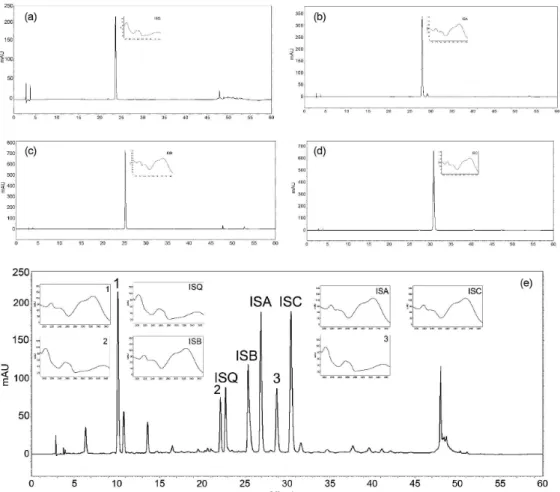
A gradient HPLC-UV method was developed for the qualitative and quantitative analysis of a hydroethanolic extractive solution and spray-dried extract of I. pes-caprae. The method was validated for the quantitative analysis of the marker (isoquercitrin-ISO; Figure 1a).
Vieira et al.5 used a similar column with a different mobile phase. The change in mobile phase composition and the gradient steps used in the present work resulted in a more suitable analytical method (Figure 1) with a satisfactory resolution (R) of four markers and their neighboring peaks (R > 2.0) in the I. pes-caprae extractive solution (Figure 1d). The markers were identified on the chromatogram when
compared with the retention times and UV spectra of authentic subs-tances. In addition, there are more than three major peaks, and the structural elucidation is currently being investigated. Peak 1 had a UV spectrum typical of those of phenolic compounds from the literature as well as ISA, ISB and ISC. Peaks 2 and 3 exhibited UV profiles typical of flavonoids, as did the ISQ. The selected conditions of the developed method (30 °C, pH 3.0 and 1.0 mL min-1 flow) presented good results for the ISQ assay, as indicated by the acceptable resolution (R = 2.0), peak asymmetry (< 1.5), purity peak (> 0.99) and area repeatability (RSD% < 2.0) determined by the suitability test. The assay of extracti-ve solution reextracti-vealed 10.80 mg g-1 ISQ (RSD% = 2.57%), 29.57 mg g-1 ISA (RSD% = 1.06%), 15.68 mg g-1 ISB (RSD% = 1.43%), and 7.68 mg g-1 ISC (RSD% = 1.87%). The spray-dried extract showed 9.17 mg g-1 ISQ (RSD% = 2.11%), 20.64 mg g-1 ISA (RSD% = 1.27%), 12.55 mg g-1 ISB (RSD% = 1.31%), and 9.47 mg g-1 ISC (RSD% = 6.52%) .
The method showed selectivity without interference of the solvent or mobile phase (data not shown) and with good marker resolution. The analysis was also carried out after degradation of the sample under different conditions to determine whether the method is stability-in-dicating. After acid, alkaline, oxidative, and visible light degradation, the degraded sample showed a slight decrease in the isoquercitrin remaining percentage (Table 1) without any significant change in the chromatographic profile (data not shown) and no overlapping with the marker peak. However, the isochlorogenic acids (A, B, C), which are markers indicative of stability, were significantly decreased under UV radiation (Table 1). As radiation affected the components of the aerial parts of I. pes-caprae, it is advisable to store the herbal drug in the appropriate packaging. In all the performed stress tests, however, the degradation peaks did not interfere with the retention
time of isoquercitrin, showing the selectivity of the developed method, which can be used in stability studies.
It is noteworthy that the development of stability indicating methods is more common for synthetic drugs11 than for plant mate-rials,12,13 as is presented in this work. In the case of herb matrices, more challenges exist in the development of stability-indicating methods due to the complexity of the active compounds compared to synthetic drugs, even considering their degradation products.
The ISQ calibration curve proved to be linear over the concentra-tion range of 5.0-50 µg mL-1. For ISA, ISB and ISC, the curves were linear over the range of 10.0-100.0 µg mL-1, as shown by the linear equations and regression coefficients (r2). The regression equations and coefficients for ISQ, ISA, ISB and ISC were y = 44284x -6138.6 (r2 > 0.999), y = 52947x + 2600.5 (r2 > 0.993), y = 88389x - 276934 (r2 > 0.997) and y = 112404x + 867891 (r2 > 0.993), respectively. These results indicate an acceptable fit of the data to the regression curves. The standard addition in the spray- dried curve showed a curve
parallel to the isolated standard without interference of the matrix on the linearity of the method. In addition, the analytical curve of ES in the range corresponding to 5-40 µg mL-1 of isoquercitrin also showed linearity (r2 > 0.999; data not shown). The method showed
high sensitivity, especially for ISQ, as indicated by the LOD and LOQ values of 0.57 and 1.88, 15.99 and 53.31, 10.19 and 33.97, 11.31 and 37.70 µg mL-1 for ISQ, ISA, ISB and ISC, respectively.
The method showed good precision on intra and inter-days with RSD% values of 1.6% and 2.3% (ISQ), 1.1% and 2.0% (ISA), 1.7% and 2.3% (ISB) and 2.21% and 3.62% (ISC), respectively, in the extractive solution.
These validation parameters indicate a good reliability for the determination of the marker level for the ES and DE of I. pes-caprae.
The robustness was estimated using the overall mean, standard deviation, RSD% and t test for area, retention time, resolution and isoquercitrin assay in the ES (Table 2). Although statistically signifi-cant differences were observed with the slight, deliberate variations at Table 1. Remaining percentage of components in the extractive solution of I. pes-caprae after stress testing
Stress condition peak 1 peak 2 ISQ ISB ISA peak 3 ISC
HCl 0.1 mol L-1 4 h 94.9 91.2 96.2 85.0 86.1 74.9 83.7
NaOH 0.01 mol L-1 4 h 92.1 85.9 97.2 100.8 67.2 76.0 92.6
H2O2 30% 3 h 95.9 94.9 94.6 98.8 95.2 84.0 95.4
UV* (200 watt h m-2) 74.1 92.2 92.9 75.3 70.0 90.8 68.5
Visible* (1.2 million lux h-1) 97.8 100.7 99.5 92.0 89.6 - 79.7
*calculated in relation to a sample control (herbal drug covered with aluminum foil and submitted to the same experimental test); ISQ = isoquercitrin; ISA = isochlorogenic acid A; ISB = isochlorogenic acid B; ISC = isochlorogenic acid C.
Table 2. Robustness of the HPLC method for the quantification of isoquercitrin in extractive solutions of I. pes-caprae
Average (RSD% intra)
Area Retention time (min) Resolution Assay of isoquercitrin (m g-1 HD)
Temperature (°C)
% RSD%inter
P value 29 30 31 1307317 (0.23) 1284977 (0.20) 1302353 (0.06) 0.79 p<0.05 23.71 (0.29) 23.89 (0.23) 23.77 (0.05) 0.39 p<0.05 2.12 (0.27) 2.12 (0.47) 2.14 (0.71) 0.46 p>0.05 4.22 (0.23) 4.14 (0.20) 4.20 (0.06) 0.99 p<0.05 Flow (mL min-1)
% RSD%inter
P value 0.9 1.0 1.1 1439412 (013) 1287335 (0.12) 1206157 (0.46) 9.03 p<0.05 25.54 (0.06) 23.85 (0.14) 23.23 (0.07) 4.96 p<0.05 2.07 (0) 2.13 (0.27) 2.16 (0.27) 2.16 p<0.05 4.64 (0.13) 4.15 (0.12) 3.89 (0.46) 9.01 p<0.05 pH of mobile phase
% RSD%inter
P value 2.88 3.0 3.1 1126867 (0.36) 1123318 (0.05) 1133985 (0.26) 0.47 p>0.05 25.89 (0.08) 24.41 (0.03) 25.40 (0.11) 2.59 p<0.05 2.12 (0.47) 2.08 (0.28) 2.10 (0.27) 0.95 p<0.05 3.63 (0.14) 3.63 (0.05) 3.64 (0.25) 0.48 p<0.05 Diluent solution
% RSD%inter
P value A B C 1134949 (2.14) 1133873 (0.44) 1152930 (2.78) 2.23 p>0.05 23.85 (0.24) 23.85 (0.23) 23.79(0.31) 0.28 p>0.05 2.07 (0.24) 2.06 (0.43) 2.03 (0.39) 0.92 p<0.05 3.66 (2.13) 3.66 (0.44) 3.72 (2.76) 0.94 p>0.05 Batch of column
% RSD%inter
P value D E 1123318 (0.05) 1095399 (0.08) 1.38 p<0.05 23.401 (0.03) 23.79 (0.20) 1.40 p<0.05 2.08 (0.28) 2,.7 (0.28) 0.36 p>0.05 3.67 (0.17) 3.54 (0.08) 2.67 p<0.05 Stability of sample
solu-tion (h)
% RSD%inter
p < 0.05, the method can be considered robust due to the low RSD% measured (< 3.0%) for all parameters except the mobile phase flow, which affected the chromatographic parameters. The demonstration of robustness is essential in the transfer of the analytical process to other laboratories. The selected conditions of the developed method (30 °C, pH 3.0 and 1.0 mL min-1 flow) produced good results for the isoquercitrin assay, as shown by the acceptable resolution (R = 2.0), peak asymmetry (< 1.5), purity peak (> 0.99) and area repeatability (RSD% < 2.0) under the routinely-analyzed suitability test.
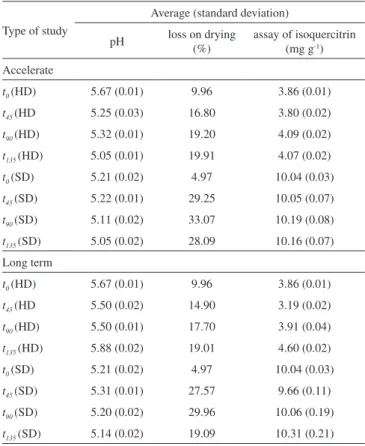
This optimized method was used in the stability studies (accele-rated and long-term for 135 days) of the herbal drug (HD) and SD of I. pes-caprae (Table 3).
The loss on drying of ES and HD increased significantly dur-ing storage, especially in the accelerated study condition at higher humidity. This demonstrated that the packaging did not protect the samples from moisture. After exposure in the accelerated condition for 135 days, both samples proved to be stable, with < 10% variation in the marker assay (Table 3). However, at the end of the long-term study, the herbal drug showed an increase of 19% in the marker assay, likely due to the lower uniformity of this sample or the instability of the components. The pH of both samples remained stable during all experiments (data not show). The results indicate the need to use a container that will better protect the samples from moisture. Following international guidelines14 for an herbal medicinal product containing an herbal substance or herbal preparation with constituents of un-known therapeutic activity, a variation in marker content during the proposed shelf-life of ±10% of the initial assay value can be accepted.
CONCLUSIONS
A selective, precise, robust and accurate HPLC-UV method has been developed for the quantification of isoquercitrin in I. pes-caprae derivatives. The method was demonstrated to be stability-indicative and suitable for assessing the stability of the herbal drug and spray-dried extract. These derivatives proved to be stable under the study conditions in the selected packaging. The results suggest that this raw material and intermediate product may be used in the future development of phytomedicines to treat dermatitis, or in cosmetic applications.
ACKNOWLEDGEMENTS
The authors are grateful to the Laboratório de Produção e Análise de Medicamentos da UNIVALI (UNIVALI-LAPAM, Itajaí, Brazil), Proppec (Proinova Edital-UNIVALI), Conselho Nacional de Desenvolvimento Científico e Tecnológico (CNPq) and Fundacão de Amparo à Pesquisa e Inovacão do Estado de Santa Catarina (FAPESC), for their financial support and to Secretaria de Educação do Estado de Santa Catarina (Edital FUMDES) to the grant to D.M. Dutra.
REFERENCES
1. Wasuwat, S.; Nature1970, 225. 758.
2. Chopade, B.A.; Wealth of India, Volumes on Biodiversity. A Dictionary of Indian Raw Materials and Industrial Products. Second Supplement Series. Raw Materials. Vol III, Council of Scientific and Industrial Re-search (NISCAIR), New Delhi, India, 2009.
3. Sunthonpalin, P.; Wasuwat, S.; Siriraj Hosp. Gaz.1985, 37, 329. 4. Pongprayoon, U.; Bohlin, L.; Sandberg, F.; Wasuwat, S.; J.
Ethnophar-macol. 1991, 35, 65.
5. Vieira, D.; Padoani, C.; Soares, J. S.; Adriano, J.; Cechinel Filho, V.; Souza, M. M.; Bresolin, T. M. B.; Couto. A. G.; Rev. Bras. Farmacogn.
2013, 23, 72.
6. Teramachi, F.; Koyano, T.; Kowithayakorn, T.; Hayashi, M.; Komiyama, K.; Ishibashi, M.; J. Nat. Prod. 2005, 68, 794.
7. Krogh, R.; Berti, C.; Madeira, A.O.; Souza, M. M.; Cechinel-Filho, V.; Delle-Monache, F.; Yunes, R. A.; Pharmazie1999, 54, 464.
8. Meira, M.; Silva, E. P.; David, J. M.; David, J. P.; Rev. Bras. Farmacogn.
2012, 22, 682.
9. ICH Quality Guideline Validation of Analytical Procedures: Text and Methodology Q2 (R1), Genebra, 2005.
10. Klick, S.; Muijselaar, P. G.; Waterval, J.; Eichinger, T.; Korn, C.; Gerd-ing, T. K.; Debets, A. J.; de Griend, C. S.; Beld, C.; Somsen, G. W.; de Jong, G .J.; Pharm. Technol.2005, 29, 48.
11. Kumar, N.; Vaghela, B.; Reddy, P. S.; Quim. Nova2012, 35, 827. 12. Cione, A. P.; Tonhi, E.; Silva, P.; In Stability Indicating Methods,
Qual-ity Control of Herbs Medicines and Related Areas; Shoyama, Y., ed.; InTech. Available from: http://cdn.intechweb.org/pdfs/23465.pdf, 2011. 13. Cesca, T. G.; Block, L. C.; Machado, M. S.; Witkowski, C.; Meyre-Silva, C.; Souza, M. M.; Quintao, N. L. M.; Lucinda, R. M.; Silva, D. B.; Fernandes, E.; Ferreira, L. S.; Lopes, N.P.; Cechinel Filho, V.; Bresolin, T. M. B.; Curr. Pharm. Anal. 2012, 8, 349.
14. European Medicines Agency, Guideline on Quality of Herbal Medici-nal Products/TraditioMedici-nal Herbal MediciMedici-nal Products. 30 March 2006 CPMP/QWP/2819/00 Rev 1. EMEA/CVMP/814/00 Rev 1, 2006. Table 3. Stability studies of the herbal drug and spray-dried extract of I.
pes-caprae
Type of study
Average (standard deviation) pH loss on drying
(%)
assay of isoquercitrin (mg g-1)
Accelerate
t0 (HD) 5.67 (0.01) 9.96 3.86 (0.01) t45 (HD 5.25 (0.03) 16.80 3.80 (0.02) t90 (HD) 5.32 (0.01) 19.20 4.09 (0.02)
t135 (HD) 5.05 (0.01) 19.91 4.07 (0.02) t0 (SD) 5.21 (0.02) 4.97 10.04 (0.03)
t45 (SD) 5.22 (0.01) 29.25 10.05 (0.07) t90 (SD) 5.11 (0.02) 33.07 10.19 (0.08)
t135 (SD) 5.05 (0.02) 28.09 10.16 (0.07)
Long term
t0 (HD) 5.67 (0.01) 9.96 3.86 (0.01)
t45 (HD 5.50 (0.02) 14.90 3.19 (0.02)
t90 (HD) 5.50 (0.01) 17.70 3.91 (0.04)
t135 (HD) 5.88 (0.02) 19.01 4.60 (0.02)
t0 (SD) 5.21 (0.02) 4.97 10.04 (0.03) t45 (SD) 5.31 (0.01) 27.57 9.66 (0.11)
t90 (SD) 5.20 (0.02) 29.96 10.06 (0.19)
t135 (SD) 5.14 (0.02) 19.09 10.31 (0.21)