Brazilian Journal of Physics, vol. 36, no. 2A, June, 2006 261
First Principles Calculations of As Impurities in the Presence
of a 90
o
Partial Dislocation in Si
T. M. Schmidt∗, J. T. Arantes†, and A. Fazzio † ∗Faculdade de F´ısica, Universidade Federal de Uberlˆandia,
Caixa Postal 593, CEP 38400-902, Uberlˆandia, MG, Brazil
†Instituto de F´ısica, Universidade de S˜ao Paulo, CP 66318, S˜ao Paulo, 05315-970, SP, Brazil
Received on 4 April, 2005
We investigated the interaction of As impurities with a 90opartial dislocation in Si. The calculations show that As atoms segregate to the dislocation core. The most stable site for the As atom is at the stacking fault side, which is favorable by 0.26 eV as compared to an As atom in a crystalline position. There is no charge transfer from the As impurity to the dislocation core when the impurity is far from it. The segregation of the impurity can be understood mainly due to structural effects. This result let us conclude that the experimentally observed negatively charged dislocations are due to impurities trapping at the core of the dislocation and not charge transfer from impurities away from the dislocation.
Keywords: First principles calculations; As impurities; Dislocation in Si
I. INTRODUCTION
Dislocations in semiconductors, in the presence of impuri-ties, have attracted considerable interest, mainly due to their influence on the electronic properties of the material which affect the fabrication and operation of electronic devices. Dis-locations can form and move during the device operation be-ing detrimental to device performance. The understandbe-ing of the interaction of point defects with dislocations is an impor-tant issue for the doping control and to elucidate how defects affect the dislocation velocity [1]. Recently, point-defects mi-gration along dislocation lines have been shown to be respon-sible for the nanostructural stability of dislocation-mediated surface [2].
Ab initio calculations [3–5] as well as experimental results [1] show that, in general, point defects in group-IV semicon-ductors as well as in zinc-blende semiconsemicon-ductors segregate to the extended defect region. An exception is verified for Mg doped GaN wurtzite in the presence of a stacking fault, where a first principles calculation showed that the impurity prefers to stay far from the stacking fault plane [6]. The interaction of point defects with dislocations usually have been described either by a local or nonlocal effect [5]. The local effect comes from the segregation of impurities in the dislocation core, and the nonlocal effect comes from the displacement of the Fermi level due to defects [7].
Among the two most important dislocations in Si, 30oand 90opartials, we focus on the latter one. It has been verified
that the 90opartial can reconstruct in different periods [8]. In this work, using a first principles calculation we investigate the interaction of substitutional As impurities with a 90o par-tial dislocation in silicon. We will show that the As impurity at the dislocation core is energetically favorable compared to the As far from the dislocation. This segregation is mainly due to structural effects.
II. THEORETICAL PROCEDURES
Ab initio total energy calculations based on the Density Functional Theory [9] have been used here. For the exchange-correlation potential we used the local density approximation (LDA) with norm-conserving pseudopotential in the Klein-man Bylander form [10, 11]. We used plane wave basis set with energy cutoff up to 150 eV, and the Brillouin zone was sampled using the Γpoint. All atoms are allowed to move until all force components are smaller than 0.025 eV/ ˚A.
The total energy has been computed with 384 and 192 atoms in orthorhombic periodic cells, in which a 90opartial dislocation dipole is introduced. This dislocation comes from a dissociated 60odislocation belonging to{111}glide planes, which is present in group-IV and zinc-blende semiconduc-tors. Each supercell contains two dislocations having oppo-site Burgers vector, with two or four reconstructions along the dislocation lines, depending on the supercell size.
III. RESULTS AND DISCUSSIONS
First, using a 192-atom supercell we compute the total en-ergy of the unreconstructed 90o partial dislocation, then we permit a single period (SP) reconstruction. There are two pos-sibilities for the SP reconstruction because the Burgers vector in the supercell needs to be zero to avoid an infinite elastic strain energy. In Fig. 1-a is showed the atomic arrangement of the SP reconstruction with parallel dislocation dipole (SPp),
while in the Fig. 1-b is the SP with non parallel dislocation dipole (SPnp). The energy required to form an unreconstructed
90opartial dislocation is 0.57 eV/ ˚A, and to reconstruct in the SP the formation energy drops to 0.43 eV/ ˚A (this is the av-erage formation energy of the two SP reconstructions). The energy difference between the two SP reconstructions is just 0.05 eV/ ˚A.
262 T. M. Schmidt et al.
band gap, differently for each reconstruction. The SPp
presents, besides the double occupied state just above the top of the valence band, two empty energy levels at the Middle of the band gap, while in the SPnpthese two empty states go up,
staying in the upper part of the band gap.
We compute the total energy for several positions of an As impurity substitutional at Si sites, as showed in Fig. 2. The most stable position for the As atom is at the dislocation core in the stacking fault side (site 3 in Fig. 2). The energy differ-ence with the As atom at this most stable position compared with the As atom far from the core is -0.26 eV, which is in agreement with previous calculation, -0.33 eV [12]. There is a segregation energy gradient with the approximation of the As to the dislocation core (see Table I).
FIG. 1. Top view of the 90o partial dislocation in a ball-and-stick representation. (a) the parallel SPp reconstruction, and (b) the non parallel SPnpreconstruction.
FIG. 2. Atomic positions at the core of the SP dislocation. The labels indicate the sites where an As atom has been substituted.
TABLE I: Segregation energy (eV) for an As substitutional around the SP reconstruction. The labels refers to the atomic sites showd in Fig. 2.
Site Energy
Out of core 0.00
1 -0.14
2 -0.13
3 -0.26
4 -0.17
5 -0.12
6 -0.02
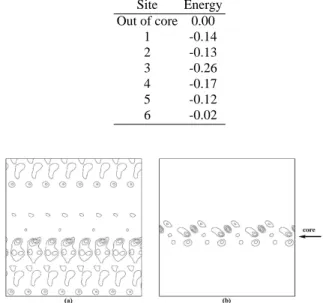
FIG. 3. Charge density of the As defect level: a) with the As atom far from the dislocation core, and b) with the As atom at the core of the dislocation.
Brazilian Journal of Physics, vol. 36, no. 2A, June, 2006 263
The presence of the As impurity at a Si site in a position far from the dislocation core breaks slightly the tetrahedral symmetry. The average bond lengths of the Si first neighbors of the impurity suffer an inward relaxation around 3%. This symmetry breaking is due to the presence of the dislocation dipole in the cell. The average bond lengths of the As impurity in the dislocation core is 2.37 ˚A, which is at the same order of the bond lengths among the Si atoms located at the dislocation core free of impurity (2.36 ˚A), and is a litle bigger than the crystalline interatomic distances, 2.35 ˚A. That makes the As atom at the dislocation core more stable than the As far from the dislocation. This results are different compared to that of As impurity in the presence of a 30opartial dislocation in Si
[5], where the structural changes does not play an important role on the stability of the impurity.
The substitutional As at a Si site introduces a single occu-pied donor level in the gap region at 0.06 eV from the bottom of the conduction band. When the As atom is at the most sta-ble position of the dislocation core (position 3 from Fig. 2), the donor level goes down pining at 0.16 eV inside the gand gap. This deeper state present a very localized charge density along the dislocation line, as we can see in Fig. 3-b. However the As atom at a crystalline environment presents typically a shallow donor level charge distribution (Fig. 3-a).
In order to clarify the origin of the stability of the As im-purity, if is a result of structural or electronic processes, we investigate the charge transfer mechanism between the im-purity and the dislocation core. We sum the total electronic charge density by atomic bilayer along the (111) direction (Fig. 4). First, we observe that the bilayer located between the seven- and four-fold coordinated rings (at the dislocation core), presents a lack of charge density compared to a bilayer far from the dislocation. This is observed for a cell with an As atom far from the dislocation (Fig. 4-a), as well in a cell free
of As atom (Fig. 4-c). Also from this figure we can see that, when the As atom is located three bilayer away from the dislo-cation core, a net charge around 1.0 of the unit electron charge stay around this bilayer, and the lack of charge at the core of the dislocation still allmost the same as compared to the As free cell (Fig. 4-c). In this way, although there is a lack of charge at the core of the dislocation, there is not charge trans-fer from the impurity to the dislocation. The charge transtrans-fer- transfer-ring occurs only when the As impurity is at the first neighbor bilayer (not shown in Fig. 4) or at the core of the dislocation as showed in Fig. 4-a. Therefore when the dislocation is neg-atively charged, as found in highly doped materials [13], the charge is due to the impurities located at the core of the dis-location and not charge transfer of impurities away from the dislocation.
IV. CONCLUSIONS
In summary our ab initio calculations show that As impu-rities segregate to the 90opartial dislocation in Si. The most stable site for the As atom is at the stacking fault side, which is favorable by 0.26 eV as compared to an As atom in a bulk site position. Differently for that has been observed from As in a 30opartial dislocation in Si [5], our results showed that there is not charge transfer from the As impurity to the dislocation core, and the segregation of the impurity can be understood mainly as structural effects.
Acknowledgments
The authors acknowledge financial support from the Brazil-ian agencies CAPES, FAPEMIG, FAPESP and CNPq.
[1] H. Alexander and J. Teichler, in Materials Science and
Technol-ogy, edited by R. W. Cahn, P. Haasen, and E. J. Kramer (VCH,
New York, 1991), vol. 4, p. 114.
[2] S. Kodambaka, S. V. ´Swie¸ch, K. Ohmori, I. Pe trov, and J. E Greene, Nature 429, 49 (2004).
[3] Jo˜ao F. Justo, Maurice de Koning, Wei Cai, and Vasily V. V. Bulatov, Phys. Rev. Lett. 84, 2172 (2000).
[4] J. F. Justo, T. M. Schmidt, A. Fazzio, and A. Antonelli, Physica B 302-303, 403 (2001).
[5] A. Antonelli, J. F. Justo, and A. Fazzio, J. Appl. Phys. 91, 5892 (2002).
[6] T. M. Schmidt, R. H. Miwa, W. Orellana, and H. Chacham, Phys. Rev. B 65, 33205 (2002).
[7] T. Susuki, S. Takeuchi, and H. Yoshinaga, Dislocation
Dynam-ics and Plasticity (Springer, Berlin, 1991).
[8] R. W. Nunes, J. Bennetto, and David Vanderbilt, Phys. Rev. B
58, 12563 (1998).
[9] P. Hohenberg and W. Kohn, Phys. Rev. 136, B864 (1964); W. Kohn and L. J. Sham, Phys. Rev. 140, A1133 (1965).
[10] L. Kleinman and D. M. Bylander, Phys. Rev. Lett. 48, 1 425 (1982).
[11] M. Bockstedte, A. Kley, J. Neugebauer, and M. Scheffler, Com-put. Phys. Commun. 107, 187 (1997).
[12] A. Maiti, T. Kaplan, M. Mostoller, M. F. Chisholm, S. J. Pen-nycook, and S. T. Pantelides, Appl. Phys. Lett. 70, 336 (1997). [13] Ph. Ebert, C. Domke, and K. Urban, Appl. Phys. Lett. 78, 480
(2001).
[14] J. Benetto, R. W. Nunes, and David Vanderbilt, Phys. Rev. Lett.
79, 245 (1997).