A cross-sectional study of oral health-related
quality of life of Piracicaba’s elderly population
Qualidade de vida pela saúde bucal em uma população de idosos
do município de Piracicaba: Um estudo transversal
Anabel Cristina Bortoletto Alcarde a Telmo Oliveira Bittar a
Denise Helena Fornazari b Marcelo Castro Meneghim a Gláucia Maria Bovi Ambrosano a Antonio Carlos Pereira a
a Community Health Department, Piracicaba Dental School, State University of Campinas, Piracicaba, Brazil
b Public Health Department, Ribeirão Preto Nursing School, State University of São Paulo, Ribeirão Preto, Brazil
Correspondence:
Telmo Oliveira Bittar
Piracicaba Dental School – State University of Campinas
Av. Limeira, 901 – Cp 52 Piracicaba, SP – Brazil 13414-903
E-mail: [email protected]
Received: March 10, 2009 Accepted: February 21, 2010
Conflict of Interest Statement: The authors state that there are no financial and personal conflicts of interest that could have inappropriately influenced their work.
Copyright: © 2010 Alcarde et al.; licensee EDIPUCRS. This is an Open Access article distributed under the terms of the Creative Commons Attribution-Noncommercial-No Derivative Works 3.0 Unported License.
Abstract
Purpose: This paper aimed to assess the self-perceived oral health status in 137 elderly from Piracicaba city, São Paulo state, Brazil, and to investigate the influence of socio-demographic variables, institutionalization status and access to dental care services on the Geriatric Oral Health Assessment Index (GOHAI) index final score.
Methods: The sample comprised institutionalized and non-institutionalized elderly, from 60 to 92 years old, socially independent or partially dependent, without significant cognitive alterations, with different educational and monthly income levels. An oral examination and two questionnaires were employed as instruments to gather subject characteristics. The first questionnaire included the 12 items of the GOHAI, and the second questionnaire gathered socio-demographic variables. The data were evaluated with a Chi-square test and logistic regression, with P < 0.05 as the significance cut-off.
Results: The GOHAI final mean score of 27.49 indicated a low oral health self-perception, and the score was significantly associated with life style and institutionalization. The risk indicators for low oral health self-perception were the demand for urgent dental care and the self-perceived need for dental treatment. These indicators correlated with a lower GOHAI score, and the differences were statistically significant (P<0.0001), demonstrating that a low oral health self-perception is directly correlated with a worse oral health clinical status. This information can be useful for planning public health policies.
Conclusion: The GOHAI final score in this study was considered low. Self-motivation and self-perception of the need for dental treatment were considered risk indicators for a low final GOHAI score.
Key words: Elderly; quality of life; GOHAI index
Resumo
Objetivo: Este trabalho objetivou medir a auto-percepção nas condições de saúde bucal de 137 idosos do município de Piracicaba, São Paulo, Brasil; considerando a influência de variáveis sociodemográficas, situação de institucionalização, e acesso aos serviços de saúde bucal sobre a pontuação final do índice GOHAI.
Metodologia: A amostra deste estudo foi composta por idosos institucionalizados e não institucionalizados, com idade variando de 60 a 92 anos de idade, socialmente independente ou parcialmente dependente, sem alterações cognitivas significantes, com diferentes níveis educacionais e renda mensal. Exame oral e dois questionários foram utilizados para coletar informações necessárias sobre os sujeitos da pesquisa: um primeiro composto pelos 12 itens do índice GOHAI, e um segundo para análise das variáveis sociodemográficas. Os dados foram tratados pelo teste do Qui-Quadrado e Regressão Logística, considerando P<0,05. Resultados: A média final do índice GOHAI foi de 27,49 denotando um baixo nível de auto-percepção, e uma associação estatisticamente significante para as variáveis estilo de vida e institucionalização. Foi considerado fator de risco para baixa auto-percepção da saúde bucal a demanda urgente por assistência odontológica e a necessidade sentida pelo paciente para assistência odontológica, resultando em um baixo índice GOHAI, com diferença estatisticamente significante (P<0,0001), provando que uma baixa auto-percepção da saúde bucal tem correlação direta com uma pior condição clínica de saúde bucal, podendo ser utilizado para planejamento em saúde pública.
Conclusão: A pontuação final do índice GOHAI neste estudo é considerada baixa. Auto-motivação e auto-percepção para necessidade de assistência odontológica foram considerados indicadores de risco para uma baixa pontuação do índice GOHAI.
Introduction
The elderly population has increased continuously in the last decades all over the world. According to the World Health Organization, the Brazilian population over age 65 will number over 1.2 billion by the year 2025 and will represent the sixth largest elderly population in the world (1). In contrast to developed countries, developing countries like Brazil have undergone a typical demographic and epidemiological transition to a higher number of elderly inhabitants (2). However, this transition was not followed by an appropriate adjustment to public oral health assistance to attend to the needs of this population, resulting in a lack of oral health quality of life.
Oral health status plays an import role in patient quality of life, affecting mental, physical and psychological well being and complete social development by interfering with word pronunciation, social life and alimentary function (3). Historically, the Brazilian oral public health service has been
deicient in providing the elderly population appropriate
dental care. Cross-sectional studies have shown a high number of cavities, periodontal disease and need for oral rehabilitation in its aging society (4-9).
In general, studies usually take into account clinical aspects of disease measurements such as many indexes, relegating patient self-perception to a second tier. Therefore, the concept of Oral Health-Related Quality of Life (OHRQoL) is established by some questionnaires,
including the Oral Health Impact Proile (OHIP), Oral
Impacts on Daily Performance (OIDP) and Geriatric Oral Health Assessment (GOHAI), to assess patient self- perception (10, 11).
The Geriatric Oral Health Assessment Instrument (GOHAI), developed by Atchison and Dolan, aims to complement clinical measures by paying special attention to problems related to physiological, physical and psychological needs (12). As life expectancy increases worldwide, especially in the Brazilian population, and as the elderly population (older than 60 years) increases, such measures must be taken into account for planning and assuring the quality of life of this population.
This present paper evaluates elderly oral health self-perception in the Piracicaba municipality, São Paulo state, Brazil, using the GOHAI index, taking into account socio-demographic, economic and cultural variables.
Methods
This observational study was approved by the Piracicaba Dental School Committee on Human Research under protocol 093/2007. The convenience sample was composed of 137 volunteers, with 90 institutionalized patients from the Betel Social Assistance and Elderly Home and 47 non-institutionalized persons engaged in city sports and physical activity projects. Volunteers were aged from 60 to 92 years and included 68 males and 69 females.
After signing the informed consent form, the allocated sample underwent an initial questionnaire to gather information regarding gender, age, marital and socioeconomic status, life style, education, monthly family income and the use of or need for removable prosthesis.
The second part of the questionnaire was utilized to gather information regarding dental appointment frequency, motivational aspects on acquiring dental care, preventative measures and the need for dental treatment. Afterwards, a dental surgeon performed oral examinations, and oral health statuses were collected under the World Health Organization protocol (13).
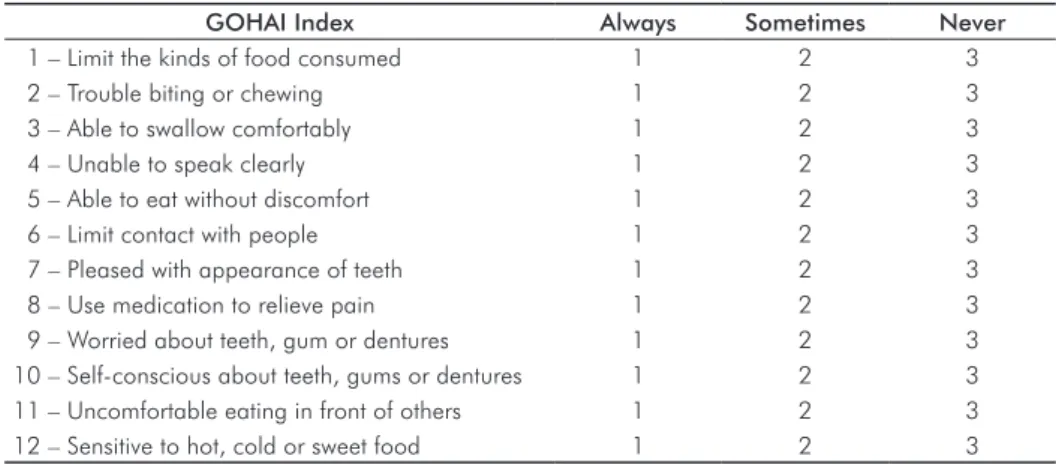
Aiming to evaluate elderly oral health self-perception, GOHAI utilizes the original questionnaire composed of 12 items divided in 3 dimensions that address physical function, pain and discomfort, and psychosocial aspects (14). Patients were questioned about the frequency at which they experience any of 12 listed problems, using a three-value scale (Table 1). The
inal score was classiied as high (34-36 points), moderate (31-33 points) and low (≤ 30 points) self-perception.
Data were analyzed with a univariate analysis in which samples were dichotomized, and a Chi-square test was implemented to measure associations. Independent variables with P<0.15 were tested by a multiple logistic regression and using P<0.05 as the signiicance threshold. All statistics were performed using the program SAS version 8.0.
GOHAI Index Always Sometimes Never
1 – Limit the kinds of food consumed 1 2 3
2 – Trouble biting or chewing 1 2 3
3 – Able to swallow comfortably 1 2 3
4 – Unable to speak clearly 1 2 3
5 – Able to eat without discomfort 1 2 3
6 – Limit contact with people 1 2 3
7 – Pleased with appearance of teeth 1 2 3
8 – Use medication to relieve pain 1 2 3
9 – Worried about teeth, gum or dentures 1 2 3
10 – Self-conscious about teeth, gums or dentures 1 2 3
11 – Uncomfortable eating in front of others 1 2 3
12 – Sensitive to hot, cold or sweet food 1 2 3
Results
The sample was composed of 137 volunteers, divided into 90 institutionalized and 47 non-institutionalized, 69 female and 68 male, with a mean age of 72.14 years. The marital status revealed 55 widowed, 34 married, 28 single and 20 divorced.
Of the 137, 7 were illiterate, 99 had inished elementary school, 24 had inished high school, and only 7 had a college or
university degree. Regarding the economic status, only 1.5% had a monthly income ten times higher than the minimum wage, 38% earned two to ten times the minimum wage, and 61% earned up to two times the minimum wage.
Regarding oral rehabilitation, 78% of the volunteers wore removable prosthesis, whereas 22% did not wear prosthesis. Of the volunteers, 31% had the self-perception that they needed a removable prosthesis, whereas 68.61% indicated that they did not need prosthesis rehabilitation.
All volunteers had been to dental appointments previously; however, only 32% had been in the last year. Private health service accounted for 72 of dental health attendance compared to 28% for the public health service.
When asked about the motivation for seeking a dental appointment, routine check-ups accounted for 51% of sample, whereas 49% indicated pain or discomfort, such as gingival bleeding, dental cavities, oral wounds or facial swelling.
The GOHAI mean score was 27.5, indicating a low self-perception of oral health by the allocated sample. The maximum value was 36 points, and the minimum value was 17 points. Comparing the scores from institutionalized and non-institutionalized individuals, scores were 27 and 28, respectively (Fig. 1).
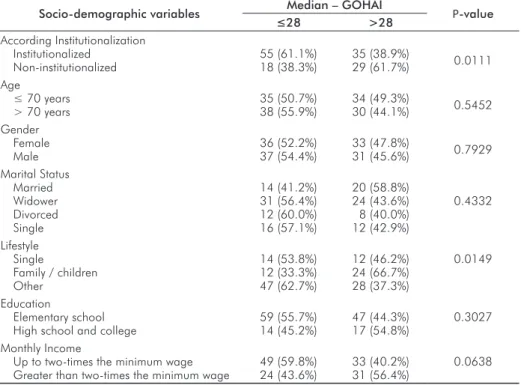
As shown in Table 2, the univariate analysis between socio-demographic variables and self-perception showed no statistical association considering age, gender, marital status, education and monthly income. However, a
signiicant statistical result was found between life style and
institutionalization and the GOHAI score. Institutionalized elderly registered a lower score compared to non-institutionalized (P=0.0111). Subjects living alone or out of a familiar environment registered a lower score compared to subjects living in a familiar environment (P=0.0149, Fig. 2).
Socio-demographic variables Median – GOHAI P-value
≤28 >28 According Institutionalization
Institutionalized Non-institutionalized
55 (61.1%) 18 (38.3%)
35 (38.9%)
29 (61.7%) 0.0111 Age
≤ 70 years
> 70 years
35 (50.7%) 38 (55.9%)
34 (49.3%)
30 (44.1%) 0.5452 Gender
Female Male
36 (52.2%) 37 (54.4%)
33 (47.8%)
31 (45.6%) 0.7929 Marital Status
Married Widower Divorced Single
14 (41.2%) 31 (56.4%) 12 (60.0%) 16 (57.1%)
20 (58.8%) 24 (43.6%) 8 (40.0%) 12 (42.9%)
0.4332
Lifestyle Single
Family / children Other
14 (53.8%) 12 (33.3%) 47 (62.7%)
12 (46.2%) 24 (66.7%) 28 (37.3%)
0.0149
Education
Elementary school High school and college
59 (55.7%) 14 (45.2%)
47 (44.3%) 17 (54.8%)
0.3027
Monthly Income
Up to two-times the minimum wage Greater than two-times the minimum wage
49 (59.8%) 24 (43.6%)
33 (40.2%) 31 (56.4%)
0.0638
Table 2. Univariate analysis for associations between socio-demographic variables and the GOHAI index.
Fig. 1. GOHAI mean score per institution.
29
28
27
-26
Total Sample Non Institutionalized Institutionalized Betel Assistance Home Elderly Home
28
27 27 27 27
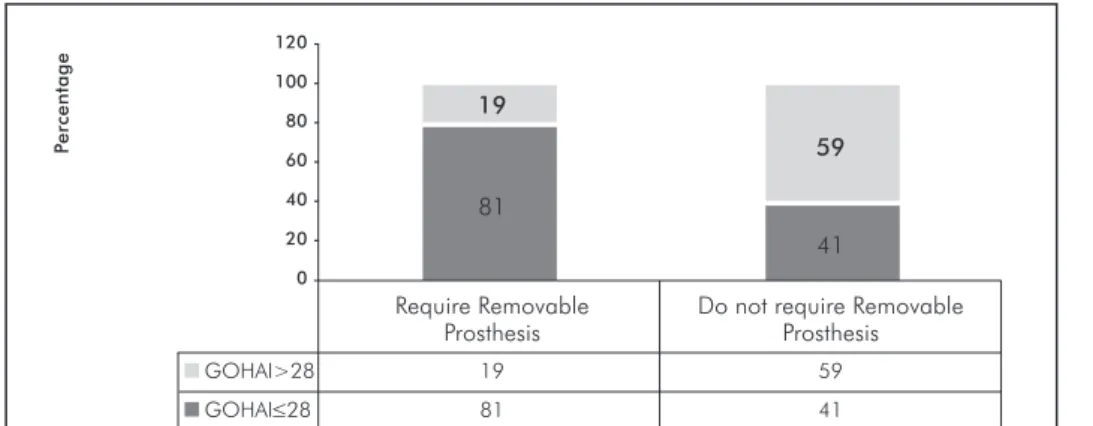
There was no statistically signiicant difference between
GOHAI score and the subjects wearing removable prosthesis. Subjects who mentioned the need for prosthesis
rehabilitation had signiicantly lower scores than those who
believed they did not need prosthesis treatment (P<0.0001; Fig. 3 and Table 3).
Considering the univariate analysis for dental care and the GOHAI index, no association was found between the last appointment or the type of dental attendance and the
GOHAI inal score, but motivational factors and self-perception of the need for treatment had a signiicant
statistical association.
Fig. 2. The distribution of subjects according to institutionalization and life style and the GOHAI median.
Independent Variables GOHAI – Median P-value
≤28 >28 Prosthesis users
No Yes
17 (60.7%) 56 (51.4%)
11 (39.3%) 53 (48.6%)
0.3770
Prosthesis required No
Yes
39 (41.0%) 34 (80.9%)
56 (59.0%) 8 (19.1%)
<0.0001
Independent Variables GOHAI – Median P-value
≤28 >28 Last appointment
Less than 1 year Over 1 year
25 (56.8%) 48 (51.6%)
19 (43.2%) 45 (48.4%)
0.5685
Type of service Public health service Private service
25 (62.5%) 48 (49.5%)
15 (37.5%) 49 (50.5%)
0.1650
Motivational factors Routine check-ups
Pain, dental cavity, gingival bleeding, etc.
22 (31.4%) 51 (76.1%)
48 (68.6%) 16 (23.9%)
<0.0001
Need for treatment Yes
No
56 (71.8%) 17 (28.8%)
22 (28.2%) 42 (71.2%)
<0.0001 Fig. 3. The sample distribution according use and need for removable prosthesis and the GOHAI median.
Table 3. The univariate analysis for associations between the use of and need for removable prosthesis and the GOHAI score.
Table 4. Univariate analysis of dental care and the GOHAI index.
39
62 46 67 37
61 38 54 33 63
Institutionalized Non Livingalone Family Others
institutionalized Environment
GOHAI>28 39 62 46 67 37 GOHAI≤28 61 38 54 33 63
Sample P
ercentage
120 100 80 60 40 20 -0
-P
ercentage
120
100
80
60
40
20
-0
19
59
81
41
Require Removable Do not require Removable
Prosthesis Prosthesis
The results of the logistic regression analysis are presented in Table 5. These results revealed that likely risk factors for low GOHAI scores were motivation for dental care and self-perception of the need for dental treatment. Therefore, subjects who urgently demand dental care had a 4.80-times greater chance of having a lower GOHAI, and those who thought that they needed dental treatment had a 6.67-times greater chance of having a lower GOHAI score.
Discussion
According to the Brazilian Institute of Geography and Statistics, the life expectancy of Brazilian women is 7.8 years higher than that of men (1). However, in the present study, both genders had a similar age distribution, which might be explained by the encouragement of men to participate in this research.
The sample age ranged from 60 to 92 years, with a mean age of 72 years, in accordance with previous elderly studies performed in Brazil (6,15-18). Regarding the marital status, a high self-perception was expected from divorced, single and widower subjects because these groups are usually motivated to establish new relationships, in contrast to married or engaged groups, who presented a lower score. Similar to the results regarding marital status described above, the group living in a non-familiar environment
had a signiicantly lower GOHAI score compared to other groups. Institutionalization variables also inluenced the inal GOHAI score. Non-institutionalized elderly presented
a higher self-perception in the univariate analysis compared to the institutionalized group, probably due to the familiar environment. The same result was found by Rodrigues (17) when comparing institutionalized and non-institutionalized elderly in the Piracicaba municipality.
Education variables had no statistically signiicant effect on the GOHAI inal score for the three levels of education
analyzed here. However, it must be considered that this sample included only 5% elderly with college or university degrees.
In general this sample presented a low monthly income, with most volunteers’ monthly incomes situated at a level of up to two-times the minimum wages; further, some of the individuals had no monthly income. Even though no
inluence was observed concerning monthly income and the GOHAI inal score, the sample characteristics might be taken into account. These elderly income indings are in agreement
with a previous study in Brazil by the Brazilian Institute of
Geography and Statistics (IBGE) (19). A study by Atieh in Saudi Arabia (14) also found no considerable differences in GOHAI scores when socio-demographic variables such as gender, education and socio-economic status were taken into account.
Though the majority of this sample had a low monthly income, private health service was the main service utilized. According to Ramos and Lima (20), this result might be due to the excessive time required to begin treatment in the Brazilian public health system after setting up an appointment.
More than 78% of subjects in this study are prosthesis users, showing a high percentage of edentulous people at this age. Similar results were found by Pereira et al. (6), Scelza et al. (21) and Reis et al. (16). The need for a prosthesis treatment in this study was considerably low, accounting for only 31% of the sample, compared to the result of Reis et al. (16), who found that over 80% of their sample required prostheses.
Over 67% of this sample had not been to a dental ofice for
over one year; these results are in agreement with Saliba et al. (22), who found that 88% of elderly in the municipality of Araraquara, Brazil, attend dental appointments every two years. The results show a lower self-perception by the Brazilian elderly, probably attributed to a high number of edentulous people. Arranging dental appointments only in urgent or emergency cases was considered in this present study to be a sign of low self-perception, with these patients scoring 4.8-times lower than those who attended routine appointments, according to the logistic regression. Thus, motivational variables are consistent in indicating self-perception for elderly patients scoring high on the GOHAI index. These results are in agreement with data reported in Saudi Arabia by Atieh, where GOHAI scores were higher among participants who had a lower number of cavities, number of missing teeth, pathological mobility and number of oral lesions.
Notwithstanding, more than half of this sample claimed
the need for dental treatment, in accordance with Saliba et al. (22), who found that 67% of their sample had dental treatment needs. However, elderly who claimed to need dental treatment had a 6.67-times greater chance of scoring under the GOHAI median in the logistic regression analysis compared to those who did not claim dental treatment needs. Thus, the needs for dental treatment might be considered a low-risk indicator for self-perception in elderly. Similar results were found by Atieh in Saudi Arabia (14), where patients who perceived their oral health status as good were Table 5. Data Logistic Multiple Regression Analysis.
Characteristics Low GOHAI Odds Ratio Odds Ratio (CI) P-value
Dental Care Routine
Pain, gingival bleeding, dental cavity or face swelling
22 (31.4%) 51 (76.1%)
1.00
4.80 2.00-16.6 <0.0001
Need for treatment Yes
No
56 (71.8%) 17 (28.8%)
6.67
more likely to have a signiicantly higher GOHAI score
compared to those who perceived their oral health as fair.
In this present study, the GOHAI inal score of 27.5 indicates
a low self-perception of oral health in Brazilian elderly living
in the municipality of Piracicaba, similar to the inding of
Rodrigues with a score of 28 (17). Comparing the GOHAI mean to other countries, results vary from 52 in Spain (12),
46 in Malaysia (23) and 12 in China (24), relecting the inluence of cultural aspects on the GOHAI inal score.
Clinical oral features alone are not an adequate measure for the assessment of dental treatment needs because
self-perception also stimulates dental self-care and motivates the population to seek dental care. Hence, self-perception enquiries must be integrated into routine surveys in order to improve the quality of oral dental services.
Conclusions
The GOHAI inal score was considered low, indicating a
low self-perception by the elderly Brazilian sample. The combination of motivation and self-perception for dental
treatment is a risk indicator for a low GOHAI inal score.
References
1. IBGE – Instituto Brasileiro de Geografia e Estatística, 2000. Disponível URL: http://www.ibge.org.br [2007 Out 20].
2. Kalache A, Veras RP, Ramos LR. O envelhecimento da população mundial: um desafio novo. Rev.Saúde Pública 1987;21:200-10. 3. Wener CW, Saunders MJ, Paunovich E. Odontologia geriátrica. Rev
Fac Odont Lins 1998;11:62-70.
4. Rosa AG, Castellanos RA, Pinto VG. Saúde bucal na terceira idade. RGO 1993;41:97-102.
5. Pereira AC, Queluz DP, Meneghim MC. Condições periodontais em idosos usuários do Centro de Saúde “Geraldo de Paula Sousa”, São Paulo, Brasil. Rev Fac Odontologia de Lins 1996;9:20-25. 6. Pereira AC, Silva FR, Meneghim MC. Prevalência de cárie e
necessidade de prótese em uma população geriátrica institu- cionalizada da cidade de Piracicaba-SP. ROBRAC 1999;8:17-21. 7. Meneghim MC, Saliba NA. Condição de saúde bucal da população
idosa de Piracicaba – SP, 1998. Rev Pos Grad 2000;7:7-13. 8. Meneghim MC, Pereira AC, Silva FR. Prevalência de cárie radicular
e condição periodontal em uma população idosa institucionalizada de Piracicaba – SP. Pesqui Odontol Bras 2002;16:50-56. 9. Carvalho OL. Condições e autopercepção da saúde bucal em adultos
e idosos. [dissertação]. Piracicaba (SP): UNICAMP/FOP; 2005. 10. Hassel AJ, Rolko C, Koke U, Leisen J, Rammelsberg P. A German
version of the GOHAI. Community Dent Oral Epidemiol 2008;36: 34-42.
11. Helbing E, Pereira AC. Oral health-related quality of life: a critical appraisal of assessment tools used in elderly people. Gerodontology 2007;24:151-161.
12. Gil-Montoya JA, Subirá C, Ramón JM, Gonzáles-Moles MA. J Publ Health Dent 2008; 68:88-93.
13. World Health Organization. Oral health surveys. Basic methods. 4th ed. Geneva: WHO, 1997.
14. Atieh MA. Arabic version of the geriatric oral health assessment index. Gerodontology 2008;25:34-41.
15. Torres SV. Pacientes odontogeriátricos: um estudo exploratório sobre saúde bucal e qualidade de vida [tese]. Campinas (SP): UNICAMP/ Faculdade de Educação; 2003.
16. Reis SC, Higino MA, Melo HM, Freire MC. Condição de saúde bucal de idosos institucionalizados em Goiânia – GO, Brasil. Rev Bras Epidemiol 2005;8:67-73.
17. Rodrigues CK. Autopercepção de saúde bucal em idosos [dissertação]. Piracicaba: UNICAMP/FOP; 2005.
18. Murakami AM, Moysés SJ, Moysés ST. Eqüidade frente à necessidade de prótese dentária na população de 65 a 74 anos de idade em Curitiba. Epidemiol.Serv Saúde 2007;16:139-41
19. IBGE. Pesquisa Nacional de Amostras por Domicílio PNAD – 2006. [Acessado em 2007 dez 2]. Disponível em: http://www.ibge.gov.br 20. Ramos DD, Lima MA. Acesso e acolhimento aos usuários de uma unidade de saúde de Porto Alegre, Rio Grande do Sul, Brasil. Cad Saúde Pública 2003;19:27-34.
21. Scelza MF, Rodrigues C, Silva VS, Faria LC, Câmara V, Scelza Neto P. Saúde bucal dos pacientes do programa interdisciplinar de Geriatria e Gerontologia da UFF. RBO 2001;58:351-354.
22. Saliba CA, Saliba NA, Marcelino G, Moimaz SA. Saúde bucal dos idosos: uma realidade ignorada. Rev Assoc Paul Cir Dent 1999;53:279-82.
23. Othman WN, Muttalib KA, Bakri R, Doss JG, Jaafar N, Salleh NC et al. Validation of the Geriatric Oral Health Assessment Index (GOHAI) in the Malay language. J Publ Health Dent 2006;66: 199-204.