788 Brazilian Journal of Physics, vol. 34, no. 3A, September, 2004
The Utilization of a Cyclotron CV-28 in Basic and Applied Nuclear
Research and in an Experimental Accelerator Driven System Zero
Power Lead Sub Critical Facility
Jos´e Rubens Maiorino, Valdir Sciani
1, and S´ergio An´efalos
21Instituto de Pesquisas Energ´eticas e Nucleares, Caixa Postal 11049, 05422-970, S ˜ao Paulo, SP, Brazil 2Instituto de F´ısica, Universidade de S˜ao Paulo, Caixa Postal 66318, 05315-970, S˜ao Paulo, SP Brazil
Received on 12 September, 2003
This paper describes the IPEN Cyclotron CV-28, and its utilization in basic and applied physics and to drive a zero power lead Accelerator Driven System (ADS), as a milestone in a road map for a program or network on the utilization of accelerators. Preliminary results for a conceptual lead sub critical cubic matrix with square or hexagonal metallic U pins driven by a proton beam (24 MeV; 50µA) are shown. These results demonstrate the
feasibility to use the CV-28 to drive the zero power ADS.
1
Introduction
As previously reported the utilization of accelerators in sub critical systems for energy generation and mainly for nuclear waste transmutation, deserves an international attention in R&D programs. Also a proposal of a national program or net work of research on the utilization of accelerators in ba-sic and applied nuclear research, products and services and an experimental accelerator driven system (ADS) was pro-posed [1]. To achieve the final goal, that is to have a medium size accelerator facility that could be used in the fields de-scribed above, a road map should be followed. One of the milestones of this road map is to have a zero power sub crit-ical facility driven by accelerator, which would allow to ini-tiate R&D in the experimental physics of ADS and to partic-ipate in the international effort being conducted to provide data on such innovative nuclear system. This paper will de-scribe how the IPEN CV-28 cyclotron could be used in the scenario described above.
2
The Cyclotron CV-28
2.1
Description
The cyclotron model CV-28, manufactured by The Cy-clotron Corporation USA, is a compact, isochronous, multi-propose radiation source were protons, deuterons, 3
He++ and alpha particles can be accelerated with variable energy up to 24, 14, 36 and 28 MeV respectively. It is a versa-tile machine and can be used in research and development in many fields such as radioisotope production, excitation functions studies, nuclear reactions, materials science and others. Although it has seven external beam lines avail-able, only three are operational and are located inside the cy-clotron vault. The nominal characteristics are shown in Ta-ble 1.
TABLE 1. Nominal characteristics of the cyclotron CV-28. Particle Energy (MeV) Iext(µA) Iint(µA)
H+ 2-24 40-60 200
2H+ 4-14 50-100 300
3He++ 6-36 5-50 135
He++ 8-28 6-40 90
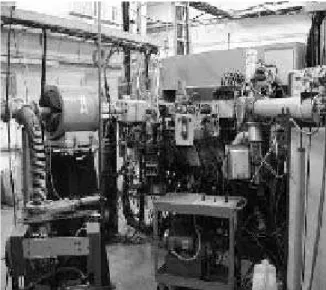
Reference 2 contains a detailed description of the CV-28 cyclotron and Fig. 1 illustrates the CV-28 Vault.
Jos´e Rubens Maiorinoet al. 789
TABLE II. Zero Power ADS in the world[6].
Facility Place Accelerator Source
Sub Critical Status Utilization FEAT
CERN Geneve Switzerland
Proton Synchrotron
Natural. Metal U
Hex. pin water-TH (k=0.92)
Validation of MC codes, ADS Gain
YALINA Misk Belarus
Neutron Gener-ator (D-T) 1012n/s
10w/o UO2pin in a CH2C(TH) k<0.98
Operational and Reactiv-ity Spectra Dy-namics Experiments MAZURCA
MUSE CEA -Cadarache -France
Deuteron GENEPI Acc.(D-T) 109n/s or252Cf
Several Config-uration - Fast, sodium, Pb-Bi;U-Pu fuel
Operational Eu-ropean Bench-mark, Kinetics and dynamics LA-0 NG-2
Czech Republic
Cyclotron U-120M Be-Target
Molten Fluo-ride Salt Fuel
Planned, Design stage
India 400 KV neutron D-T Generator
Not defined Planned
TEF-P JAERI Proton Beam(600 MeV) Spallation Pb-Bi 1012n/s
Fast Split Table, 100W
Planned, design transmutation, Control, reactor physics
2.2
Utilization of CV-28
The use of cyclotron beam covers a wide range of applica-tions in Basic and Applied Physics as described in reference 3, and in short they are: Charged Particle Activation Analy-sis (CPAA), Thin Layer Activation (TLA), Neutron Radio-graphy, Rutherford Back Scattering (RBS), Elastic Recoil Detection Analysis (ERDA), Particle Induced X ray Emis-sion (PIXE), Radiation Damage and Basic Research. Of course, there are many other uses, such as proton therapy, ion implantation, micro filters etc. Moreover, since the CV-28 has only three available beams, the scientific community has to choose among the several possibilities which one is more attractive. Without being conclusive looks like the CV-28 could be used in the following utilization: (1) to drive a zero power ADS, as will be discussed bellow, (2) Radiation Damage and (3) TLA.
3
The Zero Power ADS
Power and Waste Burner ADS are still on the stage of development, and although several concepts are underway [4,5,6,7], none of them have been built. R&D activities are being developed in several fields, such as in Reactor Physics, Nuclear Data, Target, Fuels, Thermal Hydraulics, Spalla-tion Physics and TransmutaSpalla-tion etc. For Reactor Physics and Nuclear Data, experimental facilities operating at zero power (few watts) are in operation or being planned, with the purpose to provide experimental benchmark on
calcula-tion methodology and nuclear data. Table 2 summarizes the main facilities in operation or on planning.
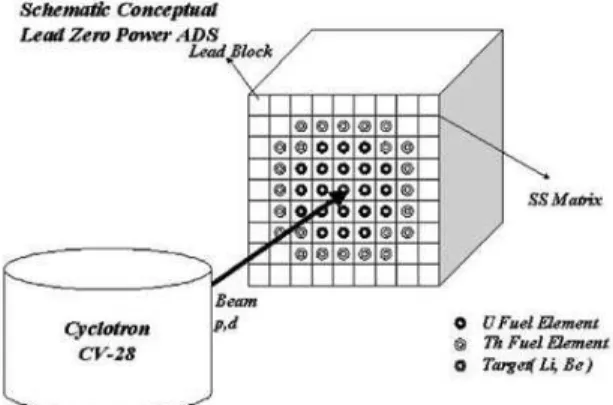
Given the conceptual modified fast energy ADS under study [8,9], it is proposed a solid lead zero power ADS, us-ing U/Th fuel, and usus-ing as neutron source proton or deu-terium from the CV-28 in a Be or Li target, or 14 MeV neu-tron from a D-T reaction from a 400 kV existing Van de Graff. Here we will describe the feasibility study made by using the CV-28. The proposed conceptual sub critical, is illustrated in Fig. 2 and in short it consist of lead blocks sup-ported by a SS structure, containing holes in which the fuel elements are inserted. Given the low power, it is cooled by air natural convection.
790 Brazilian Journal of Physics, vol. 34, no. 3A, September, 2004
3.1
Neutron Source Term
The external neutron source to drive the Zero Power ADS, using CV-28, could be induced by nuclear reaction of pro-tons or deuterons with targets of Beryllium or Lithium to produce fast neutrons. Experimental results of the neutron yield, angular and spectral distribution were obtained by Lone [10]. Fig. 3 illustrates the experimental results for the neutron source intensity.
Figure 3. Neutron Source Intensity.
From these data, for thick Be target, the CV-28 (EP= 24 MeV, I = 50µA), can provide neutrons with intensities 1011
-1012
n/s, and average energy 5.1 MeV (En= 1.14xEp1.13). Also the Lone experimental results were reproduced by LA-HET [11], and the results obtained were in good agreement. Therefore in the simulations, the source term was calculated by LAHET.
3.2
Calculation Methodology
The methodology employed in this work is shown in Fig. 4. It is based in the LAHET [11] and MCNP-4C [12] code sys-tems. LAHET is the LANL version of the HETC Monte Carlo for the transport of protons. Its geometric transport ca-pability is that of LANL’s continuous energy neutron-photon Monte Carlo code MCNP-4C. The calculation methodology is made of two parts. In the first part LAHET performs the transport of protons and the subsequent characterization of the neutron and gamma sources arising from the nuclear re-actions in the target. For this purpose, LAHET employees a Monte Carlo approaches for the transport of protons through the lead target. The sources are writing in special files de-nominated as NEUTP for neutrons and GAMTP for gamma for subsequent MCNP-4C utilization. Beyond that, LAHET has also the capability to calculate the energy deposited in the target as well as the reaction products. The second part of the calculation methodology concerns the kef f determi-nation and the transport of neutrons and gamma through the fuel core and its surroundings. This task is accomplished by the continuous energy neutron-photon Monte Carlo code MCNP-4C. The nuclear data needed for MCNP-4C are gen-erated by NJOY [13] accessing the ENDF/B-VI nuclear data file.
Figure 4. The methodology employed in this work is based in LA-HET and MCNP-4C code systems.
3.3
Cases Simulated and Results
There are some options that were taken into account. Basi-cally there are two ways to define the fuel pin distribution: square lattice and hexagonal lattice. In the first one two con-figurations were designed, where the basic difference is the fuel pin diameter. The diameter varies from 2.5 cm to 10.0 cm, and the reason is purely due to manufacturing capabil-ity at IPEN. The core containing fuels with diameter of 10 cm, has a total amount of fuel about 7,000 kg with 48 fuel pins (case 1). In the second case (2.5 cm diameter) the to-tal amount of fuel are 10,000 kg and 1080 fuel pins. In the hexagonal geometry, the fuel pin diameter is 1.138 cm and the amount of fuel is 4,600 Kg and 5490 fuel pins (case 3). The first idea was to use natural Uranium, but due to the re-stricted space that is available (1 m3
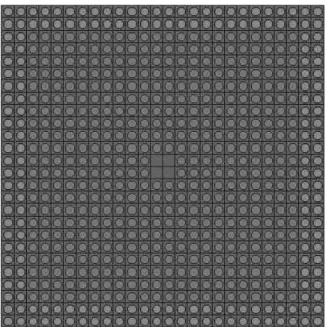
), the multiplication fac-tor obtained for this configuration was too small (∼0.36), too far from the desired value 0.95. The adopted solution was to use enriched fuel. The ideal percentage obtained to each configuration is shown in Table 3. The most suitable configuration so far is the case 2 shown in Fig. 5.
TABLE III. Results
Cases kef f Mass (kg) Power (W)
case 1 0.95 7,000 0.05
case 2 0.96 10,000 150
Jos´e Rubens Maiorinoet al. 791
Figure 5. Case 2. Square configuration core: fuel pin diam. = 2.5 cm, pith = 3 cm, enrichment = 8.5% .
4
Conclusions
The CV-28 is a suitable accelerator to be used in Basic and Applied Physics as well as to drive a zero power ADS. Its utilization would allow that the proposed net work of R&D be initiated toward in a final goal that is to have a new medium size accelerator to be utilized in R&D, Products, Services and a power experimental ADS. Additional studies needs to be made to evaluate the feasibility to operate the CV-28 in the present building, or to construct a new build-ing or cave. The preliminary results shows that it is feasible to drive a lead zero power sub critical of∼1 m3, with∼ 100 watts, metallic uranium(∼9w/o enriched), kef f=0.96, using a proton beam (24MeV, 50µA) into a Be target (1011 -1012
n/s) using CV-28. Additional calculations need to be made to refine the sub critical, such as pitch (square or hexagonal), enrichment, etc.
References
[1] J.R. Maiorino et al., Brazilian Journal of Physics33, 267 (2003).
[2] G. Lucky et all, “Isochronous Variable Energy Cyclotron of IPEN-CNEN Instalation, Uses and Perspective”, IV Japan-Brazil Symposium on Science and Technology, pp.146-153-S˜ao Paulo (1984).
[3] K. Ziegler, “Materials Research with Beams at Cyclotron Energies”, 13th International Conference on Cyclotrons and their Application, pp 149-153- Vancouver(1992).
[4] C. Rubbia et al., “ Conceptual Design of a Fast Neutron Oper-ated High Power Energy Amplifier”, European Organization for Nuclear Research, CERN/AT/95-44-ET (1995). [5] The European Technical Working Group on Ads. An
Eu-ropean Roadmap for Developing Accelerator Driven Sys-tems (ADS) for Nuclear Waste Incineration. 2001. (ISBN 88-8286-008-6).
[6] International Atomic Energy Agency, “Review of National Accelerator Driven System Programs for Partition and Trans-mutation”, IAEA-TECDOC-1365(2003).
[7] IAEA TWG-FR, “Review of National Programs on Fast Re-actor and Accelerator Driven System(ADS)”, Working Ma-terial on a Technical Meeting, Karlshure, Germany, 22-26 April, IAEA-TM-25032(2002).
[8] J.R. Maiorino et al., “Alternative Concept for a Fast Energy Amplifier Accelerator Driven Reactor”, Research and Devel-opment Brazilian Journal,31, 13 (2001).
[9] J.R. Maiorino et al, “A New Proposal for the Fast Energy Am-plifier”, Radiation Physics and Chemistry,61, 789 (2001). [10] M.A Lone et al., “Characteristic of Neutrons from Be
Tar-gets Bombarded with Protons, Deuterons, and Alpha Parti-cles, Nuclear Instruments and Methods,189, 515 (1981).
[11] R. E. Prael and H. Linchtenstein, “User Guide to LCS: The Lahet Code System ”, LA-UR-89-3014, Los Alamos Na-tional Laboratory, USA (1989).
[12] J. F. Briesmeiter, “MCNP-4C- A General Monte Carlo N-Particle Transport Code-Version 4C”, Los Alamos National Laboratory, LA-13709-M(2000).