Article
*e-mail: [email protected]
Photoeletrocatalytic Oxidation of Anionic Surfactant used in Leather Industry on
Nanoporous Ti/TiO
2Eletrodes
Fabiana M. M. Paschoal,a Marc A. Andersonb and M. Valnice B. Zanoni*,a
aDepartamento de Química Analítica, Instituto de Química, Universidade Estadual Paulista,
Av. Prof. Francisco Degni, s/n, CP 355, 14801-970 Araraquara-SP, Brazil
bEnvironmental Chemistry and Technology Program, University of Wisconsin-Madison, 660 N. Park Street,
Madison, WI 53706, USA
A oxidação fotoeletrocatalítica de solução 0,009% (m/v) do surfactante aniônico comercial, Tamol, foi investigada em Na
2SO4 0,1 mol L
-1 empregando-se ânodos de filme fino de Ti/TiO 2.
Utilizando-se as melhores condições experimentais, potencial de +1,0 V, irradiação UV e pH 2,0 foi possível obter 100% de remoção do dispersante monitorado por espectrofotometria na região do UV e 94% de remoção de carbono orgânico total (COT) após 90 min de fotoeletrólise. O método foi ainda aplicado para remoção do surfactante na presença do corante acido vermelho 151 e após 90 min de tratamento observa-se que o método promove a remoção de 98% da cor concomitante à diminuição de 81% do carbono orgânico total da solução.
The photoeletrocatalytic oxidation of 0.009% (m/v) of commercial surfactant Tamol in
0.1 mol L-1 Na
2SO4 was investigated on thin-film of TiO2 as photoanode.Using the best experimental
condition, E = + 1.0 V, pH 2.0 and UV irradiation were obtained 100% of surfactant removal followed by 94% of total organic carbon (TOC) removal after 90 min of photoelectrocatalytic treatment. The method was applied to surfactant removal in the presence of acid red 151 dye. After 90 min of treatment the method promoted 98% of discoloration concomitant to reduction of 81% total organic carbon of the resulting solution.
Keywords: surfactant oxidation, photoelectrocatalysis, photoelectrochemistry, thin-film electrodes, Ti/TiO2
Introduction
As dyes solubilization in surfactant micelles plays an important role in dyeing process, residual surfactants and their degradation products discharged to sewage treatment plants or directly to surface waters are object of concern.1,2
Dyeing of leather is one of the most important steps in post tanning operations in leather production, in which anionic surfactant is used to stabilize the color and also to improve the fixation onto the three-dimensional structure of the fiber involved in leather.1-3 According to the literature,3
both anionic and nonionic surfactants at concentrations ranging from 0.0025 to 300 mg L-1, give toxic effects to
various aquatic ecosystem. Tamol is a commercial anionic surfactant based on naphtelene sulphonic being frequently
used in the leather dyeing stage. The growing use of this kind of surfactant is in disagreement with the scarce of treatment methods present in the literature to remove them from surface water.4-19
Many water treatment methods based on removal of organic polluting agents are in many cases expensive and inefficient. Therefore, new methods and technologies of water treatment have being explored with the aim to reach complete mineralization of contaminants. Studies on photodegradation of surfactants with the use of heterogeneous photocatalysis with TiO2 as substrate have shown efficient degradation.4-12 Electrochemistry
coagulation method was also investigated and presented good results.13 Lin et al.14 have investigated the
coupling biodegradation process with photochemical treatment15 that reach 74% of surfactant removal
and with ozonization16 that increase the removal
efficiency of the surfactant to 50%. The application of photoelectrochemistry to study degradation of sodium dodecylbenzenesulfonate surfactant has been published by Hidaka et al.17 The method is based on
oxidation on TiO2/SnO2 thin-film electrode and the results point to 89% of surfactant removal after 4 h of photodegradation.
The present study aimed at investigating the degradation of a commercial anionic surfactant being frequently used in leather industry by photoelectrocatalytic oxidation on Ti/TiO2 anodes. Nanostructured semiconductor Ti/TiO2 thin-film electrodes have been extensively studied.20,21 Titanium dioxide itself has been prepared by
the sol-gel chemistry method and coated on a different supports to produce thin-film photoelectrodes as reported previously.22,23 Besides the electrochemical stability,
these new electrodes have large internal surface areas, which contribute to higher efficiency for decontaminating organic pollutants.24-27
In the present work, the feasibility of photoelectrochemical oxidation of a commercial anionic surfactant, Tamol, in sodium sulphate solution using titanium dioxide thin-film electrodes prepared by the sol-gel method was investigated. The effects of azo dye on the degradation rate of this surfactant were evaluated. Photoelectrocatalytic methods are then optimized to situations close to that occurring in textile effluent.
Experimental
Preparation of Ti/TiO
2 thin-film electrodes
Titanium (IV) isopropoxide (Aldrich) was used as a precursor for preparing TiO2 colloidal suspensions. Typically, 20 mL of titanium isoporpoxide were added to a nitric acid solution keeping the ratio Ti/H+/H
2O at
1/1.5/200. The resulting precipitate was continuously stirred until completely peptized to a stable colloidal suspension. This suspension was dialyzed against ultrapure water (Milli-Q Millipore) to a pH of 3.5 with a Micropore 3500 MW cut off membrane. Thin-film photoelectrodes were dip-coated onto a titanium foil back contact (0.05 or 0.5 mm thick, Goodfellow Cambridge Ltd.), after heating the Ti foils to 350 °C. A sequence of dipping, drying and firing at 350 °C for 3 h were used after each coating (five repetitions), according a procedure described earlier.20,22,23,27
Apparatus and procedure
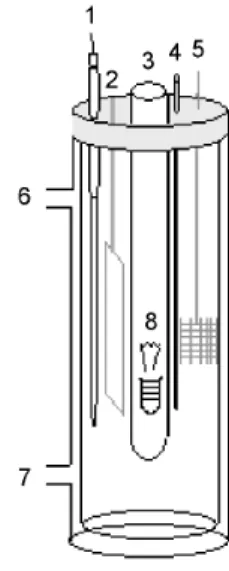
Photoelectrocatalytic oxidation experiments were performed in a 250 mL reactor (Figure 1) equipped with water refrigeration using an ultra-thermostatic bath (Nova Técnica, Brazil) at constant temperature of 25°C. In the cell, was positioned a working electrode, an auxiliary electrode and a Ag/AgCl electrode placed close to the working electrode using a bridge tube containing a Vycor frit tip. The photoactive area of the anode (TiO2) was 12 cm2 and it was
illuminated by a UV light source (315-400 nm) from a 125 W Philips medium pressure mercury lamp (I = 9.23 W/m2)
without the glass, inserted in a quartz bulb separated 2.5 cm from the photoanode. Surfactant and dye in 0.1 mol L-1
Na2SO4 solutions were placed in the reactor without any pre treatment and the photoelectrochemical process was carried out bubbling compressed air. A Pt gauze electrode was used as counter electrode.
A potentiostat/galvanostat EG & G PARC Model 283 controlled by an electrochemical 270 software was used to bias the photoanode in the photoelectrocatalytic oxidation experiments. All pH measures of Tamol and acid red 151 dye solutions in 0.1 mol L-1 Na
2SO4 were made by pHmeter
Corning 555. In experiments where pH was kept constant, 0.1 mol L-1 NaOH solution or H
2SO4 solution was added
to the cell in order to control the pH.
Surfactant Tamol concentration and acid red 151 in the solution were monitored by measuring the surfactant samples absorbance and dye solutions at controlled time using a Hewlett Packard 8453 spectrophotometer operating
from 190-1,000 nm in quartz cell. Total organic carbon (TOC) was monitored using a total organic carbon analyzer (Shimadzu 5000A).
Chromatographic conditions
A high performance liquid chromatograph Shimadzu Model 10 AVP coupled with a photodiode array detector was used to separate and identify products and intermediates of the surfactant oxidation. The separation column was C-18 (4.6 mm × 250 mm, 5 µm) and the mobile phase was acetonitrile:water (80:20) flowing at 1.0 mL min-1. Signals
obtained from detector were analyzed by area integration. Standard curves and quantitative analysis of standard Tamol were carried out by linear regression plotting peak area vs. concentration. The procedure was carried out in triplicate for each sample.
Results and Discussion
Characteristics of the photoanode
The effect of surfactant Tamol on curves of photocurrent
vs. potential recorded for oxidation on nanoporous electrode of Ti/TiO2 in 0.1 mol L-1 Na
2SO4 is shown in Figure 2.
Typically, the voltammograms recorded at the nanoporous TiO2 film electrode in the dark do not shown any oxidation peak under UV irradiation, but as expected for an n-type semiconductor electrode such as TiO2 produces a high anodic photocurrent at potentials positive (−0.40V) to the flat band potential, as shown in curve b of Figure 2. The photocurrent is markedly decreased in the presence of surfactant,as shown in curvesc-g, Figure 2. The influence of surfactant concentration on the photocurrent values taken at E = +0.4V, decreases markedly when Tamol concentration is increased in solution up to 0.010% (m/v), then reaches saturation (Figure 3). Using the data fit to a Langmuir- Hinshelwood28 model plotting
1/Iphs vs. 1/Cof Tamol, (C = surfactant concentration (% m/v) and Iphs is the photocurrent measured at E = +0.4V), one can observe that in the low concentration region (< 0.015% m/v) a straight line is obtained and agrees well with the model, suggesting that the main mechanism operating here is via adsorption of surfactant molecules onto the electrode surface. So, at higher Tamol concentration, there is a small constant photocurrent flux, attesting the competitive process responsible for lower efficiency in photogenerated charges separation. Therefore, photoelectrocatalysis could be an efficient alternative only to treat wastewater containing diluted Tamol solution as 0.009% (m/v), which conditions was adopted in the present work and it is close to that verified for leather industry effluent.
Photoelectrocatalytic oxidation of Tamol surfactant
As calculated from onset potential measurements, the flat-band potential for TiO2 in 0.1 mol L-1 Na
2SO4
media is about –0.38 V, and optimal performance of photoelectrocatalysis oxidation of surfactants has been obtained at applied potentials around +1.0 V. At this potential there is always gradient potential over the titanium film, resulting in an electric field, which keeps photogenerated charges (h+ and e− generated on the electrode surface due irradiation of UV light lower than 380 nm) apart. As a result, rate of recombination decreases and oxidation of the adsorbed water on the electrode surface generates powerful oxidants such as OH• radicals that promote faster dye decomposition and dispersing agent in the solution. In agreement with previous studies,24,29-33 all experiments were
Figure 2. Photocurrent/potential curves obtained for TiO2 thin-film
electrode in 0.1 mol L-1 Na
2SO4 (Curve b) under UV illumination and
in dark conditions (Curve a). Scan rate = 10 mV s-1. Addition of Tamol surfactant: Curve (c) 0.00075%, Curve (d ) 0.0030%, Curve (e ) 0.0075%, Curve (f) 0.015% and Curve (g) 0.030% (m/v).
Figure 3. Graphs of 1/Iphsvs [Csurfactant]
-1obtained from linear voltammograms
recorded for TiO2 thin-film electrode in 0.1 mo l L -1 Na
2SO4 under UV
carried out using +1.0 V as applied potential were good performance is obtained for Ti/TiO2 anodes.
UV-Vis spectra obtained before and after the photoelectrocatalytic oxidation of 0.009% (m/v) Tamol surfactant in 0.1 mol L-1 solutions of Na
2SO4 on Ti/TiO2
anodes are exhibited in Figure 4. The surfactant has shown two main bands at 285 nm (A) and 224 nm (B) attributed to the aromatic centre of naphthalene sulphonic derivative of the molecule. But, the photoelectrocatalytic oxidation promotes rapid degradation. This degradation process significantly modifies the chemical structure of surfactant, as shown by the total suppression after 90 min of electrolysis of the absorbance peaks at all UV region. In practice, this species completely disappeared after 120 min of electrolysis.
In Figure 5, performance of the TiO2 thin-film photoanode in surfactant removal is evaluated as Percentage removal (%) of the surfactant and plotted in a time-dependent scale as follows: i) absorbance monitored at 288 nm; ii) 204 nm. Percentage removal is the ratio of surfactant concentration variation at time (Ct) to the initial dye concentration (C0) in solution at t = 0. Concentration was determined by monitoring the absorbance of surfactant, from the UV-Visible absorption spectra as a function of time (shown in Figure 4). The percentage of all aromatic centre of the molecule reaches 100% after 60 min of photoelectrocatalytic oxidation, but removal at 285 nm is faster than at 224 nm.
pH influence on photoelectrocatalytic oxidation of
surfactant Tamol
From a typical half-reaction occurring on the TiO2 photoanode (equations 1-3) the minority charge carriers
photogenerated upon illumination on the photoanode can oxidize the H2O/OH− producing OH• radicals that adsorb on the photoelectrode surface with the release of H+ ions
to the solution. Thus, the reaction depends on the pH of the solution. The process can be resumed by the following equations:24
TiO2 + hn→ TiO2 - ecb− + TiO
2 - hvb
+ (1)
TiO2 + hvb+ + H
2Os→ TiO2 - OHs
• + H+ (2)
TiO2 - hvb+ + OH s
−→ TiO
2 - OHs
• (3)
As these reactions act to acidify the anode, hydrogen evolution (2H2O + 2e− → H
2 + 2OH−) can generate a
concomitant increase in the pH at the cathode. For this reason all the photoelectrocatalysis experiments were carried out maintaining the pH constant by correction of pH values.
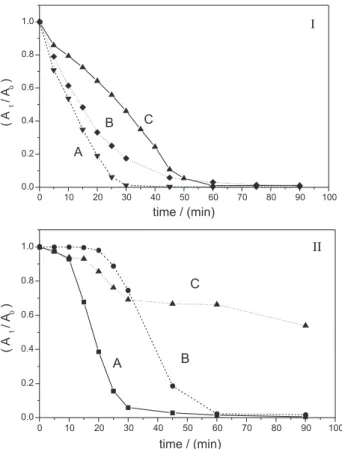
The results comparing the surfactant degradation monitored at 285 nm and 224 nm during photoelectrocatalytic oxidation at pH 2, 6 and 12 presents marked difference as shown Curve I and II of Figure 6, respectively. The results illustrate that high surfactant degradation is more favorable at pH values maintained around pH 2, but the degradation reaches 100% after 60 min of photoelectrocatalysis for both pH 2 and 6. On the other hand, by fixing the pH in 12 one stabilizes the pH and there is no need to add sodium hydroxide to correct the pH change during reaction, but the efficiency is markedly diminished.
The dependence of the initial degradation rate evaluated from slopes of the curves obtained for surfactant consumption (% m/v) monitored at 285 nm as function of time (s) at different pH is linearly decreased with the increase of photoelectrocatalytic oxidation concentration, following the equation: ln C/Co = −kt (where, C = concentration
Figure 4. UV spectra obtained for 0.009% (m/v) Tamol® in Na 2SO4
0.1 mol L-1 after photoelectrocatalytic oxidation at +1V and UV irradiation.
Time of electrolysis: (1) 0 min; (2) 15 min; (3) 30 min; (4) 60 min and (5) 90 min.
Figure 5. Graphs of percentage of surfactant removal during 90 min of photoelectrocatalytic oxidation on Ti/TiO2 anodes under E = +1V and
of Tamol at time t, C
o = concentration of Tamol at time = 0
and k = rate constant). This suggests that the initial rate for removal of surfactant follows a first order process with respect to Tamol. But, the respective values of rate constant obtained for surfactant degradation are 0.0703 min–1 for
pH 2, 0.0539 min–1 for pH 6 and 0.0213 min-1 for pH 12
(n = 3), indicating that at alkaline conditions the process is always slower than acidic conditions.
Since the surface charge of the titanium dioxide electrode is influenced by solution pH and by dissolved species, previous studies24 measuring the zeta potential
for suspended TiO2 particles as function of the pH of the suspension have indicated that isoelectric point for TiO2 was found to be 5.0. Taking into consideration that the surfactant Tamol is an anionic compound the applied positive potential on the working electrode may increase its adsorption. At pH values higher than the isoelectric point, negative ions are repelled from the TiO2 surface. In addition, by increasing the solution pH, concentration of OH− also increases, which is responsible for hydroxyl radical generation during the photocatalytic oxidation process. As a consequence, surfactant adsorption percentage could be diminished in conditions where the solution pH is higher than the
isoelectric point pH. In addition, carbonate formation could be occurring at pH 12, which could decrease the efficiency of photoelectrocatalysis, since carbonate is well known hydroxyl radical scavenge.
HPLC analysis of the photoelectrocatalytic oxidation of
surfactant Tamol
In order to optimize the best chromatographic elution, 20 µL of surfactant at concentration of 0.009% (m/v) was submitted to chromatographic separation testing acetonitrile/water at ratios of 80:20 (v/v); 75:25 (v/v) and 65:35 (v/v) monitoring the diode array detection operating at 285 nm. Chromatographic parameters as retention time, retention constant factor (tr) and resolution among peaks (r) were evaluated for the species under the experimental conditions proposed. The best condition was obtained for acetonitrile/water at ratios 80:20 v/v, which leads to an acceptable separation, good resolution between peaks (r > 1.5) and analysis time around 10 min. Figure 7, curve A exhibits a typical chromatogram obtained for surfactant. The chromatograms are characterized for a main peak at 3.5 min attributed to the surfactant peak, which increases linearly with Tamol concentration from 0.00075% (m/v) to 0.07% (m/v) and two others small peaks at 2.5 and 2.1 min due impurities presented in the commercial sample of Tamol donated by the Textile industry.
Figure 7 compares the effect of 90 min of photoelectrocatytic oxidation at E = +1.0 V from 0.009% (m/v) of Tamol in Na
2SO4 0.1 mol L
-1 on the
chromatographic performance operating with diode array detector. The main peak is decreased markedly and is completely vanished after 30 min of photoelectrocatalysis. It is also observed that after 60 min of photoelectrocatalysis
Figure 6. Effect of pH on the photoelectrocatalytic oxidation of surfactant Tamol® in Na
2SO4 0.1 mol L-1. Absorbance monitored at 285 nm (I) and
224 nm (II). (A) pH 2; (B) pH 6 and (C) pH 12.
Figure 7. HPLC chromatograms with diode array detection obtained for 0.009% (m/v) Tamol® in Na
2SO4 0.1 mol L
-1 pH 2.0 submitted
to photoelectrocatalytic oxidation during (A) 0 min; (B) 5 min; (C) 10 min; (D) 20 min; (E) 30 min (F) 60 min and (G) 90 min. Mobile phase: 80:20 acetonitrile/phosphate buffer 1 × 10⁻³ mol L-1, T = 40 ºC,
the baseline do not show any residues of surfactant or impurities. Also the chromatograms recorded for diode array operating from 200 to 800 nm do not exhibit any significant signal, suggesting that there is no measurable by-products generated after photoelectrocatalytic oxidation. The respective decreasing in peaks areas are shown in Figure 8. All the peak areas corresponding to the surfactant decreased after 90 min, suggesting that the photoelectrocatalytic technique could be a good treatment for anionic surfactant.
TOC removal for surfactant Tamol
From data above it is clear that the direct electrooxidation of surfactant Tamol has a higher reaction rate on TiO
2
thin-film electrodes. The major practical interest in using the photoelectrocatalytic method is complete mineralization of surfactant. In this context, experiments have been conducted by monitoring the total organic carbon (TOC) removal under the same operational conditions used for surfactant removal.
TOC results obtained for aliquots of 0.009% (m/v) in 0.10 mol L-1 of Na
2SO4 in different values of pH submitted
to photoelectrocatalytic treatment during 90 min at potential of +1.0 V, under UV illumination are presented in Figure 9. The results obtained reaches maximum TOC removal values of 94.0% and 90.0% at pH 2.0 and pH 6.0, respectively. The high TOC removal obtained at pH 2 indicates that the mineralization of surfactant is very high, but on the other hand TOC removal is neglected at pH 12.0. Although the UV-Vis spectra pointed to excellent removal of the band at 285 nm, TOC analysis indicates that by-products are formed during the photoelectrocatalytic oxidation and alkaline medium must be avoided.
Photoelectrochemical pretreatment of the surfactant under leather dye preparation conditions
In this part of the study, it was aimed to submit the anionic surfactant at an initial solution containing an azo dye assigned as acid red 151 commonly used in leather dyeing to mimic effluent from its preparation stage. For this experiment, a solution containing 0.003% (m/v) of acid red 151 dye + 0.009% (m/v) Tamol® in 0.1 mol L-1 Na
2SO4, pH 2.0 was submitted
to photoelectrocatalytic oxidation during 90 min. Concentrations of both acid red dye 151 and surfactant monitored at wavelength of 500 nm and 285 nm, respectively decreases during treatment, are shown in Figure 10. It can be seen that the treatment leads to a decreasing of 98% of the original acid red dye after 90 min. Curve B decreasing rate is slower when compared to the
Figure 8. Graphs of media values of the area corresponding to the peak at 3.52 min obtained from HPLC-DAD chromatograms recorded for sample removed during photoeletrocatalytic oxidation of 0.009% (m/v) Tamol® in Na
2SO4 pH 2.0.
Figure 9. Effect of pH on the total organic carbon removal obtained during photoelectrocatalytic oxidation of 0.009% (m/v) Tamol in Na
2SO4
0.1 mol L-1 at (A) pH 2; (B) pH 6 and (C) pH 12.
Figure 10. Percentage of removal of 0.003% (m/v) acid red dye 151 coloration monitored at 500 nm (A) and 0.009% (m/v) surfactant agent Tamol®monitored at 285 nm (B) as a function of time of
photoelectrocatalytic treatment on TiO2 thin-film electrode in 0.1 mol L-1 Na
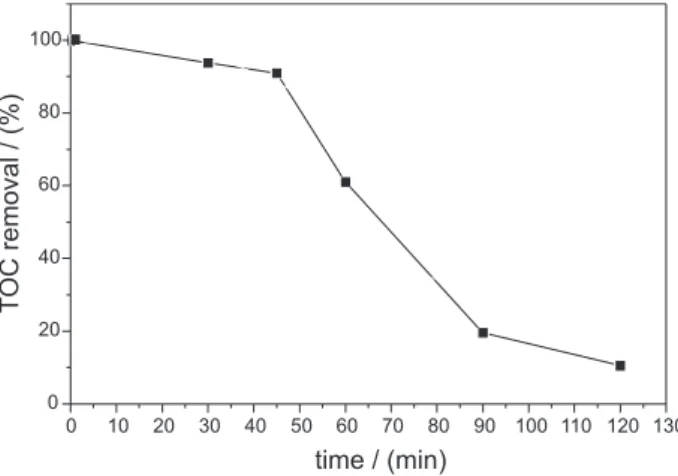
dye, but reaches 95% after 90 min of photoelectrocatalysis oxidation, demonstrating that the method could be explored for both dye and surfactant treatment. TOC abatement was also measured and the result is shown in Figure 11. As it can be seen, a maximum mineralization of 81.3% is reached after 90 min of photoelectrocatalytic oxidation. The results suggest that there is no total mineralization to CO2 of the dye containing surfactant solution but the photoelectrocatalytic results are very significant when compared to other processes described in the literature,4-12,19
and very close to those obtained for photoelectrochemical oxidation of solution containing only the surfactant.
The results indicate that TiO2 thin-film photoelectrodes prepared by sol-gel chemistry technique has proven to be a powerful, efficient alternative to usual approaches in degradation of both azo family acid dye and surfactant. This is importante, since most of the wastewater treatments for remediation of surfactant available until now are mainly on phase transfer techniques.
Conclusion
An alternative method for the degradation of surfactant widely used in leather industry is proposed. The best conditions for maximum photoelectrocatalytic oxidation were found to be at pH 2 and at a potential of +1V. In these conditions, it is possible to reach 100% of surfactant removal monitored by HPLC and UV spectra and 94% of mineralization measured by TOC removal. The photoelectrocatalytic method describe here has shown that degradation rates are rapid compared to alternative oxidation process. Results were tested to treat anionic textile surfactant in the presence of acid dye used in the leather industry and the results were quite satisfactory. In conclusion,
photoelectrochemical technique can potentially be applied to treat anionic textile surfactant at low concentration, since a dramatic reduction in both dye and surfactant amount can be obtained after short time of treatment.
Acknowledgments
The authors would like to thank financial support from Brazilian funding agencies FAPESP, process 04/07353-7, CAPES and CNPq.
References
1. Gustavson , K. H.; The Chemistry and Reactivity of Collagen, V.C.H. Publishers: New York, 1992, pp. 43-45, 136-140. 2. Alaton, I. A.; Erdinc, E.; Water Res. 2006, 40, 3409.
3. Schrank, S. G; Santos, J. N. R.; Souza, D. S.; Souza, E. S.; J.
Photochem. Photobiol.A2006, 186, 125.
4. Horikoshi, S.; Watanabe, N.; Onishi, H.; Hidaka, H.; Serpone, N.; Appl. Catal. B2002, 37, 117.
5. Horváth, O.; Bodnár, E.; Hegyi, J.; Colloids Surf. A2005, 265, 135.
6. Zhang, T.; Oyama, T.; Horikoshi, S.; Zhao, J.; Serpone, N.; Hidaka, H.; Appl. Catal. B2003, 42, 13.
7. Zhang, R.; Gao, L.; Zhang, Q.; Chemosphere 2004, 54, 405. 8. Hidaka, H.; Nohara, K.; Zhao, J.; Pelizzetti, E.; Serpone, N.; J.
Photochem. Photobiol. A1995, 91, 145.
9. Dai, Q.; Zhang, Z.; He, N.; Li, P.; Yuan, C.; Mater. Sci. Eng.C 1999, 8-9, 417.
10. Oyama, T.; Aoshima, A.; Horikoshi, S.; Hidaka, H.; Zhao, J.; Serpone, N.; Sol. Energy 2004, 77, 525.
11. Sánchez, L.; Romero, E.; Peña, A.; Chemosphere2005, 59, 969.
12. Zhang, H.; Quan, X.; Chen, S.; Zhao, H.; Zhao, Y.; Appl. Surf. Sci.2006, 252, 8598.
13. Önder, E.; Koparal, A. S.; Öğütveren, Ü. B.; Sep. Purif. Technol.
2007, 52, 527.
14. Lin, S. H.; Lin, C. M.; Leu, H. G.; Water Res. 1999, 33, 1735.
15. Arslan-Alaton, I.; Erdinc, E.; Water Res. 2006, 40, 3409. 16. Arslan-Alaton, I.; Alaton, I.; Ecotoxicol. Environ. Saf.2007,
68, 98.
17. Hidaka, H.; Ajisaka, K.; Horikoshi, S.; Oyama, T.; Takeuchi, K.; Serpone, N.; J. Photochem. Photobiol.A2001, 138, 185. 18. Fachini, A.; Joekes, I.; Clean Soil Air Wat. 2007, 35, 100. 19. Soares, E. T., Lansarin, M. A., Moro, C. C.; Braz. J. Chem. Eng.
2007, 24, 29.
20. Anderson, M. A.; Gieselmann, M. J.; Xu, Q. Y.; J. Membrane Sci. 1988, 39, 243.
21. Spanhel, L.; Anderson, M. A.; J. Am. Chem. Soc. 1991, 113, 2826.
Figure 11. Percentage of dissolved total carbon organic removal of a solution containing 0.003% (m/v) of acid red 151 dye + 0.009%(m/v) of Tamol® in 0.1 mol L-1 Na
2SO4 pH 2.0 submitted to photoeletrocatalytic
22. Candal, R. J.; Zeltner, W. A.; Anderson, M. A.; J. Adv. Oxid.
Technol.1998, 3, 270.
23. Candal, R. J.; Zeltner, W. A.; Anderson, M. A.; J. Environ.
Eng-ASCE1999, 125, 906.
24. Zanoni, M. V. B.; Sene, J. J.; Anderson, M. A.; J. Photoch.
Phobio. A2003, 157, 55.
25. Candal, R. J.; Zeltner W. A.; Anderson, M. A.; Environ. Sci.
Technol. 2000, 34, 3443.
26. Xu, Q. Y.; Anderson, M. A.; J. Mater. Res. 1991, 6, 1073. 27. Kim, D. H.; Anderson, M. A.; Environ. Sci. Technol.1994, 28,
479.
28. Lin, W.Y., Wei C., Rajeshwar, K.; J. Electrochem. Soc. 1993,
140, 2477.
29. Carneiro, A. P.; Osugi, M. E.; Sene, J.; Anderson, M. A.; Zanoni, M. V. B.; Electrochim. Acta2004, 49, 3807.
30. Osugi, M. E.; Umbuzeiro, G. A.; De Castro, F. J. V.; Zanoni, M. V. B.; J. Hazard. Mater. 2006, 137, 871.
31. Osugi, M. E.; Umbuzeiro, G. A.; Anderson, M. A.; Zanoni, M. V. B.; Electrochim. Acta2005, 50, 5261.
32. Carneiro, P. A.; Osugi, M. E.; Fugivara, C. S.; Boralle, N.; Furlan, M.; Zanoni, M. V. B.; Chemosphere2005, 59, 431. 33. Carneiro, P. A.; Osugi, M. E.; Sene, J. J.; Anderson, M. A.;
Zanoni, M. V. B.; Electrochim. Acta2004, 49, 3807.
Received: August 30, 2007
Web Release Date: May 8, 2008