*e-mail: [email protected]
Magnetic Properties of Pr-Fe-Co-B Bonded HDDR
Magnets with Alloying Additions
Eguiberto Galego*, Hidetoshi Takiishi, Rubens Nunes de Faria Jr.
Grupo de Materiais Magneticos, Instituto de Pesquisas Energéticas e Nucleares – IPEN,
Centro de Ciencia e Tecnologia de Materiais – CCTM,
Av. Prof. Lineu Prestes, 2242, Cid. Universitária, 05508-000 São Paulo - SP, Brazil
Received: February 13, 2007; Revised: July 24, 2007
Microstructures and magnetic properties of Pr-Fe-Co-B bonded magnets were investigated. The magnets can be represented by the formulae, Pr14Fe63.9Co16B6M0.1 (M = Ti, V, Cr, Ni, Zr, Nb or Mo), Pr14Fe63.8Co16B6Nb0.1T0.1 (T = Al, Si, P, Cu or Ga) and Pr14Fe63.6Co16B6Nb0.1R0.3 (R = Gd, Tb or Dy). The effects of additions on the magnetic properties of PrFeCoB-based magnets have been studied. Magnetically hard powders have been produced from homogenised alloys using the hydrogenation, disproportionation, desorption and recombination (HDDR) process. The HDDR powders were isostatically pressed and bonded with cyanoacrylate adhesive to form permanent magnets.
Keywords: Pr-based alloys, magnetic materials, hydrides, magnetic properties, PACS: 71.20.Eh
1. Introduction
Neodymium- and praseodymium-based bonded magnets can be successfully prepared by the HDDR process1-17. Isotropic magnets
are prepared using the basic alloy without additions and anisotropic with the additions of cobalt, gallium, zirconium and niobium. In the past, vanadium, chromium, aluminium have only been added to neodymium based bonded HDDR magnets18. In the present work, a
further study has been carried out on these materials with various ad-ditions (Al, Si, P, Ti, V, Cr, Ni, Cu, Ga, Zr, Nb, Mo, Gd, Tb or Dy). A Pr14Fe64Co16B6 alloy has been used as the base alloy for the additions and included in this study as a standard reference. A standard HDDR process appropriated for praseodymium-based bonded magnets11 has
also been used in the present work.
It is well established that each particular composition requires its own set of processing parameters as the thermodynamic stability and microstructure of the parent compound is modified in a specific manner by the addition of a certain element. It is also known that anisotropy can be achieved by appropriate processing and for 2-14-1 compounds, without the addition of dopants. It has been reported that to process Pr13.7Dy1.0Fe63.5Co16.7B6Nb0.1 HDDR magnets with better magnetic properties, higher hydrogen pressure is necessary than that used for processing Dy-free magnets17. A number of variables affect the HDDR
process4 and, therefore, it is reasonable to use processing conditions
that have yielded better results in the past and then seek the dopant that imparts the best magnetic properties. The HDDR treatment used in this investigation for the Pr-based alloys is very convenient because it uses a moderate temperature, a relatively low hydrogen pressure and rapid cooling rate. For the present processing conditions, that uses a straightforward HDDR treatment, finding an element that induces high anisotropy or high coercivity was considered to be very important.
2. Experimental
Various commercial alloys were investigated after a homogeniza-tion treatment in vacuum at 1100 °C for 20 hours. The chemical analy-ses of the as-cast alloys are given in Table 1. As per the supplier’s spec-ification, the alloys contain neodymium (0.2~0.7 wt. (%)), aluminium (0.02~0.2 wt. (%)) and silicon (0.01~0.04 wt. (%)) as an impurity.
The analysed amount of phosphorous in the Pr14Fe63.8Co16B6Nb0.1P0.1 alloy is much less than that specified in the formula. According to the supplier the added phosphorous would not go into solution to any significant degree and instead formed an insoluble phosphate slag on the melt surface. Hence, the Pr14FebalCo16B6Nb0.1P0.1 alloy does contain some phosphorous, but at somewhat lower level (~0.01 wt. (%)) than that suggested by the nominal composition (0.05 wt. (%)).
The following procedure was adopted to produce the Pr-based bonded magnets via the HDDR process11-18. The annealed alloys
were crushed into coarse lumps and 8 g batches were placed in the HDDR reactor. This reactor was then evacuated to the backing-pump pressure (~10-1 mbar) and hydrogen introduced until the pressure of
0.097 MPa. The temperature of the reactor was held at 100 °C for 30 minutes to provide sufficient time for the hydrogen decrepitation (HD) reaction to go to completion. The reactor was then heated to 770 °C at 15 °C/min and further up to the desorption temperature (860 °C) at 5 °C/min, with a dwell time of 15 minutes prior to des-orption11. Subsequent desorption and recombination was carried out
under vacuum at the same temperature until a pressure of 10-1 mbar
was achieved (<10 minutes). Rapid cooling of the material was carried out by removing the furnace from the HDDR reactor and by coupling a water-cooled copper coil to the reactor tube. The resultant powder was crushed in air until all the material passed through a <75 µm sieve. The fine powder was subsequently encapsulated in a small cylindrical rubber bag, pulsed in a magnetic field of 6 T and pressed isostatically at 200 MPa (isotropic magnets were pressed without pulsing). The resultant green compacts were consolidated by immersion (vacuum impregnated) in cyanoacrylate adhesive with a low viscosity (3 Pa s) and heating to 70 °C. The bonded sample was then allowed to cool to room temperature and the excess material removed to yield a cy-lindrical magnet (ρ = 5.0 ± 0.3 g.cm-3). Magnetic characterization of
the HDDR magnets was carried out using a permeameter (accuracy: 2%). Measurements were performed after saturation in a pulsed field of 6 T. Remanence values have been normalized assuming 100% density (7.5 g.cm-3) for the HDDR sample and by also considering a
Previously Pr-based HDDR magnets prepared in our laboratory used an isostatic press and paraffin as the bonding agent. In this work cyanoacrylate adhesive has been used with no significant difference (less than the measurement error) in the magnetic properties but with considerable improvement in the mechanical resistance of the samples (isostatically pressed and paraffin or wax or bonded magnets cannot withstand more than two demagnetisations in the permeameter without loosing integrity). The microstructures of the HDDR material were examined in a scanning electron microscope.
3. Results and Discussion
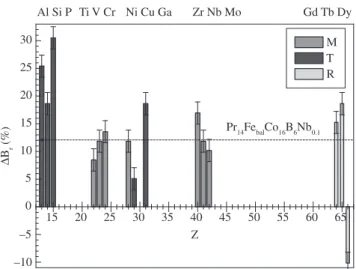
Figures 1 shows the percentage variation on the remanence of the PrFeCoB-based HDDR bonded magnets as a function of the atomic number (Z) of the addition element. These percentage variations were calculated taking the remanence of an isotropic Pr14FebalCo16B6 magnet as a reference (0.59 T). Figure 2 shows the percentage vari-ation on the intrinsic coercivity of these magnets also as a function of the atomic number of the addition element. Again, these percent-age variations were calculated taking the intrinsic coercivity of an isotropic Pr14FebalCo16B6 magnet as a reference (0.94 T).
3.1. The effect of Ti, V, Cr or Ni additions
Titanium addition increased the remanence slightly but decreased the intrinsic coercivity, also slightly. Conversely, vanadium additon enhanced the intrinsic coercivity considerably (1.17 ± 0.02 T). Data about Nd16Fe66.275Co11.6B6V0.125 HDDR magnets, reported previously, showed superior remanence and inferior coercivity18. Chromium
addition led to an increase in remanence (0.67 ± 0.01 T), but only a slight increase in the coercivity of the Pr-based magnets. Previously reported data about Nd16Fe66.275Co11.6B6Cr0.125 HDDR magnets showed slightly higher remanence and similar coercivity20. Better intrinsic
coercivity can be expected in the Nd-based magnet since the rare earth content is higher than that in the Pr14Fe63.9Co16B6Cr0.1 bonded magnet prepared in this investigation (due to the improved magnetic isolation in the Nd-based magnets). The addition of nickel induced a substan-tial anisotropy in the HDDR bonded magnets and also enhanced the intrinsic coercivity to a maximum value (1.18 ± 0.02 T).
Table 1. Composition of the as-cast praseodymium-based alloys.
Nominal composition (at %)
Analyzed composition (wt. (%))
Pr* Fe Co B Nb M/T
Pr14FebalCo16B6 30.01 54.56 14.31 1.01
-Pr14FebalCo16B6Ti0.1 29.83 54.76 14.25 0.98 - 0.07 Pr14FebalCo16B6V0.1 30.09 54.37 14.40 1.01 - 0.06 Pr14FebalCo16B6Cr0.1 30.29 54.08 14.44 0.96 - 0.08 Pr14FebalCo16B6Ni0.1 30.08 54.40 14.35 1.00 - 0.11 Pr14FebalCo16B6Zr0.1 30.06 54.32 14.42 1.01 - 0.11 Pr14FebalCo16B6Mo0.1 30.35 53.89 14.51 1.00 - 0.16 Pr14FebalCo16B6Nb0.1 30.35 54.11 14.34 0.96 - 0.14 Pr14FebalCo16B6Nb0.1Al0.1 30.33 54.18 14.24 0.99 0.18 0.02 Pr14FebalCo16B6Nb0.1Si0.1 30.07 54.36 14.14 1.00 0.16 0.07 Pr14FebalCo16B6Nb0.1P0.1 30.49 53.86 14.33 1.02 0.13 0.01 Pr14FebalCo16B6Nb0.1Cu0.1 30.51 53.79 14.25 0.99 0.15 0.13 Pr14FebalCo16B6Nb0.1Ga0.1 30.44 53.85 14.28 1.00 0.14 0.11 Pr14FebalCo16B6Nb0.1Gd0.3 29.65 54.22 14.22 1.02 0.14 0.69 Pr14FebalCo16B6Nb0.1Tb0.3 29.94 54.05 14.16 0.98 0.12 0.71 Pr14FebalCo16B6Nb0.1Dy0.3 29.61 54.33 14.23 0.97 0.14 0.65
(* Pr + ~0.3 wt. (%)Nd).
15 20 25 30 35 40 45 50 55 60 65
–10 –5 0 5 10 15 20 25 30
Pr14FebalCo16B6Nb0.1 Al Si P
∆
Br
(%)
Z
Gd Tb Dy Zr Nb Mo
Ni Cu Ga Ti V Cr
M T R
Figure 1. Remanence variation of the Pr14Fe63.9Co16B6M0.1, Pr14Fe63.8Co16B6 Nb0.1T0.1 and Pr14Fe63.6Co16B6Nb0.1R0.3 HDDR bonded magnets plotted against the atomic number of the addition element.
15 20 25 3030 35 40 45 50 55 60 65
–48 –20 –15 –10 –5 0 5 10 15 20 25 30
Pr14FebalCo16B6Nb0.1 Al Si P
Z
Dm
oi
Hc
(%)
Gd Tb Dy Zr Nb Mo
Ni Cu Ga Ti V Cr
M T R
Figure 2. Coercivity variation of the Pr14Fe63.9Co16B6M0.1, Pr14Fe63.8Co16B6Nb0.1 T0.1 and Pr14Fe63.6Co16B6Nb0.1R0.3 HDDR bonded magnets plotted against the atomic number of the addition element.
3.2. The effect of Zr, Nb or Mo additions
Zirconium and niobium addition enhanced the remanence and the coercivity of the HDDR magnets. The former showed a superior remanence (0.69 ± 0.01 T) whereas the latter showed higher coer-civity (1.08 ± 0.02 T). In sintered magnets, Nb refined the magnetic grains and formed a Nb-Fe-B phase in the grain boundaries19. This
refining effect of Nb has also been reported to Zr20. The reasonable
coercivity in the Zr- or Nb-containg HDDR magnets was attributed to this effect. The addition of molybdenum resulted in a moderate increase in these magnetic properties. It was considered that Zr, Nb or Mo have a similar behavior in the HDDR process. Zr enhanced the remanence due to a diminution of the disproportionation temperature (Nd-based HDDR magnets)10.
3.3. The effect of Al, Si or P additions
presence increased the coercivity due to the formation of non-magnetic Laves phases, Nd(Fe,Co)2, in the grains boundaries and diminished the remanence due to the substitution of Fe with this element in the matrix phase21. In the HDDR magnets the opposite occurred, suggesting that
small amounts of Al stayed in the matrix phase as nucleation sites to induce anisotropy and in the grain boundaries as reverse domains nucleation regions. Silicon also induced considerably anisotropy in the HDDR magnets and led to a slight improvement in the intrinsic coercivity. It is well known that, Fe and Si combine to form a soft magnetic phase, which is detrimental to the magnet coercivity. This was not the case in the Pr14FebalCo16B6Nb0.1Si0.1 bonded magnets.
Phosphorus addition in these bonded magnets led to the highest remanence value (0.77 ± 0.01T) and also improved somewhat the intrinsic coercivity. The remanence of the Pr14FebalCo16B6Nb0.1P0.1 magnet was much higher than that of the Pr14FebalCo16B6Nb0.1 magnet, showing that the combination Nb/P was very efficient to induce high anisotropy. The addition of P to an alloy (Pr7Tb1Fe87-xNb0.5Zr0.5PxB4) prepared by melt-spinning led to the formation of a Pr-P phase22.
This diminished the melting point of the alloy and refined the alloy microstructure. The coercivity of the Pr14FebalCo16B6Nb0.1P0.1 magnet was inferior to that of the Pr14FebalCo16B6Nb0.1 magnet indicating that the combination Nb/P was inefficient to improve the coercivity, although both being refining elements.
3.4. The effect of Cu or Ga additions
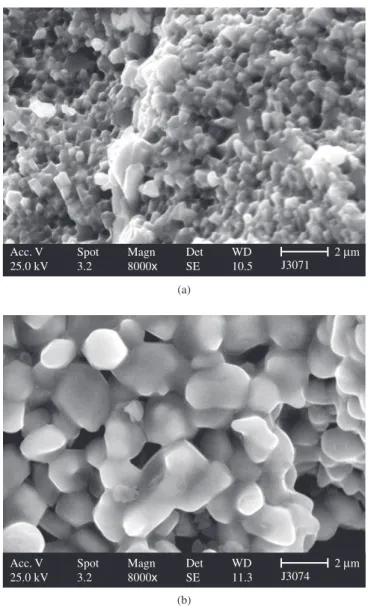
Copper addition induced some anisotropy, however, the rema-nence of the Pr14FebalCo16B6Nb0.1Cu0.1 magnet was still inferior to that of the Pr14FebalCo16B6Nb0.1 magnet. On the other hand, copper addition decreased dramatically the intrinsic coercivity. A microstructural observation showed that the Pr14FebalCo16B6Nb0.1Cu0.1 HDDR powder exhibited a grain size 10 times bigger than that typical of the oth-ers processed alloys. A comparison is given in Figures 3a and b. It has been reported that copper reduces the melting temperature of the Pr-rich phase23. This could explain the larger grain size of the
HDDR material and the low coercivity found in the Cu-containing magnets. Gallium addition also improved considerably the remanence (0.70 ± 0.01 T) but was detrimental to the coercivity. An optimum processing hydrogen pressure was necessary for obtaining high intrinsic coercivity in Nd-based bonded magnets with Ga addition (although with a reduction in the remanence)24.
3.5. The effect of Gd, Tb or Dy additions
Except for Dy, all alloying elements increased the remanence of the Pr-based HDDR magnets by inducing distinct degrees of anisot-ropy. Dysprosium was detrimental for both, remanence and coerciv-ity. The addition of Gd and Tb in these magnets induced anisotropy although with a rather low coercivity. It has been reported that a higher processing hydrogen pressure is necessary for obtaining high coercivity in PrFeCoBDy-based bonded magnets17. This also could
be the case for Gd and Tb. However, Pr13.7Dy1.0Fe63.5Co16.7B6Nb0.1 magnets processed at an optimum hydrogen pressure exhibited high coercivity but were unable to develop high anisotropy17. It is plausible
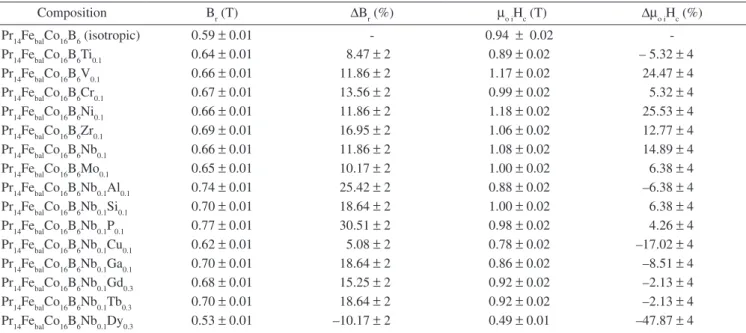
to assume that the low intrinsic coercivity related with the presence of Al, Ti, Cu, Ga, Gd or Tb, could be improved by changing the HDDR processing conditions (hydrogen pressure and/or reaction tempera-ture). Table 2 summarizes the magnetic properties of the Pr-based bonded magnets prepared using the HDDR powder and cyanoacrylate adhesive. Further microstructural studies on all the starting alloys, and corresponding HDDR powders are underway and the results will be presented and discussed in detail in a forthcoming paper.
4. Conclusions
The results indicate that vanadium, nickel, zirconium and niobium can be used as a single addition to Pr14FebalCo16B6 HDDR bonded magnets. Niobium and zirconium induce considerably anisotropy whereas vanadium and nickel enhance the intrinsic coercivity. It has also been shown that when the second element (Al, Si, P, Cu or Ga) is added to the Pr14FebalCo16B6Nb0.1 alloy only phosphorus and silicon cause the significant increase in remanence without loosing coerciv-ity. The Pr14FebalCo16B6Nb0.1P0.1 HDDR bonded magnet exbited the highest remanence whereas the Pr14FebalCo16B6Ni0.1 magnet showed the highest coercivity. Under the present processing conditions rare earth addition (Gd, Tb or Dy) to the Pr14FebalCo16B6Nb0.1 alloy was detrimental to the intrinsic coercivity of the bonded magnets.
Acknowledgments
The authors wish to thank FAPESP and IPEN-CNEN/SP for the financial support and infrastructure made available to carry out this investigation.
Figure 3. Secondary electron image of HDDR material prepared from the homogenized alloy: a) Pr14FebalCo16B6Nb0.1P0.1; and b) Pr14FebalCo16B6Nb0.1Cu0.1 (fracture surface).
Acc. V 25.0 kV
Spot 3.2
Magn 8000x
Det SE
WD 10.5
2µm J3071
(a)
Acc. V 25.0 kV
Spot 3.2
Magn 8000x
Det SE
WD 11.3
2µm J3074
References
1. Takeshita T, Nakayama R. Magnetic properties and microstructures of the NdFeB magnet powder produced by hydrogen treatment. In: Proceed-ings of the tenth Internat. Workshop on Rare Earth Magnets and Their Applications; 1989, Kyoto Japan. p. 551-557.
2. McGuiness PJ, Zang XJ, Yin XJ, Harris IR. Hydrogenation, Dispro-portionation and Desorption (HDD) - an effective processing route for Nd-Fe-B-type magnets. Journal of the Less-Common Metals. 1990; 158(2):359-365.
3. Hirosawa S, Uehara M, Mino S, Ishigaki N, Tomida T. New aspects of Nd-Fe-B-based hydrogenation-disproportionation-desorption-recom-bination powders and anisotropic bonded magnets made from them: Microstructure and magnetic properties. Journal of Applied Physics. 1997; 81(8):4821-4826 Part 2B.
4. Gutfleisch O, Harris IR. Effect of grain size on magnetic properties and deformation behaviour of NdFeB magnets made by various prepara-tion routes. In: Proceedings of the Fifteenth international workshop on rare-earth magnets and their applications; 1998, Aug 30 – Sept 3, Dresden, Germany; Frankfurt: Werkstoff-Informationsgesellschaft; 1998, p. 373-380.
5. Nakayama R, Takeshita T, Itakura M, Kuwano N, Oki K. Magnetic-Properties and Microstructures of the Nd-Fe-B Magnet Powder Pro-duced by Hydrogen Treatment. Journal of Applied Physics. 1991; 70(7):3770-3774.
6. Nakayama R, Takeshita T, Itakura M, Kuwano N, Oki K. Microstructures And Crystallographic Orientation of Crystalline Grains in Anisotropic Nd-Fe-Co-B-(Ga or Zr) Magnet Powders Produced by the Hydrogenation-Decomposition-Desorption-Recombination Process. Journal of Applied Physics. 1994;76(1):412-417.
7. Nakayama R, Takeshita T. Magnetic-Properties and Microstructures of the Nd-Fe-B System During the Hydrogenation-Decomposition-Desorption-Recombination Process. Journal of Applied Physics. 1993; 74(4):2719-2724.
8. Takeshita T, Morimoto K. Anisotropic Nd-Fe-B bonded magnets made from HDDR powders. Journal of Applied Physics. 1996; 79(8):5040-5044 Part 2A.
9. Pan W, Cui LY, Wang P, Zhou SX. Magnetic Properties of HDDR Proc-essed (Pr1-xNdx)13Fe81B6. In: Missell FP, Villas-Boas V, Rechenberg HR, Landgraf FJ, editors. Fourteenth International Workshop on Rare-Earth
Magnets and Their Applications, 1996 Sept 1-4, Sao Paulo, Brazil. Sin-gapore: World Scientific Publishing Co. Pte. Ltd; 1996. p. 467-472.
10. Kim YB, Jeung WY. Hydrogen absorption and desorption behavior in Pr-Fe-B type alloys. Journal of Applied Physics. 1998; 83(11):6405-6407 Part 2.
11. Faria RN, Williams AJ, Harris IR. High anisotropy in Pr-Fe-Co-B-Zr HDDR powders. Journal of Alloys and Compounds. 1999; 287(1-2)L10-L12.
12. Faria RN, Williams AJ, Harris IR. Permeameter measurements of ani-sotropic PrFeCoBZr hydrogenation disproportionation desorption and recombination (HDDR) magnets. Journal of Magnetism and Magnetic Materials. 1999; 202(2-3):349-353.
13. Faria RN, Brown DN, Harris IR. The influence of alloying additions and process parameters on the magnetic properties of PrFeB-based bonded magnets. Journal of Alloys and Compounds. 2000; 296(1-2):219-222.
14. Faria RN, Davies BE, Brown DN, Harris IR. Microstructural studies on Pr-Fe-B-Cu magnets produced by upset forging of cast ingot. Journal of Alloys and Compounds. 2000; 296(1-2):223-228.
15. Cannesan N, Brown DN, Williams AJ, Harris IR. The production and characterisation of highly anisotropic PrFeCoB-type HDDR powders. Journal of Magnetism and Magnetic Materials. 2001; 233(3):209-218.
16. Cannesan N, Brown DN, Williams AJ, Harris IR. The evolution of the disproportionated microstructure of PrFeB-based alloys. Journal of Magnetism and Magnetic Materials. 2002; 242-245:1372-1374 Part 2. 17. Takiishi H, Lima LF, Faria RN, Brown D N. The Effect of key Process
Variantions Upon the Magnetic Properties of HDDR (Pr,Dy)-(Fe,Co)-B-Nb Bonded Magnets. In: Hadjipanayis GC, Bonder MJ, editors. Proceed-ings of the seventeenth International Workshop on Rare Earth Magnets and Their Applications; 2002 August 18-22; Newark, Delaware, USA. Princeton: Rinton Press, Inc; 2002, p. 184-191.
18. Jurczyk M, Jakubowicz J, Gebel B, Handstein A, Gutfleisch O, Muller KH. Nd-2(Fe,Co,M)(14)B-type magnet powders produced by the HDDR process. Journal of Alloys and Compounds. 1999; 292(1-2):296-300.
19. RODEWALD W, WALL B. Structure and magnetic-properties of sintered Nd-Fe-Nb-B magnets. Journal of Magnetism and Magnetic Materials. 1989; 80(1):57-60.
20. Faria RN, Castro ARM, Lima NB. Relation between grain alignment and magnetic properties of Pr-Fe-B sintered magnets. Journal of Magnetism and Magnetic Materials. 2002; 238(1):38-46.
Table 2. Remanence and coercivity of Pr14Fe63.9Co16B6M0.1, Pr14Fe63.8Co16B6Nb0.1T0.1 and Pr14Fe63.8Co16B6Nb0.1R0.3 HDDR bonded magnets.
Composition Br (T) ∆Br (%) µo iHc (T) ∆µo iHc (%)
Pr14FebalCo16B6 (isotropic) 0.59±0.01 - 0.94±0.02
-Pr14FebalCo16B6Ti0.1 0.64±0.01 8.47±2 0.89±0.02 – 5.32±4 Pr14FebalCo16B6V0.1 0.66±0.01 11.86±2 1.17±0.02 24.47±4 Pr14FebalCo16B6Cr0.1 0.67±0.01 13.56±2 0.99±0.02 5.32±4 Pr14FebalCo16B6Ni0.1 0.66±0.01 11.86±2 1.18±0.02 25.53±4 Pr14FebalCo16B6Zr0.1 0.69±0.01 16.95±2 1.06±0.02 12.77±4 Pr14FebalCo16B6Nb0.1 0.66±0.01 11.86±2 1.08±0.02 14.89±4 Pr14FebalCo16B6Mo0.1 0.65±0.01 10.17±2 1.00±0.02 6.38±4 Pr14FebalCo16B6Nb0.1Al0.1 0.74±0.01 25.42±2 0.88±0.02 –6.38±4 Pr14FebalCo16B6Nb0.1Si0.1 0.70±0.01 18.64±2 1.00±0.02 6.38±4 Pr14FebalCo16B6Nb0.1P0.1 0.77±0.01 30.51±2 0.98±0.02 4.26±4 Pr14FebalCo16B6Nb0.1Cu0.1 0.62±0.01 5.08±2 0.78±0.02 –17.02±4 Pr14FebalCo16B6Nb0.1Ga0.1 0.70±0.01 18.64±2 0.86±0.02 –8.51±4 Pr14FebalCo16B6Nb0.1Gd0.3 0.68±0.01 15.25±2 0.92±0.02 –2.13±4 Pr14FebalCo16B6Nb0.1Tb0.3 0.70±0.01 18.64±2 0.92±0.02 –2.13±4 Pr14FebalCo16B6Nb0.1Dy0.3 0.53±0.01 –10.17±2 0.49±0.01 –47.87±4
21. Mizoguchi T, Sakai I, Niu H, Inomata K. Nd-Fe-B-Co-Al Based Permanent-Magnets With Improved Magnetic-Properties And Tem-perature Characteristics. IEEE Transactions on Magnetics. 1986; 22(5):919-921.
22. Jin ZQ, Zhang Y, Wang HL, Klaessig A, Bonder M, Hadjipanayis GC. The improved magnetic properties in phosphorus substituted Pr–Fe–P–B nanocomposites. Journal of Applied Physics. 2003; 93(10):6492-6494.
23. Noh TH, Jeung WY, Kang IK, Shin SH, Lee JJ. Magnetic properties of Pr-Fe-B alloy powders prepared by mechanical grinding. Journal of Applied Physics. 1991; 70(10):6591-6593