Maria L. Gregori* Institute of Aeronautics and Space São José dos Campos - Brazil [email protected]
Edson A. Barros Technological Institute of Aeronautics São José dos Campos - Brazil [email protected]
Gilberto P. Filho Technological Institute of Aeronautics São José dos Campos - Brazil [email protected]
Luiz Cláudio Pardini Institute of Aeronautics and Space São José dos Campos - Brazil [email protected]
Sonia F. Costa Institute of Aeronautics and Space São José dos Campos - Brazil [email protected]
*author for correspondence
Ablative and mechanical
properties of quartz phenolic
composites
Abstract. Quartz phenolic composites have been applied to thermal protection systems (TPSs) for reentry vehicles since the late fifties due to their excellent ablative resistance and mechanical performance. TPSs must withstand the aggressive reentry environment, such as atomic oxygen, when submitted to very high temperatures (> 1000° C) and heat flux. The ablative performance of composites is influenced by both base materials and environmental parameters during the ablation process.
For TPS systems phenolic resin is usually used as the base matrix due to its ability to form a stable char during decomposition. This char plays an important role in the absorption of the heat generated during the ablation process. During re-entry, parts of the charred matrix can be abrasively removed by shear force due to high pressure and velocity.
In this work the ablative and mechanical properties of quartz phenolic composites were evaluated in order to identify the range of properties suitable for the use of these materials as thermal protection systems for space vehicles. Quartz fabric
2
having an areal weight of 680 g/m and a resole-type phenolic resin were used to
prepare the composites. The resin has a viscosity of 165 MPa at 20°C. The prepreg material was cured by heating under pressure of 100 bar in a mold. The resin content of the prepreg obtained was about 50 per cent. The mechanical properties evaluated were, tensile, shear and flexural strength. The results obtained showed that this material has average values of 38.5 MPa, 52 MPa and 85 MPa for tensile, shear and flexural strength, respectively.
The ablative tests were carried out in a high-energy air plasma in ambient atmosphere and the mass losses were measured for different exposure time. Key words: Ablation, Quartz phenolic, Mechanical properties, Thermal
protection systems.
INTRODUCTION
Thermal protection systems (TPS) are essential for the is formed after this degradation (“char”) is very important successful launch and operation of all spacecraft, manned because it acts as an insulator while the material continues or unmanned. TPS must be good enough to prevent to decompose and outgas (Knop, 1985 and Kanno, 1993). excessive heat from destroying or damaging a vehicle or its The char depth and the surface temperature continue to rise contents. Of course the selection of a TPS depends on the until at a certain surface temperature the char will be spacecraft's mission. removed by mechanical shearing, melting and chemical
reaction. Also there are different mechanisms of thermal protection.
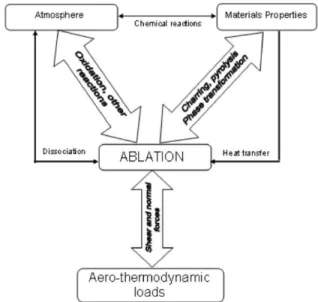
The one investigated in this work is the ablative system. For TPS applications, one of the most important Ablative materials (or ablators) are materials used in requirements is low thermal conductivity, to prevent an Thermal Protection Systems (TPS) that dissipate heat increase in temperature on the back face of the composite, generated by atmospheric friction. Ablative materials are transferring heat to the payload structure.Ablation products generally employed on non reusable planetary probes. injected into the flow field and surface recession alter the flow environment recession. Thus, these processes must be Ablative materials work by insulating a great amount of modeled to obtain accurate aero-thermodynamic heat through a phase change. When the surface of the predictions. Figure 1 shows schematically the influence of temperature, the resin begins to decompose and absorbs a atmosphere, materials properties and aero-thermodynamic large part of the heat, preventing it from passing to the loads in the process of ablation.
backup materials (Sykes, 1967). The porous layer that
This paper presents preliminary mechanical properties (tensile, shear and flexural strength) and the ablative ________________________________
Received: 27/04/09 properties of a quartz phenolic composite. The ablative
jets with gas enthalpies comparable to those encountered Mechanical tests
during atmospheric reentry.
The mechanical tests performed in this work were the tensile, shear (for “as cured” and “post-cured” samples) and In order to analyze the microscopic aspects of the samples
flexural tests. after exposure to the plasma, the scanning electron
microscope (SEM) was used.
The tensile test was carried out in an Instron universal testing machine by using the specimen geometry shown in Fig. 2, with a test speed of 0.5 mm/min. The tests were carried out by following the ASTM C1275 “Monotonic Tensile Behavior of Continuous Fiber-Reinforced Advanced Ceramics with Solid Rectangular Cross-Section Test Specimens at Ambient Temperature”.
Figur 2: Geometry of test specimen for quartz phenolic composite
The shear strength test was carried out in an Instron mechanical testing machine using a test speed of 0.5
Figura 1: Schematic view of the influence of atmosphere,
mm/min . The test was carried out by following the ASTM
materials properties and aero-thermodynamic loads in
D 5379- “Standard Test Method for Shear Properties of
the ablation process
Composite Materials by the V-Notched Beam Method”. Although the Iosipescu test in the past was used mainly for
EXPERIMENTAL
metals, since 1992 it has been defined as the standard method for composite materials.
The material analyzed is a phenolic composite containing a bi-directional quartz fabric, having an areal weight of 680
2 The fixture of the sample coupon is shown in Fig. 3. The
g/m . The properties of silica fibers, reported in literature on
3 square area between notches is referred to as the test region.
the manufacture are: density of 2.15 g/cm , tensile strength Figure 4 shows the geometry specimen utilized. The angle of 6 GPa, tensile modulus of 78 GPa and elongation to of the notches is 90°. The radius of the notch tips is 1.3 mm. failure of 7.7 per cent. The composite was manufactured by The thickness of specimen was 5.5 mm.
building up the fabric layer by layer and impregnating it with a resole-type phenolic resin.
Phenolic resin has a viscosity of 165 MPa at 20°C. The impregnation process was carried out at Plastiflow Ltd, Curitiba-PR. The prepreg material was cured by heating under pressure of 100 bar in a mold. The resin content of the prepreg obtained was around 50 per cent.
The cure was carried out in a multi-stage cycle in order to increase the soaking of the fibers and the jellification process, up to the final temperature of 187°C. After soaking, the composites presented a fiber volume of 55-60 per cent. Some samples were post-cured in order to assure that the phenolic resin was completely cured. The post-cure was carried out for 12h at 180 C.
The influence of the post-cure was investigated by
Figura 3: Scheme of the Iosipescu test jig
Figura 6: Schematic illustration of the apparatus for ablative test Figura 4: Sample of silica fabric with strain-gages using an arc plasma torch
The flexural test was performed according to ASTM D790 The burn-through time was measured. The erosion rate was “Standard Test Method for Flexural Properties of calculated by dividing the specimen thickness or the weight Unreinforced and Reinforced Plastics and Electrical change before and after the test into a burn-through time for Insulating Materials”, in four-point bending mode. The each specimen.
specimens have a width of 10 mm and 2.5 mm thickness.
The testing set-up is shown in Fig. 5. The test speed was 1 One representative sample was used for each test condition. mm/min. Flexural stress was calculated according to the The samples were manufactured by Plastiflow Ltd. The following equation: specimens were cut in samples with diameter of 1.6 cm and
thickness of 1.2 cm. (1)
RESULTS AND DISCUSSION
The tensile test results are shown in Fig. 7. The tensile strength of the plain weave quartz phenolic composite was 38 5 MPa. There is a lack of available data in the literature to compare the results obtained in this work, mainly because quartz phenolic composites are used in sensitive areas of aerospace technology. (Kumara, 2005) reported 100 MPa for the tensile strength of quartz phenolic composites, which is in the range of the results found in this work. Different sorts of quartz fibers give rise to different
Figura 5: Sample geometry for flexural test Ablative test composite properties.
A plasma torch test was performed to investigate the ablative properties of quartz phenolic composites(Fig. 6). The operation was carried out in atmospheric pressure. A DC arc plasma system was designed for continuous working at power up to 50 kW. The intensity of current was adjusted to 135A with tension of 300V. So that, the maximum achievable power obtained, due to the power supply, is about 30kW, which gives a plasma enthalpy of
-3
about 5.5MJ/kg. The gas flow was maintained at 4.5×10 kg/s.
The specimen was placed vertically to the direction of the flame in the air. The ablative test was carried out in 10 seconds and the distance between the nozzle tip of the plasma gun and the front surface of the specimen was varied from 10 to 18 cm. The surface of the samples reached temperatures in the range of 900 to 1600C and this was
Figures 8 and 9 show the results of the Iosipescu test. The quartz phenolic composites were prepared by stacking plain weave fabric plies and the counter-reacting forces were applied perpendicular to the 0/90° orientation. Considering the axis system for test specimen, the shear modulus to be measured is G . yx
The average in-plane Iosipescu shear strength and the shear modulus were measured for the as cured and post-cured samples.
The Iosipescu shear strength for the as cured sample has a value of 19 2 MPa, and is shown in Figure 8. For the post-cured sample, shown in Figure 9, the value is 52 2 MPa. Shear moduli were in the range of 2.5 3.5 GPa for both as cured and post-cured samples.
Figura 9: Shear stress for post cured samples
As cured quartz phenolic composite has a higher deformation up to failure (30000 μm/m), compared to the post-cured one (4500 μm/m). This means that post-cure is
Figure 10 shows the results of the flexural strength test. The
beneficial for composite properties providing it is not over
value obtained for quartz phenolic composite was 85 25
cured, which may lead to property degradation.
MPa. A high scatter was found for the results which may be a result of uneven defects such as fiber misalignment in the
The in-plane shear strength and shear modulus for composite.
laminated composites is highly dependent on the matrix
properties. The curve shows a typical non-linear behavior up to failure shear stress.
For composites with reinforcing fibers perpendicular to the shear loading direction, the failure mode occurs mainly by fiber slipping and debonding at the fiber/matrix interface. On the other hand, in composites with reinforcing fibers parallel to the shear loading direction, the failure may occur by an interlaminar crack at the sample gage length. In any case, shear properties are mainly dominated by the matrix and the fiber/matrix interface and the failure modes are associated with shear deformation mechanism.
Figura 10: Flexural stress for as cured samples
Figure 11 shows the behavior of the surface temperature with the exposure time for different distances from the plasma torch. The temperature increases during initial phase of heating with subsequent saturation at a certain temperature which depends on the value of heat flux density. Figure 12 shows a picture of the front surface of the test specimen during testing.
Experimental data with respect to specific mass loss rate of quartz as a function of maximum surface temperature is shown in Figure 13. It was observed that the specific mass loss rate increases exponentially with the maximum surface
-2
temperature and varies within a range of around 2.0 10
Table 1: Burn depth as a function of testing distance for the specimens submitted to the plasma torch test
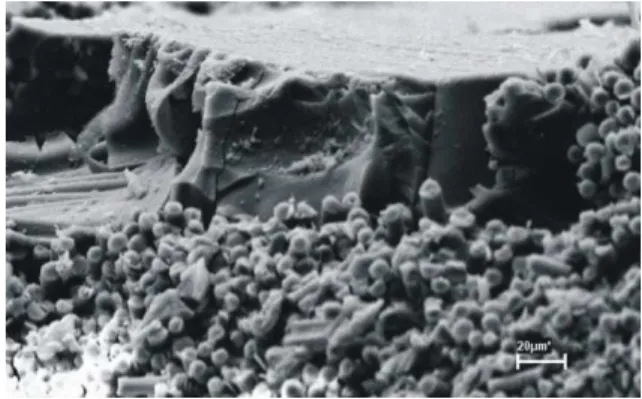
Figura 11: Surface temperature versus time Figure 14 shows a view of a burned surface of the quartz
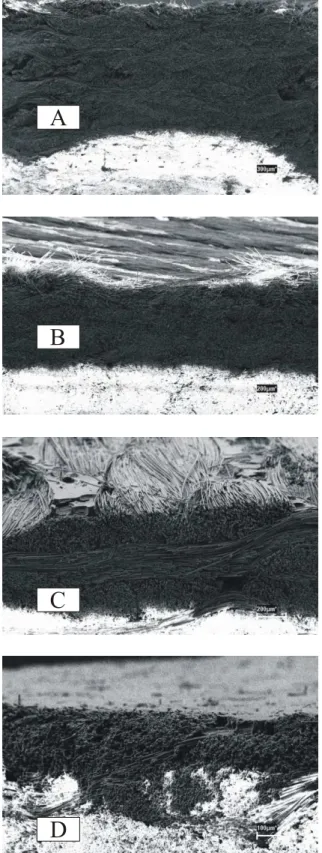
phenolic composite showing the aspect of the surface char generated during the burning test and the underneath fiber layer. Figure 15 shows the sample before burning and Figure 16 shows pictures of the burned surfaces of the specimens. The dark areas in the picture are the burned region of the specimens.
As can be seen, the burn depth is directly related to the surface temperature and also to the heat flux in the sample. The maximum surface temperatures are shown in Table 1.
Figura 12: Front surface of the test specimen
Figura 14: Surface of the quartz phenolic composite after the plasma torch burning test
Figura 13: Specific mass loss rate as a function of maximum surface temperature
Table 1 shows the values of burn depth as a function of the distance between the nozzle tip of the plasma gun and the front surface of the specimen. The thickness of the burned surface increases as the distance decreases. The thickness of the burned surface is also a function of the exposure time of the plasma torch. Although not investigated in this work,
the higher the exposure time to the plasma torch the deeper Figura 15: Side view of the specimen before exposure to the will be the burned surface of the specimen. plasma torch
Specimen
A B C D
Testing distance (cm)
10 14 16 18
Burn depth (mm)
2,5 1,0 0,5 0,2
Max. surface temp. ( C)
material has average values of 38.5 MPa, 52 MPa and 85 MPa for tensile, shear and flexural strength, respectively. As cured and post-cured samples were analyzed for the Iosipescu shear strength and it was found that the post-cured samples showed a shear strength of 19 2 MPa while for the post-cured samples the value is 52 2 Mpa.
The cured quartz phenolic composite has a higher deformation up to failure (30000 μm/m), in comparison
with the post-cured one (4500 μm/m). This means that
post-cure is beneficial for composite properties providing it is not over cured, which may lead to property degradation.
It was not possible to compare the data obtained with data published in the literature because, since quartz phenolic composites are used in sensitive areas of aerospace technology, the data is not easily available in literature. The ablative tests show that the mass loss per unit area depends strongly on the temperature of the material surface and on the distance between the nozzle tip of the plasma gun and the front surface of the specimen
The information obtained from the plasma test indicates that this composite has ablation resistance and is reliable for the construction of thermal protection systems.
REFERENCES
ASTM C1275, “Monotonic Tensile Behavior of Continuous Fiber-Reinforced Advanced Ceramics with Solid Rectangular Cross-Section Test Specimens at Ambient Temperature”.
ASTM D 5379, “Standard Test Method for Shear Properties of Composite Materials by the V-Notched Beam Method”. ASTM D790, “Standard Test Method for Flexural Properties of Unreinforced and Reinforced Plastics and Electrical Insulating Materials”.
Kanno Y., 1993, “Development of Ablative Material for
th
Planetary Entry”, Proceedings of the 9 International Conference on Composite Materials, Madrid, pp.120.
Knop A., Pilato L.A., 1985, “Phenolic Resin: Chemistry, Application and Performance”, Berlin: Springer-Verlag, Chapter 10.
Kumara, R, Vinod, G, Renjith, S., Rajeev, G., Jana, M.K.
Figura 16: Side view of the specimens subjected to the plasma
and Harikrishnan, R., 2005, “Thermo-structural Analysis
torch burning test.
of Composite Structures”, Materials Science and Engineering, A 412, pp. 6670.
CONCLUSIONS
Sykes, George F., 1967, “Decomposition Characteristics of a Char-forming Phenolic Polymer used for Ablative The mechanical properties evaluated were tensile, shear
Composites”, NASA TN D3810. and flexural strength. The results obtained showed that this