This paper presents the experimental data of the behavior of reinforced concrete beams strengthened to shear with carbon iber composites. The tests were composed of eight T beams, bw=15 cm, h=40 cm, lange width 40 cm, lange height 8 cm, and length 300 cm, divided into two series with the same longitudinal steel reinforcement and a reference beam without strengthening in each series. The beams had two types of arrange-ment of internal steel stirrups. The test variables were the internal and external geometric ratio of the transverse reinforcearrange-ment and the mechanical ratio of carbon iber composites stirrups. All the beams were loaded at two points. The strengthened beams were submitted to a preloading and the strengthening was applied to the cracked beam. All the beams were designed in order to guarantee shear failure, and the ultimate load of the strengthened beams was 36% to 54% greater than the reference beams. The Cracking Sliding Model applied to the strengthened beams was evaluated and showed good agreement with the experimental results.
Keywords: shear strengthening; reinforced concrete; external strengthening; carbon iber composites.
Este artigo apresenta os dados de ensaios de vigas de concreto armado reforçadas à força cortante com compósito de ibras de carbono. Os ensaios de oito vigas T, bw=15 cm, h=40 cm, largura da mesa igual a 40 cm, altura da mesa 8 cm, comprimento de 300 cm, divididos em duas séries com a mesma armadura longitudinal e uma viga de referência sem reforço externo para cada série. As vigas tinham dois tipos de arranjos de estribos internos de aço. As variáveis dos ensaios foram as taxas geométricas das armaduras transversais internas e externas, e a taxa me-cânica da armadura em estribos de compósito de ibras de carbono. Todas as vigas foram carregadas em dois pontos. As vigas reforçadas foram submetidas a um carregamento prévio e reforçadas após a issuração. Todas as vigas foram projetadas para garantir a ruptura por força cortante, e as forças últimas das vigas reforçadas foram de 36% a 54% superiores às das vigas de referência. O Modelo da Fissura Deslizante foi avaliado e mostrou boa concordância com os resultados experimentais.
Palavras-chave: reforço à força cortante; concreto armado; reforço externo; compósito de ibras de carbono.
RC T beams strengthened to shear with carbon
iber composites
Vigas T de concreto armado reforçadas à força cortante
com compósito de ibras de carbono
L. A. SPAGNOLO JR a [email protected]
E. S. SÁNCHEZ FILHO b [email protected]
M. S. L. VELASCO c [email protected]
a LUIS ALBERTO SPAGNOLO JR. is a Structural Engineer at Petrobras, Rio de Janeiro, Brazil. He received his M. Sc. in Structural Engineering from PUC Rio. Contact: [email protected]
b EMIL DE SOUZA SÁNCHEZ FILHO is an Associate Professor of Civil Engineering at the Fluminense Federal University, Niterói, Rio de Janeiro, Brazil. He is member of ACI, PCI, FIB, IABSE, IBRACON, ABPE and ABCM. He received his M. Sc. and D. Sc. in Structural Engineering from COPPE-Federal University of Rio de Janeiro. Contact: [email protected]
c MARTA DE SOUZA LIMA VELASCO is an Associate Professor of Civil Engineering at PUC-Rio. She received her M. Sc. from PUC-Rio, and her D. Sc. in Structural Engineering from COPPE-Federal University of Rio de Janeiro.
Received: Received: 10 Jun 2012 • Accepted: 04 Oct 2012 • Available Online: 08 Feb 2013
Abstract
1. Introduction
Concrete carbon iber strengtheninghas been widely used over the last 20 years in several countries, and can be considered a well-established construction procedure. But during the last few years, important research has contributed to new design and anal-ysis models for the strengthening system currently used by engi-neers ([1], [2], [3])
The technique of strengthening reinforced concrete beams with externally-bonded composite materials has been shown to be ef-icient. Results obtained from reports and manuals concerning the
state-of-the-art of this technique indicate that the shear strength-ening of reinforced concrete has some confusing and unexplained features. This is due to the fact that the composite material, glued to the concrete surface, has linear-elastic behavior, quite different to the non-linear behavior of the structural element.
The shear strengthening of reinforced concrete beams in bridges and buildings may be applied due to several causes: design, faults, increased load, functional changes, environmental attacks, etc. The mechanisms by which shear is carried out in reinforced concrete beams are very complex, and still not well understood. In general, the contribution of the shear reinforcement is calculated according to the truss analogy (steel and CFC). The shear resistance offered by
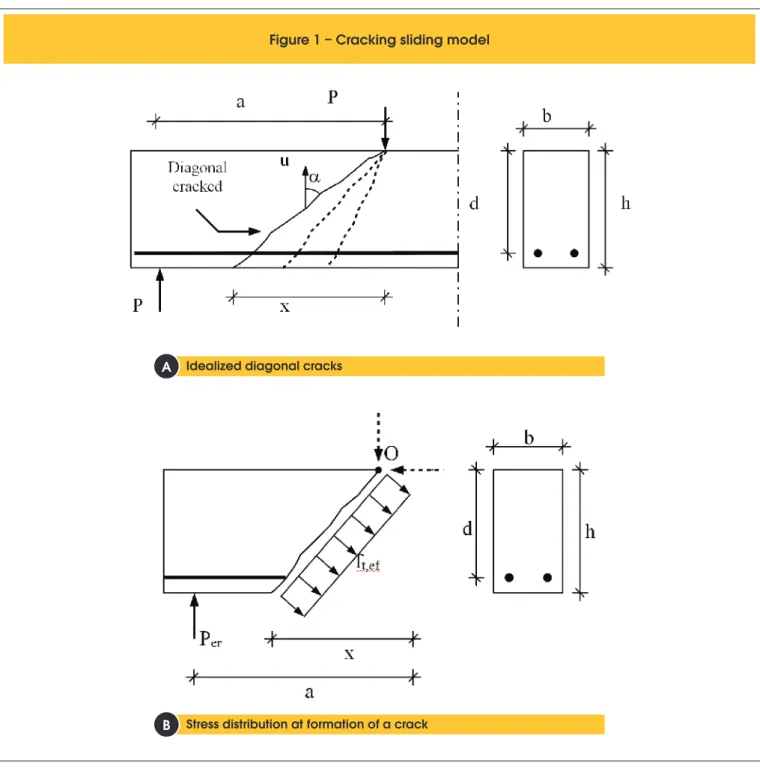
con-Figure 1 – Cracking sliding model
Idealized diagonal cracks
Stress distribution at formation of a crack
A
3.1 Upper-bound solution
An upper-bound solution shows that failure must occur for any compatible plastic deformation if the rate of the external work of applied forces on the beam equals the rate of internal energy dis-sipation for all materials: concrete, steel and CFC.
In the upper-bound approach, it is necessary to hypothesize a displacement ield in discontinuities between the rigid regions of the beam (these regions are rigid bodies), each with a constant displacement (or rate of displacement). The rate of internal dis-sipation depends on the selection of the displacement ield, and it is independent of the applied loads.
The basis for this study is summarized below, followed by the pro-posed relationships for the upper-bound model.
For beams without shear reinforcement or lightly reinforced beams, the shear strength is determined by the Cracking Sliding Model (CSM). “This model is based on the hypothesis that cracks can be transformed into yield lines, which have lower sliding strength than yield lines formed in uncracked concrete”.
For a crack transformation into a yield line, the internal work per unit length is calculated. The angle variation between the yield line and the displacement direction
a
is limited byϕ
≤
a
≤
π
−
ϕ
, whereϕ
is the angle of friction of the concrete. This limitation on a shows that crack sliding must be treated as a plane strain problem. In this upper-bound analysis of the failure mechanisms, the beams are loaded in four points divided into a series of three rigid blocks. These blocks are separated by lines of discontinuity (Figure [1]). The relationships for the shear capacity are obtained from kine-matic and yield conditions, and form an upper-bound solution of Plasticity Theory for reloaded concrete beams.The theoretical approach proposed obeys all hypotheses of the CSM, and offers some new conditions to evaluate the ultimate load of reinforced concrete beams strengthened with glued CFC verti-cal stirrups. The following analysis considers all formulas valid for T beams. The external shear reinforcement can be evaluated in an additive way, assuming that its behavior is similar to the behavior of steel stirrups (Figure [2]). The total mechanical ratio of the trans-crete is given by empirical equations. Although several experiments
concerning shear strengthening have been reported in the literature ([4], [5], [6], [7], [8]),few offer clear and conclusive experimental data. In this work, a more comprehensive shear experimental study was performed. This study aimed to establish new experimental and consistent data in order to evaluate the ultimate shear of the beams strengthened with U stirrups of carbon iber composites.
2. Research signiicance
The objective of this study was to investigate the effectiveness behavior of RC T beams strengthened to shear with CFC. This paper presents an experimental program with the followings objec-tives: 1) to understand the effect of shear mechanism in the tested beams; 2) to corroborate a theoretical model; and 3) to supply the literature with detailed test data that can support further research in this area. The theoretical model proposed herein was assessed by comparing the calculated and measured response of eight test beams, and provided accurate numerical tools that can be exploit-ed to understand and prexploit-edict this type of strengthening.
3. Analytical model
Traditional standard analyses and design speciications for the shear strengthening of reinforced concrete beams use the diago-nal cracking strength
V
c as an estimate of the concrete contribu-tion, and, in general, adopt the classical truss model for calculating shear reinforcements (steel and CFC) to shear capacity.The concrete contribution to shear resistance is far more varied because it is the sum of several internal mechanisms of resistance: shear carried in the compression zone (uncracked zone), aggre-gate interlock (shear friction between cracks), and dowel action. The literature furnishes several formulas for calculating the con-crete contribution, and the most important codes have selected signiicantly different approaches for the
V
c portion.This study seeks to investigate a suitable upper-bound solution and evaluate this model by comparison with experimental data ([9], [10], [11]).
or
(8)
21
.0
75
.0
95
.
16
67
.2
0 0
sw fw sw fwc u
h
s
for
The distance
x
in original paper [10] is given by equation 9, and the proposed in this paper is given by equation 10:(9)
c sw cf
h
x
2
(10)
sw fw
cc
f
h
x
2
The angle of idealized diagonal crack
q
CIN is given by:(11)
x
h
tg
CIN
The equations 1, 2, 3, 4, 5, 6, 7, 8, 9, 10 and 11 indicate that the effectiveness factor
ν
0 is an important parameter in thistheo-retical formulation. It governs the concrete shear resistance and transverse reinforcement contributions for shear capacity. A ratio-nal choice of one adequate expression for this parameter is funda-mental for the predicted results. The value of the effectiveness fac-tor depends on the material, size effect, geometry, reinforcement, loading of the structures, and on the internal cracking process.
3.2 Bond model
The bond between carbon iber composites and concrete is a fundamental hypothesis that requires special attention for it repre-sents the means by which stress is transferred between concrete and CFC.
Signiicant advances in experimental studies into bond have been achieved in recent years, and research shows that this technique cannot mobilize the full tensile strength of CFC, due to the debond-ing and the peeldebond-ing phenomenon.
The bond between CFC U vertical stirrups and concrete is the key factor in this study. The proposed formulation adopts a bond model for the concrete-CFC interface, in which the CFC effective mechanical properties should be carefully analyzed. The theoreti-cal model adopted is the debonding failure mode ([13]), and the effective axial CFC stress is given by:
(12)
ef f f ef fE
f
,
,verse reinforcement can be seen as the sum of two terms ([12]).
(1)
fw sw
(2)
c yw w sw swf
f
d
b
A
0
(3)
c f u f w f f fwf
f
s
b
w
t
0 ,2
Concrete strengths of tested beams are very different to the strength measured on 15 cm x 30 cm cylinder specimens be-cause the concrete is cracked and the cracking reduces the strength. It is essential to consider a reduced concrete strength and, in the models of Plasticity Theory, it is indispensable to in-sert a concrete effectiveness factor
ν
0≤
1
into the theoretical solution. Concrete is regarded as a perfectly plastic material, which has a brittle behavior with poor ductility in compression. The effectiveness factorν
0 decreases with the increase of the concrete compressive strength.The effectiveness factor is given by:
(4)
D
c
h
f
00
.
88
1
1
1
26
and the shear capacity of cracked concrete is:
(5)
064
.
11
sw fwc
u
with
(6)
c
c
0
.
059
0f
The upper-bound solution for the shear capacity of the cracked concrete taking into account inite stirrups spacing is given by:
(7)
21
.0
95
.
16
64
.
11
0 0 0
sw fw sw fw sw fwc u
The effective stress has a non-uniform distribution, and at ultimate state is deined as:
(13)
max, ,ef f f
f
D
f
and the maximum stress is given by
(14)
with
(1
5)
sin
1
sin
2
f f f
f
w
s
w
s
w
(16)
c f f e
f
t
E
L
(17)
e
L
L
max
(18)
2
sin
L(19)
2
sin
2
cos
1
2
f
D
4. Experimental investigation
4.1 Test specimens
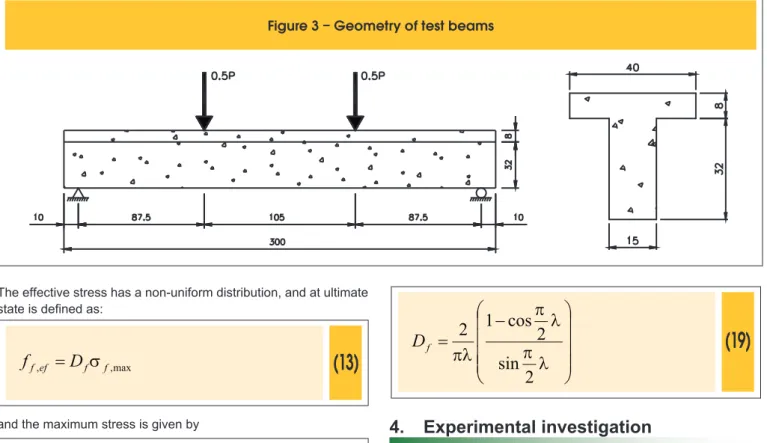
Eight T reinforced concrete beams 3.00 m long were tested ([14]). All the specimens were designed to have the same nominal cross sectional dimensions: bw = 15 cm and h = 40 cm. Cross-sectional details of the beams are shown in Figure [3]. The specimens were also designed to be tested with a constant ratio a/d = 87.5/36 = 2.4. The testing program was divided into two series with four beams tested as part of each series. In each series, one beam had no CFC reinforcement (reference beam), but the internal steel reinforcement was the same as that of the beams in the series. Specimens were la-beled by the explanatory label: 1) Series I was one reference beam VR1 and three strengthened beams with U stirrups, with either one, two or three layers of CFC, VI-1, VI-2, VI-3, respectively; and 2) Se-ries II was one reference beam VR2 and three strengthened beams with U stirrups, with either one, two or three layers of CFC, VII-1, VII-2 e VII-3, respectively. Series II had fewer internal steel stirrups in the midspan of the beam (bending zone) than Series I.
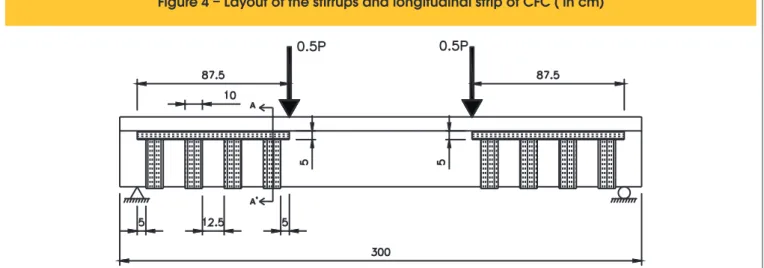
All CFC U stirrups 10 cm x 79 cm were glued on to concrete sur-face, and a 5 cm x 87.5 cm longitudinal strip (one layer of CFC) was ixed to the ends of the stirrup on both sides of the beams, as shown in Figures [4] and [5].
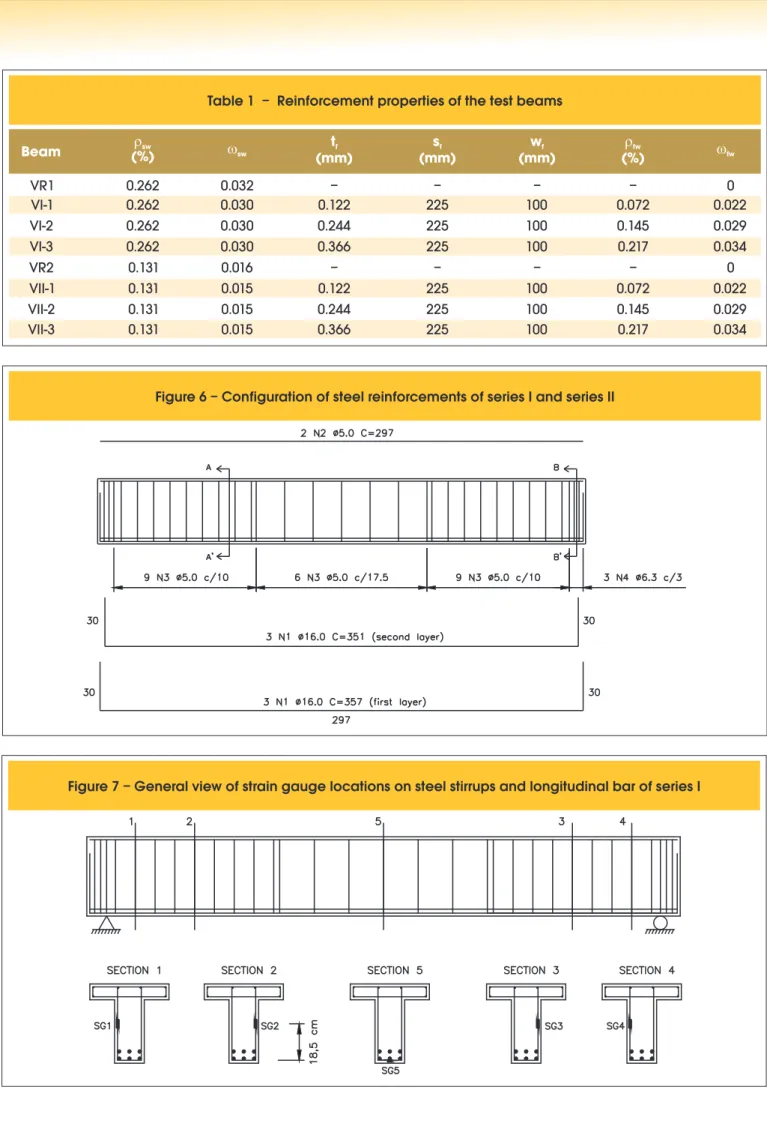
The beams in each series were cast simultaneously from the same batch of concrete, and consolidated with internal vibrators. Table [1] presents a summary of the properties of the steel rein-forcement (transverse reinrein-forcement ratio), including the thickness, width and transverse ratio of the CFC reinforcement (variables of this research). Details of the beams are presented in Figure [6]. To prevent premature localized failure (anchorage failure), both ends of the beams were heavily reinforced and longitudinal bars were care-fully anchored.
The steel transverse and longitudinal ratios are given by:
(20)
s
b
A
w sw sw
(21)
and the transverse CFC reinforcement is:
(22)
f w
f f
f
b
s
w
t
2
4.2 Instrumentation
Prior to casting the concrete, the strain gauges were attached to the steel reinforcements to obtain strain proile along these rein -forcements (Figures [7] and [8]). Strain gauge rosettes with dif-ferent angles were glued on to the concrete surface (Figure [9]) to obtain the two principal strains and the inclination angle of the main compressive strain with horizontal axis. The CFC U stirrups were instrumented with strain gauges in four different locations (Figure [10]).
A data logger was used to read and record the values given by the strain gauges, load cells, and linear variable displacement trans-ducers (LVTDs).
4.3 Materials
A commercial concrete supplier delivered all the concrete used in the experimental program.
Following the cast, the beams were cured without special tech-niques and stored in laboratory conditions until the moment of testing. The cylinders used to establish the compressive strength and the modulus of elasticity of the concrete were cured under the
Figure 4 – Layout of the stirrups and longitudinal strip of CFC ( in cm)
Figure 5 – External CFC U stirrups of beams:
a) VI-1 and VII-1; b) VI-2 and VII-2; c) VI-3 and VII-3
(a)
(b)
(c)
1ª CFC layer 2ª CFC layer
CFC Bond reinforcement
1ª CFC layer 2ª CFC layer
3ª CFC layer CFC Bond
reinforcement CFC stirrups with
one CFC layer
Table 1 – Reinforcement properties of the test beams
Beam
(%)
sw
sw
(mm)
t
f(mm)
s
f(mm)
w
f(%)
fw
fw
VR1
0.262
0.032
–
–
–
–
0
VI-1
0.262
0.030
0.122
225
100
0.072
0.022
VI-2
0.262
0.030
0.244
225
100
0.145
0.029
VI-3
0.262
0.030
0.366
225
100
0.217
0.034
VR2
0.131
0.016
–
–
–
–
0
VII-1
0.131
0.015
0.122
225
100
0.072
0.022
VII-2
0.131
0.015
0.244
225
100
0.145
0.029
VII-3
0.131
0.015
0.366
225
100
0.217
0.034
Figure 6 – Configuration of steel reinforcements of series I and series II
same conditions as the beams. The ends of the cylinders were grounded before the tests. The cylinders were cast simultaneously with beams using the same batch concrete. The average value of the compressive strength of the concrete for each test beam was obtained from three 15 cm x 30 cm cylinder specimens. Table [2] shows the concrete strength. All the specimens were tested in ac-cordance with Brazilian standards. The average concrete secant modulus is 25.01 GPa, and the average splitting stress (Brazilian test) is 4.08 MPa.
The ordinary steel bars were ribbed bars with diameters of 5
mm, 8 mm, and 16 mm. Tensile tests on three representative specimens of each reinforcing bar type were conducted. The av-erage values of the yield stress and yield strain were 596 MPa
and 0.30 % for 5 mm diameter, and 600 MPa and 0.20 % for 16
mm diameter, respectively. The 8 mm bars were not considered in the design because this reinforcement was only a support for the steel stirrups.
The CFC was tested in accordance with ASTM D3039/D3039M ([15]); CFC mechanical properties (mean values) was: tensile
strength 2969 MPa, ultimate strain 11.6 %, modulus of elasticity 255.000 MPa.
4.4 Test setup and loading procedures
All eight T reinforced concrete beams were tested on steel frames with capacities of 500 kN and 1000 kN, ixed on the plate reactor
of the Laboratory of Structures of PUC-Rio. The applied force was measured using a load cell in series with an actuator. Beams were loaded at two points with force control using a double action hydrau-lic actuator located at the top of the supplementary steel beam. The beams VR1 and VR2 were tested with a monotonic loading until failure, and the beams VI-1, VI-2, VI-3, VII-1, VII-2, and VII-3 were loaded under sustained strain with a special apparatus after bending cracking (after the irst crack) and strengthening. They were subsequently loaded monotonically until failure.
The load was applied in imposed deformation steps by a hydraulic jack, and was controlled by load cells placed at the beam supports. The load cell under the jack furnished the ultimate load
P
u,exp.F
igure 8 – General view of strain gauge locations on steel stirrups and longitudinal bars of series II, distance
from support: section 1=0.15 cm, section 2=0.45 cm; section 5=middle and other sections are symmetric
Figure 9 – Strain gauge rosette locations on concrete surface
Beams VR1 and VR2 Beams VI-1, VI-2, VI-3, VII-1, VII-2 and VII-3
5. Experimental results
5.1 Cracking
The data collected by the strain gauges and LVTDs was recorded using a special digital data acquisition system. During the test, the cracks developed were marked without interruption of the load pro-cess. Flexural cracks at the midspan started from the bottom face and propagated vertically through the height of the beams. As the applied load increased and the internal stress was redistributed, several other secondary lexural cracks were observed, starting from the main bending cracks. The load cell under the jack fur-nished the cracking load
P
CR. Table [3] shows that crack loads for VR1 and VR2 were of the same level, and that the crack loads for Series I were greater than those for Series II.5.2 Ductility
All longitudinal reinforcement yielded, but not simultaneously with the steel stirrups. Table [3] shows that the steel stirrups of Se-ries II did not yield. Nevertheless, it is possible to conclude that the beams tested in this research program presented good ductility.
5.3 Failure
For the beam with no descending branch, the authors considered the ultimate load as equal to the maximum load.
The reference beams in the experimental program failed by diago-nal tension, and the strengthened beams failed by diagodiago-nal ten-sion with simultaneous debonding of the CFC stirrups (Table [3]). Failure of the beams occurred after the steel stirrup yielded and started to present an inclined shear crack that grew in the direction of the beam lange. Bending or anchorage failure did not occur. Figure [11] shows the pattern of failure of beams VR2 and VII-1.
6. Discussion of results
6.1 Analysis of strength
The variables of the experimental program were concrete strength and mechanical ratio of CFC stirrups. The tests were conducted in reinforced concrete beams made of normal strength concrete. The concrete effectiveness factor varied only with concrete strength since all beams had the same height and longitudinal re-inforcement.
After the cracking tension, the strengthened beams experienced a sudden failure with the debonding and rupture of CFC U stirrups. The theoretical values of ultimate shear force
V
u,theor were cal-culated by considering the bond between the CFC U stirrups and concrete to be perfect, which was veriied by the theoretical ap -proach shown in this paper.The load of the strengthened beams was 36 % to 54 % greater than that of the reference beams. As presented in the penultimate column of Table [3], the mean strength ratio is
V
u,expV
u,ref.
1
.
43
with a coeficient of variation of 4.41 %. This shows that the shear strength of all the beams increased substantially, and that all the arrangements of the CFC U stirrups studied are effective for shear reinforcement.6.2 Angles
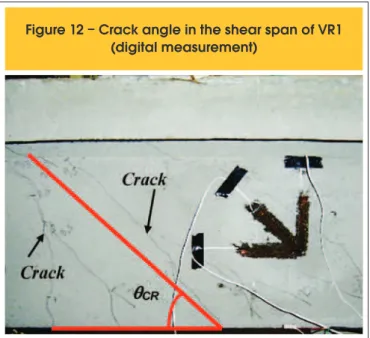
Using all the relevant images of the cracking of the beams and with the aid of a computer program, digital procedures were used to obtain the crack angle qCR (Figure [12]).
Table 2 – Concrete compressive strength
Beam
Cylindrical
Specimens
age (days)
Concrete
f
c,average(MPa)
–
4
28
44.90
VR1
3
48
48.44
VR2
3
57
49.92
VII-1
3
153
50.94
The deformation ield angle
q
e was obtained by classical formulas of Solids Mechanics, with the aid of readings of the strain gauge rosettes. The basic hypothesis of the CSM is evaluated by means of com-paring thecrack angleq
CR, the deformation ield angleq
e, and the angle of idealized diagonal crack slidingq
CIN, because the yield line is assumed to be equal to the crack in this model. This shows that this model furnishes good agreement with the experi-mental data of this test program. The suitability of this theoretical model can also be assessed by analysis of the ratios
q
CR/
q
CIN andq
eq
CIN , which gives good statistical results.Table [4] shows the different types of angle measured in tests, the crack angle
q
CR, the deformation ield angleq
e and the theoreti-cal values for the ultimate shear given by the CSMq
CIN. The cal-culated shear theoretical capacity is not limited by the bond modeladopted. As shown in the last column, the mean strength ratio is
07
.
1
,theor.
u exp u,V
V
with a coeficient of variation of 6.79 %.6.3 Comparison between experimental data
and upper-bound solution
The ultimate theoretical shear strength of each beam was comput-ed using equations 1 to 19, as discusscomput-ed earlier. The prcomput-edictions of the CSM are very close to the test beam results.
A very good agreement is obtained in terms of strength, but ad-ditional study into this theoretical approach is necessary, focusing on different reinforcement ratios and other stirrup conigurations.
7. Conclusions
The results conirm that the technique of strengthening with CFC sheets signiicantly increases shear capacity. None of the beams presented bending failure, and the ultimate load of the strength-ened beams was 36 % to 54 % greater than the reference beams. All the beams showed good ductile behavior.
The CFC strips glued on top of CFC U stirrups are an effective way of guaranteeing the bond between the CFC and the concrete surface. The proposed upper-bound model provides good results and the ratio
V
u,expV
u,theor. has a coeficient of variation of 6.79 %, butthe following considerations should be made:
n the theoretical results depend on the values assumed by the concrete effectiveness factor, i.e., the adoption of an appropri-ate expression for
ν
0 governs the results;n the equation
sw
fw is susceptible to criticism,be-cause the CFC external stirrups do not have the same mechani-cal behavior as the steel stirrups, due, mainly, to the fact that they are not completely enveloped by the concrete or provide a dowel action. The assumption that the total shear strength is the sum of the steel and CFC reinforcement strengths (i.e., the additive approach for reinforcements) is the fundamental hypothesis for all theoretical models.
Figure 12 – Crack angle in the shear span of VR1
(digital measurement)
A
B
The angles
q
CR ,q
e,q
CIN are very similar, and the low coeficient of variation of the ratioV
u,expV
u,theor. shows that the CSM and the bond model presented form a consistent approach to study the shear strengthening of reinforced concrete beams with CFC U stirrups. Due to a limited number of available experimental results, the au-thors’ opinion is that it is premature to corroborate the CSM as aconsistent and valid approach to the design of CFC stirrups for reinforced concrete beams. The research methodology presented only indicates that new theoretical approaches to this ield should be taken into account. Research in this area must continue with more tests to obtain the accurate theoretical model and provisions for the design of shear strengthening.
Table 3 – Test results
Beam
f
c(kN)
layer
CFC
(kN)
P
CRUltimate strain (%)
Maximum
deflection
(mm)
LVDT 2
P
u,exp(kN)
V
(kN)
u,expV
u,refV
u,expFailure
type
Steel
CFC
stirrup
Long.
Transv.
VR1
48.44
–
70.00
2.87
5.51
–
13.05
407.22
203.61
–
DT
VI-1
51.73
1
165.41
4.21
4.25
7.40
19.19
552.79
276.40
1.36
DTD
VI-2
51.73
2
166.97
4.58
6.71
4.75
17.91
586.65
293.33
1.44
DTD
VI-3
52.30
3
168.55
3.71
7.46
4.53
17.28
590.13
295.07
1.45
DTD
VR2
49.92
–
65.00
2.24
0.86
–
12.89
302.50
151.25
–
DT
VII-1
50.94
1
111.68
2.06
1.55
2.08
12.52
433.34
216.67
1.43
DTD
VII-2
51.73
2
135.37
2.72
1.63
5.46
12.60
466.57
233.29
1.54
DTD
VII-3
52.30
3
140.34
2.60
0.75
4.43
13.31
416.30
208.15
1.38
DTD
Average
1.43
Standard deviation
0.06
Coefficient of variation (%)
4.41
DT= diagonal tension; DTD= diagonal tension with CFC debonding
(in this order).
Table 4 – Test beams data
Beam
CR(°)
e(°)
CIN(°)
V
u,exp(kN)
V
u,theor(kN)
CIN
CR
CIN
eV
u,theorV
u,expVI-1
39
33.63
43.06
276.40
250.07
0.91
0.78
1.11
VI-2
41
40.04
45.00
293.33
259.83
0.91
0.89
1.13
VI-3
42
41.38
46.16
295.07
266.85
0.91
0.90
1.11
VII-1
38
44.97
38.30
216.67
201.00
0.99
1.17
1.08
VII-2
40
41.93
40.82
233.29
215.43
0.98
1.11
1.08
VII-3
39
43.75
42.36
208.15
224.49
0.92
1.03
0.93
Average
0.94
0.98
1.07
Standard deviation
0.04
0.15
0.07
Coefficient of variation (%)
4.21
15.14
6.79
VR1*
40
30.37
35.94
203.61
207.64
1.11
0.85
0.98
VR2*
34
**
26.96
151.25
141.98
1.26
–
1.07
The theoretical results for the beams with inclined stirrups should be carefully analyzed in the future because the original upper-bound model was formulated for vertical stirrups only.
Finally, it is necessary to verify the proposed model comparing the theoretical results with more experimental data, as well as adopt other expressions for the concrete effectiveness factor.
8. References
[01] American Concrete Institute −ACI 318. Building code requirements for structural concrete. USA. 2005. [02] American Concrete Institute − ACI 440. Guide for the
design and construction of the externally bonded FRP systems for strengthening concrete structures. USA. 2001.
[03] FIB (CEB-FIP). Externally bonded FRP reinforcement for RC structures. Bulletin 14. Lausanne. 2010. [04] SIKA – Electronic catalogue, www.sika.com.br; visited
in 2006.
[05] SALLES NETO, M. Shear behavior of reinforced concrete T beams strengthening with carbon iber composites (in Portuguese). M.Sc. Dissertation. UnB. Brazil. 2000.
[06] JAYAPRAKASH, J.; SAMAD, A. A. A.; ALI, A. A. A.; ABBASOVICH, A. A. An experimental investigation on shear enhancement cracked RC beams with
bi-directional carbon fabrics. Cement Combination for Durable Concrete, Thomas Telford. UK. 2005. pp.537-546. [07] BEBER, A. Structural behavior of reinforced concrete
beams strengthening with carbon iber composites (in Portuguese). PhD Thesis. UFRGS. Brazil. 2003. [08] KHALIFA, A.; NANNI, A. Rehabilitation of rectangular
simply supported RC beams with shear deiciencies using CFRP composites. Constructions and Building Materials, Vol. 6, No 3. 2002.
[09] ADHIKARY, B. B.; MUTSUYOSHI, H.; ASHRAF, M. Shear strengthening of RC beams using FRP sheets with bonded anchorage. ACI Structural Journal. Vol. 1001, No 5. 2004. p.660-668.
[10] HOANG, L. C. Shear strength of non-shear reinforced concrete elements. Department of Structural
Engineering and Materials. Technical University of Denmark, Report No 29. 1997.
[11] HOANG, L. C.; NIELSEN, M. P. Plasticity approach to shear design. Cement and Concrete Composites, 20. 1998. p.437-453.
[12] NIELSEN, M. P. Limit analysis and concrete plasticity. CRC Press. USA. 1999.
[13] CHEN, J. F.; TENG, J. G. Shear capacity of FRP-strengthened RC beams: FRP debonding. Construction and Building Materials, 17. 2003. p.27-41. [14] SPAGNOLO JUNIOR, L. A. Experimental study of
reinforced concrete beams strengthened for shear force with carbon iber composites. Master Science Dissertation (in Portuguese). PUC-Rio. 2008. [15] American Society for Testing and Materials – ASTM
D3039/D3039M. Standard test method for tensile properties of polymer matrix composite materials. USA. 2000.
9. Notation
a
= shear span f
A
= CFC longitudinal areaft
A
= CFC transverse areasw
A
= total cross sectional area of steel stirrups in webb
= flange widthw
b
= web width of beamd
= effective deep of beamf
D
= stress distribution factorf
E
= CFC elastic modulusc
f
= uniaxial standard compressive strength of concretef
f
= CFC tensionef f
f
, = effective axial CFC stressef t
f
, = effective tensile strength of concreteu f
f
, = CFC ultimate tensile strengths
f
= steel tensionyw
f
= yield steel strengthh
= depth of beame
L
= effective bond lengthmax
L
= maximum bond lengthP
= applied loadCR
P
= crack loadexp u,
P
= experimental ultimate loads
= steel stirrup spacingf
s
= CFC stirrup spacingf
t
= CFC thicknessu
= displacementV
= shear forcec
V
= concrete shear contributionexp u,
V
= ultimate shear strengthref u,
V
= ultimate shear strength of reference beamtheor u,
V
= ultimate theoretical shear strengthf
w
= stirrup widthx
= horizontal projections of yield line/critical diagonal crack
= angle between yield line and displacement direction
= angle of the CFC stirrup with horizontal axisL
= non-dimensional coefficientw
= non-dimensional coefficientef f,
= CFC effective straina
= shear span f
A
= CFC longitudinal areaft
A
= CFC transverse areasw
A
= total cross sectional area of steel stirrups in webb
= flange widthw
b
= web width of beamd
= effective deep of beamf
D
= stress distribution factorf
E
= CFC elastic modulusc
f
= uniaxial standard compressive strength of concretef
f
= CFC tensionef f
f
, = effective axial CFC stressef t
f
, = effective tensile strength of concreteu f
f
, = CFC ultimate tensile strengths
f
= steel tensionyw
f
= yield steel strengthh
= depth of beame
L
= effective bond lengthmax
L
= maximum bond lengthP
= applied loadCR
P
= crack loadexp u,
P
= experimental ultimate loads
= steel stirrup spacingf
s
= CFC stirrup spacingf
t
= CFC thicknessu
= displacementV
= shear forcec
V
= concrete shear contributionexp u,
V
= ultimate shear strengthref u,
V
= ultimate shear strength of reference beamtheor u,
V
= ultimate theoretical shear strengthf
w
= stirrup widthx
= horizontal projections of yield line/critical diagonal crack
= angle between yield line and displacement direction
= angle of the CFC stirrup with horizontal axisL
= non-dimensional coefficientw
= non-dimensional coefficientef f,