ISSN 0104-6632 Printed in Brazil
www.abeq.org.br/bjche
Vol. 31, No. 01, pp. 183 - 193, January - March, 2014
Brazilian Journal
of Chemical
Engineering
HIGH PERFORMANCE MALEATED
LIGNOCELLULOSE EPICARP FIBERS FOR
COPPER ION REMOVAL
A. P. Vieira
1, S. A. A. Santana
2*, C. W. B. Bezerra
2, H. A. S. Silva
2,
K. C. A. Santos
2, J. C. P. Melo
1, E. C. Silva Filho
3and C. Airoldi
11
Institute of Chemistry, University of Campinas, UNICAMP, P.O. Box 6154, 13084-971, Campinas - SP, Brazil.
2
Departamento de Química/CCET, Universidade Federal do Maranhão, Phone: + (55) (98) 33019233, Avenida dos Portugueses S/N, Campus do Bacanga, 65080-540, São Luís - MA, Brazil.
E-mail: [email protected]
3
Química, Universidade Federal do Piauí, 64900-000, Bom Jesus - PI, Brazil.
(Submitted: November 21, 2011 ; Revised: March 14, 2013 ; Accepted: March 26, 2013)
Abstract - Natural lignocellulosic fiber epicarp extracted from the babassu coconut (Orbignya speciosa) was chemically modified through reaction with molten maleic anhydride without solvent, with incorporation of 189.34 mg g-1 of carboxylic acid groups into the biopolymer structure. The success of this reaction was also
confirmed by the presence of carboxylic acid bands at 1741 and 1164 cm-1 in the infrared spectrum. Identically, the same group is observed through 13C NMR CP/MAS in the solid state, via high field signals in the 167 pm region. Both the precursor and the immobilized maleated biopolymers presented nearly the same thermal stability and similar crystallinity to cellulose. However, the pendant carboxylic groups have the ability to remove copper with maximum sorption through a batchwise process at pH 6.0, as expected from the point of zero charge, determined to be 6.45. The sorption kinetic data were fitted to pseudo-first order, pseudo-second order, Elovich-chemisorption and intra-particle diffusion models and the equilibrium data were fitted to the Langmuir, the Freundlich and Tenkim isotherm models. Taking into account a statistical error function and determination coefficients, the data were fit to the pseudo-first and pseudo-second order kinetic and Langmuir isotherm models, with a maximum sorption capacity of copper ions of 55.09 mg g-1. This value suggests the application of this biopolymer with incorporated carboxylate groups as a favorable agent for copper removal from appropriate systems.
Keywords: Babassu; Coconut epicarp; Maleic anhydride; Sorption; Copper; Kinetics.
INTRODUCTION
Natural materials derived from agricultural resi-dues consist of a rich source, with the advantage of reuse and recycling, minimizing the environmental problems associated with their build-up, and also reducing the use of other noble starting materials. This trend has contributed to the reconsideration of the use of traditional biomaterials, such as natural
fibers, to substitute synthetic polymers (Liu et al., 2007a, 2007b).
Brazilian Journal of Chemical Engineering extracting the fruits. The most common use for
epicarp is coal production due to its hardness. Recent research has explored other applications, such as pollutant removal or use as an immobilization sup-port for functional groups in order to improve its potential as a sorbent (Vieira et al., 2011, Santana
et al., 2010).
Chemical modification of lignocellulosic fiber is a valuable method to improve derivative products and, is based on reactions of the free hydroxyl groups in the anhydroglucose units (Liu et al., 2007a; Jiang et al., 2009; Šæiban et al., 2008). Among the many meth-ods of chemical modification of these materials, one of the most effective processes is esterification with dicarboxylic acid anhydrides (Liu et al., 2007a, 2007b, Jiang et al., 2009), with the focus related on agricul-tural residues (Liu et al., 2007a, 2007b; Santana
et al., 2010; Jiang et al., 2009; Šæiban et al., 2008; Doczekalska et al., 2007; Tchiama et al., 2007; Karnitz Jr. et al., 2007; Gellerstedt et al., 1999). Esterification processes are normally conducted in organic sol-vents, such as xylene, N,N-dimethylformamide or pyridine (Doczekalska et al., 2007; Tchiama et al., 2007, Karnitz Jr. et al., 2007; Gellerstedt et al., 1999), whose use can cause environmental distur-bances. Nevertheless, the major problems associated with solvents are the toxic vapors in the atmosphere and the production of other volatile molecules, as well as other combustion products such as carbon dioxide, which is the main substance responsible for the greenhouse effect, causing enormous impact on the environment (Melo et al., 2009).
Taking into account the facility of having abundant natural fibers and also the undesirable use of solvents, the present investigation deals with chemical modifi-cation of the babassu coconut epicarp, without using organic solvents in the synthetic procedure, by suc-cessfully exploring the low melting point of maleic anhydride (Melo et al., 2009). Structural chemical modifications of such biopolymers consist of incor-porating esters and carboxylic acids as pendant chains covalently bonded to the main polymeric framework. The applicability of these new synthesized materials is related to the ability of the available attached basic centers in the pendant chains to sorb copper from aqueous solution.
EXPERIMENTAL
Materials
The epicarp component was extracted from raw babassu fruit, acquired in the city of São Luís, Maranhão state, Brazil, and was used after crushing
the raw material into particle sizes in the 0.088– 0.177 mm range. Hydrated divalent copper nitrate (Carlo Erba, 99.5%) was used to prepare all solutions. Maleic anhydride (MA) (Aldrich, 99%) and N,N-dimethylacetamide (DMA) (Synth, 99%) were used without prior purification.
Synthesis of Babassu Coconut Epicarp Modified with Maleic Anhydride
The general synthetic route for the chemical modification of the natural biopolymer is shown in Figure 1. A sample of babassu coconut epicarp (BE) was added to the molten anhydride, to maintain an epicarp/maleic anhydride ratio of 1:10, in a reaction flask immersed in an oil bath at 388 K, under mag-netic stirring for 30 min. Then the mixture was separated by filtration while hot, washed in sequence with DMA, acetone and distilled water to remove unreacted anhydride and dried for 12 h at 353 K. Before the sorption experiments, the new synthe-sized material (BEM) was proton/sodium exchanged by treatment with saturated sodium bicarbonate solution (Doczekalska et al., 2007).
OH
O O
O
O O
O OH
BE BEM
Maleic anhidride
Figure 1: A general scheme for synthesis of the immobilized maleic anhydride on epicarp.
Degree of Substitution
The degrees of substitution of the chemically modified biopolymers were determined by measur-ing the amount of carboxylic functions attached on the surface through retro-titration. For this purpose, 0.1000 g of each material was mixed with 100.0 cm3 of 400.0 mg dm-3 sodium hydroxide solution for 1 h under constant magnetic stirring. The solid was separated by filtration and three aliquots of 20.0 cm3 of each solution were titrated with 365.0 mg dm-3 hydrochloric acid solution. The amount of the carboxylic function attached was calculated (Vieira
et al., 2011) by Equation (1).
(
NaOH NaOH) (
5 HCl HCl)
COOH
C V C V
Q
m
× − × ×
⎡ ⎤
⎣ ⎦
High Performance Maleated Lignocellulose Epicarp Fibers for Copper Ion Removal 185
where CNaOH and CHCl are the hydroxide and acid
(mg dm-3) concentrations, VNaOH and VHCl are the
volumes of hydroxide and hydrochloric acid (cm3) used in the titration and m is the mass (g) of the final chemically modified material used.
Instrumentation
Infrared spectra were obtained in the 4000 to 400 cm-1 range on a MB-Bomen FTIR spectrophotometer using KBr pellets with a resolution of 4 cm-1 by accumulating 32 scans. 13C NMR spectra for samples in the solid state were obtained on a Bruker AC 400/P spectrometer at room temperature, at frequen-cies of 75.47 MHz with a magic angle spinning of 10 kHz. To increase the signal/noise ratio, the CP/MAS technique was used, with pulse repetition of 5 s and a contact time of 1 ms. X-ray diffraction patterns were obtained on a Shimadzu model XRD 7000 diffrac-tometer with 40 kV applied voltage, current of 30 mA and Cu-Kα (α = 154.1 pm) radiation source scanned from 5 to 45°. Thermogravimetric curves in an argon atmosphere were obtained on a TA instrument, cou-pled to a model 1090 B thermobalance, using a heating rate of 0.167 K s-1, under a flow of 30 cm3 s-1, varying from room temperature to 773 K, with an initial mass of approximately 10 mg of solid sample.
Point of Zero Charge
The points of zero charge for BE and BEM biopolymers were determined by the solid addition method (Srivatava et al., 2005). 20 cm3 of solutions with pH varying from 1 to 12 were transferred to erlenmeyers and the pHi values of each solution were adjusted by adding either 0.10 mol dm−3 hydrochloric acid or sodium hydroxide. The pHi of
the solutions was then accurately noted and 0.10 g of BE or BEM material was individually added to each
flask, which was capped immediately. The suspen-sions were then manually shaken and allowed to equilibrate for 24 h, after which the pHf value of the
supernatant of each flask was noted. The difference between the initial and final pHvalues (ΔpH = pHi−
pHf) was plotted against the pHi and the point of
intersection of the resulting curve at which ΔpH = 0 gave the pHPZC value.
Sorption
Effect of pH
The effect of pH on the sorption was performed by an using identical series of flasks containing
100.0 mg of biomaterial with 100.0 cm3 of the 200.0 mg dm-3 solution of copper ions, maintaining stirring for 24 h. The pH in the range from 1.0 to 6.0, was adjusted when necessary with 0.10 mol dm−3 hydro-chloric acid or sodium hydroxide solutions. The content of free copper ion in the supernatant was determined through complexometric titration with standardized EDTA solutions (Flaschka, 1959). The amount of copper ions sorbed by the BEM in all ex-periments was given by the Equation (2).
(
i e)
eC C
q V
m −
= × (2)
where qe is the amount of copper ion sorbed by BEM
(mg g−1), Ci and Ce are the initial and final copper
concentrations in the aqueous phase (mg dm-3), respectively, m is the mass of BEM (g) and V is the volume of metal ion solution (dm3).
Sorption Kinetics
For kinetic experiments, an aliquot of 100.0 cm3 of 200.0 mg dm-3 copper solution was added to a series of flasks containing 0.1000 g of BEM. The
flasks were capped and the system was stirred for variable times. For all experiments the aqueous solu-tion pH was adjusted at 6.0, using hydrochloric acid/sodium hydroxide solutions. After filtration, the cation was determined as previously described. To investigate the possible mechanism of sorption, several kinetic models were used: the Lagergren, also known as pseudo-first order (Ho and McKay, 2000), pseudo-second order kinetics (Ho and MacKay, 1999), Elovich-chemissorption (Perez-Marin et al., 2007) and intra-particle diffusion (Weber and Morris, 1962), represented by the non-linear Equations (3) to (6), respectively:
[
1 exp( 1)]
t e
q =q − −k t (3)
2 2
2 1
e t
e k q t q
q k t
= + (4)
( )
1 1
ln( ) ln t
q = αβ + t
β β (5)
t id
q =k t (6)
where qe and qt are the amounts of copper ion sorbed
Brazilian Journal of Chemical Engineering order and pseudo-second order rate constants,
re-spectively; α (mg g-1 min-1) and β (g mg-1) are constants of the Elovich model and kid (mg g-1 min-0.5) is the
intra-particle diffusion rate constant.
Sorption Isotherms
The isotherms were obtained using a batchwise method, which consisted of suspending 0.1000 g of BEM in 100.0 cm3 of aqueous copper ion solutions having different concentrations, varying from 100.0 to 500.0 mg dm-3. The suspensions were shaken for 30 min and the experiments were performed at 298 ± 1 K and at pH 6.0. The solid was separated by filtration at the end of this process and the amount of metal sorbed was determined as previously described. The isotherms of the Langmuir (Langmuir, 1916), Freundlich (Freundlich, 1906) and Temkin (Temkin and Pyzhev, 1940) models in their non-linear forms, Equations (7) to (9) respectively, were applied to the equilibrium data for sorption of copper ion on BEM.
1 m L e e
L e Q K C q
K C =
+ (7)
1/nF
e F e
q =K C (8)
(
)
ln nT
e T e
q = K C (9)
where qe (mg g-1) is the amount of copper sorbed per
unit mass of sorbent, Qm is the maximum Langmuir
sorption capacity (mg g-1), KL(dm3 mg-1), KF[mg g-1
(dm3 mg-1)1/n], nF, KT (dm3 g-1) and nT (J mol-1) are
the Langmuir, Freundlich and Temkin constants, respectively.
The Langmuir isotherm assumes monolayer sorption onto a surface containing a finite number of sorption sites with uniform strategies of sorption and no transmigration of sorbate on the plane of the surface (Langmuir, 1916). The essential characteris-tics of the Langmuir isotherm can be expressed by a dimensionless constant called the separation factor or equilibrium parameter, RL (Weber and Chakkravorti,
1974), as:
1 1 L
L i R
K C
= + (10)
were Ci is the initial concentration of copper ion
(mg dm3).
The Freundlich model is an empirical equation based on sorption on heterogeneous surfaces or
surfaces supporting sites of varied affinities. It is assumed that the stronger binding sites are occupied first and that the binding strength decreases with increasing degree of site occupation (Freundlich, 1906).
The Temkin isotherm (Temkin, 1940) contains a factor that explicitly takes into account sorbent– sorbate interactions. The heat of sorption of all the molecules in the layer is assumed to decrease line-arly with coverage due to sorbent–sorbate interac-tions. The sorption is characterized by a uniform dis-tribution of binding energies, up to some maximum binding energy.
Statistical Evaluation of the Kinetic and Isotherm Parameters
The experimental values were adjusted to the non linear equations by using the Origin® scientific plotting software in order to determine the kinetic and isotherm parameters. The curves show the superposition of experimental results (points) and the calculated values (lines). Determination coefficients (R2) indicated the fit between experimental data and the non-linearized forms of the isotherm and kinetic equations, while the chi square test (χ2), indicated the
fit between the experimental and predicted values for sorption capacity after plotting the isotherm curves (Vaghetti et al., 2009).
RESULTS AND DISCUSSION
Characterization of the Sorbent
The amount of carboxylic groups incorporated on the epicarp surface by reaction with maleic anhydride was determined to be 189.34 mg g-1, while the amount of carboxylic groups in fresh unreacted epicarp was 52.29 mg g-1. Thus, a considerable increase in carboxylic groups was detected when comparing the modified product to the unmodified precursor, which confirmed the success of the proposed chemical modification.
High Performance Maleated Lignocellulose Epicarp Fibers for Copper Ion Removal 187
of the acetyl group in hemicelluloses, respectively. The strong band at 1047 cm-1 is assigned to C–O stretching in cellulose, hemicelluloses and lignin or C–O–C stretching in cellulose and hemicelluloses. The small sharp bands at 860, 769 and 710 cm-1 are related to vibrations of esters and monosubstituted aromatic rings due to the lignin fraction in the material (Vieira et al., 2011). The carbonyl stretching vibrations of ester and carboxyl groups in hemicelluloses are attributed to the small band at 1741 cm-1. The spectrum of maleated epicarp BEM shown in Figure 2b shows the success of the reaction due to the presence of important ester bands at 1741 and 1164 cm-1. The band at 1741 cm-1 is indicative of carboxyl and ester carbonyl bond vibrations and the band at 1164 cm-1 is characterized by the C–O stretching in the esters. A relative decrease in the intensity of the band at 3427 cm-1, as shown in Figure 2b, is a clear indication of the occurrence of the esterification (Liu et al., 2007b). As expected, the absence of absorption in the 1850–1750 cm-1 region in the spectrum, as shown in Figure 2b, indicated that the product is free of unreacted maleic anhydride (Talınlıet al., 1997).
4000 3500 3000 2500 2000 1500 1000 500 1164
(b)
1741 Wavenumber / cm-1
T
ra
ns
m
it
ta
n
ce
/
a
.u
.
(a)
Figure 2: Infrared spectra of the babassu coconut epicarp BE (a) and the chemically modified form BEM (b).
The 13C CPMAS NMR spectra for natural (BE) and chemically modified (BEM) epicarp are shown in Figure 3. The signal for carbon 1 in the polysaccha-ride at 104 pm was attributed by considering that it is bonded to two electronegative oxygen atoms. The peak at 83 ppm was attributed to carbon C4 in the cellulose skeleton and carbons C2, C3 and C5 were assigned to the signals in the 71 to 75 ppm interval. The peaks between 64 and 62 ppm were assigned to carbon C6 in crystalline and amorphous regions,
respectively. The spectra also showed a signal at 22 ppm related to methyl groups belonging to lignin, while the signals at 116 to 120, 133 and 149 to 153 ppm are attributed to aromatic carbons, which are also present in the same component. The broad signals at 160 and 178 ppm corresponded to aldehydes, ke-tones and esters, originating from the complex structure of the lignin (Vieira et al., 2011; Santana
et al., 2010). The carbonyl group at 167 ppm in the spectrum in Figure 3b is assigned to C7 and C10 and reveals the occurrence of epicarp maleation. The intensity of the signals in the lignin region strength-ened and the peaks at 136 and 126 ppm, assigned to the C8 and C9 carbons, also confirm the reaction of the lignin with maleic anhydride (Liu et al., 2007b; Melo et al., 2009).
200 175 150 125 100 75 50 25 0
10 9 8
7
6
5 4
3 2
1
O O HO
OH n
O
O COOH
(b)
C8, C9 C7, C10
C6 C2, C3, C5
C4 C1
Chemical shift / ppm (a)
Figure 3: 13C NMR of the babassu coconut epicarp BE (a) and the chemically modified form BEM (b).
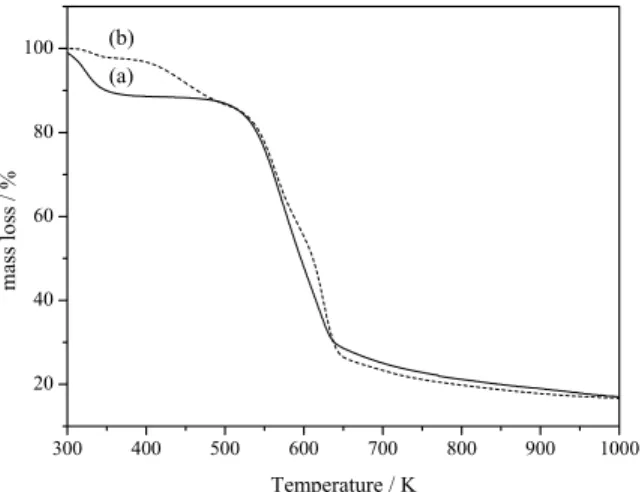
Brazilian Journal of Chemical Engineering The thermal behavior of the BE and BEM forms
are shown in Figure 5 with identical thermal stabilities. BE and BEM components showed mass losses of 11% from 298 to 375 K and 12% from 298 to 500 K, respectively. This first step of decomposition can be attributed to the release of low mass carbon-rich molecules and sorbed water. The second stage of decomposition between 521 and 675 K corresponds to mass losses of 56% due to the decomposition of organic material resulting in the expected breakdown of fibers to give the final residue (Vieira et al., 2011; Santana et al., 2010).
5 10 15 20 25 30 35 40 45
040 002
101' 101
(b) (a)
2θ / degree
Figure 4: X-ray diffraction patterns for babassu coconut epicarp BE (a) and the chemically modified form BEM (b).
300 400 500 600 700 800 900 1000 20
40 60 80 100 (b)
(a)
m
as
s
lo
ss
/
%
Temperature / K
Figure 5: Thermogravimetric curves of the babassu coconut epicarp BE (a) and the chemically modified form BEM (b).
Effects of pH
The effect of pH on the sorption efficiency of copper ion on BEM and the pHPZC of the material is
shown in Figure 6. The increase of carboxylic groups in the chemically modified biopolymer caused a de-crease in the pHPZC value from 6.95 to 6.45. This
indicates that the attraction of positive charge by BEM must be favorable at pH > 6.45 because of the negative charge on the sorbent surface (Vieira et al., 2009). Under acidic conditions, the sorbent can be protonated and the amount of cations sorbed decreases. On the other hand, an increase in pH deprotonates the carboxylate groups, a condition that favors the chelating abilities and, consequently, the amount of sorbed copper ion is increased.
0 2 4 6 8 10 12
8 16 24 32 40 48
pHi qe
/ m
g
g
-1
-4 -2 0 2 4
6.45
6.95 Δ pH
Figure 6: Effect of pH on copper ion sorption in aqueous solution by BEM (■) and the pHPZC of BEM
(○) and BE (∆).
The sorption of cations increases with the increase in pH and reaches a maximum value at pH 6. Experi-ments were not performed above this value since the formation of copper hydroxide is expected (Vieira
et al., 2010). Therefore, pH 6.0 was chosen as the optimum for the subsequent sorption experiments.
Sorption Kinetics
An sorption kinetics study is important in the treatment of aqueous effluents as it provides valuable information on the reaction pathways and sorption mechanism (Lima et al., 2008). The equilibrium be-havior of the sorption process and the fit to kinetic models are shown in Figure 7. Equilibrium involving BEM and copper ions is observed after 30 min of contact.
High Performance Maleated Lignocellulose Epicarp Fibers for Copper Ion Removal 189
of χ2. Additionally, it was verified that the qe values
found for the pseudo-second and pseudo-first order were closer to the experimental qe values, when
com-pared with the other kinetic models. These results indicate that both pseudo-first and second-order models could explain the sorption process of copper ion by the BEM sorbent. These kinetic equations have been successfully employed to explain several kinetic processes of different sorbents (Santana
et al., 2010; Vieira et al., 2010; Demirbasa et al., 2009).
0 10 20 30 40 50 60
0 10 20 30 40 50
Experimental points Elovich
Pseudo-first order qt
/
m
g
g
-1
Time / min
Pseudo-second order
Figure 7: Non-linear kinetic models for copper ion sorption from aqueous solution by BEM.
Table 1: Kinetic data for copper ion sorption, using BEM as sorbent at 298 ± 1 K.
Pseudo-first order Constant
k1/ min-1 0.090
qe/ mg g-1 46.820
R2 0.989
Ferror/ % 3.250
Pseudo-second order
k2/ g mg-1 min-1 0.001
qe/ mg g-1 56.020
h =k2qe2 / mg g-1 min-1 3.138
R2 0.985
Ferror / % 4.390
Elovich – Chemisorption
α / mg g-1 min-1 33.010
β/ g mg-1 0.081
R2 0.920
Ferror/ % 9.110
Intra-particle diffusion
kid1 / mg g-1 min-0.5 8.180
R12 0.996
Kid2 / mg g-1 min-0.5 0.015
R22 0.784
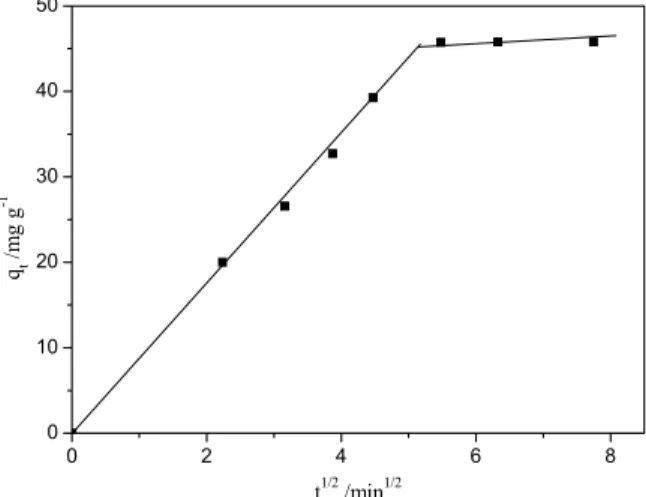
The intra-particle diffusion study demonstrated that the sorption kinetics occur with multi-linearity for copper ion using BEM as sorbent, as shown in Figure 8. For this process two kinetic stages are involved that can be attributed to two linear parts. The first linear part can be attributed to intra-particle diffusion with instantaneous sorption and to external surface sorption, while the second region is the gradual sorption stage, where intra-particle diffusion is rate limiting. It is also observed in Table 1 that the value of kid1 is greater than the value of kid2, a
difference that is due to the fact that the process of intra-particle diffusion starts to decrease after about 30 min, when kinetic equilibrium is established (Hameed et al., 2008).
0 2 4 6 8
0 10 20 30 40 50
qt
/
m
g
g
-1
t1/2 /min1/2
Figure 8: Intra-particle diffusion model for copper ion sorption from aqueous solution by BEM.
Sorption Isotherms
The isotherms of copper ion sorption by BEM predicted from all three models are plotted in Figure 9. All the correlation coefficient R2 values and the constants obtained for the models are summarized in Table 2. The Langmuir model yielded the best fit with the highest R2 value of 0.998 and lowest average percentage errors. Thus the Langmuir iso-therm was the most suitable equation to describe the adsorption equilibrium for copper. As can be seen from Figure 9, the qe values predicted from the
Brazilian Journal of Chemical Engineering babassu coconut epicarp and mesocarp modified
with ethylenesulfide (Santana et al., 2010).
0 100 200 300 400 500
0 10 20 30 40 50 60
Experimental Langmuir Freundlich Temkin
qe
/m
g g
-1
Ce/mg dm-3
Figure 9: Sorption isotherm models for copper ion sorption from aqueous solutions by BEM.
Table 2: Isotherm data for copper, using BEM as sorbent at 298 ± 1 K.
Freundlich Constant
KF/ mg g-1 (dm3 mg-1)1/n 14.7
nF 4.58
R2 0.938
Ferror / % 4.28
Langmuir
KL/ dm3 mg-1 5.0x10⁻²
Qm / mg g-1 55.1
R2 0.998
Ferror / % 1.90
Temkin
KT / dm3 g-1 0.97
nT / J mol-1 9.00
R2 0.990
Ferror / % 3.84
The parameter RL, obtained through the Langmuir
equation, indicates favorable sorption for values of 0 < RL <1, unfavorable for R > 1 and irreversible for
values of RL = 0. Figure 10 represents the calculated
RL values versus the initial concentration of copper.
All the RL values were between 0 and 1, indicating
that the sorption of copper by BEM was favorable under the conditions studied. However, as the initial concentration increased from 100 to 500 mg dm-3, the RL values decreased from 0.166 to 0.038, a
behavior which indicates that the sorption was more favorable at higher concentrations. A comparison of the maximum monolayer sorption capacity of copper ions with different sorbents is listed in Table 3. BEM presents high sorption capacity when compared with the other listed materials. Epicarp and mesocarp from babassu coconut chemically modified with ethylene sulfide (Santana et al., 2010) presented lower sorption capacity than, epicarp is modified with maleic anhydride. This could be associated with the nature of the soft sulfur atom in the SH chelating groups, that differs from oxygen hardness in the carboxylic groups. However, when comparing the mesocarp modified with maleic, phthalic and succinic anhydrides (Vieira et al., 2010), which present the same chelating groups, the epicarp derivative is still higher in sorption. On the other hand, another contribution to this phenomenon could be associated with phenol moieties present in lignin that are able to interact with copper ion. The biopolymer chitosan, which has the ability to bond cations due to its basic nitrogen atom (Lima and Airoldi, 2004), also has a lower sorption capacity. Only ponkan tangerine peel presents a higher sorption capacity, which could be related to the availability of carbonyl functional groups, in addition to the presence of hydroxyl groups (Pavan
et al., 2006). These values confirm that the presence of carbonyl groups favors copper sorption, but the additional presence of lignin in the epicarp fraction increases the sorption when compared with other babassu coconut components.
100 200 300 400 500
0.04 0.08 0.12 0.16
RL
Ci/mg dm-3
High Performance Maleated Lignocellulose Epicarp Fibers for Copper Ion Removal 191
Table 3: Comparison of different sorbents for copper sorption.
Sorbent Qm / mg g-1 Reference
Babassu coconut mesocarp/ethylenesufide 47.50 (Santana et al., 2010) Babassu coconut epicarp/ethylenesufide 47.70 (Santana et al., 2010) Babassu coconut mesocarp/maleic anhydride 34.36 (Vieira et al., 2010) Babassu coconut mesocarp/phthalic anhydride 40.47 (Vieira et al., 2010) Babassu coconut mesocarp/succinic anhydride 40.98 (Vieira et al., 2010)
Chitosan 24.14 Lima and Airoldi, 2004)
Ponkan peel 83.23 (Pavan et al., 2006)
Pinhão wastes 32.20 (Lima et al., 2007)
Olive pomace 4.26 (Pagnanelli et al., 2003)
Grape stalks 10.10 (Villaescusa et al., 2004)
Cork park 3.00 (Villaescusa et al., 2004)
Granular activated carbon 38.00 (Babel and Kurniawan, 2003)
Pyrolized coffee residue 17.79 (Boonamnuayvitaya et al., 2004)
Babassu coconut epicarp/maleic anhydride 55.09 This work
CONCLUSIONS
The maleation of the babassu coconut epicarp with molten maleic anhydride is an efficient chemi-cal modification for obtaining a product with carbox-ylic groups. The new synthetic surface, with incor-poration of pendant chains containing basic centers that are potentially available for cation removal, behaved as a promising material, with good sorption capacity for copper ion and potentially of great utility for ecosystem purification. The best condi-tions were established with respect to pH and contact time to saturate the available sites located on the sorbent surface. Kinetic models were used to adjust the sorption and both pseudo-first and second order models showed good fits.
The intra-particle diffusion model gave two linear regions, which suggested that the sorption could also follow multiple adsorption rates. The sorption process follows the Langmuir isotherm model, with a maximum sorbed amount of 55.09 mg g-1.
ACKNOWLEDGEMENTS
The authors are indebted to CAPES for financial support, and CNPq, CAPES and FAPESP for fellow-ships.
NOMENCLATURE
Ce equilibrium copper
concentration
mg dm-3
Ci initial copper concentration mg dm-3
CHCl hydrochloric acid
concentration
mg dm-3
CNaOH sodium hydroxide
concentration
mg dm-3
Ferror average percentage error %
H initial rate of sorption mg g-1 min-1
k1 rate constant of the
pseudo-first order model
min-1
k2 rate constant of the
pseudo-second order model
g mg-1 min-1
kid intra-particle diffusion rate
constant
mg g-1 min-0.5
KF Freundlich constant
representing sorption capacity
mg g-1 (dm3 mg-1)1/n
KL Langmuir constant related to
the apparent energy of sorption
dm3 mg-1
KT Temkin equilibrium constant dm 3
mg−1
M mass of the sorbent g
nF Freundlich exponent related
to the sorption intensity
nT Temkin constant related to
heat of sorption
J mol-1
P the number of experimental data points
qe amount of copper sorbed at
equilibrium
mg g-1
qt amount of copper sorbed at
time t
mg/g
qi exp experimental copper uptake
amount
mg g-1
qi mod copper uptake amount
calculated from kinetic or isotherm fitted models
Brazilian Journal of Chemical Engineering QCOOH amount of the carboxylic
function
mg g-1
Qm maximum Langmuir sorption
capacity
mg g-1
R2 correlation coefficient
RL Langmuir equilibrium
parameter
T contact time min
V volume of the solution dm3
VHCl volume of hydrochloric acid cm3
VNaOH volume of sodium hydroxide cm3
Greek Letters
α initial adsorption rate (mg g−1 min−1) of the Elovich equation
β Elovich constant related to the extent of surface coverage and also to the activation energy involved in chemisorption
g mg−1
REFERENCES
Babel, S. and Kurniawan, T. A., Low-cost adsorbents for heavy metals uptake from contaminated water: A review. J. Hazard. Mater., B97, 219 (2003). Boonamnuayvitaya, V., Chaiya, C., Tanthapanichakoon,
W., Jarudilokkul, S., Removal of heavy metals by adsorbent prepared from pyrolyzed coffee residues and clay. Sep. Purif. Technol., 35, 11 (2004). Demirbasa, E., Dizgeb, N., Sulakb, M. T., Kobya,
M., Adsorption kinetics and equilibrium of copper from aqueous solutions using hazelnut shell activated carbon. Chem. Eng. J., 148, 480 (2009). Doczekalska, B., Bartkowiak, M., Zakrzewski, R.,
Modification of sawdust from pine and beech wood with the succinic anhydride. Holz Roh Werkst 65, 187 (2007).
Flaschka, H. A., EDTA Titration, An Introduction to Theory and Practice. 2nd Ed., Pergamon Press, London (1959).
Freundlich, H. M. F., Uber die adsorption in lasugen. Z. Phys. Chem., 57A, 385 (1906).
Gellerstedt, F., Gatenholm, P., Surface properties of lignocellulosic fibers bearing carboxylic groups. Cellulose 6, 103 (1999).
Hameed, B. H., Tan, I. A. W., Ahmad, A. L., Ad-sorption isotherm, kinetic modeling and mecha-nism of 2,4,6-trichlorophenol on coconut husk-based activated carbon. Chem. Eng. J., 144, 235 (2008).
Ho, Y. S., McKay, G., Pseudo-second order model for sorption process. Process Biochem., 34, 451 (1999). Ho, Y. S., McKay, G., The kinetics of sorption of
divalent metal ions onto sphagnum moss peat. Water Res., 34, 735 (2000).
Jiang, Y., Pang, H., Liao, B., Removal of copper (II) ions from aqueous solution by modified bagasse. J. Hazard. Mater., 164, 1 (2009).
Karnitz Jr., O., Gurgel, L. V. A., Melo, J. C. P., Botaro, V. R., Melo, T. M. S., Gil, R. P. F., Gil, L. F., Adsorption of heavy metal ion from aqueous single metal solution by chemically modified sugarcane bagasse. Bioresour. Technol., 98, 1291 (2007). Langmuir, I., The constitution and fundamental
properties of solids and liquids. J. Am. Chem. Soc., 38, 2221 (1916).
Lima, I. S., Airoldi, C., A thermodynamic investi-gation on chitosan–divalent cation interactions. Thermochim. Acta, 421, 133 (2004).
Lima, E. C., Royer, B., Vaghetti, J. C. P., Brasil, J. L., Simon, N. M., Santos Jr., A. A., Pavan, F. A., Dias, S. L. P., Benvenutti, E. V., Silva, E. A., Adsorption of Cu(II) on Araucaria angustifolia wastes: Determination of the optimal conditions by statistic design of experiments. J. Hazard. Mater., 140, 211 (2007).
Lima, E. C., Roye, B., Vaghetti, J. C. P., Simon, N. M., Cunha, B. M., Pavan, F. A., Benvenutti, E. V., Cataluña-Veses, R., Airoldi, C., Application of Brazilian pine-fruit shell as a biosorbent to removal of reactive red 194 textile dye from aqueous solution. Kinetics and equilibrium study. J. Hazard. Mater., 155, 536 (2008).
Liu, C. F., Sun, R. C., Zhang, A. P., Ren, J. L., Wang, X. A., Qin, M. H., Chao, Z. N., Luo, W., Homo-geneous modification of sugarcane bagasse cellu-lose with succinic anhydride using a ionic liquid as reaction medium. Carbohydr. Res., 342, 919 (2007a).
Liu, C. F, Sun, R. C., Qin, M. H., Zhang, A. P., Ren, J. L., Xu, F., Ye, J., Wu, S. B., Chemical modifi -cation of ultrasound-pretreated sugarcane bagasse with maleic anhydride. Ind. Crop. Prod., 26, 212 (2007b).
Melo, J. C. P., Silva Filho, E. C., Santana, S. A. A., Airoldi, C., Maleic anhydride incorporated onto cellulose and thermodynamics of cation-exchange process at the solid/liquid interface. Colloids Surf., A 346, 138 (2009).
Pagnanelli, F., Mainelli, S., Vegliò, F., Toroa, L., Heavy metal removal by olive pomace: Biosorbent characterisation and equilibrium modeling. Chem. Eng. Sci., 58, 4709 (2003).
High Performance Maleated Lignocellulose Epicarp Fibers for Copper Ion Removal 193
Gushikem, Y., Use of Ponkan mandarin peels as biosorbent for toxic metals uptake from aqueous solution. J. Hazard. Mater., B137, 527 (2006). Perez-Marin, A. B., Meseguer-Zapata, V., Ortuño, J. F.,
Aguilar, M., Sáes, J., Lloréns, M., Removal of cad-mium from aqueous solutions by adsorption onto orange waste. J. Hazard. Mater., 139, 122 (2007). Santana, S. A. A., Vieira, A. P., Silva Filho, E. C.,
Melo, J. C. P., Airoldi, C., Immobilization of ethyl-enesulfide on babassu coconut epicarp and meso-carp for divalent cation sorption. J. Hazard. Mater., 174, 714 (2010).
Šæiban, M., Klašnja, M., Škrbiæ, B., Adsorption of copper ions from water by modified agricultural by-products. Desalination, 229, 170 (2008). Srivatava, V. C., Mall, I. D., Mishra, I. M.,
Charac-terization of mesoporous rice husk ash (RHA) and adsorption kinetics of metal ions from aqueous solution onto RHA. J. Hazard. Mater., 134, 257 (2005).
Sun, J. X., Sun, X. F., Sun, R. C., Fowler, P., Baird, M. S., Inhomogeneities in the chemical structure of sugarcane bagasse lignin. J. Agric. Food Chem., 51, 6719 (2003).
Talinli, N., Mirzalar, F., Sirkecioglu, O., Odabas, S., Synthesis of new functional dioxepin polymers. React. Funct. Polym., 40, 289 (1997).
Tchiama, R. S., Jéso, B., Akagah, A. G., Sèbe, G., Pétraud, M., A preliminary survey of the interfa-cial bonding of some tropical hardwoods towards succinic anhydride and 2-octen-1-yl succinic an-hydride molecules: Impact of lignin and carbohy-drate polymers structure on the chemical reactivity. Ind. Crop. Prod., 26, 173 (2007).
Teixeira, M. A., Babassu - a new approach for an ancient Brazilian biomass. Biomass Bioenergy, 32, 857 (2008).
Temkin, M. I., Pyzhev, V., Kinetics of ammonia syn-
thesis on promoted iron catalyst. Acta Physio-chim. URSS, 12, 327 (1940).
Vaghetti, J. C. P., Lima, E. C., Royer, B., Cunha, B. M., Cardoso, N. F., Brasil, J. L., Dias, S. L. P., Pecan nutshell as biosorbent to remove Cu(II), Mn(II) and Pb(II) from aqueous solutions. J. Hazard. Mater., 162, 270-280 (2009).
Vieira, A. P., Santana, S. A. A., Bezerra, C. W. B., Silva, H. A. S., Chaves, J. A. P., Melo, J. C. P., Silva Filho, E. C., Airoldi, C., Kinetics and thermo-dynamics of textile dye adsorption from aqueous solutions using babassu coconut mesocarp. J. Hazard. Mater., 166, 1272 (2009).
Vieira, A. P., Santana, S. A. A., Bezerra, C. W. B., Silva, H. A. S., Melo, J. C. P., Silva Filho, E. C., Airoldi, C., Copper sorption from aqueous solu-tions and sugar cane spirits by chemically modified babassu coconut (Orbignya speciosa) mesocarp. Chem. Eng. J., 161, 99 (2010).
Vieira, A. P., Santana, S. A. A., Bezerra, C. W. B., Silva, H. A. S., Chaves, J. A. P., Melo, J. C. P., Silva Filho, E. C., Airoldi, C., Epicarp and mesocarp of babassu (orbignya speciosa): Characterization and application for copper phtalocyanine dye removal. J. Braz. Chem. Soc., 22, 21 (2011). Villaescusa, I., Fiol, N., Martínez, M., Miralles, N.,
Poch, J., Serarols, J., Removal of copper and nickel ions from aqueous solutions by grape stalks wastes. Water Res., 38, 992 (2004).
Weber, W. J., Morris, J. C., Advances in water pollu-tion research: Removal of biologically resistant pollutants from waste waters by adsorption. In: Proceedings of the International Conference on Water Pollution Symposium, Pergamon, Oxford (1962).