333
Metallurgy and materials
Metalurgia e materiais
Abstract
This investigation addressed the evaluation of the use of copper tailings in the construction industry in order to reduce the impact on the environment. The evalu-ation was performed by a technical comparison between stucco mortars prepared with crushed conventional sand and with copper tailings sand. The best results were achieved with the stucco mortars containing tailings. The tailings presented a ine particles size distribution curve different from that suggested by the standard. The values of compressive strength, retentivity, and adherence in the stucco mortars pre-pared with copper tailings were much higher than those obtained with crushed sand. According to the results from this study, it can be concluded that the preparation of stucco mortars using copper tailings replacing conventional sand is a technically fea-sible alternative for the construction industry, presenting the beneit of mitigating the impact of disposal to the environment.
Keywords: copper tailings, stucco, compression strength, construction, environment.
Osvaldo Pavez Profesor
Universidad de Atacama
Departamento de Ingeniería en Metalurgia Copiapó – Región de Atacama – Chile [email protected]
Luis González Profesor
Universidad de Atacama Instituto Tecnológico
Copiapó – Región de Atacama – Chile [email protected]
Hernán Vega Profesor
Universidad de Atacama Instituto Tecnológico
Copiapó – Región de Atacama – Chile [email protected]
Eduardo Rojas Alumno de pregrado Universidad de Atacama Instituto Tecnológico
Copiapó – Región de Atacama – Chile [email protected]
Copper tailings
in stucco mortars
http://dx.doi.org/10.1590/0370-446720156901481. Introduction
In the construction industry, the use of solid wastes generated in mining and metallurgical activities becomes at-tractive, i.e., the use of tailings and slags (Onuaguluchi and Eren, 2012a; Nazer,
et al., 2012; Nazer et al., 2013). Tailings
deposits are considered environmental liabilities. Therefore, the possibility of an alternative use in the construction industry could reduce the undesirable impact.
Different types of tailings have been used in the construction industry: copper tailings (Sultan, 1979; Mahmood and Mul-ligan, 2007), iron ore tailings (Kumar et al.,
2014; Shetty et al., 2014; Zhao et al., 2014;
Uchechukwu and Ezekiel, 2014), gold mine tailings (Roy et al., 2007; Malatse and
Ndl-ovu, 2015), scheelite tailings (De Araújo, 2013), quartzite waste (Russo, 2011).
Regarding the use of copper tailings
in the construction industry, Oluwasola
et al., (2014) reported that the potential
uses of copper mine tailings and steel slag require studies and the negative impact of mine tailings should be reduced by explor-ing potential uses of these waste materials in the construction industry. Prahallada and Shanthappa (2014) studied the suitability of using copper ore tailings as an admixture in the preparation of concrete by replacing the cement in different percentages viz., 0%, 10%, 20%, 30%, 40%, and 50%. Zhang
et al., (2014) prepared standardized mortar
specimens, where cement was replaced by 55, 10, 15, 20, 25, 30, and 35 % of copper tailings. They reported that copper tailings can be used as cement admixture to solve the problem of environmental pollution. Thomas et al., (2013) used copper tailing
in cement concrete as a partial replacement
abrasion resistance, and reduced chloride penetration are observed in mixtures in-corporating copper tailings. Sultan (1979) determined the feasibility of using stabilized copper mill tailings in road construction. The results indicated that there is excellent
potential for using tailings as compacted ill in embankments, compacted founda-tion and subgrade material, cement lining canals, ponds, and reservoirs.
In order to evaluate the use of tail-ings in the construction industry and thus
reduce the impact on the environment, this article presents a technical comparison between stucco mortars prepared with crushed natural sand (conventional) and with copper tailings collected at the Manuel Antonio Matta plant, Chile.
2. Materials and methods
2.1 Materials
The cement, Pozzolana Portland (special INACESA), was manufactured according to the NCh148 standard. The sand utilized was obtained from the MCR
Áridos plant. The sample of copper tail-ings sand was collected at the Manuel Antonio Matta plant, located in the Ata-cama Region, Chile. The plant processes
150,000 tons of copper sulide ore per month, yielding 4,500 tons of concentrate and 145,500 tons of tailings. Drinking water was used in the stucco mortars.
2.2 Methods
The experimental program con-sidered a study with the following materials:
a) Dry stucco mortars (exterior stuc-co DryMix) as a reference for stuc-comparison; b) Stucco mortars with crushed conventional sand for comparison; and
c) Stucco mortars with copper tailings sand. The tests were performed in different specialized laboratories according to Chilean standards (INN NCh). Mechanical testing of compres-sive strength and lexural strength at ages 1, 3, 7 and 28 days were con-ducted at INACESA-Antofagasta. Assays of chlorides and sulfates were conducted at SESMEC laboratories. Weight dosage and volume dosage for copper tailings sand and crushed conventional sand were conducted at theWBS SERVILABHOR laboratories. Assays of adherence and retentivity were performed at the Printec labora-tories. Chemical analyzes of the copper tailings were conducted at the Manuel Antonio Matta plant.
According to NCh 2256/1.Of 2001, mortar is deined as the mix-ture of cement, sand and optionally other binder material that reacts with the addition of water and acquires resistance. The mixture may also have some other product to improve its properties whenever this complies with the requirements for use. When water is added to cement, it gives rise to the cement paste, which passes through an initial stage, in which the cement hydration process is devel-oped, during which it has a plastic consistency. Subsequently, it starts a progressive hardening process that transforms the plastic consistency material into a solid. During this process, the properties of the
mor-tar gradually evolve over time. The dosing used are: Cement/sand = 1/3; Cement/tailings = 1/3; Water/cement = 0.65. Cement: 400 kg/m3, Arid:
1200 kg/m3, and Water: 260 kg/m3.
The sand was crushed to obtain a particle size as close as possible to that required by the standard. The reduction in size of the sand was per-formed in a cone crusher laboratory of setting 5 mm. On the other hand, the tailings that had a iner grain size than required by the standard, were not crushed.
In the measurement of the me-chanical strengths, 3 samples of 40x40x160 mm for each type of mortar and age were prepared. Iron molds of 3 compartments with the inside dimensions indicated were used. For these tests the NCh 2261. Of1996 was applied. In measuring the compressive strength and lexural strength, the molds after having been illed with cement mortars, compacted in compaction table and smoothed for removal of mortar in excess, were sent to humid chambers by 24 hours and then demoulded and immersed in a water bath saturated with lime until their breakup in ages 1, 3, 7 and 28 days. In the case of the lex-ural strength, the resulting resistance value corresponds to the average of three specimens tested resistance to its rupture. On the other hand, the compressive strength is the average resistance of each piece tested that it come from the lexural test.
For testing adherence, the direct drive method is used according to NCh 2471. Of2000 standard. The assay for direct drive is effected by means of a steel disc attached to the surface of the coating to be tested,
on which a separating force per-pendicular to the surface is applied using a calibrated equipment, which is gradually increased to produce takeoff between the coating and the substrate or breakage in another area. Before placing the ixing disc, make sure that the surface of the specimen is clean and free of surface moisture. If needed, surface moisture must be removed with an absorbent material such as a blotting paper. With regard to process traction, it must connect the applicator equipment traction to the ixer disc, ensuring that the tensile force is applied perpendicular to the surface and with the appropri-ate speed according to the expected adherence until takeoff or breakage occurs in some area.
335
mm. The operation must be done in less than 11 minutes, counted from the time of mixing the cement with water. The retentivity is calculated with the percentage of the inal spread mortar sucked by the vacuum (B) relative to the initial spread mortar (A).
Chemical analysis of the samples were carried out by using different techniques: chemical elements (Cu, Zn) were analyzed in an atomic ab-sorption spectrophotometer GBC; volumetric technique (volumetry) was used in the determination of S and
chemical compounds (SiO2, Al2O3, Fe2O3, others); a hydride generator coupled to the atomic absorption spectrophotometer was applied in the determination of As; and to determi-nate Hg, the cold vapor technique was used with a mercury analyzer.
3. Results
The particle size distribution of the copper tailings does not comply with speci-ications of the NCh2256/1 standard, and is completely outside the limits of the size recommended. The particle size of the cop-per tailings sand is quite ine (91% -0.315
mm and 55% -0.16 mm). Moreover, sand tailings have a ineness modulus of 0.54, a very low value. The limit values for ine-ness modulus are 1.40 to 2.38. The particle size of the crushed sand does not comply with the speciications recommended by
the NCh2256/1 standard, for sizes above 2.00 mm. Moreover, the crushed sand presented a ineness modulus of 3.05 that is within the required limits (2.15 to 3.38). The particle size of the tailings and crushed sand are presented in Table 1.
Size (mm)
Crushed sand Cumulative
passing (%)
Tailings Cumulative
passing (%)
Crushed sand Lower limit – Upper limit Cumulative passing ( %) NCh 2256/1. Of2001
Tailings Lower limit – Upper limit
Cumulative passing (%) NCh 2256/1. Of2001
10 94 100
5 78 95 – 100
2,5 69 80 – 100 100
1,25 61 50 – 85 95 - 100
0,63 51 100 25 – 60 50 - 100
0,315 30 91 10 – 30 15 - 40
0,16 12 55 2 - 10 2 - 20
Fineness
Modulus 3,05 0.54 3.38 – 2.15 2.38 – 1.4
Table 1 Granulometry of the tailings and crushed sand. Also the tableshows the lower and upper limits and the cumulative passing percentage according to NCH standard 2256/1.Of2001.
The quantitative chemical analysis of the copper tailings sand indicated the presence of: SiO2 (54.30%), FeO (12.10%), Al2O3 (9.21%), Fe3O4 (3.60%), MgO (2.26%), S (1.94%), CaO (1.14%). These chemical species are characteristic of cop-per tailings produced at the concentrators
located in the Atacama Region. Moreover, the chemical analysis of crushed sand showed the presence of: SiO2 (45.23%), Fe2O3 (16.34%), Al2O3 (11.37%), CaO (8.53%), MgO (7.66%), Na2O (1.75%), K2O (1.42%), MnO (0.83%), P2O5 (0.64%), Cu (0.02%), As (0.003%), Zn
(0.02%), and Hg(1 ppm).
Table 2 shows the contents of chlo-rides and sulfates in the copper tail-ings sand. The igures comply with the maximum values recommended by the NCh1444 standard for concrete, 1.20 kgCl-/m3 and 0.60 kg SO
4=/m3.
Assay Unit Value
Chlorides kgCl-/kg arid 2.3 x 10⁻⁵
Sulfates kgSO4=/kg arid 5.8 x 10⁻³ Table 2
Figure 1 shows the results for thecompressive strength of stucco mortars with crushed sand and cop-per tailings sand for ages 1, 3, 7
and 28 days. The best results were achieved with copper tailings. Also, the compressive strength was deter-mined for exterior stucco DryMix for
age 28 days; the value obtained was 60.0 kgf/cm2, which it is very similar
to that of stucco mortars of crushed sand for the same age.
Figure 1
Compressive strength of stucco mortars with crushed sand and copper tailings sand for ages 1, 3, 7 and 28 days.
Moreover, Figure 2 shows the results obtained of the lexural strength for stucco mortars with crushed sand and copper tailings for ages 1, 3, 7 and 28 days. It is observed that with copper tailings the val-ues increase from 5 kgf/cm2 to 36 kgf/cm2
at the ages 1 day and 28 days respectively, while with crushed sand the values increase from 3 kgf/cm2 to 26 kgf/cm2 at those ages.
Table 3 presents the values of re-tentivity for exterior stucco DryMix, stucco with crushedsand and stucco of
copper tailings. It is appreciated that the value obtained for copper tailing is 87%, which is 45% and 40.3% greater than thatachieved with the exterior stucco DryMix (60%) and with the crushedsand (62%) respectively.
Figure 2
Flexural strength obtained for stucco mortars with crushed sand and copper tailings sand for ages 1, 3, 7 and 28 days.
Table 3
Retentivity values for exterior stucco DryMix, stucco with crushed sand and stucco with copper tailings sand.
Material Retentivity(%) Exterior stuccoDryMix 60 Stuccowithcrushedsand 62 Stucco with copper tailings sand 87
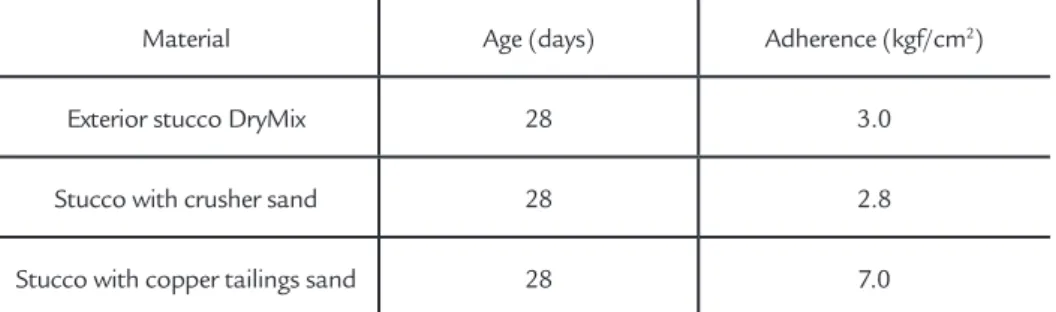
Table 4 shows the values of ad-herence for stucco exterior DryMix, stucco with crushed sand and stucco with copper tailings sand for age 28
days. The stucco mortars must have a minimum adhesion of 2.0 kgf/cm2
at 28 days when they are placed on new surfaces (INN(2000) NCh2471.
Of2000). The value of adherence for stucco with copper tailings (7.0 kgf/cm2)
337 Table 4
Values of adherence for stucco exterior DryMix, stucco with crusher sand and stucco with copper tailings sand for age 28 days.
Material Age (days) Adherence (kgf/cm2)
Exterior stucco DryMix 28 3.0 Stucco with crusher sand 28 2.8 Stucco with copper tailings sand 28 7.0
4. Discussion
The size distribution of the copper tailings sand presented 55% passing 0.1 mm. These tailings do not comply with the speciications of the standard and the size distribution curve is completely out-side the recommended limits. However, despite this, the results obtained using copper tailings were very good. The litera-ture indicates that the copper tailings used in construction contain a high proportion of ine particles. Onuaguluchi and Eren (2012b) reported that the copper tail-ings used in their experiments contained 50% passing 0.1 mm. In the case study reported by Mahmood and Mulligan (2007), the copper tailings fraction pass-ing 0.075 mm reached 56.9%. Moreover, Oluwasola et al. (2014) reported that the
size analysis of a sample of Malaysian copper tailings contained 60% passing 0.9 mm and 10% passing 0.2 mm.
The compressive strength of stucco mortars prepared with copper tailings sand was greater than the values obtained with crushed sand at all ages(1,3, 7 and 28 days). The requirements for compres-sive strength are 25 kgf/cm2 for exterior
stucco and 10 kgf/cm2 for interior stucco.
Figure 1 shows that the stucco mortars with copper tailings comply very quickly with the requirements of compressive re-sistance; at age 3 days, it reached a value of 49.0 kgf/cm2. Furthermore, the
com-pressive strength obtained with stucco mortars of copper tailings at 28 days was 148.0 kgf/cm2. This value would be 150%
higher than the compressive strength
obtained with exterior stucco DryMix and with stucco mortars of crushed sand of the same age. It is also important to mention that with copper tailings at the age of 7 days, a compressive resistance of 75.0 kgf/cm2 was achieved, this value
being 27% and 25% higher than the values obtained at 28 days with crushed sand (58.9 kgf/cm2) and exterior stucco
DryMix (60 kgf/cm2), respectively. Higher
values of compressive strength of stucco mortars with copper tailings indicate that this stucco has a good internal cohesion and a high capacity to support pressure without disintegrating. Onuaguluchi and Eren (2012a) reported that the compres-sive strength was increased by the addi-tion of copper tailings to concrete, leading to higher strengths compared with the control concrete at the 7th, 28th and 90th days. Similarly, all the concrete mixtures incorporating copper tailings recorded higher lexural strengths compared to the control at all test ages. Zhang et al., (2014)
showed that when copper tailings are added at a proportion lower than 15 %, it can increase the compressive strength,the lexural strength, and improve the cement performances, while additions above 15 % would decrease the strength. More-over, Prahallada and Shanthappa (2014) reported that: a) strength of concrete blocks decreases with increase in the percentage of tailings (the cement can be replaced by copper tailings up to 30%); b) the addition of copper tailings replacing ordinary Portland cement causes
reduc-tion in the compressive strength of con-crete; and c) the replacement of ordinary Portland cement by copper tailings is safe up to 20% considering average minimum ield strength.
The retentivity is an impor-tant property of the stuccos. The NCh2259. Of1996 standard recom-mended that the value of the reten-tivity must be greater than 60% to ensure the operation of the continuous coatings. In the case of constructions that are built under extreme weather conditions, the values may be higher to cover the effect that may be caused by the water retention capacity of the mortar. According to the retentiv-ity value obtained in the stucco with copper tailings (87%), this stucco would comply with the requirements of retentivity for high standards (for example, very rigorous environment).
The adherence obtained at 28 days for the copper tailing stucco was 250% higher than the value required by the standard, and 130% and 150% higher than that achieved by the exte-rior stucco DryMix and crushed sand stucco, respectively. These results con-irm that the tailings easily adhere to the elements with which they have contact. In the copper concentrator plants, it can be seen that the tailings adhere to the elements and structures of the place, rendering it dificult to clean equipment and machines, since the tailings are strongly adhered.
5. Conclusions
The results obtained with stucco mortars prepared with copper tailings were better than those achieved with stucco mortars prepared with crushed sand. The particles of the copper tailings were iner than the recommended stan-dard. However, the results obtained using these tailings in stucco mortars were very good. The values of compressive strength
in stucco mortars prepared with copper tailings were better than those obtained in stucco prepared with crushed sand at all examined ages (1, 3, 7 and 28 days). According to the retentivity value obtained in the stucco with copper tailings (87%), this stucco would comply with the require-ments of retentivity for high standards (for example, very rigorous environment).
obtained in this study, the preparation of stucco mortars using copper tailings
re-placing conventional sand is a technically feasible alternative for the construction
industry, which would reduce the impact of this environmental liability.
6. References
DE ARAÚJO, J.E. Estudo de caso: uso de resíduo de scheelita em argamassa e
con-creto. (Case study: use of scheelite residue in concrete and argamassa). Monograia
para obtencão do título de Bacharelem Ciëncia e Tecnologia, Universidade Federal Rural do Semi-Árido, RN, 2013. 50p.
INN (2010) NCh1444. Of2010. Áridos para morteros y hormigones. Determinación de cloruros y sulfatos (Aggregates for mortars and concretes. Determination of chlorides and sulfates). INN, Instituto Nacional de Normalización, Chile.
INN (2001) NCh2256/1. Of2001. Morteros - Parte 1: Requisitos generales (Mortars - Part 1: General requirements). INN, Instituto Nacional de Normalización, Chile. INN (1996) NCh2259. Of1996. Morteros. Determinación de la retentividad –
Méto-do de la succión de agua por vacío (Mortars. Retentivity determination - Method of water succión by vacuum). INN, Instituto Nacional de Normalización, Chile. INN (1996) NCh2261. Of1996. Morteros. Determinación de las resistencias
mecáni-cas de probetas confeccionadas en obra (Mortars. Determination of the mechani-cal strength of specimens prepared on site). INN, Instituto Nacional de Normali-zación, Chile.
INN (2000) NCh2471. Of2000. Morteros. Ensayos de adherencia – Método de trac-ción directa (Mortars. Adhesion tests - Method of direct traction). INN, Instituto Nacional de Normalización, Chile.
KUMAR, B.N.S., SUHAS, R.,SHET, S.U., SRISHAILA, J.M. Utilization of iron ore tailings as replacement to ine aggregates in cement concrete pavements.
Interna-tional Journal of Research in Engineering and Technology, v. 3, n. 7, p. 369-376,
2014.
MAHMOOD, A. A., MULLIGAN, C.N. Investigation of the use of mine tailings for unpaved road base.In: ANNUAL INTERNATIONAL CONFERENCE ON SOILS, SEDIMENTS, WATER AND ENERGY, 2007, Massachusetts, Procee-dings…(Proceedings…). Massachusetts, 2007. v. 12, Article 11, 2007.
MALATSE, M., NDLOVU, S. The viability of using the Witwatersrand gold mine tai-lings for brick making. The Journal of The Southern African Institute of Mining
and Metallurgy, v. 115, p. 321-327, 2015.
NAZER, A., PAVEZ, O., ROJAS, F. Use of copper slag in cement mortar. REM -
Re-vista Escola de Minas, v. 65, n. 1, p. 87-91, 2012.
NAZER, A., PAVEZ, O., TOLEDO, I. Effect of type cement on the mechanical strength of copper slag mortars. REM - Revista Escola de Minas, v. 66, n. 1, p.
85-90, 2013.
OLUWASOLA, E.A., HAININ, M.R., AZIZ, M.M.A., YAACOB, H.,WARID, M.N.M. Potentials of steel slag and copper mine tailings as construction materials.
Materials Research Innovations, v. 18, n. S6, p. S6-250 - S6-254, 2014.
ONUAGULUCHI, O. Properties of cement based materials containing copper tailings.
Turkey: Eastern Mediterranean University, 2012. (These Doctor of Philosophy). ONUAGULUCHI, O., EREN, O. Cement mixtures containing copper tailings as an
additive: durability properties. Materials Research, v. 155, n. 6, 2012a.
ONUAGULUCHI, O., EREN, O. Copper tailings as a potential additive in concrete: consistency, strength and toxic metal immobilization properties. Indian Journal of
Engineering & Materials Science, v. 19, p. 79-86, 2012b.
PRAHALLADA M.C., SHANTHAPPA B.C. Use of copper ore tailings – as an excel-lent pozzolana in the preparation of concrete. International Journal of Advanced
Research in Engineering and Applied Sciences, v. 3, n. 3, 9p., 2014.
ROY, S., ADHIKARI, G.R., GUPTA, R.N. Use of gold mill tailings in making bricks: a feasibility study. Waste Management and Research,v. 25, n. 5, p. 475-482, 2007.
RUSSO, M.L.C. Waste reciclagem obtained from extraction of quartzite. Belo
Hori-zonte, MG: Universidade Federal de Minas Gerais, 2011. 174p. (Doctoral Thesis). SHETTY, K.K., NAYAK, G., VIJAYAN, V. Use of red mud and iron tailings in self
compacting. International Journal of Research in Engineering and Technology, v.
3, n. 6, p. 111-114, 2014.
ANNU-339
AL MEETING OF THE TRANSPORTATION RESEARCH BOARD, 58, 1979. Washington, Proceedings… (Proceedings…). Washington, 1979. p. 1-7.
THOMAS, B.S., DAMARE, A., GUPTA, R.C. Strength and durability characteristics of copper tailing concrete. Construction and Building Materials, v. 48, p.
894-900, 2013.
UCHECHUKWU, E. A., EZEKIEL, M.J. Evaluation of the iron ore tailings from Itakpe in Nigeria as concrete material.Advances in Materials, v. 3, n. 4, p. 27-32,
2014.
ZHANG, C.S., ZHOU, T.T., WU, Q.S., ZHU, H.J., XU, P. Mechanical performances and microstructures of cement containing copper tailings. Asian Journal of
Che-mistry, v. 26, n. 5, p.1371-1375, 2014.
ZHAO, S., FAN, J., SUN, W. Utilization of iron ore tailings as ine aggregate in ultra--high performance concrete. Construction and Building Materials, v. 50, n. 15,
p. 540-548, 2014.