O
R
I
G
I
N
A
L
A
R
T
I
C
L
E
Modification of thermal and rheological behavior of
asphalt binder by the addition of an ethylene-methyl
acrylate-glycidyl methacrylate terpolymer and
polyphosphoric acid
Gerson da Silva Pereira
1and Ana Rita Morales
1*
1
Department of Materials Science and Bioprocess, School of Chemical Engineering,
Universidade Estadual de Campinas – UNICAMP, Campinas, SP, Brazil
Abstract
This study evaluated the modiication effects of adding ethylene-methyl acrylate-glycidyl methacrylate terpolymer (EMGMA) in the presence of polyphosphoric acid (PPA) to an asphalt binder graded as 50/70 (0.1mm) in the Brazilian penetration grade speciication (AC 50/70). The EMGMA terpolymer has been presented as a new alternative to modify asphalt binders properties, as scientiic literature is scarce on its usage in this context and also on the role of PPA when used in combination with reactive polymers. The characteristics of the modiied binder were analyzed by standard and rheological testing, including Multiple Stress Creep Recovery test (MSCR) and Fourier Transform Infrared Spectroscopy (FTIR) analysis. The MSCR test showed that the modiied binder presented lower values of non-recoverable compliances (Jnr) and a higher percent recovery, when compared to the conventional binder. This behavior indicates that addition of EMGMA and PPA in asphalt binders could enhance the resistance to rutting of asphalt mixtures. The statistical evaluation showed that EMGMA had greater inluence on the studied properties of Jnr (0.1kPa), MSCR recovery, softening point and elastic recovery at 25°C and that the PPA had also signiicant inluence on these properties. FTIR analysis showed that chemical reactions occurred between the asphalt binder and EMGMA, forming a three-dimensional polymeric network, which promotes improved characteristics.
Keywords: asphalt binder, modiied asphalt binders, MSCR, non-recoverable compliance, ethylene-methyl acrylate-glycidyl methacrylate terpolymer.
1. Introduction
Modified asphalt binders have been increasingly used in paving applications as an interesting alternative to deal with shortcoming of the petroleum asphalt cement (PAC). Nowadays, the use of modified asphalt binders is an excellent alternative for more durable flexible pavements, improving some deficiencies and enhancing asphalt concrete properties such as resistance to rutting and cracking and reducing the damage due to fatigue and thermal susceptibility[1].
Several polymeric modifiers may confer beneficial characteristics to asphalt binders, among them can be cited styrene-butadiene block copolymer (SBR), styrene-butadiene-styrene (SBS), styrene-isoprene-styrene (SIS), styrene-ethylene-butadiene-styrene (SEBS), acrylonitrile-butadiene-styrene (ABS), ethylene vinyl acetate (EVA)[2]. SBS copolymer is considered the most appropriate
material for asphalt modification, despite the addition of it has economic limitations and may have serious technical limitations, as the low resistance to heat and oxidation[1].
Reactive terpolymers have been also used as modifiers of asphalts binders. Their reactivity is due to the presence of functional groups that are able to interact with the carboxyl groups of the asphaltenes. The asphaltenes fraction consists of large micelles with average molecular weight estimated between 800-3500 g/mol, and each micelle has a large number of available carboxyl groups, as shown in Figure 1.
The terpolymers reacts with the asphaltenes and develops a chemical bond network between micelles improving the rheological properties of the asphalt binder. Also, there is the epoxy opening ring that can react with the hydroxyl groups and causes the formation of an ether bond. The same reaction may happen through an amino group, and once the epoxy ring is open, crosslinking between the polymer chains may occur, not necessarily involving asphaltene molecules[3]. Examples of reactive polymers are thermoplastic
elastomers functionalized with maleic anhydride and ethylene copolymers containing epoxy rings[3]. Various studies show
the improvement of the characteristics of PAC by adding ethylene-butyl acrylate-glycidyl methacrylate terpolymer (EBGMA)[3-6]. Studies with EBGMA terpolymer show
important aspects to be considered in these systems, for instance, the polymer concentration, the curing time and the curing temperature that can promote a substantial increase in viscosity, which may induce the system to gel[3]. According to standard tests of penetration, softening
point, rotational viscosity and aging, the modified asphalt binder with EBGMA became more consistent and with less thermal susceptibility compared to the unmodified asphalt binder[4]. It was also reported that the addition of 1% EBGMA
Some studies also related the use of the polyphosphoric acid (PPA) in very low amounts to catalyze the reaction between the terpolymer and the asphalt molecular groups, as this is a slow reaction that requires up to 24 hours to complete the cure[3,7]. The addition of PPA in modified asphalts can
also decrease the amount of polymer, reducing costs[8,9].
Related to the rheological properties, a system of PAC + EBGMA + PPA showed a very high deformation recovery and a very low non-recoverable compliance (Jnr) values, as well presented more resistance when subjected to a sudden increase in stress level[5]. In other study the
addition of EBGMA terpolymer into the PAC modified its rheological properties, evidenced by an increase in the dynamic viscosity and a change of the Newtonian behavior at different temperatures[6].
Currently, the growing demand for modified asphalt binders has encouraged search for alternative new polymeric
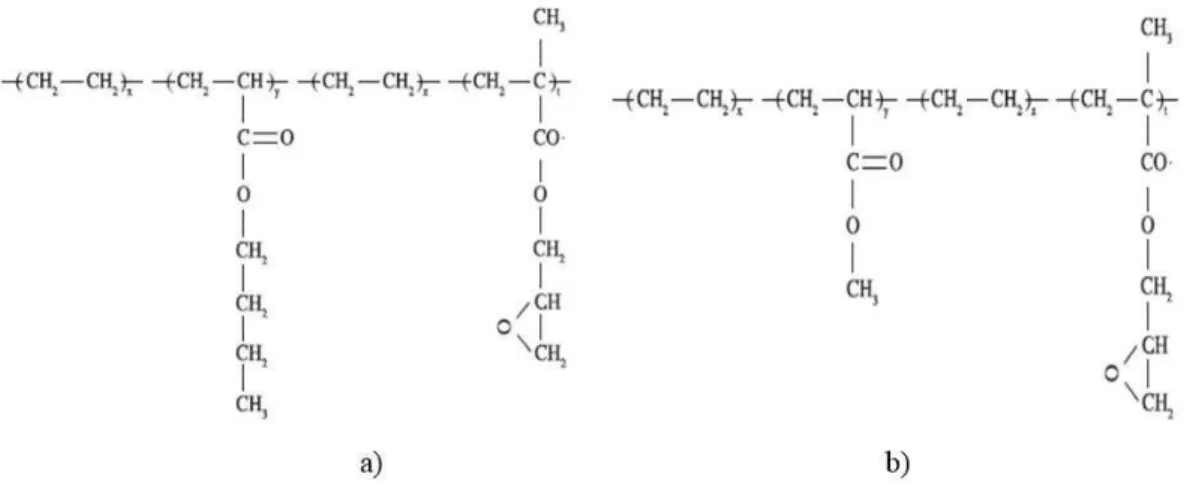
materials that meet the performance and economic viability requirements. Within this context, a new ethylene-methyl acrylate–glycidyl methacrylate terpolymer (EMGMA), studied in this paper, was recently introduced to the market, this modifier being the main object of this work. The main difference between the new EMGMA and the most studied terpolymers is the replacement of the butyl acrylate monomer by the methyl acrylate monomer[11]. The chemical structure
of EBGMA and EMGMA are presented in Figure 2a and b. In this study, the addition of PPA was also evaluated since several researchers have looked into the use of this acid also as a modifier, either by itself or associated to other modifiers[12-14]. As described by many researchers, adding
PPA in the PAC increases the content of asphaltenes, because it acts in this fraction as a deflocculant and increases the contact area with the maltenic phase[15,16].
Considering that scientific literature on the use of EMGMA terpolymer as asphalt binder modifier is scarce and the PPA function is not clear when used in combination with reactive polymers, this paper presents a laboratorial study of the thermal and rheological behavior for an asphalt binder modified with EMGMA in the presence of PPA in order to understand the polymer and PPA action and the components interactions.
2. Materials and Methods
2.1 Materials
One PAC from Replan – Petrobras Refinery (Paulinia, São Paulo, Brazil) was used in this study. This unmodified material is graded as 50/70 in the Brazilian penetration grade (AC50/70), indicating a penetration of 50 -70 (dmm), according to ASTM D5-06.
The EMGMA terpolymer was produced by Arkema (Lotader AX8900) and supplied by Quimigel Indústria Comércio Ltd., containing 23.13% of methyl acrylate and 8.35% of glycidyl methacrylate, having a glass transition temperature (Tg) of -2°C. It was supplied as extruded granules. Figure 1. 2-Dimensional model of an asphaltene molecule[10].
Figure 2. Molecular structure of (a) ethylene-butyl acrylate-glycidyl methacrylate terpolymer and (b) ethylene-methyl acrylate-glycidyl
Polyphosphoric Acid (PPA) is an inorganic oligomer obtained by the condensation of the monophosphoric acid or by the hydration of phosphorus pentoxide (P2O5).
The PPA is typically a mixture of orthophosphoric acid with pyrophosphoric acid and triphosphoric acid and does not contain free water. It is produced and marketed based on its relative level of H3PO4 (phosphoric acid) or P2O5 (phosphorus
pentoxide) in its content[16]. In this study was used the PPA at
the concentration of 84% of P2O5, proportional to 116% of
H3PO4, supplied by the company Prana Petroquímica Ltda.
2.2 Preparation of modified asphalt binder samples The unmodified PAC was preheated at a temperature of 175°C using an electric hot plate. Next, the EMGMA polymer was added to the PAC at the rate of 10g/min. An IKA stirrer (model RW20) with a propeller type R 1342 with four blades, was used to promote mixing at a speed of 1750 rpm. The stirring was done for 30 min, until the complete dispersion of the polymer, then, the PPA was added, remaining under agitation for additional 90 min.
2.3 Experimental design
It was used a factorial experimental design of 22, as
shown in Table 1, according to the methodology described by Neto et al.[17].
The statistical analysis of the data was performed using the software Statistica 10.0, with a confidence level of 95%. The factorial analysis was used to assess the effects and interactions of the variables in the traditional binder properties of softening point and elastic recovery at 25°C, and also in the non-recoverable compliance (Jnr) and in the percent of recovery, obtained at Multiple Stress Creep and Recovery (MSCR) test.
The properties evaluated by the conventional binder test were: penetration at 25°C (ASTM D5-06[18]), ring-and-ball
softening point (ASTM D36-06[19]) and elastic recovery
by ductilometer – (ASTM D6084-13[20]. The rotational
viscosity was measured using a Brookfield Viscometer RVDV-I Prime model with spindle No. 20, according to ASTM D4402-06[21], at temperatures of 135°C, 155°C and
177° and rotational speeds of 20 rpm, 50 rpm and 100 rpm, respectively. The rheological tests were performed using a dynamic shear rheometer (DSR) from TA Instruments (DHR-1 model), with a parallel plate geometry of 25mm diameter and deformation amplitude of 12%, controlled automatically by the equipment software. The dissipation modulus, storage modulus and phase angle were also determined on the same DSR equipment, according ASTM D7175-08 standard[22].
The DSR is used to measure asphalt properties at high and intermediate temperatures. High values of complex
shear stiffness modulus (G*) represents high rigidity, while a small phase angle represents a greater elastic response (recoverable). An asphalt binder with these properties provides to an asphalt mixtures better resistance to rutting. Thus, the G*/sinδ parameter was originally adopted using the Superpave[23] methodology to express the resistance of
asphalt binders to rutting. After the adoption of G*/sinδ in the Superpave specification, various studies showed that it was not appropriated to evaluate modified asphalt binders[24,25] because of its inability to assess the elastic
contribution provided by the addition of polymers to the asphalt binders. Thus, in this study, the recovery percentage and the non-recoverable compliance values (Jnr) were determined, in the Multiple Stress Creep Recovery test (MSCR), following the procedure established by ASTM D7405-10[26]. The MSCR test applies an oscillatory regime
to characterize permanent deformation of asphalt binders. This test was performed on the DSR equipment using unaged asphalt binder samples. In the MSCR test, a constant stress of 0.1 kPa for 1 second is applied on an asphalt sample of 1 mm thickness and then the load is removed, allowing the material to relax for 9 seconds. This cycle is repeated 10 times, without time intervals between cycles. After these 10 cycles, the same procedure is repeated using a constant stress of 3.2 kPa. The recovery percentage is obtained from the ratio of the recoverable deformation and the total deformation, as shown in Equation 1.
( )
(
0) (
0)
0
.1 00
, C R
C
E E E E
R N E E − − − −
σ = (1)
Where R(σ,N) is the percent recovery under stress σ (0.1 kPa or 3.2 kPa) and N is the cycle of the creep and recovery (1 ≤ N ≤ 10). Figure 3 shows the deformation values used for the calculations.
Table 1. Experimental design 22 for AC 50/70, EMGMA and PPA.
Independent variables % EMGMA Polymer % PPA Sample nomenclature
Levels
1.0
0.05 (1% EMGMA + 0.05% PPA)
2.0 (2% EMGMA + 0.05% PPA)
1.0
0.30 (1% EMGMA + 0.30% PPA)
2.0 (2% EMGMA + 0.30% PPA)
Figure 3. Deformations E0, EC and ER for one creep and recovery
The non-recoverable compliance is the ratio of the non-recoverable deformation and the stress applied, and is typically expressed as the inverse of the stress unit (Pa-1 or
kPa-1), according to Equation 2.
(
,)
R 0NR E E
J σN = −
σ (2)
Where Jnr(σ,N) is the non-recoverable compliance relative to the stress σ at the creep and recovery cycle N, (1 ≤ N ≤ 10 and σ = 0.1 kPa or 3.2 kPa). With all the results of R(σ,N) and Jnr(σ,N) obtained in the 10 creep and recovery cycles, their average results were calculated by means of the simple arithmetic average. Studies have demonstrated that the Jnr value has good correlations with rutting measurements on asphalt mixtures[27,28].
With the purpose to investigate the chemical reaction that may occur between the asphalt binder and the EMGMA, analysis were performed by Fourier Transform Infrared Spectroscopy (FTIR) on a spectrometer Thermo Scientific Nicolet 670 model, measured in transmittance mode, in the range of 4000-675cm-1.
3. Results and Discussion
Table 2 shows the results for unmodified and modified asphalt binder samples produced in accordance to the experimental design. The results indicated that binder with a higher PPA content had lower penetration values. Significant increase of the softening point was observed for all modified asphalt binder samples, increasing from 49°C to 76°C for the sample with 2% EMGMA + 0.30% PPA, which shows a lower temperature sensitivity of the asphalt binder. In the elastic recovery test performed at 25°C, it was noted that the modified binders have up to 6 times elastic recovery, when compared to the unmodified binder. The increase of the elastic recovery and the softening point values even with low EMGMA and PPA levels indicates that the terpolymer promotes the formation of a polymeric network, capable to provide an improvement in the elasticity of the PAC,
as described also by Polacco et al.[3] using the terpolymer
EBGMA.
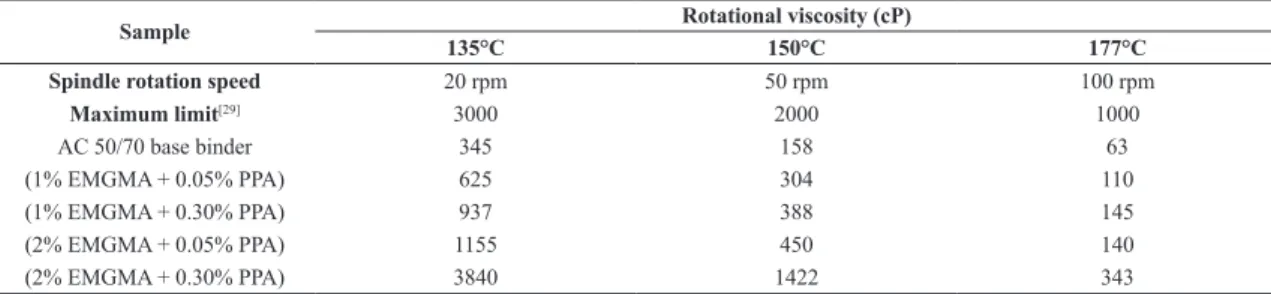
Table 3 and Figure 4 present the results of rotational viscosity at high temperatures. It is noted that the addition of EMGMA increased the rotational viscosity of the asphalt binder. Adding higher amounts of PPA to the modified binders for the same EMGMA content, the rotational viscosity also increased, which may be associated to the crosslinking process. This behavior was also observed by other researchers when EBGMA was used[3,6].
As observed from the softening point and the elastic recovery results, a polymeric network in the asphalt matrix may be developed, which also promotes an increase of the rotational viscosity, hindering the molecules flow.
The rotational viscosity is important to measure the consistency properties of asphalt binder, which are used as a guide for processing and storing temperatures. Asphalt binders excessively viscous can be inappropriate to be used in asphalt mixtures.
In Brazil, a maximum rotational viscosity is specified for modified asphalt binders at each temperature, as shown in Table 3[29]. Therefore, as shown by the experimental
data in Figure 4, only the modified asphalt binder with 2% EMGMA + 0.30% PPA exceeded the 3000 cP viscosity limit, indicating the possibility of operational problems.
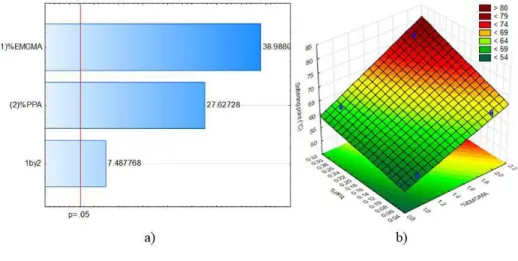
The data obtained at the laboratory tests were analyzed using the Statistica software 10.0, at 95% confidence level and it was possible to evaluate the effects and interactions of the variables in the responses. This method is useful to analyze the results in a statistical base, pointing out the factors that are statistically significant. Figures 5 and 6 illustrates the effects and interactions of each factor (EMGMA % and PPA %) regarding the softening point and elastic recovery.
Figures 5 and 6 show that both, the EMGMA concentration as the PPA concentration, influence in the evaluated properties, with a statistically significance (p<0.05). The concentration of EMGMA was the most influential factor, because of its higher value in the softening point and elastic recovery
Table 2. Results of conventional tests of the AC 50/70 and the modified asphalt binder samples.
Sample Penetration (dmm) Softening point (°C) Elastic recovery (%)
AC 50/70 base binder 55+/-1 49.0+/-0.8 9.0+/- 0.3
(1% EMGMA + 0.05% PPA) 53+/-1 55.0+/-0.6 71.0+/-0.8
(1% EMGMA + 0.30% PPA) 48+/-1 62.0+/-0.3 77.0+/-0.8
(2% EMGMA + 0.05% PPA) 58+/-1 66.0+/-0.5 83.0+/-1.0
(2% EMGMA + 0.30% PPA) 48+/-1 77.0+/-0.8 92.0+/-0.8
Table 3. Rotational viscosity results and the maximum limits according to Brazilian specification.
Sample Rotational viscosity (cP)
135°C 150°C 177°C
Spindle rotation speed 20 rpm 50 rpm 100 rpm
Maximum limit[29] 3000 2000 1000
AC 50/70 base binder 345 158 63
(1% EMGMA + 0.05% PPA) 625 304 110
(1% EMGMA + 0.30% PPA) 937 388 145
(2% EMGMA + 0.05% PPA) 1155 450 140
tests. Besides, there is a significant interaction between the factors in both responses, showing more pronounced in the softening point test. The evaluation of the response surface (Figure 5b and 6b) confirms that the concentration of EMGMA is the factor that most contributes to the increase of softening point and elastic recovery, but it is observed that the concentration of PPA also has strong influence on elastic recovery response. This suggests that PPA acts as a co-modifier of the PAC + EMGMA system, providing improved characteristics to the asphalt binder.
Conventional tests employed in the characterization of asphalt binder do not allow the determination of fundamental properties related to paved runway performance due to empiricism involved and practical complications related to the results interpretation[30]. To address this deficiency
new tests based on rheological properties related to the performance of the asphalt mixture were established by the Superpave specification[25,26]. Thus, MSCR test was used
to better assess the samples performance at performance temperatures of flexible pavements. The results of MSCR are shown in Figure 7 and it is noted that when EMGMA Figure 4. Rotational viscosities for the asphalt binder AC 50/70
and modified samples at temperatures of 135°C, 150°C and 177°C.
Figure 5. Softening point (a) Pareto chart and (b) response surface.
content and PPA content are increased, the deformation decreases and the deformation recovery enhances.
The overall behavior of the samples, observed at MSCR test, was similar at both applied stresses levels (3.2 kPa and 0.1 kPa). However, as expected, higher deformation was obtained at the stress of 3.2 kPa. Only the sample with 1% EMGMA + 0.05%PPA showed a greater deformation compared to the AC50/70.
In Figure 8 are shown the 0.1 kPa and 3.2 kPa recovery results obtained by MSCR test and it can seen an increase in the deformation recovery because of the addition of EMGMA polymer. Samples with 1% EMGMA content exhibit significant recovery enhancement with increase in PPA addition. Samples with 2% EMGMA show the same behavior.
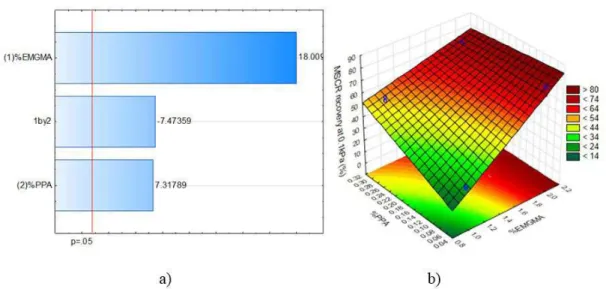
The effects and interactions of the MSCR recovery percentage at the stress of 0.1 kPa are illustrated in Figure 9. It is noted that the EMGMA concentration has a high contribution in this property. Additionally, the lower PPA concentration significantly affects the response, but a higher percentage of PPA did not contribute to the increase of the MSCR recovery.
The non-recoverable compliance values (Jnr) at the stresses of 0.1 kPa and 3.2 kPa are shown in Figure 10. Again, higher concentrations of EMGMA and PPA decrease the non-recoverable compliance values, except sample with 1% EMGMA and 0.05% of PPA. This behavior confirms the better performance of the modified binder, obtaining a EMGMA + PPA system that could contribute towards better rutting resistance of asphalt mixtures.
The statistical analysis of the effects and interaction of the variables on non-recoverable compliance (Jnr) response at the stress of 0.1 kPa stress is shown in Figure 11a and b. Both variables (PPA% and EMGMA%) influence this response and the EMGMA concentration has a higher
significance. The interaction between the two variables was more significant than the PPA concentration.
The MSCR test results obtained in this study using EMGMA are similar to those observed with EBGMA terpolymer, indicating that the mechanism of action in both cases are similar[5]. The improvement of the elastic characteristics
with minimum percentage of EMGMA and PPA can only be explained by the formation of a three-dimensional polymer network formed by the bonding of epoxy groups EMGMA with asphaltene molecules[3].
The rheological properties of the samples were also studied in the linear viscoelastic region, defined as the strain interval where the complex modulus (G*) does Figure 7. MSCR results for the applied stress of (a) 0.1 kPa and (b) 3.2 kPa.
Figure 8. MSCR recovery percentage at stresses of 0.1 kPa and
not vary with the applied shear stress, considering an accuracy of 5% for constant temperature and frequency[24].
Results of the complex modulus (G*) test were used to construct curves to better assess the modified samples. Figure 12 shows the results, indicating that the modification process significantly extended the linear viscoelastic region for the samples (2% EMGMA + 0.05% PPA) and (2% EMGMA + 0.30% PPA). It is also observed a total overall linearity for the complex modulus to shear stress values between 90 and 150 Pa, that corresponds to the shear stress specified for the dynamic-mechanical tests for an asphalt binder without aging.
Figure 13 shows the viscoelastic behavior of modified asphalt binder, represented by the storage modulus (G’) and the loss modulus (G”) as function of the temperature. As the EMGMA polymer and PPA percentage increase, the storage modulus (G’) also increases in all modified asphalt binder samples, indicating an improvement in the elastic
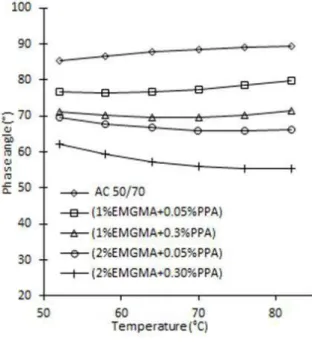
behavior of the asphalt. The viscous dissipation, represented by loss modulus (G”) values indicate that, at relatively low temperatures (52°C), asphalts behave in a similar manner regarding the viscous component; however, with the increase of the temperature a gap is noted between unmodified asphalt binder and the modified samples. The viscoelastic behavior of the binder is also evaluated using the phase angle (δ). At intermediate temperatures (normal conditions in asphalt mixtures), the asphalt binder has a viscoelastic behavior, and depending on the temperature and frequency, the peak response of asphalt binders may occur at any point for δ between 0 and 90°. This delay (δ) is a fundamental property to describe the viscoelastic behavior of asphalt binders.
The higher the phase angle (δ) the higher the predominance of the viscous component. Figure 14 presents the δ values of the samples studied. The unmodified asphalt binder had δ of 89° at 82°C showing a predominance of the viscous component. The sample (2% EMGMA + 0.30% PPA) had the lowest δ value, 55° at the same temperature, indicating a significant increase in the elastic properties of the modified asphalt.
Figure 15a shows the FTIR spectrum of the unmodified asphalt binder, EMGMA and the sample 2%EMGMA+0.3%PPA recorded in the range 2000-600 cm-1. The FTIR spectrum
corresponding to EMGMA terpolymer shows a remarkable band at 1736cm-1, which is assigned to the carbonyl stretching
(C=O) of glycidyl methacrylate (GMA)[31,32]. There are
two bands of stretching vibration for ester compound: one is νas(C–O–C) at 1195 cm-1, the other is νs(C–O–C) at 1164 cm-1. There is also a weak shoulder around 910cm-1 characteristic
of the epoxy group[11,31,32].
Comparing the spectrum of unmodified asphalt binder and the modified one, the bands show few differences. Therefore, it is not possible to identify any product of the reaction between the unmodified asphalt binder and EMGMA.
Figure 15b presents a zoom that shows that the band characteristic of the epoxy group at 910cm-1 disappears in
the modified asphalt binder. This indicates that the epoxy Figure 9. MSCR recovery at the stress of 0.1 kPa (a) Pareto chart and (b) response surface.
Figure 10. Average of non-recoverable compliances (Jnr) at the
Figure 11. Non-recoverable compliance (Jnr) at the stress of 0.1 kPa (a) Pareto chart and (b) response surface.
Figure 12. Modulus complex G* as function of the shear stress for the samples tested at 64°C.
rings of the EMGMA opened and reacted with the carboxyl groups in asphaltenes forming ester groups that are not differentiated from existing in the original material. As the epoxy groups EMGMA have a greater affinity reaction with the hydroxyl and carboxyl groups, and is more reactive with the carboxyl groups than with hydroxyl groups[11], the
interaction between the terpolymer EMGMA and the PAC probably due the carboxylic groups that exist in abundance in the asphaltene fraction[3,10]. Moreover, many changes occur in
the PAC because of the modification action of PPA that can be explained by the increase in the content of asphaltenes, as PPA acts as a deflocculant of this fraction, leading to an increase of the contact area of asphaltenes with maltenic phase[15,16]. Furthermore, at the beginning of the modification
process, the dispersion of EMGMA and the reaction with
the carboxylic groups in the asphaltene fraction happens, but this reaction is slow[3,7]. With the addition of the PPA the
deflocculation of asphaltene micelles occurs, which leverages the effect of EMGMA. Thus, a three-dimensional network which connects the asphaltene micelles is formed, as well as cross-reactivity with the polymer chain itself, contributing to the gain of the elastic properties of the asphalt binder.
4. Conclusion
The addition of EMGMA terpolymer and the PPA into the asphalt binder AC 50/70 produced modified asphalt binders with improved elastic properties, as evidenced by the softening point tests and elastic recovery at 25°C. Figure 14. Phase angle (δ) as function of the temperature.
The viscoelastic behavior showed lower phase angle values and higher storage modulus values.
The Multiple Stress Creep Recovery (MSCR) tests showed lower deformation and higher recovery stress values in the modified asphalt binders, besides, the results of non-recoverable compliances (Jnr) for applied stresses of 0.1 kPa and 3.2 kPa had a considerable decrease when EMGMA and PPA concentrations were increased. This fact is indicating that the modified asphalt binder may have a greater elastic response during the service conditions, contributing for a longer lifetime of the asphalt mixture in flexible pavements and a reduction in the susceptibility to rutting at longer loading-unloading times.
The statistical evaluation results give support to conclude that the EMGMA has greater influence on the non-recoverable compliance (Jnr) at 0.1 kPa, softening point and elastic recovery at 25°C. The PPA has also a significant influence on properties, meaning that it acts not only as a catalyst of the reaction between the asphalt components and the EMGMA terpolymer. There was also a significant interaction between the factors EMGMA% and PPA%.
FTIR spectrum showed that epoxy functional group of EMGMA disappear in the modified asphalt binder. The improvement of the elastic characteristics with very low amount of EMGMA and PPA can only be explained by the development of a three-dimensional network formed by the reaction of epoxy groups EMGMA with the functional groups of the asphaltene molecules, while the PPA acts as a co-modifier.
The results presented agree to those observed with EBGMA terpolymer, indicating that the mechanisms of action in both cases are similar.
5. References
1. Yildirim, Y. (2005). Polymer modified asphalt binders.
Construction & Building Materials, 21(1), 66-72. http://dx.doi.
org/10.1016/j.conbuildmat.2005.07.007.
2. Bernucci, L. B., Ceratti, J. A. P., Soares, J. B., & Motta, L. M. G. (2008). Pavimentação Asfáltica: formação básica para
engenheiros. Rio de Janeiro: Abeda.
3. Polacco, G., Stastna, J., Biondi, D., Antonelli, F., Vlachovicova, Z., & Zanzotto, L. (2004). Rheology of asphalts modified with
glycidylmethacrylate functionalizes polymers.Journal of Colloid and Interface Science, 280(2), 366-373. PMid:15533409. http://
dx.doi.org/10.1016/j.jcis.2004.08.043.
4. Topal, A. (2009). Evaluation of the properties and microstructure
of plastomeric polymer modified bitumen.Fuel Processing Technology, 91(1), 45-51. http://dx.doi.org/10.1016/j.
fuproc.2009.08.007.
5. Domingos, M. D. I., & Faxina, A. L. (2015). Rheological
analysis of asphalt binders modified with Elvaloy® terpolymer and polyphosphoric acid on the multiple stress creep and recovery test.Materials and Structures, 48(5), 1405-1416.
http://dx.doi.org/10.1617/s11527-013-0242-y.
6. Tomé, L. G. A., Soares, J. B., & Lima, C. S. (2004). Estudo
do cimento asfáltico de petróleo modificado pelo terpolímero de etilieno-butilacrilato-glicidilmetacrilato. In Anais do 3° Congresso Brasileiro de P&D em Petróleo e Gás (p. 1-6).
Rio de Janeiro: Instituto Brasileiro de Petróleo e Gás - IBP.
Retrived in 2015, April 3, from http://www.portalabpg.org.br/ PDPetro/3/trabalhos/IBP0499_05.pdf
7. DuPont. DuPontTM Elvaloy® Ret Lab Screening Guide: Technical Bulletin RET 1.1: Suggested Guidelines for Initial Screening of Elvaloy® RET in Asphalt for Paving Applications. Delaware:
DuPont, 2015. Retrived in 2015, March 28, from http://www.
dupont.com/content/dam/dupont/products-and-services/ additives-and-modifiers/additives-and-modifiers-landing/ documents/ret-asphalt-for_paving-lab-screening_guide.pdf
8. Van der Werff, J. C., & Nguyen, S. M. (1996). USPatent No
5.519.073A. Washington: U.S. Patent and Trademark Office. 9. Kodrat, I., Sohn, D., & Hesp, S. (2007). Comparison of
polyphosphoric acid-modified binders with straight and polymer-modified materials.Transportation Research Record,
1998, 47-55. http://dx.doi.org/10.3141/1998-06.
10. Murgich, J., Rodriguez, J., & Aray, Y. (1996). Molecular
recognition and molecular mechanics of micelles of some model asphaltenes and resins.Energy & Fuels, 10(1), 68-76.
http://dx.doi.org/10.1021/ef950112p.
11. Brito, G. F., Agrawal, P., Araújo, E. M., & Melo, T. J. A. (2012). Tenacificação do Poli(Ácido Lático) pela Adição
do Terpolímero (Etileno/Acrilato de Metila/Metacrilato de Glicidila).Polímeros: Ciência e Tecnologia, 22(2), 164-169.
http://dx.doi.org/10.1590/S0104-14282012005000025. 12. Pamplona, T. F., Nuñez, J. Y. M., & Faxina, A. L. (2014).
Desenvolvimentos recentes em ensaios de fadiga em ligantes asfálticos.Revista Transportes, 22(3), 12-25. http://dx.doi.
org/10.14295/transportes.v22i3.682.
13. Pamplona, T. F., Sobreiro, F. P., Faxina, A. L., & Fabbri, G.
T. P. (2012). Propriedades reológicas sob altas temperaturas
de ligantes asfálticos de diferentes fontes modificados com ácido polifosfórico.Revista Transportes, 20(4), 5-11. http://
dx.doi.org/10.4237/transportes.v20i4.612.
14. Orange, G., Dupuis, D., Martin, J. V., Farcas, F., Such, C., &
Marcant, B. (2004). Chemical modification of bitumen through
polyphosphoric acid: properties- microstructure relationship. In
Proceedings of the 3rd Eurasphalt & Eurobitume Congress (p.
733-745). The Netherlands: Foundation Eurasphalt. Retrived
in 2015, April 12, from http://worldcat.org/isbn/9080288446
15. Baumgardner, G. L., Masson, J. F., Hardee, J. R., Menapace, A. M., & Williams, A. G. (2005). Polyphosphoric acid modified
asphalt: proposed mechanisms.Journal of the Association of Asphalt Paving Technologists, 74, 283-306.
16. Masson, J. F. (2008). Brief review of the Chemistry of
Polyphosphoric Acid (PPA) and Bitumen.Energy & Fuels,
22(4), 2637-2640. http://dx.doi.org/10.1021/ef800120x.
17. Neto, B., Scarminio, I. S., & Bruns, R. E. (2007). Como fazer
experimentos: pesquisa e desenvolvimento na ciência e na
indústria. Campinas: Editora Unicamp.
18. American Society for Testing and Materials – ASTM. (2006).
ASTM D5-06: Standard Test Method for Penetration of Bituminous Materials. West Conshohocken: ASTM.
19. American Society for Testing and Materials – ASTM. (2006).
ASTM D36-06: Standard Test Method for Softening Point of Bitumen (Ring-and-Ball Apparatus). West Conshohocken: ASTM. 20. American Society for Testing and Materials – ASTM. (2013).
ASTM D6084/D6084M – 13: Standard Test Method for Elastic Recovery of Bituminous Materials by Ductilometer. West
Conshohocken: ASTM.
21. American Society for Testing and Materials – ASTM. (2006). ASTM D4402-06: Standard Test Method for Viscosity
Determination of Asphalt at Elevated Temperatures Using a Rotational Viscometer. West Conshohocken: ASTM. 22. American Society for Testing and Materials – ASTM. (2008).
ASTM D7175-08: Standard test method for determining dynamical shear rheometer (DSR). West Conshohocken: ASTM.
23. Transportation Research Board (2010). Development of the
E-C147). Washington: Transportation Research Board. Retrived
in 2015, March 15, from http://onlinepubs.trb.org/onlinepubs/ circulars/ec147.pdf
24. Bouldin, M. G., Dongré, R., & D’Angelo, J. (2001). Proposed
refinement of Superpave high-temperature specification parameter for performance-graded binders.Transportation
Research Record, 1766, 40-47. http://dx.doi.org/10.3141/1766-06.
25. D’Angelo, J. (2015). Multi-stress creep and recovery test
method a new specification. Austin: Association of Modified
Asphalt Producers - AMAP. Retrived in 2015, March 15, from http://amap.ctcandassociates.com/wp/wp-content/uploads/ dangelo-MSCR-2-08E.pdf
26. American Society for Testing and Materials – ASTM. (2010).
ASTM D7405-10: Standard Test Method for Multiple Stress Creep and Recovery of Asphalt Binder Using a Dynamic Shear Rheometer. West Conshohocken: ASTM.
27. Hafeez, I., & Kamal, M. A. (2014). Creep compliance: a
parameter to predict rut performance of asphalt binders and
mixtures. Arabian Journal for Science and Engineering, 39(8),
5971-5978. http://dx.doi.org/10.1007/s13369-014-1216-2. 28. Adorjányi, K., & Fuleki, P. (2013). Correlation between
permanent deformation-related performance parameters of
asphalt concrete mixes and binders.Central European Journal of Engineering, 3, 534-540. http://dx.doi.org/10.1007/s13369-014-1216-2.
29. Resolução ANP nº 32, de 21.9.2010. (2010, 22 de setembro).
Diário Oficial da República Federativa do Brasil, Brasília.
30. Bahia, H. U., & Anderson, D. A. (1995). Strategic highway
research program binder rheological parameters: background and comparison with conventional properties.Transportation
Research Record, 1488, 32-39.
31. Kaci, M., Kaid, N., & Boukerrou, A. (2011). Influence of
ethylene-butyl acrylate-glycidyl methacrylate terpolymer on compatibility of ethylene vinyl acetate copolymer/olive husk flour composites.Composite Interfaces, 18(4), 295-307. http://
dx.doi.org/10.1163/092764411X584487.
32. Jun, L., Yuxia, Z., Yuzhen, Z. (2008). The research of
GMA-g-LDPE modified Qinhuangdao bitumen.Construction and Building Materials, 22, 1067-1073. http://dx.doi.org/10.1016/j.
conbuildmat.2007.03.007.