ANALYSIS ON LATERALLY LOADED GROUP PILES BY
PLAXIS 3D FOUNDATION
Sri Dewi; Gouw Tjie-Liong
Civil Engineering Department,Faculty of Engineering, Binus University Jl. K.H. Syahdan No. 9, Palmerah, Jakarta Barat 11480
ABSTRAK
Telah lama dikenal bahwa kapasitas lateral group tiang lebih kecil dari penjumlahan kapasitas lateral dari masing-masing tiang. Untuk menentukan kapasitas lateral efektif group tiang, diperlukan faktor reduksi yang dikenal juga dengan nama faktor efisiensi. Sepanjang pengetahuan penulis, dalam buku-buku text geoteknik hanya jarak antar tiang yang diperhitungkan terhadap kapasitas lateral group. Faktor modulus kekakuan tanah dan jumlah total tiang dalam satu group tidak pernah diperhitungkan. Penelitian ini ditujukan untuk mencari pengaruh dari faktor-fator tersebut dalam kapasitas lateral tiang. Penelitian menggunakan perangkat lunak Plaxis 3D Foundation, yaitu perangkat lunak element hingga 3D khusus geoteknik. Hasil penelitian menunjukan bahwa semakin banyak jumlah tiang dalam satu group tiang semakin kecil faktor efisiensi kapasitas lateral group tiang tersebut, dan semakin besar kekakuan tanahnya semakin besar faktor efisiensinya.
Kata kunci: faktor efisiensi, kapasitas lateral grup tiang, Plaxis 3D Foundation.
ABSTRACT
It has been known that a group pile lateral capacity is smaller than the sum of each pile capacity composing the group. A reduction factor, also known as efficiency factor, is required to determine the effective lateral capacity of group piles. To the authors’ knowledge, in most geotechnical text books, only the spacing of piles is considered in evaluating the pile group lateral capacity. No consideration on the effects of soil stiffness modulus and the total number of piles forming the group is taken into account. This research tried to investigate the influence of those factors by using geotechnical 3D finite element software, namely Plaxis 3D foundation. It is found that the bigger the number of piles in a group, the lower the efficiency factor is; the higher the soil stiffness modulus, the greater the efficiency is.
INTRODUCTION
Apart from axial loads, lateral loads induced by wind, earthquakes, berthing of ships, vehicle acceleration and braking forces on the bridges, etc, have to be taken into account in designing a foundation system. Therefore, determination of the lateral capacity of pile foundation is one of the utmost important in foundation engineering.
It is well understood that a group pile lateral capacity is smaller than the sum of each pile capacity composing the group. A multiplier is required to determine the effective lateral capacity of group piles. The multiplication factor is known as group efficiency factor or reduction factor. In the available geotechnical text books, the only factor considered in determining the reduction factor is the center-to-center spacing of the piles.
To the authors’ knowledge, no in-depth study has been carried out to investigate the influence of the total number of piles forming the group and the effects of soil stiffness on the said efficiency factor. To answer whether there is any influence of these factors on the carrying capacity of the laterally loaded group pile – under the supervision of the second author – the first author carried out numerous analyses by using Plaxis 3D Foundation software version 2.2.
Due to time constraints, the extend of the study is limited to the following scope: (1) only 1 m diameter bored pile of 40 meter length is considered; (2) the center-to-center spacing of piles considered are 4D, 5D and 6D, where D is the diameter of the pile; (3) in evaluating the effect of pile spacing, the numbers of piles taken into account in a group are 4, 9, 16, 25, 36, 49 and 64 piles; (4) the value of soil stiffness ranges from 3000 kN/m2 to 25000 kN/m2; (5) in evaluating the effect of soil stiffness modulus, the numbers of piles considered in a group are 2, 4, 6, 9, 12, 25, 36, 49 and 64; (6) no existence of axial load; (7) pile head deflection is limited to 6 mm; (8) no pile cap effect is considered; (9) only fixed head capacity of piles is considered. As the present Plaxis version cannot determine the single pile fixed head capacity; the pile single pile capacity of pile is determined from finite difference method.
Literature Review
There are numerous methods available in determining the lateral capacity of a single pile, e.g. Reese Matlock method, Chang method, finite difference method, etc. From all the available methods, only finite difference method can directly evaluate the pile lateral carrying capacity of layered soils without going through the averaging of the horizontal sub grade reaction coefficient. Therefore, this method is adopted in determining the lateral capacity of a single pile.
Finite Difference Method
Winkler (1867) stated that the reaction force of a laterally loaded pile is proportional to the displacement. Pressure (P) and deflection (y) are related through the coefficient of horizontal subgrade reaction (kh),
y k
P= h ⋅ ... ...(1)
The pile is considered as a thin rod which satisfies the following equation:
B
P
dz
y
d
I
E
44 p
p
⋅
⋅
=
−
⋅
... (2)where:
Z = Depth B = Diameter of pile Combining equation (1) and (2),
0
y
B
k
dz
y
d
I
E
4 h4 p
p
⋅
⋅
+
⋅
⋅
=
... (3)The solution to the above differential equation can be obtained either analytically or numerically. An analytical solution is easy to obtain when the value of kh is constant throughout the pile. When the value of kh varies with depth, a numerical solution by finite difference method is employed (Palmer and Thompson, 1948; Gleser, 1953).
In this method, the basic differential equation (3) is written in the form of finite difference as follows:
(
)
04 6 4 4 2 1 1 2 = ⋅ ⋅ + ⎟⎟ ⎠ ⎞ ⎜⎜ ⎝ ⎛ − − − + − + + + i h i i i i i p p y B k y y y y y I E
δ
... (4)Equation (4) leads to:
0
y
y
4
y
y
4
y
i−2−
i−1+
α
i i−
i+1+
i+2=
... (5) with: 4 4 6 n I E B L k p p hi i ⋅ ⋅ ⋅ ⋅ + =α
... (6)where:
n = number of interval throughout the pile
khi = Coefficient of horizontal subgrade reaction at point i.
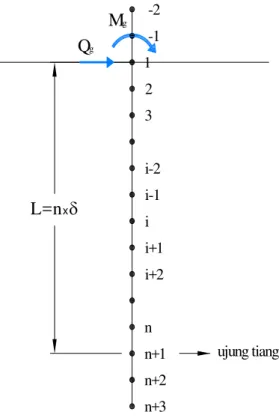
Figure 1 below shows the finite difference method for laterally loaded pile.
-2 -1 1 2 3 i-2 i-1 i i+1 i+2 n n+1 n+2 n+3
L
=
n
xδ
M
gujung tiang
Q
gA total simultaneous equation n+5 is needed to calculate the n+5 displacement which is unknown at the point (-2, -1, n +2 and n +3). Equation (6) can be employed from point 2 to point n in order to provide (n-1) equations. Further equations can be obtained from boundary conditions at the pile head. At the pile head there are two conditions to consider, i.e. free head and fixed head conditions.
Free head pile Shear force: g 3 3 p p
Q
dz
y
d
I
E
⋅
⋅
=
... (7)thus: 3 p p 2 g 3 2 1 2
n
I
E
L
Q
y
y
2
y
2
y
⋅
⋅
⋅
=
+
−
+
−
− − ... (8)Moment: g 2 2 p p
M
dz
y
d
I
E
⋅
⋅
=
... (9)hence: 2 p p 2 g 1 1 2
n
I
E
L
M
y
y
2
y
⋅
⋅
⋅
=
+
−
− ... (10)Fixed head pile Shear force: g 3 3 p p
Q
dz
y
d
I
E
⋅
⋅
=
... (11)thus: 3 p p 2 g 3 2 1 2
n
I
E
L
Q
y
y
2
y
2
y
⋅
⋅
⋅
=
+
−
+
−
− − ... (12)Rotation:
0
dz
dy
I
E
p⋅
p⋅
=
... (13)hence:
0 y
y2 − −1 = ... (14)
The pile tip is considered free, so: Shear Force at pile tip:
0
dz
y
d
I
E
3 3 pp
⋅
⋅
=
... (15)hence:
0
y
y
2
y
2
y
n 1+
n−
n 2+
n 3=
−
− + + ...(16) Moment at pile tip:0
dz
y
d
I
E
2 2 pp
⋅
⋅
=
... (17)hence:
0 y y 2
Two more required equations are obtained from equilibrium condition of horizontal force and moment.
Another way to solve the above is to ignore the shear force equation at the pile end (tip) and the pile head (top), i.e., equations (8) or (12) and (16). Therefore, ignore the two displacement variables at the point -2 and n +3. In this case only n +3 equations have to be solved. This procedure gives similar results to the previous procedure.
Group Pile Analysis
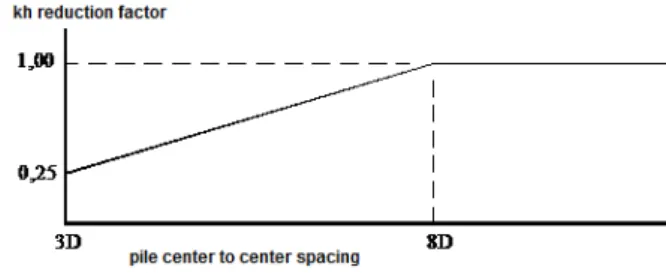
To find the lateral capacity of the group pile, Prakash in 1962 (Poulos, 1980) proposed to reduce the value of coefficient of horizontal sub grade reaction (kh), as shown in Figure 2. The group pile can then be performed using the finite difference method described earlier by entering reduced kh values.
METHOD
Modeling in Plaxis 3D
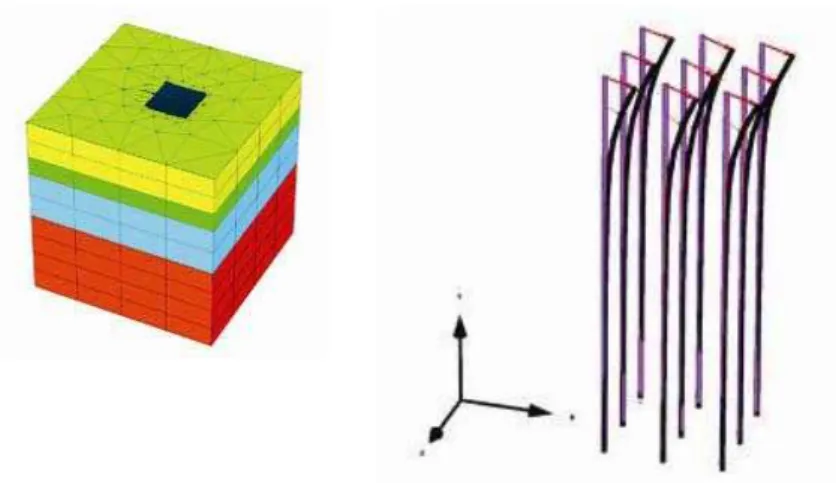
Plaxis 3D Foundation is a three-dimensional Plaxis program, developed for the analysis of three dimensional foundation and geotechnical problems. It is part of the Plaxis suite finite element software used worldwide for geotechnical engineering design. The software allows the complex finite element model to be solved quickly. The various available output facilities can be used to display the detail computational results. In this study the effect of pile cap is not considered. To eliminate friction between the soil and the pile cap, a dummy soil of 10 cm thick beneath the pile cap is introduced in the modeling (Figure 3). The dummy soil has the characteristics of water, so as to eliminate the friction.
Figure 2. Group pile reduction proposed by Prakash in 1962 (Poulos, 1980).
Dummy Soil
Figure 4. Output of plaxis 3d foundation for the group of 9 piles
The Input Parameters
Pile parameter: Diameter = 1 m Length = 40 m
2 7
p 2,59 10 kN/m
E = ×
Table 1
Soil Parameters
Soil MH 1 MH 2 MH 3 MH 4
Depth (m) 0 – 12 12 – 18 18 – 33 33 – 60
γd (kN/m3) 11 10 11 13
γsat (kN/m3) 17 16 17 18
E (kN/m2) 8000 14000 20000 25000
c (kN/m2) 10 15 20 25
φ 21º 22º 25º 25º
RESULTS AND DISCUSSION
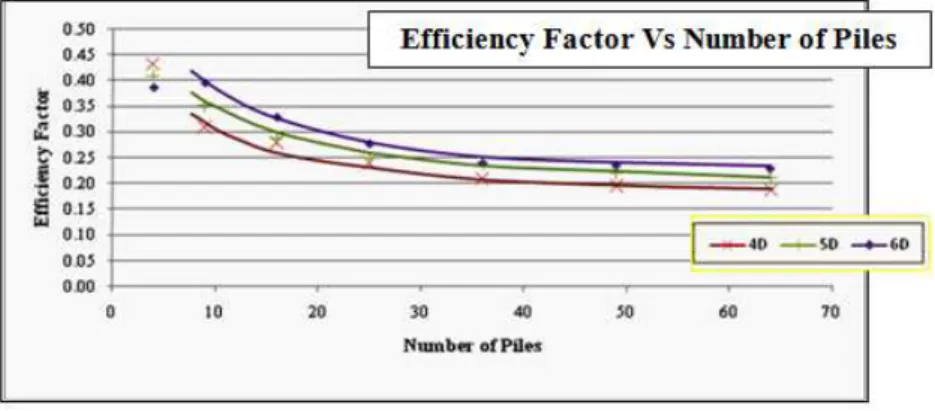
The results of the study are presented in Table 2 and Figure 5 and 6 below.
Table 2
Lateral Capacity of Single Pile Based on Finite Difference
Method
Lateral Capacity
Free Head Pile Fixed Head Pile
Figure 5. Efficiency factor vs. pile spacing (center to center) based on Plaxis analysis.
Figure 6. Efficiency factor vs. number of piles based on Plaxis analysis.
Figure 7. Influence of soil stiffness modulus for symmetrical pile configuration; E = Soil Stiffness Modulus in kN/m2
CONCLUSION
behind each pile is larger. Therefore, the interaction region among the piles (i.e. the overlapping reaction areas) becomes smaller. Hence, the lateral capacity of the group pile becomes greater; (2) the total number of piles in a group has significant influence on the efficiency factor of the group pile. The greater the number of piles in a group pile, the lower the efficiency factor is; giving the lowest efficiency factor to around 0.20; (3) the stiffness modulus of the soil also affects the efficiency factor of the group pile. The efficiency factor increases a long with the higher stiffness modulus of the soil.
The above is the interim results of the study. To make the study complete, the following shall be investigated further: (1) pile spacing of 2, 3, 7 and 8 times pile diameter; (2) various pile lengths and diameter; (3) pile cap effects; (4) comparative study by using different geotechnical finite element program, such as the GeoStudio or other.
REFERENCES
Gouw, T. L. (2007). Materi Kuliah Teknik Pondasi. Jakarta: Universitas Bina Nusantara.
Gouw, T. L. (2008). Materi Kuliah Aplikasi Komputer Dalam Teknik Sipil. Jakarta: Universitas Bina Nusantara.
Gouw, T. L., Usmanto & Natalius, K.W. (1984). Studi Pressuremeter Menard dan Oyo Serta Aplikasinya Dalam Daya Dukung. Bandung:Universitas Katolik Parahyangan.
PLAXIS b.v. (2002). PLAXIS 3D Foundation Version 2.0. Netherlands: A.A. Balkema Publisher.