ASSESSMENT OF SEXUAL FUNCTION IN PATIENTS UNDERGOING
VASECTOMY USING THE INTERNATIONAL INDEX OF ERECTILE
FUNCTION
EDUARDO BERTERO, JORGE HALLAK, CELSO GROMATZKY, ANTONIO M. LUCON,
SAMI ARAP
General Hospital, School of Medicine, University of Sao Paulo, USP, Sao Paulo, SP, Brazil
ABSTRACT
Introduction: The present study aims to prospectively compare the sexual function in males before and after vasectomy surgery using the international index of erectile function (IIEF).
Materials and Methods: From October to December 2002, sixty-four patients who were candidates for male sterilization in the vasectomy program of the Urology Section at the General Hospital of the University of São Paulo were included. The same investigator applied the IIEF before and 90 days after the surgery. The mean scores obtained on pre and postoperative visits for all do-mains of sexual function were analyzed and compared with the Wilcoxon test.
Results: The mean patient age was 35 years (range from 25 to 48 years) and the mean num-ber of children per man was 3. The total mean score of the IIEF was 64.06 before surgery and 65.64 after the procedure, with this difference considered statistically significant (p < 0.001). Sixty-seven per cent of the patients improved their scores, versus 17% and 16% who showed worsening or no change at all in IIEF scores following surgery, respectively. Of the 5 sexual function domains, desire and sexual satisfaction presented statistically significant improvement.
Conclusion: This study showed that vasectomy caused a positive impact on sexual function, especially on desire and sexual satisfaction, in the majority of men undergoing surgery. There was no case of surgery-related erectile dysfunction.
Key words:vasectomy; sexual activity; questionnaires; IIEF
Int Braz J Urol. 2005; 31: 452-8
INTRODUCTION
Currently, voluntary male sterilization through vasectomy is a very common procedure, which presents low complication rates (1-4). Post-vasectomy sexual dysfunction has been reported in the literature and is defined as a psychological com-plication of the surgery (5-7). Though many papers have reported post-vasectomy complications, only a few deal with psychological or sexual issues (7,8). In general, the incidence of psychological or sexual
prob-lems following vasectomy has been reported at be-tween 1 and 3% (8). However, none of these studies used the international index of erectile function (IIEF) for assessing post-vasectomy erectile function.
applica-tion in several subpopulaapplica-tions was published, al-though it did not include vasectomized patients (10). The questionnaire consisted of 15 items that should be answered by the patient himself with no interfer-ence from third parties. In 1999, through the “First Consultation on Erectile Dysfunction,” the World Health Organization adopted the IIEF as the main tool for assessing efficacy in clinical studies (11). The IIEF has been already validated in 32 languages, includ-ing Portuguese (12).
The object of this study is to prospectively assess through the IIEF the change in sexual function following voluntary vasectomy.
MATERIALS AND METHODS
We selected 65 patients from October to De-cember 2002 who had appointments scheduled for the vasectomy program of the Urology Section at the General Hospital of the University of São Paulo. Ages ranged from 25 to 48 years (35 ± 6).
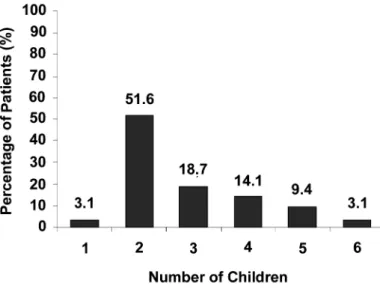
On average, patients had 3 living children (± 1) ranging from 1 to 6 years of age. The mean age of the youngest child was 18 months (± 20 months), rang-ing from 4 months to 12 years (Figure-1).
This study was approved by the Institutional Medical Ethics Committee, and all couples signed
Figure 1 – Number of children per vasectomized patient.
the informed consent form in order to participate in the research. On the day of the first interview, both the patient and his partner signed the responsibility form in accordance with Law 9.263 from January 12, 1996 regarding the regulation of family planning (13). We included patients who were candidates for vasectomy who were in accordance with the afore-mentioned law, and who complied with the follow-ing requirements: 1) two livfollow-ing children or, 2) older than 25 years. Additionally, the aforementioned law states that a minimum period of 60 days should be observed between the manifestation of will and the surgical act. During this period, the interested indi-vidual will be provided with access to a fertility regu-lation service, including counseling by a multidisciplinary team aiming to discourage early ster-ilization (13,14). All couples that were interviewed and participated in this study have respected this pe-riod. One patient was excluded because he had ab-stained from sexual intercourse during the 4 weeks preceding the application of the questionnaire at the first interview. Therefore, the study group was com-posed of 64 men.
follow-ing vasectomy (70 to 126 days). Patients completed the questionnaire during visit 1 on the same day that the social worker conducted the interview and re-quested the signature of the informed consent and responsibility term. Thus, the patients would have to comply with the 60-day period and would be able to discuss with their partners other commercially avail-able contraceptive methods. The same physician (EB) always performed both visits.
The IIEF-15 was fully applied to the patient according to the Portuguese-validated version (12). The questions are divided into 5 sexual function do-mains: erectile function (questions 1 to 5 and 15), sexual satisfaction (questions 6, 7 and 8), orgasm (questions 9 and 10), sexual desire (questions 11 and 12) and overall satisfaction (questions 13 and 14). Each question has a value ranging numerically from 0 to 5, with the lowest value presenting the poorer sexual response. Therefore, the total possible score is 75. The total score of items relative to erectile func-tion as adopted by the “1st Internafunc-tional Consulta-tion on Erectile DysfuncConsulta-tion” are quesConsulta-tions 1 to 5 and 15 (11). Based on this score, the degree of erec-tile dysfunction is defined as normal (> 25), mild (21 to 24), moderate (16 to 20) and severe (< 15).
On visit 2, the IIEF-15 was applied again in the same way as on visit 1. This follow-up visit was
performed on the seventh postoperative day by the same physician that performed the surgery. Also on visit 2, the patient was given the results of the semi-nal asemi-nalysis, which had been performed approxi-mately 60 days following the vasectomy.
The vasectomy procedure was performed at the hospital’s outpatient clinic using the traditional technique.
The quantitative variables were represented by mean and standard deviation, and qualitative vari-ables were absolute and relative frequency. Non-para-metric tests were used due to the nature of quantita-tive data; discrete continuous variables. Comparison between assessments on visits 1 and 2 in relation to the scores obtained on isolate questions, the sum of questions in each domain, and the total score, was performed by the Wilcoxon test for related samples. A significance level of p < 0.05 was adopted.
RESULTS
In relation to the 5 sexual function domains, statistically significant variations were found for the domains of sexual desire and sexual satisfaction (p = 0.05 and p = 0.003, respectively), with the score on visit 2 being significantly higher than on visit 1 (Tables-1 and 2).
Table 1 – Score and questions related to the sexual desire domain of the IIEF on visits 1 and 2 (n = 64).
IIEF – Sexual Desire Domain
Score Question 11 Question 12
Visit 1 Mean ±±±±± SD
7.75 ± 1.40 4.16 ± 0.93 3.59 ± 0.77
Visit 2 Mean ±±±±± SD
8.25 ± 1.11 4.36 ± 0.70 3.89 ± 0.76
P value (Wilcoxon test)
0.005 * 0.082 0.001 *
Table 2 – Score and questions related to the sexual satisfaction domain of the IIEF on visits 1 and 2 (n = 64).
IIEF – Sexual Satisfaction Domain
Score Question 6 Question 7 Question 8
Visit 1 Mean ±±±±± SD
11.59 ± 2.27
03.14 ± 1.40
04.47 ± 0.94
03.98 ± 0.75
Visit 2 Mean ±±±±± SD
12.16 ± 2.08
03.61 ± 1.00
04.50 ± 0.80
04.05 ± 0.81
P value (Wilcoxon test)
0.003 * 0.002 *
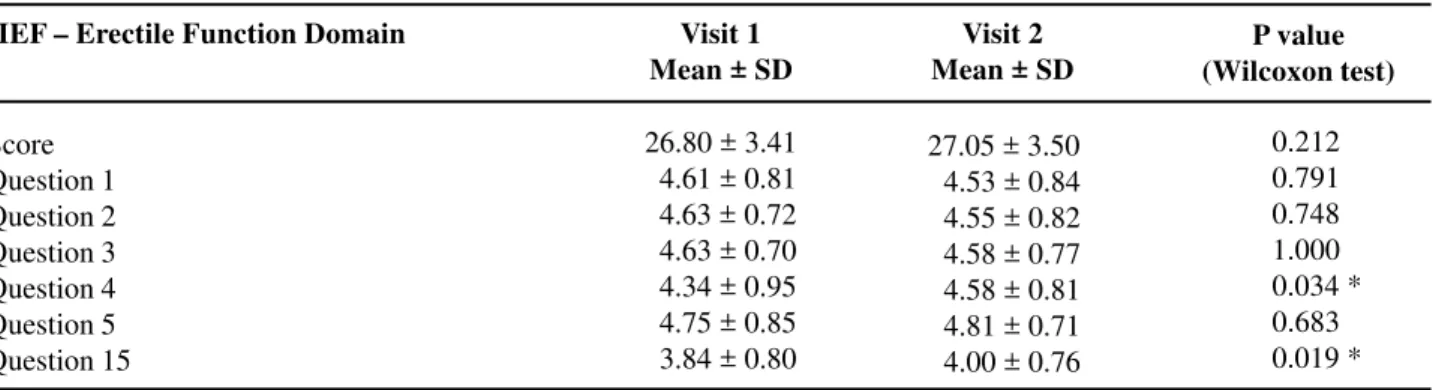
Concerning the erectile function domain, we did not observe in any of the 64 studied patients a postoperative sum lower than 26, thus indicating that there was no case of erectile dysfunction related to vasectomy surgery in this study (Table-3).
No statistically significant variation was found for scores in the domains of orgasm and over-all satisfaction between the visits, though an increase in the score sum was identified on visit 2 (Tables-4 and 5).
Table-6 presents the results for mean score of the total score IIEF-15 between visits 1 and 2 where a statistically significant variation was found between
visits (p < 0.001), with the score on visit 2 being sig-nificantly higher than on visit 1.
Figure-2 shows the distribution of the 64 pa-tients relative to the comparison between total scores on visits 1 and 2.
COMMENTS
Voluntary male sterilization or vasectomy has become the best contraceptive method performed on males, primarily because of its simplicity, effective-ness, and low complication rates (15). Approximately 100 million men have already been vasectomized
Table 3 – Score and questions related to the erectile function domain of the IIEF on visits 1 and 2 (n =64).
IIEF – Erectile Function Domain Visit 1
Mean ± SD
Visit 2 Mean ± SD
P value (Wilcoxon test)
0.212 0.791 0.748 1.000 0.034 * 0.683 0.019 * 27.05 ± 3.50
4.53 ± 0.84 4.55 ± 0.82 4.58 ± 0.77 4.58 ± 0.81 4.81 ± 0.71 4.00 ± 0.76 26.80 ± 3.41
04.61 ± 0.81
04.63 ±0.72
04.63 ± 0.70
04.34 ± 0.95
04.75 ± 0.85
03.84 ± 0.80 Score
Question 1 Question 2 Question 3 Question 4 Question 5 Question 15
Table 4 – Score and questions related to the orgasm domain of the IIEF on visits 1 and 2 (n = 64).
IIEF – Orgasm Domain Visit 1
Mean ±±±±± SD
9.03 ± 1.45 4.67 ± 0.62 4.36 ± 1.12
Visit 2 Mean ±±±±± SD
9.19 ± 1.51 4.66 ± 0.76 4.53 ± 0.87
P value (Wilcoxon test)
0.136 0.874 0.128 Score
Question 9 Question 10
Table 5 – Score and questions related to the overall satisfaction domain of the IIEF on visits 1 and 2 (n = 64).
IIEF – Overall Satisfaction Domain
Score Question 13 Question 14
Visit 1 Mean ± SD
8.89 ± 1.43 4.39 ± 0.75 4.50 ± 0.78
Visit 2 Mean ±±±±± SD
9.00 ± 1.40 4.48 ± 0.73 4.52 ±0.76
P value (Wilcoxon test)
worldwide as a method of family planning (16). One great concern for men who choose this sterilization method has always been the capacity of maintaining a satisfactory sexual life following surgery (7).
Erectile dysfunction is considered to be a se-rious psychological complication following a vasec-tomy surgery (7). Though the procedure has been proven not to cause any damage to erection or ejacu-lation mechanisms, 0.3 % of patients operated in one study have complained of erectile dysfunction (1). According to this same author, in one study with 1000 men undergoing vasectomy who were given question-naires, the results were as follows: 99% of the men and 95% of their wives were happy with the surgical result; concerning their sexual life, 60% stated that it was better, 2.5% worse and 37% reported that their sexual performance had not changed at all.
Table 6 – Total score of the IIEF applied on visits 1 and 2 (n = 64).
In one of the largest series published on va-sectomy performed by the same surgeon totaling 6248 cases, post-vasectomy sexual dysfunction was reported by 39 men (4). In this paper, no specific validated tool or questionnaire was used to identify sexual or erectile dysfunction, which could certainly lead to an inaccurate number of men with this com-plaint.
Contrarily, in other publications the psycho-logical effects of vasectomy are uniformly positive, improving sexual intercourse, harmony between the couple, libido and increasing sexual frequency (17-19). One exception for the series of positive results is the anecdotal and curious case published in 1980 where a man reported having changed his sexual pref-erence and becoming homosexual as a direct conse-quence of the surgery (20).
Figure 2 – Comparison between total scores on the IIEF applied on visits 1 and 2 (n = 64).
IIEF – 15
Total Score
Visit 1 Mean ± SD
64.06 ± 7.49
Visit 2 Mean ±±±±± SD
65.64 ± 7.89
P value (Wilcoxon test)
In this study, the first one using the IIEF-15 as a tool for assessing sexual changes following va-sectomy, the mean total score before and after vasec-tomy was 64.06 and 65.64 respectively, out of a total of 75 points. This difference, which is favorable to vasectomy, was statistically significant. This data is strongly representative and means an overall improve-ment in sexual function following surgery.
When considering the IIEF in the domain of erectile function (questions 1 to 5 and 15), the mean score before and after surgery was 26.80 and 27.05, respectively. Though the difference was not statisti-cally significant, it shows that the vasectomy did not have any psychologically negative impact that could contribute to the development of erectile dysfunction, as other studies have stressed.
Performance anxiety can be caused by sev-eral factors, such as stress and fear, which culminate in a discharge of the neurohormones, adrenaline and noradrenaline, with consequent contraction in the cavernous smooth muscles and resulting detumes-cence and, thus, inability to maintain an erection long enough to complete sexual intercourse. Question 4 of the IIEF related to the ability to maintain an erect penis inside the partner following penetration. In this study, this item had a statistically higher score on visit 2, thus suggesting that men feel more secure and self-assured during coitus following surgery.
Additionally, in relation to self-assurance, when we analyze the statistical differences in the mean scores between visits for question 15, which refers to the self-assurance of men in obtaining and maintaining an erection, we stress the theory that following vasectomy surgery male self-assurance can be increased during coitus. We believe that male self-assurance increases as a consequence of his unconcern with pregnancy following sterilization. When considering question 6 of the IIEF, which re-fers to sexual frequency during the past 4 weeks, the mean score on the pre-vasectomy visit was 3.14, which means sexual intercourse 5 to 6 times per month. Following surgery there was an increase in sexual frequency represented by the increase in the score for this item to 3.61, which was statistically significant. This data suggests that patients have a greater frequency of sexual intercourse after
under-going sterilization, mainly because they do not have to worry anymore about family planning or an un-wanted pregnancy.
Other relevant data taken from this study was the finding that 67% of patients under study have improved their total of IIEF items when comparing visits 1 and 2, which means a slight tendency towards an improvement in sexual function following vasec-tomy surgery. On the other hand, only 17% of oper-ated men have decreased their IIEF totals 90 days following surgery. It is worth stressing that even if these patients have lower IEFF totals following sur-gery, no case was considered as clinically significant. In other words, based on the IIEF no patient was cat-egorized as having ED following surgery.
Among the patients whose mean score had worsened following vasectomy, we identified a sta-tistically significant difference in questions 1, 2 and 8 of the IIEF. Questions 1 and 2 refer to erectile function itself. Question 8 concerns sexual satisfac-tion. Though no case of ED has been diagnosed
us-ing the IIEF criteria in this group of patients (n =
11), we attribute this decrease in score to several reasons, including anxiety and expectation gener-ated for the waiting time until the sperm analysis result, use of condoms until being certain of having achieved azoospermia and fear of pain during ejacu-lation.
An interesting finding was the significant improvement seen in the domains of desire and sexual satisfaction, when comparing pre and postoperative visits, once again confirming the influence and posi-tive impact that vasectomy can have on the sexual life of these men. When considering other sexual func-tion domains, such as orgasm and overall satisfac-tion, there was no significant difference between the score from the previous visit and that obtained 90 days following vasectomy.
CONCLUSION
REFERENCES
1. Finkbeiner AE, Bissada NK, Redman JF: Complica-tions of vasectomies. Am Fam Physician. 1977; 15: 86-9.
2. Gingell C, Crosby D, Carroll R: Review of the com-plications and medicolegal imcom-plications of vasectomy. Postgrad Med J. 2001; 77: 656-9.
3. Hendrix NW, Chauhan SP, Morrison JC: Sterilization and its consequences. Obstet Gynecol Surv. 1999; 54: 766-77.
4. Schmidt SS: Vasectomy by section, luminal fulgura-tion and fascial interposifulgura-tion: results from 6248 cases. Br J Urol. 1995; 76: 373-4; discussion 375.
5. Garrison PL, Gamble CJ: Sexual effects of vasectomy. J Am Med Assoc. 1950; 144: 293-5.
6. Dias PL: The long-term effects of vasectomy on sexual behaviour. Acta Psychiatr Scand. 1983; 67: 333-8. 7. Buchholz NP, Weuste R, Mattarelli G, Woessmer B,
Langewitz W: Post-vasectomy erectile dysfunction. J Psychosom Res. 1994; 38: 759-62.
8. Jones E: Vasectomy sequelae: empirical studies. J Reprod Med. 1977; 19: 254-8.
9. Rosen RC, Riley A, Wagner G, Osterloh IH, Kirkpatrick J, Mishra A: The international index of erectile func-tion (IIEF): a multidimensional scale for assessment of erectile dysfunction. Urology. 1997; 49: 822-30. 10. Rosen RC, Cappelleri JC, Gendrano N 3rd: The
In-ternational Index of Erectile Function (IIEF): a
state-of-the-science review. Int J Impot Res. 2002; 14: 226-44.
11. Jardin A, Wagner G, Khoury S, Giuliano F, Padma-Nathan H, Rosen R: Erectile Dysfunction: 1st
Interna-tional Consultation on Erectile Dysfunction. Health Publications, Plymouth, UK. 2000.
12. Ferraz MB, Ciconelli M Jr: Translation and cultural adjustment of the international index of erectile func-tion to Portuguese. Rev Bras Med. 1998; (special edi-tion). [in Portuguese]
13. Federal Constitution: Law #9263. 1996; Chap. I, art. 10. [in Portuguese]
14. Ferriani RA: The sterilization law. Reprod Clim. 1997; 12: 161-2. [in Portuguese]
15. Haldar N, Cranston D, Turner E, MacKenzie I, Guillebaud J: How reliable is a vasectomy? Long-term follow-up of vasectomised men. Lancet. 2000; 356: 43-4.
16. Weiske WH: Vasectomy. Andrologia. 2001; 33: 125-34. 17. Frances M, Kovacs GT: A comprehensive review of the sequelae of male sterilization. Contraception. 1983; 28: 455-73.
18. Leavesley JH: A study of vasectomized men and their wives. Aust Fam Physician. 1980; 9: 8-10.
19. Maschhoff TA, Fanshier WE, Hansen DJ: Vasectomy: its effect upon marital stability. J Sex Res. 1976; 12: 295-314.
20. Bass C, Rees D: Homosexual behaviour after vasec-tomy. Br Med J. 1980; 281: 1460.
Received: April 14, 2005 Accepted after revision: June 10, 2005
Correspondence address:
Dr. Eduardo Bertero
Rua Vieira de Moraes, 420 / 87 São Paulo, SP, 04617-000, Brazil Fax: + 55 11 5542-9557