RESPONSIVENESS TO THE PORTUGUESE VERSION OF THE
INTERNATIONAL CONSULTATION ON INCONTINENCE
QUESTIONNAIRE - SHORT FORM (ICIQ-SF) AFTER STRESS URINARY
INCONTINENCE SURGERY
JOSE T. N. TAMANINI, MIRIAM DAMBROS, CARLOS A. L. D’ANCONA, PAULO C. R.
PALMA, N. RODRIGUES-NETTO JR
Center for Prevention and Treatment of Urogynecological Dysfunction, Jau, and Division of Urology, School of Medicine, University of Campinas, Campinas, Sao Paulo, Brazil
ABSTRACT
Objective: To evaluate the reliability and responsiveness (internal and external) of the Portu-guese version of the ICIQ-SF. We assessed the responsiveness of the ICIQ-SF after surgical proce-dures for the treatment of stress urinary incontinence.
Materials and Methods: Prospective open label study in 2 tertiary referral centers. Sixty-one patients of both genders (54 female and 7 male) were enrolled. Patients were treated using surgical procedures, mostly with synthetic sling (82%). Patients were assessed before surgery and at least 1 month postoperatively using the ICIQ-SF in its translated and validated Portuguese version. Patients also underwent pre-operative urodynamic tests, Stamey incontinence grading and pad usage assess-ments. After surgery, patients underwent stress tests, Stamey incontinence grading and pad usage assessments.
Results: The mean age was 57.2 (± 11.6) years and the mean duration of follow-up was 7.2 months (± 4.5). Objective parameters such as urodynamic tests (by means of VLPP) and pad usage had significant correlation with changes in post-treatment scores on the ICIQ-SF (p = 0.0062 and p < 0.0001 respectively). The responsiveness expressed in terms of standardized effect sizes (SES) and standardized response means (SRM) was large for both questionnaires (p < 0.0001).
Conclusion: The results showed high responsiveness (large effect sizes I and II) for the Por-tuguese version of the ICIQ-SF, indicating that this instrument is suitable for measuring outcomes in clinical trials for Brazilian patients with stress urinary incontinence.
Key words: urinary incontinence, stress; urodynamics; prostheses and implants; quality of life; ques-tionnaires
Int Braz J Urol. 2005; 31: 482-90
INTRODUCTION
Patient-reported outcomes including symp-toms, functional status and perceived quality of life (QoL) are increasingly used alongside objective
de-veloped to assess the perceived impact of UI, par-ticularly for women, who report symptoms consis-tent with UI prevalence estimates of between 10% and 30% (1). The King’s Health Questionnaire (KHQ) (2) was the first QoL questionnaire trans-lated and validated into Portuguese in Brazil (3). The International Consultation on Incontinence Ques-tionnaire-Short Form (ICIQ-SF) (4) is a brief instru-ment used to assess the impact of UI in patients’ lives. It has been recently translated into Portuguese and its psychometric parameters, such as validity and reliability, have already been assessed (APPEN-DIX) (5). The usefulness of instruments designed to measure changes within individuals over time is dependent not only on their reliability and validity, but also on their ability to detect minimal clinically important differences. This psychometric property is called “responsiveness” (6). Responsiveness to the KHQ in its Portuguese version has just been as-sessed (7). According to Norman et al. (8), there has been an increasing emphasis on responsiveness as an essential characteristic for the use of health-re-lated quality of life measures in studies of therapeu-tic interventions. The necessity for distinguishing between responsiveness and validity remains be-cause an instrument can be valid and still fail to de-tect clinically important changes when they occur (9).
Based on the simple construct that “the goal of any therapy is to effect change in health status”, our aim was to determine whether the Portuguese version of the ICIQ-SF can be considered reliable before and after treatment, and whether it is sensitive to change in continence status over time (internal and external responsiveness) following surgery to treat genuine stress incontinence (GSI).
MATERIALS AND METHODS
Patients
A total of 61 consecutive patients of both genders complaining of stress urinary incontinence that had been urodynamically diagnosed before treat-ment. The patients were chosen from two tertiary re-ferral centers (seven male and nine female patients
from the first tertiary referral center; 45 female pa-tients from the second tertiary referral center) for this prospective open label study. Eligibility criteria in-cluded patients aged over 18 years old who were un-dergoing surgery for stress urinary incontinence with at least one month of follow up. Patients who were pregnant or currently breastfeeding or who had clini-cally severe cognitive dysfunction were not enrolled in the study.
Methods
Patients who underwent surgical procedures to treat stress urinary incontinence between Septem-ber/2003 and November/2004 in both centers were enrolled. They were assessed by subjective and ob-jective parameters, as well as by analysis of the QoL and incontinence impact using the ICIQ-SF.
Measures
Subjective parameters: Stamey incontinence grading (10) (0 = cured; 1 = leakage with stressful activities (coughing, sneezing); 2 = leakage with mini-mally stressful activities (e.g. walking); 3 = leakage at all times, with any activity) and QoL impact on patients’ lives evaluated with the Portuguese version of the ICIQ-SF.
Objective parameters: urodynamic test Val-salva leak point pressure (VLPP) (Uromaster, Dynamed/Brazil), according to the standard protocol (11) and analysis of pad usage (yes/no). If pads were used, the frequency of their usage was recorded (0 = no use; 1 = 1-2 units/day; 2 = 3-4 u/d and 3 = 4 u/d). If patient stated no leakage at all during the postop-erative period, no further urodynamic testing was performed.
Outcome Standardization
leakage (even drops) was recorded as an objective failure of the surgical procedure and the patients un-derwent urodynamic testing. The patients were also asked to re-rate their QoL assessment according to ICIQ-SF after at least one-month follow-up.
Quality of Life Questionnaire
The International Consultation on Inconti-nence Questionnaire - Short Form (ICIQ-SF) is a simple and brief self-administered questionnaire used to assess the level and impact on QoL of urinary in-continence specifically. It is comprised of 3 questions regarding frequency, severity and QoL impact of the UI along with an eight-item scale, which assess the possible causes or situations related to UI. The ICIQ-SF final score is the result of the total of the scores from questions 3, 4 and 5.
Psychometric Properties Evaluation
Reliability
Cronbach’s alpha was calculated by using pre- and post-treatment data to assess internal con-sistency, which is considered the degree of associa-tion between the items and scale scores. A minimum value of 0.70 for group comparison was desirable.
Responsiveness
Responsiveness refers to an instrument’s ability to detect change (improvement or deteriora-tion) that occurs as a result of therapy or disease progression. Participants who have an indication of clinical change, whether improvement or deteriora-tion, should have a parallel change in their scale scores, while participants who show no change should have stable scale scores (12). Internal respon-siveness is the ability of a measurement to change over a particular pre-specified time frame. External responsiveness reflects the extent to which changes in a measurement over a specified time frame relate to corresponding changes in a reference measure-ment of health status (13).
Statistical Analysis
To assess ICIQ-SF reliability, standardized Cronbach’s alpha was used. The assessment of
inter-nal responsiveness involves statistical estimation of the size of the effect; i.e. an estimate of the magni-tude of the change in health status (13). Standardized effect size (SES or ES I) and standardized response mean (SRM or ES II) provide a standardized mea-surement of the change in score from an instrument. Both SES and SRM can be considered large (> 0.80), moderate (0.5-0.8) or small (< 0.5) (13). The Exact Mann-Whitney U - test for independent groups was used to compare ICIQ-SF final scores to pad usage and VLPP (external responsiveness). The McNemar test was used to assess significant changes between proportions. Wilcoxon’s signed rank test was used to compare the scores between follow-up and baseline. Statistical tests were considered significant at the 5% level.
The software used was SAS (System for Win-dows - Statistical Analysis System), version 8.2 (SAS Institute Inc., 1999-2001, Cary, NC, USA). The sta-tistical analysis was based on recommendations by Husted et al. (13), Conover (14) and Fleiss (15).
Ethical Approval
The study obtained prior approval from the Ethical Committee of the Medical Sciences School, Unicamp (No. 261/2001). All the participants signed the informed consent statement before being included in this study.
RESULTS
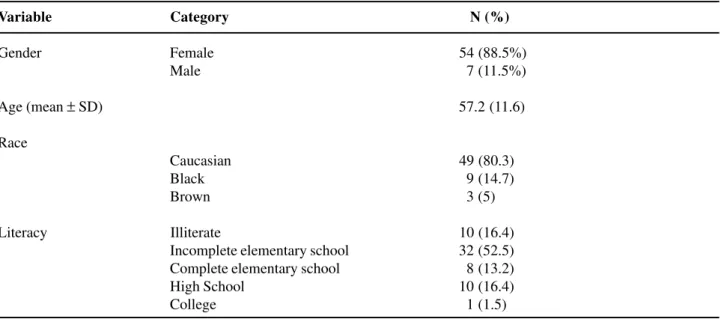
The socio-demographic characteristics of the ICIQ-SF sample population are displayed in Table-1. Forty-six female (75.4%) and 4 male pa-tients (6.6%) underwent synthetic sling procedures; 7 female patients (11.5%) underwent classic sling procedures; 1 female and 3 male patients (1.7% and 4.9% respectively) underwent periurethral in-jection therapy. The mean Valsalva leak point pres-sure (VLPP ± SD) was 80.5 ± 31.9 cm H2O. The mean length of follow-up was 7.2 months (SD = ± 4.5).
The great majority of the patients (58 or 95.1%) had a negative stress test after surgical treat-ment for stress urinary incontinence.
A total of 54 out of 61 patients (88.5%) who filled out the ICIQ-SF considered themselves cured after surgical treatment (p < 0.0001, Wilcoxon’s signed rank test).
Fifty (82%) out of 61 patients used pads be-fore surgical treatment. After the procedure only 4
Table 1 – Background data on sample population assessed by ICIQ-SF.
Variable Category N (%)
Gender Female 54 (88.5%)
Male 07 (11.5%)
Age (mean ± SD) 57.2 (11.6)
Race
Caucasian 49 (80.3)
Black 09 (14.7)
Brown 03 (5)
Literacy Illiterate 10 (16.4) Incomplete elementary school 32 (52.5) Complete elementary school 08 (13.2) High School 10 (16.4) College 01 (1.5)
(6.6%) were still using them (p < 0.0001, McNemar test).
Twenty-five out of 61 patients (41%) changed at least 3 pads per day before treatment. Nevertheless, 57 patients (93.5%) did not use pads at all after surgery.
Responsiveness Study
The study of the internal responsiveness for ICIQ-SF is shown in Table-2. The internal
respon-Table 2 – Comparison between pre and postoperative scores of the ICIQ-SF and internal responsiveness study (sensitivity to change), using effect size I (SES) and effect size II (SRM), N = 61.
Preop Score Postop Score P value* SES SRM
Mean ± SD
Question 3 3.6 ± 1.2 0.3 ± 0.6 0.0001 -3.11 -3.04 Question 4 4.0 ± 1.8 0.5 ± 1.0
Question 5 7.7 ± 2.1 0.6 ± 1.2 General score 15.3 ± 4.5 1.4 ± 2.7
The ICIQ-SF has just been validated and translated into Portuguese (5). The King’s Health Questionnaire differs from the ICIQ-SF in many as-pects. KHQ was designed for female patients only and assesses the impact of UI in eight domains of the patients’ lives. The more comprehensive instrument is, more detailed is the health profile it provides (2). Contrarily, ICIQ-SF is brief and simple to understand and fill in. Furthermore, it is not gender-specific like the KHQ and is intended to be universal (applicable for use in individuals of all ages, genders, back-grounds, patient groups, diagnoses and cultures). A further disadvantage of the KHQ is that it does not attempt to determine clearly the severity of inconti-nence in terms of the frequency or amount of leak-age. In addition, the KHQ has received limited use outside of clinical settings. Conversely, the ICIQ-SF is intended to be brief yet comprehensive enough for use in assessing incontinence and serves as an outcome measure in clinical trials and other research to assess the efficacy of interventions. Moreover, it is suitable for use as an epidemiological tool to de-termine the distribution of incontinence in popula-tions around the world, allowing international multi-center studies to be made (4). One of the criticisms of the QoL assessment by ICIQ-SF is that the QoL construct is based on one question in a 10-item scale to quantify the burden of urinary incontinence in the perceived quality of a patient’s life. It is to be used as a visual analog scale (VAS) where the pa-tients can choose the degree of interference from UI in their lives by ticking or circling a number on a siveness was quantified using standardized effect size
(SES or ES I) and standardized response mean (SRM or ES II), which demonstrated a large effect size. Comparison between pre- and post-operative scores of the ICIQ-SF is also shown in Table-2. We found statistically significant differences between pre- and post-treatment ICIQ-SF scores (p < 0.0001). Similar results were found from the study of external respon-siveness when the post-treatment final score was com-pared with an external variable such as pad usage and stress test (Table-3).
COMMENTS
This study investigated the reliability and responsiveness of the ICIQ-SF in Portuguese. Al-though it was not our main goal, we have now com-pared the results from the ICIQ-SF responsiveness study with the results from the just-published paper assessing the responsiveness of the Portuguese ver-sion of the King’s Health Questionnaire.
Nowadays, Quality of Life questionnaires are considered to be one of the most important out-come measures in many clinical studies. Tradition-ally, there is a consensus that newly developed in-struments should be tested for validity and reliabil-ity before they can be used in clinical trials. For evaluative instruments designed to measure longi-tudinal changes in health-related quality of life over time, responsiveness has been proposed as a third requirement (16).
Table 3 – Study of the external responsiveness of the ICIQ-SF comparing post-treatment questionnaire final score, pad usage and VLPP.
Variable Category N Mean ± SD P value**
Pad usage No 57 1.0 2.2 < 0.0001
Yes 04 7.3 2.6
Stress test Negative 58 1.2 2.6 00.0062 Positive 03 5.7 0.6
scale ranging from zero to ten (when zero is consid-ered “not interfere at all” and 10 represents “inter-fere a lot”).
According to De Boer et al. (17), their study assessing the role of VAS as a valid and reliable tool for the study of QoL in clinical practice and research found that VAS could be considered a good instru-ment when compared to multi-item questionnaires. Based on their results, they recommend its use as a global quality of life measure in clinical trials. In-deed, most QoL questionnaires are composed of many items divided into several domains – such as role and physical limitation, personal relationships, emotion, among others. The criticisms of these questionnaires are that they are time-consuming and difficult to use outside clinical settings. Contrarily, the brevity of the ICIQ-SF enables it to be used without greatly increas-ing the burden on the respondents.
As shown in Table-1, 10 patients (16.4%) were illiterate and an interviewer read the question to ensure important data was not missed. According to data from the 2000 Census (18), the illiteracy rate for Brazilian people of both sexes aged 15 or over is 13.3%, and the mean length of schooling was 5.7 years. Comparing the mean level of schooling of our population sample with the literacy level for the whole Brazilian population, it can be seen that our sample had almost the same overall rate of literacy. These patients were considered unable to understand the questions, so we chose to have the questionnaire read out loud (without explanation of the questions) by a nursing professional who was trained for this task. In our environment, such a procedure is normal, espe-cially in studies that utilize scales. It should be added that, after comparing different methods of adminis-tering questionnaires, Weinberger et al. (19) con-cluded that 70% of the patients preferred interviews and 20% the self-administered forms.
Reliability as measured by Cronbach’s Al-pha showed a good to excellent degree of associa-tion between the scale scores before and after treat-ment.
Internal responsiveness expressed in terms of the SES and the SRM (Table-2) showed large values for effect size studies for all ICIQ-SF scores. This study highlighted that ICIQ-SF was strongly
sensi-tive to change, enabling it to be used as an important tool in clinical practice or research.
As shown in Table-3 (external responsiveness study), there was a good correlation between the ICIQ-SF general score after treatment regarding pad usage analysis. The ICIQ-SF general score showed a significant difference when the two groups (yes/no) were compared (p < 0.0001). Similar results were found when the ICIQ-SF scores were also compared to the post-treatment analysis of Stress test (p = 0.0062), showing excellent external responsiveness.
These results are in line to the responsiveness study of KHQ, which yielded good results from the assessed parameters, for both internal and external responsiveness, apart from having excellent reliability (7).
Beaton et al. (20) proposed a new taxonomy for responsiveness based not only on statistical characteristics such as “large effect sizes” but also on a very highly contextualized attribute of an in-strument. There are three axes (questions) under-lying the new classification system: “who is being analyzed?” (individuals or groups); “which scores are being contrasted?” (over time / one point in time); and “Which type of change is being quanti-fied?” (for example, observed change over impor-tant change). So, a questionnaire could, thus, be described as being “responsive to” a given category in this new taxonomy.
The present study demonstrates the relevance of quality of life to the assessed clinical condition. The performance of the ICIQ-SF in this clinical trial suggests that it can be an important addition to the compendium of outcome measures used to assess UI and its treatment. Both ICIQ-SF and KHQ are now available for use in clinical practice and research in Brazil. Our next aim is to check ICIQ-SF sensitivity in a large community-based population epidemiologi-cal study, as it is also intended to be used.
REFERENCES
1. Patrick DL, Martin ML, Bushnell DM, Yalcin I, Wagner TH, Buesching DP: Quality of life of women with urinary incontinence: further development of the incontinence quality of life instrument (I-QOL). Urology. 1999; 53: 71-6. Erratum in: Urology 1999; 53: 1072. 2. Kelleher CJ, Cardozo LD, Khullar V, Salvatore S: A
new questionnaire to assess the quality of life of urinary incontinent women. Br J Obstet Gynaecol. 1997; 104: 1374-9.
3. Tamanini JT, D’Ancona CA, Botega NJ, Rodrigues Netto N Jr: Validation of the Portuguese version of the King’s Health Questionnaire for urinary incontinent women. Rev Saude Publica. 2003; 37: 203-11. 4. Avery K, Donovan J, Abrams P: Validation of a new
questionnaire for incontinence: the International Consultation on Incontinence Questionnaire (ICIQ). Abstract no. 86 of the International Continence Society 31st annual meeting. Seoul, Korea. Neurourol Urodyn. 2001; 20: 510-1.
5. Tamanini JT, Dambros M, D’Ancona CA, Palma PC, Rodrigues Netto N Jr: Validation of the “International Consultation on Incontinence Questionnaire - Short Form” (ICIQ-SF) for Portuguese. Rev Saude Publica. 2004; 38: 438-44.
6. Guyatt G, Walter S, Norman G: Measuring change over time: assessing the usefulness of evaluative instruments. J Chronic Dis. 1987; 40: 171-8.
7. Tamanini JT, Dambros M, D’Ancona CA, Palma PC, Botega NJ, Rios LA, et al.: Concurrent validity, internal consistency and responsiveness of the Portuguese version of the King’s Health Questionnaire (KHQ) in women after stress urinary incontinence surgery. Int Braz J Urol. 2004; 30: 479-86.
8. Norman GR, Stratford P, Regehr G: Methodological problems in the retrospective computation of responsiveness to change: the lesson of Cronbach. J Clin Epidemiol. 1997; 50: 869-79.
9. Guyatt GH, Deyo RA, Charlson M, Levine MN, Mitchell A: Responsiveness and validity in health status measurement: a clarification. J Clin Epidemiol. 1989; 42: 403-8.
10. Stamey TA: Urinary Incontinence in the Female. In: Campbell’s Urology, 4th ed., Harrison JH, Guittes RF, Perlmutter AD (eds.). Philadelphia, WB Saunders. 1979; pp. 2272-93.
11. Nitti VW, Combs AJ: Correlation of Valsalva leak point pressure with subjective degree of stress urinary incontinence in women. J Urol. 1996; 155: 281-5.
12. Lubeck DP, Prebil LA, Peeples P, Brown JS: A health related quality of life measure for use in patients wht urge urinary incontinence: A validation study. Qual Life Res. 1999; 8: 337-44.
13. Husted JA, Cook RJ, Farewell VT, Gladman DD: Methods for assessing responsiveness: a critical review and recommendations. J Clin Epidemiol. 2000; 53: 459-68.
14. Conover WJ: Practical Nonparametric Statistics. In: Contingency Tables and the Use of Ranks. New York. John Wiley & Sons. 1971; pp. 140-281.
15. Fleiss, JL Statistical Methods for Rates and Proportions. 2nd ed. New York. John Wiley & Sons. 1981; pp 212-22.
16. Terwee CB, Dekker FW, Wiersinga WM, Prummel MF, Bossuy PM: On assessing responsiveness of health-related quality of life instruments: guidelines for instrument evaluation. Qual Life Res. 2003; 12: 349-62.
17. de Boer AG, van Lanschot JJ, Stalmeier PF, van Sandick JW, Hulscher JB, de Haes JC, et al.: Is a single-item visual analogue scale as valid, reliable and responsive as multi-item scales in measuring quality of life? Qual Life Res. 2004; 13: 311-20.
18. IBGE Foundation (Brazilian Institute of Geography and Statistics). Minimal Social Indicators: Demographic Aspects - General Information. 1999. Available at http://www.ibge.gov.br/home/estatistica/ populacao/condicaodevida/indicadoresminimos/ tabela3.shtm [in Portuguese]
19. Weinberger M, Oddone EZ, Sansa GP, Sandsman PB: Are health-related quality of life measures affected by the mode of administration? J Clin Epidemiol. 1996; 49: 135-40.
20. Beaton DE, Bombardier C, Katz JN, Wright JG: A taxonomy for responsiveness. J Clin Epidemiol. 2001; 54: 1204-17.
Received: February 2, 2005 Accepted after revision: May 3, 2005
Correspondence address:
Dr. Jose Tadeu Nunes Tamanini Rua Floriano Peixoto, 443 Jau, SP, 17201-100, Brazil Fax: + 55 14 3621-1829
EDITORIAL COMMENT
In order to incorporate in a single question-naire the most relevant aspects of urinary incontinence and its impact on quality of life, the ICIQ, which is more widely used in research studies, was summa-rized in the ICIQ-SF format, which is directed to clini-cal application in the daily practice. The three ques-tions on the ICIQ-SF consistently assess frequency, severity and impact on quality of life caused by uri-nary incontinence. It can be applied to patients of both genders, either young or elderly. Since 2001, it has been validated in several other countries with a na-tive language different from English, such as Spain and Japan (1,2).
Its recent validation for Portuguese was clearly important since it allows the use of this as-sessment tool in studies on urinary incontinence con-ducted in Brazil, thus enabling the comparison be-tween results obtained here with those published in urologic international literature.
The present study, which was prospectively performed at two tertiary referral centers, verified the responsiveness of ICIQ-SF, which was applied to patients undergoing surgical treatment for urinary in-continence. The positive correlation between urodynamic findings and e pad test and ICIQ-SF val-ues, as well as its responsiveness with a high level of
statistical significance, confirmed the applicability of this questionnaire in its Portuguese version.
Another significant aspect regarding the ICIQ-SF questionnaire is the recent demonstration (3) of equivalence in results – both when it is self-ap-plied (according to its initial proposal) and when it is completed by the physician. This fact is important in our environment where a great deal of patients can have difficulties in interpreting and completing the questionnaire.
REFERENCES
1. Espuna Pons M, Rebollo Alvarez P, Puig Clota M: Validation of the Spanish version of the International Consultation on Incontinence Questionnaire-Short Form. A questionnaire for assessing the urinary incon-tinence. Med Clin (Barc). 2004; 122: 288-92. 2. Terai A, Ueda N, Utsunomiya N, Kouhei N, Ichioka
K, Yoshimura K: Effect of urinary incontinence on lower urinary tract symptoms in Japanese women. Urology. 2004; 64: 1139-43.
3. Hajebrahimi S, Corcos J, Lemieux MC: International consultation on incontinence questionnaire short form: comparison of physician versus patient completion and immediate and delayed self-administration. Urology. 2004; 63: 1076-8.