Fisioter. Mov., Curitiba, v. , n. , p. - , Jan./Mar. Licenciado sob uma Licença Creative Commons DO): http://dx.doi.org/ . / - . . .AO
[T]
Effect of Pilates method and conversation
circles on the health of older adults
Efeito do método Pilates e das rodas de conversa na saúde de idosos
Davi da Silva Duarte, Clóvis Arlindo de Sousa, Carlos Roberto de Oliveira Nunes*
Universidade Regional de Blumenau FURB , Blumenau, SC, Brazil
Abstract
Introduction: (ealth education practices associated with oriented exercises have potential bene icial effect
on health promotion and prevention of chronic diseases. Objective: This study aimed to verify the effect of
an intervention protocol using Pilates and conversation circles on the functional autonomy and quality of life of older adults in the context of the primary health care of Taió, SC, Brazil. Methods: This study applied
a single case experimental design ABAB , with participants aged years or older who changed phases with and without interventions performed with Pilates sessions and conversation circles. At the end of each phase, anamnesis interview applied with the W(OQOL-OLD inventory and the GDLAM protocol were in-dividually performed. Results:)nterventions were associated with increased functional parameters and
quality of life as well as to reduced body mass index. Participants also reported improvement in emotional conditions, body harmony and global mobility. Conclusion: The Pilates Method assured increased
function-ality of the volunteers, and further studies should be carried out to evaluate the subjective indicators.
Keywords: Quality of Life. Exercise Movement Techniques. (ealth Education. Public (ealth. Physical Therapy.
Resumo
Introdução: Práticas de educação em saúde associadas com exercícios ϔísicos orientados têm potencial efeito benéϔico para a promoção de saúde e prevenção de agravos de doenças crônicas não transmissíveis. Objetivo: Veriϔicar o efeito de um protocolo de intervenção com método Pilates e com rodas de conversa na autonomia funcional e na qualidade de vida de idosos. Métodos: Trata-se da aplicação de delineamento experimental de caso único (ABAB), com 24 participantes com 60 anos ou mais que alteraram fases com e sem intervenção,
40
durante 20 semanas, realizadas com sessões de rodas de conversa sobre saúde, 30 min., e de Pilates, 45 a 50 min., no contexto da atenção primária em saúde da cidade de Taió em Santa Catarina. Em cada fase de inter-venção foram realizadas 10 sessões de Pilates e rodas de conversas, duas vezes por semana. Ao ϔinal de cada fase, foram realizadas entrevista, aplicação do inventário WHOQOL-OLD e do protocolo GDLAM. Resultados: As intervenções foram associadas com o aumento dos parâmetros funcionais e de qualidade de vida, bem como redução de índice de massa corporal. Os participantes também relataram melhora nas condições emocionais, harmonia corporal e de mobilidade global. Conclusão:O método Pilates e as rodas de conversa sobre saúde asseguraram melhora da autonomia funcional e qualidade de vida dos participantes.
Palavras-chave: Qualidade de Vida. Técnicas de Exercício e de Movimento. Educação em saúde. Saúde Pública. Fisioterapia.
Introduction
Brazil presents demographic and epidemiological transitions characterized by increased incidence of non-communicable chronic diseases and aging population. This requires adjustments of social policies, particularly those aimed at meeting the growing demands in health, social security and social assistance areas , .
Physiological losses accompany senescence, includ-ing reduction in bone mineral density, muscle strength,
lexibility, cardiorespiratory itness, and reduction of static and dynamic balance. Aging is understood as a natural process of gradual reduction of the functional au-tonomy and capacity and consequently of daily activities and quality of life. This reduction is more pronounced in sedentary and insuf iciently active individuals , , .
Older adults who engage in regular physical activ-ity demonstrate greater independence and autonomy and are often considered healthy even in the presence of chronic diseases. An alternative to physical activity is the Pilates method. This method was developed by Joseph Pilates in the decade of and is based on a concept called contrology, which means consciously control of all body movements. Movements can be per-formed on the ground with weight/resistance of the own body, and with the help of accessories such as ball, dumbbells, ankle weights or speci ic devices. Direct bene its may involve increased strength and lexibility, trunk strengthening and stability, improved posture and balance, increased self-esteem and prevention and treat-ment of muscle pain , , .
Studies have shown positive effects of the Pilates method on the physical itness and health conditions of practitioners. There are studies on, among other topics, balance and strength , lexibility , pain , spinal mobility and pulmonary function , quality of life , body composition , functional capacity ,
and bone remodeling . (owever, most publications address the effect of the Pilates method for treating low back pain .
Considering that the percentage of physically inactive individuals increases with aging and that nearly % of people aged and over do not do any physical activity in the four contexts leisure, work, commuting and do-mestic activities , strategies to increase empower-ment and autonomy are important ways to change the way of living of people, since lifestyle involves a set of habitual daily activities that are incorporated in terms of attitudes, values and opportunities present in people's lives. People experience reality and make choices, deter-mined by social, economic, cultural and environmental factors .
The primary health care is aimed at promoting indi-vidual and collective changes to the process of commu-nity empowerment to work on improving the health and quality of life of individuals with greater participation in the control of this process. )n this sense, conversation circles are a strategy of health education practices that enable dialogic meetings, creating opportunities for pro-duction and reinterpretation of meanings, knowledge and practices about experiences among participants. Conversation circles go beyond the physical layout cir-cular of participants. The conversation circle space in-tends to build new possibilities that open to thinking. )t is a continuous movement of perceiving, thinking, acting and modifying, where participants can recognize each other as actors of their actions and their own ability to change .
41 )nclusion criteria were people aged or more self-suf icient in basic human needs, in satisfactory physical condition, and who agreed to voluntarily participate in this study.
)nformed consent was obtained by reading and signing the )nformed Consent Form. This study was approved by the Ethics Research Committee of the Regional University of Blumenau, under protocol
num-ber / .
The total study duration was weeks with con-versation circle and Pilates sessions. During phase A, at baseline, participants remained without any interven-tion for ive weeks. )n step B, individuals participated in conversation circle and Pilates intervention sessions also for ive weeks, twice a week. )n sessions, conversa-tion circles were held for minutes, followed by Pilates for - minutes Figure .
Methods
This is an intervention study with reversal between baseline A and intervention periods B , A-B-A-B , carried out with older adults in the context of primary health care in the municipality of Taió, Santa Catarina, Brazil. Participants were exposed to repeated measure-ments by means of reversal design with successive com-parisons between experimental and control groups by the insertion and removal of the independent variable, i.e., combined Pilates and conversation circles.
42
located in a place called (ouse of Culture, Municipal Department of Education.
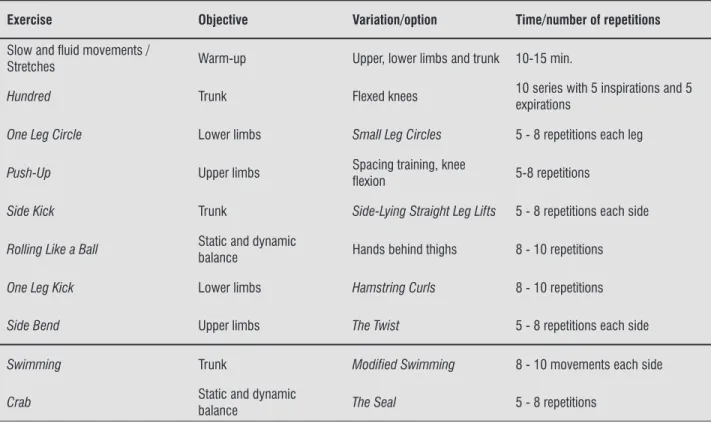
The Pilates method was carried out with focus on strength, lexibility, balance, breathing and concentra-tion improvements, as well as improvements in body awareness and posture. The exercise sequence was maintained throughout the study in order to achieve the maximum bene its and excellence in physical per-formance. Each exercise was carried out with and repetitions , . Warm-up exercise was composed of slow and luid movements in order to increase con-centration, prepare the body for further efforts and en-courage deep and conscious breathing. Then, exercises for strengthening and lexibility were proposed: lower limbs one leg circle and one leg kick , upper limbs push-up and side bend and trunk hundred, side kick, swimming . The static and dynamic balances were also trained rolling like a ball and crab Table .
Figure 1 - Intervention study flowchart.
For conversation circles, the problematization meth-odology was used , , , . Participants were encouraged to critically observe their reality from their prior knowledge, linking it to the theme. Conversation circles were held in the early stages of the session, with everyone sitting on the loor making a circle. One participant was responsible for mediating discussions for each session with the help of health professionals. Participants had the opportunity to express their pre-vious knowledge, analyze them, and reconstruct their knowledge about their life and health.
Topics were recommended by the expanded concept of health and those proposed in the W(OQOL-OLD qual-ity of life domains: self-esteem, healthy eating, physical exercise, death, happiness, aging dif iculties and self-love. The intervention took place in the morning in a large room equipped with the necessary equipment,
Table 1 - Pilates Method Protocol
Exercise Objective Variation/option Time/number of repetitions
Slow and fl uid movements /
Stretches Warm-up Upper, lower limbs and trunk 10-15 min.
Hundred Trunk Flexed knees 10 series with 5 inspirations and 5
expirations
One Leg Circle Lower limbs Small Leg Circles 5 - 8 repetitions each leg
Push-Up Upper limbs Spacing training, knee
fl exion 5-8 repetitions
Side Kick Trunk Side-Lying Straight Leg Lifts 5 - 8 repetitions each side
Rolling Like a Ball Static and dynamic
balance Hands behind thighs 8 - 10 repetitions
One Leg Kick Lower limbs Hamstring Curls 8 - 10 repetitions
Side Bend Upper limbs The Twist 5 - 8 repetitions each side
Swimming Trunk Modified Swimming 8 - 10 movements each side
Crab Static and dynamic
balance The Seal 5 - 8 repetitions
At the end of all interventions, participants were asked to anonymously answer some questions assess-ing the group structure, the dynamics of meetassess-ings and the work of the professional. This material was deliv-ered to be completed at home and brought in subse-quent meetings.
43 from the chair and walk around the house LCLC . Measurements were performed by the time in seconds and allow estimating functional autonomy capabilities. All of these tests can be used to calculate the GDLAM )ndex G) . Lower scores in this instrument represent higher level of functional autonomy , . The G) is calculated as follows:
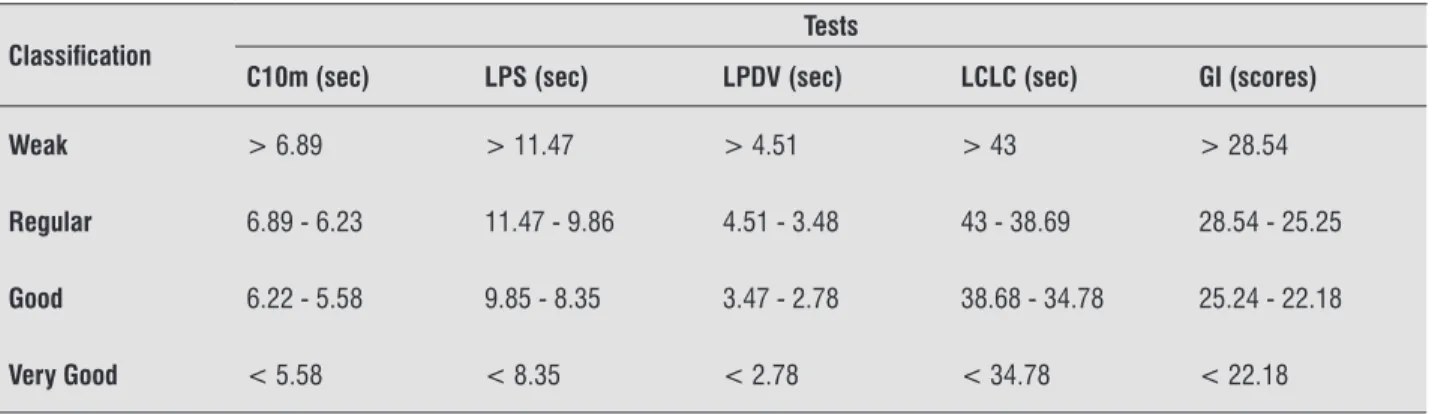
Table shows the classi ications for estimating func-tional autonomy through the GDLAM protocol, obtained by quartiles , .
for evaluation of quality of life; and application of the Latin American Development Group for Maturity
GDLAM protocol to assess functionality.
W(OQOL-OLD rates quality of life for seniors in six areas distributed into questions on a Likert scale: needs improvement, regular, good and very good and has the following self-evaluation categories: a sensory functioning; b autonomy; c past-present-future activities; d social participation; e death and dying; f intimacy. Each domain has items, and in this sense, for all domains, the score of possible values range from to .
GDLAM protocol tests consist of: a -m walking test C m ; b standing from a sitting position LPS ; c standing from prone position LPDV ; d standing
Table 2 - Classification of functional autonomy by GDLAM protocol
Classifi cation
Tests
C10m (sec) LPS (sec) LPDV (sec) LCLC (sec) GI (scores)
Weak > 6.89 > 11.47 > 4.51 > 43 > 28.54
Regular 6.89 - 6.23 11.47 - 9.86 4.51 - 3.48 43 - 38.69 28.54 - 25.25
Good 6.22 - 5.58 9.85 - 8.35 3.47 - 2.78 38.68 - 34.78 25.24 - 22.18
Very Good < 5.58 < 8.35 < 2.78 < 34.78 < 22.18
Note: C10m = 10-m walking test; LPS = standing from a sitting position; LPDV = standing from the prone position; LCLC = standing from a chair and move around the house; GI = GDLAM index.
Data were analyzed using descriptive statistics, in-cluding median, mean, standard deviation and maxi-mum and minimaxi-mum values. Parametric tests were ap-plied for quantitative variables with normal distribution and non-parametric for nominal and ordinal variables, as well as for discrete variables when not normally dis-tributed. For parametric analyses, Analysis of Variance for repeated measures and Tukey D(S were applied. For nonparametric analyses, Analysis of Variance of Friedman and Wilcoxon test were applied, with sig-ni icance level of p < . .
Results
44
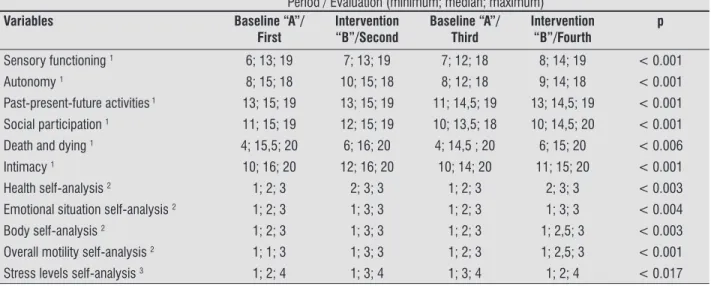
Table 4 - Comparison of the quality of life domains by the WHOQOL-OLD and self quality of life-analysis of subjects after intervention and baseline periods (n = 24).
Period / Evaluation (minimum; median; maximum)
Variables Baseline “A”/
First
Intervention “B”/Second
Baseline “A”/ Third
Intervention “B”/Fourth
p
Sensory functioning 1 6; 13; 19 7; 13; 19 7; 12; 18 8; 14; 19 < 0.001 Autonomy 1 8; 15; 18 10; 15; 18 8; 12; 18 9; 14; 18 < 0.001 Past-present-future activities 1 13; 15; 19 13; 15; 19 11; 14,5; 19 13; 14,5; 19 < 0.001 Social participation 1 11; 15; 19 12; 15; 19 10; 13,5; 18 10; 14,5; 20 < 0.001
Death and dying 1 4; 15,5; 20 6; 16; 20 4; 14,5 ; 20 6; 15; 20 < 0.006 Intimacy 1 10; 16; 20 12; 16; 20 10; 14; 20 11; 15; 20 < 0.001 Health self-analysis 2 1; 2; 3 2; 3; 3 1; 2; 3 2; 3; 3 < 0.003
Emotional situation self-analysis 2 1; 2; 3 1; 3; 3 1; 2; 3 1; 3; 3 < 0.004 Body self-analysis 2 1; 2; 3 1; 3; 3 1; 2; 3 1; 2,5; 3 < 0.003 Overall motility self-analysis 2 1; 1; 3 1; 3; 3 1; 2; 3 1; 2,5; 3 < 0.001 Stress levels self-analysis 3 1; 2; 4 1; 3; 4 1; 3; 4 1; 2; 4 < 0.017
Note: 1 Possible amplitude of the crude score in the quality of life domain = 16, Minimum = 4, Maximum = 20; 2 Score name: 1 = weak, 2 = regular, 3 = good; 3 Score name: 1 = none, 2 = little, 3 = moderate, 4 = very.
Table 3 - Comparison of body composition results and functionality tests (GDLAM) of older adults after intervention and
baseline periods (n = 24).
Period / Evaluation (Mean ± SD)
Variables Baseline “A”/First Intervention “B”/
Second Baseline “A”/Third
Intervention “B”/
Fourth p
BMI (kg/m2) 27.29 ± 4.25 26.98 ± 3.95 27.21 ± 3.89 26.74 ± 3.92 < 0.001
C10m (sec) 7.11 ± 1.05 5.68 ± 1.08 6.43 ± 1.08 5.21 ± 1.10 < 0.001
LPS (sec) 12.73 ± 2.21 10.15 ± 2.16 11.29 ± 2.21 9.43 ± 1.66 < 0.001
LPDV (sec) 4.99 ± 1.39 3.67 ± 0.92 4.53 ± 1.41 3.76 ± 1.38 < 0.001
LCLC (sec) 47.92 ± 5.07 44.64 ± 5.39 47.49 ± 5.55 45.17 ± 5.28 < 0.001
G I (sec) 32.52 ± 3.90 27.88 ± 3.92 30.65 ± 4.05 27.31 ± 3.79 < 0.001
Note: C10m = 10-m walking test; LPS = standing from a sitting position; LPDV = standing from the prone position; LCLC = standing from a chair and move around the house; GI = GDLAM index.
The -m walking test in the irst line was weak, with . seconds. After intervention, it improved to good. When intervention was over after weeks, average of regular classi ication was obtained, and in the inal weeks of intervention with Pilates and conversation circles, the classi ication of the -m walking test im-proved to very good. Comparing Table to Table , the time of the standing from a sitting position test was weak in the irst baseline and after weeks showed good classi ication. The standing from the prone posi-tion and standing from a chair and move around the house tests improved from weak to regular, as well as the GDLAM index.
45 The categorical classi ication of the average or
me-dian of W(OQOL-OLD can be used as low quality of life scores below . , average to and high quality of life scores between . and , , .
The "Sensory Functioning" quality of life domain evaluates the sensory functioning and impact of the loss of sensory abilities on quality of life. After the inal intervention, the median was , considered average quality of life. The "Autonomy" domain was similar, with median after intervention. The "Autonomy" domain refers to independence in the elderly stage. )t describes how well older individuals are able to live independently and make their own decisions.
The domains that most contributed to the overall median of in the W(OQOL-OLD were death / dying and intimacy. The "Death and Dying" domain is related to concerns, worries and fears about death and dying and the facet ")ntimacy" assesses the ability to have per-sonal and intimate relationships. Both domains showed high quality of life after intervention.
The "Past, Present and Future Activities" domain describes the satisfaction of achievements in life and things that one desires and "social participation" do-main delineates participation in everyday activities, es-pecially in the community. Both domains had median of . after the inal intervention, classi ied with high quality of life.
Discussion
With the implementation of Pilates and conversa-tion circles binomial, it was possible to increase the functional autonomy parameters and quality of life levels and reduce body mass index. Participants im-proved their emotional conditions, body harmony and global mobility. The reversibility factor between baseline A and intervention B , an essential feature of this experimental design, excluded the in luence of extraneous variables in the study. Thus, it was possible to ensure greater reliability among changes of depen-dent variables.
Regular physical exercise is an excellent strategy to reduce the negative effects of the aging process. Lacourt and Marini found that strength, resistance and muscle power suffer signi icant decrease with advanc-ing age and these losses can be considered factors that affect quality of life, functional capacity and indepen-dence among older people. The bene its of regular
physical activity on health during the aging process include anthropometric, functional, neuromuscular, metabolic, cognitive and psychosocial effects, reduc-ing falls and therapeutic effects and are effective in the treatment of several chronic diseases .
)n the present study, BM) decreased after interven-tion with Pilates and conversainterven-tion circles and increased after cessation. Fourie et al. randomly distributed ifty older women into control group and intervention group with Pilates program for two months, three times a week. The intervention group signi icantly reduced body fat percentage and increased muscle mass. The control group showed no signi icant changes in any anthropometric variable.
Bird and Fell investigated the effect of ive weeks of physical training with Pilates method on the risk of falling among older adults. The risk of falling was checked again after months of training interruption. The authors found that Pilates would have a positive effect on the risk factors of physical decline in those who continued training compared to those who have ceased. After ive weeks, the muscle strength of the lower limbs and the dynamic balance showed signi i-cant improvements. Signi ii-cant effects were maintained after months without training with Pilates method. After months there were signi icant differences in balance and muscle strength among participants who continued performing Pilates and also for those who had ceased. After a short intervention with Pilates, the effect on balance could be observed one year later in all participants.
For the present study, the functional autonomy of participants, measured through a group of tests by the GDLAM protocol in the irst assessment was compro-mised. They also reported dif iculty in performing daily life activities. The functional autonomy improved after intervention and worsened when intervention ceased. When intervention with Pilates and conversation cir-cles resumed, functional autonomy improved again.
Perez et al. also found that older adults have reduced the time to carry out their functional activities. Sabatini assessed older women, one group be-ing submitted to the Pilates method and the other not, for weeks, once a week, and found out an improve-ment in the functional capacity, with positive effects on
lexibility, muscle strength and balance.
46
autonomy. Overall, the results tended to higher levels of self-reported quality of life after Pilates and con-versation circles phases than at baseline.
The implementation of health education through conversation circles or other method, in combina-tion with Pilates exercise should be encouraged in primary care. Thus, these practices will gain strength, ensuring bene its to the academic community and the general population. The insertion of Pilates in health promoting actions of primary care ensures the popularization of this method, sometimes considered elitist and the democratization of its positive effects on the human body. By promoting health and conse-quently preventing diseases, it reduces the number of individuals in the search for secondary and tertiary health care, which are more costly when compared to Pilates exercises and health education in primary health care.
Conclusion
With the implementation of the Pilates exercises and binomial conversation circles, it was possible to im-prove the functional autonomy and quality of life levels reducing body mass index. Participants improved their emotional conditions, body harmony and global mobil-ity. The reversibility factor between baseline A and intervention periods B , which is an essential feature of this experimental design, excluded the in luence of extraneous variables. Thus, it was possible to ensure greater reliability among changes of dependent vari-ables. The effect of Pilates method and conversation circles on health ensured improved functional autono-my and quality of life of participants.
There is a lack of studies in literature on the applica-tion of conversaapplica-tion circles in combinaapplica-tion with Pilates method. This inding is unfortunate, as this combination of factors would bring important bene its to population, as observed in this study, although the precise identi ica-tion of what was generated by the applicaica-tion of Pilates method and conversation circles is not clear. Further studies are required for the clari ication of the results of these procedures in isolation.
from Pilates exercise. They also agreed that the method can improve functional capacity, movement con i-dence, body awareness, posture and movement con-trol. Other studies concluded that the method should be considered as a way to improve the quality of life of older adults .
)n the present study regarding quality of life, it is possible that in the subjective responses of the W(OQOL-OLD questionnaire, high levels have oc-curred in the irst assessment due to the need for social approval as a result of lack of connection with the interviewer at the beginning of the study. With the course of the study, with the creation of a relationship with the researcher and more knowledge about the instrument assessing quality of life, participants felt more comfortable to expose their reality. )n our study, quality of life was considered medium or high for all domains and for all evaluations. Sensory functioning, autonomy and social participation were the domains that showed the most signi icant improvements.
The study of Sabatini with older women, one group submitted to Pilates method for weeks once a week, and a control group, showed improve-ment in quality of life, with positive results in dimen-sions functional capacity, physical and emotional as-pects and vitality, emotional and functional evaluation and inal total score.
Most participants reported pain of weak and me-dium intensity in different parts of the body, which decreased throughout intervention. They also men-tioned increased willingness to perform daily ac-tivities after intervention. )n the study by Conte and Lopes , participants also reported feeling less pain and more willingness and energy to perform dai-ly activities after intervention with physical exercises. Conversation circles emerged in this population a link between the wish for living with better quality of life and expectations that the government could provide more effective health programs. Even not be-ing evaluated, it is expected that participants have acquired knowledge, skills and important attitudes, inserting them in their habits. Melo et al. found that health education programs have as a challenge the integration of various branches of human knowl-edge and biological areas of popular folk knowlknowl-edge. Thus, new interfaces of action in the health care mod-el aimed at wmod-ell-being are proposed.
Anyway, between phases A and B, respectively in
st, rd and nd and th evaluations, there were
47 . Miyamoto GC, Costa LO, Cabral C. Ef icacy of the Pilates
method for pain and disability in patients with chronic nonspeci ic low back pain: a systematic review with meta-analysis. Braz J Phys Ther. ; : - . . Brasil. Ministério da Saúde. Secretaria de Vigilância em
Saúde. Vigitel Brasil : vigilância de fatores de risco e proteção para doenças crônicas por inquérito tele-fônico/Ministério da Saúde, Secretaria de Vigilância em Saúde. Brasília: Ministério da Saúde; . Portuguese. . Nahas MV. Atividade ísica, saúde e qualidade de vida: conceitos e sugestões para um estilo de vida ativo. th ed. Londrina Brazil : Midiograf; . p. Portuguese. . Sampaio J, Santos GC, Agostini M, Salvador AS. Limits and potentialities of the circles of conversation: analysis of an experience with young people in the backcountry of Pernambuco, Brazil. )nterface Botucatu . ; Supl
: - .
. Correia N, Daniel JR, Aguiar C. Desenhos de investigação ABAB: uma abordagem experimental para a avaliação de intervenções em contextos naturais. Laboratório de Psicologia. ; : - .
. Cof ito. Resolução nº. , de de junho de . Fixa e estabelece os Parâmetros Assistenciais Fisioterapêuticos nas diversas modalidades prestadas pelo isioterapeuta e dá outras providências [cited May ]. Available from: http://cof ito.gov.br/nsite/?p= .
. Berbel NAN. A problematização e a aprendizagem baseada em problemas: diferentes termos ou diferen-tes caminhos. )nterface Botucatu . ; : - . . Cyrino EG, Toralles-Pereira ML. Trabalhando com estra-tégias de ensino-aprendizado por descoberta na área da saúde: a problematização e a aprendizagem baseada em problemas. Cad Saúde Pública. ; : - . . Costa RRO, Bosco Filho J, Medeiros SM, Silva MBM. As
rodas de conversas como espaço de cuidado e promoção da saúde mental. Rev Aten Saúde. ; : - . . Picolli F. Efeitos do treinamento proporcionado pelo
mé-todo Pilates clássico nas aptidões ísicas em mulheres saudáveis: um ensaio clínico controlado [master´s the-sis]. Porto Alegre Brazil : Universidade Federal do Rio Grande do Sul; . p. Portuguese.
. Mendes PMV, Santos LE, Andrade Mesquita LS, Carv-alho FT. Análise da funcionalidade e lexibilidade de mulheres em exercícios de pilates no solo. Arq Ciênc Saúde. ; : - .
References
. Brasil. Ministério da Saúde. Secretaria de Atenção à Saúde. Departamento de Ações Programáticas e Estra-tégicas. Atenção à saúde da pessoa idosa e envelheci-mento. Área Técnica Saúde do )doso. Brasília: Ministério da Saúde; . Portuguese.
. Brasil. Ministério da Saúde. Secretaria de Atenção à Saúde. Departamento de Atenção Básica. Envelheci-mento e saúde da pessoa idosa. Brasília: Ministério da Saúde; . Portuguese.
. Bird ML, Fell J. Positive Long-Term Effects of Pilates Exer-cise on the Aged-Related Decline in Balance and Strength in Older, Community-Dwelling Men and Women. J Aging Phys Act. ; : - .
. Guimarães ACA, Azevedo SF, Simas JPN, Machado Z, Jonck VTF. Efeito do método Pilates na lexibilidade de idosos. Fisioter Mov. ; : - .
. Kolyniak )EGG, Cavalcanti SMB, Aoki MS. Avaliação isoci-nética da musculatura envolvida na lexão e extensão do tronco: efeito do método Pilates. Rev Bras Med Esporte.
; : - .
. Oliveira LC, (oshina CS, Furlan LA, Oliveira RG, Martini FAN. O método Pilates no tratamento de espondilolis-tese traumática em L -L : estudo de caso. Fisioter Mov.
; : - .
. Roşu MO, Ţopa ), Chirieac R, Ancuta C. Effects of Pilates, McKenzie and (eckscher training on disease activ-ity, spinal motility and pulmonary function in patients with ankylosing spondylitis: a randomized controlled trial. Rheumatol )nt. ; : - .
. Lara S, Wendt P, Silva ML. Comparação da qualidade de vida em mulheres praticantes de Pilates e musculação. ConScientiae Saúde. ; : - .
. Fourie M, Gildenhuys GM, Shaw ), Shaw BS, Toriola AL, Goon DT.Effects of a mat Pilates programme on body composition in elderly women. West )ndian Med J.
; : - .
48
. Pérez VSC, (aas AN, Wolff SS. Analysis of activities in the daily lives of older adults exposed to the Pilates Method. J Bodyw Mov Ther. ; : - .
. Wells C, Kolt GS, Marshall P, Bialocerkowski A. )ndications, bene its, and risks of Pilates exercise for people with chronic low back pain: a Delphi survey of Pilates-trained physical therapists. Phys Ther. ; : - . . Bullo V, Bergamin M, Gobbo S, Sieverdes JC, Zaccaria
M, Neunhaeuserer D, et al. The effects of Pilates exer-cise training on physical itness and wellbeing in the elderly: a systematic review for future exercise prescrip-tion.Prev Med. ; : - .
. Conte EMT, Lopes AS. Qualidade de vida e atividade ísica em mulheres idosas. RBCE(. ; : - . . Melo MC, Souza AL, Leandro EL, Arruda Mauricio (, Silva
)D, Oliveira JMO. A educação em saúde como agente pro-motor de qualidade de vida para o idoso. Ciênc Saúde Coletiva. ; Suppl : - .
Received in / /
Recebido em 10/07/2015
Approved in / /
Aprovado em 18/12/2015
. Fleck MP, Chachamovich E, Trentini C. Development and validation of the Portuguese version of the W(OQOL-OLD module. Rev Saúde Pública. ; : - . . Dantas E(M, Vale RGS. Protocolo GDLAM de avaliação
da autonomia funcional. Fit Perf J. ; : - . . Alencar NA, Souza Jr JV, Aragão JCB, Ferreira MA, Dantas
E. Nível de atividade ísica, autonomia funcional e quali-dade de vida em idosas ativas e sedentárias. Fisioter Mov.
; : - .
. Vale RGS, Novaes JS, Dantas E(M. Efeitos do treinamento de força e de lexibilidade sobre a autonomia de mulheres senescentes. Rev Bras Ciênc Mov. ; : - . . Fleck MPA, Chachamovich E, Trentini CM. Projeto
W(O-QOLOLD: método e resultados de grupos focais no Brasil. Rev Saúde Pública. ; : - .
. Borges LM, Seidl EMF. Saúde autopercebida e qualidade de vida de homens participantes de intervenção psico-educativa para idosos. Psico USF. ; : - . . Lacourt MX, Marini LL. Decréscimo da função muscular
decorrente do envelhecimento e a in luência na quali-dade de vida do idoso: uma revisão de literatura. RBCE(.
; : - .
. Matsudo SM, Matsudo VKR, Marin RV. Atividade ísi-ca e envelhecimento saudável. Diagn Tratamento.