online | memorias.ioc.fiocruz.br
Bovine tuberculosis (BTB) is an infectious disease primarily caused by Mycobacterium bovis, which affects a wide range of mammals, including humans (Amanfu 2006). M. bovis is a member of the Mycobacterium berculosis complex (MTBC), which also includes M. tu-berculosis, Mycobacterium africanum, Mycobacterium canetti, Mycobacterium microti, Mycobacterium caprae and Mycobacterium pinnipedii (Cataldi & Romano 2007) and the recently described species Mycobacte-rium mungi (Alexander et al. 2010) and MycobacteMycobacte-rium orygis (van Ingen et al. 2012).
In Argentina, the rate of condemnation of carcasses exhibiting lesions consistent with BTB dropped from 6.7% to 0.7% between 1969-2011 (de Kantor et al. 2012). The last national screening for purified protein derivative (PPD) reactors was performed in 1972 (Nader & Husberg 1988). Therefore, the current prevalence of PPD reactors is unknown, but it may be higher than 0.7% and even higher in dairy cattle. The control strategies are based on
the caudal fold skin test, which is used primarily in dairy herds and slaughter surveillance. M. bovis has been iso-lated from tuberculin-positive bovines after a post mor-tem inspection of reactors in the slaughterhouse.
Although there are no reports of a phenotypic method to distinguish between different M. bovis isolates, geno-typing methods have achieved some distinction. Among the molecular methods available for genotyping, the most convenient are spoligotyping (a reverse line probe assay) and genotyping by variable number of tandem re-peats (VNTR).
At present, the methods for genotyping M. bovis and other MTBC species include restriction fragment length polymorphism (Otal et al. 1991, Collins et al. 1993) and VNTR (Haddad et al. 2001). However, until now, spoligotyping has been the best option for large-scale screening studies on the distribution of M. bovis strains (Kamerbeek et al. 1997). The theories of molecular fin-gerprinting suggest that epidemiologically related iso-lates will have similar fingerprints, which are expected to be different from epidemiologically unrelated strains (Maslow et al. 1993). Desirable characteristics for a typ-ing method are related to the stability of the strain and the diversity within the species (Skuce & Neill 2001). Although spoligotyping may fulfil these characteristics in some cases, other typing methods such as VNTR must be performed to discriminate among isolates, especially in settings where one spoligotype is largely predominant or has been used to investigate a recent transmission. doi: 10.1590/0074-0276140292
Financial support: National Agency of Research Promotion of Argentina (PICT 1114)
KC and AC are career members of CONICET. + Corresponding author: [email protected] Received 31 May 2013
Accepted 27 November 2013
Genotyping
Mycobacterium bovis
from cattle in the Central Pampas
of Argentina: temporal and regional trends
Ernesto Shimizu1, Analía Macías2, Fernando Paolicchi1, Gabriel Magnano2,
Laura Zapata2, Analía Fernández3, Ana Canal4, Sergio Garbaccio5,
Angel Cataldi6/+, Karina Caimi6, Martín Zumárraga6
1Bacteriology Laboratory, School of Agricultural Sciences, National University of Mar del Plata, Buenos Aires, Argentina 2School of Agronomy and Veterinary, National University of Río Cuarto, Córdoba, Argentina 3General Direction of Animal Production,
Secretary of Production, Entre Ríos, Argentina 4Department of Basic Pathology, School of Veterinary Sciences, National University of Litoral,
Santa Fe, Argentina 5Pathobiology Institute 6Biotechnology Institute, Centro de Investigación en Ciencias Veterinarias y Agronómicas,
Instituto Nacional de Tecnología Agropecuaria, Castelar, Buenos Aires, Argentina
Mycobacterium bovis is the causative agent of bovine tuberculosis (TB), a disease that affects approximately 5% of Argentinean cattle. Among the molecular methods for genotyping, the most convenient are spoligotyping and variable number of tandem repeats (VNTR). A total of 378 samples from bovines with visible lesions consistent with TB were collected at slaughterhouses in three provinces, yielding 265 M. bovis spoligotyped isolates, which were distributed into 35 spoligotypes. In addition, 197 isolates were also typed by the VNTR method and 54 combined VNTR types were detected. There were 24 clusters and 27 orphan types. When both typing methods were combined, 98 spoligotypes and VNTR types were observed with 27 clusters and 71 orphan types. By performing a meta-analysis with previous spoligotyping results, we identified regional and temporal trends in the population structure of M. bovis. For SB0140, the most predominant spoligotype in Argentina, the prevalence percentage remained high during different periods, varying from 25.5-57.8% (1994-2011). By contrast, the second and third most prevalent spoligo-types exhibited important fluctuations. This study shows that there has been an expansion in ancestral lineages as demonstrated by spoligotyping. However, exact tandem repeat typing suggests dynamic changes in the clonal popu-lation of this microorganism.
Previous studies have demonstrated a wide diversity of M. bovis spoligotypes for cattle populations in Latin American countries. For example, different M. bovis spoligotypes have been found in different regions of Ar-gentina, Brazil, Uruguay and Mexico (Zumárraga et al. 1999, Milián-Suazo et al. 2002, Rodriguez et al. 2004). The distribution of circulating M. bovis spoligotypes in five Latin American countries has been analysed recent-ly (Zumárraga et al. 2012).
The aim of this work was to assess the genetic diver-sity of M. bovis in Argentina and to envisage temporal and spatial trends in the clonal population of this patho-gen in the context of active transmissions in cattle.
MATERIALS AND METHODS
Animals - The bovines used in this study were exam-ined in slaughterhouses in three provinces of Argentina, namely Buenos Aires, Córdoba and Santa Fe. The ani-mals were classified according to age and weight as fol-lows: calves 10% (< 12 months, < 220 kg), young steers 5% (12-18 m < 350 kg), steers 14% (> 18 m, > 350 kg), heifers 8.5% (12-30 m, 260 kg), cows 60.5% (> 30 m, > 350 kg) and bulls 0.5% (> 24 m).
Bacterial cultures - Tissue samples collected from 378 bovines with lesions classified as tuberculous were detected during regular post mortem inspections in na-tional abattoirs.
A convenience, non-probabilistic sampling was per-formed at each slaughterhouse with the assistance of the local animal health service staff (National Health Serv-ice and Food Quality). For bacteriological analysis, the samples were placed in sterile receptacles and stored at -20ºC until processing. Petroff’s method was used to decontaminate the samples for mycobacterial isolates. Each sample was inoculated on Stonebrink and Löwen-stein-Jensen media at 37ºC for 60 days. Each culture was performed in duplicate. During this period, the cultures were examined every seven days and when growth was visible, smears were prepared and stained with Ziehl-Neelsen to observe acid-fast bacilli. The bacteriological identification of the isolates was performed on the basis of the culture media, incubation temperature, growing time, colony morphology and Ziehl-Neelsen staining.
Isolates - A total of 261 M. bovis isolates were includ-ed in this study. The isolates originatinclud-ed from bovines at slaughterhouses in Buenos Aires (n = 67), Córdoba (n = 112) and Santa Fe (n = 82). These isolates were obtained between 2008-2011. These three Argentinean provinces are inhabited by 60% of the cattle in the country.
Spoligotyping assays and analysis - Spoligotyping was performed according to Kamerbeek et al. (1997). Bovine tissue samples were decontaminated by using Petroff’s method and cultured in Löwenstein-Jensen and Stonebrink media at 37ºC for 60 days. A loopful of colonies was transferred into a microcentrifuge tube containing 250 µL of distilled water and heated at 96ºC for 45 min. The samples were then centrifuged at 12,000 rpm for 10 min and 5 µL of the supernatant was used for polymerase chain reaction (PCR) to amplify the DR
region. Spoligotyping was performed with a spoligotyp-ing kit (Ocimun Biosolutions, Hyderabad, India). M. tu-berculosis H37Rv (ATCC 27294) and M. bovis Bacillus Calmette-Guerin (BCG) (ATCC 27289) were included as reference strains in each spoligotyping experiment. The spoligotypes were collected in binary format in an Excel database and scanned images of the films were analysed by using BioNumerics (v.3.5, Applied Maths, Sint-Martens-Latem, Belgium). Spoligotypes were com-pared with the M. bovis spoligotypes contained in the Biotechnology Institute of National Institute of Agricul-National Institute of Agricul-tural Tecnology database, Argentina, and in the mbovis. org database from the Veterinary Laboratories Agency (VLA) (servers hosted at the University of Sussex in the United Kingdom). The spoligotypes were named accord-ing to VLA code (SB). We defined the followaccord-ing criteria for the purpose of this study: a unique spoligotype or VNTR type was observed only once within a province; an orphan spoligotype was observed only once during the study and an exclusive spoligotype was clustered or not clustered, in only one province.
VNTR typing - The analysis of the six VNTR loci originally identified by Frothingham and Meeker-O’Connell (Frothingham & Meeker-Meeker-O’Connell 1998) was limited to the exact tandem repeat (ETR) of ETR-A to -D loci, as previously performed by Smith et al. (2003). The VNTR genotype of a strain, which represents the number of repeat elements at each locus, is presented as a series of four integers between 1-12 that are separated by hyphens. When the variant of an integer was identi-fied, it was marked by an asterisk (*).
Multiplex PCRs were used to combine primer pairs ETR-A/B and ETR-C/D. The PCR mix was prepared in 96-well plates using the Hot Start Master Mix Kit (Qia-gen, Germany). Five nanograms of DNA were added to a final volume of 20 µL containing 0.4 µM of each primer. For each multiplex mixture, one primer of each oligonu-cleotide pair was tagged with a different fluorescent dye (Table I). The thermocycler programs for both multiplex reactions were identical. The PCRs were performed with an initial denaturation of 15 min at 94ºC followed by 35 cycles of denaturation at 94ºC for 30 s, annealing at 68ºC for 1 min and extension at 72ºC for 2 min, followed by a final extension at 72ºC for 10 min.
Statistical analysis - The discriminatory index (D) described by Hunter and Gaston and expressed by the Simpson formula was calculated to determine the dis-criminatory power of spoligotyping in each province (insilico.ehu.es) (Rodríguez et al. 2010). This index is given by the following equation (N: total number of strains in the sample population; s: total number of types described; xj: number of strains belonging to the jth type)
(Hunter & Gaston 1988): s
D = 1 - 1 Σ xj(xj - 1) N(N - 1) j = 1
RESULTS
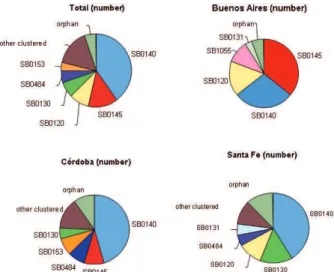
Geographical distribution of isolates and spoligo-types - Valid spoligospoligo-types were obtained for 261 isolates across 32 patterns. Of these spoligotypes, 13 patterns were orphans and 248 (94.6%) isolates were grouped in 18 clusters of more than two isolates (Table II), with a discrimination index of 0.80. The spoligotype SB0140 represented 39.8% of the isolates. The isolates from Cór-doba specifically came from slaughterhouses located in the Juarez Celman department. The numbers of spoli-gotypes detected in Buenos Aires, Córdoba and Santa Fe were nine, 21 and 19, respectively. A map showing the distribution of the four major spoligotypes is shown in Fig. 1A. These data can be compared to the cattle density per department (Fig. 1B) and it should be noted that in general samples were taken from departments with higher numbers of cattle. In Buenos Aires, SB0140 comprised 28.4% (n = 19) of the isolates, SB0145, 35.8% (n = 24), SB0120, 16.4% (n = 11) and SB1055, 10.4% (n = 7). In Córdoba, SB0140 comprised 45.5% of the iso-lates (n = 51), SB0145, 8.9% (n = 10) and SB0153 and SB0484, 8% (n = 9 each). In Santa Fe, which has a strong dairy cattle industry, SB0140 comprised 41.4% (n = 34), SB0130, 14.6% (n = 12) and SB0120, 10.9% (n = 9). Bue-nos Aires had the lowest number of unique spoligotypes (n = 4) followed by Córdoba (n = 11) and Santa Fe (10). Regarding orphan spoligotypes, Buenos Aires presented only one orphan spoligotype (xx138), Córdoba had sev-en (SB0996, 1043, 1068, 1776, xx126, xx131 and xx134) and Santa Fe had six (SB0678, 1066, 2117, 2165, 2166 and xx139). The number of major spoligotypes, the re-maining clustered spoligotypes and the orphan types are shown in Fig. 2.
The exclusive spoligotypes were composed of the orphans in addition to four clustered spoligotypes, with one from Buenos Aires (SB1055, n = 7), three from Córdoba (SB0269, n = 2, SB0273, n = 4 and SB0520, n = 4) and one from Santa Fe (SB1790, n = 2). The dis-tribution of spoligotypes in each province is shown in Table II. Four spoligotypes (SB0120, SB0131, SB0140 and SB0145) were shared among the three provinces and they made up 65.9% of the isolates. Six
spoligo-TABLE I
Primers for exact tandem repeat (ETR)-A-D typing
Variable number of tandem repeats locus
Primer sequence (5-3) (labelling)
ETR-A AAATCGGTCCCATCACCTTCTTA-(FAM)
CGAAGCCTGGGGTGCCCGCGATTT
ETR-B GCGAACACCAGGACAGCATCAT
(JOE)-GGCATGCCGGTGATCGAGTGG
ETR-C GTGAGTCGCTGCAGAACCTGCAG-(HEX)
GGCGTCTTGACCTCCACGAGTG
ETR-D CAGGTCACAACGAGAGGAAGAGC-(FAM)
GCGGATCGGCCAGCGACTCCTC
TABLE II
Spoligotypes distribution, number of patterns per province
Spoligotype (SB code)
Total of isolates
Buenos
Aires Córdoba
Santa Fe
SB0120 24 11 4 9
SB0130 18 - 6 12
SB0131 8 2 2 4
SB0140 104 19 51 34
SB0145 36 24 10 2
SB0153 11 - 9 2
SB0267 2 - 1 1
SB0269 2 - 2
-SB0273 4 - 4
-SB0484 13 - 9 4
SB0520 4 - 4
-SB0678 1 - - 1
SB0820 2 1 1
-SB0980 4 - 1 3
SB0996 1 - 1
-SB1033 2 1 - 1
SB1043 1 - 1
-SB1055 7 7 -
-SB1066 1 - - 1
SB1068 1 - 1
-SB1776 1 - 1
-SB1787 2 1 - 1
SB1790 2 - - 2
SB1799 2 - 1 1
SB2117 1 - - 1
SB2165 1 - - 1
SB2166 1 - - 1
SBxx126 1 - 1
-SBxx131 1 - 1
-SBxx134 1 - 1
-SBxx138 1 1 -
-SBxx139 1 - - 1
types were present in Córdoba and Santa Fe (SB0130, SB0153, SB0267, SB0484, SB0980 and SB1799), which represented 26.8% of the isolates from these provinces. Another spoligotype was detected in Córdoba and Bue-nos Aires (SB0820) (with 1.1% of the isolates from these 2 provinces) and two spoligotypes were in Buenos Aires and Santa Fe (SB1033 and SB1787) (with 2.7% of the iso-lates from these 2 provinces).
With regards to the distribution of spoligotypes per animal category, we observed that in the calf category (n = 27), SB0145 was predominant, with 19 isolates. The animals from this specific category were primarily sam-pled from Buenos Aires (81.5%). There were 13 samples in the category for young steers. All of these samples came from Córdoba and SB0140 was the predominant spoligotype (n = 5) in this category. Samples from 35 animals were included in the steer category (65.7% from Córdoba and 31.4% from Santa Fe). Out of these samples, 16 belonged to SB0140 and five to SB0145. In the heifer category, most animals came from Córdoba (83.3%). Of the 24 animals from this particular category, nine belonged to SB0140 and six to SB0145. In the cow category (n = 158) (Buenos Aires, n = 40; Córdoba, n = 49 and Santa Fe, n = 69), the following spoligotypes were described: SB0120 (19), SB0130 (13), SB0140 (68), SB0153 (5), SB0484 (11) and SB1055 (7). Only one ani-mal, which came from Córdoba, was included in the bull category and it exhibited spoligotype SB0140. In Santa Fe, there were 11 isolates from the steer category and spoligotype SB0140 included 45.5% of the isolates. From cows, we obtained 69 isolates and the spoligotypes were distributed as follow: SB0140 (28), SB0130 (12), SB0120 (7) and SB0484 (4). In Córdoba, SB0140 predominated in all categories [young steers (38.5%), steers (47.8%), heifers (45%) and cows (49%)].
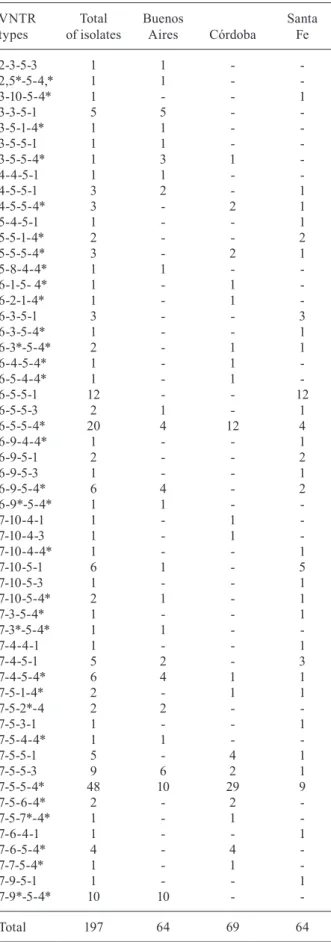
VNTR typing - A total of 197 isolates were also typed by VNTR (Buenos Aires, n = 64, Córdoba, n = 69 and Santa Fe, n = 64). There were 55 combined VNTR types that were determined by using primers directed to ETR
A, B, C and D (Table III). The discrimination index was 0.92. There were 25 clusters (comprising 168 isolates) and 29 orphan types. The predominant cluster was 7-5-5-4* with 48 isolates present in the three provinces. The second most prevalent cluster was 6-5-5-4* with 20 iso-lates present in the three provinces, followed by 6-5-5-1 with 12 isolates from Santa Fe.
Subtyping of spoligotypes by VNTR - The highly predominant spoligotype SB0140 was divided in 26 VNTR types, where 7-5-5-4* included 15 of the 64 isolates (data not shown). The 34 isolates belonging to SB0145 were divided into eight VNTR types. In turn, the third most frequent spoligotype, namely SB0120 (with 21 isolates), was subdivided into 11 VNTR types. With regards to the major VNTR types, the predomi-nant 7-5-5-4* with 48 isolates was split into 14
differ-Fig. 1A: distribution per department of the four major spoligotypes in the three provinces (1 dot = 1 case). Department are the secondary admin-istrative and political division of provinces in Argentina; B: number of cattle per department (source: rian.inta.gov.ar/ganaderia/stock2011).
ent spoligotypes, which were primarily distributed into the following three spoligotypes: SB0153, SB0145 and SB0140. The second most prevalent VNTR was 6-5-5-4*, with 20 isolates composing spoligotype SB0140 in 14/20 isolates and this VNTR was split into six dif-ferent spoligotypes. Finally, 6-5-5-1 comprised SB0140 and SB0130 with 12 isolates each.
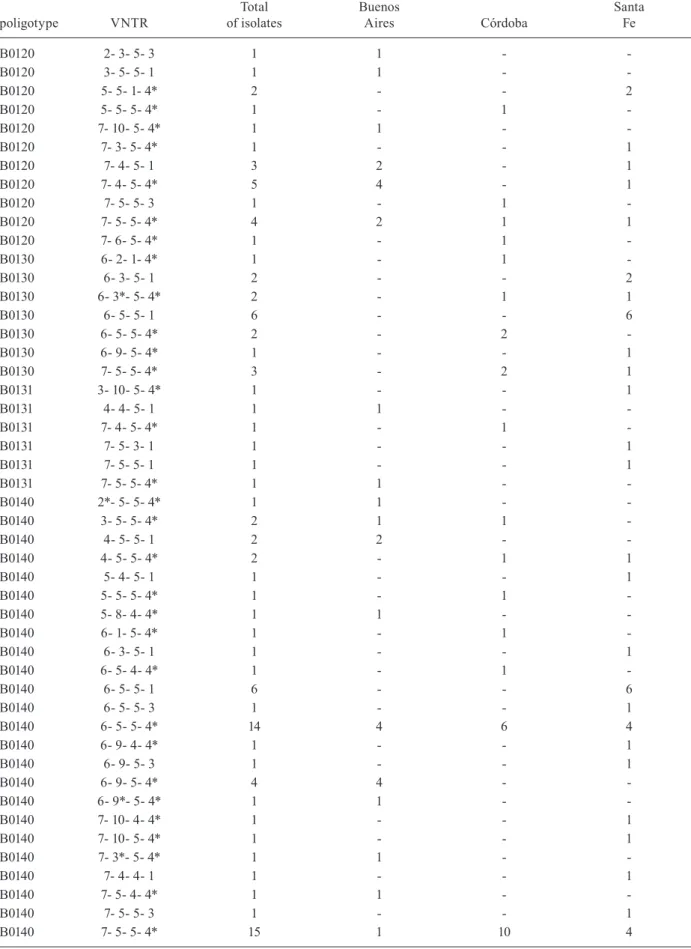
Combined discrimination by spoligotyping and VNTR typing - When both typing methods were combined, we detected 96 spoligotypes and VNTR types (Table IV) with 30 clusters (comprising 131 isolates) and 66 orphan types and a discrimination index of 0.98. SB0140-7-5-5-4* was the predominant cluster with 15 isolates dis-tributed in South Córdoba, Santa Fe and Buenos Aires, followed by SB0140-6-5-5-4* with 14 isolates distrib-uted in the three provinces. Then, SB0145-7-5-5-4* was present in Córdoba and Buenos Aires and SB0145- 7-9*-5-4* was observed only in south Buenos Aires with 10 isolates each.
In addition to the orphan types, there were 18 spo-ligo-VNTR types that were exclusives (6 of each prov-ince), which were clustered in 60 isolates (Buenos Aires, 25, Córdoba, 15 and Santa Fe, 20).
Temporal trends - A study of temporal trends was performed with a meta-analysis of spoligotypes. We used data from 1994-2011 that were recorded in our genotyping database. The analysis was performed by di-viding the data into periods of four years (except for the 1st period that includes only the years 1994 and 1995). The predominant spoligotype was SB0140 and its preva-lence percentage remained high throughout the different periods, varying from 25.5-57.8% (Fig. 3). SB0130 was the second most prevalent in the database registers and experienced an important fluctuation and it reached a peak of 65.2% in 2000-2003. Similarly, SB0145 also dis-played fluctuations, although they were at lower preva-lence levels. By contrast, other minor spoligotypes had low representation, but they were constant or sporadic. For instance, SB0131 had low representation and SB0484 was sporadically represented.
When temporal trends are taken into account by province, the most predominant spoligotype in Buenos Aires was SB0140, which is in line with the rest of the country. However, the prevalence percentage highly dif-fers throughout the different time periods (Fig. 3), from 100-16%. SB0145, the second most predominant type in Buenos Aires, increased sharply during the last study period. Additionally, important fluctuations are ob-served in the periodical frequency of SB0130. In some cases, the sampling number was too low to validate the analysis (data not shown). This challenge was also the case for the analysis in Córdoba, where the number of collected isolates was too low during some periods (data not shown). In Santa Fe, SB0140 was the predominant spoligotype with a percentage above 37% during all periods, except for 2000-2003. The second most pre-dominant spoligotype was SB0130, which varied from 0-93.75%. Finally, SB0120 rose from 0-10.2% in 2008-2011 (data not shown).
TABLE III
Variable number of tandem repeats (VNTR) types distribution, number of patterns per province
VNTR types
Total of isolates
Buenos
Aires Córdoba
Santa Fe
2-3-5-3 1 1 -
-2,5*-5-4,* 1 1 -
-3-10-5-4* 1 - - 1
3-3-5-1 5 5 -
-3-5-1-4* 1 1 -
-3-5-5-1 1 1 -
-3-5-5-4* 1 3 1
-4-4-5-1 1 1 -
-4-5-5-1 3 2 - 1
4-5-5-4* 3 - 2 1
5-4-5-1 1 - - 1
5-5-1-4* 2 - - 2
5-5-5-4* 3 - 2 1
5-8-4-4* 1 1 -
-6-1-5- 4* 1 - 1
-6-2-1-4* 1 - 1
-6-3-5-1 3 - - 3
6-3-5-4* 1 - - 1
6-3*-5-4* 2 - 1 1
6-4-5-4* 1 - 1
-6-5-4-4* 1 - 1
-6-5-5-1 12 - - 12
6-5-5-3 2 1 - 1
6-5-5-4* 20 4 12 4
6-9-4-4* 1 - - 1
6-9-5-1 2 - - 2
6-9-5-3 1 - - 1
6-9-5-4* 6 4 - 2
6-9*-5-4* 1 1 -
-7-10-4-1 1 - 1
-7-10-4-3 1 - 1
-7-10-4-4* 1 - - 1
7-10-5-1 6 1 - 5
7-10-5-3 1 - - 1
7-10-5-4* 2 1 - 1
7-3-5-4* 1 - - 1
7-3*-5-4* 1 1 -
-7-4-4-1 1 - - 1
7-4-5-1 5 2 - 3
7-4-5-4* 6 4 1 1
7-5-1-4* 2 - 1 1
7-5-2*-4 2 2 -
-7-5-3-1 1 - - 1
7-5-4-4* 1 1 -
-7-5-5-1 5 - 4 1
7-5-5-3 9 6 2 1
7-5-5-4* 48 10 29 9
7-5-6-4* 2 - 2
-7-5-7*-4* 1 - 1
-7-6-4-1 1 - - 1
7-6-5-4* 4 - 4
-7-7-5-4* 1 - 1
-7-9-5-1 1 - - 1
7-9*-5-4* 10 10 -
TABLE IV
Distribution of combined spoligotyping-variable number of tandem repeats (VNTR) types, number of patterns per province
Spoligotype VNTR
Total of isolates
Buenos
Aires Córdoba
Santa Fe
SB0120 2- 3- 5- 3 1 1 -
-SB0120 3- 5- 5- 1 1 1 -
-SB0120 5- 5- 1- 4* 2 - - 2
SB0120 5- 5- 5- 4* 1 - 1
-SB0120 7- 10- 5- 4* 1 1 -
-SB0120 7- 3- 5- 4* 1 - - 1
SB0120 7- 4- 5- 1 3 2 - 1
SB0120 7- 4- 5- 4* 5 4 - 1
SB0120 7- 5- 5- 3 1 - 1
-SB0120 7- 5- 5- 4* 4 2 1 1
SB0120 7- 6- 5- 4* 1 - 1
-SB0130 6- 2- 1- 4* 1 - 1
-SB0130 6- 3- 5- 1 2 - - 2
SB0130 6- 3*- 5- 4* 2 - 1 1
SB0130 6- 5- 5- 1 6 - - 6
SB0130 6- 5- 5- 4* 2 - 2
-SB0130 6- 9- 5- 4* 1 - - 1
SB0130 7- 5- 5- 4* 3 - 2 1
SB0131 3- 10- 5- 4* 1 - - 1
SB0131 4- 4- 5- 1 1 1 -
-SB0131 7- 4- 5- 4* 1 - 1
-SB0131 7- 5- 3- 1 1 - - 1
SB0131 7- 5- 5- 1 1 - - 1
SB0131 7- 5- 5- 4* 1 1 -
-SB0140 2*- 5- 5- 4* 1 1 -
-SB0140 3- 5- 5- 4* 2 1 1
-SB0140 4- 5- 5- 1 2 2 -
-SB0140 4- 5- 5- 4* 2 - 1 1
SB0140 5- 4- 5- 1 1 - - 1
SB0140 5- 5- 5- 4* 1 - 1
-SB0140 5- 8- 4- 4* 1 1 -
-SB0140 6- 1- 5- 4* 1 - 1
-SB0140 6- 3- 5- 1 1 - - 1
SB0140 6- 5- 4- 4* 1 - 1
-SB0140 6- 5- 5- 1 6 - - 6
SB0140 6- 5- 5- 3 1 - - 1
SB0140 6- 5- 5- 4* 14 4 6 4
SB0140 6- 9- 4- 4* 1 - - 1
SB0140 6- 9- 5- 3 1 - - 1
SB0140 6- 9- 5- 4* 4 4 -
-SB0140 6- 9*- 5- 4* 1 1 -
-SB0140 7- 10- 4- 4* 1 - - 1
SB0140 7- 10- 5- 4* 1 - - 1
SB0140 7- 3*- 5- 4* 1 1 -
-SB0140 7- 4- 4- 1 1 - - 1
SB0140 7- 5- 4- 4* 1 1 -
-SB0140 7- 5- 5- 3 1 - - 1
Spoligotype VNTR
Total of isolates
Buenos
Aires Córdoba
Santa Fe
SB0140 7- 5- 7*- 4* 1 - 1
-SB0140 7- 6- 4- 1 1 - - 1
SB0145 3- 5- 1- 4* 1 1 -
-SB0145 6- 5- 5- 4* 1 - 1
-SB0145 7- 4- 5- 1 1 - - 1
SB0145 7- 5- 2*- 4 2 2 -
-SB0145 7- 5- 5- 3 7 6 1
-SB0145 7- 5- 5- 4* 10 5 5
-SB0145 7- 6- 5- 4* 2 - 2
-SB0145 7- 9*- 5- 4* 10 10 -
-SB0153 6- 3- 5- 4* 1 - - 1
SB0153 6- 5- 5- 4* 1 - 1
-SB0153 7- 5- 1- 4* 1 - 1
-SB0153 7- 5- 5- 4* 4 - 3 1
SB0153 7- 5- 6- 4* 2 - 2
-SB0153 7- 6- 5- 4* 1 - 1
-SB0153 7- 7- 5- 4* 1 - 1
-SB0267 7- 5- 5- 4* 1 - - 1
SB0269 6- 4- 5- 4* 1 - 1
-SB0273 7- 10- 4- 1 1 - 1
-SB0273 7- 10- 4- 3 1 - 1
-SB0273 7- 5- 5- 4* 2 - 2
-SB0484 4- 5- 5- 1 1 - - 1
SB0484 7- 10- 5- 1 2 - - 2
SB0484 7- 5- 5- 1 4 - 4
-SB0484 7- 5- 5- 4* 1 - 1
-SB0520 7- 5- 5- 4* 3 - 3
-SB0820 7- 10- 5- 1 1 1 -
-SB0980 5- 5- 5- 4* 1 - - 1
SB0980 6- 9- 5- 1 1 - - 1
SB0980 7- 9- 5- 1 1 - - 1
SB0996 6- 5- 5- 4* 1 - 1
-SB1033 6- 5- 5- 3 1 1 -
-SB1033 6- 9- 5- 1 1 - - 1
SB1043 7- 5- 5- 4* 1 - 1
-SB1055 3- 3- 5- 1 5 5 -
-SB1055 3- 5- 5- 4* 2 2 -
-SB1068 4- 5- 5- 4* 1 - 1
-SB1787 7- 4- 5- 1 1 1 -
-SB1787 7- 5- 1- 4* 1 - - 1
SB1790 7- 10- 5- 1 2 - - 2
SB1799 7- 5- 5- 4* 1 - 1
-SB2117 7- 10- 5- 1 1 - - 1
SB2165 6- 9- 5- 4* 1 - - 1
SB2166 7- 10- 5- 3 1 - - 1
Spo126 6- 5- 5- 4* 1 - 1
-Spo138 7- 5- 5- 4* 1 1 -
-Spo139 7- 5- 5- 4* 1 - - 1
DISCUSSION
Among the 32 spoligotypes detected, 10 have not been previously included or described in Argentina and are not included in the databases from mbovis.org; therefore, they were considered to be new spoligotypes. Of these 10 spoligotypes, three formed clusters of two isolates each, that is, SB1790 of Santa Fe, SB1787 of Santa Fe and Bue-nos Aires and SB1799 of Santa Fe and Córdoba. The oth-er new spoligotypes woth-ere also orphans, namely SBxx138 from Buenos Aires, SBxx131 and 1776 from Córdoba and SB2165, 2166, xx126 and xx139 from Santa Fe. Santa Fe had the majority of new spoligotypes, most likely be-cause of the active TB eradication program in that prov-ince. This program, which was implemented across the whole country, consists of the sacrifice of infected bo-vines and the inspection of carcasses in slaughterhouses. In this way, when a new M. bovis strain is introduced into a herd, the infected animals are detected early and sacrificed, so a new M. bovis genotype can be detected before it can spread among the other animals. Other au-thors have proposed that if a human or bovine TB control program is active and long-lasting, then a reduction in predominant clones should be observed as transmission is halted (van Soolingen et al. 1991, Durr et al. 2000).
Early in the application of VNTR elements to M. bo-vis, the method’s discriminatory power was observed to be higher than that of spoligotyping (Roring et al. 2004). Specifically, ETR A and ETR B exhibited an important allelic variation in M. bovis (Romero et al. 2011). The ETR A-C elements were previously shown to have a dis-crimination index higher than 0.4 (Martinez et al. 2008, Boniotti et al. 2009, Price-Carter et al. 2011). However, the individual discrimination indexes in M. bovis for ETR A-D may be highly variable according to the geo-graphic setting (Sahraoui et al. 2009, Sun et al. 2012). This discrimination index increases when ETRs A-D are evaluated together. Additionally, the combination of VNTR typing and spoligotyping increases the discrimi-nation index above that of VNTR alone (Martinez et al. 2008). In contrast with the ETR-VNTR elements, mini-mum inhibitory concentration (MIRU)-VNTR (with the exception of MIRU26) yields a low discriminatory power for M. bovis (Rodriguez et al. 2004, Parreiras et al. 2012, Rocha et al. 2013).
One important aspect to evaluate is the discrimination conferred by VNTR typing in predominant spoligotypes. We observed that the predominant SB0140 spoligotype was split into 26 different ETR A-D types. This result is in accordance with the findings of McLernon et al. (2010) in Ireland, where SB0140 is also the predominant spoli-gotype and was highly subtyped by VNTR typing. Bon-iotti et al. (2009) observed that 408 isolates of SB0120, which is the most predominant spoligotype in Italy, were split into 64 different patterns (Boniotti et al. 2009).
The presence of combined cluster patterns is an index for the active transmission of TB. There were 66.5% of the isolates distributed into 30 different spoligotyping-VNTR combined patterns. Smith et al. (2003) suggested that the clonal expansion of a genotype is caused either by the spread of a favourable mutation or by the invasion of a geographic region by a few genotypes (Smith et al. 2003).
In this work, we detected 18 combined and clustered spoligotyping-VNTR patterns (6 in each province) that were exclusives in the sampled provinces. These com-bined patterns represented 30.5% of the analysed isolates. Together with the 66 orphans, these patterns yielded 84 combined and exclusive patterns. This finding suggests a pattern association with a particular geographical re-gion. However, this putative association must be demon-strated with more isolates in the future; the association was supported by a chi-square test because of the low number of isolates (data not shown).
Our database consists of M. bovis molecular typ-ing data from 1994 until the present. When we divided this 17-year span into regular periods, we observed that although the incidence of different spoligotypes fluctu-ated, the most predominant spoligotypes were unaltered. To the best of our knowledge, only one previous publica-tion on the evolupublica-tion of the M. bovis populapublica-tion structure has been reported (Haddad et al. 2001).
The predominance of major spoligotypes in cattle from the primary cattle farms in these Argentine prov-inces suggests that there is still an active transmission of the pathogen, in spite of the reduced incidence of animals with visible lesions in slaughterhouses. Spoli-gotypes are more stable than VNTR types. In fact, the BCGs obtained in 1921 from which the substrains origi-nated cannot be differentiated by spoligotyping (de la Salmonière et al. 1997, Bauer et al. 1999) and VNTR subdivides BCG (Magdalena et al. 1998, Supply et al. 2000). As a consequence, the predominant spoligotypes may ancient, as suggested by the subdivision of the main spoligotypes by VNTR typing.
ACKNOWLEDGEMENTS
To Valeria Rocha, for their technical help.
REFERENCES
Alexander KA, Laver PN, Michel AL, Williams M, van Helden PD, Warren RM, Gey van Pittius NC 2010. Novel Mycobacterium
tuberculosis complex pathogen, M. mungi. Emerg Infect Dis 16:
1296-1299.
Amanfu W 2006. The situation of tuberculosis and tuberculosis con-trol in animals of economic interest. Tuberculosis (Edinb) 86: 330-335.
Bauer J, Andersen AB, Kremer K, Miorner H 1999. Usefulness of spoligotyping to discriminate IS6110 low-copy-number
Myco-bacterium tuberculosis complex strains cultured in Denmark.
J Clin Microbiol 37: 2602-2606.
Boniotti MB, Goria M, Loda D, Garrone A, Benedetto A, Mondo A, Tisato E, Zanoni M, Zoppi S, Dondo A, Tagliabue S, Bonora S, Zanardi G, Pacciarini ML 2009. Molecular typing of
Myco-bacterium bovis strains isolated in Italy from 2000 to 2006 and
evaluation of variable-number tandem repeats for geographically optimized genotyping. J Clin Microbiol 47: 636-644.
Cataldi A, Romano MI 2007. TB caused by other members of the
My-cobacterium tuberculosis complex. In JC Palomino, V Rittacco,
S Leao (eds.), Tuberculosis, Amedeo, Berlin, 450 pp.
Collins DM, Erasmuson SK, Stephens DM, Yates GF, de Lisle GW 1993. DNA fingerprinting of Mycobacterium bovis strains by re-striction fragment analysis and hybridization with insertion ele-ments IS1081 and IS6110. J Clin Microbiol 31: 1143-1147.
de Kantor IN, Torres PM, Morcillo N, Imaz MS, Sequeira MD 2012. Zoonotic tuberculosis in Argentina. Medicina 72: 514-520.
de la Salmonière YOG, Li HM, Torrea G, Bunschoten A, van Embden J, Gicquel B 1997. Evaluation of spoligotyping in a study of the transmission of Mycobacterium tuberculosis. J Clin Microbiol 35: 2210-2214.
Durr PA, Clifton-Hadley RS, Hewinson RG 2000. Molecular epide-miology of bovine tuberculosis. II. Applications of genotyping.
Rev Sci Tech 19: 689-701.
Frothingham R, Meeker-O’Connell WA 1998. Genetic diversity in the
Mycobacterium tuberculosis complex based on variable numbers
of tandem DNA repeats. Microbiology 144: 1189-1196.
Haddad N, Ostyn A, Karoui C, Masselot M, Thorel MF, Hughes SL, Inwald J, Hewinson RG, Durand B 2001. Spoligotype diversity
of Mycobacterium bovis strains isolated in France from 1979 to
2000. J Clin Microbiol 39: 3623-3632.
Hunter PR, Gaston MA 1988. Numerical index of the discriminatory ability of typing systems: an application of Simpson’s index of diversity. J Clin Microbiol 26: 2465-2466.
Kamerbeek J, Schouls L, Kolk A, van Agterveld M, van Soolingen D, Kuijper S, Bunschoten A, Molhuizen H, Shaw R, Goyal M, van Embden J 1997. Simultaneous detection and strain differentiation
of Mycobacterium tuberculosis for diagnosis and epidemiology.
J Clin Microbiol 35: 907-914.
Magdalena J, Supply P, Locht C 1998. Specific differentiation between
Mycobacterium bovis BCG and virulent strains of the
Mycobac-terium tuberculosis complex. J Clin Microbiol 36: 2471-2476.
Martinez LR, Harris B, Black WC, Meyer RM, Brennan PJ, Vissa VD, Jones RL 2008. Genotyping North American animal
Myco-bacterium bovis isolates using multilocus variable number
tan-dem repeat analysis. J Vet Diagn Invest 20: 707-715.
Maslow JN, Mulligan ME, Arbeit RD 1993. Molecular epidemiology: application of contemporary techniques to the typing of microor-ganisms. Clin Infect Dis 17: 153-162.
McLernon J, Costello E, Flynn O, Madigan G, Ryan F 2010. Evalua-tion of mycobacterial interspersed repetitive-unit-variable-num-ber tandem-repeat analysis and spoligotyping for genotyping of
Mycobacterium bovis isolates and a comparison with restriction
fragment length polymorphism typing. J Clin Microbiol 48: 4541-4545.
Milián-Suazo F, Banda-Ruiz V, Ramirez-Casillas C, Arriaga-Diaz C 2002. Genotyping of Mycobacterium bovis by geographic loca-tion within Mexico. Prev Vet Med 55: 255-264.
Nader A, Husberg H 1988. Estimación de pérdidas de producción por tuberculosis bovina en un rodeo lechero. Rev Med Vet (B. Aires) 69: 36-43.
Otal I, Martin C, Vincent-Levy-Frebault V, Thierry D, Gicquel B 1991. Restriction fragment length polymorphism analysis using IS6110 as an epidemiological marker in tuberculosis. J Clin
Mi-crobiol 29: 1252-1254.
Parreiras PM, Andrade GI, do Nascimento TF, Oelemann MC, Gomes HM, de Alencar AP, de Assis RA, Mota PMPC, Pereira MAS, Lobato FCF, Lage AP, Suffys PN 2012. Spoligotyping and vari-able number tandem repeat analysis of Mycobacterium bovis iso-lates from cattle in Brazil. Mem Inst Oswaldo Cruz 107: 64-73.
Price-Carter M, Rooker S, Collins DM 2011. Comparison of 45 vari-able number tandem repeat (VNTR) and two direct repeat (DR) assays to restriction endonuclease analysis for typing isolates of
Mycobacterium bovis. Vet Microbiol 150: 107-114.
Rocha VC, de Figueiredo SC, Rosales CA, Grisi Filho JHH, Keid LB, Soares RM, Ferreira Neto JS 2013. Molecular discrimina-tion of Mycobacterium bovis in São Paulo, Brazil. Vector Borne
Zoonotic Dis 13: 17-21.
Rodriguez CAR, Zumárraga MJ, de Oliveira EM, Cataldi AA, Roma-no MI, Otto HH, Bonafé VL, Ferreira Neto JS 2004. Caracteri- zação molecular de isolados de Mycobacterium bovis do estado de São Paulo, Brasil, utilizando a técnica de spoligotyping. Arq
Inst Biol 71: 277-282.
Rodríguez S, Romero B, Bezos J, de Juan L, Alvarez J, Castellanos E, Moya N, Lozano F, González S, Sáez-Llorente JL, Mateos A, Domínguez L, Aranaz A, Spanish Network on Surveillance and Monitoring of Animal Tuberculosis 2010. High spoligotype di-versity within a Mycobacterium bovis population: clues to under-standing the demography of the pathogen in Europe. Vet
Micro-biol 141: 89-95.
Romero B, Rodríguez S, Bezos J, Díaz R, Copano MF, Merediz I, Mínguez O, Marqués S, Palacios JJ, Viedma DG, Sáez JL, Ma-teos A, Aranaz A, Domínguez L, de Juan L 2011. Humans as source of Mycobacterium tuberculosis infection in cattle, Spain.
Emerg Infect Dis 17: 2393-2395.
Roring S, Scott AN, Hewinson RG, Neill SD, Skuce RA 2004. Evalu-ation of variable number tandem repeat (VNTR) loci in molecu-lar typing of Mycobacterium bovis isolates from Ireland. Vet
Mi-crobiol 101: 65-73.
Sahraoui N, Muller B, Guetarni D, Boulahbal F, Yala D, Ouzrout R, Berg S, Smith NH, Zinsstag J 2009. Molecular characterization
of Mycobacterium bovis strains isolated from cattle slaughtered
at two abattoirs in Algeria. BMC Vet Res 5: 4.
Skuce RA, Neill SD 2001. Molecular epidemiology of
Mycobacte-rium bovis: exploiting molecular data. Tuberculosis (Edinb) 81:
169-175.
Smith NH, Dale J, Inwald J, Palmer S, Gordon SV, Hewinson RG, Smith JM 2003. The population structure of Mycobacterium bo-vis in Great Britain: clonal expansion. Proc Natl Acad Sci USA 100: 15271-15275.
Sun Z, Cao R, Tian M, Zhang X, Li Y, Xu Y, Fan W, Huang B, Li C 2012. Evaluation of spoligotyping and MIRU-VNTR for
Myco-bacterium bovis in Xinjiang, China. Res Vet Sci 92: 236-239.
Supply P, Mazars E, Lesjean S, Vincent V, Gicquel B, Locht C 2000. Variable human minisatellite-like regions in the Mycobacterium
tuberculosis genome. Mol Microbiol 36: 762-771.
van Ingen J, Rahim Z, Mulder A, Boeree MJ, Simeone R, Brosch R, van Soolingen D 2012. Characterization of Mycobacterium
ory-gis as M. tuberculosis complex subspecies. Emerg Infect Dis 18:
van Soolingen D, Hermans PW, de Haas PE, Soll DR, van Emb-den JD 1991. Occurrence and stability of insertion sequences
in Mycobacterium tuberculosis complex strains: evaluation
of an insertion sequence-dependent DNA polymorphism as a tool in the epidemiology of tuberculosis. J Clin Microbiol 29: 2578-2586.
Zumárraga MJ, Arriaga C, Barandiaran S, Cobos-Marin L, de Waard J, Estrada-Garcia I, Figueiredo T, Figueroa A, Giménez F, Gomes HM, Gonzalez-y-Merchand JA, Macías A, Suazo FM, Rodríguez
CAR, Santillán MA, Suffys PN, Trangoni MD, Zárraga AM, Cat-aldi A 2012. Understanding the relationship between
Mycobacte-rium bovis spoligotypes from cattle in Latin American countries.
Res Vet Sci 94: 9-21.