Molecular typing of Argentinian
Mycobacterium avium
subsp.
paratuberculosis
isolates by multiple-locus variable number-tandem repeat analysis
Andrea Gioffré
1, Magnolia Correa Muñoz
2, María F. Alvarado Pinedo
3, Roberto Vaca
4,
Claudia Morsella
5, María Andrea Fiorentino
5, Fernando Paolicchi
5, Paula Ruybal
1,
Martín Zumárraga
1, Gabriel E. Travería
3, María Isabel Romano
1 1Instituto de Biotecnología, Centro de Investigación en Ciencias Veterinarias y Agronómicas, Instituto Nacional de Tecnología Agropecuaria, Buenos Aires, Argentina.
2
Universidad Autónoma de Baja California, Mexicali, México.
3
Centro de Diagnóstico e Investigaciones Veterinarias, Faculdad de Ciencias Veterinarias, Universidad Nacional de La Plata, Chascomús, Argentina.
4
Cátedra de Zootecnia Especial II, Faculdad de Ciencias Veterinarias, Universidad Nacional de La Plata, Buenos Aires, Argentina.
5
Laboratorio de Bacteriología, Estación Experimental Agropecuaria, Instituto Nacional de Tecnología Agropecuaria, Balcarce, Argentina.
Submitted: April 3, 2014; Approved: November 16, 2014.
Abstract
Multiple-locus variable number-tandem repeat analysis (MLVA) ofMycobacterium avium subspe-ciesparatuberculosis(MAP) isolates may contribute to the knowledge of strain diversity in Argen-tina. Although the diversity of MAP has been previously investigated in Argentina using IS900-RFLP, a small number of isolates were employed, and a low discriminative power was reached. The aim of the present study was to test the genetic diversity among MAP isolates using an MLVA approach based on 8 repetitive loci. We studied 97 isolates from cattle, goat and sheep and could describe 7 different patterns: INMV1, INMV2, INMV11, INMV13, INMV16, INMV33 and one incomplete pattern. INMV1 and INMV2 were the most frequent patterns, grouping 76.3% of the isolates. We were also able to demonstrate the coexistence of genotypes in herds and co-infection at the organism level. This study shows that all the patterns described are common to those described in Europe, suggesting an epidemiological link between the continents.
Key words:paratuberculosis, molecular typing, MIRU-VNTR, MLVA.
Introduction
Johne’s disease or paratuberculosis (PTB) is an en-teric disease aetiologically associated withMycobacterium aviumsubsp. paratuberculosis(MAP). This chronic and progressive intestinal infection causes important economic losses to dairy and beef herds around the world (OIE, 2009). Moreover, its zoonotic potential, an issue currently under discussion, is also considered a major concern. MAP has been largely described as restricted to ruminants, such as goats, sheep, cattle, deer, and bison, and recently in camelids (Buergeltet al., 2000; Djønneet al., 2005;
Sal-gadoet al., 2009; Attiliet al., 2011; Ghoshet al., 2012). Despite this, the isolation of MAP from non-ruminant wild-life, in some cases with pathological lesions, may constitute supporting evidence of a widening of the host range and reservoirs (Beardet al., 2001; Stevensonet al., 2009). Their long-term survival in soil, grass, water samples and bio-films (Whittingtonet al., 2004; Pickupet al., 2005, Cooket al., 2010), replication and persistence in amoeba (Muraet al., 2006) constitute important evidence that the environ-ment (natural or artificial) may be a major source of MAP strains. These factors increase the exposure of animals and
DOI: http://dx.doi.org/10.1590/S1517-838246220140283
Send correspondence to A. Gioffré. Dr. Nicolás Repetto y De Los Reseros S/Nº PO Box B1686IGC Hurlingham, Buenos Aires, Argentina. E-mail: [email protected].
humans to this pathogen and could contribute to the ende-micity of PTB. Although epidemiological data are scarce in Argentina, PTB has been well characterised in Buenos Ai-res province, one of the most productive regions of the country, where a seroprevalence ranging from 7.2 to 19.6% in cattle herds has been reported in the Salado river basin region (INTA-Balcarce, data not published). Additionally, the disease has been widely described in different hosts such as sheep (Nader and Bernardelli, 1986; Jorgeet al., 2000; Bernardelliet al., 2002), cattle (Moreiraet al., 1999; Paolicchiet al., 2003), captive deer (Paolicchiet al., 2001; Verna et al., 2002), a captive mouflon (Ovis musimon) (Bernardelliet al., 2005) and goats (Fiorentinoet al., 2012). Several factors such as limitations in diagnostic availability all over the country, the absence of an official infection control programme and the intensification of livestock pro-duction systems lead to speculation that PTB will be more widespread in the country in the future. In contrast, bovine tuberculosis (bTB) is better characterised at the epidemio-logical level in our country. However, although the volun-tary official control programme has been successfully applied since 1999, the region is not considered bTB-free. As a consequence, co-infection withM. bovisand MAP is plausible in Argentinean herds and flocks (Jorge et al., 2000). Furthermore, PTB also appears to be a possible in-terference in bTB diagnosis, which has not been estimated in our country. A previous study in the late 1990s per-formed in bovine and farmed deer isolates from our country suggested a low epidemiological association with Europe. In that study, Moreira and co-workers typed 61 MAP iso-lates from cattle and deer by IS900-restriction fragment polymorphisms analysis (RFLP), and four main patterns were found. The pattern named A was identical to a less fre-quent pattern, R9 (C17), from Europe, whereas the rest
were not found on the same continent (Moreira et al., 1999). Molecular typing based on MIRU (Mycobacterial interspersed repetitive unit) and VNTR (variable number in tandem repeat) loci has been employed as a simple and rapid procedure for differentiation between MAP and other M. aviumcomplex isolates (Bullet al., 2003; Radomskiet al., 2010). PCR-based genotyping is rapid and inexpensive, and its discriminative power is similar to that previously re-ported for other techniques such as RFLP (Motiwalaet al., 2006; Thibaultet al., 2007). Moreover, it has the potential to be applied directly to clinical samples and does not re-quire highly specialised personnel or sophisticated equip-ment. Consequently, this method is particularly desirable for MAP because of the very slow-growing nature of these organisms (Bullet al., 2003) and could be easily applied in low-income countries. In this study, we aimed to study MAP strain diversity in Argentina by means of MIRU-VNTR.
Materials and Methods
MAP isolates and DNA extraction
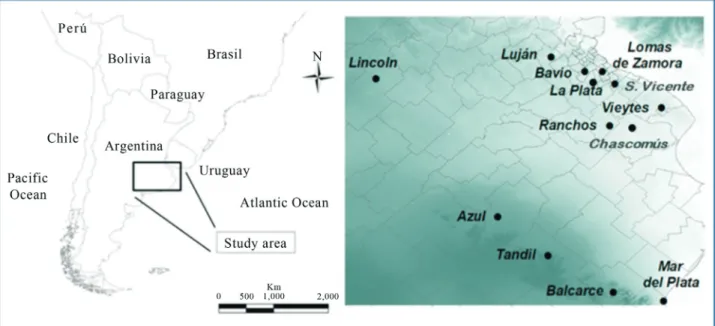
We tested ninety-seven isolates from a MAP collec-tion, as confirmed by their mycobactin J dependence for growth, IS900-PCR (Englundet al., 1999) and F57-PCR (Vansnicket al., 2004). These isolates were classified by PCR and restriction endonuclease analysis (PCR-REA) as “cattle type” (C type) (Marshet al., 1999). The tested clini-cal isolates corresponded to cattle, (n = 78) goats (n = 16) and sheep (n = 3) belonging to herds (n = 23) from thirteen geographic localities of the Buenos Aires province (Fig. 1). The isolates were obtained over the period from 2005 to 2010. A loopful of each isolate was suspended in sterile dis-tilled water, and cell lysis was performed by serial
boiling cycles. The samples were centrifuged (10,000 xg, 5 min), and 2mL of the supernatant was used as the tem-plate in PCR reactions.
MIRU-VNTR typing: PCR conditions and number of tandem repeat determination
MIRU-VNTR typing was used for eight different MAP-specific markers, as described by Thibaultet al., and designated VNTR292, MIRUX3 (alias MIRU2 and MIRU3, respectively, Bull et al., 2003; Thibault et al., 2007) VNTR25, VNTR47, VNTR3, VNTR7, VNTR10 and VNTR32 (Thibaultet al., 2007). The primers and PCR conditions were as suggested previously (Thibaultet al., 2007), with minor modifications.The amplification mix-ture consisted of 1X buffer (10 mM Tris-HCl pH 9; 50 mM KCl and 0.1% Triton X-100, 2.5 mM MgCl2) 0.2 mM each
dNTP, 1mM each primer and 1.25 U GoTaq polymerase (Promega). MgCl2 was supplemented for MIRUX3
(2 mL/reaction), and DMSO and betaine were supple-mented when amplifying VNTR loci 47, 3, 7, 10 and 32, as suggested previously. The described previously annealing temperatures were employed, except for locus 47, for which the annealing temperature during the first 10 cycles was decreased 1 °C per cycle from 69 °C to 59 °C, accord-ing to a touch-down protocol, and then a final annealaccord-ing temperature at 64 °C was selected for 35 cycles. The PCR products were resolved by 3.5% agarose gel electrophore-sis, and the molecular weights were determined using 100 bp and 50 bp DNA markers (Promega Corp.) and BioNumerics software (Applied Maths, Belgium). The number of tandem repeats in each locus was assigned ac-cording to a previous report (Radomskiet al., 2010; see Supplementary tables). Numerical profiles were classified according to INMV (INRA, Nouzilly, MIRU-VNTR) com-binations, as suggested previously (Thibaultet al., 2007; Radomski et al., 2010). DNA from M. avium subsp. paratuberculosisK10 was included as a control (INMV2).
Index of discrimination
The allelic diversity for each locus and the discrimi-natory power of complete MIRU-VNTR scheme typing were determined using the Hunter and Gaston discrimina-tory index (Hunter, 1990; Hunter and Gaston, 1988) calcu-lated using Simpson’s index of diversity formula, as follows:
D
N N j x xj j s
=
--
å
=-1 1
1 1 1
( ) ( )
whereDcorresponds to the index of discriminatory power, Nto the number of unrelated strains tested,Sto the number of different types, andxjto the number of strains belonging to the jth type, assuming that strains will be classified into mutually exclusive categories.
This index was estimated considering epidemiolo-gically unrelated strains and was calculated using the on-line software: http://insilico.ehu.es/mini_tools/discrimina-tory_power/, University of the Basque Country.
Epidemiological study
The eBURST algorithm described by Feil et al. (2004) was initially developed for MLST but is also suit-able for MLVA studies. The goe-BURST algorithm (goeburst.phyloviz.net/) (Francisco et al., 2009), which uses the same clustering rules as eBURST (Feilet al., 2004) but provides a global optimal solution, was used to deter-mine relationships between the obtained profiles. Clonal complexes were defined as MIRU-VNTR loci that are linked through single-locus variants (SLVs) and named on the basis of the predicted founder, which is the MIRU-VNTR pattern associated with most SLVs.
Results
MIRU-VNTR genotypes: Frequency, hosts and geographic distribution
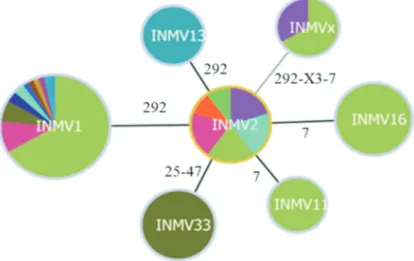
The overall analysis yielded seven different INMV MIRU-VNTR patterns in the MAP isolates studied (n = 97). The INMV1 pattern grouped 65% of the isolates and was the most frequent. The rest of the genotypes were less represented, with INMV2 (11.3%), INMV16 (8.2%), and INMV33 (7.2%) being almost equally frequent. Al-though we were not able to amplify loci 292 and 7 in three isolates, the other loci indicated a pattern different from those mentioned above. This incomplete pattern repre-sented 3.1% of the isolates. The most frequent patterns (INMV1 and INMV2) were described in at least two hosts (cattle, goat and sheep or cattle and goat, respectively), whereas the less frequent ones (INMV 11, INMV13, INMV16, INMV33, INMVx) were related to cattle (Table 1). The most common MIRU-VNTR patterns were widely distributed geographically, which limits their use-fulness for tracing the geographic spread of infection. The MAP isolates from San Vicente showed the pattern INMV 13, and this pattern occurs exclusively in that location. The patterns INMV 11, INMV 16 and INMV 33 were exclu-sively from Tandil (Table 1 and Fig. 2).
Analysis of profiles by individual herds
Allelic diversity and discriminatory power
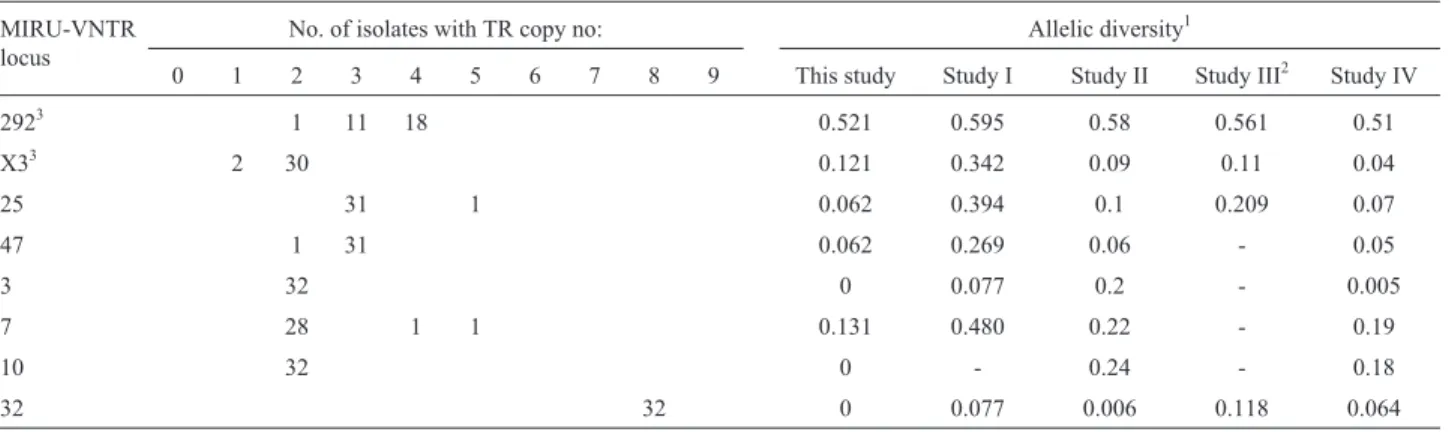
Thirty-two non-epidemiologically related isolates were resampled to carry out both allelic diversity and dis-criminatory power analyses. According to our study, VNTR292 showed the maximum allelic diversity for Ar-gentinean MAP strains (0.521). In contrast, VNTR loci 3, 10 and 32 were un-informative. The discriminatory power of the remaining MIRU-VNTR loci (X3, 25, 47 and 7) was weak, similar to most previous studies (Table 3). With the exception of VNTR32, which has eight tandem repeats (TRs), the rest of the loci showed a TR copy number lower than five. MIRU X3 was the only locus with one tandem re-peat, and alleles without TRs were absent in the studied iso-lates. The complete MIRU-VNTR scheme discriminatory index D reached 0.6331. However, the discriminatory in-dex was unchanged when the number of MIRU-VNTR loci was reduced to VNTR292-MIRUX3-VNTR25-VNTR47 and VNTR7, and the exclusion of VNTR47 or VNTR25 from the last combination did not reflect a significant dif-ference in the discriminatory power reached (0.6086). Therefore, these findings indicate that a reduced MIRU-VNTR scheme (MIRU-VNTR292-MIRUX3-MIRU-VNTRs25/47 and VNTR7) yields discriminatory values comparable to the scheme of the complete 8 loci.
goeBURST analysis
To study the relationship among MIRU-VNTR pat-terns, we performed a cluster analysis using the goeBURST algorithm. The goeBURST clustering suggested pattern INMV2 as the primary founder. This pattern, together with INMV1, was the most geographically widespread, and only these two patterns were isolated from different hosts (Figu-re 2 and Table 1).
Discussion
The import of live animals from the United Kingdom is considered the most probable route of the introduction of M. bovisto Argentina, and this fact is supported by the genotyping of isolates from both regions (Cataldiet al., 2002; Smithet al., 2011). Considering the nature of MAP, we hypothesised that the genotypes/patterns of MAP from our country and Europe are also common. Our results ex-pand an earlier study that examined the diversity of Argen-tinean MAP isolates using IS900-RFLP (Moreira et al., 1999). MIRU-VNTR is faster and less labour-intensive than RFLP and has been internationally adopted (Steven-sonet al., 2009, Inagaki et al., 2009, Castellanos et al., 2010; Radomskiet al., 2010; Fernández-Silvaet al., 2011, Bietet al., 2012). Hence, we selected a previously reported MIRU-VNTR scheme to study the diversity of circulating strains in Argentina in an effort to eventually perform a comparative analysis between different locations. We stud-ied a larger sample size from three different hosts, covering a broad area of study compared to the aforementioned
study. We demonstrate here that the most frequent MIRU-VNTR pattern is INMV1 (65%). This result is concordant with a previous report in which 51% of European isolates were typed as INMV1, which was also shown to be distrib-uted in 6 out of the 7 countries assessed in that study (Stevensonet al., 2009). Additionally, patterns INMV1 and INMV2 were found to represent most of the isolates (36% and 34%, respectively) from 10 different countries and hosts (Thibaultet al., 2007). The goeBurst analysis indi-cated INMV2 as the founder genotype in our study. A
simi-lar result was obtained by the minimum-spanning-tree ap-proach performed in a strain panel containing mainly European isolates (Radomskiet al., 2010).
To date, the patterns INMV1, INMV2, INMV11, INMV13, INMV16, INMV33 (this work), and INMV8 (Thibaultet al., 2007) have been described in Argentinean isolates. The currently available information for pattern distribution in the United Kingdom shows the presence of INMV1, INMV2, INMV19, INMV21, INMV25 (Steven-sonet al., 2009) and INMV14 and INMV33 (Thibaultet
Figure 2- GoeBURST clustering of the seven MIRU-VNTR profiles. Locations are represented in different colours. Differential loci between the pat-terns are shown in black numbers. The size of the pie is related to the number of samples.
Table 2- Analysis of diversity by herd.
Herd1no. (district) MIRU-VNTR pattern TRs at loci: 292-X3-25-47-3-7-10-32 No. of isolates/genotype Host
I (Tandil) INMV1 42332428 25 cattle
INMV16 32332528 7
INMV11 32332428 2
INMV2 32332228 3
INMVx N1332N28 2
II (San Vicente) INMV13 22332228 3 cattle
INMV1 42332428 1
III (L. de Zamora) INMV2 32332228 2 cattle
INMVx N1332N28 1
IV (Chascomús) INMV1 42332428 2 cattle
V (Lincoln) INMV33 32522228 10 cattle
INMV1 42332428 5
VI (Mar del Plata) INMV1 42332428 15 goat
VII (La Plata) INMV1 42332428 2 sheep
VIII (La Plata) INMV1 42332428 1 cattle
INMV2 32332228 1
IX (Balcarce) INMV1 42332428 2 cattle
1Only herds represented by more than one isolate were considered.
2Designated according to the INRA Nouzilly MIRU-VNTR patterns (Thibault
et al., 2007). 3Loci were arranged in the same order as that of Thibault
al., 2007) in different hosts. Considering these data in com-bination with the fact that INMV1 and INMV2 are distrib-uted worldwide, we cannot assume or discard the epidemi-ological link between the UK and Argentina using this VNTR-MIRU typing approach, and further evidence is re-quired to confirm this hypothesis. Nonetheless, almost all described patterns in our study have been previously re-ported in European isolates (Thibaultet al., 2007). The combination of other typing technique(s) with MIRU-VNTR analysis has enabled an improvement of the dis-criminatory power (Thibaultet al., 2008; Stevensonet al., 2009). More recently, Fernández Silvaet al. were able to improve the discrimination between six INMV1 Argentinian strains, which were resolved into three geno-types using multilocus short sequence repeats (Fernández Silvaet al., 2012). Hence, the use of more than one typing method to further discriminate between isolates and the in-clusion of a larger number of strains by random sampling could be more informative about the real epidemiological scenario in Argentina.
We found that the most important limitation of MIRU-VNTR typing was the lack of amplification for two loci. We herein report INMVx as an incomplete pattern be-cause two MIRU-VNTR loci (292 and 7) remained refrac-tory to amplification in three samples. This could be due to target sequence polymorphisms or to the absence of these loci in these strains.
The discriminatory index we obtained reached 0.63, in accordance with previous studies by Thibault et al. (2007) and Stevensonet al.(2009), 0.75 and 0.64, respec-tively. Based on information derived from these previous studies and the present work, a reduced scheme can be con-sidered for typing MAP isolates without a significant loss of discriminative power. In this regard, MIRU-VNTR loci 3, 10 and 32 can be excluded in future studies involving lo-cal strains, and moreover novel markers could be consid-ered for improving the discriminatory power.
The coexistence of different genotypes within cattle herds has been previously reported (van Hulzen et al., 2011; Fernández-Silvaet al., 2011). Within this context, cattle herd I (Tandil) with at least five different patterns constitutes a good example. The observed genotype co-existence within herds strongly suggests that a lack of ani-mal monitoring prior to their introduction into a herd may represent a factor that is key to the observed diversity. Ac-cordingly, we cannot rule out the presence of more than one genotype in all the tested herds, and a wider sampling should be performed to examine this. For most of the herds assessed in this study, animals are currently introduced, or were introduced in the past, without prior testing, justifying this practice based on the apparent healthy condition of the animals. One case was the introduction of a bull for breed-ing purposes in an infected herd (herd II, San Vicente). The isolate from this animal showed a pattern different from those described for other isolates from the same herd. Con-sidering that animals usually become infected early in their life, one can assume that this bull was already infected. However, we also studied a MAP-infected flock (herd VI, Mar del Plata) in which the PTB seroprevalence was 48% (Fiorentinoet al., 2012). In this case, the introduction of foreign animals was not a common practice, which clearly correlates with the presence of isolates sharing the same pattern. It is important to mention that, unfortunately, this MAP-infected herd is a frequent supplier of animals to neighbouring herds.
Since the early epidemiological studies on PTB, mo-lecular typing techniques have been described and applied. The MIRU-VNTR approach has been used to type M. avium complex strains from different countries, such as France, Germany, Czech Republic, Finland, Greece, The Netherlands, Norway, Scotland, Spain, Japan and more re-cently Colombia and Argentina (Möbiuset al., 2008; Ste-vensonet al., 2009; Inagakiet al., 2009; Castellanoset al., 2010; Radomskiet al., 2010; Fernández-Silvaet al., 2011,
Table 3- Frequency of tandem repeats in each MIRU-VNTR locus and comparative allelic diversity between different studies.
MIRU-VNTR locus
No. of isolates with TR copy no: Allelic diversity1
0 1 2 3 4 5 6 7 8 9 This study Study I Study II Study III2 Study IV
2923 1 11 18 0.521 0.595 0.58 0.561 0.51
X33 2 30 0.121 0.342 0.09 0.11 0.04
25 31 1 0.062 0.394 0.1 0.209 0.07
47 1 31 0.062 0.269 0.06 - 0.05
3 32 0 0.077 0.2 - 0.005
7 28 1 1 0.131 0.480 0.22 - 0.19
10 32 0 - 0.24 - 0.18
32 32 0 0.077 0.006 0.118 0.064
1Allelic diversity compared to those previously reported by Möbius
et al., 2008 (Study I), Stevensonet al., 2009 (Study II), Castellanoset al., 2010 (Study III) and Radomskiet al., 2010 (Study IV).
2The reported allelic diversity from type II strains was selected.
this work). Despite the high acceptance of this technique, the results from different studies are often difficult to com-pare due to the lack of standardisation. At present, a con-sensus on which is the best technique or combination of multiple genotyping techniques is urgently needed to defin-itively understand the global epidemiology of PTB, and this can be achieved through collaborative work. This report constitutes the first MIRU-VNTR study of a large panel of strains from one of the most productive regions of Argen-tina.
Acknowledgments
This work was partially supported by grants from INTA (AESA202831) and BiotecSur. The authors acknowledge V. Rocha and V. Montenegro for technical assistance, Dr. A. Bernardelli and L. Fernández for biblio-graphic support and Dr. J. Sabio-García for critical reading of the manuscript. AG, PR and MIR are members of the Re-search Career of the CONICET, Buenos Aires, Argentina.
References
Attili AR, NguNgwa V, Preziuso Set al.(2011) Ovine
paratu-berculosis: A seroprevalence study in dairy flocks reared in
the Marche region, Italy. Vet Med Int
doi:10.4061/2011/782875.
Beard PM, Daniels MJ, Henderson Det al. (2001)
Paratuber-culosis infection of nonruminant wildlife in Scotland. J Clin Microbiol 39:1517-1521.
Bernardelli A, Cicuta NE, Nicola Aet al. (2002) Ovine
para-tuberculosis: field diagnosis. 7thInternational Colloquium
on Paratuberculosis Bilbao, Spain.
Bernardelli A, Zumárraga M, Alonso B et al. (2005)
Paratu-berculosis in Mouflon (Ovis musimon). 8th International
Colloquium on Paratuberculosis, Copenhagen, Denmark.
Biet F, Sevilla IA, Cochard Tet al.(2012) Inter- and intra-subtype
genotypic differences that differentiate Mycobacterium
aviumsubspeciesparatuberculosisstrains. BMC Microbiol 12:264.
Buergelt CD, Layton AW, Ginn PEet al.(2000) The pathology of
spontaneous paratuberculosis in the North American bison (Bison bison). Vet Pathol 37:428-438.
Bull TJ, Sidi-Boumedine K, McMinn EJet al. (2003)
Myco-bacterial interspersed repetitive units (MIRU) differentiate Mycobacterium avium subspecies paratuberculosis from
other species of the Mycobacterium aviumcomplex. Mol
Cell Probes 17:157-164.
Castellanos E, Romero B, Rodríguez Set al.(2010) Molecular
characterization of Mycobacterium avium subspecies
paratuberculosisType II and III isolates by a combination of MIRU-VNTR loci. Vet Microbiol 144:118-126.
Cataldi AA, Gioffré A, Santángelo MPet al.(2002) The genotype
of the principalMycobacterium bovisin Argentina is also
that of the British isles: did bovine tuberculosis come from Great Britain? Rev Argent Microbiol 34:1-6.
Cook KL, Britt JS, Bolster CH (2010) Survival ofMycobacterium
aviumsubsp.paratuberculosisin biofilms on livestock wa-tering trough materials. Vet Microbiol 141:103-109.
Djønne B, Pavlik I, Svastova Pet al.(2005) IS900Restriction
Fragment Length Polymorphism (RFLP) Analysis of
Myco-bacterium avium subsp. paratuberculosis isolates from goats and cattle in Norway. Acta Vet Scand 46:13-18.
Englund S, Ballagi-Pordany A, Bölske Get al.(1999) Single PCR
and nested PCR with a mimic molecule for detection of
My-cobacterium avium subsp. paratuberculosis. Diagn Micr Infec Dis 33:163-171.
Feil EJ, Li BC, Aanensen DMet al.(2004) eBURST: Inferring
patterns of evolutionary descent among clusters of related bacterial genotypes from multilocus sequence typing data. J Bacteriol 186:1518-1530.
Fernández-Silva JA, Abdulmawjood A, Bülte M (2011)
Diagno-sis and molecular characterization ofMycobacterium avium
subsp.paratuberculosisfrom dairy cows in Colombia. Vet
Med Int doi:10.4061/2011/352561.
Fernández-Silva JA, Abdulmawjood A, Akineden Öet al.(2012).
Genotypes of Mycobacterium avium subsp.
paratuberculosis from South American countries deter-mined by two methods based on genomic repetitive se-quences. Trop Anim Health Prod 44:1123-1126.
Fiorentino MA, Gioffré A, Cirone Ket al.(2012) First isolation of
Mycobacterium avium subsp. paratuberculosisin a dairy goat in Argentina: Pathology and molecular
characteriza-tion. Small Ruminant Res
http://dx.doi.org/10.1016/j.smallrumres.2012.06.010.
Francisco AP, Bugalho M, Ramírez Met al.(2009) Global
opti-mal eBURST analysis of multilocus typing data using a
graphic matroid approach. BMC Bioinformatics
doi:10.1186/1471-2105-10-152.
Ghosh P, Hsu C, Alyamani EJet al.(2012) Genome-wide analysis
of the emerging infection withMycobacterium avium
sub-species paratuberculosisin the Arabian camels (Camelus
dromedarius). PLoS One doi:
10.1371/jour-nal.pone.0031947.
Hunter PR, Gaston MA (1988) Numerical index of the discrimi-natory ability of typing systems: an application of Simpson’s index of diversity. J Clin Microbiol 26:2465-2466.
Hunter P (1990) Reproducibility and indices of discriminatory power of microbial typing methods. J Clin Microbiol 28:1903-1905.
Inagaki T, Nishimori K, Yagi Tet al. (2009) Comparison of a
variable-number tandem-repeat (VNTR) method for typing Mycobacterium aviumwith mycobacterial interspersed
re-petitive-unit-VNTR and IS1245restriction fragment length
polymorphism typing. J Clin Microbiol 47:2156-2164.
Jorge MC, Schettino DM, Torres Pet al.(2000) Primera
des-cripción de infección concomitante de tuberculosis y para-tuberculosis en ovinos lecheros en Argentina. Rev Sci Tech Off Int Epizoot 19:800-809.
Marsh I, Whittington R, Cousins D. (1999) PCR-restriction
endo-nuclease analysis for identification and strain typing of
My-cobacterium aviumsubsp.paratuberculosisand Mycobac-terium avium subsp. avium based on polymorphisms in IS1311. Mol Cell Probes 13:115-126.
Möbius P, Luyven G, Hotzel Het al.(2008) High genetic
diver-sity amongMycobacterium aviumsubsp.paratuberculosis
strains from German cattle herds shown by combination of
and mycobacterial interspersed repetitive unit-variable-number tandem-repeat typing. J Clin Microbiol 46:972-981.
Moreira AR, Paolicchi F, Morsella Cet al.(1999) Distribution of
IS900 restriction fragment length polymorphism types
among animal Mycobacterium avium subsp.
paratuberculosisisolates from Argentina and Europe. Vet Microbiol 70: 251-259.
Motiwala AS, Li L, Kapur Vet al.(2006) Current understanding
of the genetic diversity of Mycobacterium avium subsp.
paratuberculosis. Microbes Infect 8:1406-1418.
Mura M, Bull TJ, Evans Het al.(2006) Replication and long-term
persistence of bovine and human strains ofMycobacterium
avium subsp. paratuberculosis within Acanthamoeba polyphaga. Appl Environ Microbiol 72:854-859.
Nader A, Bernardelli A (1986) Utilización del test tuberculínico intradérmico comparativo en ovinos como prueba de screen-ing en paratuberculosis. Revista de Medicina Veterinaria 67:335-338.
OIE. 2009. World Animal Health Information Database (WAHID) - Version: 1.4 Available at http://www.oie.int.
Paolicchi FA, Vagnozzi A, Morsella CGet al. (2001)
Paratu-berculosis in red deer (Cervus elaphus): an immuno-histochemical study. J Vet Med, Series B 48:313-320.
Paolicchi F, Zumárraga J, Gioffré Aet al.(2003) Application of
different methods for the diagnosis of paratuberculosis in a dairy cattle herd in Argentina. J Vet Med 50:20-26.
Pickup RW, Rhodes G, Arnott Set al.(2005) Mycobacterium
avium subsp.paratuberculosisin the catchment area and water of the river Taff in South Wales, United Kingdom, and its potential relationship to clustering of Crohn’s disease cases in the city of Cardiff. Appl Environ Microbiol 71:2130-2139.
Radomski N, Thibault VC, Karoui Cet al.(2010) Determination
of genotypic diversity ofMycobacterium aviumsubspecies
from human and animal origins by mycobacterial inter-spersed repetitive-unit-variable-number tandem-repeat and
IS1311 restriction fragment length polymorphism typing
methods. J Clin Microbiol 48:1026-1034.
Salgado M, Herthnek D, Bölske Get al.(2009) First isolation of
Mycobacterium avium subsp. paratuberculosisfrom wild
guanacos (Lama guanicoe) on Tierra del Fuego Island. J Wildl Dis 45:295-301.
Smith NH, Berg S, Dale Jet al.(2011) European 1: a globally
im-portant clonal complex of Mycobacterium bovis. Infect
Genet Evol 11:1340-1351.
Stevenson K, Alvarez J, Bakker Det al.(2009) Occurrence of
My-cobacterium aviumsubspeciesparatuberculosisacross host species and European countries with evidence for transmis-sion between wildlife and domestic ruminants. BMC Microbiol doi: 10.1186/1471-2180-9-212.
Thibault VC, Grayon M, Boschiroli MLet al.(2007) New
vari-able-number tandem-repeat markers for typing
Mycobacte-rium aviumsubsp.paratuberculosisandM. aviumstrains:
comparison with IS900 and IS1245 restriction fragment
length polymorphism typing. J Clin Microbiol 45:2404-2410.
Thibault VC, Grayon M, Boschiroli MLet al.(2008) Combined
multilocus short-sequence-repeat and mycobacterial inter-spersed repetitive unit-variable-number tandem-repeat
typ-ing of Mycobacterium aviumsubsp.paratuberculosis
iso-lates. J Clin Microbiol 46:4091-4094.
van Hulzen KJE, Heuven HCM, Nielen Met al.(2011) Different
Mycobacterium avium subsp. paratuberculosis MIRU-VNTR patterns coexist within cattle herds. Vet Microbiol 148:419-424.
Vansnick E, De Rijk P, Vercammen Fet al.(2004) Newly
devel-oped primers for the detection ofMycobacterium avium
sub-speciesparatuberculosis. Vet Microbiol 100:197-204.
Verna A, Morsella C, Zumárraga Met al.(2002) Strains
charac-terization by PCR and RFLP from Mycobacterium avium
subsp. paratuberculosis isolates of red deer with
paratu-berculosis. 7th International Colloquium on
Paratubercu-losis, Bilbao, Spain.
Whittington RJ, Marshall DJ, Nicholls PJet al.(2004) Survival
and dormancy of Mycobacterium avium subsp.
paratuberculosis in the environment. Appl Environ Microbiol 70:2989-3004.
Associate Editor: Walter Lilenbaum