Proteus mirabilis
biofilm - Qualitative and quantitative colorimetric
methods-based evaluation
Joanna Kwiecinska-Piróg, Tomasz Bogiel, Krzysztof Skowron, Ewa Wieckowska,
Eugenia Gospodarek
Department of Microbiology, Faculty of Pharmacy, Ludwik Rydygier Collegium Medicum, Nicolaus Copernicus University in Torun, Bydgoszcz, Poland.
Submitted: August 13, 2013; Approved: April 17, 2014.
Abstract
Proteus mirabilisstrains ability to form biofilm is a current topic of a number of research worldwide. In this study the biofilm formation ofP. mirabilisstrains derived from urine of the catheterized and non-catheterized patients has been investigated. A total number of 39P. mirabilisstrains isolated from the urine samples of the patients of dr Antoni Jurasz University Hospital No. 1 in Bydgoszcz clinics between 2011 and 2012 was used. Biofilm formation was evaluated using two independent quantitative and qualitative methods with TTC (2,3,5-triphenyl-tetrazolium chloride) and CV (crys-tal violet) application. The obtained results confirmed biofilm formation by all the examined strains, except quantitative method with TTC, in which 7.7% of the strains did not have this ability. It was shown thatP. mirabilisrods have the ability to form biofilm on the surfaces of both biomaterials ap-plied, polystyrene and polyvinyl chloride (Nelaton catheters). The differences in ability to form biofilm observed between P. mirabilis strains derived from the urine of the catheterized and non-catheterized patients were not statistically significant.
Key words:Proteus mirabilis, biofilm, colorimetric methods.
Introduction
Proteusspp. rods are widely disseminated in the envi-ronment. They live in soil, water and organisms of mam-mals, including humans. They play important role in the natural environment, decomposing organic material of the animal origin (Drzewiecka and Sidorczyk, 2005; Holaet al., 2012; Jacobsen and Shirtliff, 2011; Liu, 2011; Rózalski
et al., 2007). The most commonly isolated representative of this genus,P. mirabilis, is the cause of the nosocomial in-fection butcan be also found in the digestive tract of dogs, cows and birds (Liu, 2011; Rózalski et al., 2007; Szewczyk, 2006).
Proteusspp. rods are Gram-negative bacteria (1-3x 0.4-0.8mm), motile at the temperature of 36 °C. They can be cultured in both, aerobic and anaerobic condition, with fermentation metabolism type. One of the main Proteus
spp. strains properties is dimorphism - depending on the current environment conditions they display physiologic
and morphologic changes (Joneset al., 2007; Mobley and Belas, 1995). This process is initiated by the bacteria con-tact with the solid surface and refers for example to mor-phology type change from shorter “swimmer cells” to elongated “swarmer cells”.
Proteusspp. rods are typical opportunistic pathogens, relatively infectious and contribute to the infections mostly in immunocompromised patients. Those infections are usu-ally long-term and difficult to cure (Drzewiecka and Si-dorczyk, 2005).
Urinary tract infections (UTI) (Rózalskiet al., 2007) belong to one of the mainProteusspp. rods infections man-ifestation. They can be found usually amongst patients with anatomical and/or physiological malformations in the uri-nary tract but can also afflict patients with long-term or re-peating catheterization or after surgical procedures (Drzewiecka and Sidorczyk, 2005).Proteusspp. rods may also contribute to respiratory tract and wounds infection, including burn ones, but also to other infections,e.g.
diges-Send correspondence to K. Skowron. Department of Microbiology, Faculty of Pharmacy, Nicolaus Copernicus University in Torun, Ludwik Rydygier Collegium Medicum in Bydgoszcz, 9 Maria Sklodowska-Curie Street, 85-094 Bydgoszcz, Poland. E-mail: [email protected].
tive tract, throat, bones, eyes, ears, nose, skin infection and
arthritis or meningitis. Proteusspp. rods have been also isolated from the blood cultures. Over 60% of the infections caused by Proteusspp. afflict hospitalized patients, with 5% cases of the nosocomial bacteraemia linked with P. mirabilis (Drzewiecka and Sidorczyk, 2005; Rózalski et al., 2007; Dubielet al., 2011).
An important virulence factor of these bacteria is the ability to form biofilm. In which different fractions of micro-organism play specialized roles. The biofilm structure pre-serves bacteria from unfavourable influence of the environment conditions and facilitates distribution of the nu-tritional agents (Kolwzan, 2011). Biofilm protects bacteria from immune system response of the host (hinders pha-gocytosis, chemotaxis, opsonisation), decreases antibiotics and antibodies penetration (Bartoszewicz and Rygiel, 2006). Biofilm forming process consists of initial reversible bacterial adhesion to a surface, irreversible attachment, microcolony formation, maturation and detachment (Kolwzan, 2011; O’Tooleet al., 2000). The mature biofilm is multilayer with free bacteria on the surface that can come off the biofilm structure and move in order to find favour-able environment conditions (Rózalskiet al., 2007).
The typical property of the biofilm-submerged bacte-ria is approximately 1000-fold increased resistance to a ma-jority of the antimicrobials, when compared to planktonic counterparts. Biofilm formed on the abiotic surfaces is be-lieved to be major cause of 65% of the nosocomial infec-tions (Czaczyk and Myszka, 2007).
P. mirabilisrods display ability to form biofilm in dif-ferent environments, including abiotic (e.g. polystyrene, glass, latex, silicone) and biological surfaces. It was also confirmed that the biofilm can consist of single-species or multi-genera bacteria community (Jacobsen and Shirtliff, 2011).
P. mirabilis rods develop two types of biofilm, de-pending on the culture medium. In Luria-Bertanii bullion and human urine biofilm has a typical fungal biofilm-like structure with nutritional channels while in the artificial urine it is formed as a flat layer with swarmer cells” popula-tion protruding the structure surface (Joneset al., 2007).
The most widely investigatedP. mirabilis biofilms are those in the urinary tract, particularly on the catheters surface. The important issues are the crystalized biofilms that lead to catheter incrustation and obstruction. Two main types of crystals may be found inside them: struvite (mag-nesium ammonium phosphate) and apatite (hydroxyl cal-cium phosphate). They appear in the urinary tract biofilms and block the urine flow (Jacobsen and Shirtliff, 2011). It may cause urine blockage in the bladder, bacteriuria epi-sodes, fever, sepsis and shock (Joneset al., 2007).
The aim of this work was the evaluation and compari-son of the usefulness of selected qualitative and quantita-tive colorimetric methods to estimate ofP. mirabilis bio-film forming abilities.
Materials and Methods
Strains origin and identification
Thirty nineP. mirabilisstrains were used in this study. They were isolated from urine derived from the patients treated between 2011 and 2012 in the clinics of the Dr Antoni Jurasz University Hospital No. 1 in Bydgoszcz. Nineteen (48.7%) strains were isolated from urine collected from catheterized while 20 (51.3%) strains from the urine of non-catheterized patients. The majority of theP. mirabilis
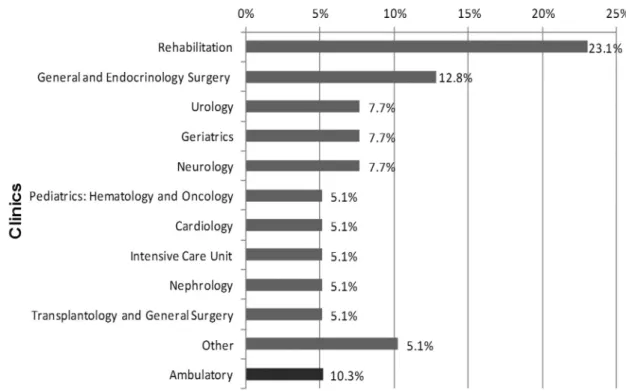
strains was derived from the specimens of the patients treated in the Rehabilitation (9; 23.0%) and General and En-docrinology Surgery 5 (12.8%) Clinics (Figure 1).
Identification of the strains was conducted using one of the following tests: API 20E/ID32E (BioMérieux) or VITEK GN cards (BioMérieux) according to the manufac-turers’ recommendations. Strains were stored in a brain-heart infusion (Becton Dickinson) with 20.0% glycerol (POCH) at -70 °C.
Quantitative evaluation of biofilm formation
Biofilm was formed in the wells of the 96-wells poly-styrene titer plates and investigated with two quantitative methods. Absorbance values of two dyes: crystal violet (CV; POCH) and formazan (product of the 2,3,5-triphe-nyl-tetrazolium chloride dissolution, TTC; POCH) were in-vestigated at the same time.Staphylococcus aureusATCC 6538P (very strongly biofilm forming strain) and E. coli
ATCC 35218 (weakly biofilm forming strain) reference strains served as controls.
The examined strains ofP. mirabiliswere plated on the cysteine lactose electrolyte deficient medium (CLED; Becton Dickinson) while the reference strains on 5.0% sheep blood agar (Becton Dickinson). Strains were cultured at 37 °C for 18 h. Next, the single colonies were inoculated into tryptic soy bullion (Bio-Rad). After 18 h at 37 °C, each culture was centrifuged for 15 min at 4000 rpm, and the supernatant was discarded. The remaining pellet was rinsed with 3 mL of phosphate buffered saline solution (pH = 7.2) (PBS; POCH). Next, the bacterial suspension was centri-fuged at 4000 rpm for 10 min and the pellet was used to make the suspension of 0.5 MacFarland turbidity in TSB. Then, 20mL of every suspension was placed in the wells of polystyrene 96-well plate, in four repetitions each. The wells were filled with 180mL of a sterile TSB medium. A sterility control was made of 200 mL TSB medium in at least four repetitions. The culture was incubated in a humid chamber at 37 °C for 24 h.
CV-based assay
metha-nol was removed and the plates left to dry at 37 °C for 20 min. In the next step, 200mL of 0.1% CV were added to each well and the plates were placed on a shaker at 400 rpm for 10 min at room temperature. Next, the CV was removed by rinsing the wells with water thoroughly until the control wells became colorless. The plates were left for 20 min at 37 °C for the water to evaporate. Finally, 200mL of metha-nol were added to each well and left on a shaker for 5 min at 400 rpm and room temperature.
TTC-based assay
After 24-h incubation, the solutions were removed and the wells rinsed tree times with sterile PBS. Next, 100mL of TSB and 100mL of 0.1% TTC were added to each well. The plates were placed on a shaker at 400 rpm for 5 min at room temperature. Next, the plates were placed in 37 °C. After 2-h incubation, the TTC was removed and plates were rinsed tree times with sterile PBS. Finally, 200mL of methanol were added to each well and left on a shaker at 400 rpm for 5 min at room temperature.
Absorbance measurement
Absorbance (A) read-outs were conducted with a spectrophotometer at the wavelength of 570 and 470 nm for CV and TTC, respectively using KC4 v3.4 and KC4 Signa-ture programs. To assess biofilm forming for each strain and negative control, the arithmetic mean of absorbance and standard deviation were used. The threshold value of absorbance (T) was proof of the biofilm formation and was
defined as the sum of the arithmetic mean of negative con-trol and a triple value of its standard deviation (T =xnc+ 3d)
(Table 1).
Qualitative methods for biofilm detection
Qualitative methods for biofilm detection were ap-plied for biofilm evaluation on the polyvinyl chloride sur-face of the urinary catheter (Nelaton, Unomedical).
Single colonies of each of the examined strains from the bacteria cultures on CLED and 5.0% sheep blood me-dium (control strains) were inoculated into 2 mL TSB. 1-cm long sterile catheter fragments were added to the sus-pensions and incubated for 22 h at 37 °C for TTC or 24 h for CV assay.
For the TTC dissolution intensity 20mL of 0.5% TTC were added to the wells with 22-h cultures and additionally incubated for two hours at 37 °C. Next, the catheter frag-ments were rinsed three times in PBS and biofilm forma-Figure 1- Origin of the examinedP. mirabilisstrains (n = 39). Other: Palliative Care Unit, Endocrinology and Diabetology Clinic, Stroke Unit, Rehabili-tation in Orthopedics.
Table 1- P. mirabilisstrains biofilm forming intensity criteria with re-spect to the measured absorbance (A) value.
Absorbance value Biofilm intensity
A£T Lack
T<A£2T Weak
2T<A£4T Moderate
4T< A £8T Strong
tion was estimated visually in terms of the obtained colour intensity (Figure 2A).
For the CV assay the biomaterial fragments, previ-ously incubated and covered with 24-h biofilm, were mo-ved to Petri dishes filled with CV. After 5 min of staining, biomaterial were washed with water and visually evaluated in terms of biofilm forming intensity (Figure 2B).
Statistical analysis
Statistical analysis was conducted using the StatSoft Inc. (2011)STATISTICA 10.0program (data analysis soft-ware system) and Microsoft Office Excel 2007 with differ-ences at p£0.05 considered as statistically significant. The obtained results normality was evaluated with Shapiro-Wilk test. Non-parametric Wilcoxon test was applied to compare differences obtained for the same strains while the comparison of the differences in the results observed be-tween groups was evaluated with chi2 and U Mann-Whitney’s tests.
Results
Quantitative evaluation of biofilm formation
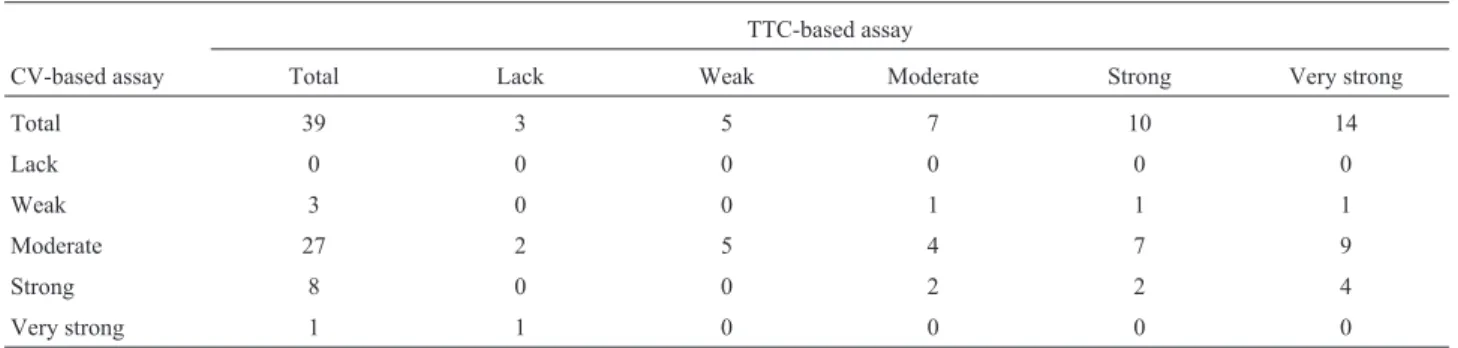
CV assay results revealed ability of all of the strains tested to form biofilm, while in the TTC assay - 36 (92.3%) of the strains studied (Table 2). Three of the strains that did not form biofilm while quantitative results interpretation was applied, were confirmed as moderate and strong bio-film producers - 1 (2.6%) and 2 (5.1%), respectively when qualitative evaluation was done.
Higher percentage (35.9%) of the strains with the ability to form biofilm very strongly was noted for quantita-tive interpretation of the TTC assay was applied when com-pared to the CV assay (2.5%). The results obtained using CV indicated the highest percentage (69.0%) of the
P. mirabilisstrains with ability to form biofilm moderately (Table 2).
Statistically important difference (p = 0.0003) was observed inP. mirabilisbiofilm formation intensity evalu-ated by two independent quantitative methods.
Qualitative evaluation of biofilm formation
Applying qualitative methods for interpretation of
P. mirabilisability to form biofilmin vitro, all of the exam-ined strains were interpreted as biofilm producers. Higher percentage (64.1%) of the strains interpreted as strong biofilm producers was obtained applying TTC method. Using CV assay predominantly, moderate ability to form biofilm was detected (48.7%). Amongst the strains inter-preted as strong biofilm producers using TTC assay, 7 were confirmed as weak biofilm producer when CV assay was applied (Table 3).
Statistically significant difference (p = 0.0022) was observed inP. mirabilisbiofilm formation intensity evalua-tion by two independent qualitative methods.
Relation between the results of the qualitative and quantitative methods applied
Applying TTC assay only qualitative interpretation revealed the ability to form biofilm by all examined
P. mirabilis strains and domination of the isolates with strong biofilm forming ability (64.1%) (Table 4). Mean-while, in the quantitative methodP. mirabilisstrains with very strong biofilm forming ability accounted for 35.9% of the all tested strains (Table 4).
Figure 2- Criteria of the biofilm formation ability evaluation established for qualitative TTC- (A) and CV-based (B) method.
Table 2-P. mirabilisstrains biofilm forming intensity evaluation with respect to the applied quantitative methods.
TTC-based assay
CV-based assay Total Lack Weak Moderate Strong Very strong
Total 39 3 5 7 10 14
Lack 0 0 0 0 0 0
Weak 3 0 0 1 1 1
Moderate 27 2 5 4 7 9
Strong 8 0 0 2 2 4
Very strong 1 1 0 0 0 0
CV - crystal violet.
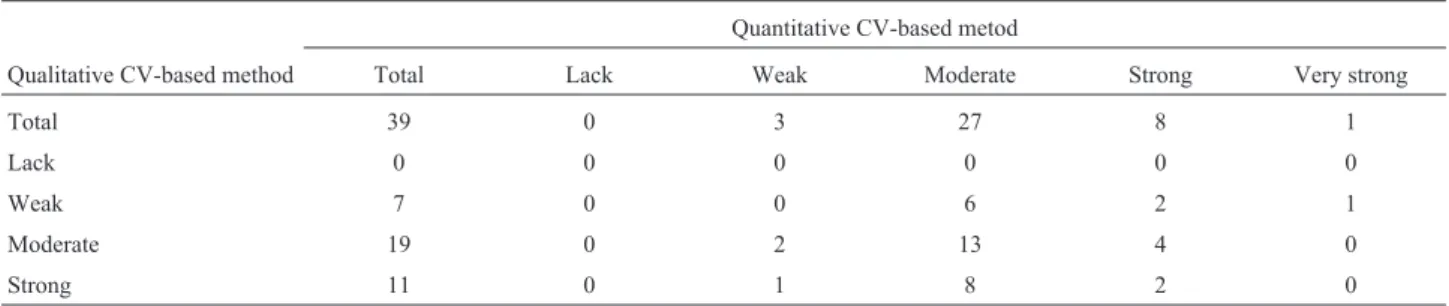
Using both evaluation methods types and CV assay, only oneP. mirabilisstrains (2.5%) was detected to form biofilm very strongly (Table 5) in quantitative estimation. Higher percentage (69.2%) of the strains in this case was classified as moderate biofilm producers. Applying qualita-tive method, moderate ability to form biofilm was detected amongst the highest percentage (48.7%) of the strains ex-amined (Table 5).
Comparison of the urine-derivedP. mirabilisstrains ability to form biofilm with respect to catheterization of the patients
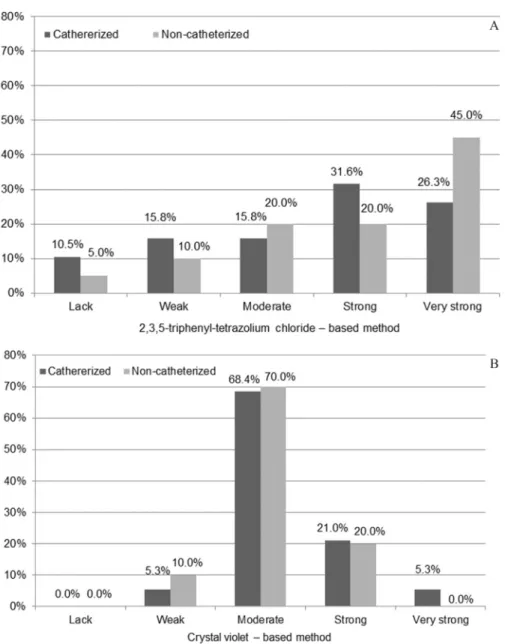
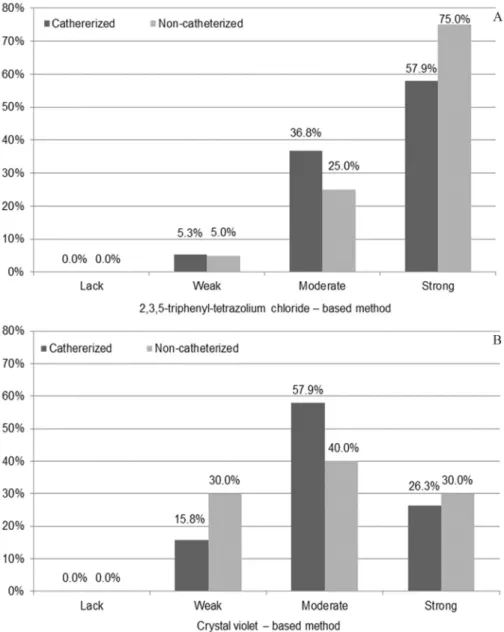
Regardless of the applied quantitative or qualitative methods for the ability to form biofilm investigation by urine-derivedP. mirabilisstrains isolated from non- and catheterized patients none statistically significant
differ-ences were observed (p > 0.05) between patients groups (Figures 3 and 4).
Discussion
Biofilm formation on the surfaces of material of med-ical devices is unquestionably critmed-ical therapeutic problem of the current medicine. This phenomenon forP. mirabilis
is particularly common and linked to clinical complications due to crystalized biofilm type. Urinary tract catheteri-zation facilitates bacteria growth in the favourable condi-tions of biofilm structure. Because of that, proper detection of bacteria ability to form biofilm seems to be crucial aspect of medical investigation.
Mahdaviet al.(2007) during the evaluation of differ-ent nisin concdiffer-entration on biofilm forming by pathogenic
Table 3-P. mirabilisstrains biofilm forming intensity comparison, evaluated on the polyvinyl chloride surface, with respect to the applied qualitative method.
TTC-based assay
CV-based assay Total Lack Weak Moderate Strong
Total 39 0 2 12 25
Lack 0 0 0 0 0
Weak 9 0 0 2 7
Moderate 19 0 2 8 9
Strong 11 0 0 2 9
CV - crystal violet.
TTC - 2,3,5-triphenyl-tetrazolium chloride.
Table 4-P. mirabilisstrains biofilm forming intensity comparison, obtained with quantitative and qualitative TTC-based method.
Quantitative TTC-based metod
Qualitative TTC-based method Total Lack Weak Moderate Strong Very strong
Total 39 3 5 7 10 14
Lack 0 0 0 0 0 0
Weak 2 0 0 0 2 0
Moderate 12 1 1 2 1 7
Strong 25 2 4 5 7 7
TTC - 2,3,5-triphenyl-tetrazolium chloride.
Table 5-P. mirabilisstrains biofilm forming intensity comparison, obtained with quantitative and qualitative CV-based method.
Quantitative CV-based metod
Qualitative CV-based method Total Lack Weak Moderate Strong Very strong
Total 39 0 3 27 8 1
Lack 0 0 0 0 0 0
Weak 7 0 0 6 2 1
Moderate 19 0 2 13 4 0
Strong 11 0 1 8 2 0
Salmonella Enteritidis, S. aureus and Listeria monocytogenesbacteria concluded that CV-based method is a quick screening technique with high sensitivity. How-ever, CV is suitable for biofilm structure size detection but not for its activity estimation. Korenováet al.(2008) evalu-ated biofilm developed by Pseudomonas aeruginosa,
Staphylococcus saprophyticus,S. aureusandE. colistrains derived from food processing factories in Slovakia. They recommend CV application for quantitative biofilm form-ing estimation, regardless of cells viability due to its ability to stain both, alive and death bacterial cells. It also indicates CV uselessness for biofilm activity evaluation, mentioned in Mahdaviet al.(2007) study. Korenováet al.(2008) re-sults highlighted also CV-based method tendency to over-rate biofilm formation level by bacterial strains producing
extracellular polysaccharides as a disadvantage but on the other hand advantages of its high reproducibility due to ap-plication in many laboratories worldwide, low cost of the dye and rather common instruments for the results read-out. This technique belongs to one of the most popular (Ali, 2012; Balasubramanianet al., 2012; Estebanet al., 2010; Etemadifar and Emtiazi, 2008; Hassanet al., 2011; Khanet al., 2011; Wasfiet al., 2012) and is considered highly opti-mized. The quantitative method described by Christensen
et al. (1985) is believed as gold standard amongst other biofilm detection methods.
activity evaluation forRhodococcusspp.R1 derived from petrol-polluted soil.
Based on the results presented in the current study it is concluded that quantitative CV-based absorbance allows for detection of higher percentage of biofilm-forming strains (100%) when compared to TTCbased counterpart -36 (92.3%) strains. The discrepancies observed in biofilm formation intensity in the study presented might be due to differences in procedures applied. In the available literature there is a lack of information on simultaneous evaluation of biofilm formation by the same group ofP.mirabilisstrains and applying TTC- and CV-based absorbance. In the study presented, additional urine-derived P. mirabilis strains ability to form biofilm on the surface of Nelaton catheter fragments was also detectedin vitroby applying two simul-taneous visual qualitative methods with TTC and CV. The
in vivo biofilm forming by Staphylococcus spp.,
Enterococcusspp.,EnterobacteriaceaeandPseudomonas aeruginosa strains was detected. Rózalska et al. (1998) highlight that TTC reduction effect appears as shortly as af-ter 1-h incubation and increases with time. Moreover, Reslinskiet al.(2010) indicate also sensitivity of TTC re-duction-based method, exceeding classic culture methods. It allows for biofilm detection without necessity of its sepa-ration from the implant surface and bacteria detection on the biomaterial surface even when the bacteria number is below detectable level when cultured techniques are ap-plied. Rózalskaet al. (1998) and Reslinski et al. (2008) studies proved similar metabolism of TTC by the bio-material-attaching bacterial cells, regardless of biomaterial type, shape and colour. It was also concluded that the formazan accumulation by bacteria does not influence fur-ther diagnostic steps. Additional aspect of the method is its doubtless simplicity to perform. Similarly, in the results of the current study none red staining of the sterile biomaterial fragments submerged in TTC-supplemented medium was observed. The results obtained by Rózalskaet al.(1998) and Wolska and Jakubczak (2003) as well as results of the study presented confirm the usefulness of the applied method for biofilm formation estimation on the surfaces of biomaterials. According to Reslinskiet al.(2010) study re-sults, sensitivity of the visual method applying TTC may decrease number of false negative results in biofilm detec-tion. It was confirmed in the results of the current study. Theability of all examined P. mirabilis strains to form biofilm directly on the surface of Nelaton catheter frag-ments was confirmed. On the contrary to quantitative method with TTC- biofilm formation ability was observed for 92.3% of the strains tested, and additionally needed for earlier bacterial strains culture. On the other hand, its inter-pretation depends on visual observation and the possible differences or mistakes result from subjectivity of the re-searcher. Apart from the studies mentioned above, it was also applied by us in the previous work by Kwiecinska-Piróg et al. (2011) and by Bartoszewicz and Secewicz (2008) for biofilm detection on the surface of urinary cathe-ters.
CV-based method for biofilm forming detection with visual interpretation is significantly less common. The re-sults of the present study, confirming ability of all of the ex-amined bacterial strains to form biofilm, are consistent with those obtained when Richards’ method was applied. The highest percentage (48.7%) of the tested strains was classi-fied as moderate biofilm producers. In the Ali (2012) work biofilm formation by the incrustated urinary catheters-derivedP. mirabilisstrains was evaluated with both, quali-tative and quantiquali-tative methods with CV. It was concluded thatP. mirabilisstrains display high ability to form biofilm on the urinary catheters as well as in the 96-wells of the polystyrene titter plates (Ali, 2012).
In the study presented,P. mirabilis ability to form biofilmin vitro was confirmed for urine isolates derived from catheterized patients as well as physiologically ob-tained samples. In the Stickleret al.(2006) study of biofilm formation 20 long-term catheterized patients-derived urine samples served as material for bacterial isolation.
P. mirabilisrods infection was confirmed for 15 patients. The catheters that the P. mirabilis strains were isolated from, displayed incrustation and urine flow blockage. Also other authors (Ali, 2012; Balasubramanian et al., 2012) evaluated in vitro P. mirabilisbiofilm formation by the strains isolated from the urine of the catheterized patients. In all of themP. mirabilisbiofilm was observed and accom-panied bycatheter incrustation and obstruction.
In the available literature none information on simul-taneous studies on detection of biofilm formed by P. mirabilis strains derived from non- and catheterized pa-tients has been found. In the study of Abdallahet al.(2011), 43.3% of the uropathogenic strains of e.g. E. coli,
Klebsiellaspp.,S. aureusand coagulase-negative staphylo-cocci derived from the urine of the catheterized patients displayed ability to form biofilm while for non-catheterized patients’ urine-isolated strainse.g. Enterococcusspp. and
Pseudomonasspp. the corresponding value was 30%. The comparable results of the biofilm formation were also ob-tained by Wattset al.(2010) whileE. coliisolates derived from non- and catheterized patients urine samples were in-vestigated. In both (Abdallah et al., 2011; Watts et al., 2010) studies mentioned above none statistically signifi-cant differences in the obtained results were found in terms of patients catheterization groups. The results of the present study are in concordance with them.
To summarize,P. mirabilisstrains generally display ability to form biofilm. Its intensity depends on particular strain properties and the accuracy of the detection method applied. Quantitative method with 2,3,5-triphenyl-tetra-zolium chloride (TTC) allows for wider discrimination of the strains in terms of biofilm intensity when compared to quantitative crystal violet-based (CV) assay. Applying qualitative method with 2,3,5-triphenyl-tetrazolium chlo-ride (TTC), higher percentage of the examined strains is classified as strong biofilm producers when compared to crystal violet (CV) the assay.Proteus mirabilisstrains iso-lated from the urine derived from non- and catheterized pa-tients form biofilm at the comparable level.
Acknowledgments
References
Abdallah NMA, Elsayed SB, Yassin MM, gohary M, El-gohary GM (2011) Biofilm forming bacteria isolated from urinary tract infection relation to catherization and suscepti-bility to antibiotics. Int J Biotechnol Mol Biol Res 2:172-178.
Ali OAU (2012) Prevention of Proteus mirabilis Biofilm by Sur-factant Solution. Egypt Acad J of Biol Sci 4:1-8.
Balasubramanian A, Chairman K, Ranjit Singh AJA, Alagumuthu G (2012) Isolation and identification of microbes from bio-film of urinary catheters and antimicrobial susceptibility evaluation. Asian Pac J Trop Biomed 2:1780-S1783. Bartoszewicz M, Rygiel A (2006) Biofilm jako podstawowy
me-chanizm zakazenia miejsca operowanego-metody prewencji w leczeniu miejscowym. Chir Pol 8:171-178.
Bartoszewicz M, Secewicz A (2008) Biofilm w zakazeniach odcewnikowych ukladu moczowego-etiologia i metody prewencji”. Przegl Urol 9:43-45.
Christensen GD, Simpson WA, Younger JA, Baddour LM, Barrett FF, Melton DM, Beachey EH (1985)Adherence of cogulase negativeStaphylococito plastic tissue cultures: a quantitative model for the adherence ofStaphylococcito medical devices. Clin Microbiol 22:996-1006.
Czaczyk K, Myszka K (2007) Mechanizmy warunkujace opor-nosæ biofilmów bakteryjnych na czynniki antymi-krobiologiczne. Biotechnologia 76:40-52.
Drzewiecka D, Sidorczyk Z (2005) Charakterystyka gatunku Pro-teus penneri -warunkowych patogenów czlowieka”. Post Mikrob 44:113-126.
Dubiel G, Dziublewska B, Zaloudik E (2011) Analiza wyników posiewów krwi pacjentów specjalistycznego zespolu chorób pluc i grulicy w Bystrej w latach 2008-2010. Prz Epidemiol 65:447-450.
Esteban J, Molina-Manso D, Spiliopoulou I, Cordero-Ampuero J, Fernández-Roblas R, Foka A , Gómez-Barrena E (2010) Biofilm development by clinical isolates ofStaphylococcus
spp. from retrieved orthopedic prostheses. Acta Orthop 81:674-679.
Etemadifar Z and Emtiazi G (2008) Microtitre plate assay for biofilm formation, production and utilization of hydroxy-biphenyl by Rhodococcus sp. isolated from gasoline-contaminated soil. J Biosciences 63:599-604.
Hassan A, Usman J, Kaleem F, Omair M, Khalid A, Iqbal M (2011) Evaluation of different detection methods of biofilm formation in the clinical isolates. Braz J Infect Dis 15:305-311.
Hola V, Peroutkova T, Ruzicka F (2012) Virulence factors in Pro-teus bacteria from biofilm communities of catheter-associated urinary tract infections. FEMS Immunol Med Microbiol 65:343-349.
Jacobsen SM, Shirtliff ME (2011)Proteus mirabilisbiofilms and catheter-associated urinary tract infections. Virulence 2:460-465.
Jones SM, Yerly J, Hu Y, Ceri H, Martinuzzi R (2007), Structure ofProteus mirabilisbiofilms grown in artificial urine and standard laboratory media. FEMS Microbiol Lett 268:16-21.
Khan F, Shukla I, Rizvi M, Mansoor T, Sharma SC (2011), Detec-tion of biofilm formaDetec-tion inStaphylococcus aureus. Does it have a role in treatment of MRSA infections?. Trends Med Res 6:116-123.
Kolwzan B (2011) Analiza zjawiska biofilmu - warunki jego powstawania i funkcjonowania. Ochr Sr 33:3-14.
Korenová J, Lopasovská J, Kuchta T (2008) Comparison of three microtitre plate-based methods for quantification of biofilm formation ability of bacteria contaminating food technolo-gies. J Food Nutr Res 47:100-104.
Kwiecinska-Piróg J, Bogiel T, Gospodarek E (2011) Porównanie dwiema metodami tworzenia biofilmu przez paleczki Pro-teus mirabilisna powierzchni róznych biomaterialów, Med Dosw 63:131-138.
Liu D (ed.) (2011) Molecular Detection of Human Bacterial Pathogens. CRC Press.
Mahdavi M, Jalali M, Kermanshahi RK (2007) The effect of nisin on biofilm forming foodborne bacteria using microtiter plate method. Res Pharm Sci 2:113-118.
Mobley HLT, Belas R (1995) Swarming and pathogenicity of
Proteus mirabilis in the urinary tract. Trends Microbiol 3:280-284.
O’Toole G, Kaplan HB, Kolter R (2000), Biofilm formation as microbial development. Annu Rev Microbiol 54:49-79. Reslinski A, Mikucka A, Szczesny W, Szmytkowski J,
Gospo-darek E, Dabrowiecki S (2008) Wykrywanie biofilmuin vivona powierzchni siatki chirurgicznej. Chir Pol 10:181-188.
Reslinski A, Mikucka A, Szmytkowski J, Glowacka K, Szczesny W, Gospodarek E, Dabrowiecki S (2010) Biofilm detection on the surface of hernia mesh implants. Adv Clin Exp Med 19:685-690.
Rózalska B, Sadowska B, Wieckowska M and Rudnicka W (1998) Wykrywanie biofilmu bakteryjnego na biomate-rialach medycznych. Med Dosw 50:115-122.
Rózalski A, Kwil I, Torzewska A, Baranowska M and Straczek P (2007), Bakterie z rodzaju Proteus - cechy i czynniki chorobotwórczosci. Post Hig 61:204-219.
Stickler DJ, Jones SM, Adusei GO, Waters MG, Cloete J, Mathur S, Feneley RCL (2006) A clinical assessment of the perfor-mance of a sensor to detect crystalline biofilm formation on indwelling bladder catheters. BJU International 98:1244-1249.
Szewczyk EM (ed) (2006) Diagnostyka bakteriologiczna. Wydawnictwo Naukowe PWN, Warszawa.
Wasfi R, Abd El-Rahman OA, Mansour LE, Hanora AS, Hashem AM, Ashour MS (2012) Antimicrobial activities against biofilm formed byProteus mirabilisisolates from wound and urinary tract infections. Indian J Med Microbi 30:76-80. Watts RE, Hancock V, Ong C-LY, Vejborg RM, Mabbett AN,
Totsika M, Looke DF, Nimmo GR, Klemm P, Schembri MA (2010) Escherichia coli isolates causing asymptomatic bacteriuria in catherized and noncatherized individuals pos-sess similar virulence properties. J Clin Microbiol 48:2449-2458.
Wolska K, Jakubczak A (2003) Wykrywanie biofilmu Pseudomo-nas aeruginosana biomaterialach medycznych. Med Dosw 55:371-378.