589 589 589 589 589 Mem Inst Oswaldo Cruz, Rio de Janeiro, Vol. 93(5): 589-594, Sep./Oct. 1998
Molecular Genetic Analysis of Multi-drug Resistance in
Indian Isolates of
Mycobacterium tuberculosis
Noman Siddiqi/
++, Md. Shamim/
++, NK Jain*, Ashok Rattan**, Amol Amin,
VM Katoch***, SK Sharma****, Seyed E Hasnain/
+National Institute of Immunology, New Delhi, 110067, India *New Delhi T.B. Centre, New Delhi, India **De-partment of Microbiology, A.I.I.M.S., New Delhi, India ***Central Jalma Institute of Leprosy, Agra, India
****Department of Medicine, A.I.I.M.S., New Delhi, India
A total of 116 isolates from patients attending the out-patient department at the All India Institute of Medical Sciences, New Delhi and the New Delhi Tuberculosis Centre, New Delhi, India were collected. They were analyzed for resistance to drugs prescribed in the treatment for tuberculosis. The drug resis-tance was initially determined by microbiological techniques. The Bactec 460TB system was employed to determine the type and level of resistance in each isolate. The isolates were further characterized at molecular level. The multi-drug loci corresponding to rpo b, gyr A, kat G were studied for mutation(s) by the polymerase chain reaction-single strand conformational polymorphism (PCR-SSCP) technique. The SSCP positive samples were sequenced to characterize the mutations in rpo b, and gyr A loci. While previously reported mutations in the gyr A and rpo bloci were found to be present, several novel mutations were also scored in the rpo b locus.
Interestingly, analysis of the gyr A locus showed the presence of point mutation(s) that could not be detected by PCR-SSCP. Furthermore, rifampicin resistance was found to be an important marker for checking multi-drug resistance (MDR) in clinical isolates of Mycobacterium tuberculosis. This is the first report on molecular genetic analysis of MDR tuberculosis from India, and highlights the increasing incidence of MDR in the Indian isolates of M. tuberculosis.
Key words: clinical isolates - gyrA gene - multi-drug resistance - Mycobacterium tuberculosis - rpo b gene -polymerase chain reaction-single strand conformational polymorphism
Until recently, the common belief held that tu-berculosis (TB) no longer posed a major threat to public health, at least in developed countries. How-ever due to various reasons there is an increasing incidence of TB leading to high morbidity and mor-tality rates (Bloom & Murray 1992). Furthermore, the association of TB with the AIDS pandemic leading to increase in fatality rates and emergence of multi-drug resistant (MDR) strains of Mycobac-terium tuberculosis is a cause of grave concern worldwide (Iseman 1994).
Resistance to rifampicin, isoniazid and fluoroquinolones have been well studied and char-acterized at the molecular level (Honore & Cole
1993, Heym et al. 1993, Miller 1994, Takiff et al. 1994). Rifampicin resistance arises due to muta-tions in rpob gene encoding the DNA-dependent
RNA polymerase. The primary target of rifampi-cin is the b-subunit of RNA polymerase. The
as-sociation of the RNA polymerase b (rpob)
sub-unit gene with resistance to rifampicin has been documented previously and subsequent reports from various groups have confirmed this associa-tion in clinical isolates of M. tuberculosis (Kapur et al. 1994, Williams et al. 1994, Musser 1995, Hasnain et al. 1998). Most of the mutations have been mapped to the 27 codons located at the cen-ter of rpob gene that is known to bear mutations
that confer rifampicin resistance in Escherichia coli. Many of the reported mutations are missense with a few cases of insertions and deletions also (Telenti et al. 1993a, b). Resistance to rifampicin is a relatively rare event and leads to selection of mutants that are already resistant to other compo-nents of short-course chemotherapy. Therefore, rifampicin resistance is often regarded as an ex-cellent surrogate marker for MDR-TB (CDC 1993). Isoniazid acts as the prodrug which is converted to an active form (isonicotinic acid or
aldehyde-This project was supported by a grant from the Depart-ment of Biotechnology, Ministry of Science and Tech-nology, India.
+Corresponding author. Fax: +9111-616.2125. E-mail:
++Both authors contributed equally.
590 590 590 590
590 MDR-M.tb in India Noman Siddiqi et al.
bearing groups or free radicals) by the kat G-en-coded catalase-peroxidase enzyme in M. tubercu-losis. Isoniazid resistance is due to conversion of Arg463 to Leu in the kat G protein (Heym et al. 1993, 1994). The second mechanism, conferring low level resistance, is mutation in the inh A gene which encodes fatty acid synthase. This enzyme requires NADH as a cofactor; the mutant enzyme has been shown to have a lower affinity for NADH and cannot be saturated at NADH concentrations existing within M. tuberculosis (Johnsson & Schultz 1994).
The target of fluoroquinolones action is the DNA gyrase, an ATP-dependent type II DNA topoisomerase that catalyses the negative super-coiling of DNA. This enzyme is made up of four units (a2b2), which are encoded by the gyrA and
gyrB genes respectively. Fluoroquinolones bind to the gyrase and inhibit the supercoiling of DNA. The gyrA and gyrB genes of M. tuberculosis have been cloned and mutations in the quinolone-bind-ing site have been mapped (Takiff et al. 1994).
The present study represents the first report of molecular genetic analysis of clinical isolates of MDR M. tuberculosis from India. While associa-tion of rifampicin resistance with MDR is evident, we also demonstrate the utility of polymerase chain reaction-single strand conformational polymor-phism (PCR-SSCP) for rapidly scoring mutations within the rpob locus. Sequence analysis of the rpob and gyrA loci shows that the more common
missense mutations are also prevalent in the In-dian isolates. This study reaffirms the growing in-cidence of MDR-TB in India.
MATERIALS AND METHODS
Clinical isolates of M. tuberculosis were pro-cured from TB patients attending the out-patient departments at the All India Institute of Medical Sciences and the New Delhi Tuberculosis Center, New Delhi, India. Susceptibility testing of all the
M. tuberculosis isolates was done by Bactec 460TB system. Minimum inhibitory concentration (MIC) was defined as the lowest drug concentration that inhibited bacterial growth by at least 99%.
DNA was extracted from clinical isolates grown on LJ slants. The colonies were scraped, suspended in TE and subjected to freeze thawing (30 min at -70°C to 100°C for 10 min). This was followed by treatment with lysozyme (40 mg/ml), SDS (0.5%)
and proteinase K (50 mg/ml) at 37C for 2 hr. The
protein and other contaminants were removed by CTAB precipitation. DNA was finally precipitated with 0.6 volumes of isopropanol. The precipitate was washed twice with 70% ethanol, air dried and re-dissolved in water.
PCR was performed using 150 pmoles of each primer with 1 U of Taq polymerase (Bangalore Genei, India), 200 mmoles of each dNTPs and 1.5
mM magnesium chloride. Mutations in the rpob
gene, conferring rifampicin resistance were de-tected with previously reported forward (5 TAC GGT CGG CGA GCT GAT CC 3) and reverse (5 TAC GGC GTT TCG ATG ATG AAC 3) primers. 250 mg of template was amplified in 30 cycles in
Perkin Elmer Cetus thermal cycler using the fol-lowing conditions: 94°C-1min; 56°C-1min; 72°C-2min. The 350 bp rpob amplicon was checked by
electrophoresis on a 1.5% agarose gel.
Similar conditions were used for amplification of the kat G genes mutational hot spot region us-ing forward (5 GCC CGA GCA ACA CCC 3) and reverse (5 ATG TCC CGC GTC AGG 3) prim-ers.
Sixteen isolates resistant to ofloxacin were checked for mutations in gyrA. For gyrA amplifi-cation the primers used were 5 CAG CTA CAT CGA CTA TGC GA 3 and 5 GGG CTT CGG TGT ACC TCA T 3. The PCR amplification conditions were similar to that of rpob gene amplification
except that the annealing temperature was 45°C. The amplicons were purified using Qiaquick PCR purification kit (Qiagen, USA). Samples were ini-tially analyzed for SSCP. Briefly, the samples were heat denatured and electrophoresed on a compos-ite gel (0.25% agarose, 5% acrylamide and 5% glycerol). The gel was then silver stained (BioRad Silver stain Kit) and the DNA bands visualized. A change in the banding pattern as compared to the wild type H37Rv strain was taken as indicative of mutation(s).
Cycle sequencing was performed following the manufacturers protocol using the cyclist Pfu Exo-kit (Stratagene, USA).The forward primers of rpo b and gyr A were used to sequence the SSCP
posi-tive samples. The 81 bp and 30 bp sequence corre-sponding to the hot spot region of the rpob and gyrA respectively, were read and compared with the respective sequences of standard H37Rv strain.
RESULTS
The MDR data for the 116 clinical isolates is shown in Table I. A majority of the strains (69%) turned out to be resistant to at least one drug. It is important to mention at the outset that this study has a sampling bias in terms of the drug resistance cases and does not represent the observed fre-quency of the occurence of drug resistance (~13%) in Indian clinical isolates of M. tuberculosis
591 591591 591591 Mem Inst Oswaldo Cruz, Rio de Janeiro, Vol. 93(5), Sep./Oct. 1998
closely followed by rifampicin (53%). The num-ber of isolates resistance to the rest of the drugs was lesser (about 25% for ethambutol and strepto-mycin) and was least in case of fluoroquinolones. This data corelates well with the treatment regime followed in the TB clinics in India where fluoroquinolones represent the last line of drugs (Pande 1998). We observed that 58 isolates out of 62 positive for rifampicin resistance, were also re-sistant to atleast one other drug. Therefore, a ma-jority (93%) of the rifampicin resistant strains showed an association with resistance to other drugs thereby supporting earlier observations (Kapur et al. 1994, Williams et al. 1994, Musser 1995, Hasnain et al. 1998) on rifampicin as a sur-rogate marker for multidrug resistance.
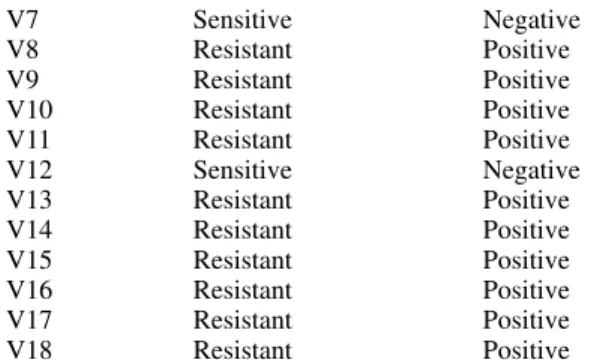
The principle of PCR-SSCP is based on the fact that the two denatured strands of DNA (in this case PCR-amplified) adopt stable intramolecular con-formations which may differ from the wild type upon mutation. This causes a change in the elec-trophoretic mobility of the strands. We utilized SSCP to conduct a primary screening of the rpob, kat G and gyr A amplicons for the presence of mutations. The results of SSCP analysis reveal that while most of the rifampicin resistant strains did exhibit the expected mobility shifts correlating with point mutations, a very large percentage of isolates resistant to fluoroquinolone and carrying point mu-tations (revealed upon sequencing), however did not display altered electrophoretic mobility. The results of SSCP analysis of rpob amplicons for
few isolates are summarized in Table II. Some typi-cal SSCP gel electrophoresis patterns correspond-ing to the rpob(Fig. 1a), kat G (Fig. 1b) or gyrA
amplicons (Fig. 1c) are represented.
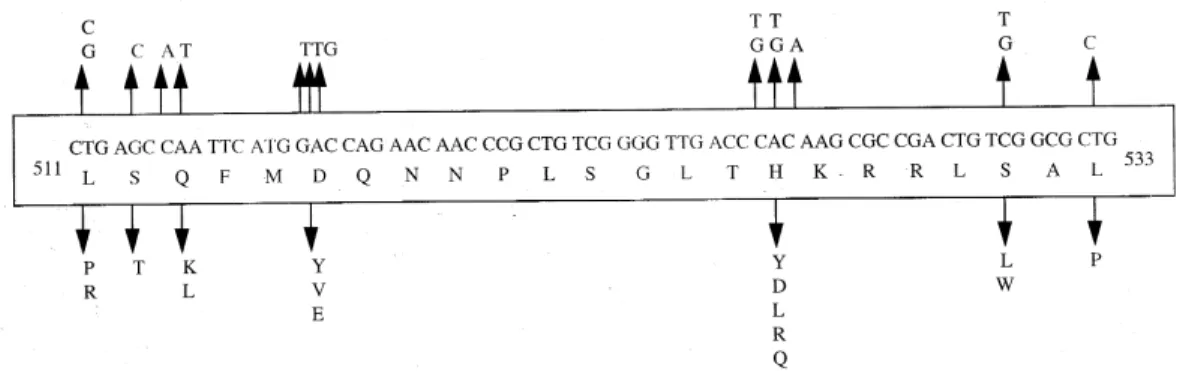
The precise mutations within the drug resistant loci were identified by direct sequencing of the amplified regions. Sequence analysis (Fig. 2) of the rpob gene hotspot for the rifampicin resistant
isolates revealed the presence of many of the com-mon mutations reported earlier ( Kapur et al. 1994) in addition to several novel mutations (data not
shown). Mutations in the gyr A gene, however were only of the types already reported earlier (Takiff et al. 1994 ). The S95T and A90V mutations were the two more common mutations within the Indian isolates of quinolone resistant M. tuberculosis. The amino acid changes caused by the corresponding point mutations in the DNA within the gyrA loci are shown in Fig. 3.
Fig. 1a: PCR-SSCP analysis of representative rpo b
amplicons.gel picture of few rpob amplicons. Arrow denotes the shift in bands due to the conformational polymorphism as a result of point mutation. Lanes 3 is the control lane; Fig 1b: typical PCR-SSCP pattern displayed by kat G amplicons. Arrowmark denotes the DNA mobility shift due to the confor-mational polymorphism as a result of point mutation within the kat G locus; Fig. 1c: typical PCR-SSCP gel picture of few mu-tant gyrA amplicons. Arrow mark denotes the DNA mobility shift due to the conformational polymorphism as a result of point mutation within the gyrA locus. Lanes 2 to 8 are amplicons from quinolone resistant strains while lane 1 has the wild type H37Rv strain.
TABLE I
Summary of multi drug resitance in Mycobacterium tuberculosis isolates from Indian patients
Drugs No. of isolates MRD status Samples
Isoniazid 65 1 drug 15 Rifampicin 62 2 drugs 25 Ethambutol 27 3 drugs 20 Streptomycin 25 4 drugs 5 Ofloxacin 16 5 drugs 13
None 38
592 592 592 592
592 MDR-M.tb in India Noman Siddiqi et al.
DISCUSSION
In this study we present molecular genetic analysis of rifampicin, isoniazid and quinolone resistance in Indian clinical isolates of MDR M. tuberculosis. Point mutations within rpob , kat G
and gyrA genes respectively lead to amino acid polymorphism in the target protein of the drug re-sulting in drug resistance (Rattan et al. 1998). MDR does not appear to arise due to the acquisition of a transposable element or a plasmid carrying drug resistant marker, but is perhaps a reflection of stepwise acquisition of new mutations in the genes for different drug targets. Alterations in the chro-mosomal genes are random but get selected due to poor compliance or prescription. Inadequate pre-scription of chemotherapy, poor compliance of the drug regime and in recent times infection with HIV have caused an increase in the selection of MDR strains of M.tuberculosis (Lederberg 1998). A lack of monitoring programs and poor follow up of the patients health has caused an increase in relapse cases for TB. In most cases, the secondary infec-tion is by drug resistant mycobacterium. What is of graver concern is the increasing incidence of primary infection by MDR- Mycobacterium tuber-culosis (Hasnain et al. unpub. data). Patients in-fected with a rifampicin resistant strain of M. tu-berculosis generally have a poor prognosis, par-ticularly because rifampicin resistance is often as-sociated with resistance to other frontline drugs.
We found a majority of the rifampicin resistant Indian isolates to be resistant to at least one an-other anti-tubercular drug, supporting the idea of using rifampicin resistance as a surrogate marker for MDR TB. PCR-SSCP analysis while offering a rapid method for detecting MDR particularly for rifampicin resistance however, has limitations as it failed to detect mutations within the gyrA locus. These results representing a first report on the molecular genetic analysis of MDR in clinical iso-lates of M. tuberculosis from India have important bearing on the management and control of this re-emerging infectious disease.
TABLE II
Susceptibility to rifampicin and polymerase chain reaction-single strand conformational polymophism
(PCR-SSCP) results. ‘?’ mark denotes that these isolates were resistant but were not positive in SSCP
analysis
Isolate no. Rifampicin SSCP analysis sensitivity (>1mg/ml)
C46 Sensitive Negative C49 Resistant Positive C56 Resistant Positive C64 Resistant Positive C68 Sensitive Negative C71 Resistant Negative? C74 Sensitive Negative C78 Resistant Positive C80 Sensitive Negative C93 Sensitive Negative C97 Sensitive Negative
A1 Sensitive Negative
A2 Sensitive Negative
A3 Sensitive Negative
A4 Sensitive Negative
A5 Sensitive Negative
A6 Sensitive Negative
A7 Sensitive Negative
A8 Sensitive Negative
A9 Sensitive Negative
B1 Sensitive Negative
B2 Sensitive Negative
B3 Sensitive Negative
B4 Sensitive Negative
B5 Sensitive Negative
B6 Resistant Positive
B7 Sensitive Negative
F1 Resistant Positive
F2 Resistant Positive
F3 Resistant Positive
F4 Resistant Positive
F5 Resistant Positive
F6 Resistant Positive
F7 Resistant Positive
F8 Resistant Positive
F9 Resistant Positive
D1 Sensitive Negative
D2 Resistant Negative?
D3 Resistant Negative?
D4 Resistant Negative?
D6 Resistant Negative?
D7 Resistant Positive
D9 Resistant Positive
D10 Resistant Positive D11 Resistant Positive D12 Resistant Positive D18 Sensitive Negative
V1 Resistant Positive
V2 Resistant Positive
V3 Resistant Positive
V4 Resistant Positive
V5 Resistant Positive
V6 Resistant Positive
V7 Sensitive Negative
V8 Resistant Positive
V9 Resistant Positive
593 593593 593593 Mem Inst Oswaldo Cruz, Rio de Janeiro, Vol. 93(5), Sep./Oct. 1998
ACKNOWLEDGMENTS
To Mr Sunder Singh Bisht for his help in sequenc-ing and SSCP.
REFERENCES
Bloom BR, Murray JL 1992. Tuberculosis: commen-tary on a reemergent killer. Science 257: 1055-1064. CDC - Centers for Disease Control 1993. Initial therapy for tuberculosis in the era of multi-drug resistance. recommendations of the advisory council for the elimination of tuberculosis. MMWR 42: RR-7. Hasnain SE, Amin A, Siddiqi N, Shamim M, Jain NK,
Rattan A, Katoch VM, Sharma SK 1998. Molecular genetics of multiple drug resistance (MDR) in My-cobacterium tuberculosis, p. 35-40. In RLSinghal & OP Sood (eds), Drug Resistance: Mechanism and Management, Proceedings of the Fourth Annual Ranbaxy Science Foundation Symposium Communicore Publishers, New Delhi, India Heym B, Alzari PM, Honore N, Cole ST 1994.
Mis-sense mutations in the catalase-peroxidase gene, katG, are associated with isoniazid resistance in
Mycobacterium tuberculosis. Mol Microbiol 15: 235-245.
Heym B, Zhang Y, Poulet S, Young D, Cole ST 1993. Characterization of the katG gene encoding a cata-lase-peroxidase required for the isoniazid suscepti-bility of Mycobacterium tuberculosis. J Bacteriol 175: 4255-4259.
Honore N, Cole ST 1993. The molecular basis of rifampin resistance in Mycobacterium leprae. Antimicrob Agents Chemother 37: 414-418.
Fig. 2: common mutations in the rpob gene. Top panel shows the nucleotide changes that are similar to previously reported mutations. The bottom panel depicts the corresponding amino acid changes within the RNA polymerase b subunit.
Fig. 3: mutations within the gyrA gene. The top panel shows the nucleotide change while the bottom panel depicts the corre-sponding amino acid changes. The common mutations in the Indian isolates are depicted in bold letters.
Iseman MD 1994. Evolution of drug-resistant tubercu-losis: A tale of two species. Proc Natl Acad Sci USA 91: 2428-2429.
Johnsson K, Schultz PG 1994. Mechanistic studies of the oxidation of isoniazid by the catalase peroxidase from Mycobacterium tuberculosis. J Am Chem Soc 116: 7425-7426.
Kapur V, Ling Ling LI, Iordanescue S, Krieswirth BN, Musser JM 1994. Characterization by automated DNA sequencing of mutations in the gene (rpo b)
encoding the RNA polymerase bsubunit in rifampin
Mycobacterium tuberculosis strains from New York and Texas. J Clin Microbiol 32: 1095-1098. Lederberg J 1998. The future of infectious disease,
p.5-14. In RLSinghal & OP Sood (eds), Drug Resistance: Mechanism and Management, Proceedings of the Fourth Annual Ranbaxy Science Foundation Sym-posium Communicore Publishers, New Delhi, India. Miller LP, Crawford JT, Shinnick TM 1994. The rpob
gene of Mycobacterium tuberculosis. Antimicrob Agents Chemother 38: 805-811.
Musser JM 1995. Antimicrobial agent resistance in my-cobacteria: molecular genetic insights. Clin Microbiol Rev 8: 496-514.
Pande JN 1998. Multidrug resistant tuberculosis: Cur-rent concepts and future directions for management, p. 87-90. In RLSinghal & OP Sood (eds), Drug Resistance: Mechanism and Management, Proceed-ings of the Fourth Annual Ranbaxy Science Foun-dation Symposium Communicore Publishers, New Delhi, India.
Ramalingaswami V 1998. Opening address, p. 1-3. In RLSinghal & OP Sood (eds), Drug Resistance: Mechanism and Management, Proceedings of the Fourth Annual Ranbaxy Science Foundation Sym-posium Communicore Publishers, New Delhi, India. Rattan A, Kalia A, Ahmad N 1998. Multidrug resistant tuberculosis: Molecular perspectives. Emerg Infec Dis 4: 195-209.
Takiff HE, Salazar L, Guerrero C, Philipp W, Huang WM, Kreiswirth B, Cole ST, Jacobs Jr WR, Telenti A 1994. Cloning and nucleotide sequence of the
594 594 594 594
594 MDR-M.tb in India Noman Siddiqi et al.
Telenti A, Imboden P, Marchesi F, Lowrie D, Cole S, Bodmer T 1993a. Detection of rifampicin-resis-tance mutations in M. tuberculosis. Lancet 341: 647-650.
Telenti A, Imboden P, Marchesi F, Schmidheini T, Bodmer T 1993b. Direct automated detection of rifampicin-resistant Mycobacterium tuberculosis by
polymerase chain reaction and single-strand con-formation polymorphism analysis. Antimicrob Agents Chemother 37: 2054-2058.