Arq Neu ro p siq u iat r 2003;61(4):1023-1025
HEM OPHILIA AND CHILD ABUSE AS
POSSIBLE CAUSES OF EPIDURAL HEM ATOM A
Case rep o rt
Fernando Campos Gomes Pint o
1, Fabrizio Frut os Porro
1, Liliana Suganuma
2,
Ricardo Bragança de Vasconcellos Font es
2, Almir Ferreira de Andrade
3, Raul M arino Jr
4ABSTRACT - Introduction: Head traum a is an im portant consequence of child abuse. Specific pathophysiological m echanism s in child ab use are resp onsib le for the “w hip lash shaken-b ab y synd rom e”, w hich w ould favour the occurrence of intracranial hem orrhages. Case report: We rep ort the case of a child who d evelop ed ep id ural hem atom a follow ing m inor-intensity head traum a. Initial d iag nosis of child ab use w as m ad e, b ut sub seq uent investig ation led to the d iag nosis of hem op hilia A. Conclusion: Even thoug h ep id ural hem atom a is not closely associated w ith child ab use, this aethiolog y m ust alw ays b e consid ered w hen the rep orted traum a m echanism is out of p rop ortion to the m ag nitud e of the encountered lesions.
KEY WORDS: hem op hilia A, child ab use, ep id ural hem atom a.
Hemofilia e abuso infantil como possíveis causas de hematoma extradural: relato de caso
RESUMO - Introdução: Traum atism o crânio-encefálico é im portante conseqüência de abuso infantil. Mecanism os fisiop atológ icos esp ecíficos d o ab uso infantil são resp onsáveis p ela “w hip lash shaken-b ab y synd rom e”, o q ue favoreceria o ap arecim ento d e hem orrag ias intracranianas. Relato de caso: Relatam os o caso d e um a criança q ue d esenvolveu hem atom a extrad ural ap ós traum a d e p eq uena intensid ad e. Foi feito d iag nóstico inicial d e ab uso infantil, m as investig ações sub seq üentes levaram ao d iag nóstico d e hem ofilia A. Conclusão: Em b ora o hem atom a extrad ural não esteja intim am ente relacionad o com ab uso infantil, esta etiolog ia d eve ser sem p re consid erad a q uand o o m ecanism o d e traum a relatad o estiver fora d e p rop orção com as lesões encontrad as.
PALAVRAS-CHAVE: hem ofilia A, ab uso infantil, hem atom a extrad ural.
Neu ro su rg ery Divisio n , Neu ro lo g y an d Neu ro su rg ery Dep art m en t , Un iversit y o f São Pau lo Med ical Sch o o l, São Pau lo SP, Brazil (USP):
1M.D., Resid en t , USP; 2M.D., Lig a d e Neu ro ciru rg ia, USP; 3M.D., Ph .D., Head o f t h e Neu ro su rg ery Em erg en cy Sect io n , USP; 4M.D., Ph .D.,
Head o f t h e Neu ro su rg ery Divisio n , USP.
Received 17 Jan u ary 2003, received in fin al fo rm 23 May 2003. Accep t ed 23 Ju n e 2003.
Dr. Ricardo B. V. Font es - Rua Jandiro Joaquim Pereira 389 - 05658-000 São Paulo SP - Brasil. E-mail: rbvf ont [email protected]
Head t rau m a is t h e m o st freq u en t cau se o f m o r-b id it y an d m o rt alit yin ch ild ren w h o h ave su ffered ab use. Billm ire and Myers1 rep ort that, exclud ing un-co m p licat ed sku ll fract u res, 95% o f serio u s in t racra-n ial iracra-n ju ries aracra-n d 64% o f all sku ll iracra-n ju ries iracra-n ch ild reracra-n u n d er 1 year o f ag e are co n seq u en ces o f ch ild ab u se. Besid es t h at , 80% o f all d eat h s d u e t o h ead t rau -m a in ch ild ren u n d er 2 years are p ro vo ked b y t h e sa m e t ra u m a m ech a n ism2. Th e d ia g n o sis o f ch ild ab u se m u st b e rem eb ered w h en evalu at in g h ead in -ju ries in ch ild ren u n d er 2 years o f ag e, esp ecially w h en t h e rep o rt ed t rau m a m ech an ism is o u t o f p ro p o rt io n t o t h e m ag n it u d e o f sig n s en co u n t ered d u rin g p h ysical exam in at io n o r w h en t h ere are evid en -ces o f vio len ce in o t h er reg io n s o f t h e b o d y, su ch as
1024 Arq Neu ro p siq u iat r 2003;61(4)
sh o u ld b e su sp ected esp ecially in th e ab sen ce o f evi-d en ces o f ext ern al t rau m a. On t h e o t h er h an evi-d , t h e m o st serio u s fo rm s o f t h is syn d ro m e are relat ed t o d irect im p act as t h e p recip it at in g fact o r o f su d d en d ecelerat io n7. Th e sym p t o m s o f sh aken b ab y syn -d ro m e are n o n -sp ecific an -d co m p rise irrit ab ilit y, lt h arg y, vo m ilt in g , n au sea, fever an d resp iralt o ry allt e-rat io n s, w h ich ren d er clin ical d iag n o sis d ifficu lt8.
We rep o rt t h e case o f an in fan t w h o d evelo p ed in t racran ial h em o rrh ag e (ep id u ral h em at o m a) fo l-lowing m inor-intensity head traum a. Initial d iagnosis w as m ad e o f ch ild ab u se. Ho w ever, su b seq u en t cli-n ical icli-n vest ig at io cli-n revealed t h e d iag cli-n o sis o f classic hem op hilia. The d ifferential d iagnosis b etween these t w o clin ical en t it ies is d iscu ssed .
CASE
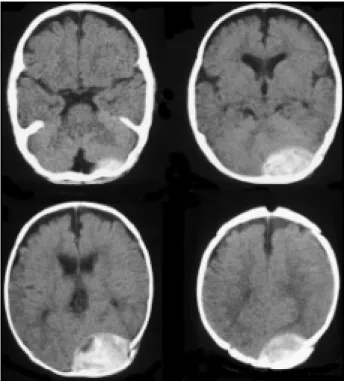
A, w hite, m ale, seven m onths old infant, b orn and resid en t in t h e cit y o f São Pau lo , w as aresid m it t eresid t o t h e Neu ro -su rg ery Em erg en cy Sect io n o f t h e Ho sp it al d as Clin icas d a Facu ld ad e d e Med icin a d a Un iversid ad e d e São Pau lo (HC-FMUSP) o n Decem b er 31, 2000. Acco rd in g t o h is m o t h er, a d ivo rced h o u sem aid , h is au n t lo o ked aft er h im d u rin g t h e d a y w h ile sh e w a s o n h er jo b . Ho w ever, d u rin g o n e o f t h ese p erio d s t w o w eeks b efo re ad m issio n , t h e ch ild h ad h it h is h ead ag ain st t h e w all aft er fallin g fro m h is crad le. A larg e su b g aleal h em at o m a p ro g ressively fo rm ed o n t h e left p ariet o -o ccip it al reg io n . Th e ch ild su b seq u en t ly b eca-m e so eca-m n o len t o n e d ay b efo re ad eca-m issio n an d h ad t w o ep iso d es o f vo m it in g . Ph ysica l exa m in a t io n revea led a h ip o act ive an d react ive ch ild , sp o n t an eo u sly m o vin g all fo u r lim b s, n o rm o t en se b reg m at ic fo n t an elle, larg e su b -g aleal h em at o m a o n t h e left p ariet o -o ccip it al re-g io n an d d isju n ct io n o f t h e left lam b d o id su t u re. Cran ial p erim et er w as co n sid ered n o rm al at 46 cm . Co m p u t ed t o m o g rap h y (CT) scan of the skull confirm ed the diagnosis of disjunction of the left lam b d oid suture, show ed a left p arieto-occip ital e p id u ra l h e m a t o m a a n d su g g e st e d b ifro n t a l co rt ica l atrop hy (Fig 1). The child und erwent a left p arieto-occip ital cran io t o m y. Du rin g su rg ery, a left o ccip it al fract u re w as found and a large ep id ural hem atom a d rained . Hem ostasis o f d iffu se b leed in g p o in t s w as p erfo rm ed an d n o o t h er in cid e n t s o ccu rre d d u rin g t h e su rg e ry. Po st o p e ra t ive co n t ro l CT scan s revealed g o o d su rg ical resu lt s an d co m -p le t e re m o va l o f t h e h e m a t o m a (Fig 2 ). Du e t o t h e co n fu sin g clin ica l st o ry re p o rt e d b y t h e m o t h e r, t h e d iag n o sis o f ch ild ab u se w as su sp ect ed an d t h e Ho sp it al das Clínicas Social Services Departm ent was notified during t h e im m ed iat e p o st o p erat ive p erio d . Rad io g rap h s o f lo n g b o n es w ere p erfo rm ed b u t d id n o t reveal an y sig n s o f fra ct u re s. Op h t h a lm o lo g ica l e va lu a t io n w a s n o rm a l. Ab norm al b lood lab oratory find ing s w ere hem og lob in 7.6 g /d L, h em at o crit 24.1% an d a p lat elet co u n t 513,000. Th e child was d ischarged on the eighth p ostop erative d ay after a court ord er w as ob tained . Physical exam ination revealed
a n a ct ive a n d re a ct ive ch ild , n o rm o t e n se b re g m a t ic fo n t an elle an d n o o t h er ab n o rm alit ies.
On Jan u ary 14, 2001 t h e p at ien t w as b ro u g h t o n ce ag ain t o t h e HC-FMUSP. He h ad d evelo p ed a d eh iscen ce o f t h e su rg ica l w o u n d b eca u se o f a la rg e su b g a lea l h
e-Fig 2. Post operat ive result .
Arq Neu ro p siq u iat r 2003;61(4) 1025
m a t o m a . He u n d erw en t a n ew o p era t io n . Aft er t h is n ew p ro ced u re, w h ile t h e ch ild w as st ill o n t h e w ard s, an o t h er su b g aleal h em at o m a fo rm ed at t h e sam e sit e. Hem at o lo g ical in vest ig at io n w as p erfo rm ed an d co ag u lat io n lab o -rat o ry resu lt s revealed a p art ial act ivat ed t h ro m b o p last in t im e o f 63.7 seco n d s (R= 2.55), an d fact o r VIII act ivit y w as m easu red at 2%. Th e d iag n o sis o f classical h em o p h ilia A w as t h u s est ab lish ed an d ch ild ab u se exclu d ed .
DISCUSSION
Severa l st u d ies d isso cia t e ep id u ra l h em a t o m a fro m ch ild ab u se, b u t relat e t h is p at h o p h ysio lo g ical m ech an ism t o in t erh em isp h eric su b d u ral h em at o -m a, su b arach n o id eal h e-m o rrh ag e, b ilat eral ch ro n ic su b d u ral h em at o m a an d ret in ian h em o rrh ag e. Th is last fin d in g is p at h o g n o m o n ic w h en ch ild ab u se is su sp ect ed9. Ep id u ral h em at o m a in t h e p ed iat ric p o -p u lat io n is relat ed t o d irect h ead im -p act su ch as ac-cid en t al falls. In t h ese cases, t h e im p act g en erat es lin ear accelerat io n , lead in g t o t h e lacerat io n o f m e-ningeal b lood vessels located in the virtual sp ace b et-w een t h e d u ra m at er an d t h e sku ll d u e t o excessive acu t e t ract io n . Even t u ally, sku ll fract u res an d d ip lo e o r ven o u s sin u ses b leed in g s m ay b e t h e cau se o f ep id u ral h em at o m as. Th erefo re t h e d eg ree o f su s-p icio n o f ch ild ab u se m u st b e m u ch h ig h er in cases o f su b d u ral h em at o m as, d esp it e t h e fact t h at su b -d u ra l h e m a t o m a s ca n a lso fo rm se co n -d a ry t o accid en t al h ead t rau m a10, 11.
Sh u g erm an et al. rep o rt t h at o n ly 6% o f t h eir 93 p at ien t s b et w een 0 an d 3 years o f ag e t h at su ffered ch ild ab u se p resen t ed w it h ep id u ral h em at o m a. On the other hand, 47% of these patients possessed sub-d u ral h em at o m a. Even t h o u g h o u r case in clu sub-d esub-d an ep id u ral h em at o m a an d t h e ch ild d id n o t p resen t fra ct u res o r o t h er h em o rrh a g es, t h e d ia g n o sis o f child ab use was susp ected b ecause of the recurrence o f in t racran ial h em o rrh ag e an d t h e ab sen ce o f an y com patible traum a m echanism related during clinical in t erview w it h t h e m o t h er, w h ich is a co m m o n ch a-ract erist ic o f ch ild ab u se cases10.
Esp ecially in cases w h ich t h e p h ysician su sp ect s o f ch ild ab u se w it h n o ext ern al evid en ces o f t rau -m a, rad io lo g ical fin d in g s -m ay b e valu ab le fo r t h e d iagnosis. Rad iograp hs m ay reveal m ultip le fractures in t yp ical sit es su ch as rib s an d t h e m et ap h yses o f lo n g b o n es. Th ese fract u res m ay also sh o w d ifferen t healing p hases. CT and m ag netic resonance im ag ing (MRI) scan s o f t h e t h e b rain m ay reveal co n t u sio n s, sub arachnoid eal hem orrhage, cereb ral ed em a, infar-ct areas o r sig n s o f p revio u s b rain lesio n s, su ch as co rt ical at ro p h y, ex vacu o h yd ro cep h alu s an d b ilat e-ral ch ro n ic su b d u e-ral h em at o m a11-13.
Th e in co n g ru en ce b et w een clin ical h ist o ry an d p hysical find ing s in child ab use cases d efies even the m ost skilled clinicians. This case rem ind s us that even t h o u g h very freq u en t in o u r so ciet y, ch ild ab u se is n o t t h e so le cau se o f in co n g ru en ce b et w een h ist o ry an d p h ysical exam . Neu ro su rg eo n s sh o u ld t h u s al-w ays b ear in m in d t h e d ifferen t ial d iag n o sis o f t h is clin ical en t it y.
REFERENCES
1. Billmire ME, Myers PA. Serious head injury in infants: accident or abu-se? Pediatrics 1985;75:340-342.
2. Bruce DA, Zimmerman RA. Shaken impact syndrome. Pediatr Ann 1989;18482-494.
3. Caffey J. Multiple fractures in the long bones of infants suffering from subdural hematomas. AJR 1946;56:163-173.
4. Caffey J. On the theory and practice of shaking infants: its potential residual effects of permanent brain damage and mental retardation. Am J Dis Child 1972;124:161-169.
5. Caffey J. The whiplash shaken infant syndrome: manual shaking by the extremities w ith w hiplash-induced intracranial and intraocular bleedings, linked with residual permanent brain damage and mental retardation. Pediatrics 1974;54:396-403.
6. Guthkelch NA. Infantile subdural hematoma and its relationship to whiplash injury. Br Med J 1971;2:430-431.
7. Duhaime AC, Genarelli TA, Thibault LE, Bruce DA, Margulies SS, Wiser R. The shaken baby sy nd ro me: a clinical, p atho lo g ical and biomechanical study. J Neurosurg 1987;66:409-415.
8. Comittee on Child Abuse and Neglect. Shaken baby syndrome: inflicted cerebral trauma. Del Med J 1997;69:365-370.
9. Eisemberg AB. Retinal hemorrhage in the battered child. Childs Brain 1979;5:40-44.
10. Shugerman RP, Paez A, Grossman DC, Feldman KW, Grady S. Epidural hemorrhage: is it abuse? Pediatrics 1996;97:664-668.
11. Ewing-Cobbs L, Kramer L, Prasad M, et al. Neuroimaging, physical and developmental findings after inflicted and noninflicted traumatic brain injury in young children. Pediatrics 1998;102:300-307. 12. Bach KP, Schouten-van Meeteren AY, Smit LM, Veenhuizen L, Gemke
RJ. Intracranial hemorrhages in infants: child abuse or a congenital coagulation disorder? Ned Tijdschr Geneeskd 2001;145:809-813. 13. Bray GL, Luban NLC. Hemo philia presenting w ith intracranial