DEMONSTRATION PROJECT ON EPILEPSY IN BRAZIL
Outcome assessment
Li M. Li
1,2, MD PhD; Paula T. Fernandes
1,2, MSc PhD;
Ana L.A. Noronha
1,2, MD PhD; Lucia H.N. Marques
3, MD PhD;
Moacir A. Borges
3, MD PhD; Karina Borges
3, MSc; Fernando Cendes
1, MD PhD;
Carlos A.M. Guerreiro
1, MD, PhD; Dirce M.T. Zanetta
4, MD, PhD;
Hanneke M. de Boer
5,6; Javier Espíndola
7, MD, PhD; Claudio T. Miranda
7, MD, PhD;
Leonid Prilipko
5,8, MD; Josemir W. Sander
6,9, MD, PhD, FRCP
ABSTRACT - Purpose:To assess the outcome of patients with epilepsy treated at primary care health units under the framework of the demonstration project on epilepsy in Brazil, part of the WHO/ILAE/IBE Global Campaign Against Epilepsy. Method:We assessed the outcome of patients treated at four primary health units. The staff of the health units underwent information training in epilepsy. The outcome assessment was based on: 1) reduction of seizure fre q u e n c y, 2) subjective perception from the patient’s and the physi-c i a n ’s point of view, 3) reduphysi-ction of absenteeism, 4) sophysi-cial integration (sphysi-chool and work), and 5) sense of independence. Results:A total of 181 patients (93 women - 51%) with a mean age of 38 (range from 2 to 86) years were studied. The mean follow-up was 26 months (range from 1 to 38 months, 11 patients had follow-up of less than 12 months). Seizure frequency was assessed based on a score system, ranging f rom 0 (no seizure in the previous 24 months) to 7 (>10 seizure/day). The baseline median seizure - f re q u e n-cy score was 3 (one to three seizures per month). At the end of the study the median seizure - f re q u e n c y score was 1 (one to three seizures per year). The patients’ and relatives’ opinions were that in the major-ity (59%) the health status had improved a lot, some (19%) had improved a little, 20% experienced no change and in 2% the health status was worse. With regard to absenteeism, social integration and sense of independence, there were some modest improvements only. Discussion:The development of a mod-el of epilepsy treatment at primary health levmod-el based on the existing health system, with strategic meas-u res centred on the health care providers and the commmeas-unity, has proved to be effective providing impor-tant reductions in seizure fre q u e n c y, as well as in general well being. This model can be applied nation-wide, as the key elements already exist provided that strategic measures are put forw a rd in accord a n c e with local health providers and managers.
KEY WORDS: epilepsy, anti-epileptic drug, seizure, primary care.
Projeto demonstrativo em epilepsia no Brasil: avaliação do desfecho
RESUMO -Objetivo:Avaliar o resultado do tratamento de pacientes com epilepsia na atenção básica sob o modelo proposto pelo Projeto Demonstrativo no Brasil, como parte da Campanha Global Contra a Epilepsia da WHO/ILAE/IBE. Método:Avaliamos o resultado do tratamento nos pacientes acompanhados em qua-t ro unidades básicas de saúde. As equipes de saúde fizeram um qua-treinamenqua-to padrão. O resulqua-tado do qua-traqua-ta- trata-mento foi baseado em cinco aspectos: 1) redução da freqüência das crises, 2) percepção subjetiva dos pacientes e dos médicos, 3) redução de absenteísmo, 4) integração social (escola, trabalho), e 5) senso de independência. Resultados:Um total de 181 pacientes (93 mulheres - 51%), com uma média de 38 anos (variando de 2 a 86 anos) entraram nesta análise. O tempo médio de seguimento foi de 26 meses (variou de 1 a 38 meses, 11 pacientes tinham seguimento menos de 12 meses). A freqüência das crises foi catego-rizada variando de 0 (sem nenhuma crise nos últimos 24 meses) a 7 (>10 crises/dia). O escore mediano da
1Department of Neurology, Faculty of Medicine, UNICAMP, Campinas, SP, Brazil;2Assistência à Saúde de Pacientes com Epilepsia -ASPE, Campinas, SP, Brazil; 3Department of Neurology, Faculty of Medicine of São José do Rio Preto, São José do Rio Preto, Brazil; 4D e p a rtment of Epidemiology, Faculty of Medicine of São José do Rio Preto, São José do Rio Preto, SP, Brazil;5Global Campaign Against Epilepsy Secretariat, Geneva, Switzerland;6Epilepsy Institute of the Netherlands, SEIN, Heemstede, Achterweg 5, 2103 SW Heemstede, the Netherlands;7Pan-american Health Organization, Washington DC, USA;8D e p a rtment of Mental Health and Substance Abuse World Health Organization, Geneva, Switzerland;9D e p a rtment of Clinical and Experimental Epilepsy, UCL Institute of Neurology, London UK.
f reqüência de crises no começo era de 3 (uma a três crises por mês). O escore mediano da freqüência de crises no final era de 1 (uma a três crises por ano). A opinião dos pacientes e familiares é que a maioria (106 casos) houve uma melhora importante na saúde, 34 tiveram pouca melhora, 37 não tiveram mudanças e em quatro houve piora. Em relação ao absenteísmo, integração social e senso de independência houve pouca melhora. Discussão:O modelo desenvolvido de tratamento de epilepsia na atenção primária com base na estrutura de saúde existente, com estratégias centradas nos profissionais de saúde e na comu-nidade, provou ser efetivo com redução importante na freqüência das crises bem como na melhora em geral da saúde. Esse modelo pode ser aplicado em âmbito nacional, pois os elementos chaves já existem, desde que essas estratégias sejam pactuadas com os organismos locais de saúde.
PALAVRAS-CHAVE: epilepsia, droga anti-epiléptica, crises, atenção primária.
In the1980s, health in Brazil underwent an impor-tant re f o rm in the public sector, producing a public policy of universal health care delivery. This led to the institution of the Sistema Único de Saúde (SUS -Unified Health System) in 1988, an expression of the policy of social inclusion. Challenges faced by SUS include dealing with agendas imposed by infectious, contagious and chronic diseases. In the 1950s and 60s, the main health problems in Brazil were pre-dominantly related to acute diseases of short dura-tion, often bacterial or viral in nature. These still fre-quently occur, but are usually controlled by dru g s1.
To d a y, chronic diseases are the main causes of health p roblems and negative affects on the quality of life. The advent of new technologies and scientific knowl-edge provide treatment for most illness, in that dis-eases rarely lead to immediate death as they used to in the past. However, the novel re s o u rces do not pro-vide improvement of well-being to patients, and their relatives, with disabling conditions involving physi-cal, social and psychological domains with numero u s practical implications1.
Epilepsy is an example of this type of chronic dis-ease. Epilepsy is the most frequent serious non-com-municable neurological disease worldwide, and is one of the major conditions which affects behaviour and quality of life, imposing complex challenges to health pro f e s s i o n a l s2. In addition to the problems of
having seizures, epilepsy imposes a psychological bur-den with direct and indirect social consequences and economic impact.
The National Demonstration Project (DP) on Epi-l e p s y3, part of the Global Campaign Against Epilepsy
under the auspices of the World Health Org a n i z a t i o n , the International League Against Epilepsy and the I n t e rnational Bureau of Epilepsy, launched on the 2 7t hSeptember 2002 and executed by the Assistência
à Saúde de Pacientes com Epilepsia (ASPE, a charita-ble non-governmental organization), assessed a series of actions with the overall aim of developing and testing a self sustaining model of epilepsy assistance
within the existing primary health care system. This study is part of the Phase VI of the Demonstration P roject on Epilepsy part of the Global Campaign Epilepsy Out of the Shadows-WHO-ILAE-IBE in Brazil3.
METHOD
The DP is divided into three main stages of pro g re s s evaluation: Situation assessment, Intervention assessment, Control assessment.
The Situation and Intervention assessments have been discussed in other papers, and here we consider the Contro l assessment. All the staff from the health units of the study a rea underwent a standard training (see article 2). The C o n t rol assessment is based on the outcome of people with epilepsy treated in the catchm ents areas, Barão Geraldo, Village, Santo Antonio, Jaguaré.
F rom the epidemiological survey of Phase I of the DP, those people identified as having epilepsy were invited to p a rticipate in the study, and were given information on the nature of the study; consent forms were signed. The study carried a minimal risk and was approved by the Ethics Committee of the Faculty of Medical Sciences of UNICAMP (number 331/2002). The epidemiological surv e y4i d e n t i f i e d
122 people with epilepsy in Santo Antonio, 194 in Jaguaré, 132 in Barão Geraldo and 48 in Village. These patients, as well as any other patients from the catchments area of health unit who wished to, were invited to participate in the DP. The nature of the study was explained to all poten-tial participants. It is important to note that, although we e n rolled in the study only those who signed informed con-sent forms, all patients had access to health care assistance. All health workers involved in the project underwent stan-dard training. The patients were asked to return on aver-age every two months, and they were questioned in re g a rd to their seizure frequency, their perception of well-being, and social activity. In this paper for outcome assessment we used only the baseline and the last entry datasets. We only assessed those patients who were still enrolled in the study; those who had dropped out were excluded.
The outcome assessment was based on: 1) reduction of s e i z u re fre q u e n c y, 2) subjective perception from patient’s and physician’s point of view, 3) reduction of absenteeism, 4) social integration (school and work), and 5) sense of inde-pendence.
months), score 1=one to three seizures per year, score 2= four to eleven seizures per year, score 3=one to three sei-z u res per month, score 4=one to six seisei-zures per week, score 5=one to three seizures per day, score 6=four to ten seizure s per day, score 7=more than ten seizures per day. All part i c-ipants were asked to record their seizures in a diary.
Subjective perception was divided into: ‘improved a lot’, ‘improved a little’, ‘no change’ and ‘worsened’.
Reduction of absenteeism, social integration (school and work) and sense of independence were assessed on d i rect interview using, for comparison, the period of six months prior to baseline and that of six months prior to the end of the study.
RESULTS
The initial study population consisted of 100 pa-tients at health units in Santo Antonio, 90 in Jaguaré, none in Barão Geraldo, and 17 in Village. At the end of the study, the study population consisted of 133 patients at Santo Antonio, 37 at Jaguaré, none at Barão and 11 at Village. These patients were identi-fied during the Phase I - epidemiological surv e y4. The
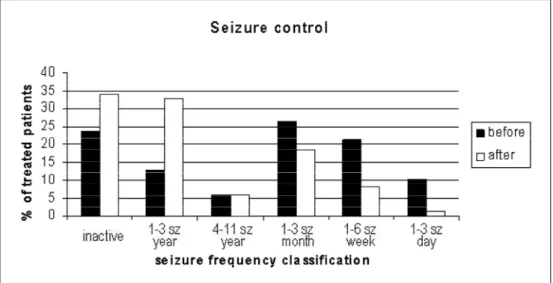
final population, a total of 181 patients (93 women - 51%) with a mean age of 38 years (range 2 to 86 years), was studied, and their results described here-in. The mean follow-up was 26 months (range 1 to 38 months, 11 patients had follow-up less than 12 months). The baseline median seizure - f requency score was 3 (interq u a rtile range 1 to 4). At end of the study the median seizure - f requency score was 1 (interq u a r-tile range 0 to 3). Figure 1 shows the distribution of
s e i z u re - f requency scores before and after the DP. T h e rewas a significant reduction in seizure fre q u e n-cy after treatment at the health units (Wilcoxon Sign-ed Ranks Test Results= –8.160, p<0.001).
With re g a rd to the overall health status at the end of the DP, the opinions of patients and re l a t i v e s w e re that in 59% health had improved a lot, in 19% it had improved a little, in 20% there was no change and in two percent the situation was worse. The phy-sicians assessment were fairly similar to those of the patients (Cohen’s Kappa = 0.58). Physicians’ opinions w e re that 56% had improved a lot, 22% had im-p roved a little, 20% had exim-perienced no change, and three percent had become worse.
We assessed school attendance in those aged less than 18 years and with a follow-up period of more than 12 months. At baseline, 20 out of 22 patients w e re at school, and eight of 20 (40%) had pro b l e m s with epilepsy and with absenteeism due to seizure s . At end of the study, 19/22 were at school, and four out of 19 (21%) had problems with epilepsy and with absenteeism due to seizures. The “problems with epi-lepsy” re p o rted were all related to discrimination. In this aspect, it was at times difficult to disentangle whether absenteeism was truly due to temporary post-ictal incapability (somnolence, malaise) or whe-ther it was more psychology related. We assessed em-ployment in 131 subjects aged between 18 and 65 years and with a follow-up of at least 12 months. At
baseline, 27 of 65 (42%) people who were working experienced interf e rence in their work due to epilep-sy (including seizures or consequences of stigma), and 35/65 (54%) had a formal job (signed contract guarantee by Law). At the end of the study, 11 out of 44 (25%) experienced interf e rence in work due to e p i l e p s y, and 20/44 (45%) had a formal job. Four patients who had never worked started working (in-f o rmal job) a(in-fter treatment, and two received a mon-thly income of U$270.00 (R$600,00). This can be con-s i d e red a good income; however, more important icon-s the behavioural change, from a state of stagnation to a pro-active attitude.
With re g a rd to social activity and sense of inde-pendence, at baseline 116/181 were able to go out alone, and 90 people engaged in social activity. At the end of the study 119/181 were able to go out by them-selves, and 100 people engaged in social activity.
We also conducted individual interviews with patients, relatives and health professionals on over-all aspects of the DP. The patients and relatives not-ed that it was convenient for them to be assistnot-ed at a place near home. The most important factor was that there was a re f e rence person in the health unit that they could rely on, and all agreed on the impor-tance of having the regular group meetings. The phy-sicians’ opinion was that the protocol was simple and that they felt more confident managing epilepsy after the training (see article 2); all agreed that it was essential to have the facility of re f e rral in cases of doubt.
DISCUSSION
Setting: success and failure –The four health care units had distinct outcomes. The health unit of Barão Geraldo had a series of problems with infrastru c t u re and increased turnover of staff. Another major pro b-lem faced at Barão Geraldo was lack of interest fro m patients in participating in the study. This became a p p a rent when all of the first 30 patients invited defaulted their initial appointments. The main re a-son given was that they were already under tre a t-ment elsewhere. The health unit at Village perf o rm e d well. This unit is an extension of the Barão Geraldo health unit for the rural areas, which was convenient for patients who did not need to travel long distances for treatment. The health unit of Jaguaré had an ex-cellent start with good attendance and acceptance by patients. However, the situation changed after a management change. The new manager re a l l o c a t-ed a nurse who had been the liaison person between patients and the health unit. This broke the bond
and the monthly patients meeting ceased. Most pa-tients went to another service (at a tertiary centre), and were invited by a physician for a monthly gro u p meeting, and ended up being followed at that serv-ice. The health unit of Santo Antonio was very suc-cessful; although there were four changes of man-agers, a nurse stayed as a liaison person and month-ly meetings took place. Over time, the health unit assumed the status of a “re f e rence centre” for epilep-s y, aepilep-s epilep-some people with epilepepilep-sy who were not fro m its catchments area came for treatment. The diff e r-ences observed in these four health units show the necessity for a liaison person and for regular gro u p meetings. In interviews with patients, it became clear that one of the advantages of treatment pro v i d e d by the DP, particularly at Santo Antonio, was that the p rogramme went beyond drug prescription, and the patients felt cared for in all senses. Assistance was clearly provided by the liaison person and by the re g-ular meetings, when patients could express their dai-ly life problems and share mutual experiences. In the Jaguaré health unit, which was perf o rming quite well i n i t i a l l y, once the liaison person and the meetings were removed, patients move to alternate settings. This experience demonstrates that health assistance of people with epilepsy requires a holistic approach including psycho-social support.
The physicians expressed the view that after the DP they started to see patients with epilepsy in a dif-f e rent perspective, as people who could be tre a t e d at primary health level. They mentioned, however, that the presence of a tert i a ry centre for re f e rral was very important.
During the study period the AED supply was pre-dominantly regular, although there were two occa-sions when the supply was briefly interrupted with-out causing problem to the patients.
Medical outcome –The impact on seizure contro l was clear in that, on average, patients were initially having monthly seizures and by the end of the assess-ment this had been reduced to one to three seizure s a year.
fact that people in the study area tend to move, (as was observed in the Phase I - epidemiological surv e y ) .
Social outcome –The effect on seizure control had d i rect consequences in reduction of absenteeism o b s e rved in school and the work environment. Never-theless this effect was not consistent. With re g a rdto employment the effect was minimal, with changes in very few individuals. Suggestions for impro v i n g this situation include: training patients for activity, d i ff e rent work schedules, acceptance of the work e n v i ronment, follow-up. We are currently working on a project aiming to develop a partnership with the private sector for employment. The effect on independence and participation in social gatherings was also small. We observed that psychological inter-vention can help patients improve self-confidence and self-esteem, but we also observed that there w e re other variables, such as the local society, lack of social skills, and years of being sedentary, which influence the patients’ attitudes. We are curre n t l y testing a complementary treatment (G.I.S. - G ru p o s de Interação Social - Social Interaction Groups) aim-ing to empower people with epilepsy, to impro v e their resiliency and to provide their social inclusion.
Final remarks and future direction –We devel-oped a model of epilepsy treatment at primary health level based on the existing health system with strate-gic measures centred on health care providers and the community.
We demonstrated that, using this model, people with epilepsy can be effectively treated at the pri-mary health level, with important reductions in sei-z u re fre q u e n c y, as well as improvements in general well being.
This model can be applied nationwide, as the key elements already exist5, provided the strategic
meas-u res are pmeas-ut forw a rd in accordance with local health providers and managers.
The four year DP was instrumental in pro v i d i n g data on the magnitude of the burden of epilepsy on s o c i e t y, and for developing alternate cost-eff e c t i v e strategies to bring epilepsy out of the shadows. Over this period there was an open dialogue with the M i n i s t ry of Health for construction of public policy for users, and it became clear that it was necessary to institute a protocol for epilepsy assistance at pri-mary care setting. This constitutes the concrete first steps towards creation of a National Program for Epilepsy.
REFERENCES
1. Guimarães SS. Psicologia da Saúde e doenças crônicas. In Kerbauy RR, (Ed). Comportam ento e saúde: explorando alternativas. São Paulo: ARBytes Editora Ltda, 1999:22-45.
2. Baker G. The Psychosocial burden of epilepsy. Epilepsia 2002;43:26-30. 3. Li LM, Sander JW. National demonstration project on epilepsy in Brazil.
Arq Neuropsiquiatr 2003;61:153-156.
4. N o ronha AL, Borges MA, Marques LH, Zanetta DM, Fernandes PT, de Boer HM, Espindola J, Miranda C, Prilipko L, Bell GS, Sander JW, Li, LM. Prevalence and pattern of epilepsy treatment in diff e rent socialeconomic classes in Brazil. Epilepsia, **(*):1–6, 2007, doi:10.1111 / j . 1 5 2 8 -1167.2006.00974.