1Department of Neurology, University of São Paulo, São Paulo SP, Brazil;2Department of Internal Medicine (Neurology), Federal University of Rio Grande do Sul, Porto Alegre RS, Brazil;3Institute of Neurology Deolindo Couto, Federal University of Rio de Janeiro, Rio de Janeiro RJ, Brazil;4AURUS-IEPE - Institute of Research and Education on Aging, Belo Horizonte MG, Brazil;5Department of Neurology and Neurosurgery, Federal University of São Paulo, São Paulo SP, Brazil; and 6Department of Neurology, Psychiatry and Medical Psychology, University of São Paulo at Ribeirão Preto, Ribeirão Preto SP, Brazil;7Appendix.This study was supported by
Janssen-Cilag.
Received 7 October 2003, received in final form 7 January 2004. Accepted 3 February 2004
Dr. Paulo Caramelli - Rua Itapeva 518/601 - 01332-000 São Paulo SP - Brasil. E-mail: [email protected]
EFFECTS OF GALANTAM INE ON ATTENTION AND M EM ORY IN
ALZHEIM ER’S DISEASE M EASURED BY COM PUTERIZED
NEU-ROPSYCHOLOGICAL TESTS
Results of the Brazilian Multi-Center Galantamine Study
(GAL-BRA-01)
Paulo Caramelli
1, Márcia L.F. Chaves
2, Eliasz Engelhardt
3, João Carlos B. Machado
4, Rodrigo R. Schultz
5,
Francisco A.C. Vale
6, Helenice Charchat-Fichman
1, for the Brazilian Galantamine Study Group
7ABSTRACT - Objective: To investigate the effects of galantamine on the performance of patients with mild to moderate Alzheimer’s disease (AD) in a computerized neuropsychological test battery (CNTB). Method:Thirty-three patients with probable AD were treat-ed with galantamine for three months and evaluattreat-ed in a prospective, open-label, multi-center study. The CNTB and the ADAS-Cog were administered at baseline and after 12 weeks. The CNTB includes reaction time tests to evaluate attention, implicit and episod-ic memory for faces and words. Statistepisod-ical comparisons were performed between the results in week 12 versus baseline. Patients who did not reach the therapeutic doses were excluded from the efficacy analysis. Results: Four patients (12.1%) were excluded from the analysis either because of treatment discontinuation (n=3) or because a therapeutic dose was not reached (n=1).The remain-ing 29 patients were treated with doses of 24 mg/day (n=22) and 16 mg/day (n=7). After 12 weeks, significant reductions in reac-tion time were seen in the test of episodic memory for faces (p=0.023) and in the test of two-choice reacreac-tion time (p=0.039) of the CNTB. Conclusion: Treatment with galantamine produced improvement in computerized tests of attention and episodic memory after 12 weeks, leading to statistically significant reduction in the reaction times.
KEY WORDS: Alzheimer’s disease, clinical trial, galantamine, computerized neuropsychological tests, attention, memory.
Efeit os da galant amina sobre a memória e a at enção na doença de Alzheimer medidos por t est es neuropsi-cológicos comput adorizados: result ados do Est udo M ult icênt rico com Galant amina (GAL-BRA-01)
RESUMO - Objetivo: Investigar os efeitos da galantamina no desempenho de pacientes portadores de doença de Alzheimer (DA) leve a moderada em uma bateria de testes neuropsicológicos computadorizados (BTNC).Método: Trinta e três pacientes com DA provável receberam tratamento com galantamina por três meses em ensaio clínico multicêntrico aberto e prospectivo. A escala BTNC e a ADAS-Cog foram administradas no início e ao final de 12 semanas. A BTNC incluiu testes de tempo de reação avaliando atenção, memória implícita e memória episódica para palavras e faces. Comparações estatísticas foram realizadas entre os resul-tados na 12ª semana versus a linha de base. Pacientes que não atingiram dose terapêutica foram excluídos da análise. Resultados: Quatro pacientes (12,1%) foram excluídos por interrupção do tratamento (n=3) ou por não atingir dose terapêutica (n=1). Os 29 pacientes remanescentes foram tratados com doses de 24 mg/dia (n=22) e 16 mg/dia (n=7). Ao final de 12 semanas, reduções nos tempos de reação foram observadas nos testes de memória episódica para faces (p=0,023) e no teste de tempo de reação de dupla escolha (p=0,039) da BTNC. Conclusão: O tratamento com galantamina melhorou o desempenho em testes de atenção e memória episódica, com redução estatisticamente significativa dos tempos de reação.
Alzheimer’s disease (AD) is the leading cause of demen-tia in the elderly, being responsible for more than 50% of the dementia cases arising at ages 65 and over1,2.The disease leads
to substantial impairment in cognition and behavior, result-ing in progressive functional dependence for the perform-ance of daily activities. Long-term memory deficits, particular-ly related to the episodic memory system, are usualparticular-ly the first cognitive change to occur in AD. Attention is, in most cases, the second cognitive domain to be affected, a feature that is already present at mild stages of the disease and which is responsible for part of the troubles with activities of daily liv-ing3 . Three main subtypes of attention are described,
name-ly, divided, selective and sustained attention, which depend upon distinct neuroanatomical structures. In AD, besides a general slowness of the cognitive processing, that is also pres-ent - although in less degree - in normal aging, specific selec-tive and divided attention deficits become evident3 .
The pathological process involved in AD includes the accu-mulation of neurofibrillary tangles and neuritic plaques espe-cially in the hippocampal formation, basal forebrain, limbic cor-tex and in cortical associative areas of the brain. This process follows a usual temporal sequence, with involvement of the entorhinal cortex and hippocampus in the earliest phases and subsequent spreading to the limbic cortices and to the basal forebrain nuclei, which represent the major cholinergic inner-vation to the neocortex4. The basal forebrain cholinergic
sys-tem is represented by the
nucleus basalis
of Meynert, themedial septum and the diagonal band of Broca. The spread-ing of the AD pathology to these structures produces a signif-icant reduction of the cholinergic innervation to the cortical mantle, which has been related both to cognitive and non-cog-nitive (neuropsychiatric) symptoms of the disease5-7
.Within the
cognitive domain, attention deficits have been related to the neuropathological involvement of the basal forebrain and its consequent cholinergic deprivation8.
Treatment with cholinesterase inhibitors (AChEI) is the current main pharmacological intervention available for treat-ing AD patients9. Tacrine was the first AChEI approved for
clinical use. Nevertheless, although presenting unquestionable efficacy, it is rarely prescribed nowadays because of the high rate of adverse events (mainly hepatotoxicity). The second generation of AChEI is represented by donepezil, galantamine and rivastigmine. These three drugs have shown to be supe-rior to placebo in many controlled clinical trials, with positive effects on cognition, behavior and activities of daily living 10-15. Galantamine is a reversible inhibitor of
acetylcholines-terase and also exerts an allosteric modulation of the cholin-ergic nicotinic receptors.These two complementary mechanisms result in increase of the cholinergic neurotransmission in the brain. Galantamine has shown to be effective in the sympto-matic treatment of patients with AD, vascular dementia, AD with cerebrovascular disease and dementia in Parkinson’s dis-ease12,13,16,17.
The present study reports the results from a Brazilian mul-Appendix (GAL-BRA-01 participating centers and investigators).
1. Behavioral and Cognitive Neurology Unit, Department of Neurology, University of São Paulo School of Medicine
Paulo Caramelli (GAL-BRA-01 study coordinator and site’s principal investigator); Ricardo Nitrini (co-investigator); Helenice Charchat-Fichman (neu-ropsychologist); Juliana Nery (site monitor)
2. Department of Internal Medicine (Neurology), Federal University of Rio Grande do Sul, Porto Alegre
Márcia Lorena Fagundes Chaves (site’s principal investigator); Eduardo Daura Ferreira (co-investigator); Alberto Luiz Gricoli e Maia (co-investigator); Rachel Tavares de Laforete Padilha (co-investigator); Vera Beatriz Delgado dos Santos (site monitor)
3. Institute of Neurology Deolindo Couto and Center of Alzheimer’s Disease, Institute of Psychiatry, Federal University of Rio de Janeiro Eliasz Engelhardt (site’s principal investigator); Jerson Laks (co-investigator); Valeska Marinho (co-investigator); Tatiana Quitério (co-investigator); Irene Moreira (neuropsychologist)
4. AURUS-IEPE - Institute of Research and Education on Aging, Belo Horizonte
João Carlos Barbosa Machado (site’s principal investigator); Daniel Gonçalves Rego (co-investigator); Gustavo Vaz de Oliveira Moraes (co-investigator); Flávia Pinheiro Machado (neuropsychologist); Érica de Araujo Brandão Couto (speech pathologist)
5. Department of Neurology and Neurosurgery, Federal University of São Paulo
Rodrigo Rizek Schultz (site’s principal investigator); Paulo Henrique Ferreira Bertolucci (co-investigator); Ivan Hideyo Okamoto (co-investigator); Eliana Rysovas (neuropsychologist)
ti-center open-label study to investigate the effects of galan-tamine on the performance of mild to moderate AD patients in computerized neuropsychological tests.The main goal of the study was to investigate the effects of galantamine on atten-tion and memory tests, especially focusing on the effects on reaction time measures.
M ETHOD
Population and eligibility criteria
Thirty-three patients (18 female), aged 75.1 ± 7.9 years (range 56-87), with educational level (mean ± SD) of 7.1 ± 4.4 years and duration of symptoms (mean ± SD) of 36.7 ± 23.3 months, were includ-ed in the study. All patients met the NINCDS-ADRDA criteria for probable AD, with mild to moderate symptoms, as defined by scores in a Brazilian version of the Mini-Mental State Examination (MMSE)18,19.
Regarding the latter, patients were recruited if the MMSE scores fell between 14 and 24 points, both inclusive.
Appropriate laboratory blood tests (in order to fulfill the diag-nostic criteria of probable AD) and neuroimaging assessment (com-puterized tomography or magnetic resonance of the skull within a period of 18 months preceding the beginning of the trial) were per-formed in every study participant. Presence of two or more ischemic lesions (either cortical and subcortical infarcts or lacunes), a single strategically located infarct, or evidence of intense leukoaraiosis on neuroimaging, excluded participation. Electrocardiogram was also per-formed in order to rule out severe heart conduction abnormalities.
Subjects with previous treatment with AChEI were allowed to par-ticipate in the trial only if the drug had been discontinued at least 60 days before inclusion. Patients had to live with or to receive reg-ular visits (at least five days a week) from a caregiver, which should be capable to provide all the necessary information about the patient. The study has been approved by the Ethics Committee from all the centers participating in the trial and all patients and the care-givers signed the informed consent.
Study design
The study was conducted at six research centers from five dif-ferent cities. A complete list of the participating centers and investi-gators is provided at the end of the manuscript.
The study lasted 12 weeks. Galantamine was initiated at a dose of 4mg bid for four weeks. At the end of the fourth week a medical visit was scheduled, for clinical examination and safety evaluation. If the initial drug regimen was well tolerated, the dose was increased to 8 mg bid for an additional four-week period. A similar procedure was adopted at the end of the eighth week. The dose was then increased to 12 mg bid for the final four-week period. Patients exhibiting mild adverse events were maintained at 8 mg bid until the end of the tri-al.
Primary and secondary outcome efficacy measures were record-ed at baseline and at week 12.The primary efficacy measure was the performance in the computerized neuropsychological test battery (CNTB)20.
The CNTB was developed using the MEL professional software (version 2.0)21. This software modifies the input and output systems
of the computer, allowing registration of reaction time in millisec-onds. The tests were administered in a PC (IBM compatible) with a
12’’ screen. A serial response box with five numbered buttons was used as interface between patient and computer screen. The battery administration lasted an average of 20 minutes. The CNTB includes five reaction time tests evaluating attention, as well as episodic and implicit memories, as follow:
a) Face Recognition test (episodic memory):Ten unfamiliar faces were presented simultaneously on the computer screen for ten sec-onds to be remembered. After this first presentation, a single face was shown and the patient had to press button one if he/she remem-bered or, otherwise, button five. The recognition test consisted in a random presentation of ten pre-exposed faces and ten new faces as distracters.
b) Word Recognition and Learning test: similar to the Face Recognition test procedure using Words. The recognition procedure was repeated three times to evaluate a learning effect.
c) Simple reaction time test: The number one was presented in the center of the computer screen and the patient had to press this number in the response box as quickly as possible. This procedure was repeated 100 times.The patient’s finger was put over button one before the test begun.
d) Two-choice reaction time test: The numbers one or five were presented in the center of the computer screen in a random order. The patient had to press the correspondent button in the response box as quickly as possible. This procedure was repeated 100 times. The patient’s right finger was put over button five and the left fin-ger over button one before the test begun.
e) Serial reaction time test: The numbers one, two, three, four or five were presented in the center of the computer screen and the patient had to press the correspondent button in the response box as quickly as possible. This test was divided in five blocks, with 50 trials each. In blocks 1, 2, 3 and 4 the numbers were presented in a fixed order and in block 5, in a random order. The reaction time dif-ferences between blocks 1 - 4 and 4 - 5 were considered implicit learn-ing measures.
The CNTB was administered by neuropsychologists working in each of the sites, who had been previously trained in the procedure. The training session was carried out during the investigator’s meet-ing, lasting four hours. In the following weeks, the neuropsycholo-gists performed three pilot evaluations with patients that would not be included in the trial.
The secondary efficacy measure was the performance in the Brazilian version of the Alzheimer’s disease Assessment Scale Cognitive Subscale (ADAS-Cog)22. The ADAS-Cog is widely used in clinical
tri-als for the evaluation of treatment effects in AD. It is an 11-item scale that evaluates memory, language, orientation and praxis, taking about 40 minutes to be administered.
Safety evaluations were performed at weeks 4, 8 and 12, includ-ing physical examination and vital signs.
Statistical analysis
All patients that received at least one dose of galantamine were included in the demographic characterization of the sample and in the safety report.All efficacy analysis was based on the intent-to-treat pop-ulation, defined as all patients who received medication (8mg or 12 mg bid) for at least two months and for which any of the efficacy meas-ures (CNTB or ADAS-Cog) were available.
at the CNTB at week 12 in comparison with baseline, with analysis of the percentage of correct responses and the reaction times.The second-ary efficacy measure was the variation in the total and in the individ-ual item scores of the ADAS-Cog between weeks 12 and baseline. The percentage of responders to galantamine treatment based on the changes in the ADAS-Cog scores was also determined (≥0 vs < 0,≥4 vs < 4, and ≥7 vs < 7).
The Wilcoxon non-parametric test for related samples was used in the analysis of both the CNTB and the ADAS-Cog data. The paired t-test was used for the comparisons of the safety parameters between baseline and the last evaluation.
RESULTS
Thirty-three patients were included in the trial, with a mean MMSE score of 19.9 points at baseline. Twenty-two patients (66.7%) reported no previous use of AChEI, while 11 (33.3%) referred usage of at least one agent from this class. Four (12.1%) out of the 33 patients were excluded from the efficacy analysis: two (6.1%) because of adverse events (nausea, vomiting and dizziness) and two for other reasons non-related to the study medication.
The remaining 29 patients were treated with galantamine at doses of 24 mg/day (n= 22) and 16 mg/day (n= 7). Data regarding performance in the CNTB and in the ADAS-Cog were available from all these patients.
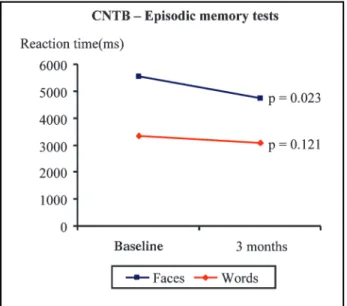
Statistically significant differences emerged between the performances of patients at week 12 versus baseline in the CNTB, particularly in the reaction times. In the face recogni-tion test, the mean reacrecogni-tion time fell from 5,543.1 millisec-onds at baseline to 4,750.5 millisecmillisec-onds at week 12 (p= 0.023; Figure 1). In the test of two-choice reaction time, the mean reaction time fell from 1,024.1 milliseconds at baseline to 908.5 milliseconds at week 12 (p= 0.039; Figure 2).A trend for reduction of the reaction time in the block 2 of the serial
reac-tion time test was also observed (p= 0.053). No difference in the percentage of correct responses was observed in any of the CNTB tests.
No difference between total scores at the ADAS-Cog between weeks 12 and baseline was found (p= 0.673). A sig-nificant reduction (improvement) in the sub-item “ Word-find-ing difficulties in spontaneous speech” was observed at the end of the trial (p= 0.008).
In the responder analysis of the ADAS-Cog, 10 (34.5%) patients showed signs of mild improvement (total score vari-ation between 0 and 3 points, both inclusive), 8 (27.6%) pre-sented moderate improvement (total score variation between 4 and 6 points, both inclusive) and 2 (6.9%) had marked improvement (total score variation
≥
7 points), while 9 (31.0%) did not improve.DISCUSSION
The present study reports the results from the first Brazilian multi-center trial with galantamine in the treatment of patients with mild to moderate AD. Patients were treated for 12 weeks and positive effects were seen at the end of the treatment peri-od in specific cognitive measures, namely the performance in computerized neuropsychological tests of attention and mem-ory.
Previous clinical trials have shown that galantamine leads to significant improvement of the cognitive, behavioral and functional impairment both in AD and in vascular demen-tia12,13,16. Moreover, in one of this trials, 36 to 37% of patients
treated with the drug improved
≥
4 points in the ADAS-Cogand thus could be considered as “ responders”13. Similarly, in
our study the analysis of the ADAS-Cog performance profile shows that 34.5% of the patients showed moderate to marked responses.
In the current trial galantamine treatment effects were Fig 1. Changes in the reaction times in the episodic memory tests of the CNTB
(face and word recognition tests).
measured through a computerized neuropsychological test battery. The major advantages of this computer-based cogni-tive examination are the precise time control of stimuli pres-entation and the accurate measurement of the reaction time. This level of accuracy and resolution is practically unattainable using the classic paper-and-pencil tests, even in the use of a chronometer. Furthermore, this approach allows the generation and use of multiple versions of a single test, thus reducing the interference of a learning effect23. These features place the
computerized evaluation in a privileged position for measur-ing the effects of any sort of symptomatic treatment for demen-tia.
Reaction time measures in computerized tests have been previously used as efficacy variables in very few dementia tri-als, such as a recent study with rivastigmine in the treatment of patients with Lewy-body dementia, with positive results on these outcomes24.
Despite the small number of patients included in the cur-rent trial, the performance in the CNTB improved at the end of the study, with significant reductions of the reaction times in the tests of episodic memory for faces and attention (two-choice reaction time). These findings suggest that the bene-fits produced by galantamine were more marked within the domain of attention, since even for the episodic memory task the reaction time was the variable influenced by the treatment, while the percentage of correct responses was not.
Attention deficits are frequent in AD, already present in the early stages of the disease3. In the CNTB, the two-choice
reac-tion time task, which has been consistently reduced with galan-tamine treatment, focus on the selective attention subcompo-nent. Lined with this observation, a recent PET study with healthy elderly subjects found that action on nicotinic receptors modulated arousal and selective attention to a visual task25.Thus,
improvement in this aspect of cognition can be regarded as a truly positive effect, also because enhancement of the atten-tional tonus may lead to benefits in other neuropsychological functions, especially memory, with also some positive effects on functional status.
Since the current trial was not placebo controlled (for eth-ical reasons), one could argue that the reduction in reaction time at week 12 in comparison with baseline could represent only a reflex of implicit (procedural) learning rather than a real benefit. If this was indeed the case, we should have observed a reduction of the reaction time in all the CNTB tests, espe-cially in the simple reaction time task, which consists on an objective measure of motor speed. However, improvement in these other tasks did not occur.
Galantamine treatment was well tolerated, with 29/33 (87.8%) patients reaching a therapeutic dose. Only two patients had to discontinue the drug due to adverse events (mainly gas-trointestinal effects). This discontinuation rate is similar to what has been previously described in other galantamine tri-als12,13.
In conclusion, treatment with galantamine at doses 16 to 24 mg/day in patients with mild to moderate AD produced improvement in their performance in computerized tests of episodic memory and attention after 12 weeks, leading to sta-tistically significant reduction in the reaction times.
REFERENCES
1. Herrera E Jr, Caramelli P, Silveira ASB, Nitrini R. Epidemiological sur-vey of dementia in a community-dwelling Brazilian population. Alzheimer Dis Assoc Disord 2002;16:103-108.
2. Fratiglioni L, Launer LJ, Andersen K, et al. Incidence of dementia and major subtypes in Europe: a collaborative study of population-based cohorts. Neurology 2000;54 (Suppl 5):S10-S15.
3. Perry RJ, Hodges JR. Attention and executive deficits in Alzheimer’s disease: a critical review. Brain 1999;122:383-404.
4. Geula C. Pathological diagnosis of Alzheimer’s disease. In Scinto LFM, Daffner KR (ed). Early diagnosis of Alzheimer’s disease. Totowa: Humana Press, 2000:65-82.
5. Rossor MN, Garrett NJ, Johnson AL, Mountjoy CQ, Roth M, Iversen LL. A post-mortem study of the cholinergic and GABA systems in senile dementia. Brain 1982;105:313-330.
6. Minger SL, Esiri MM, McDonald B, et al. Cholinergic deficits con-tribute to behavioral disturbance in patients with dementia. Neurology 2000;55:1460-1467.
7. Iraizoz I, Guijarro JL, Gonzalo LM, Lacalle S. Neuropathological changes in the nucleus basalis correlate with clinical measures of dementia. Acta Neuropathol 1999;98:186-196.
8. Samuel W, Terry RD, DeTeresa R, Butters N, Masliah E. Clinical corre-lates of cortical and nucleus basalis pathology in Alzheimer dementia. Arch Neurol 1994;51:772-778.
9. Doody RS, Stevens JC, Beck C, et al. Practice parameter: management of dementia (an evidence-based review). Report of the Quality Standards Subcommittee of the American Academy of Neurology. Neurology 2001;56:1154-1166.
10. Rogers S, Farlow M, Doody R, et al. and the Donepezil Study Group. A 24-week, double-blind, placebo-controlled trial of donepezil in patients with Alzheimer’s disease. Neurology 1998;50:136-145. 11. Burns A, Rossor M, Hecker J, et al. The effects of donepezil in Alzheimer’s
disease: results from a multinational trial. Dement Geriatr Cogn Disord 1999;10:237-244.
12. Raskind M, Peskind E, Wessel T, et al. and the Galantamine Study Group. Galantamine in AD: a 6-month randomized, placebo-controlled trial with a 6-month extension. Neurology 2000;54:2261-2268. 13. Tariot PN, Solomon PR, Morris JC, Kershaw P, Lilienfeld S, Ding C, and
the Galantamine Study Group. A 5-month, randomized, placebo-con-trolled trial of galantamine in AD. Neurology 2000;54:2269-2276. 14. Corey-Bloom J, Anand R, Veach J. A randomized trial evaluating the
efficacy and safety of rivastigmine tartrate, a new acetylcholinesterase inhibitor, in patients with mild to moderately severe Alzheimer’s dis-ease. Int J Geriatr Psychopharmacol 1998;1:55-65.
15. Rosler M, Anand R, Cicin-Sain A, et al. Efficacy and safety of rivastig-mine in patients with Alzheimer’s disease: international randomized clinical trial. Br Med J 1999;318:633-638.
16. Erkinjuntti T, Kurz A, Gauthier S, Bullock R, Lilienfeld S, Damaraju CV. Efficacy of galantamine in probable vascular dementia and Alzheimer’s disease combined with cerebrovascular disease: a randomised trial. Lancet 2002;359:1283-1290.
17. Aarsland D. Galantamine for Parkinson’s disease with dementia. Eur Neuropsychopharmacol 2002;12 (Suppl. 3): S378-S379.
18. Mc Khann G, Drachman D, Folstein M, et al. Clinical diagnosis of Alzheimer’s disease: report of the NINCDS-ADRDA work group under the auspices of department of health and human services task force on Alzheimer’s disease. Neurology1984;34:939-944.
19. Brucki SMD, Nitrini R, Caramelli P, Bertolucci PHF, Okamoto IH. Nor-mas sugeridas para o uso do Mini-Exame do Estado Mental (MEM) no Brasil. Arq Neuropsiquiatr (in press).
20. Charchat H, Nitrini R, Caramelli P, Sameshima K. Investigação de mar-cadores clínicos dos estágios iniciais da doença de Alzheimer com testes neuropsicológicos computadorizados. Revista Psicologia: Reflexão e Crítica2001;14:305-316.
22. Schultz RR, Siviero MO, Bertolucci PH. The cognitive subscale of the “Alzheimer’s disease Assessment Scale” in a Brazilian sample. Braz J Med Biol Res 2001;34:1295-1302.
23. Kay GG, Starbuck VN. Computerized neuropsychological assessment. In Maruish EM, Moses JA (eds). Clinical neuropsychology: theoretical foundations for practitioners. New Jersey: Lawrence Erlbaum Associates, 1997:143-161.
24. McKeith I, Del Ser T, Spano P, et al. Efficacy of rivastigmine in demen-tia with Lewy bodies: a randomised, double-blind, placebo-controlled international study. Lancet 2000;356:2031-2036.