Restorative Dentistry
Lívia Aguilera Gaglianone(a) Adriano Fonseca Lima(a)
Larissa Sgarbosa Napoleão de Araújo(a)
Andrea Nóbrega Cavalcanti(b) Giselle Maria Marchi(a)
(a)Department of Restorative Dentistry, Operative Dentistry Area, Piracicaba Dental School, State University of Campinas, Piracicaba, SP, Brazil.
(b)Department of Oral Rehabilitation, School of Dentistry, School of Medicine and Public Health of Bahia, Salvador, BA, Brazil.
Corresponding Author: Lívia Aguilera Gaglianone E-mail: [email protected]
Received for publication on Aug 20, 2011 Accepted for publication on Jan 04, 2012
Influence of different shades and LED
irradiance on the degree of conversion
of composite resins
Abstract: The aim of this study was to evaluate the degree of conver-sion (DC) of two composite resins with different shades that were light cured by light-emitting diodes (LEDs) of different irradiances. Specimens (5 mm × 2 mm) were prepared with a nanoilled (Filtek Supreme – A2E, A2D, and WE) or microhybrid resin (Opallis – A2E, A2D, and EBleach Low) and were randomly divided into 12 groups (n = 5 each) according to the composite resin and light-curing unit (Elipar FreeLight 2, 1250 mW/ cm²; Ultralume 5, 850 mW/cm²). After 24 h, the DC was measured on two surfaces (top and bottom) with Fourier Transform infrared spectros-copy (FTIR). Data were statistically analyzed with two-way ANOVA and Tukey test (α = 0.05). Statistical differences among the surfaces were observed in all experimental conditions, with higher values on the top surface. The microhybrid resin presented the highest DCs for shades A2E and A2D on the top surface. The LED with higher irradiance promoted better DCs. Taken together, the data indicate that the shade of a com-posite resin and the irradiance of the light source affect the monomeric conversion of the restorative material.
Descriptors: Composite Resins; Polymerization; Curing Lights, Dental.
Introduction
To promote an adequate and natural appearance, composite resins are available in a variety of colors and shades; however, this characteris-tic can make the restorative procedure challenging for clinicians.1
Com-posite resin shades vary substantially among manufacturers.2 Despite
having the same designation (e.g., A2 or B1), characteristics like color and translucency can differ according to the composite type, because the composition and inorganic content inluence the optical properties of these materials.3
As light passes through a translucent material, it is dispersed, such that an object cannot be viewed clearly through the material. In other words, translucency is an intermediate state between complete opacity and transparency. Composite resins with different translucencies can present distinct behaviors with regards to the degree of conversion (DC), due to light dispersion in the materials.
Different light sources can be used to stimulate photoinitiators to be-gin free radical formation and start the curing process.4-6 Eficient curing
depends on the light-curing irradiance and wavelength emitted,7,8 such
that the spectrum irradiated by the device is higher than the absorption spectrum of the photoinitiator.9
Despite having different levels of irradiance than halogen lamps (QTH), light-emitting diodes (LEDs) present irradiance concentrated around 470 nm, co-incident with the absorption peak of camphorqui-none.8,10 In some situations, this characteristic
favors the improved DC of dental adhesives.11
How-ever, the inluence of different irradiances on the DC of composite resins is questionable.
As manufacturers introduce more options for composite resins, with different shades and compo-sitions to promote better performance and charac-teristics similar to those of the natural tooth, studies are necessary to evaluate the inluence of these pa-rameters on composite behavior.
The aim of this study was to evaluate the DC of composite resins (microhybrid and nanoilled) of different shades that were light cured by LEDs with distinct irradiances. The null hypothesis was that differences in DC would not be observed among the shades and types of composite resins, and that monomer conversion would not be inluenced by the LEDs tested.
Methodology
Two composite resins were used in the current study:
• a nanoilled resin (Filtek Supreme XT) and
• a microhybrid resin (Opallis).
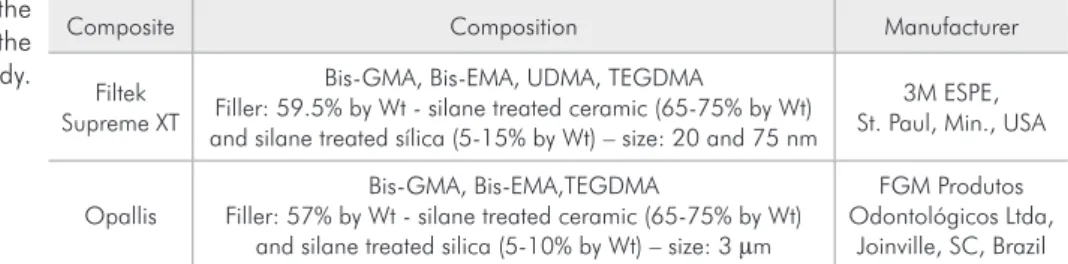
The commercial names, composition, and manu-facturers of the resins used are listed in Table 1.
Specimens were divided into groups (n = 5 each) according to the light-curing irradiance (EliparTM Freelight 2 [EF], 3M ESPE, St. Paul, USA, 1250 mW/
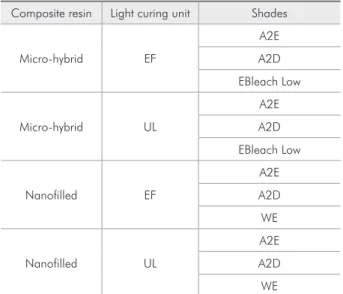
cm²; Ultralume 5 [UL], Ultradent Products Inc., South Jordan, USA, 850 mW/cm²) and shades (Su-preme – A2E, A2D, and WE; Opallis – A2E, A2D, and EBleach Low). The experimental groups are listed in Table 2. The wavelength spectra and peak emissions of tested LEDs are presented in Figure 1.
Specimens were prepared with a metallic matrix (5 mm ∅ and 2 mm height). Composite resin was in-serted in a single increment. A mylar strip and 500 g weight were placed over the mold and left for 20 s, to allow for better accommodation of the composite. Specimens were light cured according to the manu-facturers’ instructions (20 s with Filtek Supreme A2E/A2D/WE and Opallis A2E/ EBleach Low; or 40 s with Opallis A2D) with the light-curing unit corresponding to each group. Specimens were stored for 24 h at 37 °C under light-protected and dry
Figure 1 - Light spectrum profiles emitted by the light-curing units. Elipar Freelight 2 presented an emission spectrum be-tween 415 and 520 nm. Ultralume 5 presented a spectrum similar to that of Elipar Freelight 2; however, its wavelength spectrum was extended, with initiation at 385 nm and a peak at 405 nm. Both light-curing units had a peak at 454 nm.
Composite Composition Manufacturer
Filtek Supreme XT
Bis-GMA, Bis-EMA, UDMA, TEGDMA
Filler: 59.5% by Wt - silane treated ceramic (65-75% by Wt) and silane treated sílica (5-15% by Wt) – size: 20 and 75 nm
3M ESPE, St. Paul, Min., USA
Opallis Filler: 57% by Wt - silane treated ceramic (65-75% by Wt) Bis-GMA, Bis-EMA,TEGDMA and silane treated silica (5-10% by Wt) – size: 3 µm
FGM Produtos Odontológicos Ltda,
Joinville, SC, Brazil Bis-GMA (Bisphenol A Diglycidyl Ether Methacrylate), Bis-EMA (Bisphenol A Polyethylene Glycol Diether Dimeth-acrylate), TEGDMA (Triethylene Glycol DimethDimeth-acrylate), UDMA (Diurethane Dimethacrylate).
conditions. After this period, both the top and bot-tom surfaces were polished with abrasive papers of decreasing grit (400, 600, and 1200, Buehler Ltd., Lake Bluff, USA) to analyze monomer conversion.
The DC of the composite resin was measured on the bottom and top surfaces of each specimen. Measurements were performed with Fourier Trans-form infrared spectroscopy (FTIR - Spectrum 100
Optica; PerkinElmer, USA), equipped with an at-tenuated total relectance (ATR) device, in a room with controlled temperature and humidity. The DC (%) was evaluated in the absorbance mode with a baseline technique12 and was traced by the Spectrum
program (Spectrum 100 Optica; PerkinElmer, USA). The DC was calculated with an equation consider-ing the intensity of the C=C stretchconsider-ing vibration (peak height) at 1638 cm-1 and, as an internal
stan-dard, with symmetric ring stretching at 1608 cm-1.
The DC results were statistically analyzed by split-plot two-way ANOVA and Tukey test (α = 0.05) with the SAS 9.1 software package (SAS Institute, Cary, USA).
Results
Table 3 shows the results obtained in the present study. A signiicant interaction was found between the variables “composite resin” and “light source” (p < 0.01). Specimen tops showed better DC values than specimen bottoms. The nanoilled composite resin presented lower DC values than the microhy-brid resin in all situations, except for the A2E shade (bottom), which presented similar results. The high-irradiance LED (Elipar) showed better DC values than the third-generation LED (Ultralume 5). Table 2 - Experimental groups according to the light-curing
unit, type, and shade of composite resin.
Composite resin Light curing unit Shades
Micro-hybrid EF
A2E A2D EBleach Low
Micro-hybrid UL
A2E A2D EBleach Low
Nanofilled EF
A2E A2D WE
Nanofilled UL
A2E A2D WE
Light curing unit Composite resin and shades Surface
Top Bottom
EF
Micro-hybrid EBleach Low 59.3 (3.7) Ba 52.2 (3.6) Ab Micro-hybrid A2D 63.5 (1.4) ABa 54.0 (2.0) Ab Micro-hybrid A2E 66.3 (10.3) Aa 55.4 (3.7) Ab @
Nanofilled WE 53.2 (2.8) Ca 47.9 (2.3) Bb Nanofilled A2D 53.3 (4.7) Ca 37.7 (1.3) Cb Nanofilled A2E 55.9 (1.3) Ca 49.3 (3.8) ABb
UL
Micro-hybrid EBleach Low 57.7 (1.6) Ba 55.4 (2.4) Ab Micro-hybrid A2D 62.9 (2.5) ABa 51.5 (2.1) Ab Micro-hybrid A2E 64.7 (1.1) Aa 54.4 (0.9) Ab *
Nanofilled WE 49.7 (5.9) Ca 44.9 (5.1) Bb Nanofilled A2D 51.5 (8.1) Ca 31.8 (2.7) Cb Nanofilled A2E 55.5 (1.8) Ca 47.9 (3.1) ABb Different letters indicate statistically significant difference (two-way ANOVA/Tukey’s Test, p < 0.05). Upper- and lower-case letters compare resin on columns and surfaces on lines, respectively. */@ indicate differences among the light-curing units.
Table 3 - Percent means (standard deviations) of the degree of conversion, according to the
Discussion
According to the current results, the resin shade and LED irradiance can affect the DC of the com-posite resin. Therefore, the null hypothesis of this study must be rejected.
The specimen bottoms (2 mm height) presented lower DC values than the tops. This result can be explained by the increased distance between the light-curing tip and bottom of the composite, which attenuates light activation at the bottom surface and compromises the extent of curing.13,14 Similarly,
Beun et al.15 showed a progressive reduction in DC
depending on the specimen thickness when either QTH or LED was used.
The microhybrid resin promoted better conver-sion than the nanoilled resin. According to some studies, the DC is inluenced by the organic content, because characteristics such as reactivity and mono-mer mobility are related to the formation of poly-meric chains.16,17 The higher amount of iller present
in the nanoilled resin could inluence the results by promoting a lower DC.
Nanoilled composites are characterized by the wide distribution of nanosized iller particles. This characteristic improves the mechanical properties of the resin. Nevertheless, due to the higher amount of iller, a reduction in the organic matrix can be observed in the interfacial region between the parti-cles. This reduction alters the DC, which is directly related to the concentration of monomer content.18
In addition, a reduced light intensity reaches the photoinitiator, due to the proximity of the illers. As a result, the formation of free radicals (which are re-sponsible for the curing process) is reduced.
No differences were observed among the nano-iller resins in terms of the shades on the top sur-faces. However, EBleach Low (which was developed to restore bleached teeth) showed lower DC values with the microhybrid resins. It can be speculated that EBleach Low presents an alternative photoini-tiator, because camphorquinone has a yellow color-ation.19 Alternative initiators are activated at
differ-ent wavelengths that are not provided by the LEDs used, due to the short spectrum of light that they emit, which compromises the curing eficacy of this material.20 Because manufacturers are usually
reluc-tant to reveal the exact compositions of their prod-ucts,21 it is not possible to determine whether this
situation explains the current results completely. Greater DC values and similar results were ob-served among the microhybrid resins on the speci-men bottoms. However, the nanoilled resin A2D showed a reduced DC compared to the other shades. As described above, use of high amounts of iller can reduce the formation of free radicals and com-promise the DC.18 The high amount of iller and
reduced translucency of this resin likely interfered with the passage of light through the material and decreased the monomeric conversion. This problem was not observed with the microhybrid resin, prob-ably because of the extended curing time applied to shade A2D. The manufacturer’s instructions were followed rigidly, because manufacturers generally recommend the best way to use their materials to obtain optimal results. Nevertheless, use of the ex-tended curing time could have promoted improved monomer conversion of the tested nanoilled resins.
Use of high-irradiance LED (1250 mW/cm²) re-sulted in the best DC values. Despite having narrow wavelength spectra (between 415 and 520 nm), the LEDs tested presented a peak emission of around 454 nm (Figure 1). This peak emission is near the ab-sorption peak of camphorquinone (470 nm), which was the photoinitiator used in the resins evaluated. Because the two LEDs displayed similar wavelength spectra, the high irradiance of Elipar FreeLight was most likely responsible for the obtained results. The third-generation LED used (Ultralume 5) has auxil-iary LEDs, which expanded the emitted wavelength spectrum22 (Figure 1). However, due to the
proxim-ity of the light source to the specimen at the moment of curing, the advantage of the auxiliary LEDs was not fully realized. As a result, the optimal perfor-mance of this LED was restricted.
Conclusion
The DC of composite resin is inluenced by the light source, with high-irradiance LEDs promoting better DC values. Specimen bottoms presented low-er DC values in all situations tested, and the nano-illed resin presented lower means of DC. The shade can inluence the DC of the top of microhybrid res-ins and the bottom of nanoilled resres-ins.
Acknowledgements
This research was partially supported by the Fundação de Amparo à Pesquisa do Estado de São Paulo (Grants: #2007/02800-3; #2009/08992-7; #2009/03763-0 and #2009/03661-2) and Consel-ho Nacional de Pesquisa e Desenvolvimento – PQ/ CNPq (Grant: #304076/2009-0).
References
1. Kim BJ, Lee YK. Influence of the shade designation on the color difference between the same shade-designated resin com-posites by the brand. Dent Mater. 2009 Sep;25(9):1148-54. 2. Swift EJ Jr, Hammel SA, Lund PS. Colorimetric evaluation
of vita shade resin composites. Int J Prosthodont. 1994 Jul-Aug;7(4):356-61.
3. Lee YK, Lim BS, Rhee SH, Yang HC, Powers JM. Color and translucency of A2 shade resin composites after cur-ing, polishing and thermocycling. Oper Dent. 2005 Jul-Aug;30(4):436-42.
4. Ogunyinka A, Palin WM, Shortall AC, Marquis PM. Photo-initiation chemistry affects light transmission and degree of conversion of curing experimental dental resin composites. Dent Mater. 2007 Jul;23(7):807-13.
5. da Silva EM, Poskus LT, Guimaraes JG. Influence of light-polymerization modes on the degree of conversion and me-chanical properties of resin composites: a comparative analysis between a hybrid and a nanofilled composite. Oper Dent. 2008 May-Jun;33(3):287-93.
6. da Silva EM, Poskus LT, Guimaraes JG, de Araujo Lima Bar-cellos A, Fellows CE. Influence of light polymerization modes on degree of conversion and crosslink density of dental com-posites. J Mater Sci Mater Med. 2008 Mar;19(3):1027-32. 7. Jimenez-Planas A, Martin J, Abalos C, Llamas R.
Devel-opments in polymerization lamps. Quintessence Int. 2008 Feb;39(2):e74-84.
8. Leonard DL, Charlton DG, Roberts HW, Cohen ME. Polym-erization efficiency of LED curing lights. J Esthet Restor Dent. 2002;14(5):286-95.
9. Chen YC, Ferracane JL, Prahl SA. Quantum yield of con-version of the photoinitiator camphorquinone. Dent Mater. 2007 Jun;23(6):655-64.
10. Uhl A, Sigusch BW, Jandt KD. Second generation LEDs for the polymerization of oral biomaterials. Dent Mater. 2004 Jan;20(1):80-7.
11. Faria-e-Silva AL, Lima AF, Moraes RR, Piva E, Martins LR. Degree of Conversion of Etch-and-Rinse and Self-etch Ad-hesives Light-cured Using QTH or LED. Oper Dent. 2010 Nov-Dec;35(6):649-54.
12. Rueggeberg FA, Hashinger DT, Fairhurst CW. Calibration of FTIR conversion analysis of contemporary dental resin composites. Dent Mater. 1990 Oct;6(4):241-9.
13. Jandt KD, Mills RW, Blackwell GB, Ashworth SH. Depth of cure and compressive strength of dental composites cured with blue light emitting diodes (LEDs). Dent Mater. 2000 Jan;16(1):41-7.
14. Froes-Salgado NR, Pfeifer CS, Francci CE, Kawano Y. Influ-ence of photoactivation protocol and light guide distance on conversion and microleakage of composite restorations. Oper Dent. 2009 Jul-Aug;34(4):408-14.
15. Beun S, Glorieux T, Devaux J, Vreven J, Leloup G. Charac-terization of nanofilled compared to universal and microfilled composites. Dent Mater. 2007 Jan;23(1):51-9.
16. Sideridou I, Tserki V, Papanastasiou G. Effect of chemical structure on degree of conversion in light-cured dimethacry-late-based dental resins. Biomaterials. 2002 Apr;23(8):1819-29.
17. Lovell LG, Newman SM, Bowman CN. The effects of light intensity, temperature, and comonomer composition on the polymerization behavior of dimethacrylate dental resins. J Dent Res. 1999 Aug;78(8):1469-76.
18. Turssi CP, Ferracane JL, Vogel K. Filler features and their ef-fects on wear and degree of conversion of particulate dental resin composites. Biomaterials. 2005 Aug;26(24):4932-7. 19. Shin DH, Rawls HR. Degree of conversion and color stability
of the light curing resin with new photoinitiator systems. Dent Mater. 2009 Aug;25(8):1030-8.
20. Arikawa H, Takahashi H, Kanie T, Ban S. Effect of various visible light photoinitiators on the polymerization and color of light-activated resins. Dent Mater J. 2009 Jul;28(4):454-60. 21. Van Landuyt KL, Snauwaert J, De Munck J, Peumans M,
Yoshida Y, Poitevin A, et al. Systematic review of the chemical composition of contemporary dental adhesives. Biomaterials. 2007 Sep;28(26):3757-85.