Glaucia Marengo(a)
Ana Paula Borges de Paola(a) Fernanda Morais Ferreira(b) Eduardo Pizzatto(a)
Gisele Maria Correr(a) Estela Maris Losso(a)
(a)Masters Program in Clinical Dentistry, School of Dentistry,Univ Positivo, Curitiba, PR, Brazil.
(b)Masters Program in Dentistry, Department of Stomatology, School of Dentistry, Univ Federal do Paraná - UFPr, Curitiba, PR, Brazil.
Corresponding Author: Estela Maris Losso E-mail: [email protected]
Child abuse: validation of a
questionnaire translated into Brazilian
Portuguese
Abstract: This study sought to validate the Portuguese translation of a questionnaire on maltreatment of children and adolescents, developed by Russell et al. and to test its psychometric properties for use in Brazil. The original questionnaire was translated into Portuguese using a stan-dardized forward-backward linguistic translation method. Both face and content validity were tested in a small pilot study (n = 8). In the main study, a convenience sample of 80 graduate dentistry students with dif-ferent specialties, from Curitiba, PR, Brazil, were invited to complete the inal Brazilian version of the questionnaire. Discriminant validity was assessed by comparing the results obtained from the questionnaire for different specialties (pediatric dentistry, for example). The respondents completed the questionnaire again after 4 weeks to evaluate test-retest reliability. The comparison of test versus retest questionnaire answers showed good agreement (kappa > 0.53, intraclass correlation > 0.84) for most questions. In regard to discriminant validity, a statistically signii-cant difference was observed only in the experience and interest domains, in which pediatric dentists showed more experience with and interest in child abuse compared with dentists of other specialties (Mann-Whitney test, p < 0.05). The Brazilian version of the questionnaire was valid and reliable for assessing knowledge regarding child abuse by Portuguese-speaking dentists.
Descriptors: Child Abuse; Dentists; Questionnaires; Validation Studies.
Introduction
According to the Brazilian Ministry of Health, violence against chil-dren and adolescents is the great challenge of the century, and incurs high economic and social costs for both the federal government and fam-ilies.1 The Network of Protection for Children and Adolescents at Risk
for Violence, an organization associated to the City Hall of Curitiba, PR, reported data revealing 4,735 suspected or proven cases of child abuse in 2009, including cases of neglect (66%), physical abuse (15%), sexual abuse (10%), psychological abuse (6.9%), and abandonment (1%). The age of the children ranged from 5 to 14 years of age, although violence was recorded in cases of children from as young as prenatal age up to 18 years of age. Similar data were reported in 2008.2
Maltreatment is any action or omission by an adult that results in physical, emotional, intellectual, or social harm to a child or adolescent.
Declaration of Interests: The authors certify that they have no commercial or associative interest that represents a conflict of interest in connection with the manuscript.
Submitted: Oct 21, 2012
Maltreatment is classiied according to the type of abuse, including physical violence, sexual violence, psychological violence, and neglect. However, these categories overlap because all forms of maltreatment have psychological sequelae.1,3
Roughly 50% to 65% of the physical injuries in cases of child abuse occur to the head, neck, face, and mouth. These regions are easily seen by a dentist because the face accounts for 41% of abuse injuries. The lips are the most affected area, followed by oral mucosa, teeth, gum, and the tongue.4-6 Therefore,
dentists are in an ideal position to detect signs of abuse, and should be able to recognize these signs.
Health professionals in Brazil have a legal obli-gation to report cases of suspected abuse against children and adolescents, based on Brazil’s Federal Constitution and its Statute of the Child and Ado-lescent.7 Studies in several countries have reported
the dificulties that dentists face in diagnosing, docu-menting, and reporting suspected cases of abuse. As a result, these cases have gone underreported.8-19
Child maltreatment studies among dentists, using a validated instrument, are important because they make it possible to evaluate how well these profes-sionals can recognize physical abuse signs in chil-dren, and can help develop strategies to change den-tists’ behavior toward reporting cases of child abuse, thus improving reporting results.
Brazil currently lacks validated research instru-ments on child maltreatment, causing limitations to researchers. There are two alternatives: either devel-op new questionnaires or else translate, adapt, and validate existing ones. However, the development of a new questionnaire makes comparisons with mal-treatment data from different parts of the world dif-icult, unlike the use of a translated and validated instrument.20
Therefore, the present study sought to translate into Brazilian Portuguese and validate the question-naire developed by Russell et al.10 as a research
in-strument to assess child maltreatment.
Methodology
The questionnaire developed by Russell et al.10
was selected for this study. This instrument was de-veloped in English and consists of four parts. The
irst part refers to the social and demographic iden-tiication of the professional. The second part refers to prior experience with maltreatment (including six “yes” or “no” closed questions). The third part refers to the healthcare professional’s knowledge, diagnosis, and conduct, and includes six questions (one “yes” or “no” closed question, two on a 0–10 scale, and three open questions). The fourth part re-fers to interest in involvement with the subject, and includes three questions (two closed questions and one on a 0–10 scale).
The research methodology included the follow-ing steps:
• translation, • back-translation, • cultural adaptation, and
• both content and psychometric validation.21
A pilot test was conducted with eight dentistry professors at Positivo University to evaluate ques-tionnaire understanding and to validate its content. All of the professors had extensive knowledge of English and answered the original questionnaire in English, as well as the translated one in Portuguese.
They then evaluated each question of the ques-tionnaire, attributing the following scores:
• 0 (I did not understand anything), • 1 (I understood just a little), • 2 (I understood it in part),
• 3 (I understood almost everything, but had some doubts),
• 4 (I understood almost everything),
• 5 (I understood it perfectly and had no doubts).
Scores 0, 1, 2, and 3 were rated as insuficient understanding, and scores 4 and 5 as suficient un-derstanding, as suggested by Conti et al.22 A score
• a group more closely related to the topic (i.e., pe-diatric dentistry students) and
• another group composed of graduate students from other specialties.
The Mann-Whitney test was used to assess dis-criminant validity. SPSS software version 15.0 (Sta-tistical Package for the Social Sciences, Chicago, IL, USA) was used to analyze the data, and a 5% sig-niicance level was adopted for all of the statistical analyses.
The study was performed following approval by the Research Ethics Committee of Positivo University (protocol no. 117/2011) and permission from the au-thors of the original questionnaire (Russell et al.).10
Results
Table 1 summarizes the answers to closed and scale questions of the questionnaire. Tables 2 and 3 show the comparisons of the questionnaire test and retest answers, demonstrating good agreement (kap-pa > 0.53, ICC > 0.84) for most of the questions.
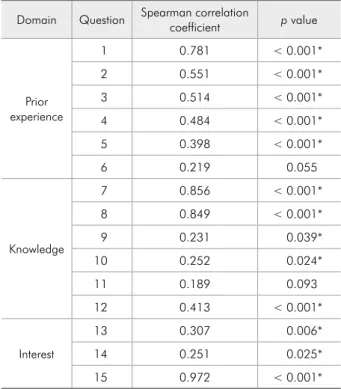
A signiicant correlation was found for all of the questions in regard to the analysis of each question within its domain, with the exception of questions 6 and 11 (Table 4).
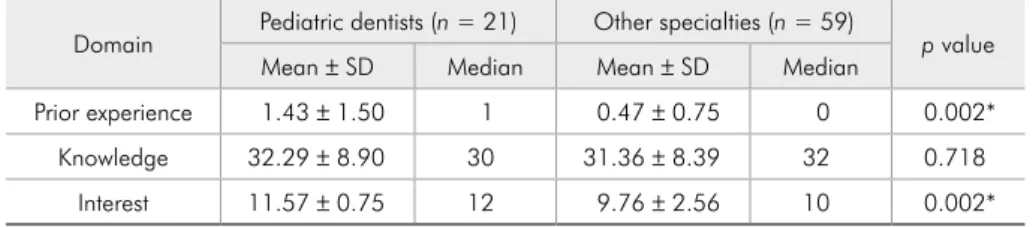
In regard to discriminant validity, a statistically signiicant difference was observed only in the ex-perience and interest domains, in which pediatric dentists showed more experience with and interest in child abuse, compared with dentists from other specialties (Mann-Whitney test, p < 0.05; Table 5).
Discussion
The number of respondents in the sample of this study was close to the number of respondents in other questionnaire translation and validation stud-ies.24,25 The form of the application of the instrument
(self-application) was the same as that used in the original questionnaire.10 This form of application
was also used in other studies, and did not affect the psychometric evaluation of the instrument.25,26
The questionnaire test and retest were performed at an interval of 26 to 30 days between the irst and the second application; this is consistent with other studies.19-21 The assessment of internal consistency
translation of the legend showing “0 - unable” and “10 - proicient,” for which respondents suggested that the word “proicient” should be replaced by “able to recognize” (question 7), “able to diagnose” (question 8), and “willing to get involved in the de-tection” (question 15).
Question 13 was modiied in the adaptation pro-cess. The initial translation stated, “…how to identify and on the mechanism for reporting suspicions…”; the amendment changed the terms to “how to iden-tify and report suspicions…” A inal version of the questionnaire was developed in Portuguese with these modiications.
The inal version of the translated questionnaire was applied to 80 graduate dentistry students with different specializations at Positivo University, Curi-tiba, PR, Brazil. The questionnaire was self-applied. The questionnaires were retested 26 to 30 days after the initial application.
Test-retest reliability was calculated using the kappa coeficient and intraclass correlation coefi-cient (ICC). Bartko23 classiication was used to
mea-sure the ICCs.
The irst part of the questionnaire, related to the professional’s personal identiication, was not considered, in order to afford a better psychomet-ric analysis of the instrument itself. The remaining parts were divided into three domains:
• prior experience (questions 1–6), • knowledge (questions 7–12), and • interest (questions 13–15).
The answers to the closed questions were scored as 1 (“yes”) or 0 (“no”). The open questions were categorized as coherent or incoherent answers, and scored the same way as the closed questions. The an-swers to questions 7, 8, and 15 were already in the form of a scale and were not changed. The proper response of the questions was used to conduct the evaluation. The values of each question were later added together.
Table 2 - Internal test-retest consistency (kappa values).
Questions Kappa p value
1 0.812 < 0.001
2 0.772 < 0.001
3 0.672 < 0.001
4 0.531 < 0.001
5 0.388 < 0.001
6 1.000 < 0.001
9 0.645 < 0.001
13 0.640 < 0.001
14 0.573 < 0.001
Table 3 - Internal consistency (interclass correlation coef-ficient values).
Questions Interclass correlation coefficient 95% confidence interval
7 0.85 0.76–0.90
8 0.83 0.74–0.89
15 0.88 0.81–0.92
Table 4 - Spearman correlation coefficient values for each question within its domain.
Domain Question Spearman correlation coefficient p value
Prior experience
1 0.781 < 0.001*
2 0.551 < 0.001*
3 0.514 < 0.001*
4 0.484 < 0.001*
5 0.398 < 0.001*
6 0.219 0.055
Knowledge
7 0.856 < 0.001*
8 0.849 < 0.001*
9 0.231 0.039*
10 0.252 0.024*
11 0.189 0.093
12 0.413 < 0.001*
Interest
13 0.307 0.006*
14 0.251 0.025*
15 0.972 < 0.001*
Questions*
1. In your professional experience, have you ever seen a suspicious case of physical abuse among your child patients?
Yes No
20 (25%) 60 (75%)
2. Have you ever reported a suspicious case of child physical abuse among your patients?
Yes No
11 (12.7%) 69 (86.3%)
3. Did you see any case of child orofacial trauma in the last six months?
Yes No
14 (17.5%) 66 (82.5%) 4. Did you see any suspicious case
of child physical abuse in the last 6 months?
Yes No
8 (10%) 72 (90%) 5. Did you see any definite case
of physical abuse in the last 6 months?
Yes No
4 (5%) 76 (95%) 6. Did you report any suspicious
or definite case of child physical abuse to authorities in the last 6 months?
Yes No
1 (1.3%) 79 (98.7%)
7. Using a scale from 0–10, to what extent can you recognize signs and symptoms of child physical abuse?
Median (Min-Max)
6 (4.5–7)
8. Using a scale from 0–10, to what extent can you effectively diagnose child physical abuse? 0_1_2_3_4_5_6_7_8_9_10
Median (Min-Max)
5 (4–7)
9. Do you know any mechanism for reporting child physical abuse (e.g., name of an agency to which suspicious cases should be reported, legal procedures to report)?
Yes No
46 (57.5%) 34 (42.5%)
13. Do you want further training on how to identify and on the mechanism for reporting suspicions of possible child physical abuse (e.g. courses, workshops)?
Yes No
75 (93.7%) 5 (6.3%)
14. Do you think that identification and reporting mechanisms of suspicions of possible child physical abuse should be part of vocational training courses?
Yes No
75 (93.7%) 5 (6.3%)
15. Using a scale from 0–10, to what extent are you willing to get involved in detecting child physical abuse?
Median (Min-Max)
10 (7–10) Table 1 - Responses of dentists to the questionnaire on child abuse (n = 80).
showed that most of the questions ranged in agree-ment from acceptable to excellent. The type of ques-tion (e.g., scale) may have contributed to the excel-lent degree of agreement obtained for questions 7, 8, and 15. Only question 5 had fair agreement. This could be related to a misunderstanding of the word “conirmed.” The respondents may have had doubts during the second application of the questionnaire, seeing that this question was very similar to question 4, which contains the word “suspicious.” The Spear-man correlation coeficient was used to analyze each question within its domain. Signiicant agree-ment was found for most of the questions, with the exception of question 6 (prior experience domain) and question 11 (knowledge domain). Question 11, which was an open question, could have con-fused respondents, insofar as the statement of this question was similar to that of question 10. Some respondents answered question 11 as “the same as question 10,” not paying attention to the actual con-tent of the question. This shows a lack of knowledge of the subject by the respondents, because they con-fused the words “suspicious” and “conirmed.”
In regard to the comparison between pediatric dentists and dentists from other specialties, a statis-tically signiicant difference was found only in the prior experience and the interest domains. The pe-diatric dentist group presented higher mean scores in these domains than the other group. This can be explained by the fact that these professionals have greater contact with children and adolescents. How-ever, no difference was found between these groups in the knowledge domain. This demonstrates that all of the respondents, regardless of their specialty, encountered dificulties in regard to knowledge (i.e., diagnosis and management of child and adolescent abuse). These results are similar to those of previous
national and international studies in this ield.10,13,18
Accordingly, this validated questionnaire may be useful for investigating the degree of dificulty that health professionals have in relation to this subject and for developing forms of guidance and education regarding child abuse.
The present study has some limitations, such as the lack of a gold standard instrument that evalu-ates knowledge regarding child abuse and to which the results of the translated questionnaire could be compared. Another limitation is that the question-naire is not originally a scale, requiring some adjust-ments to allow psychometric analyses.
The instrument developed by Russell et al.10 was
selected for this study because it is easy to apply and interpret. These characteristics were maintained af-ter translation and adaptation. This questionnaire is a tool that aims at obtaining epidemiological data and can help in the learning process regarding child maltreatment, and also help determine if health pro-fessionals are capable of diagnosing and reporting cases of abuse, or if speciic training is needed for this purpose. It also provides information to devise strategies for healthcare professionals, especially dentists and their staff, who work directly with chil-dren and adolescents.
Conclusions
The results of the present study indicate that the Brazilian version of the questionnaire developed by Russell et al.10 was easy to understand by dentists
and had good psychometric properties (i.e., reliabil-ity, reproducibilreliabil-ity, and internal consistency). This instrument can be considered reliable for research purposes or comparative literature-related purposes. It may also help resolve the doubts of healthcare professionals regarding child maltreatment.
Table 5 - Mean ± standard deviation (SD) and median scores of the groups (pediatric dentists and other specialties) in the discriminant validity analysis.
Domain Pediatric dentists (n = 21) Other specialties (n = 59) p value Mean ± SD Median Mean ± SD Median
Prior experience 1.43 ± 1.50 1 0.47 ± 0.75 0 0.002* Knowledge 32.29 ± 8.90 30 31.36 ± 8.39 32 0.718
References
1. Brasil. Ministério da Saúde. Impacto da violência na saúde das crianças e adolescentes: prevenção de violências e promoção da cultura de paz [Internet]. Brasília (DF): Ministério da Saúde; 2010 [cited 2012 Sep 2]. 16 p. Available from: http://www. saude.gov.br/bvs.
2. Curitiba. Relatório da rede de proteção à criança e adolescente em situação de risco para a violência. [Internet]. Curitiba: Secretaria Municipal de Saúde; 2009 [cited 2012 Sep 2]. 29 p. Available from: http://sitesms.curitiba.pr.gov.br/saude/ar-eastematicas/saude_crianca/relatorioperfilrede 2009. 3. American Academy of Pediatrics Committee on Child Abuse
and Neglect; American Academy of Pediatric Dentistry; Amer-ican Academy of Pediatric Dentistry Council on Clinical Af-fairs. Guideline on oral and dental aspects of child abuse and neglect. Pediatr Dent. 2008-2009;30(7 Suppl):86-9. 4. Cavalcanti AL. Prevalence and characteristics of injuries to the
head and orofacial region in physically abused children and adolescents: a retrospective study in a city of the Northeast of Brazil. Dent Traumatol. 2010 Apr;26(2):149-53.
5. Naidoo S. A profile of the oro-facial injuries in child physi-cal abuse at a children’s hospital. Child Abuse Negl. 2000 Apr;24(4):521-34
6. Cairns AM, Mok JY, Welbury RR. Injuries to the head, face, mouth and neck in physically abused children in a community setting. Int J Paediatr Dent. 2005 Sep;15(5):310-8.
7. Brasil. Lei n. 8069 de 13 de julho de 1990. Estatuto da Criança e do Adolescente. Brasília (DF): Presidência da República; 1990 [cited 2012 Sep 2]. Available from: http://www.planalto.gov.br/ ccivil_03/leis/l8069.htm.
8. John V, Messer LB, Arora R, Fung S, Hatzis E, Nguen T, et al. Child abuse and dentistry: a study of knowledge and attitudes among dentists in Victoria, Australia. Aust Dent J. 1999 Dec;44(4):259-67.
9. Bsoul SA, Flint DJ, Dove SB, Senn DR, Alder ME. Reporting of child abuse: a follow-up survey of Texas dentists. Pediatr Dent. 2003 Nov-Dec;25(6):541-5.
10. Russell M, Lazenbatt A, Freeman R, Marcenes W. Child physi-cal abuse: health professionals’ perceptions, diagnosis, and responses. Br J Community Nurs. 2004 Aug;9(8):332-8 11. Andrade-Lima K, Colares V, Cabral HM. [Evaluation of
pe-diatric dentist’s attitudes towards the child abuse in Recife]. Rev Odonto Cien. 2005 Jul-Ago;20(49):231-6. Portuguese. 12. Cairns AM, Mok JYQ, Welbury RR. The dental prac-titioner and child protection in Scotland. Br Dent J. 2005 Oct;199(8):517-20
13. Lazenbatt A, Freeman R. Recognizing and reporting child physical abuse: a survey of primary healthcare professionals. J Adv Nurs. 2006 Nov;56(3):227-36.
14. Thomas JE, Straffon L, Inglehart MR. Knowledge and pro-fessional experiences concerning child abuse: an analysis of
provider and student responses. Pediatr Dent. 2006 Sep-Oct;28(5):438-44.
15. Manea S, Favero GA, Stellini E, Romoli L, Mazzucato M, Facchin P. Dentists’ perceptions, attitudes, knowledge, and experience about child abuse and neglect in northeast Italy. J Clin Pediatr Dent. 2007 Fall;32(1):19-25.
16. Owais AI, Qudeimat MA, Qodceih S. Dentists’ involvement in identification and reporting of child physical abuse: Jordan as a case study. Int J Paediatr Dent. 2009 Jul;19(4):291-6. 17. Uldum B, Christensen HN, Welbury R, Poulsen S. Danish
dentists’ and dental hygienists’ knowledge of and experience with suspicion of child abuse or neglect. Int J Paediatr Dent. 2010 Sep;20(5):361-5.
18. El Sarraf MC, Marengo G, Correr GM, Pizzatto E, Losso EM. Physical child abuse: perception, diagnosis, and manage-ment by southern Brazilian pediatric dentists. Pediatr Dent. 2012 Jul-Aug;34:e72-6.
19. Azevedo MS, Goettems ML, Brito A, Possebon AP, Domingues J, Demarco FF, et al. Child maltreatment: a survey of dentists in southern Brazil. Braz Oral Res. 2012 Jan-Feb;26(1):5-11. 20. Goursand D, Paiva SM, Zarzar PM, Ramos-Jorge ML, Cor-nacchia GM, Pordeus IA, et al. Cross-cultural adaptation of the Child Perceptions Questionnaire 11-14 (CPQ11-14) for the Brazilian Portuguese Language. Health Quality Life Out-comes. 2008 Jan;6:1-7.
21. Herdman M, Fox-Rushby J, Badia X. “Equivalence” and the translation and adaptation of health-related quality of life questionnaires. Qual Life Res. 1997 Apr;6(3):237-47. 22. Conti MA, Slater B, Latorre MRDO.[Validity and
repro-ducibility of Escala de Evaluación da Insatisfación Cor-poral para Adolescentes]. Rev Saude Publica. 2009 May-Jun;43(3):515-24. Portuguese.
23.Bartko JJ. The intraclass correlation coefficient as a measure of reliability. Psychol Rep. 1966 Aug;19(1):3-11.
24. Scarpelli AC, Paiva SM, Pordeus IA, Varni JW, Viegas CM, Al-lison PJ. The Pediatric Quality of Life InventoryΤΜ (PedsQLΤΜ) family impact module: reliability and validity of the Brazilian version. Health Qual Life Outcomes. 2008 May;6:1-8. 25. Goursand D, Paiva SM, Zarzar PM, Pordeus IA, Grochowski
R, Allison PJ. Measuring parental-caregiver perceptions of child oral health-related quality of life: psychometric prop-erties of the Brazilian version of the P-CPQ. Braz Dent J 2009 Jan; 20(2):169-74.