IX
Radiol Bras. Set/Out;44(5):IX–XI
Marcelo Souto Nacif1, Ricardo Oliveira Falcão2, Arilton José dos Santos Carvalhal3
Study developed at Plani Diagnósticos Médicos por Imagem, São José dos Campos, SP, Brazil. 1. PhD, Professor, Universidade Federal Fluminense (UFF), Niterói, RJ, Advisor in Cardiac Imaging, Plani Diagnósticos Médicos por Imagem, São José dos Campos, SP, Brazil. 2. MD, Radiologist, Coordinator for the Group of Internal Medicine, Plani Diagnósticos Médicos por Imagem, São José dos Campos, SP, Brazil. 3. Medical Director, Plani Diagnósticos Médicos por Imagem, São José dos Campos, SP, Brazil. Mailing Address: Dr. Marcelo Souto Nacif. 4853 Cordell Avenue, 419. Bethesda, MD, USA. E-mail: [email protected]
0100-3984 © Colégio Brasileiro de Radiologia e Diagnóstico por Imagem
WHICH IS YOUR DIAGNOSIS?
Nacif MS, Falcão RO, Carvalhal AJS. Which is your diagnosis? Radiol Bras. 2011 Set/Out;44(5):IX–XI.
A male, 16-year-old, asymptomatic pa-tient presented murmur at cardiac auscul-tation. Echocardiography demonstrated
that such a murmur was related to morpho-functional alteration in the valve apparatus of the right heart. The patient was referred
to undergo cardiac magnetic resonance imaging (CMRI).
Figure 2. Images acquisition with ECG-gating. Delayed enhancement, long axis four-chambers. (A)and(B), dif-ferent planes.
X Radiol Bras. 2011 Set/Out;44(5):IX–XI
Images description
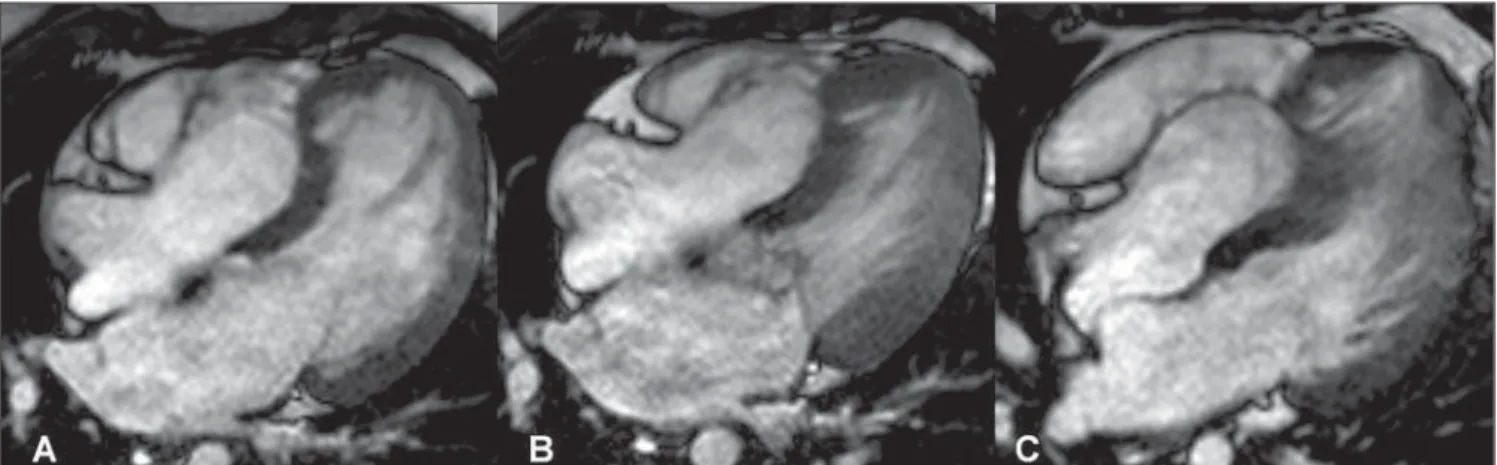
Figure 1. Images acquisition with
ECG-gating, in cine-Fiesta sequence (SSFP), long axis four-chambers. (A) at diastole, (B) systole and (C) mid-diastole. Note the apical displacement of the tricuspid valve apparatus into the right ventricle, with in-crease in volume of the right atrium and partial fusion of the leaflets with the sep-tal heart muscle, causing deformity of the left ventricle apex.
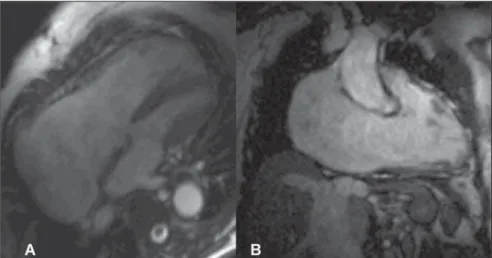
Figure 2. Images acquisition with
ECG-gating. Delayed enhancement, long axis four-chambers. (A) and (B), different planes. Note the positive delayed enhancement on the middle third of the septum.
Diagnosis: Ebstein’s anomaly with
sep-tal fibrosis
COMMENTS
For more than 20 years CMRI has been utilized as a reference method in the study of congenital cardiopathies, particularly those of the right ventricle. The capability to perform a functional evaluation with measurements of flow and gradient in as-sociation with an anatomical study of the heart and great vessels allows an almost complete evaluation for the purposes of surgical planning and patients follow-up(1,2).
Ebstein’s anomaly is a rare congenital cardiopathy found in only 0.5–1% of cases in necropsies and may cause cyanosis at birth. Such anomaly is characterized by a tricuspid valve malformation associated with its displacement towards the apex of the right ventricle (atrialization)(1,2).
The clinical condition progression var-ies and depends upon the degree of valve dysfunction and malformation. Generally, death in the neonatal period is most com-monly caused by severe heart failure. Af-ter the neonatal period, arrhythmia and fa-tigue are the most frequent findings. Arrhythmias tend to present a higher inci-dence because of abnormalities in the car-diac conduction system, with a certain fre-quency generating cases of Wolff-Parkin-son-White syndrome, premature atrial or ventricular contractions, or presence of flutter/atrial fibrilation. Despite the pattern of involvement of the right ventricle, the left side may also be affected, particularly
because of abnormalities in the mitral valve and in the left ventricular contractility(2,3). The possibility of coexistence with other congenital cardiopathies that may affect the cardiac skeleton or the functional mechanics of the heart, such as interatrial communication, pulmonary valve stenosis, pulmonary atresia or non-compaction of the myocardium, among others, makes car-diac MRI a noninvasive diagnostic method to be performed before any other therapeu-tic procedure(1,4,5).
Volumetric study of heart’s chambers should be performed by means of a repro-ducible method, with low interobserver variability and without risks, particularly those originated by radiation exposure, since in many cases patients must undergo long-life follow-up(1).
The evaluation of myocardial delayed enhancement using CMRI allows the de-tection of fibrotic areas in the myocardial tissue. Recently, Nakamura et al.(5) reported the presence of myocardial fibrosis in the atrialized portion of the right ventricle in a 69-year-old patient. In the present case, the same finding was identified, but in a 16-year-old patient. However, the clinical im-plications related to the survival of patients with Ebstein’s anomaly with fibrosis in the childhood or youth are still to be under-stood.
In cases involving late diagnosis, the most characteristic imaging finding is the disproportion between right and left cavi-ties (Figure 3).
There are different modalities of treat-ment for Ebstein’s anomaly. In the neona-tal period, as the anomaly is very severe and the patient remains cyanotic even under ag-gressive drug and ventilatory therapy, plant is the best choice. However, trans-plants have been poorly successful because of the reduced size of the lungs. After the neonatal period, treatment options in-crease. For many years, the treatment of choice was only tricuspid valve replace-ment in association with reduction of the atrialized portion of the left ventricle. Re-cently, cone reconstruction has been more frequently used. Such procedure involves the creation of a tunnel-type structure with the tricuspid valve to help minimize post-procedural regurgitation. Interatrial septal defect, if present, is closed and the size of the right atrium is reduced. During the sur-gical procedure, it is necessary to reduce the number of probable pathological cir-cuits of electrical conduction(2,6–12).
Final considerations
Surgical treatment has been proposed in innumerable cases(6,7,9–11), but clinical evi-dences associated with cardiac MRI in the preoperative stratification will facilitate the understanding of the clinical outcomes for patients with Ebstein’s anomaly.
Cardiac MRI is essential in the nonin-vasive preoperative diagnosis of this con-dition. It is the authors’ opinion that the utilization of such imaging modality can influence the survival, particularly in the
XI
Radiol Bras. Set/Out;44(5):IX–XI
case of patients who will be submitted to electrophysiological interventions.
REFERENCES
1. Yalonetsky S, Tobler D, Greutmann M, et al. Cardiac magnetic resonance imaging and the as-sessment of ebstein anomaly in adults. Am J Cardiol. 2011;107:767–73.
2. Link KM, Herrera MA, D’Souza VJ, et al. MR imaging of Ebstein anomaly: results in four cases. AJR Am J Roentgenol. 1988;150:363–7.
3. Beerepoot JP, Woodard PK. Case 71: Ebstein anomaly. Radiology. 2004;231:747–51.
4. Bagur RH, Lederlin M, Montaudon M, et al. Im-ages in cardiovascular medicine. Ebstein anomaly
associated with left ventricular noncompaction. Circulation. 2008;118:e662–4.
5. Nakamura I, Kotooka N, Komori Y, et al. Ebstein anomaly by cardiac magnetic resonance imaging. J Am Coll Cardiol. 2009;53:1568.
6. Brown ML, Dearani JA, Danielson GK, et al. Functional status after operation for Ebstein anomaly: the Mayo Clinic experience. J Am Coll Cardiol. 2008;52:460–6.
7. Brown ML, Dearani JA, Danielson GK, et al. The outcomes of operations for 539 patients with Ebstein anomaly. J Thorac Cardiovasc Surg. 2008;135:1120–36, 36 e1–7.
8. Nakata T, Fujimoto Y, Hirose K, et al. Norwood procedure combined with the Starnes procedure. Ann Thorac Surg. 2008;86:1378–80.
9. Van Arsdell G. Can we modify late functional out-come in Ebstein anomaly by altering surgical strategy? J Am Coll Cardiol. 2008;52:467–9. 10. Brown ML, Dearani JA, Danielson GK, et al.
Comparison of the outcome of porcine biopros-thetic versus mechanical prosbiopros-thetic replacement of the tricuspid valve in the Ebstein anomaly. Am J Cardiol. 2009;103:555–61.
11. Boston US, Goldberg SP, Ward KE, et al. Com-plete repair of Ebstein anomaly in neonates and young infants: a 16-year follow-up. J Thorac Cardiovasc Surg. 2011;141:1163–9.