Nascif RL et al. / Leiomyosarcoma of the inferior vena cava: a case report
Radiol Bras. 2014 Nov/Dez;47(6):384–386 384
0100-3984 © Colégio Brasileiro de Radiologia e Diagnóstico por Imagem
Case Report
Leiomyosarcoma of the inferior vena cava: a case report
*
Leiomiossarcoma da veia cava inferior: relato de caso
Nascif RL, Antón AGS, Fernandes GL, Dantas GC, Gomes VA, Natal MRC. Leiomyosarcoma of the inferior vena cava: a case report. Radiol Bras. 2014 Nov/Dez;47(6):384–386.
Abstract
R e s u m o
The authors report a case of a 48 year-old female patient with moderate abdominal pain and bulging in the abdomen. Physical examination demonstrated the presence of a palpable abdominal mass. Computed tomography showed a heterogeneously enhancing retroperitoneal mass in close contact with the inferior vena cava. En bloc resection of the mass and of the attached vena cava segment was performed. Histological analysis revealed leiomyosarcoma.
Keywords: Leiomyosarcoma; Inferior vena cava; Computed tomography.
Relatamos um caso de paciente do sexo feminino, 48 anos, com quadro clínico de dor abdominal de moderada intensidade e abaula-mento do abdome. Ao exame físico constatou-se massa abdominal palpável. A tomografia computadorizada mostrou volumosa massa retroperitoneal, com realce heterogêneo e íntima relação com a veia cava inferior. Realizou-se ressecção em bloco da massa e do segmento invadido da veia cava. A histologia revelou leiomiossarcoma.
Unitermos: Leiomiossarcoma; Veia cava inferior; Tomografia computadorizada.
* Study developed at Hospital de Base do Distrito Federal (HBDF), Brasília, DF, Brazil.
1. MDs, Residents of Radiology and Imaging Diagnosis, Hospital de Base do Dis-trito Federal (HBDF), Brasília, DF, Brazil.
2. MD, Radiologist, Hospital de Base do Distrito Federal (HBDF), Brasília, DF, Brazil. 3. MD, Radiologist, Preceptor of Medical Residency of Radiology and Imaging Diagnosis at Hospital de Base do Distrito Federal (HBDF), Brasília, DF, Brazil.
4. MD, Radiologist, Head of Medical Residency of Radiology and Imaging Diagno-sis at Hospital de Base do Distrito Federal (HBDF), Brasília, DF, Brazil.
Mailing Address: Dr. Rafael Lemos Nascif. SHN, Quadra 5, Bloco B, ap. 1108, Asa Norte. Brasília, DF, Brazil, 70705-000. E-mail: [email protected].
Received August 30, 2013. Accepted after revision January 6, 2014.
ing of moderate abdominal pain, gastric plenitude, abdomi-nal distention and bulging of the upper part of the abdomen. At physical examination, the patient presented with distended abdomen painful at palpation, with a palpable, round, hard mass located in the epigastrium and without lower limbs edema.
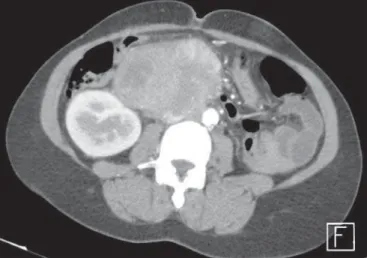
Computed tomography (CT) demonstrated the presence of a large, well defined retroperitoneal mass, with heteroge-neous contrast uptake and slightly lobulated contours (Fig-ure 1). The lesion extended from the hepatic hilum up to the aortic bifurcation, and was in close contact with the IVC, causing distortion in some segments of the vessel, making it imperceptible, particularly in its infrarenal portion, displac-ing the pancreatic head without a clear cleavage plane (Fig-ures 1, 2 and 3). Cavography demonstrated dilatation of the infrarenal segment of the IVC, with negative images of ir-regular contrast uptake representing the irir-regular filling pattern (Figure 4).
Differential diagnoses included lymphoma, primary ret-roperitoneal leiomyosarcoma, leiomyosarcoma of the IVC, and metastasis. Ultrasonography-guided biopsy was per-formed and histological and immunohistochemical analyses revealed leiomyosarcoma. The patient was submitted to sur-gery, with en bloc resection of the tumor mass and of a 9 cm-segment of the infrahepatic IVC invaded by the lesion. The IVC was reconstructed with Dacron prosthesis implan-tation.
DISCUSSION
In a reference to the PubMed database, only 85 out of a total of 1210 cases of tumors involving the IVC reported in Rafael Lemos Nascif1, Ana Graziela Santana Antón2, Gabriel Lacerda Fernandes1, George Caldas Dantas1,
Vinícius de Araújo Gomes3, Marcelo Ricardo Canuto Natal4
http://dx.doi.org/10.1590/0100-3984.2013.1902 INTRODUCTION
Leiomyosarcoma of the inferior vena cava (IVC) is a ma-lignant tumor that develops from middle layer smooth muscle cells. It is the most common tumor of the venous system, most frequently affecting the IVC and representing 5% to 10% of all soft parts sarcomas(1,2). In the
retroperito-neum, leiomyosarcomas and liposarcomas are the most com-mon types of sarcomas(3). Mild, nonspecific abdominal pain
is the most prevalent symptom, preceding the diagnosis in months or even years(4). Its incidence peak is in the sixth
decade of life, with predominance in women(4,5). The mean size of the tumor at the moment of the diagnosis is 10.8 cm(4).
Complete surgical resection with negative margins represents the only chance for long term survival of the patient(1,6).
Ran-dom clinical trials utilizing chemotherapy and radiotherapy have not demonstrated any benefit to patients’ survival(6).
CASE REPORT
complain-Nascif RL et al. / Leiomyosarcoma of the inferior vena cava: a case report
Radiol Bras. 2014 Nov/Dez;47(6):384–386 385
the literature in the period from 1961 to 2008 were primary leiomyosarcomas of the IVC, and in the absolute majority of cases there was secondary neoplastic involvement of other organs(7).
Leiomyosarcoma of the IVC is an uncommon tumor with poor prognosis; but with an aggressive surgical approach in association with the absence of metastasis a long-term sur-vival or even cure can be expected(3,4,6). Tumor size is one
of the main prognostic factors and five-year survival is ob-served in 30% to 53% of patients submitted to resection with free margins(6). It may be difficult to differentiate between a
sarcoma of IVC and another soft parts sarcoma of the retroperitoneum involving the IVC(6). The true sarcoma of
IVC originates from smooth muscle cells of the vessel and its growth pattern may be either intra- or extraluminal, with possibility of invasion of adjacent structures(6). In cases of
tumors with intraluminal growth, the vessel lumen is dilated and filled by the mass(7). The abdominal cavity has room for the growth of a tumor without causing symptoms or rec-ognizable signs at early stages of the disease(5).
Liposarcomas and leiomyosarcomas are the most com-mon soft parts sarcomas of the retroperitoneum(3). Leiomyo-Figure 1. Contrast-enhanced, axial abdominal CT image demonstrating the
pres-ence of a heterogeneously enhanced, large slightly lobulated mass in close con-tact with the IVC, and a small intraluminal component.
Figure 2. Contrast-enhanced, axial abdominal CT image demonstrating the le-sion extending up to the hepatic hilum, displacing the pancreatic head, with imper-ceptible signal from the IVC.
Figure 3. Non-contrast-enhanced, sagittal abdominal CT image more clearly demonstrating the intraluminal component in the IVC as well as the relationship between the lesion and the hepatic hilum.
Nascif RL et al. / Leiomyosarcoma of the inferior vena cava: a case report
Radiol Bras. 2014 Nov/Dez;47(6):384–386 386
sarcomas represent about 0.5% to 1% of all malignant soft tissue tumors, followed by liposarcomas and malignant fi-brous histiocytomas. At CT, the typical pattern of a leiomyo-sarcoma is that of retroperitoneal, lobulated, noncalcified mass, either with or without areas of low central attenuation resulting from necrosis or cystic degeneration, with no fat content and heterogeneous contrast enhancement(3,7).
Ac-cording to Webb et al., the signal from the IVC impercep-tible at the point of maximal contact between the IVC and the retroperitoneal mass has 75% sensitivity and 100% speci-ficity to predict the origin of the mass from the IVC(8)
(Fig-ure 2).
Most data regarding treatment of leiomyosarcomas of IVC come from case reports and small series. Therefore, the strategies for an ideal treatment remain uncertain(6).
Imag-ing methods play a relevant role in the characterization and preoperative staging of retroperitoneal masses, showing the lesions extent as well as their relationship with adjacent or-gans and structures(5). Complete surgical resection with
nega-tive margins represents the only chance for long term sur-vival of the patient(1,6). Random clinical trials utilizing
che-motherapy and radiotherapy have not demonstrated any ben-efit to patients’ survival(6).
The present report describes a rare case that should be included in the differential diagnosis of retroperitoneal masses, considering that the surgical planning impacts the patient’s survival(1,2,5).
REFERENCES
1. Imao T, Amano T, Takemae K. Leiomyosarcoma of the renal vein. Int J Clin Oncol. 2011;16:76–9.
2. Sokolich J, Mejia A, Cheng S, et al. Retroperitoneal leiomyosarcoma of the inferior vena cava mimicking a liver tumor. Am Surg. 2008; 74:433–6.
3. Cantwell CP, Stack J. Abdominal aortic invasion by leiomyosarcoma. Abdom Imaging. 2006;31:120–2.
4. Drukker L, Alberton J, Reissman P. Leiomyosarcoma of the inferior vena cava: radical surgery without vascular reconstruction. Vasc Endovascular Surg. 2012;46:688–90.
5. Sessa B, Iannicelli E, Caterino S, et al. Imaging of leiomyosarcoma of the inferior vena cava: comparison of 2 cases and review of the literature. Cancer Imaging. 2010;10:80–4.
6. Dew J, Hansen K, Hammon J, et al. Leiomyosarcoma of the inferior vena cava: surgical management and clinical results. Am Surg. 2005; 71:497–501.
7. Narata M, Okuhata Y, Abe K, et al. Primary leiomyosarcoma of the inferior vena cava: case report. Abdom Imaging. 2010;35:481–4. 8. Webb EM, Wang ZJ, Westphalen AC, et al. Can CT features