Phosphorus and nitrogen interaction:
loss of QC identity in response to P or N
limitation is antecipated in
pdr23
mutant
cibele t. costa
1,
Mércio l. strieder
1,2, stephen abel
3, carla a. Delatorre
1*
1 Department of crop science, Graduate Program in Plant science, Federal University of rio Grande do sul, Porto
alegre, rs, Brazil;
2 centro Nacional de Pesquisa de trigo (cNPt), empresa Brasileira de Pesquisa agropecuária (eMBraPa), Passo
Fundo, rs, Brazil;
3 Department of Molecular signal Processing, leibniz institute of Plant Biochemistry, halle (saale), Germany.
* corresponding author:carla andréa Delatorre, Depto Plantas de lavoura, Faculdade de agronomia, UFrGs, av. Bento Gonçalvez, 7712, PoBox 15100, 91501-970, Porto alegre-rs, Brazil; Phone: +55 51 33086005, Fax: +55 51 3308 6013; e-mail: [email protected]
received: 17 May 2011; accepted: 30 October 2011
abstract
changes in root architecture are an important adaptive strategy used by plants in response to limited nutrient availability to increase the odds of acquiring them. the quiescent center (Qc) plays an important role by altering the meristem activity causing differentiation and therefore, inducing a determinate growth program. the arabidopsis mutant pdr23 presents primary short root in the presence of nitrate and is inefficient in the use of nucleic acids as a source of phosphorus. in this study the effect of the pdr23 mutation on the Qc maintenance under low phosphorus (P) and/or nitrogen is evaluated. Qc identity is maintained in wild-type in the absence of nitrate and/or phosphate if nucleic acids can be used as an alternative source of these nutrients, but not in pdr23. the mutant is not able to use nucleic acids efficiently for substitute Pi, determinate growth is observed, similar to wild-type in the total absence of P. in the absence of N pdr23 loses the expression of Qc identity marker earlier than wild-type, indicating that not only the response to P is altered, but also to N. the data suggest that the mutation affects a gene involved either in the crosstalk between these nutrients or in a pathway shared by both nutrients limitation response. Moreover loss of Qc identity is also observed in wild-type in the absence of N at longer limitation. less drastic symptoms are observed in lateral roots of both genotypes.
Key words: QC25::iudA, nutrient deficiency, root development, determinate root growth program, stress
resuMo
em pdr23. O mutante não é capaz de usar eficientemente os ácidos nucléicos como substituto de fosfato, crescimento determinado é observado, similar à planta silvestre na ausência de P. Na ausência de N, pdr23 perde a expressão do marcador de identidade do cQ antes que a planta silvestre, indicando que as respostas a P e a N estão alteradas. Os dados sugerem que a mutação em pdr23 afete um gene envolvido na interação destes nutrientes ou em uma rota usada na resposta à limitação de ambos. além disso, perda da identidade do cQ é também observada na planta silvestre na ausência de N em longos períodos. sintomas menos dramáticos são observados nas raízes laterais de ambos os genótipos.
palavras-chave: deficiência nutricional, desenvolvimento radicular, estresse, QC25::iudA, programa de crescimento radicular determinado
introDuction
Nutrients are essential for plant growth and development and must be constantly obtained from the soil (arnon and stout, 1939); however, the nutrient supply in the soil is not homogeneous. the supply variability is due to several factors like soil characteristics, fertilizer application, environmental conditions, microbiology activity and crop system. the temporal and spatial variations in the nutrient availability are environmental cues used by the roots to modulate its development. this modulation is an important adaptive strategy causing changes in the root architecture to increase nutrient uptake (Gojon et al., 2009). several processes affect the root system architecture: (a) cell division and elongation rates, which establish the extension of the roots; (b) lateral root formation, which increases the volume of exploited soil; and (c) root hair formation, which increases the total root surface. Besides its importance, little is known about the regulation of the processes related to root architecture changes in response to nutrient limitations.
One important component in determining root architecture during nutrient limitation is the meristem activity. a failure in root meristem maintenance can be caused by the loss of stem cell division potential, a more rapid differentiation of stem cell daughters or the lack of quiescent center (Qc) activity. the Qc cells are located in the root tip, they are a small number of mitotically inactive and histologically distinct cells from their neighbor cells (Doerner, 1998). Qc is a reservoir of cells to allow the regeneration and maintenance of the root meristem. in arabidopsis, the Qc is formed by 4-7 cells, surrounded by stem cells (Nawy et al., 2005). some transcription factors play an important role in the maintenance of the Qc, such as scarecrOW (scr) and shOrtrOOt (shr) (sabatini et al., 2003; cui et al., 2007). PlethOra aP2-domain transcription factors are important regulators of
root stem cell activity, they are induced by auxins and are also involved in Qc maintenance, acting in parallel to scr and shr (aida et al., 2004).
among the nutrients, nitrogen (N) and phosphorus (P) are the most limiting in natural conditions. Nitrogen (N) is one of the most abundant elements in the earth; however, its availability in the soil is limited. Nitrate, the most common form of N in soils is very soluble and easily leached as well as denitrified (Graham and Vance, 2000). Nitrogen is required for the main processes in the plant cell, being part of several molecules such as amino acids, nucleic acids and chlorophylls (amtmann and Blatt, 2009). Phosphorus (P) is the second most limiting nutrient for plant development and crop yield. the assimilated form of P, orthophosphate (Pi), has low mobility and reacts with several cations, such as ca+2,
Mg+2 and al+3, forming precipitates, limiting its availability
(Fang et al., 2009). Phosphorus is a component of several biomolecules. examples are the sugar-P, intermediates of photosynthesis and respiration, phospholipids from membranes and nucleotides from nucleic acids as well as from the energy compounds atP and GtP (amtmann and Blatt, 2009). the addition of Pi to proteins affects their activity, therefore, P is an important player on protein regulation and signal transduction.
(iii) the suppression of lateral root initiation by high c:N ratio; and (iv) inhibition of primary root growth by high external l-glutamate levels. Despite the diverse final responses, there are emerging evidences for crosstalk between nutrient signaling pathways.
Mutants of Arabidopsis thaliana have been used aiming to identify components of the nutrient starvation signaling pathway. chen et al. (2000) identified several mutant lines unable to use nucleic acids as the only source of P. later studies with mutants derived from this type of screening identified interaction with other nutrients. One of these mutants, pdr23 (phosphate deficiency response 23), shows also a strong reduction in primary root length when growth in the presence of nitrate in comparison with the wild-type, regardless the P supply. it suggests an interaction between P and N signaling. We hypothesized that the Qc could act as a sensor of environmental cues for remodeling the root architecture; therefore the reduction in root length caused by organic P and by N in pdr23 might be related to alterations in the Qc maintenance. to test this hypothesis we analyzed the expression of the Qc identity marker QC25::uidA.
Material anD MethoDs
plant material and growth conditions: Arabidopsis
thaliana ecotype columbia (col), the transgenic line QC25::uidA (sabatini et al., 2003) and F3 seeds from the
cross between the eMs mutant pdr23 and the transgenic line QC25::uidA (homozygous for both characters) were used in the experiment. seeds were surface sterilized with 30% (v/v) bleach and 0.01% (v/v) tween 20 for 8 min. after five washes in sterile distilled water, seeds were plated in petri dishes containing different media. the seed dormancy was broken by applying low temperature (4oc) for 48h. the plates were
placed vertically, to facilitate the visualization of the roots, inside a growth room with a photoperiod of 16 h of light, 8 h of darkness, light intensity of 30 µmol.m-2.s-1 and temperature
of 21ºc (±2ºc).
Media composition: the media was based on somerville and Ogren (1980) and contained 50 µM Fe-eDta, 5 mM KNO3, 2 mM MgsO4, 2 mM ca(NO3)2, 10 µM Nacl, 2.5 mM
Kh2PO4, 70 µM h3BO3, 14 µM MnsO4, 1 µM ZnsO4, 0.2 µM
Na2MoO4, 0.01 µM cocl2, 0.5 µM cusO4, 100 mg.l-1 myo
inositol, 0.5 mg.l-1 nicotinic acid, 0.5 mg.l-1 pyridoxine , 0.1
mg.l-1 thiamine and 2.5 mM Mes, ph 5.5. also 0.5% sucrose
and 0.8% micropropagation agar-type i (caisson lab., North logan, U.s.a.) were added. the amount of P in the agar was analyzed and contributed with less than 10 µM, so it was used without further purification. For –P media, Kh2PO4 was omitted
and for –N media, KNO3 was replaced by Kcl, and ca(NO3)2
by casO4. in the +DNa media, 0.6 mg.l-1 DNa purified from
torula yeast was added. DNa was purified using the protocol described in chen et al. (2000).
histochemical analysis: For histochemical analysis of GUs activity, the protocol described by Vitha et al. (1995) was followed. the seedlings were grown on different media (+Pi/+DNa/+N, +Pi/+DNa/-N, DNa/-N; +Pi/-DNa/+N, -Pi/-DNa/-N, -Pi/+DNa/-N, -Pi/++Pi/-DNa/+N, and -Pi/-DNa/+N) for 7, 9 and 11 days. For each treatment and time point, at least 10 plants were analyzed. representative roots were chosen for each treatment and photographed in 100X and 400X on an optical microscope.
root analysis: For root length and lateral root number analysis 30 plants were evaluated per treatment. images of the roots were captured with digital camera (sony DscF707) and imported into the public domain National institutes of health imageJ program for quantitative analysis of root length and number. in transferring experiments, plants were grown vertically for five days in +P/-N or +P/+N media and transferred for 7 days to media containing different phosphorus and nitrogen availability, pictures were taken at transferring and seven days after. the data was submitted to variance analysis and mean comparison by DMs.
results
7
9
11
a +Pi / +DNa / +N
pdr 23 Col pdr 23 Col pdr 23 Col pdr 23 Col
b +Pi / -DNa / +N c -Pi / +DNa / +N D -Pi / -DNa / +N
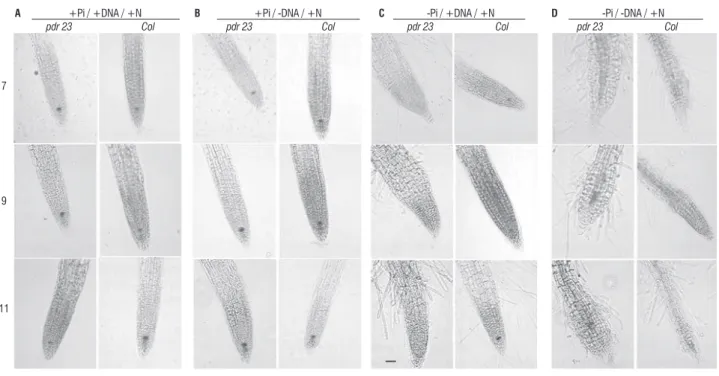
figure 1. expression of QC25::uidA in pdr23 and wild-type columbia primary roots grown on media with high N supply and different P availabilities (a, +Pi/+DNa; B, +Pi/-DNa; c, -Pi/+DNa; D, -Pi/-DNa) at 7, 9 and 11 days after germination. Bar = 100µm.
Wild-type plants grown in the presence of P showed the expected structure of a normal root apical meristem in the three time points evaluated. the quiescent center was clearly visible in the differentiated columella stem cells. No difference was observed when DNa was added to the medium (Figure 1a, 1B, table 2). the mutant pdr23 did not differ from wild-type at these conditions in relation to the meristem structure
and Qc identity. however, the primary root length of pdr23 plants is much shorter than those of wild-type (table 1, 2).
table 1. Primary root length of Arabidopsis thaliana columbia (col) and pdr23
plants grown for 8 days in presence or absence of nitrogen and phosphate
Media primary root length of genotypes (cm)
pdr23 col
+P/+N 0.93 6.39*
-P/+N 0.49 2.71*
+P/-N 1.96 2.22
-P/-N 1.38 1.99*
* Statistical difference between genotypes (p≤0.05)
table 2. Primary root length of arabidopsis thaliana columbia (col) and
pdr23 plants grown for 8 days in the presence of phosphate (2.5mM) and an organic phosphorus source (DNa 0.6 mg ml-1)
Media primary root length of genotypes (cm)
pdr23 col
+P/+DNa 0.44b 3.88 a*
+P/-DNa 0.96 a 4.02 a*
-P/+DNa 0.33 b 2.61 b*
-P/-DNa 0.43 b 2.04 c*
* statistical difference between genotypes. same letter indicates no statistical
difference between media by DMS (p≤0.05).
7 days after germination (dag) (Figure 1c). the pdr23 roots were shorter and showed signals of differentiation in the zone near the tip, i.e. the elongation zone disappeared and root hairs could be seen near the apical zone at 11 dag. No expression of the Qc identity marker was observed in this condition in pdr23 primary root at any time point. a similar phenotype was observed in wild-type plants grown under total absence of P (-Pi/-DNa/+N) indicating that pdr23 was not able to efficiently acquire P from DNa (Figure 1D). pdr23 plants showed even less structured root tips when none P was added. the cells seemed more globular and swelled, and the symptoms of differentiation were more evident. this data confirms the results obtained by Pinto (2005), where pdr23 plants showed short root phenotype in the presence of organic P, behaving like in total P absence.
there are evidences that roots can sense the local P availability , and P limitation affects the Qc maintenance, causing reduction in cell division and induction of a determinate root developmental program. these modifications may cause changes in the hormone homeostasis, which in turn induces lateral root formation. in pdr23, this process was observed also when organic P was supplied, indicating either a failure in breaking organic P, or sensing low Pi levels. it was shown previously that the Pi levels in media containing DNa as the only source of P are kept very low, in general below 50 µM (chen et al., 2000).
the induction of the determinate root development program in pdr23 explains the short root phenotype observed when nucleic acids are the only source of P in comparison to wild-type. Nevertheless, it does not explain the short root observed when P is present.
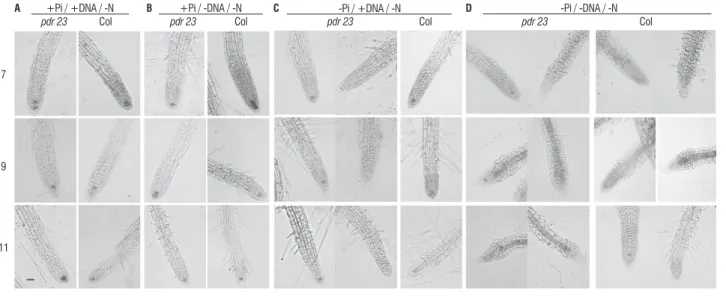
When P was kept high, nitrate was not added to the media and DNa was present, in the wild-type, as well as in pdr23, Qc was clearly label at the three time points evaluated (Figure 2a). however, when DNa was also removed from the media, the determinate root program was induced in wild-type plants, although in a slower rate than the one observed in the absence of P (Figure 2B). On this media (+Pi/-DNa/-N) at 7 dag, the expression of the Qc identity marker was observed in all plants, indicating an active quiescent center, at 9 dag, some plants stopped showing GUs activity and at 11 dag the marker expression in the primary root had vanished from all wild-type plants. the amount of DNa added to the medium can supply 6.4 mM nitrogen. this indicates that a minimal amount of N
is required for the Qc normal maintenance, i.e., not only the lack of P, but also N absence can induce the root to shift to a determinate program. a similar response was observed in the pdr23 Qc, although the Qc exhaustion was faster; the QC25 was already not expressed in the first time point. therefore, the normal pdr23 Qc in +P/+DNa/-N suggests that the DNa was being degraded at least partially when nitrate was removed from the media. it is known that Pi limitation induces secretion of enzymes related to organic P degradation, such as acid phosphatases, diesterases and nucleases (Duff et al, 1994; Bariola et al, 1994), therefore it is possible that enzymes related to N scavenge are secreted under severe N limitation. Moreover, the faster Qc collapse in pdr23 indicates that the recessive single mutation present in this mutant not only affects the root response to P, but also to N, suggesting N and P crosstalk.
the combination of both stresses was also analyzed. When DNa was the only source of N and P, the expression of QC25::uidA was observed until 11 dag in wild-type primary roots, but less intensely (Figure 2c). No addition of N and P sources caused the Qc to collapse, and no GUs was visualized even at 7 dag (Figure 2D). interesting, the Qc from pdr23 primary roots could not be visualized regardless the DNa presence if P was absent. considering the fact that pdr23 Qc was kept unchanged in the +Pi/+DNa/-N media, DNa must have been at least partially degraded to release N, hence the mutation cannot only be related to lack of ability to induce degrading enzymes but possibly to the perception of local low P.
7
9
11
a +Pi / +DNa / -N
pdr 23 col pdr 23 col pdr 23 col pdr 23 col
b +Pi / -DNa / -N c -Pi / +DNa / -N D -Pi / -DNa / -N
100X 400x
figure 2. expression of QC25::uidA in pdr23 and wild-type columbia primary roots grown on media with N deficiency and different P availabilities (a, +Pi/+DNa; B, +Pi/-DNa; c, -Pi/+DNa; D, -Pi/-DNa) at 7, 9 and 11 days after germination. For col plants in –Pi/+DNa/-N magnification of 100 and 400x are shown. Bar = 100µm.
7
9
11
a +Pi / +DNa / +N
pdr 23 col pdr 23 col pdr 23 col pdr 23 col
b +Pi / -DNa / +N c -Pi / +DNa / +N D -Pi / -DNa / +N
7
9
11
a +Pi / +DNa / -N
pdr 23 col pdr 23 col pdr 23 col pdr 23 col
b +Pi / -DNa / -N c -Pi / +DNa / -N D -Pi / -DNa / -N
figure 4. expression of QC25::uidA in pdr23 and wild-type columbia secondary roots grown on media with N deficiency and different P availabilities (a, +Pi/+DNa; B, +Pi/-DNa; c, -Pi/+DNa; D, -Pi/-DNa) at 7, 9 and 11 days after germination. if the response to the condition varied more than one picture is shown representing the population. Bar = 100µm.
analogous results were observed when only N was removed (Figure 4). the normal pattern was observed in the Qc at 7, 9 and 11 dag in both genotypes independently from the DNa addition (Figure 4a and B). at all three time points, about 50% of pdr23 secondary roots were affected and did not show GUs expression if N and P were omitted independently of DNa addition (Figure 4c and D). On the other hand, if only DNa was added as the source of N and P, no effect was observed in the lateral roots of wild type at 7 dag. at 9 dag, the older lateral roots yet showed the GUs expression, meanwhile the majority of the new lateral roots did not expressed it, and at 11 dag, 57% of the secondary roots were also not showing GUs activity. it suggests faster Qc consumption effect on pdr23 than in wild-type. the absence of GUs activity in the younger lateral roots in wild-type disagree with the pattern observed if only P was removed. it might be possible that the pathway conducting to the determinate growth by P limitation and N limitation is not exactly the same.
Plants grown first for four days in +P/-DNa/-N condition and transferred to different P availability in the presence of N differed on the lateral root emission from those grown initially in +P/-DNa/+N (table 3). if transferred to +P/-DNa/+N the genotypes did not differ, however the plants initially
grown in +P/-DNa/-N had about eight times more roots. it indicates that the nitrogen deficiency response was carried over the next condition. When they were transferred to organic phosphorus (-P/+DNa/+N), no difference was observed in both genotypes if compared to +P/-DNa/+N if they came originally from lack of N, however wild-type increased the number of lateral roots in comparison to pdr23 if they had grown in the presence of N. it may indicate that wild-type is able to respond faster to P limitation if no N limitation was previously imposed. this was even more pronounced when plants were transferred to –P/-DNa/+N (table 3).
table 3. Number of lateral roots in plants grown in +P/-N or +P/+N media for 5 days and transferred for 7 days to media containing different phosphorus and nitrogen availability
initial Medium
lateral roots of genotypes (no)
+p/-n +p/+n
pdr23 col pdr23 col +p/+n 9.40 a 9.66 a 1.0 c 1.16 c
-p/+Dna/+n 8.00 a 10.41 a 7.55 b 17.67 b*
-p/+n 7.60 a 6.16 b* 10.51 a 21.17 a*
* statistical difference between genotypes. same letter indicates no statistical
Discussion
One known effect of P limitation on root development is the inhibition of primary root growth and increased formation of lateral roots. this phenotype involves reduction in cell length in the root tip , and a progressive reduction in the length of cell meristem. the addition of organic P, such as nucleic acids, can rescue this phenotype and no significant difference is observed in the primary root length compared to high Pi supply (chen et al., 2000).
the root phenotype of pdr23 differs significantly from wild-type when nucleic acids are the only source of P; the root is very short, more branched, its trichoblasts produce root hairs much close to the root tip than wild-type plants. analysis of meristem activity of pdr23 primary root showed reduced number of cells undergoing cell division at this condition, and it intensified when no P was added, in this case after 6 days, the cell division ceased (strieder, 2009). Plant meristems control the development of the organs by balancing cell proliferation and differentiation. the Qc arrests cell differentiation to allow cell division of stem cells. it has been suggested that Pi limitation could affect the root growth by changing the Qc specification and meristem maintenance. therefore, here the Qc identity of pdr23 roots was compared to the wild-type columbia at different time points under P and /or N limitation.
Our data indicate that pdr23 roots were not able to use the nucleic acids as an effective source of P, and the Qc was as much affected as in the total absence of P (Figure 1c and 1D). the root differentiation zone was closer to the root tip in pdr23 and the cells became irregular and misshaped. similar phenotype was observed in the mutant ccs52a2, in which the gene mutated affects the cell division rate and the Qc maintenance (Vanstraelen et al., 2009).
pdr23 plants also showed consistently, but less severe, reduced primary root length when compared to wild-type in other conditions, including the presence of high P. in this case, the meristem and Qc activity did not differ from wild-type, thus the mutant gene affects the root morphology probably by more than one mechanism. this shorter root phenotype is rescued by the omission of nitrate from the media. at very low N, pdr23 root phenotype does not differ from col. similar behavior was observed in another mutant pdr1 (Delatorre, 2009). the mutation in pdr23 seems to also affect the Qc
response to nitrogen, the loss of identity is faster at pdr23 than at wild-type (Figure 2B). Previously, it had been hypothesized that pdr1was incapable of inducing the Pi-rescue system and was hypersensitive to N. however, if this was the case for pdr23, one would expect delay in Qc exhaustion under no N, unless the N signaling involves two separate mechanisms, one related to Qc viability and another to cell elongation.
the DNa presence reduced the effects of N limitation on the Qc in both genotypes, indicating that it was being degraded at least partially. the addition of nucleic acids on high Pi media has no effect on wild-type growth, but it reduces the pdr23 root length slightly when compared to high Pi. even so, the overall shoot appearance is not affected. No effect on Qc identity was observed, maybe the nitrogen liberated has some effect on root elongation, but it remains to be evaluated.
the evaluation of QC25::uidA under P deficiency indicates that the Qc of lateral roots is less sensitive than the primary roots, but again pdr23 showed the loss of Qc identity for some secondary roots at the 11 dag. it has been shown that modifications in meristem cell division are dependent on the local Pi supply and it takes at least 4 days for the new lateral root to show the symptoms. considering that lateral roots are not formed at the same time, a gradient is expected. it is likely that at longer exposures, a higher number of lateral roots would change their Qc identity.
path and tertiary roots would be formed. this would give rise to the typical P-limited root architecture.
the changes in root architecture driven by N deficiency are different from those from P deficiency. the uniform N supply along the root induces lateral root inhibition, and local supply associated to N limitation induces localized lateral root elongation. here we observed loss of QC25::iudA expression when N limitation was longer than 9 days in wild-type primary roots and much earlier in pdr23 ones, suggesting induction of root determinate program. however, it has to be confirmed by other Qc identity markers, once the true role of these genes has not been established yet. it also indicates that pdr23 mutation affects not only the P-limitation response but also the N-limitation response. remarkably, the primary root length of pdr23 in –N media is longer than in +N (table 1), it suggests that in this mutant N may negatively affect elongation. interesting, the lateral roots were not affected by the lack of N, at least until 11 dag in both genotypes, and the addition of both stresses caused the younger lateral roots to loss Qc identity first, thus N seems to override this P response.
Qc cells produce WOX5, which inhibits the differentiation of adjacent meristem cells. this suggests that indeterminate growth can only occur if the Qc is active. the combined high expression of four Plt-related genes, PLT1, PLT2, PLT3 and BABYBOOM defines Qc cells, a gradient is observed in the neighbor cells, until the lowest PLT expression is observed within the root meristem in cells starting the differentiation program. Qc maintenance is also related to the expression of some other transcription factors, such as SCARECROW (SCR) expressed in endodermal/Qc cells (sabatini et al., 2003) and shOrtrOOt (SHR) expressed in procambial cells (cui et al., 2007). the activity of scr is required to keep the neighbor cells in a non-defined state (sabatini et al., 2003). the complex scr-shr goes to the nucleus and induces SCR transcription (cui et al., 2007). it has been suggested that under low Pi availability, PDr2, a P5-type atPase, is required for the correct activity of scr and therefore for cell division and meristem maintenance (ticconi et al., 2009). PDr2 is located to the er and it may act by affecting lPr (cu-oxidases) movement, activity or the removal of its products (ticconi et al., 2009). therefore, pdr23 may also be related to this pathway.
loss of Qc identity has also been observed if roots are incubated in dehydroascorbate , conversely cell division
was stimulated by ascorbate precursors. there are some suggestions that auxin distribution would affect the rOs and antioxidant content, imposing an oxidized environment keeping the Qc. thus, antioxidants would induce root growth arrest and determinate growth. recently, the genes RCD1 and SRO1 from the ParP family were identified as regulators of division and differentiation. they were considered necessary to maintain Qc identity by controlling the redox balance in the cell. reduction in rOs was observed in roots of wheat plants growing under low P availability (Delatorre and espindula, unpublished).
another possibility is that pdr23 affects the hormone homeostasis. high auxin levels have been observed in the Qc and in the columella cells (sabatini et al., 1999), and are required for distal stem cell differentiation (Ding and Friml, 2010). Moreover, the expression of PLT genes and auxin fluxes are interdependent. additionally, it has been demonstrated that glutathione is necessary for stabilizing accumulation of the auxin efflux carriers, such as PiN1, PiN2 and PiN7, connecting the redox to auxin. Genetic analysis shows that auxin acts upstream of the major regulators of the stem cell activity. arF10 and arF16 activities repress the WOX5 transcription and restrict it to the quiescent center, where it in turn is required for PlethOra activity. the regulation of meristem size seems to be affected by the interaction between auxin and cytokinin. it is also known that N induces cytokinin production in the roots. therefore, if the mutated gene affects cytokinin signaling, it could cause changes in the meristem and Qc maintenance. the addition either of cytokinin or auxin was not able to rescue the mutant, so possibly there is not defect in its production (strieder, 2009). effect on other hormones cannot be excluded, once reduction in brassinosteroids also conducts to loss of Qc identity.
the cloning of the mutated gene may clarify its function in the regulation of root architecture under nutrient limitation, and the type of cross-talk occurring between N and P. the mutant pdr23 has a chemical induced (eMs) mutation, so chromosome walking is required.
acknowledgments: this research was supported
references
aida, M; Beis, D; heidstra, r; Willemsen, V; Blilou, i; Galinha, c; Nussaume, l; Noh, y-s; amasino, r; schere, B (2004) the PLETHORA genes mediate patterning of the Arabidopsis root stem cell niche. cell Press 119:109-120. amtmann, a; Blatt, Mr (2008) regulation of macronutrient transport. New Phytologist 181:35–52.
anandacoomaraswamy, a; De costa, W; tennakoon, PlK;Van Der Werf, a (2002) the physiological basis of increased biomass partitioning to roots upon nitrogen deprivation in young clonal tea (Camellia sinensis (l.) O. Kuntz). Plant and soil 238:1-9.
arnon, Di; stout, Pr (1939) the essentiality of certain elements in minute quantity for plants with special reference to copper. Plant Physiol. 14:371-375.
arrigoni, O; calabrese, G; De Gara, l; Bitonti, MB;liso, r (1997) correlation between changes in cell ascorbate and growth of Lupinus albus seedlings. J. Plant Physiol. 150:302-308.
Bariola, Pa; howard, cJ; taylor, cB; Verburg, Mt; Jaglan, VD; Green, PJ (1994) the arabidopsis ribonuclease gene rNs1 is tightly controlled in response to phosphate limitation. Plant J. 6:673-685.
chen, Dl; Delatorre, ca; Bakker, a;abel, s (2000) conditional identification of phosphate-starvation-response mutants in Arabidopsis thaliana. Planta 211:13-22.
cui, h; levesque1, MP; Vernoux, t; Jung, JW; Paquette ,aJ; Gallagher, Kl; Wang, Jy; Blilou, i; scheres, B; Benfey, PN (2007) an evolutionarily conserved mechanism delimiting shr movement defines a single layer of endodermis in plants. science 316:421-425.
De tullio, Mc; Jiang, K;Feldman, lJ (2010) redox regulation of root apical meristem organization: connecting root development to its environment. Plant Physiol. and Biochem. 48:328-336.
Delatorre, ca (2009) Phosphate deficiency response: searching for the signaling pathway. 1st ed. laP lambert academic Publishing, Kohn.
Dello ioio, r; linhares sclagia, F; scacchi, e; casamitjana-Martinez, e; heidstra, r; constantino, P;sabatini, s (2007) cytokinins determine arabidopsis root-meristem size by controlling cell differentiation. curr. Biol. 17:678-682.
Ding, Z;Friml, J (2010) auxin regulates distal stem cell differentiation in
Arabidopsis roots. PNas 107:12046-12051.
Doerner, P (1998) root development: Quiescent center not so mute after all. curr. Biol. 8:42-44.
Duff, sMG; sarath, G; Plaxton, W (1994) the role of acid-phosphatases in plant phosphorus metabolism. Physiol. Plantarum 9:791-800.
Fang, Z; shaob, c; Menga, y Wua, P; chen, M (2009) Phosphate signaling in
Arabidopsis and Oryza sativa. Plant science 176:170-180.
Forde, BG; Zhang, hM (1998) Nitrate and root branching. trends in Plant science 3:204-205.
Forde, BG;Walch-liu, P (2009) Nitrate and glutamate as environmental cues for behavioural responses in plant roots. Plant, cell and env. 32:682-693.
Galinha, c; hofhuis, h; luijten, M; Willemsen, V; Bilou, i; heidstra, r;scheres, B (2007) Plethora proteins as dose-dependent master regulators of
Arabidopsis root development. Nature 449:1053-1057.
Gojon, a; Nacry, P; Davidian, Jc (2009) root uptake regulation: a central process for NPs homeostasis in plants. curr. Opin. Plant Biol. 12:328-338. Gonzalez-Garcia, M-P; Vilarrasa-Blasi, J; Zhiponova, M; Divol, F; Mora-Garcia, s; russinova, e;caño-Delgado, ai (2011) Brassinosteroids control meristem size by promoting cell cycle progression in Arabidopsis roots. Development 138:849-859.
Graham, Ph; Vance, cP (2000) Nitrogen fixation in perspective: an overview of research and extension needs. Field crops res. 65:1184-1194.
Grieneisen, Va; Xu, J; Maree, aFM; hogeweg, P;scheres, B (2007) auxin transport is sufficient to generate a maximum and gradient guiding roor growth. Nature 449:1008-1013.
Koprivova, a; Mugford, st;Kopriva, s (2010) Arabidopsis root growth dependence of gluthathione is linked to auxin transport. Plant cell rep. 29:1157-1167.
linkohr, Bi; Williamson, lc; Fitter, ah;leyser, hMO (2002) Nitrate and phosphate availability and distribution have different effects on root system architecture of Arabidopsis. Plant J. 29:751-760.
lopez-Búcio, J; hernández-abreu, e; sánchez-calderón, l; Nieto-Jacobo, MF; simpson, J; herrera-estrella, l (2002) Phosphate availability alters architecture and causes changes in hormone sensitivity in the Arabidopsis
root system. Plant Physiol. 129:244-256.
Nawy, t; lee, J-y; colinas, J; Wang, Jy; thongrod, sc; Malamy, Je; Birnbaum, K; Benfey, PN (2005) transcriptional profile of the Arabidopsis root quiescent center. the Plant cell 17:1908-1925.
Osmont, Ks; sibout, r; hardtke, cs (2007) hidden branches: developments in root system architecture. annu. rev. Plant Biol. 58:93-113.
Petersson, sV; Johansson, ai; Kowalczyk, M; Makoveychuck, a; Wang, Jy; Moritz, t; Grebe, M; Benfey, PN; sandberg, G;ljung, K (2009) an auxin gradient and maximum in the Arabidopsis root apex shown by high-resolution cell-specific analysis of iaa distribution and synthesis. Plant cell 21:1659-1668.
Pinto, KG (2005) caracterização de mutantes condicionais de Arabidopsis thaliana l. em organofosfatos. 81p. Graduate Group in Plant science, Federal University of rio Grande do sul - UFrGs, Master thesis.
rodriguez-rodriguez, JF; shishkova, s; Napsucialy-Mendivil, s;Dubrovsky, JG (2003) apical meristem organization and lack of establishment of the quiescent center in cactaceae roots with determinate growth. Planta 217:849-857.
sabatini s; heidstra, r; Wildwater, M; scheres, B (2003) scarecrOW is involved in positioning the stem cell niche in the Arabidopsis root meristem. Genes Dev. 17:354-358.
sabatini s; Beis, D; Wolkenfelt, htM; Murfett, J; Guilfoyle, t; Malamy, J; Benfey, PN; leyser, O; Bechtold, N; Weisbeek, PJ; scheres, BJG (1999) an auxin-dependent distal organizer of pattern and polarity in the Arabidopsis
root. cell 99:463-472.
sanchez-calderon, l; lopez-Bucio, J; chacon-lopez, a; cruz-ramirez, a; Nieto-Jacobo, F; Dubrovsky, JG;herrera-estrella, l (2005) Phosphate starvation induces a determinate developmental program in the roots of
Arabidopsis thaliana. Plant and cell Physiol. 46:174-184.
sarkar, aK; luijten, M; Niyashima, s; lenhard, M; hashimoto, t; Nakajima, K; scheres, B; heidstra, r;laux, t (2007) conserved factors regulate signalling in Arabidopsis thaliana shoot and root stem cell organizers. Nature 446:811-814.
silva, aada;Delatorre, ca (2009) alterações na arquitetura de raiz em resposta à disponibilidade de fósforo e nitrogênio. rev. de ciências agrovet. 8:152-163.
somerville, cr; Ogren, W (1980) isolation of photorespiration mutants in
Arabidopsis thaliana. in: chua N-h (eds), MethODs in chloroplast biology, pp.129-138. elsevier Biomedical Press, amsterdam, the Netherlands.
strieder, Ml (2009) Deficiência de fósforo em Arabidopsis thaliana: caracterização de mutantes e interações nutricionais. 217p. Graduate Program in Plant science, Federal University of rio Grande do sul - UFrGs, Ph.D. thesis.
teotia, s;lamb, rs (2011) rcd1 and sro1 are necessary to maintain meristematic fate in Arabidopsis thaliana. J. exp. Bot. 62:1271-1284.
ticconi, ca; Delatorre, ca; lahner, B; salt, De; abel, s (2004) Arabidopsis
pdr2 reveals a phosphate-sensitive checkpoint in root development. Plant J. 37:801-814.
ticconi, c; luceroa, rD; sakhonwaseea, s; adamson, aW; creffb, a; Nussaumeb, l; Desnosb, t; abel, s (2009) er-resident proteins PDr2 and lPr1 mediate the developmental response of root meristems to phosphate availability. PNas 106:14174-14179.
tyburski, J; Krzeminski, l;tretyn, a (2008) exogenous auxin affects ascorbate metabolism in roots of tomato seedlings. Plant Growth reg. 54:203-215. Van den Berg, c; Willemsen, V; hendriks, G; Weisbeek, P;scheres, B (1997) short-range control of cell differentiation in the Arabidopsis root meristem. Nature 390:287-289.
Vanstraelen, M; Balobana, M; inesa, OD; cultronea, a; lammensb, t; Boudolfb, V; Browna, sc; Veylderb, lD; Mergaerta, P; Kondorosi, e (2009) aPc/cccs52a complexes control meristem maintenance in the Arabidopsis
root. PNas 106:11806-11811.
Walch-liu, P; Forde, BG (2008) Nitrate signalling mediated by the nrt1.1 nitrate transporter antagonises l-glutamate-induced changes in root architecture. the Plant J. 54:820-828.
Walch-liu, P; liu, lh; remans, t; tester, M; Forde, BG (2006) evidence that l-glutamate can act as an exogenous signal to modulate root growth and branching in Arabidopsis thaliana. Plant cell Physiol. 47:1045-1057. Williamson, lc; ribrioux, s; Fitter, ah; leyser, hMO (2001) Phosphate availability regulates root system architecture in Arabidopsis. Plant Physiol. 126:875-882.
Zhang, h; rong, h; Pilbeam, D (2007) signalling mechanisms underlying the morphological responses of the root system to nitrogen in Arabidopsis thaliana. J. exp.l Bot. 58:2329-2338.
Zhang, h; Jennings, a; Barlow, PW; Forde, BG (1999) Dual pathways for regulation of root branching by nitrate. PNas, Usa 96:6529-6534.