288 Rev. odonto ciênc. 2010;25(3):288-291
Received: April 12, 2009 Accepted: July 17, 2010
Conflict of Interest Statement: The authors state that there are no financial and personal conflicts of interest that could have inappropriately influenced their work.
Copyright: © 2010 Luisi et al.; licensee EDIPUCRS. This is an Open Access article distributed under the terms of the Creative Commons Attribution-Noncommercial-No Derivative Works 3.0 Unported License.
Original Article
Apical extrusion of debris after hand, engine-driven
reciprocating and continuous preparation
Extrusão apical de “debris” após o preparo manual e
mecanizado oscilatório e contínuo
Simone Bonato Luisi a
Alice Cunegatti Zottis a
Caroline Scheeren Piffer a
Andrea Cabral de Mello Vanzin a
Rosane Angélica Ligabue a
a Pontifical Catholic University of Rio Grande do
Sul, Porto Alegre, RS, Brazil
Correspondence:
Simone Bonato Luisi
Faculdade de Odontologia da PUC-RS Avenida Ipiranga, 6681 – Prédio 6 Porto Alegre, RS – Brazil 90619 900
E-mail: [email protected] Abstract
Purpose: This in vitro study assessed the amount of debris extruded apically after preparation with different techniques.
Methods: Sixty healthy, extracted, human mandibular incisors were randomly divided into 3 groups: Group A - hand crown-down technique; Group B - crown-down technique with engine-driven rotary reciprocating instruments; Group C - Protaper: engine-driven continuous rotary instrumentation. The roots were immersed in 2.3 mL of distilled water. After preparation, the water in each tube was filtered to collect solid material extruded, and the filters were weighed using a precision scale. Data were analyzed by Kolmogorov-Smirnov and Kruskal-Wallis tests at the 0.05 level of significance.
Results: The statistical analysis showed that group C had significantly higher values of debris than groups A and B.
Conclusion: The instrumentation using a continuous rotary technique, Protaper, produced greater apical extrusion than the hand and engine-driven crown-down techniques. The direction of instrumentation, whether cervical-apical or apical-cervical, seems to be a more important factor influencing apical extrusion than whether the instrumentation was performed by hand or was engine-driven.
Key words: Root canal preparation; crown-down technique; periapical tissue; Protaper
Resumo
Objetivo: Este estudo, in vitro, avaliou a quantidade de extrusão apical de “debris”, após o preparo químico-mecânico do canal radicular, utilizando diferentes técnicas.
Metodologia: Sessenta incisivos inferiores humanos hígidos foram aleatoriamente divididos em três grupos: Grupo A: técnica coroa-ápice manual; Grupo B: técnica coroa-ápice mecanizada com sistema de rotação oscilatória; Grupo C: Protaper, técnica mecanizada com sistema de rotação contínua. As raízes foram imersas em 2,3 mL de água destilada. Após os preparos, a água destilada de cada amostra foi filtrada, e o filtro de papel, contendo o material sólido extruído, foi pesado em uma balança analítica de precisão. Os dados foram analisados estatisticamente pelos testes Kolmogorov-Smirnov e Kruskal-Wallis ao nível de significância de 0,05.
Resultados: A análise estatística demonstrou que o grupo C apresentou valores superiores de “debris” do que os grupos A e B.
Conclusão: A técnica rotatória contínua com Pro-taper produziu maior quantidade de extrusão apical do que as técnicas coroa-ápice manual e mecanizada com sistema de rotação oscilatória. A direção da instrumentação, se cérvico-apical ou ápico-cervical, parece ser o fator mais determinante na extrusão de “debris” independente desta ser realizada manual ou mecanizada.
Rev. odonto ciênc. 2010;25(3):288-291 289 Luisi et al.
Introduction
Apical extrusion of debris during chemical and mechanical preparation of root canals is one of the most common problems found by endodontists (1). Biologically, all irritating agents must be removed from the root canal by chemical and mechanical preparation so that cleaning and debridement are adequate but periapical tissues are not damaged (2). However, the removal of necrotic pulp tissues and irrigation may cause extrusion of irritants to periapical tissues regardless of the instrumentation technique used. This extrusion may cause pain, discomfort
and persistent inlammation (3-5). As all instrumentation techniques produce some amount of apical extrusion (4,6-8),
the choice of a technique should also take into consideration how well the apical extrusion of debris can be controlled. Sonic, ultrasonic and cervical enlargement techniques
produce less apical extrusion of debris than hand
instru-mentation (9). Apical extrusion of debris tends to be greater with hand instrumentation than with techniques that use
rotary forces (2,5,8,10) because the iles may act as pistons
that push irrigating solutions and debris towards the apex (11). Conversely, rotary instrumentation may move
debris along the iles, which may result in debris being
expelled cervically (12).
The performance of a balanced force technique is similar to
that of engine-driven techniques, but the former extrudes less irrigating solution than the Proile .04 system (5). According to Ferraz et al. (5), there is no signiicant difference in the
volume of irrigating solution or amount of debris extruded
apically among engine-driven techniques that use Proile .04, Quantec 2000 and Pow-R instruments. The hand balanced-force technique promotes signiicantly less extrusion
of irrigating solution and debris than the hybrid hand
instrumentation. The latter, in turn, results in signiicantly
greater extrusion of irrigating solution and debris than
engine-driven techniques. Apical extrusion may be greater when hybrid techniques are used because of the type of ile
movements used in instrumentation of the apical third. The
ProTaper and System GT systems do not differ signiicantly in the amount of apical extrusion of bacteria (13), but the Protaper instrumentation system extrudes signiicantly more debris than the Proile system (12).
The purpose of this in vitro study was to assess the amount of apical extrusion of debris after chemical and mechanical
preparation of root canals using a hand crown-down technique, an M-4 reciprocating system and the Protaper continuous rotary system (Dentsply-Maillefer™).
Methodology
Sixty healthy, extracted human mandibular incisors with completely formed apices and straight canals were used.
These teeth, measuring 18-20 mm and extracted due to
clinical indications, were selected from the collection of the Endodontic Laboratory Course of the School of Dentistry,
Pontifícia Universidade do Rio Grande do Sul (PUCRS),
Porto Alegre, Brazil. Teeth were excluded if they had
more than one canal, internal calciications or resorptions conirmed on periapical radiographs.
Teeth were stored in saline solution until the periodontal
ligament was scaled with periodontal curettes (Neumar 13-14,
São Paulo, Brazil). They were then rinsed in tap water for 1 minute and dried at room temperature. Specimens were packed and autoclaved (M9 UltraClave, Dabi Atlante, São
Paulo, Brazil) for 40 minutes at 126º C and 20 psi pressure. Selected teeth were randomly numbered from 1 to 60 with
a black pencil on the buccal surface. Before the beginning of the experimental procedures, all specimens were kept in
saline solution for 48 hours for hydration.
All procedures were performed by 2 operators trained for the use of the systems. Tooth roots were covered with wet gauze and were vertically held between the jaws of a vice
(40 mm Baby Vice); the pulp chamber was opened with an air-turbine handpiece and a #1012 round diamond bur (KG Sorensen, São Paulo, Brazil). A #10 ile was introduced in
the canal until its tip reached the apex, and the working length was established at 1 mm from the apex. All teeth were
then placed in sterilized tubes with 2.3 mL of distilled water; the tooth crown was ixed to the tube top and the root was
submersed in the liquid.
The teeth were randomly divided into 3 groups (A, B and
C). The root canals were irrigated with 2 mL of 1% sodium
hypochlorite, (Virex 2%; Johnsons & Johnsons, Saõ Paulo, Brazil; diluted in distilled water) after the use of each
instrument. The irrigating solution was kept in a 10-ml disposable syringe with a 25X4 needle (B-D) calibrated with a silicone stop at 3 mm from the working length. A #10 suction cannula (B-D) was used for aspiration.
In groups A and B, Flexoile (Dentsply-Maillefer, Ballaigues,
Switzerland) instruments were used 4 times. In group C,
NiTi Protaper (Dentsply-Maillefer) instruments were used.
These instruments have a triangular and convex transverse section, which reduces the contact area between instrument and dentin and increases their cutting action. In addition, they have a variable helicoidal angle, which increases their cutting action and the amount of debris extruded out of the root canal. They also have variable tapering and inactive tips. The instruments were disposed of after being used in four root canals.
The irst instruments in the root canal, in all groups, were #10 and #15 iles used with hand balanced-force movements to the working length. These iles were called initial
instruments and were used to make the root canal accessible to the subsequent instruments.
Group A: hand crown-down technique
Files were used with balanced-force movements: a quarter
of turn to the right, half turn to the left and withdrawal of
the instrument until it was loose in the canal. The #45, #40, #35, #30, #25, #20 iles were used in this sequence until the
working length was reached. The apex was prepared at the
290 Rev. odonto ciênc. 2010;25(3):288-291
Apical extrusion of debris
greater taper were used. Before each instrument change, the initial instrument was used again to remove obstructions or elbows that might have formed.
Group B: crown-down technique with engine-driven reciprocating rotary system
The M-4 system performs reciprocating movements to the right and left at a 30-degree amplitude and at a 10:1 gear reduction. Sequential #45, #40, #35, #30, #25 and #20 iles connected to the reciprocating system (M-4) were used until the working length was reached. The iles were introduced
gently into the root canal until resistance was met. The
operator introduced and pulled out the iles moving them
against the root canal walls. The apical preparation was performed as in group A. Before each instrument change, the initial instrument, connected to the reciprocating system, was used again to remove obstructions and elbows that might have formed.
Group C: mechanical technique with continuous rotary system
An electric motor (EndoPlus, Driller) with speed and torque
control was used at 250 rpm and 2 N.cm. Gentle
push-pull motions (tapping motion) that applied pressure in the
cervical-apical direction were repeated ive times for each instrument. The following sequence was used:
– The irst rotary instrument (SX; 2-19% taper) was used
to prepare the cervical and middle thirds of the root canal and prevent any obstructions to the access to the apical third.
– After that, the S1 instrument (2%-11% taper) was used
to shape the cervical and middle thirds.
– The S2 instrument (4%-11.5% taper) was used to prepare the middle and apical regions of the root canal. The SX,
S1 and S2 instruments were used until initial resistance was met, when the operator did not push the instrument any further.
– An F1 instrument (7%-5.5% taper) was used at the
working length.
After preparation was completed, 2 mL of 1% sodium hypochlorite was used for irrigation along with aspiration and irrigation of 17% trisodium EDTA (Iodontec). The solution
was stirred with the initial ile and was left in the root for 3 minutes. After that, 2 mL of 1% sodium hypochlorite was used for the inal irrigation, and the root canal was
suctioned.
Method of weighing debris
To obtain measurements, 80-g/m2 paper ilters 12,5 cm in
diameter were used; they were weighed in a precision scale (AG 200, Gehaka) before and after iltering the solution
in the tubes. The tubes were opened after the end of the
procedures, and the paper ilters were used to ilter it. The
debris was separated from the distilled water solution. The residual material in the tube and in the tooth roots was rinsed
with a small amount of distilled water. The ilters were dried in a stove (Soc. Fabbe Ltda) at 100ºC for 12 hours.
The extrusion weight was calculated and statistically
analyzed using the non-parametric Kolmogorov-Smirnov test for each group. The Kruskal-Wallis non-parametric test
was used for comparisons among the three groups. The level
of signiicance was set at 5%.
Results
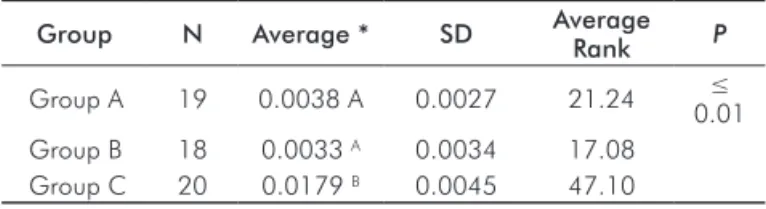
The results of the Kruskal-Wallis test revealed a signiicant
difference between the three groups Table 1. Group C
(continuous rotary instrumentation – Protaper) had
signii-cantly greater amounts of debris than the other groups. The
amounts for Groups A (hand instrumentation – crown-down) and B (reciprocating engine-driven instrumentation – M-4) were not signiicantly different.
Table 1. Comparison of the quantity of debris among the
experimental groups.
Group N Average * SD Average Rank P
Group A 19 0.0038 A 0.0027 21.24 ≤
0.01
Group B 18 0.0033 A 0.0034 17.08
Group C 20 0.0179 B 0.0045 47.10
*Means followed by the same letter are not statistically different.
Discussion
The extrusion of debris to the periapical region may cause
inlammation and lare-ups after endodontic treatment. This
extrusion may also cause serious systemic diseases, such as endocarditis, brain abscesses and sepsis, especially in
medically-compromised patients (14,15).
Although this study did not evaluate the difference in apical extrusion between vital and necrotized teeth, this discussion
is relevant. Vital teeth have a pulp stump that may serve
as a barrier to the extrusion of debris, but such resistance
is not found in necrotized teeth. However, possible
over-instrumentation in cases of pulpectomy, in which some extrusion may occur, may lead to more serious symptoms postoperatively than in cases of pulp necrosis. In an in vivo study, Salzgeber and Brilliant (16) showed that vital pulp tissues help to control lateral and apical penetration of the irrigating solution. In cases of necrosis, the solution disperses when it reaches the apical lesion. Moreover, there is a difference in the amount of in vivo and in vitro extrusion because of the presence of periapical tissues that prevent excessive extrusion of debris (17).
Curvature and presence of more than one canal are factors
that may affect the inal amount of apical extrusion (12). Therefore, only single-rooted teeth with straight canals were
used in this study to eliminate variables that might interfere with results.
The diameter of the apical foramen is greater in young patients than in older people. Therefore, young teeth
Rev. odonto ciênc. 2010;25(3):288-291 291 Luisi et al.
Mc Kendry (19), and Fairbourn et al. (9) found no signiicant
correlation between apical diameter and amount of extruded debris. As dentin mineralization is less intense in young teeth, these teeth would also be expected to be more liable to wear, causing greater extrusion (12). As it is not possible
to control this factor in teeth, Ruiz-Hubard et al. (2) used acrylic models to simulate root canals; however, simulated
canals are limited study models that do not reproduce dentin characteristics. Therefore, in this study, as well as in the ones
conducted by Tanalp et al. (12) and Sümer and Akpinar (13),
extracted human teeth were used.
Various factors, such as instrumentation technique, instrument
size, apical stop and type of irrigating solution, affect the
amount of apical extrusion (6,16). Rotary instrumentation techniques (Protaper and HERO Shaper) reduce the number
of instruments used for root canal preparation, which may
be seen as an advantage at irst. However, Tanalp et al. (12)
compared Protaper systems with other continuous rotary
techniques and found signiicantly greater amounts of
extruded debris when using the Protaper technique. In
our study, this technique had signiicantly better apical
extrusion results than those found for a hand technique and a reciprocating rotary technique. Although the Protaper System uses fewer instruments, it promotes greater dentin wear in a shorter time because of its greater cutting capacity and taper. The other techniques in this study (hand and
alternating rotary technique) required the use of more iles
with only one, lower taper (0.2 mm). Their cutting capacity
was, therefore, lower, and the root canal was prepared slowly and gradually until the working length was reached.
The tapering of the Protaper iles favors the preparation of
the apical third as soon as instrumentation begins. Thus, wear occurs early throughout the whole canal because the instruments reach the working length in the beginning of the preparation, which causes greater apical extrusion.
Reciprocation engine-driven techniques reduce work
time, which is an advantage for both the operator and the
patient. This technique uses conventional iles and does not produce signiicantly greater apical extrusion than the hand
technique. Nevertheless, attention should be paid when
using reciprocating engine-driven instrumentation in teeth
with curved canals because it may create elbows and root canal deviations.
Conclusions
The results of this in vitro study showed that the endodontic instrumentation using a continuous rotary technique (Protaper) produced greater apical extrusion than hand and
engine-driven crown-down techniques. The direction of instrumentation, whether cervical-apical or apical-cervical,
seems to be a more determinant factor of apical extrusion than whether instrumentation was performed by hand or
was engine-driven.
References
Mangalam S, Rao CV, Lakshminarayanan L. Evaluation of apically 1.
extruded debris and irrigant using three instrumentation techniques. Endodontology 2002; 14:19-23.
Ruiz-Hubard E
2. E, Gutmann JL, Wagner MJ. A quantitative assessment of canal debris forced periapically during root canal instrumentation using two different techniques. J Endod 1987;13:554-8.
Lee S
3. J, Lee CS, Strittmatter EJ. An in vitro comparison of root canal content extrusion using ultrasonic and hand instrumentation. Endod Dent Traumatol 1991:7:65-8.
Lambrianidis
4. T, Tosounidou E, Tzoanopoulou M. The effect of maintaining apical patency on periapical extrusion. J Endod 2001;27: 696-8.
Ferraz C
5. C, Gomes NV, Gomes BP, Zaia AA, Teixeira FB, Souza-Filho FJ. Apical extrusion of debris and irrigants using two hand and three engine-driven instrumentation techniques. Int Endod J 2001;34:354-8.
Vande Visse J
6. E, Brilliant JD. Effect of irrigation on the production of extruded material at the root apex during instrumentation. J Endod 1975;1:243-6.
Beeson TJ, Hartwell GR, Thornton JD, Gunsolley JC. Comparison of 7.
debris extruded apically in straight canals: conventional filings versus profile .04 Taper series 29. J Endod 1998;24:18-22.
Reddy S
8. A, Hicks ML. Apical extrusion of debris using two hand and two rotatory instrumentation techniques. J Endod 1998;24: 180-3.
Fairbourn D
9. R, McWalter GM, Montgomery S. The effect of four preparation techniques on the amount of apically extruded debris. J Endod 1987;13:102-8.
Bidar M, Rastegar AF, Ghaziani P, Namazikhah MS. Evaluation of 10.
apically extruded debris in conventional and rotary instrumentation techniques. J Calif Dent Assoc 2004;32:665-71.
Brown D
11. C, Moore BK, Brown CE Jr, Newton CW. An in vitro study of apical extrusion of sodium hypochlorite during endodontic canal preparation. J Endod 1995;12:587-91.
Tanalp
12. J, Kaptan F, Sert S, Kayahan B, Bayirl G. Quantitative evaluation of the amount of apically extruded debris using 3 different rotary instrumentation systems. Oral Surg Oral Med Oral Pathol Oral Radiol Endod 2006;101:250-7.
Er K, Sümer Z, Akpinar E. Apical extrusion of intracanal bacteria 13.
following use of two engine-driven instrumentation techniques. Int Endod J 2005;38:871-6.
Debelian GJ, Olsen I, Tronstad L. Bacteremia in conjunction with 14.
endodontic therapy. Endod Dent Traumatol 1995;11:142-9. Savarrio
15. L, Mackenzie D, Riggio M, Saunders WP, Bagg J. Detection of bacteraemias during nonsurgical root canal treatment. J Dent 2005;33:293-303.
Salzgeber R
16. M, Brilliant JD. An in vivo evaluation of the penetration of an irrigating solution in root canals. J Endod 1977;3:394-8. Seltzer
17. S, Soltanoff W, Sinai I, Goldenberg A, Bender IB. Biologic aspects of endodontics. 3. Periapical tissue reactions to root canal instrumentation. Oral Surg Oral Med Oral Pathol 1968;26:534-46. al-Omari MA, Dummer PM. Canal blockage and debris extrusion 18.
with eight preparation techniques. J Endod 1995;21:154-8. McKendry DJ. Comparison of balanced forces, endosonic and step-19.