_____________________________
*) Corresponding author: [email protected]
doi: 10.2298/SOS1002245J
UDK 622.785:552.52
Effect of the Change of Firing Temperature on Microstructure
and Physical Properties of Clay Bricks from Beruas (Malaysia)
I. Johari
1, S. Said
1, B. Hisham
1, A. Bakar
1, Z. A. Ahmad
2*1
School of Civil Engineering, University Sains Malaysia, Penang, Malaysia
2School of Material and Mineral Resources Engineering, University Sains Malaysia,
Engineering Campus, 14300 Nibong Tebal, Penang, Malaysia
Abstract:
This study is focused on the behaviour of fired-clay brick from the area around Beruas (Malaysia) that is known for it brick industries. The firing temperatures were set from
800oC to 1250oC and soaking time was fixed for an hour. The effects of firing temperature on
the phase changes, microstructure, compressive strength, water absorption and porosity of the bricks were investigated. Test results indicate that the optimum firing temperature was
found to be 1200oC. The percentage of porosity significantly reduces from 39.33% to 5.87%
when sintered from 1000 oC to 1250 oC. Bricks sintered at 1200oC exhibited the highest
strength of 89.5 N/mm2. The effect of firing temperature significantly improved the
microstructure in terms of porosity and the quality of physical properties of fired-clay bricks. Keywords: Fired-clay brick, Microstructure, Porosity, Phase analysis, Compressive strength, Water absorption
1. Introduction
During firing of fired clay brick, a series of transformation occurs which determine the final properties of the brick product. The main factors involved in manufacturing bricks are the type of raw materials, fabrication method, drying procedure, firing temperature and firing profile. These factors will affect the quality of the final product [1]. However, [2] suggested that the durability and strength of bricks are related to their microstructure and mineralogy. In unfired clay bricks, the strength and water permeability are related to the size and shape of the particles present and the forming process, but upon heating, the nature of the mineral comprising the mass has a very important influence because of the chemical reactions and partial fusings which occur then [3].
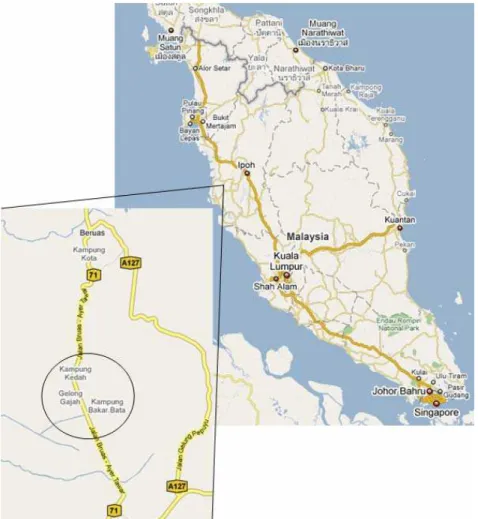
The objective of this research is to study the effect of the change of firing temperature on microstructure and physical properties of clay bricks from Beruas (Malaysia). Beruas is known as one of the important clay brick manufacturing areas in Malaysia, located on the west coast of the Malaysian Peninsular as illustrated in Fig. 1. Beruas is rich in ball clay which is suitable in producing fired-clay bricks and is thus the major producer for the northern part of Malaysia. Bricks in Beruas are traditionally produced using wood firing kilns.
Fig. 1. Location of the clay pits and the brick factory in Beruas, Malaysia
Most of the factories have been in production for more than 30 years. To date, there is no systematic scientific information published regarding clays from Beruas. The method of manufacturing fired-clay brick was adopted from the factories but the firing process is different. Heating rate, soaking time and firing schedule were constant. The firing temperatures used are varied, from 800oC to 1250oC.
2.
Materials and method
2.1.
Preparation of test specimens (before firing)
patterns were scanned in steps of 0.034o in a range of diffraction angles from 10o to 58o of 2θo for clay using Copper (CuKα) as X-ray source with a wavelength of 1.5406 Ǻ.
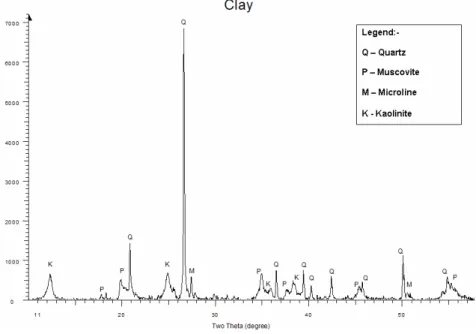
Fig. 2. XRD diffractogram of clay taken from Beruas, Malaysia
The results are shown in Fig. 2. An X-Ray spectrometer machine, Rigaku RIX 3000, was used to determine the chemical composition of the clays. Samples were sieved passing 75μm before testing was conducted. 25g of a particular sample was collected in a dried state and then compacted inside a sample holder. Loss of ignition value for the sample was prepared separately. For the Atternberg limit test and density test, the clays were sieved passing 425μm and the test was performed in accordance to BS1377: Part 2 Clause 4.3 (1990) and BS 1377: Part 2 clause 8.3 (1990), respectively. Using a suitable amount of water for mixing, the sieved clays were extruded and wire cut to form brick shapes in the size of 67 x 33 x 20 mm3. The green bricks were air-dried for 24 hours in an ambient room temperature of 27oC and oven dried at 105oC for another 3 days. Before the firing process, the simultaneous thermogravimetric analysis (TGA) and differential thermal analysis (DTA) techniques that permit the continuous weighing of samples as a function of temperature at desired temperature were carried out [6-8]. The machine used was NETZSCH model STA 409 PC LUXX.
2.2.
Preparation of test specimens (after firing)
3.
Results and Discussion
3.1.
Properties of clay
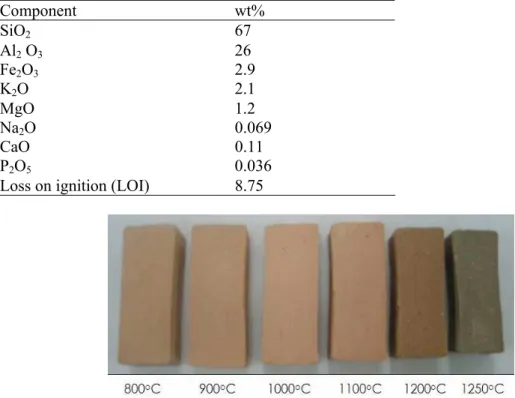
The physical colour of clay supplied was grey. After the sintering process, the colour of fired-clay brick turned into dark red (Fig. 3) at the temperature of 1200oC and indicated that there is a Fe2O3 content. It is shown from the XRF analysis as tabulated in Tab. I. The
clay contained less than 3 wt% fluxing components (K2O, Na2O and CaO). Fig. 2 presents the
XRD patterns of clays. The clay is contains two major minerals, kaolinite Al2(Si2O5)(OH)4
(ICDD 01-079-1570) and quartz SiO2 (ICDD 00-046-1045). Other minerals such as microline
KAlSi3O8 (ICDD 01-084-0709) and muscovite K(MgAl)2.04(Si3.34Al0.66)O10(OH)2 (ICDD
00-040-0020) were detected. Tab. II shows the Atterberg limit of clay. The value of plasticity index, plastic limit and liquid limit were 24.14%, 25.56% and 49.70%, respectively.
Tab. I. XRF analysis of clay from Beruas, Malaysia (wt %) Component wt%
SiO2 67
Al2 O3 26
Fe2O3 2.9
K2O 2.1
MgO 1.2
Na2O 0.069
CaO 0.11
P2O5 0.036
Loss on ignition (LOI) 8.75
Fig 3. Effect of firing temperature on the colour and shrinkage of the clay
Tab. II. The properties of clay from Beruas, Malaysia
3.2.
Thermal analysis (TG/DTA) on raw clays
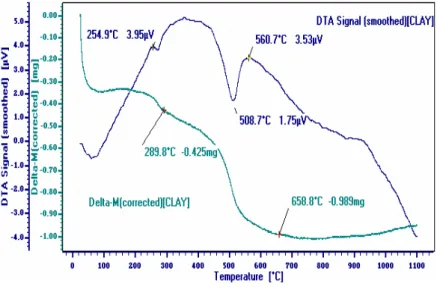
From Fig. 4, the first stage of firing clay is a completion of drying pore water. From the TG curve, it can be seen that the initial weight of the sample was reduced by 0.62% when Properties Result
Natural water content (%) Liquid limit (%)
Plastic limit (%) Plasticity index (%) Density (g/cm3) Colour
16.30 49.70 25.56 24.14 2.60
the temperature was increased up to 289.8oC. At the temperature of 350oC, the chemical combination water of the clay started to be driven off. This chemically combined water is not to be confused with pore water and water of plasticity, which escapes during early stages of drying. This chemically combined water is part of the molecular structure of the clay and is only affected by temperatures above 350oC. The weight of the sample was reduced by 1.43% when the temperature increased to 658.8oC where the dehydroxylation of clay minerals occurs. The effect of flux components such as K2O, Na2O and CaO can be seen when the clay
started to have a reaction at around 900oC. This also marks the beginning of the sintering process for the clay.
Fig. 4. Thermogravimetric and differential thermal analyses of the raw clay
3.3.
Phase identification
In Fig. 5, changes of diffractograms of fired-clay bricks with increasing sintering temperatures are illustrated.
Based on the results, quartz SiO2 (ICDD 00-046-1045), potassium aluminum silicate
KAl3Si3O11 (ICDD 00-046-0741), orthoclase KAlSi3O8 (ICDD 01-075-1592), and mullite
Al(Al1.272Si0.728O4.864) (ICDD 01-083-1881) were detected. It shows a significant change of
clay phase when sintered from 800oC to 1250oC. Along with the disappearance of the lines of quartz, a decrease in the feldspar content and the formation of aluminosilicate is noted (Fig. 5). Most of the quartz phases and peaks disappeared and changed form when temperature rises to 1250oC. The orthoclase peak was slowly diminishing when sintered from 800oC to 1100oC and completely disappeared at 1200oC. This is due to the formation of mulite phase. A new phase of mullite developed between the temperatures of 1100oC to 1250oC as explained by [9]. The peak also became sharp, showing a highly crystalline compound [10].
3.4. Microstructure of clay brick
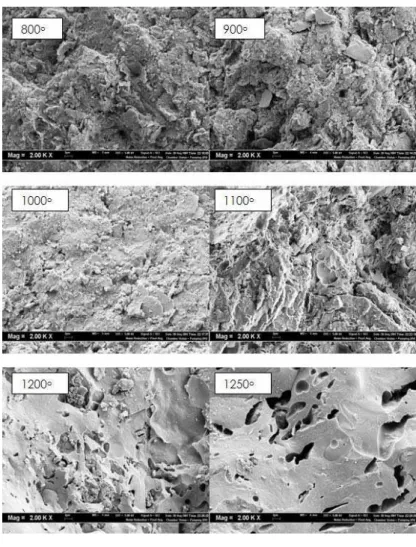
Fig. 6 shows the microstructure of the fracture surface of the clay bricks sintered from 800oC to 1250oC for 1 hour. The microstructure changes with the sintering temperature. At 800oC and 900oC, the brick has not yet experienced full solid state sintering process since the individual clay particles are still existent.
Fig. 6. SEM micrographs for the clay fired at different temperatures
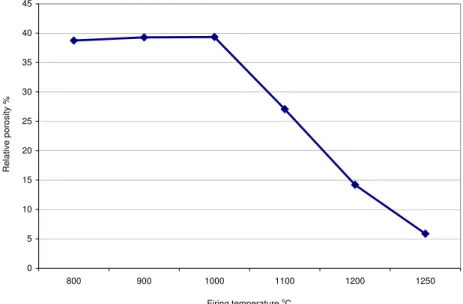
of over 1080oC are reached. The porosity of brick shows an increment of 1.4% and 0.1% from 800oC to 900oC and 900oC to 1000oC, respectively (Fig. 7). The increasing in porosity was the result of diffusion at relatively low temperature without significant shrinkage. The shrinkage value for temperature 800oC, 900oC and 1000oC is 0.31%, 0.50% and 1.04%, respectively. The surface also looks rough and a bit dusty. The bricks that were sintered until 1000oC are considered as having a porous structure since their water absorption rates are higher than 25%, as shown in Fig. 8.
0 5 10 15 20 25 30 35 40 45
800 900 1000 1100 1200 1250
Firing temperature oC
Relat
ive por
osit
y %
Fig. 7. Effect of firing temperature of the clay on the porosity
0.00 5.00 10.00 15.00 20.00 25.00 30.00
800 900 1000 1100 1200 1250
Firing temperature oC
W a te r ab sor pt ion %
Fig. 8. Effect of firing temperature of the clay on the water absorption
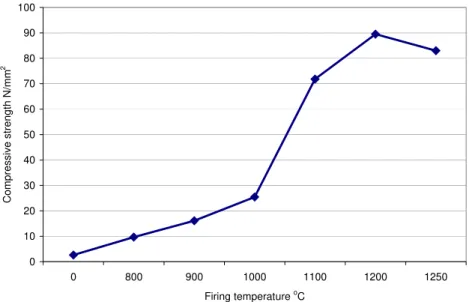
causing the reduction in volume for brick sintered from temperature 10000C to 11000C. A progressive gain in strength can be observed on brick sintered at 11000C where the compressive strength increased from 25.4N/mm2 to 71.8 N/mm2. This is also the temperature at which vitrification was first detected by SEM [14].
Starting from 11000C, the liquid phase sintering becomes a very important sintering mechanism. [15] emphasized that the liquid phase sintering was existent if there is a liquid phase that coexists with particulate solids during the sintering process. During this process, the reduction of pores becomes more significant as the compacted structure starts to increase its performances, such as strength and water permeability. The fired-clay brick sintered at 1100oC begins to diffuse and shrink as the liquid phase starts to form and fill up the pores, creating smaller pores. The brick shrunk 37% when sintered from 11000C to 12000C causing the porosity to reduce 47.5%. The effect of firing also causes the water absorption value to reduce 42% lower than the value for brick sintered at 1000oC.
0 10 20 30 40 50 60 70 80 90 100
0 800 900 1000 1100 1200 1250 Firing temperature oC
Compressive st rengt h N/ mm 2
Fig. 9. Effect of firing temperature of the clay on the compressive strength
The internal surface of pores in bricks sintered at 12000C and 12500C has a "glazed" view (Fig. 6). The sintering process reached the optimum temperature at 12000C, whereby its microstructure contains minimum pores with porosity value 14.2 % and produces the highest strength, 89.5 MPa, as shown in Fig. 9. However, at 12500C, the microstructure shows larger pore sizes and lower porosity value which is 5.87% with brittle fracture behaviour. The brick becomes more brittle due to a larger portion of glassy phase in the microstructure. Therefore, the strength of the sample becomes lower (83 MPa). Even though the porosity value is lower than the brick sintered at 12000C, this only effect on the water absorption properties where the value of water absorption for brick sintered at 12000C and 12500C was 6.63% and 2.71%, respectively.
4.
Conclusions
properties of bricks can be controlled to a significant extent by varying the firing temperature. The best firing temperature for fired-clay bricks with good performance of mechanical properties was discovered to be 12000C. There is no doubt about its potential in the construction industry, not only as filler in walling systems, but also as load bearing structures. However, due to economic reasons, the firing temperature can be reduced to between 1050°C to 1100ºC. The fired-clay brick can still achieve strength around 40-70 N/mm2, porosity below 29% and obtain water absorption value below 25%.
Acknowledgements
The support provided by Universiti Sains Malaysia in the form of facilities for this study is very much appreciated. The authors wish to acknowledge the technicians of the Structure Engineering Laboratory, School of Civil Engineering and technicians of Material Engineering, School of Materials and Mineral Resources Engineering for their help in carrying out the laboratory works.
References
1. G. Cultrone, E. Sebastian, M. J. De la Torre, Constr. Build. Mater. 19 (2005) 39. 2. R. A. Livingston, P. E. Stutman and I. Schuman, Conservation of Historic Brick
Structure, 11 (1998), 105.
3. A. Bremner, Origin and effect of cryptoflorescence of FEB. PhD thesis, Leeds University, London, 2002.
4. F. M. Khalaf, A. S. DeVenny, J. Mater. Civil Eng. 14 (2002), 334. 5. M. S. Tite and Y. Maniatis, Nature 257 (1975) 122.
6. W. E. Worrall, Clays and Ceramic Raw Materials. 2nd Edition, Elsevier Applied Science Publishers LTD, England, 1986.
7. B. Velde, Introduction to Clay Minerals. 1st Edition, Chapmen & Hall, London, 1992.
8. Y. P. Khanna, Thermal Characterization of Material, in Guide to Materials Characterization and Chemical Analysis. 2nd Edition, Sibilia, J.P. (Ed.), Wiley-VCH: New York, 1996, 261-285.
9. M. M. Jordan, M. A. Montero, S. Meseguer, T. Sanfeliu, Appl. Clay Sci. 42 (2008) 266.
10. P. Chindraprasirt, K. Pimraksa, Powder Technol. 182 (2008) 33. 11. M.S. Tite, Y. Maniatis, Trans. Brit. Ceram. Soc. 74 (1975) 19.
12. M. W. Barsoum, Fundamental of Ceramics. McGraw-Hill, Singapore, 1997.
13. R. Warren, Ceramic – Matrix Composites. Blackie USA Chapman & Hall, New York, 1992.
14. G. Cultrone, C. Rodriguez-Navarro, E. Sebastian Pardo, O. Cazalla, M. J. De la Torre Lopez, Eur. J. Mineral. 13 (2001) 624.
15. R. M. German, Liquid Phase Sintering. Plenum Press, New York, 1985.
Са р а: Ф
Б М .
ђ 800 1250 1 .
. 1200 C.
39.33% 5.87% 1000 1250 . Ц 1200
89.5 N/mm2.
.
К учн р чи: , , , ,