Annals of the University of Petroşani, Economics, 13(2), 2013, 125-132 125
BANKRUPTCY – EFFECTS ON BUSINESS ENVIRONMENT
CLAUDIA ISAC
ABSTRACT: Assuming that insolvency is an economic reality that cannot be ignored especially in the current context, and the concerns in the regulation of a flexible and efficient procedures are numerous both nationally and in the European Union, we have structured the work in two parts, respectively the first part, in which are presented the theoretical aspects of the implementation of the insolvency, more precisely the reorganization and bankruptcy proceedings and the second part, where we made a brief analysis of insolvent companies between 2010-2012. The paper ends with a brief presentation of the insolvency process in Eastern and Central European countries compared to Romania.
KEY WORDS: insolvency, bankruptcy, reorganization.
JEL CLASSIFICATION: G01, M10.
1. INTRODUCTION
In the Middle Ages, bankruptcy regulations have evolved in two distinct ways, respectively the Anglo-Saxon origin laws aimed to discharge the debt of the creditor from the debtor and granted the creditor a certain delay in order to lead to the survival and recovery of business and the Latin origin laws which pursued in a manner to prioritize the creditor protection. Initially, commercial insolvency were proceedings were narrowed to the bankruptcy procedure and it represented a special way of enforcement by liquidating the debtor's assets and settling the liabilities by the payment of debt. Over time, this procedure was subject to changes and now, the law gives the creditors a special tool to cover the debtor’s claims who is unable to pay the debts, the commercial bankruptcy procedure.
According to the Law no. 85/2006 concerning bankruptcy, the insolvency is the state of the debtor's assets which is characterized by the shortage of funds available for the payment of liquid and certain debts. Insolvency is presumed to be manifest when the debtor, after 30 days from the due date has not paid his debt to one or more
126 Isac, C.
creditors and is imminent when it turns out that the debtor will not be able to pay by the due by the debts with funds available on the due date.
This procedure opens, at the request of the debtor or the creditor and may include the procedure of reorganization and/or the procedure of bankruptcy. Therefore, the two sub-procedures - bankruptcy and reorganization - are both part of insolvency.
The judicial reorganization procedure is the insolvency procedure that apply to the debtor in order to pay his debts, according to a plan of debt payment rescheduling. It involves the preparation, approval, implementation and compliance of a plan, called reorganization plan, which may include, together or separately: the operational and/or financial reorganization of the debtor; the corporate reorganization by changing the social capital structure; the cessation of certain activities by the liquidation of certain assets from the debtor assets. If following the application of reorganization procedure, the company subject to the procedure, respectively the debtor fails to pay the debts in the period established in the procedure, it proceeds to the next step, the implementation of bankruptcy proceedings.
The bankruptcy procedure is part of insolvency procedure which is applied to the debtor in order to liquid the assets to cover his liabilities, followed by removal of the debtor from the registry in which he is registered. Accordingly, when a company is in bankruptcy, it can be said that it is insolvent. Conversely, if a company is in insolvency proceedings does not mean that, by default, it is in bankruptcy, it may be the stage of reorganization and by following the steps of this stage to recover financially.
2. THE MAIN STEPS IN THE IMPLEMENTATION OF THE INSOLVENCY PROCEDURE
The opening of insolvency procedure is based on an application brought to court by the debtor or by creditors as well as any other persons or institutions established by law. This application must be accompanied by the following documents: annual financial statements; trial balance for the month preceding the date of filing of initiation; the situation of the debtor's assets, including all the accounts and banks through which the debtor is running liquid assets.
The complete list of creditors and the value of the debts to them as well as their form, certain or under condition, liquid or illiquid, due or not yet due, uncontested or contested, indicating the amount, the cause and the preferential rights; the list of payments and property transfers made by the debtor during the 120 days preceding the filing of the application.
Bankruptcy – Effects on Business Environment 127
stage; certificate of admission to trading on a regulated market of securities or other financial instruments issued. During the observation period the trustee examines the legal and patrimonial situation of the society to assess whether there are real perspectives for the financial recovery go it, and in this case it will continue with the judicial reorganization procedure under a reorganization plan, or if after the review, it finds that the company must be liquidated, the procedure of bankruptcy.
The implementation of the reorganization procedure. In principle, the legal regulations discourage the debtor to ask for reorganization, based on the argument that if an insolvent company has a chance to reorganize, it shall be the responsibility of another person than the one who brought the company insolvent, respectively the insolvency administrator or the creditors. According to the Law no.85/2006 on insolvency proceedings, the procedure involves the application of a reorganization plan that will indicate the prospects for recovery in relation to the possibilities and the specific activity of the debtor, with the available funds and with the market demand to the offer of the debtor, and it will include measures consistent with the public order, including the manner of selection, appointment and replacement of the administrators and directors.
The reorganization plan will include payment program of the claims and its application cannot be made for a period exceeding three years. This plan must be drawn both from the financial perspective and includes the claims situation, the compensation offered to the holders of claims and whether and to what extent the debtor, the economic interest group members, the holders of the collective companies associations and the general partners of limited partnership companies will be discharged of responsibility as well as from the methodological perspective by prioritizing appropriate measures for its implementation, such as: the retention by the debtor of the company's management; obtaining financial resources to support achieving the plan; the transmission of the debtor's assets; the merger of the debtor; the liquidation of all or of a part of the debtor's assets; the modification or termination of the real pledges; the extend of the due dates etc..
The implementation of bankruptcy. When a company recovery is no longer possible, bankruptcy is a last resort to pay the company's debts by liquidating the entire asset. In general, the payment of such debts is only partially made when the losses of the company exceed its equity, these losses being financed, basically, by loans from financial institutions or suppliers. Most debtors ask for the opening of the insolvency procedure too late, when it is imminent, and the chances of a reorganization are minimal, so they are in fact, simplified bankruptcy procedures. Bankruptcy, in general, follows the steps:
a) The initial stage in which take place the seal and the inventory of the assets belonging to the debtor, the freeze of the bank deposits, the preparation of the creditors list and the checking procedure of the accounting documents of the company;
128 Isac, C.
demand for them or are insufficient to cover the administrative costs, the judge may give the verdict of terminating the proceeding, which give the opportunity to strike the debtor from the register where it has been registered;
c) The liquidation stage which evaluates the assets that can be sold, the debtor's assets are sold at auction or directly and it collects the revenue from the assets liquidation. Every three months, the liquidator presents to the creditors' committee a report on the funds obtained from liquidation and collection of receivables and a plan of distribution between creditors.
The distribution of funds stage involves the establishment of the fund distribution rapport and plan by the liquidator and the notification the results to the creditors, the cover of the expenses related to the liquidation and payment of receivables, in the order established by the law and the preparation of the final report and the balance by the liquidator; the bankruptcy closure stage implies that all persons concerned debtors, creditors, security holders, shareholders or members are discharged of any duties or responsibilities that they had before bankruptcy; the delisting of the company implies deleting the firm from the authorities records, respectively from the Trade Register, the territorial branches of public finance etc. Insolvency is an economic reality that cannot be ignored especially in the current context, and the concerns in the regulation of a flexible and efficient procedure are numerous both nationally and at the European Union level.
Regardless of how they apply insolvency, respectively the procedure of reorganization or / and bankruptcy, the purpose of implementation of it is to ensure a viable financial recovery of economic entities. In terms of the effects that this legal-economic mechanism has, we consider it finds two opposite orientations, so if its main objective is to improve the business environment and reducing negative effects of insolvent debtors, the long period of implementation of all stages makes debtors incapability to pay to be passed on to creditors.
3. STATISTICAL ANALYSIS OF INSOLVENT COMPANIES
Even though there are opinions according to which a society which has reached insolvency go on a journey of no return, still we give some examples of companies in the Romanian business environment which shows that by a reorganization flexible managed to recover financially:
a) Flanco International SRL succeeded after 21 months of decline, through an extensive reorganization process, to reach the break-even after eight months of the declaration of insolvency, to restructure loans and reorganize retail network so it becomes the main player in the retail market of IT and electronics;
Bankruptcy – Effects on Business Environment 129
goods of the 79 stores closer to the existing potential of the market in Romania;
c) Pro Express Retail SA, the company which operates Diverta bookstores, began restructuring of society at both operational and financial corporate debt by converting a portion of the company debts into shares. Period of financial crisis and declining purchasing power of the population has led to a continuous decrease of turnover and hence an increase in operating expenses but the insolvency procedure was succeeded after two consecutive years of negative results for the year, ie 18,439,653 lei in 2009 and 23,768,468 lei in 2010, in 2011 to record a profit of 1,999,998 lei;
d) National Society Plafar S. A. is a famous example for insolvency, it succeeded a rebranding of the product portfolio and technological modernization of all lines and after 11 years of losses in 2011 registered a gross profit of over 80,000 lei.
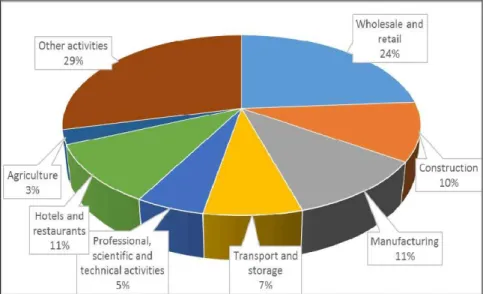
As shown in the following figure and the previous examples, the largest share of firms that become insolvent belongs to the trade area with 23.85% in 2011. Equal relative weight between 10 to 11% is still three major areas of the economy, that construction, catering and tourism sector and manufacturing activity. A smaller number of companies entering insolvency record transport and storage of weights over 7% and agriculture 2.6% - where risk factors are addicts, mainly climate and favourable climatic environment can be decisive record of positive financial results.
Figure 1. Situation on the domain structure of the insolvent firms in 2011
130 Isac, C.
Source: Creditreform Economic Research Unit, Corporate insolvencies in Europe 2012, http://www.creditreform.com/fileadmin/user_upload/CR-International/local_
documents/Analysen/Corporate_Insolvencies_12_13.pdf
Figure 2. Contribution of the key economic sectors to overall insolvency in Central and Eastern Europe in 2012
Compared with other countries, in 2012 Romania registered a record number of companies became insolvent so that over 26,800 companies exceed the combined number of companies became insolvent in Slovakia, Slovenia, Estonia, Lithuania, Latvia, Bulgaria and Croatia, despite that our country has a much smaller number of companies than the European average.
Regarding the evolution of the number of firms that became insolvent, is barely visible a sinuous their number and their geographical distribution. Thus, while in 2010 their number was 21692, which decreases by more than 10% by next year but the year 2012 is one with a substantial increase respectively by 36.4% compared to 2011 and by 23.5% compared to 2010. Their geographical distribution is heterogeneous but the largest concentration of firms toward insolvency is the most developed urban areas where the number of established companies is very high and a much smaller number of poorer, those southern and eastern Romanian regions.
Thus, besides Bucharest in the first period, ie 2010-2011 stands Timis, Constanta, Prahova, Brasov, Cluj, Bihor, Arges, Galaţi and in 2012 started to increase substantially the number of companies in insolvency counties ranking in the continuation of economic development and Iasi, Gorj, Hunedoara, Arad, Bacau, etc..
In terms of size structure of firms became insolvent, it is found that the highest number reached in this case were SMEs, which represent more than 96-97% at the expense of medium-sized companies, large and very high.
Bankruptcy – Effects on Business Environment 131
Table 1. Situation of insolvency firms
Years No. County
2010 2011 2012
1 Alba 300 10 307
2 Arad 611 76 1031
3 Argeş 562 137 1111
4 Bacău 517 1 547
5 Bihor 1188 49 1309
6 Bistriţa-Năsăud 291 54 652
7 Botoşani 412 11 205
8 Braşov 851 59 992
9 Brăila 417 79 528
10 Bucureşti 551 79 3565
11 Buzău 461 41 604
12 Caraş-Severin 157 7 310
13 Călăraşi 952 38 156
14 Cluj 990 122 851
15 Constanţa 112 35 1149
16 Covasna 273 59 194
17 Dâmboviţa 1105 29 694
18 Dolj 768 35 863
19 Galaţi 203 61 1275
20 Giurgiu 351 42 339
21 Gorj 321 17 649
22 Harghita 516 44 282
23 Hunedoara 188 20 530
24 Ialomiţa 717 19 336
25 Iaşi 368 111 539
26 Ilfov 418 - 690
27 Maramureş 104 12 582
28 Mehedinţi 2256 10 165
29 Mureş 526 90 537
30 Neamţ 289 91 253
31 Olt 235 33 246
32 Prahova 677 55 847
33 Satu Mare 839 - 382
34 Sălaj 219 11 390
35 Sibiu 427 45 425
36 Suceava 232 13 517
37 Teleorman 170 24 240
38 Timiş 790 29 844
39 Tulcea 317 13 361
40 Vaslui 241 - 407
41 Vâlcea 261 - 422
42 Vrancea 509 - 481
132 Isac, C.
Although in 2012 the share of large firms in insolvency was only 3%, their share by turnover volume represents 49% of total insolvencies - up from 16% in 2011 - so for a company declared insolvent will be affected at least 10 SMEs. Of the 800 big companies became insolvent in 2012, 31 entries were registered companies managed by the General Administration of Large Taxpayers whose total debts amounted to 301.1 million lei.
4. CONCLUSIONS
The economic situation in Western Europe – whether in the eurozone or elsewhere in the European Union – remains precarious. The governmental, sovereign debt and banking crisis, which is now in its fifth year, has certainly not been resolved. On the contrary, because of the slowness and half-heartedness with which agreements are reached and action is taken within the EU and the euro area, the crisis of budgets, banks and the currency is impacting more and more visibly on the real economy, manufacturing and service out-put, and the supply of public needs.
REFERENCES:
[1]. Birchal, A. (2010) Procedura insolvenţei. Reorganizarea judiciară şi procedura falimentului, Ed. Universul Juridic, Bucureşti
[2]. Monea, A. (2007) Teoria şi practica insolvenţei, Editura Universitas, Petroşani [3]. http://www.creditreform.com/fileadmin/user_upload/CR-International/local _
documents/Analysen/Corporate_Insolvencies_12_13.pdf [Accessed 10 May 2012] [4]. http://www.wall-street.ro/slideshow/Legal-Business/136916/insolventa-reorganizari-
povesti-de-succes/8/asmita-gardens.html#anchor-of-navigator#ixzz3802mVThl [Accessed 10 May 2012]