MECHANISM OF INJURY- A SIGNIFICANT
COM-PONENT IN EVALUATION OF MAXILLOFACIAL
TRAUMATIC PATIENTS STATUS
Elitsa G. Deliverska
Department of Oral and Maxillofacial surgery, Faculty of Dental medicine, Medi-cal University- Sofia, Bulgaria.
Journal of IMAB - Annual Proceeding (Scientific Papers) 2014, vol. 20, issue 1 ISSN: 1312-773X (Online)
ABSTRACT:
Knowing the injury mechanisms is of extreme im-portance for correct diagnostic evaluation. Specific injury models can be related to exactly determine trauma mecha-nisms. Understanding the way of injury may be a key to solving the occult injuries. Thus, some life threatening in-juries may be diagnosed without present clinical symptoms at the moment of examination.
Purpose: The aim of our study is to analyse the risk factors for arising of associated maxillofacial trauma inju-ries (AMFI)
Material and methods: A total of 352 traumatic pa-tients were retrospectively and prospectively examined for the period 05.2005 - 12.2011, treated at the Department of Oral and maxillofacial surgery at the St. Anna University Hospital, Sofia, whereas AMFI were determined in 129 pa-tients
Results: Our study results indicate that most often, RTA are a reason for a combined trauma at the age group of 20-29, followed by the age group of 30-39, and less in the age group of 40-49. The most often reasons for com-bined traumas are RTA(road traffic accident) and IPV(interpersonal violence), each of which has a relative share, significantly higher than the other reasons (x2, ð<0.001). Our study results indicate that following a RTA, the most common combined trauma is CrT - 31 patients, followed by muscular skeletal system trauma - 11, equal number of eye injuries and polytrauma – 4 patients, spinal cord trauma - 1, and more than one concomitant injury - 1. When analyzing the mutual relation between aetiology and combined trauma, the most common reasons are included (RTA and thrash) as well as combined traumas (neurosur-gical, MSS trauma and eye trauma).
Conclusion: Data analysis in our study indicates that trauma mechanism is the most important factor that imposes the need of CT examination, especially in intoxicated and disorientated patients, as well as in unconscious patients.
Key words: maxillofacial trauma, etiology, mecha-nism
INTRODUCTION:
According to most studies, knowing the mechanism of injury is a significant component in evaluation of trau-matic patients status [11, 17]. In case of falling from a height of 3 or more meters, there is a high risk of presence
of spinal cord trauma, of long bones and pelvis trauma [16]. A RTA with anterior-posterior hit, as well as with incident at a sudden slowing down the car are also alarming. There-fore, diagnostics of some potential life threatening injuries (especially mediastinal) is based on: mechanism of trauma, radiography of the thorax or ultrasound examination. Ac-cording to Perry [10, 11], clinical study and repeated radi-ography of the thorax are not so reliable in estimation of the thorax status, and the estimation of abdominal area sta-tus may also be too difficult, especially if the patient is un-sociable.
Most studies confirm the thesis that brain injury is more likely at high energy traumas - RTA(road traffic acci-dent), height traumas and also in cases of more serious fa-cial skeleton injuries.
The aim of our study is to analyse the risk factors for arising of associated maxillofacial trauma injuries (AMFI) (factors - predicators for concomitant injuries pres-ence)
MATERIAL AND METHODS
A total of 352 traumatic patients were retrospectively and prospectively examined for the period 05. 2005 - 12. 2011, treated at the Department of Oral and maxillofacial surgery at the St. Anna University Hospital, Sofia, whereas AMFI were determined in 129 patients.
RESUTS
In our study, we determined the following relations regarding the trauma mechanism.
1. Data analysis according to injury mechanisms and patients age at the moment of trauma
We analyse the mechanism of injury and patients’ age at the moment of trauma
Our study results indicate that most often, RTA are a reason for a combined trauma at the age group of 20-29, followed by the age group of 30-39, and less in the age group of 40-49, but no significant differences are deter-mined in patients distribution (x2, p=0.088) in the indicated age groups. Thrash is the combined trauma reason most of-ten in the age group of 20-29, followed by 40-49, and less in the age group of 30-39, but no significant differences are determined in combined trauma patients distribution as a result of a thrash in the analysed age groups (x2, p=0.338) (Table 2).
Data analysis indicates that RTA is the more frequent
combined reason than IPV(interpersonal violence) in age groups of 20-29 and of 30-39, while in the age group of 40-49, thrash prevails, but no significant differences are de-termined in patients distribution according to the reason in each of the indicated age groups (x2, p>0.05).
2. Results according to associated trauma aetiol-ogy
The most often reasons for combined traumas are RTA and IPV(interpersonal violence), each of which has a relative share, significantly higher than the other reasons (x2, p<0.001).
Trauma Age groups (years) Total
aetiology <12 12-19 20-29 30-39 40-49 50-59 >60 number
RTA 1 6 18 15 7 4 2 53
IPV 0 6 16 9 11 2 6 50
Employment 0 0 0 0 1 2 1 4
Sport 2 2 1 0 0 0 0 5
Fall 0 1 1 0 3 2 3 10
Falling from a height 0 0 2 1 2 0 0 5
Gunshot 0 0 1 1 0 0 0 2
Total number 3 15 39 26 24 10 12 129
Table 1. Data analysis according to injury mechanisms and patients age at the moment of trauma
Table 2. Distribution of trauma reasons per age groups
Trauma Age groups Level of
aetiology 20-29 30-39 40-49 significance
RTA 18 15 7 p=0.088
IPV 16 9 11 p=0.338
Level of significance p=0.732 p=0.221 p=0.346
Patients as a result of RTA are 53 (41.1%), of a IPV - 50 (38.8%), of an employment trauma - 4 (3.1%), of a sport trauma - 5 (3.9%), of a fall - 10 (7.8%), of falling from a height trauma - 5 (3.9%), of a firearm trauma - 2 (1.6%) (Table 3).
Combined trauma reason Number % Level of significance
RTA 53 41.1
IPV 50 38.8
Employment 4 3.1
Sport 5 3.9 p<0.001
Fall 10 7.8
Falling from a height 5 3.9
Gunshot 2 1.6
Total number 129 100
Table 3. Associated trauma aetiology
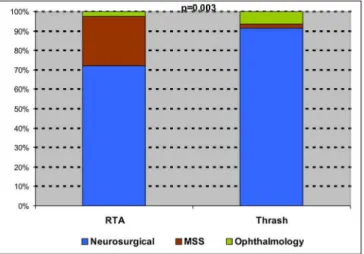
Our study results indicate that following a RTA, the most common combined trauma is CrT - 31 patients, fol-lowed by muscular skeletal system trauma - 11, equal number of eye injuries and polytrauma – 4 patients, spinal cord trauma - 1, and more than one concomitant injury - 1. Clinical material analysis indicates that after a thrash, the
Fig. 1. Mutual relation between trauma reason and type of occurred combined trauma
3. Mutual relation between combined trauma and reason
When analyzing the mutual relation between aetiol-ogy and combined trauma, the most common reasons are included (RTA and thrash) as well as combined traumas (neurosurgical, MSS trauma and eye trauma). Because of expected low frequencies in other combinations, there is a
risk of results untrustworthiness.
Significantly higher relative share of combined MSS traumas was determined, resulting from RTA (x2, p=0.003). MSS traumas are not a typical consequence of a thrash, when usually neurosurgical and in some cases ophthalmol-ogy combined traumas occur (Table 5, Figure 1).
Table 5. Mutual relation between aetiology and combined trauma
Aetiology Combined trauma Level of
Neurosurgical MSS trauma Ophthalmology significance
RTA 31 11 4
p=0.003
IPV 43 1 3
DISCUSSION:
Patients that suffered as a result of an employment accident, are 3.1%. Patients are above 40 years of age. Pos-sibility for this trauma is greatest in individuals that use tools or machines at work (1.5 to 7 times higher risk) [9]. Our study results indicate lower percentage compared to the study of Down et al. [4], who state that 5% of patients have suffered in such trauma, and higher compared to Lim’s study [9] - 1.6%.
Clinical material analysis in our study indicate that 10 (7.8%) patients have suffered from falling (of their own height) and is lower compared to studies of Lim [9] (9.7%) and of Thoren [13] (19.2%).
Trauma from falling from a height, as a high energy injury mechanism, is a precondition for combined trauma presence. In our study, patients suffered from such a trauma, were 5 (3.9%). Compared to other authors, this percentage is lower - 6.5% [12,13].
Some authors have published interesting data, ac-cording to which ÑMFT in low energy injury mechanisms are 14% (thrash, fall) and 64% are in high energy injury mechanisms (RTA, trauma from falling from a height) [9]. Table 4. Data analysis regarding the trauma aetiology and combined trauma type
Legend: CrT – cerebral trauma, MSS – muscular skeletal system, OPh – ophthalmology trauma, SCT – spinal cord trauma, >CH – more than one combined trauma, PT - polytrauma, ORL – otorhinolaryngology trauma, A – ab-dominal.
Trauma Combined trauma Total
aetiology CrT MSS OPh SCT >1 CT PT ORL A number
RTA 31 11 4 1 1 4 0 1 53
IPV 43 1 3 1 1 1 0 0 50
Employment 1 0 1 0 1 0 1 0 4
Sport 5 0 0 0 0 0 0 0 5
Fall 9 0 1 0 0 0 0 0 10
From a height 2 0 0 0 1 2 0 0 5
Gunshot 1 0 1 0 0 0 0 0 2
tor for ÑMFT appearance follows right after RTA. Large number of traumas as a result of a thrash (as not so high energy mechanism) very likely determines the not so high ÑMFT incidence in our study (36.6%) compared to other studies. As a leading ÑMFT mechanism, Bryan Bell et al. [3] also indicate RTA - 44% (a little higher percent than in our study - 41.1); next come falling - 22%, thrash - 9%, employment accidents - 7%, sport accidents - 9%, other ac-cidents - 3%, firearm traumas - 6%.
Down et al. [4] also report RTA as a main reason for trauma - 70% (much higher percentage compared to our data - 41.1), of which the largest number are motor vehi-cles drivers (42), followed by pedestrians (28), motorcyclists (22), passengers (10); trauma from falling from a height (21); thrash (6) and falling from personal height (4); bicyclers (3); sport trauma (1) etc. (4). This study shows presents of multisystemic traumas at RTA, including MFT, which is confirmed by our study as well.
Clinical material analysis shows that MFT at RTA are more serious compared to traumas obtained by other mecha-nisms of injury. The incidence of RTA and traumas caused by these, depend on many different factors: traffic regula-tions, roads status, drivers’ abilities, good working order and type of motor vehicles etc. Alcohol abuse and motor vehi-cles drivers’ tiredness play a major role as a reason for these accidents and therefore various organizations lead cam-paigns for RTA prevention. In these accident reasons, con-comitant trauma presence is more likely according to our study – in 65%. RTA are the reason for severe MFT, often combined with other organs and systems traumas, which lead to life threatening statuses. In order to decrease the RTA risk, it is important to observe safety standards regard-ing seat belts, limits for use of alcohol and sedatregard-ing drugs, standards for motor vehicle safety.
Combined MFT may result from various injury mechanisms, having in mind increasing global problems of today’s world – intensive migration and increasing violence. The most common mechanisms according to Vetter et al. still are RTA and thrash [14], which is confirmed by our study as well.
Our study indicates that ÑMFT result mainly from RTA (suddenly turning down the speed), falling and thrash (hit by blunt object in head and face). In ÑMFT with eye injury, optical nerve injury mechanism in maxillofacial frac-tures may be a result of a nerve compression or laceration by bone fragments, of neurilemma haematomas, of nerve contusion following an oedema and of supplying vessels secondary compression [1]. Nerve may be injured in its en-tire length, whereas the most common trauma is intracra-nial injury, and its early diagnostics is of extreme impor-tance for prognosis and result of treatment. Nerve may be injured in stretching, contusion or in reflected forces along relatively dense and robust canal. Initial hit starts a cascade of mediators which in turn cause secondary vasospasm, vasoocclusion, oedema and necrosis. This happens more fre-quently when trauma force is transferred to optical canal and as a result, n.opticus is injured, and neuronal compression occurs, together with vasoocclusion and a localized form of compartment syndrome, which is initially reversible, but
after that leads (progresses) to arterial obstruction and irre-versible thrombosis [15]. Neurilemma haematoma formation and nerve transaction are more rarely observed. When there is an overall nerve transaction, no treatment is possible, un-like the other injury mechanisms, in which early treatment may lead to better prognosis for the patient’s vision. Clini-cally various type of n.opticus injuries are hard to determine and therefore ophthalmology consultation and CT or MRI examinations are required.
Specific injury models are related to exactly deter-mined injury mechanisms and today are well known: in trauma from falling from a height, there is a great risk for SCT presence, of long bones and pelvis fractures; RTA with anterior-posterior hit (whiplash hit), as well as sudden turn-ing down the speed (even at low speed) are critical for tho-racic trauma (mediastinum compression, aorta dissecation), internal organs injuries (supplying vessels laceration). High energy fractures are problematic regarding to neurology in-juries (mainly CrT). In these, there is a real risk of intrac-ranial pressure increase, dura laceration, rhinoliquorrhea, ophthalmology injuries, frontal sinus damage etc. [10, 11].
Forces leading to bulb injury, may not affect perior-bital tissues and thus patient vision threatening injury may be omitted. Clinical material analysis in our study indicates that penetrating injuries may be a result of small projectiles during an accident, for example. Special attention must be paid in traumas caused by broken glass, wooden or metal fragments, as well as in examination in eyelid trauma or periorbital laceration. Rupture and bulb perforation with presence of foreign body should be considered in all cranio-facial traumas. Because of close relation between structures in anterior and middle cerebral fossa and orbit (divided only by a thin bone barrier), intracranial injury should be sus-pected in all penetrating orbital injuries. Suspecting of such trauma (penetrating cerebral and eye trauma) is based on the anamnesis, of injury mechanism and of clinical examination result.
This study results indicate that concomitant traumas must be suspected in all high energy traumas. According to Thoren et al. [13], concomitant trauma was diagnosed in three of 4 patients falling from a height, and in two of three patient suffered in a RTA, which confirms concomitant trauma incidence in high energy injury mechanisms that may cause life threatening conditions.
Our examination data confirm bibliographic data that AMFI(associated maxillofacial injuries) are more frequent as a result of high energy traumas. Most combined traumas result from RTA (41.1%), second are AMFI resulted from not so powerful mechanisms – thrash, employment trauma, sport trauma. High percentage of combined maxillofacial trauma obtained as a result of a thrash (38.8%) is impres-sive and may be related to increasing aggression and value system violation in modern society. In multiple injuries pa-tients and in polytrauma papa-tients, primary mechanisms of injuries are RTA, followed by falling from a height.
1. Ardekian, L, Rosen D, Klein Y, Peled M, Michaelson M, Laufer D. Life threatening complications and ir-reversible damage following maxillofa-cial trauma. Injury, 1998 May;29(4): 253-256. [PubMed]
2. Brooks A, Holroyd B, Riley B. Missed injury in major trauma patients. Injury, 2004 Apr;35(4):407-410. [PubMed] [CrossRef]
3. Bell BR. The Role of Oral and Maxillofacial Surgery in the Trauma Care Center J. Oral Maxillofac. Surg. 2007 Dec;65(12):2544-53. [PubMed] [CrossRef]
4. Down KE, Boot DA, Gorman DF. Maxillofacial and associated inju-ries in severely traumatized patients: Implications of a regional survey. Int. J. Oral Maxillofac. Surg. 1995 Dec;
24(6):409-412. [PubMed]
5. Gerrelts BD, Petersen EU, Mabry J, Petersen SR. Delayed diagno-sis of cervical spine injuries. J. Trauma. 1991 Dec;31(12):1622-1626. [PubMed]
6. Grover RS, Antonyshyn OM. Care ofmaxillofacial injuries inmultiple trauma. Current Orthopaedics. 2003 Aug;17(4)274-286. [CrossRef]
7. Hackl W. Hausberger K. Sailer R. Ulmer H. Gassner R. Prevalence of cervical spine injuries in patients with facial trauma. Oral Surg Oral Med Oral Pathol Oral Radiol Endod. 2001 Oct;92(4):370-6. [PubMed] [CrossRef] 8. Lewis VL Jr, Manson PN, Cerullo LJ, Meyer PR Jr. Facial inju-ries associated withcervical fractures: recognition, patterns and management. REFERENCES:
J Trauma. 1985 Jan;25(1):90-3. [PubMed]
9. Lim LH, Lam LK, Moore MH, Trott JA, David DJ. Associated injuries in facial fractures: review of 839 pa-tients. Br J Plast Surg. 1993 Dec; 46(8):635-638.
10. Perry M. Advanced Trauma Life Support (ATLS) and facial trauma: can one size fit all? Part 1: Dilemmas in the management of the multiply jured patient with coexisting facial in-juries. Int J Oral Maxillofac Surg. 2008 Mar;37(3):209-214. [PubMed] [CrossRef]
11. Perry M, Morris C. Advanced Trauma Life Support (ATLS) and fa-cial trauma: can one size fit all? Part 2: ATLS, maxillofacial injuries and air-way management dilemmas Int. J Oral years old, and has suffered by high-energy trauma –
usu-ally RTA [7].
High-energy facial skeleton traumas (such as RTA) cause more frequent cervical spine injury in comparison to traumas caused by low-energy mechanism. Most cervical spine injuries that come together with mandibular fracture are caused by forces exercised directly or indirectly by fa-cial skeleton towards neck. It is considered that mandibu-lar fractures are more often connected to upper cervical part injuries, while mid-face fractures – with lower cervical part. This is related to cervix flexion and/or extension at the mo-ment of strike [8].
A banal frontal laceration in adult patient, obtained as a result of a trivial fall, may be the only indication for cervical spine injury [8]. Clinical diagnosis is basically dif-ficult because of the fact that cervical spine traumas are of-ten not manifested by local clinical signs, therefore authors emphasize that radiography examination in MFT patients must be compulsory [12, 13].
Grover & Antonyoshyn [6] indicate that excluding a cervical trauma in some patients may be difficult – for ex-ample patients under influence of drugs (seducing agents), alcohol, uncooperative, irresponsive patients, patients with changed mind. Cervical spine injuries affect the MFT treat-ment, therefore excluding of this trauma is required before performing any therapeutic measures (in 10-15% of polytrauma patients, cervical trauma is determined). Both detailed anamnestic information and trauma mechanism evaluation are of great importance as a warning factor in-dicating to a possible SCT(spinal cord trauma) [10].
Our examination results indicate comparatively low ÑMFT with SCT incidence (1.6%), whereas obtained data are not in conformity with most studies that underline high incidence of these traumas, but should not be neglected, and have to be accepted as existing in any traumatic patients
until the opposite is determined.
Knowing the injury mechanism is extremely impor-tant in MFT diagnostics and treatment, as it is possible the patient to be directed to the MFS wards, and sometime interhospital transfer is required in case that the only vis-ible injury is MFA trauma.
It is important to know that about 15% of all inju-ries (especially of spinal cord and muscular skeletal system) may be omitted during the initial examination and in status estimation [2, 5]. Data show that surprisingly, even a weak sudden turning down the speed (in RTA) has the potential to cause death as a result of mechanisms mentioned (inter-nal organs may be torn partially or totally from their sup-plying vessels). A large part of these injuries is not deter-mined immediately and remain hidden for hours or days until diagnosed. SCT(spinal cord trauma) for example are related to a larger percentage to the mandible fracture cases and are more common in RTA
CONCLUSION:
We determine that multiple trauma is possible to a largest extent in the following injury mechanisms: height trauma – falling from more than 3 meters; RTA, in which the passenger was found outside the car in case there is a dead passenger; hit pedestrian; RTA in motorcyclist or bicycler; high speed RTA; RTA in which there is a serious car deformation, as well as in case of disturbed taking the victims outside the car. The concept of high energy trauma (except trauma from falling from a height) is hard to de-fine. Thrash and RTA include a large number of heteroge-neous conditions.
Address for correspondence: dr Elitsa Deliverska,
Department of Oral and Maxillofacial surgery, Faculty of Dental Medicine, 1, Georgi Sofiyski blvd., 1431 Sofia, Bulgaria; tel.+359 888 949 740; Maxillofac Surg. 2008
Apr;37(4):309-320. [PubMed] [CrossRef]
12. Raveh J, Laedrach K, Vuillemin T, Zingg M. Management of combined frontonaso-orbital/skull base fractures and telecanthus in 355 cases. Arch Otolaryngol Head Neck Surg. 1992; 118(6):605-614. [CrossRef]
13. Thorén H, Snäll J, Salo J, Suominen-Taipale L, Kormi E, Lindqvist C, et al. Occurrence and types of associated injuries in patients with fractures of the facial bones. J
Oral Maxillofac Surg. 2010 Apr;68(4): 805-10. [PubMed] [CrossRef]
14. Vetter JD, Topazian RG, Goldberg MH, Smith DG. Facial frac-tures occurring in a medium-sized met-ropolitan area: recent trends. Int J Oral Maxillofacial Surg. 1991 Aug;20(4): 214-216. [PubMed]
15. Walsh FB. Pathological - clini-cal correlations. I: Indirect trauma to the optic nerves and chiasm. II: Certain cerebral involvements associated with defective blood supply. Investig.
Ophthalmol. 1966 Oct;5(5):433-49. [PubMed]
16. Williams J, Jehle D, Cottington E, Shufflebarger C. Head, facial, and clavicular trauma as a predictor of cer-vical-spine injury. Ann Emerg Med. 1992, Jun;21(6):719-722. [PubMed] [Cross Ref]