586
Srp Arh Celok Lek. 2013 Sep-Oct;141(9-10):586-591 DOI: 10.2298/SARH1310586J
ОРИГИНАЛНИ РАД / ORIGINAL ARTICLE UDC: 617.7-001.4-053.2
Correspondence to:
Miloš JOVANOVIĆ Clinic of Eye Diseases Clinical Center of Serbia Pasterova 2, 11000 Belgrade Serbia
SUMMARY
Introduction Eye injuries represent a significant problem in children.
Objective The aim of the study was to determine the incidence and causes of the eye injury and to propose measures of the eye injury prevention in children up to 15 years of age.
Methods This was a retrospective study of 552 children with the eye injuries treated at the Clinic of Eye Diseases in Belgrade during the period March 1999 to February 2010. Gender and age of the children, time of injury, the type and site of injuries, visual acuity upon admission and at discharge, as well as the time of surgery in relation to time of injury were analysed.
Results The ratio between the injured boys and girls was 3.6:1. The highest percentage of injured children was in the group 6-10 years old (39.7%); the injuries were almost evenly distributed according to months during the year and days during the week. The percentages of severe closed and open injuries of the eyeball were almost equal. Visual acuity upon discharge and subsequent follow-up examinations were significantly improved after the applied treatment in comparison with the visual acuity upon admission.
Conclusion Eye injuries in children still represent a severe health problem. Regarding the youngest age group of children, adults are mainly responsible for these injuries due to their lack of attention, while in older children these injuries are the result of the production and distribution of inappropriate toys and a failure to implement the legal traffic regulations applicable to children. The prevention of eye injuries is essential.
Keywords: eye injury; child; cause; frequency; prevention
INTRODUCTION
Eye injuries represent a major cause of visual impairment and blindness in children [1]. Since this disability is acquired during the earliest phase of life, the reaction to it differs significantly from the same disability acquired in adult age. On one hand, adjustment to the newly developed condition may be more rapid but, on the other, severe traumas will have psy-chiatric consequences for the child [2]. It is un-derstandable that individual responses will vary widely depending on the type and severity of the injury. Nevertheless, it is an awkward mo-ment in the life of the child and his/her family, which changes the child’s destiny for life. The former also has a considerable socioeconomic significance. However, the fact is that 90% of all eye injuries provide hope for possible fu-ture patients and provide a chance for better treatment to future physicians [3]. However, prevention strategies demand knowledge about the characteristics of these injuries and the circumstances and causes of injuries in order to define the problems, set priorities, develop action programs and focus on the knowledge and material resources available for the clearly defined objectives of the programme.
In this paper we analyzed the factors lead-ing to mechanical eye injuries in children. The analysis was essentially aimed at the
identifica-tion and emphasis of prevenidentifica-tion possibilities and, accordingly, reduced number of injuries and their consequences.
OBJECTIVE
The aim of the study was to determine the inci-dence and causes of eye injury and to propose measures of the eye injury prevention in chil-dren up to 15 years of age.
METHODS
This paper represents a retrospective study that was carried out on children up to 15 years of age with the mechanical eye injuries who were treated as in-patients at the Clinic of Eye Dis-eases, Clinical Center of Serbia in Belgrade, from the beginning of March 1999 to the end of February 2010. Inpatient treatment was re-quired due to the severity of eye injuries. The following factors were analysed: gender and age, time of injury (year, month, day), place of injury (outdoors, at home, at school) and mode of the injury infliction. The types of injuries were also analysed (open and closed injuries of the eyeball and injuries of the ocular adnexa). Finally, visual acuity on admission as well as definitive visual impairment was examined; in
Mechanical Eye Injuries in Children Aged 0–15 Years
Treated at the Clinic of Eye Diseases in Belgrade:
Frequency, Causes and Preventive Measures
Miloš Jovanović1,2, Aleksandar Medarević1, Miroslav Knežević1,2, Vera Krstić1,2 1School of Medicine, University of Belgrade, Belgrade, Serbia;
addition, the number of admitted patients who required surgical management (at least one) and the time of surger-ies with respect to the time of injury were also recorded.
RESULTS
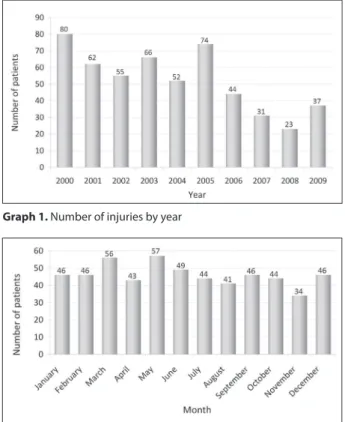
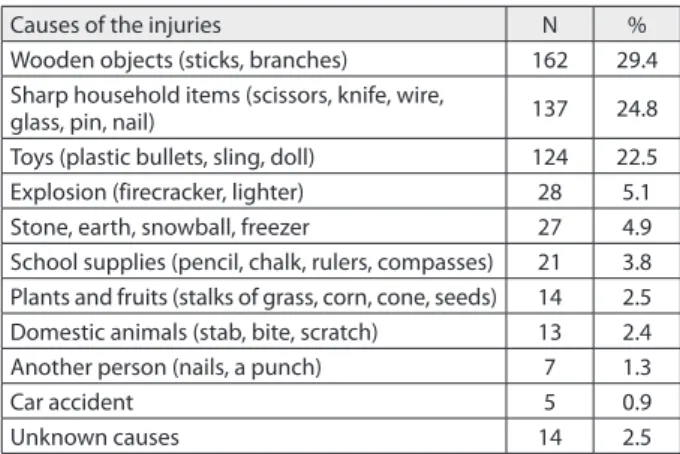
During the analysed period, a total of 3,215 patients were treated for mechanical eye injuries, out of whom 552 (17.2%) were children below the age of 15 years. Out of this number, 138 (25.0%) were children aged up to 5 years old, 219 (39.7%) were between 6 and 10 years old, while 195 (35.3%) were between 11 and 15 years of age (Table 1). On average, one child was hospitalized per week. Out of the total number of hospitalized children, 431 (78.1%) were boys and 121 (21.9%) were girls, accounting for male to female ratio of the injured children of 3.6:1. The right eye and the left eye injuries were evidenced in 272 (49.3%) and 271 (49.1%) patients, respectively, while the injuries of both eyes were present in 9 (1.6%) patients. The injuries were most commonly inflicted outdoors – 360 (65.2%), followed by the injuries sustained at home – 162 (29.4%), whereas the injuries that occurred at school were the least common – 30 cases (5.4%) (Table 1). The results show that the number of injuries tended to decrease according to year (Graph 1), while the injuries were almost equally distributed according to month and day (Graphs 2 and 3). The causes and modes of injuries are presented in Table 2.
Among the youngest group of children (0-5 years), the most common causes of injury were sharp household ob-jects, which accounted for 52 (37.7%) cases of all injuries in this age group, followed by wood in 42 (30.4%), toys in 19 (13.8%), domestic animals in 7 (5.1%), stones and dirt in 4 (2.9%), plants and fruits in 3 (2.1%) and explosions in 2 (1.5%), and 1 (0.7%) manual injury. The cause of injury was unknown in five (3.6%) cases.
In the group aged 6-10 years, the most common causes of injury were wood and wood objects – 63 (29.7%), fol-lowed by toys in 58 (26.5%), sharp household objects in 51 (23.3%), explosions in 11 (5.0%), stones in 11 (5.0%), school supplies and aids in 9 (4.1%), traffic accidents in 4 (1.8%), domestic animals in 3 (1.4%), plants and fruits in 2 (0.9%), and (0.5%) manual injury. The cause of injury was unknown in four (1.8%) cases.
Among the oldest group of children, aged 11-15 years, the injuries were most commonly inflicted by wooden
objects 55 (28.2%), followed by toys in 47 (24.1%), sharp household objects in 34 (17.4%), explosive devices in 15 (7.7%), stones or dirt in 12 (6.2%), plants and fruits in 9 (4.6%), school supplies and aids in 9 (4.6%), arms or legs in 5 (2.6%), domestic animals in 3 (1.5%) and traffic ac-cidents in 1 (0.5%). The cause of injury was unknown in five (2.6%) cases in this age group.
Table 1. Gender and place of injury by age
Variable Category
Age of children (years) 0–5
(N=138)
6–10 (N=219)
11–15 (N=195)
Total (N=552)
N % N % N % N %
Gender Males 108 78.3 178 81.3 145 74.4 431 78.1
Females 30 21.7 41 18.7 50 25.6 121 21.9
Place of injury
Home 71 51.5 57 26.0 34 17.4 162 29.4
Outdoors 67 48.6 154 70.3 139 71.3 360 65.2
School 0 0.0 8 3.7 22 11.3 30 5.4
N – number of patients
Graph 1. Number of injuries by year
Graph 2. Number of injuries by month
588
Jovanović M. et al. Mechanical Eye Injuries in Children Aged 0–15 Years Treated at the Clinic of Eye Diseases in Belgrade
Close eyeball injuries were evidenced in 274 (49.6%) and open injuries were found in 257 (46.6%), while the in-juries of the ocular adnexa were present in 21 cases (3.8%) only. Out of all hospitalized patients, 232 (42.0%) under-went surgical intervention on the eye. Out of all surgically treated patients, surgery was performed on the day of in-jury in 40 (17.2%), on the following day in 129 (55.6%), two days after the injury in 31 (13.4%), and more than two days after the injury in 32 (13.8%).
On admission, visual acuity ranged from amaurosis to normal. Upon discharge, and during subsequent follow-up visits, positive changes in visual acuity were evidenced (Graph 4). It was not possible to establish changes of the visual acuity in some children because it was not recorded in their medical files – on admission in 146 (26.4%) and upon discharge in 79 (14.3%) cases.
DISCUSSION
A prolonged observation period, a large number of sam-ples and the fact that the Clinic of Eye Diseases in Belgrade is the only institution with paediatric ophthalmology de-partment allowed for results to be considered valid.
A total number of children who were treated as in-patients was 552, which accounted for 17.2% of all eye injuries in all age groups treated during this period. These figures are smaller compared to those published in the lit-erature [4, 5, 6]. A total of 17.2% of injuries found among children aged 0-15 years exceeds the share for this age group of 15.8% in the total population of Serbia, accord-ing to the Statistical Yearbook of the Republic Institute of Statistics [7]. Based on the yearbook data, it has been found that the annual morbidity rate associated with the eye injuries in paediatric population aged 0-15 years old is 4.3 per 100,000 children.
The incidence of the left and right eye injuries was equal. The literature data are different, with the slight pre-dominance of the right eye injuries [8, 9]. Injury to both eyes was found in nine subjects. Bilateral eye injuries were most commonly caused by traffic accidents (three cases) and explosions (two cases), while individual cases of bilat-eral eye injuries were also caused by plastic toys, balls, tree branches and dog bites.
Numerous studies [6, 10, 11, 12] confirmed our find-ing that the eye injuries are far more frequent in males. In our study, the ratio between injured boys and girls was 3.6:1 in the whole group. The ratio in the youngest group was 3.6:1, 4.3:1 in the following age group and 2.9:1 in the oldest age group. Such ratios in favour of males could be explained by their higher activity levels, occasional and over-the-top bravado, and sport activities in which play-ers come into contact with each other. [1, 10]. The lowest ratio between the injured boys and girls was found in the Republic of South Africa, where it was 2.0:1 in favour of boys [13], which could be explained by the similar outdoor activities practiced by both girls and boys, the inability to afford more expensive toys specifically intended for girls or boys, living conditions and the earlier participation of children in household chores.
As for distribution of the injuries according to age, the data in the literature are diverse and different [12, 14, 15, 16]; the comparison with our results was shown in Table 3. School-age children are exposed to a high risk of injury since they are, despite their relative immaturity, independ-ent from other people’s assistance and spend a lot of time unattended [10]. Regarding the age, two age groups are distinguished in the literature in which injuries are more common than generally found during childhood [2]. The first age group includes children between 4 and 5 years of age, when the child is mobile but lacks the necessary experience. The second age group includes children aged
Graph 4. Visual acuity on admission and final visual acuity
Table 3. Literature data on the distribution of eye injuries by age groups (%)
Country Authors and reference number Age of children (years)
0–5 6–10 11–15
Northern Ireland Canavan YM et al., 1980 [12] 22.3 35.4 42.3
USA, Philadelphia Grin TR et al., 1987 [14] 31.0 33.0 36.0
Austria, Graz Sommerauer P et al., 1987 [15] 22.0 27.0 51.0
Mali, Africa Ag el Mouchtahide M, 1994 [16] 14.3 47.6 38.1
Serbia Jovanović M et al., 2013 25.0 39.7 35.3
Table 2. Frequency of injuries by their causes
Causes of the injuries N %
Wooden objects (sticks, branches) 162 29.4 Sharp household items (scissors, knife, wire,
glass, pin, nail) 137 24.8
Toys (plastic bullets, sling, doll) 124 22.5 Explosion (firecracker, lighter) 28 5.1
Stone, earth, snowball, freezer 27 4.9
School supplies (pencil, chalk, rulers, compasses) 21 3.8 Plants and fruits (stalks of grass, corn, cone, seeds) 14 2.5 Domestic animals (stab, bite, scratch) 13 2.4
Another person (nails, a punch) 7 1.3
Car accident 5 0.9
about 10 years old, when the child is reckless and careless in handling the accessible objects.
Places where the injuries were inflicted were also con-sidered: they were most frequently inflicted outdoors (65.2%), less frequently at home (29.4%), and least fre-quently at school (5.4%). The home setting was a predomi-nant place of the injury of children below 5 years of age, accounting for 51.5% of all eye injuries in this age group. This large number of such injuries among the youngest children emphasizes the need for their prevention, prima-rily by appropriate parental or other adult’s supervision. The second measure of prevention is keeping all potentially dangerous objects out of reach of curious children. The lat-ter is even more important in light of the fact that the inju-ries inflicted by sharp objects (scissors, needle, nail, knife, screwdriver, glass) were predominant among the youngest children in our series, accounting for 37.7% of all injuries below 5 years of age. We can only wonder what knives or scissors were doing in the hands of so young children and why such injuries are three times more frequent in this age group than injuries inflicted by toys (13.8%). The parents and caregivers need to answer these questions.
The study revealed that injuries were most frequently caused by wooden objects, followed by sharp household objects and toys. These three groups of causes collectively accounted for 76.6% of all injuries. The wooden objects most frequently involved were tree branches, rod and lath, while the most common sharp objects were glass, nails, razor blades and scissors.
Toys were the third most common cause of all eye inju-ries and the leading cause of eye contusions. They were the most frequent cause of injury in children aged between 6 and 10 years in comparison to the older children and par-ticularly in comparison to the children of the youngest age group. Out of all injuries caused by toys, those inflicted by plastic toy guns or plastic “bullets” accounted for 13.4% of all eye injuries recorded in our study. This figure is higher compared to information available from other parts of the world [17]. Plastic balls (bullets), regardless of their small mass, can cause severe injuries that may occasionally ap-pear insignificant to nonprofessional. Unfortunately, such picture may be confusing and thus we found, in our study, the cases of week- or even month-delays in seeking for medical attention. In order to illustrate the seriousness of such situation, it should be mentioned that such a “bullet” travels at a speed of 36 m/s or even 70 m/s; a speed of 39 m/s is sufficient for a penetrating eye injury, while open wounds through skin and bone require speeds of at least 106 m/s [18]. If the trend of adjustment to demands of an increasingly choosy market was continued, it would not be impossible for such speeds to be achieved. Toy manufac-turers must be aware that toys are intended for children of different age, different psychophysical maturity level and different cultural milieu. Therefore, manufacturers must pay greater attention to toy safety [14], and special stand-ard regulations applicable to toys must be imposed as well [19]. Toys should be appropriately marked with a declara-tion that clearly and legibly states the child’s age for which they are intended to, as well as all precautions to be taken
during play and warnings about the possibility of injury. Regulations related to instructions for the use of toy guns must include the statement that their use is prohibited for children below 16 years of age, although this is only the first step in protecting the children. Detailed research re-lated to this issue [18] found that more than 80% of injuries among children below fifteen years of age took place with-out adult supervision. The particular danger from these toys lies in the fact that they represent realistic replicas of firearms with an appearance that may confuse the child and have catastrophic consequences.
Eye injuries inflicted during traffic accidents still occur; however, their frequency is decreasing. It is a troublesome fact that in four out of five children injured in traffic ac-cidents, the children were sitting in the front seat without a fastened seat belt. Bilateral eye injuries were found in three out of four children. Therefore, attention must be paid to traffic safety in children, nurturing a culture of traffic safety where regulations on the mandatory use of seat belts are followed [3, 20], and where protective systems such as air bags and air curtains will additionally contrib-ute to the safety of passengers and the prevention of injury. Eye injuries caused by firecrackers were recorded in 20 cases. Most of the injuries were inflicted during win-ter: in December and January, during the Christmas and New Year holidays. Injuries caused by firecrackers were the most frequent among the oldest children (11-15 years) and they were found in 11 (55.0%) cases, followed by the group of 6-10-year-olds involving 8 (40.0%) cases and the youngest group, aged 0-5 years old, with only 1 (5.0%) case. It appeared that the children were not satisfied with the explosion itself; they used imagination to increase their pleasure by putting firecrackers in a can, in a plastic bottle or putting firecrackers in a glass bottle, which led to more severe injuries. The data in the literature about these inju-ries [21], as well as our findings, indicate that these injuinju-ries are more common among children who just happen to be in the area rather than among those who activate and toss the firecrackers. Lack of information on the hazards associated with the use of pyrotechnic devices and the lack of adult supervision and insufficient distance from the ac-tivated firecrackers are factors that considerably contribute to such injuries [21]. Stricter control of firecracker sales, banning of their sale to children, their prohibited use in public places, prohibition of sales of products that do not meet quality and safety standards and public firework displays organized exclusively by professional pyrotech-nicians are all measures that should be applied in order to minimize both the number and the consequences of this type of injury.
590
the number of these injuries. In this way, Canada managed to reduce the number of injuries associated with hockey, its national sport, by 90% [22].
The most unusual cases of the eye injuries included those inflicted with hair barrettes, zippers, chocolate pack-aging, a telephone cable, a damp cloth, a chain saw, a hedge-hog, cactus spines and a watch spring. The causes were not reported in four cases, either incidentally or deliberately.
We were pleased to find that the number of injuries decreased over the years. According to months, the injuries were somewhat more frequent during the “warmer” [23] season, 50.7%, compared to the “cold” season. According to the days, the distribution of injuries was almost equal.
The ratio between open and closed eyeball (open:closed) injuries was 1.1:1. According to age group, the ratios were as follows: in the group aged 0-5 years – 2.1:1; in the group aged 6-10 years – 0.8:1; and in the group aged 11-15 years – 0.7:1. A predominance of the open injuries was only found in the youngest age groups due to massive injuries at home, where children, particularly of a given age, should be close-ly watched by their parents in order to protect them against these severe and dangerous injuries.
Most of the injuries requiring surgical interventions were managed on the same day or the day after. It should be stressed that either the parents or caregivers were re-sponsible for delayed treatment due to their late presenta-tion to physician’s office. The reasons for this that were re-ported in other studies [24] included: remoteness (45.1%), lack of material resources (22.0%), negligence and care-lessness (19.7%), delayed referral by health professionals (10.6%) and insufficient symptoms to arouse the suspicion of parents (9.1%). The consequences of delayed presenta-tion on treatment outcome, as measured by visual acuity upon discharge, were diverse. Some studies reported that, in the case of lack of inflammation of the injured eye, this delay was not associated with less favourable outcome [13]. Other studies reported a correlation between delayed pres-entation, postoperative complications and poor postop-erative recovery with a poor outcome from the treatment [19]. Our study results are consistent with these findings. A lower socioeconomic status, based on household income and educational level of the injured child’s parents, were also reported to be the predictors of more frequent and more severe injuries and less favourable prognosis [6].
Further studies of eye injuries should be based on inter-nationally accepted standards or evidence of injury-related circumstances [25, 26], classification of injuries [26, 27,
28], measurement of visual acuity [29], treatment expenses [28, 29, 30] and follow-up of children during the postop-erative period.
Each injury, even the slightest one, is associated with the expenses: travel expenses, medical-care expenses and ex-penses related to parent’s absence from work and decreased productivity. A study carried out in Australia showed that the costs associated with eye injuries in children amounted to USD 155 million per year [3]. Forty-four percent of this amount accounted for penetrating injuries. A study car-ried out in the USA estimated that the annual costs related to in-patient treatment of children with the eye injuries amounted to USD 88,065,800 [30]. There are no precise data on the annual costs of treating children with the eye injuries in Serbia; however, they are estimated to be ap-proximately USD 500,000.
A study carried out by the American National Soci-ety for the Prevention of Blindness found that 55% of all injuries happen before the age of 25, and that trauma is the most frequent cause of the vision loss during the first decade of life in one third of cases with the open eyeball injuries, being the most common reason for enucleation in children over 3 years of age [8]. In spite of continuous im-provements in equipment and surgical techniques, materi-al and knowledge, the results of penetrating eyebmateri-all injury treatment are often unsatisfactory [8], which points out the need to improve preventive measures. Prevention will be best applied if the dangers are understood by obtaining the insights into the most common causes of injuries, through the identification and elimination of causes of injuries at home and in traffic and through paying greater attention to the supervision of children. The above recommendations are universal and applicable to children of different age groups and socioeconomic classes.
CONCLUSION
This paper shows that eye injuries in children are frequent, they are more common in boys and most frequently inflict-ed outdoors, less frequently at home and least frequently at school. The injuries were most frequently caused by wooden objects, sharp household objects and toys. Cer-tain types of eye surgery were required in almost half of the injured children. The treatment of injuries was a significant factor in health-care costs; prevention of this type of injury requires the action of a wider community.
1. Jovanović M. Mechanical injuries of the eyeball: frequency, structure and possibility of the prevention. Srp Arh Celok Lek. 2006; 134(1-2):11-21.
2. Dorn Lj, Vlahović S. Eye injuries in children. Pediatr Croat. 2004; 48 (Suppl 1):259-65.
3. Thompson CG, Kumar N, Billson FA, Martin F. The aethiology of perforating injuries in children. Br J Ophthalmol. 2002; 86:920-2.
4. Punnonen E. Epidemiological and social aspects of perforating eye injuries. Acta Ophthalmol. 1989; 67:492-8.
5. Blomdahl S, Staffan N. Perforating eye injury in the Stockholm population. An epidemiological study. Acta Ophthalmol. 1984; 62:378-90.
6. Moreira CA, Debert-Ribeiro M, Belfort R. Epidemiological study of the injuries in Brasilian children. Arch Ophthalmol. 1988; 106:781-4.
7. Republic Bureau of Statistics. Statistical Almanac of Serbia 2010 (internet). Belgrade; 2010 (accessed 2011 Mar 2nd). Available from: http://webrzs.stat.gov.rs./WebSite/repository/ documents/00/00/17/75/god2010pog04.pdf.
REFERENCES
8. Koval MD, Teller J, Belkin M. The Israeli ocular injuries study. Arch Ophthalmol. 1988; 106:776-81.
9. Dasgupta S, Mukherjee R, Ladi DS, Gandhi VH, Ladi BS. Pediatric ocular trauma – a clinical presentation. J Postgrad Med. 1990; 36:20-1. 10. MacEwen CJ, Baines PS, Desai P. Eye injuries in children: the curent
picture. Br J Ophthalmol. 1999; 83:933-6.
11. Niiranem M, Ratvio I. Eye injuries in children. Br J Ophthalmol. 1981; 65:436-8.
12. Canavan YM, O’Flaherty MJ, Archer DB. 10-year survey of eye injuries in Northern Ireland 1967-1976. Br J Ophthalmol. 1980; 64:618-25.
13. Grieshaber MC, Stegmann R. Penetrating eye injuries in South African children: aetiology and visual outcome. Eye. 2006; 20:789-95. 14. Grin T, Nelson L, JeVers JB. Eye injuries in childhood. Pediatrics.
1987; 80:13-7.
15. Sommerauer P, Hesse W, Lerchner H. Augenverletztungen im Kindesalter. Klin Monatsol Augenheilkd. 1987; 191:364-6. 16. Ag el Mouchtahide M. Les traumatismes oculaires chez les enfants
de 0 á 15 ans. A propos de 63 dossiers cliniques. J Fr Ophtalmol. 1994; 17:750-4.
17. Poon AS, Ng JS, Lam DS, Fan DS, Leung AT. Epidemiology of severe childhood eye injuries that require hospitalisation. Hong Kong Med J. 1988; 4:371-4.
18. American Academy of Pediatrics Committee on Accident and Poison Prevention. Injuries related to “toy” firearms. Pediatrics. 1987; 79:473-4.
19. Laraque D. American Academy of Pediatrics Committee on Injury, Violence, and Poison Prevention. Injury risk of nonpowder guns. Pediatrics. 2004; 114:1357-61.
20. Hall NF, Denning AM, Elkington AR. The eye and the seatbelt in Wessex. Br J Ophthalmol. 1985; 69:317-9.
21. Kumar R, Puttanna M, Sripracash KS, Sujatha Rathod BL, Prabhakaran VC. Firecracker eye injuries during Deepavali festival: a case series. Indian J Ophthalmol. 2010; 58:157-9.
22. Strahlman E, Elman M Daub E, Baker S. Causes of pediatric eye injuries. A population-based study. Arch Ophthalmol. 1990; 108:603-6.
23. Cariello AJ, Moraes NS, Mitne S, Oita CS, Fontes BM, Melo LA Jr. Epidemiological findings of ocular trauma in childhood. Arch Bras Oftalmol. 2007; 70:271-5.
24. Serrano JC Chalela P, Arias JD. Epidemiology of childhood ocular trauma in a northeastern Colombian region. Arch Ophthalmol. 2003; 121:1439-45.
25. Kuhn F, Morris R, Witherspoon D, Herman K, Jeffers JB, Trester G. A standard classification of ocular trauma. Ophthalmology. 1996; 103:240-3.
26. International Society of Ocular Trauma (Internet). Birmingham (Al): The Society; c2000-2011 (updated 2010 Jun 24; accessed 2011 Feb 24th). Downloads from ISOT. Available from: http://www.isotoline. org/downloads.html.
27. Pieramici DJ, Sternberg P, Aaberg TM, Bridges WZ, Caspone A, Cardillo JA, et al. A system for classifyng mechanical injuries of the eye (globe). The Ocular Trauma Classification Group. Am J Ophthalmol. 1997; 123:820-31.
28. World Health Organisation. International Classification of Impairments, Disabilities and Handicaps. Geneva: WHO; 1980. 29. Negrel AD, Thylerfors B. The global impact of eye injuries.
Ophthalmic Epidemiol. 1998; 5:143-69.
30. Brophy M, Sinclair S, Grim-Hostetler S, Xiang H. Pediatric eye injury-related hospitalizations in the United States. Pediatrics. 2006; 117:1263-71.
КРАТАК САДРЖАЈ
Увод По вре де ока су зна ча јан про блем код де це.
Циљ ра да Циљ ис тра жи ва ња био је да се утвр де уче ста лост и раз лог на ста ја ња по вре да очи ју код де це уз ра ста до 15 го ди на и пред ло же ме ре пре вен ци је.
Ме то де ра да Ре тро спек тив на сту ди ја је об у хва ти ла 552 де-те та с по вре да ма очи ју ко ја су ле че на на Кли ни ци за оч не бо ле сти у Бе о гра ду од мар та 1999. до фе бру а ра 2010. го ди-не. Ана ли зи ра ни су пол и уз раст де це, вре ме по вре ђи ва ња, вр ста и ме сто по вре да, оштри на ви да на при је му и на от пу-сту, као и тра ја ње опе ра ци ја.
Ре зул та ти Од нос по вре ђе них де ча ка и де вој чи ца био је 3,6:1. Нај ве ћи про це нат по вре ђе не де це био је ме ђу ис пи та-ни ци ма уз ра ста 6–10 го ди на (39,7%). По вре де су се де ша ва ле
ско ро рав но мер но по ме се ци ма у го ди ни и да ни ма у не де-љи. Био је ско ро под јед нак про це нат те шких за тво ре них и отво ре них по вре да оч не ја бу чи це. Оштри на ви да при от пу-сту и на ка сни јим кон трол ним пре гле ди ма би ла је знат но бо ља у од но су на при јем ну, тј. на кон при ме ње ног ле че ња.
За кљу чак По вре де ока код де це и да ље су озби љан здрав-стве ни про блем. Умно го ме су за на ста ја ње ових по вре да кри ви од ра сли: код де це нај мла ђег уз ра ста због не до вољ не па жње, а код ста ри је де це, пре све га, због ко ри шће ња нео д-го ва ра ју ћих игра ча ка и не при ме њи ва ња за кон ских нор ми у са о бра ћа ју ко је се од но се на де цу. Пре вен ци ја по вре да ока игра нај ва жни ју уло гу.
Кључ не ре чи: по вре де ока; де ца; узро ци; уче ста лост; пре-вен ци ја
Механичке повреде ока код деце узраста до 15 година лечене на Очној
клиници у Београду: учесталост, узрок настајања и мере превенције
Милош Јовановић1,2, Александар Медаревић1, Мирослав Кнежевић1,2, Вера Крстић1,2 1Медицински факултет, Универзитет у Београду, Београд, Србија;
2Клиника за очне болести, Клинички центар Србије, Београд, Србија