S
C
I
E
N
T
I
F
I
C
-T
E
C
H
N
I
C
A
L
Synthesis, characterization and thermal degradation of
cross-linked polystyrene using the alkyne-functionalized
esters as a cross-linker agent by click chemistry method
Hakan Akat
1*
and Fehmi Saltan
1,21
Department of Chemistry, Faculty of Science, Ege University, Bornova, Izmir, Turkey
2Department of Chemistry, Faculty of Science, Çankırı Karatekin University,
Merkez, Çankırı, Turkey
Abstract
In this study, it has been demonstrated that cross-linked polystyrene (CPS) was successfully prepared by using click chemistry. For this purpose, irstly, poly (styrene-co-4 chloromethylstyrene) with 4-chloromethylstyrene was synthesized. Secondly, alkyne-functionalized esters (dipropargyl adipate, dipropargyl succinate) were obtained using propargyl alcohol, adipoyl chloride and succinyl chloride. Azide-functionalized polystrene (PS-N3) and dipropargyl adipate (or dipropargyl succinate) were reacted in N,N-dimethylformamide for 24 h at room temperature to give CPS. The synthesized polymer and compounds were characterized by nuclear magnetic resonance (1H-NMR), gel permeation chromatography (GPC), fourier transform infrared spectroscopy (FT-IR) and thermogravimetric (TG/DTG) analysis. The surface properties were investigated by Scanning Electron Micrography (SEM).
Keywords: polystyrene, cross-linked polymers, click chemistry, thermal degradation.
1. Introduction
In last years, polystyrene (PS) has managed to become one of the world’s most widely used polymers. PS is one of the three standard plastics (polyolefins, poly(vinyl chloride), and PS), and PS can be applied in many fields, such as the packaging of electrical equipment, apparatus, instruments, and foods, thermal insulation materials for buildings and cold storage, and disposable dinner service[1]. However polystyrene do not offer the properties associated with thermoset polymers, and hence its applications are limited. Cross-linking of polystyrene is one approach to improve the properties and consequently to access the demanding regimes of high-tech applications. Crosslinked polystyrene (CPS) have excellent mechanical properties and good chemical stability. Their excellent performances provide wide applications as packing materials for liquid chromatography[2-5], as ion-exchange resins[6,7] and as imprinted adsorbents for the selective separation of hazardous organic compounds[8,9]. Cross-linking of PS is readily achieved by the incorporation of a multifunctional monomer during the polymerization process[10-15]. High-energy radiation or photochemical irradiation has been used, but in addition to the cross-linking both methods may also involve chain scission that can result in polymer degradation or the introduction of unwanted impurities. Alternative thermal methods for the formulation of thermosetting materials usually involve Diels-Alder and click chemistry reactions which may suffer from the reversibility[16-17]. Yagci et al.[15] synthesized polystyrene using click chemistry method. Other methods involves classical cross linker agent as DVB in literature. In our study, we introduce new strategy using both click chemistry method and new crosslinker agents (alkyne-functionalized esters).
2. Experimental
2.1 Materials
Styrene (S, 99%, Sigma-Aldrich Company, USA) and 4-chloromethylstyrene (CMS, ca. 60/40 meta/para isomer mixture, 97%, Sigma-Aldrich Company, USA) were distilled under reduced pressure before use. 2,2 Azobis(isobutyronitrile) (AIBN, 98%, Sigma-Aldrich Company, USA) was recrystallized from ethanol. Other solvents were purified by conventional procedures. Triethylamine (98%, Sigma-Aldrich Company, USA) and dichloromethane (99.9%, HPLC grade, Sigma-Aldrich Company, USA) were distilled from CaH2. Noxyl- free radical (TEMPO, 99%, Sigma-Aldrich Company, USA) was used as received Ethylenediaminetetraacetic acid (EDTA, 99%, Sigma-Aldrich Company, USA) N,N-dimethylformamide (DMF 99%, Sigma-Aldrich Company, USA). Propargyl alcohol (99%, Sigma-Aldrich Company, USA) were used without any purification. Pyridine (anhydrous, 98%, Sigma-Aldrich Company, USA). Adipoyl chloride (98%, Sigma-Aldrich Company, USA). Succinyl chloride (95%, Sigma-Aldrich Company, USA). 2,2’-bipyridine (reagent plus >99%, Sigma-Aldrich Company, USA). Copper(I) bromide(98%, Sigma-Aldrich Company, USA). Hydrochloric acid (ACS reagent, 37%, Sigma-Aldrich Company, USA).
2.2 Instrumentation
2.3 Synthesis of poly(styrene-co-chloromethylstyrene)
Poly(styrene-co-4-chloromethylstyrene) (P(S-co-CMS)) was synthesized as described previously[18].
2.4 Synthesis of polystyrene azide (PS-N3)[19]
A typical procedure for the preparation of PS-N3 from 10 mol % CMS containing P(S-co-CMS) is as follows: P(S-co-CMS) (1.0 g, 1.04 ×10⁻⁴ mol) was dissolved in DMF, and NaN3 (0.07 g, 1.01 ×10⁻³ mol) was added. The resulting solution was allowed to stir at 25 °C overnight and precipitated in excess methanol/water mixture (1/1 by volume). 1H NMR
(CDCl3): δ ppm) 7.40–6.20 (b, 9H), 4.25 (s, 2H) FTIR T% (cm_1): 3060, 2924, 2096, 1681, 1601, 1492, 1453, 757, 698. Mn: 3500 g/mol PDI: 1.50.
2.5 Synthesis of dipropargyl adipate (DPA, diprop-2-ynyl adipate) and dipropargyl succinate (DPS, diprop-2-ynyl succinate)
Propargyl alcohol (2.01 g, 0.036 mol), pyridine (2.69 g, 0.034 mol), and dry dichloromethane (20 mL) were charged to a 50 mL round-bottom flask. The resulting solution was maintained at 0 °C by means of a salt-ice bath. A solution of adipoyl chloride (2.63 g, 0.017 mol) or succinyl chloride (3.11 g, 0.017 mol) in 5 mL of dry dichloroethane was added dropwise over 30 min. The solution was stirred overnight at room temperature and then transferred to a 250 mL separatory funnel with the aid of a small amount of dichloromethane. The dichloromethane solution was washed with water (2×25 mL), 5% HCl (20 mL), and saturated sodium bicarbonate solution (25 mL). The dichloromethane solution was dried over MgSO4 and the mixture was filtered. Organic phase was removed by evaporator. The products
were dried under vacuum overnight. DPA: yield of 70%.
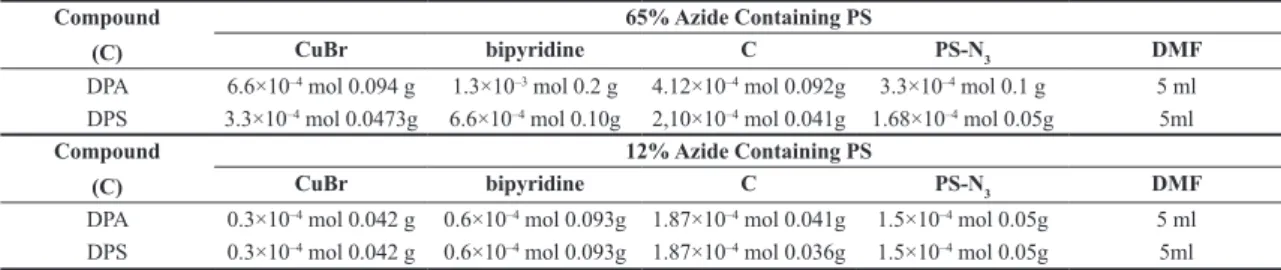
The mixture was stirred overnight at room temperature. After removing the catalyst by EDTA, functionalized polymer was precipitated in methanol (200 mL), filtered, and dried under vacuum overnight with a yield of 70% (mol feed ratios are seen Table 1).
3. Result and Discussion
In our study, we first synthesized (P(S-co-CMS)) and P-N3. Following experiment was carried out for alkyne-functionalized esters (DPA and DPS). DPA and DPS were used to obtain cross-linked polystyrene. CPS was synthesized via click chemistry (Scheme 1). Chemical structure of both esters and polymers were identified by several techniques such as FT-IR, NMR, GPC, TG, DTG and SEM.
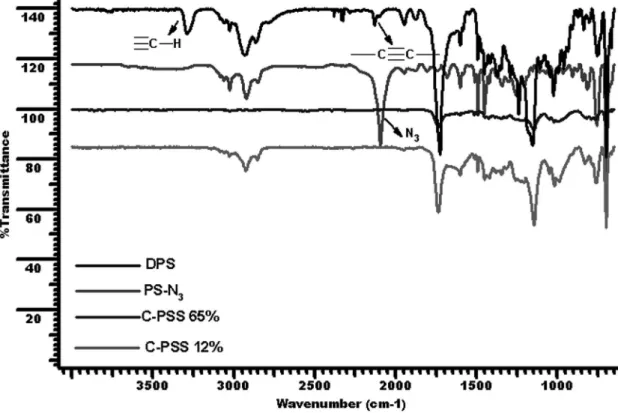
The FT-IR spectra of DPA;PS-N3;C-PSA65%;C-PSA12% and DPS;PS-N3;C-PSS65%;C-PSS12% are shown in Figure 1 and Figure 2, respectively. According to this FT-IR spectra, appearance of the -N3 stretching is clear at 2096 cm–1 and it is notable that spectra of ADP and DPS show -HC≡ CH- ; ≡C-H- peaks at around 3290;2120 cm-1. After cross-linked reaction between DPA(or DPS) and PS-N3, disappearance of –N3 and alkyne peaks can be seen. These FT-IR data show successful of PS-N3, CPS, DPA and DPS synthesis. On the other hand, they are also supported by 1H-NMR. From the 1H NMR spectra of synthesized DPA and DPS, it
is observed that -C≡H protons signals at 2.40 and 2.20 ppm,
respectively. O-CH2 protons are observed at 4.72(DPA) and 4.40(DPS) ppm. -CH2-CO protons can be seen at 2.45 ppm and 2.50 ppm.
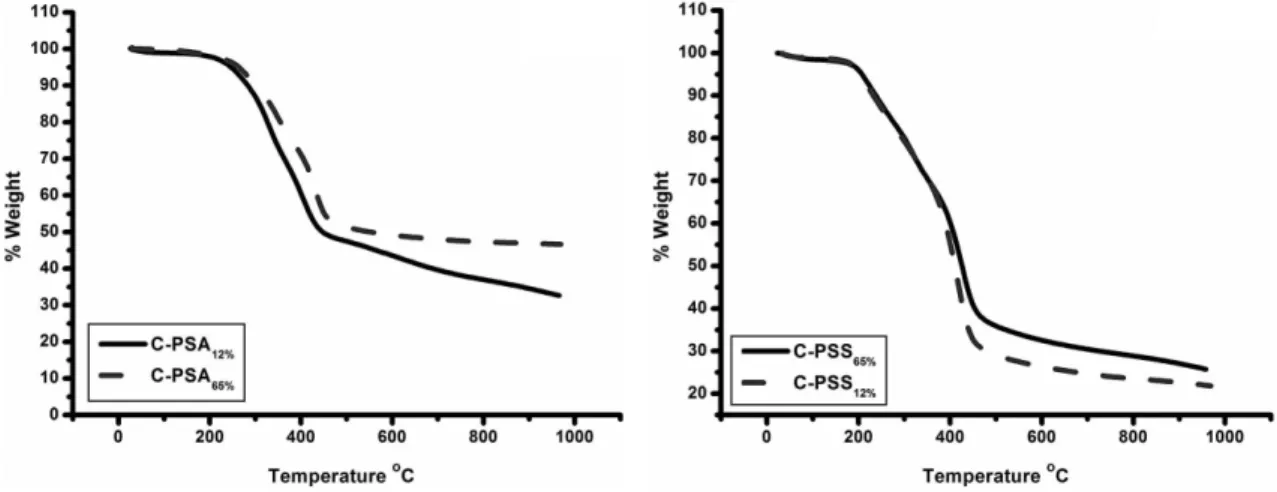
Thermal behaviour and thermal stability of the synthesized CPS is investigated by TG measurement. TG curves and the corresponding derivative curves (DTG) for cross-linked polystrene are shown in Figure 3 and Figure 4, respectively. The derivative of the thermogram with respect to temperature,
Table 1. Mol feed ratio of synthesized cross-linked polymers.
Compound
(C)
65% Azide Containing PS
CuBr bipyridine C PS-N3 DMF
DPA 6.6×10⁻⁴ mol 0.094 g 1.3×10⁻³ mol 0.2 g 4.12×10⁻⁴ mol 0.092g 3.3×10⁻⁴ mol 0.1 g 5 ml
DPS 3.3×10⁻⁴ mol 0.0473g 6.6×10⁻⁴ mol 0.10g 2,10×10⁻⁴ mol 0.041g 1.68×10⁻⁴ mol 0.05g 5ml
Compound
(C)
12% Azide Containing PS
CuBr bipyridine C PS-N3 DMF
DPA 0.3×10⁻⁴ mol 0.042 g 0.6×10⁻⁴ mol 0.093g 1.87×10⁻⁴ mol 0.041g 1.5×10⁻⁴ mol 0.05g 5 ml
also known as a differential thermogram or DTG, indeed shows the maximum rate of polymer decomposition (Tmax). TG thermogram under N2 atmosphere revealed that C-PSA65% and C-PSS65% degradation takes place in three stages, C-PSA12% and C-PSS12% degradation takes place in two stages.
The first stage for the C-PSA65% being at a temperature around 312 °C that corresponds to a very small mass loss
Figure 1. Comparison of FT-IR spectra of DPA;PS-N3;C-PSA65%;C-PSA12%.
C-PSS65% and C-PSS12%, it is observed that C-PSS65% more stable then C-PSS12%.
The first, second and third degradation stages of C-PSS65% begin 225, 296, 396 °C and the mass loss is about 10%, 20% and 75%, respectively. C-PSS12% curves show two degradation stages which temperatures are 220 oC and 412 oC. When thermal degradation curves of polystyrene compared with crosslinked polystyrene, the char yield of the thermally cured polystyrene was about 40% and much higher than PS (0.0%) in literature[15,20-22]. We also observed that thermal stability of CPS increases with the chain length of alkyne functionalized esters used (All Tmax values are shown in Table 2).
Table 3 displays the SEM micrographs obtained before and after cross-linked PS-N3/DPA/DPS. The SEM microphotographs of PS-N3 show that, most of the microspheres are unregularly spherical, and the interface is clear and smooth. The average particle size is between 1500μm-680 nm in diameter. The SEM images of various crosslinked PS, it could be visualized that no inert layer was formed on the surfaces of the C-PSS and C-PSA after cross-linked between PS-N3 and alkyne functionalized esters. The images also indicate an increase in compact
packing with increasing DPA or DPS content, suggesting the formation of a rigid interpenetrating network formation and increased crosslinking.
4. Conclusions
In conclusion, we introduce an effective strategy to synthesize a novel cross-linked polystyrene(C-PS) by using click chemistry. The Cross-linking reaction was Figure 3. Comparison of TG curves of PSS65%;C-PSS12% and C-PSA65%;C-PSA12%.
Figure 4. Comparison of DTG curves of C-PSA65%;C-PSA12% and PSS65%;C-PSS12%.
Table 2. Tmax values of the synthesized cross-linked polystyrene.
CPS C-PSS C-PSA
N3% 12 65 12 65
Tmax(oC) 225 235 351 335
412 320 423 387
- 421 - 629
Table 3. SEM micrographs of PS-N3, C-PSA65%;C-PSA12% and
C-PSS65%-C-PSS12%.
Azid% Sem micrographs of PS-N
3
Sem micrographs of CPS after crosslinked
technology and coagulum ratio. Journal of Applied Polymer Science, 96(4), 1405-1409. http://dx.doi.org/10.1002/app.21571. 2. Qin, L., He, X. W., Zhang, W., Li, W. Y., & Zhang, Y. K. (2009).
Surface-modified polystyrene beads as photografting imprinted polymer matrix for chromatographic separation of proteins.
Journal of Chromatography. A, 1216(5), 807-814. http://dx.doi. org/10.1016/j.chroma.2008.12.007. PMid:19111313. 3. Yu, P., Li, X., Li, X., Lu, X., Ma, G., & Su, Z. (2007).
Preparative purification of polyethylene glycol derivatives with polystyrene-divinylbenzene beads as chromatographic packing. Bioorganic & Medicinal Chemistry Letters, 17(20), 5605-5609. http://dx.doi.org/10.1016/j.bmcl.2007.07.094. PMid:17822896.
4. Mizutani, A., Nagase, K., Kikuchi, A., Kanazawa, H., Akiyama, Y., Kobayashi, J., Annaka, M., & Okano, T. (2010). Thermo-responsive polymer brush-grafted porous polystyrene beads for all-aqueous chromatography. Journal of Chromatography. A,
1217(4), 522-529. http://dx.doi.org/10.1016/j.chroma.2009.11.073. PMid:20015506.
5. Zhang, X., Shen, S., & Fan, L. (2007). Studies progress of preparation, properties and applications of hyper-cross-linked polystyrene networks. Journal of Materials Science, 42(18), 7621-7629. http://dx.doi.org/10.1007/s10853-007-1763-y. 6. Belfer, S., & Glozman, R. (1979). Anion exchange resins
prepared from polystyrene crosslinked via a Friedel–Crafts reaction. Journal of Applied Polymer Science, 24(10), 2147-2157. http://dx.doi.org/10.1002/app.1979.070241007. 7. Jun, B. H., Byun, J. W., Kim, J. Y., Kang, H., Park, H. J.,
Yoon, J., & Lee, Y. S. J. (2010). Facile method of preparing silver-embedded polymer beads and their antibacterial effect.
Journal of Materials Science, 45(11), 3106-3108. http://dx.doi. org/10.1007/s10853-010-4345-3.
8. Yun, Y. H., Shon, H. K., & Yoon, S. D. (2009). Preparation and characterization of molecularly imprinted polymers for the selective separation of 2,4-dichlorophenoxyacetic acid.
Journal of Materials Science, 44(22), 6206-6211. http://dx.doi. org/10.1007/s10853-009-3863-3.
9. Yu, H., Cai, Z., Liu, X., Li, M., Shi, Z., & Cui, Z. (2014). Crosslinked polystyrene beads modified with polar groups for the separation of aromatic/aliphatic hydrocarbons. Journal of Applied Polymer Science, 131(8), 40156-40162. http://dx.doi. org/10.1002/app.40156.
55(1), 531-534. http://dx.doi.org/10.1002/masy.19920540140. 14. Morel, E., Bellenger, V., Bocquet, M., & Verdu, J. (1989).
Structure-properties relationships for densely cross-linked epoxide-amine systems based on epoxide or amine mixtures.
Journal of Materials Science, 24(1), 69-75. http://dx.doi. org/10.1007/BF00660934.
15. Yagci, Y., Kiskan, B., Gacal, B., & Ergin, M. (2007). Thermally curable polystyrene via click chemistry. Macromolecules,
40(13), 4724-4727. http://dx.doi.org/10.1021/ma070549j. 16. Wang, Y. X., & Ishida, H. (1999). Cationic ring-opening
polymerization of benzoxazines. Polymer, 40(16), 4563-4570. http://dx.doi.org/10.1016/S0032-3861(99)00074-9. 17. Kasapoglu, F., Cianga, I., Yagci, Y., & Takeichi, T. (2003).
Photoinitiated cationic polymerization of monofunctional benzoxazine. Journal of Polymer Science. Part A, Polymer Chemistry, 41(21), 3320-3328. http://dx.doi.org/10.1002/ pola.10913.
18. Gacal, B., Akat, H., Balta, D. K., Arsu, N., & Yagci, Y. (2008). Synthesis and characterization of polymeric thioxanthone photoinitatiors via double click reactions. Macromolecules,
41(7), 2401-2405. http://dx.doi.org/10.1021/ma702502h. 19. Yildirim, Y., Dogan, B., Muğlali, S., Saltan, F., Ozkan, M.,
& Akat, H. (2012). Synthesis, characterization, and thermal degradation kinetic of polystyrene-g-polycaprolactone. Journal of Applied Polymer Science, 126(4), 1236-1246. http://dx.doi. org/10.1002/app.36888.
20. Malhotra, S. L., Hesse, J., & Blanchard, L. P. (1975). Thermal decomposition of polystyrene. Polymer, 16(2), 81-93. http:// dx.doi.org/10.1016/0032-3861(75)90133-0.
21. Sivalingam, G., & Madras, G. (2003). Thermal degradation of poly (ε-caprolactone).Polymer Degradation & Stability, 80(1), 11-16. http://dx.doi.org/10.1016/S0141-3910(02)00376-2. 22. McNeill, I. C., Zulfiqar, M., & Kousar, T. A. (1990). Detailed
investigation of the products of the thermal degradation of polystyrene. Polymer Degradation & Stability, 28(2), 131-151. http://dx.doi.org/10.1016/0141-3910(90)90002-O.