Corresponding Author: Rou-Xi CHEN Received on: 22/09/2014 Accepted on: 24/11/2014
1
Nantong Textile Institute, Soochow University, Nantong, People’s Republic of China
2 National Engineering Laboratory for Modern Silk, College of Textile and Engineering, Soochow University, China
Email: [email protected]
ABSTRACT
Wild silk has properties of waterproof and dustproof, but its domestic partner has neither. Scanning electron microscopy (SEM) was usedto observe and compare their morphology difference so that the possible mech-anism can be elucidated. By the contrastive research, this paper concludes that the mechmech-anism of waterproof and dustproof of wild silk is due to selective repulsion, each hierarchical cascade of nanoparticles can repel either water molecules or fine particles in air. The SEM study reveals that the different nanoparticles with hierarchical structure on the silk surface are main factors of the highly selective repulsion. This theory can also explain the waterproof property of lotus leaf. A better understanding of the repulsion mechanism of wild silk could help the further design of bio-mimetic waterproof/dustproof artificial materials.
Keywords: wild silkworm silk, domestic silkworm silk, mechanism of waterproof and dustproof, surface morphology, selective repulsion.
1. INTRODUCTION
The wild silkworm and domestic silkworm have many different properties. As early as 1637, it was recorded that the wild silkworm silk is of waterproof and dustproof, but the domestic silkworm silk behaves differently [1,2]. Many researchers investigated the morphology, composition and structure of cocoons of various differ-ent species from differdiffer-ent environmdiffer-ents, and concluded that morphlogy of silks differs greatly among the species [3,4]. Some interesting examples of textual discussion and artistic renderings of the development of silk worm cultivation and of the exploitation of the products of wild silk worms in China is available in Refs.[5,6], and now the silk fibroin is wildly used for nanomaterials fabrication[7-10]. However, all of the previous studies focused on silk size by ignoring the surface of the fibers, in this paper the unsmooth surafce of wild silk is emphasized, and it is concluded that the properties of wild silk’s waterproof and dustproof are of both material and geometrical properties, the later behaves greatly when the particles on fiber’s surface tends to nano scales.
2. THE SURFACE MORPHOLOGY OF WILD SILKWORM SILK AND DOMESTIC SILKWORM SILK
396 Figure 1: The domestic silkworm cocoon and wild silkworm cocoon
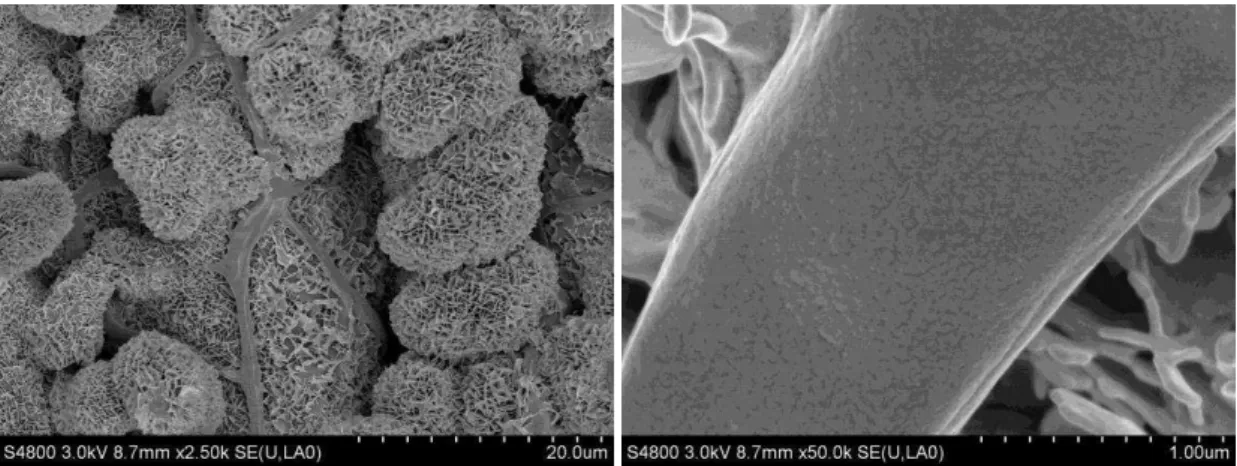
By a careful comparison on the morphology of domestic silkworm silk and wild silkworm silk fibers, the surface of the later is much tougher. There are lots of nanoparticle-like crystals attached on the surface of wild silkworm silk; while the domestic silkworm silk looks extraordinarily smooth. The average fiber diame-ter of wild silkworm silk is about 11 μm; while the domestic silkworm silk is about 18.4 μm, much bigger than that of the wild silkworm silk. What is more, the structure of the wild silkworm silk is much harder than the domestic silkworm silk.
Figure 2: The outer layer of the domestic cocoon (a) and wild cocoon (b)
397
Figure 4: The scanning electron microscopy(SEM) images of the lotus leaf`s upper surface
3. WATERPROOF AND DUSTPROOF
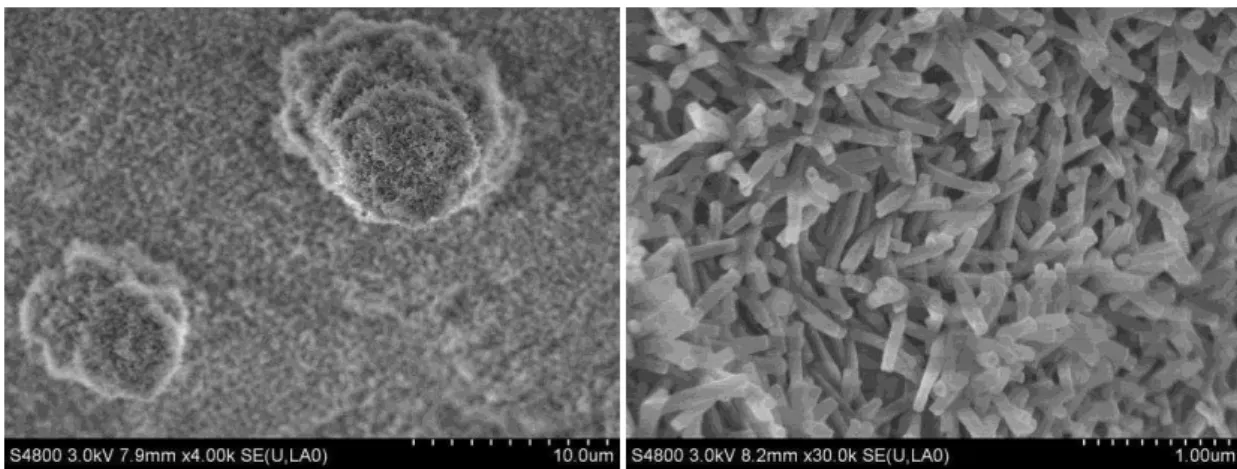
As we all know, the “lotus-effect” is the phenomenon that the lotus can repel the water. Fig. 4 is the SEM images of the lotus leaf`s upper surface. We can see that the lotus leaf`s upper surface support lots of tiny randomly intertwined nanofibrils and a series of separate rounded “puffs” , which are also made up of tiny, randomly intertwined nanofibrils. The mechanism of waterproof is the structure contained a series of separate
rounded “puffs”, which is shown as Fig. 5.
Shown as Fig.2 and Fig. 3, there are lots of crystals attached on the surface of the wild silkworm silk fi-ber with different sizes and hierarchical structure. Each hierarchical cascade is extremely similar to the
rounded “puffs” and randomly intertwined nanofibrils on the upper epidermis` structure of lotus leaf, which is the other answer why the wild silkworm silk can repel the water and dust but the domestic silkworm silk cannot.
In Ref. [11], we find a natural material that possesses the property of dust adsorption. This property might be contributed to the nanoporous structure of the material. The same phenomenon of dust adsorption was found in the the SEM images of upper epidermis of indocalamus pedalis (Fig. 5). However, shown as Fig.6, there are hardly any nanoparticles or dust on the lower epidermis of indocalamus pedalis. By a careful observation in the surface morphologies of the lower epidermis, we found that its structure is extremely simi-lar to the upper epidermis` structure of lotus leaf. The mechanism of the lower epidermis of indocalamus pedalis repel dust is in a similar way as that of “lotus effect”.
398 Figure 6: The scanning electron microscopy (SEM) images of lower epidermis of indocalamus pedalis
Therefore we can infer that the mechanism of waterproof and dust proof is the crystals attached on the wild silkworm silk. The repulsive mechanism of the wild silkworm silk is illustrated in Fig. 7.
Figure 7: The repulsive mechanism of wild silkworm silk
4. CONCLUSIONS
The present study reveals three main features of wild silks, i.e., 1) nanoparticle-like crystals on its surface; 2) smaller fibers and 3) compacted structure. Interaction of material property and geometrical property results in different properties of silk. The combination of smaller fibers and compacted structure of wild silk leads to
nano scale pores, which combine together with nano particles on wild silk’s silk produces the properties of waterproof and dustproof.
The experiment also reveals that the smaller fiber size is, the smaller critical water drop volume is, and the crystals attached on the wild silkworm silk can repel the water and dust, whose repulsive mechanism be-tween the crystals on the wild silkworm silk surface and dust in air or water is similar to that of lotus effect.
The present study shows possible biomimic design of waterproof and dustproof materials. When the sur-face is similar to those of lotus or wild silk, material’s proerties change greatly when it tends to nano scales.
5.ACKNOWLEDGEMENT
399 [5] CHEN, R.X., HE, J.H., KONG, H.Y., ”Waterproof and Dustproof of Wild Silk: A Theoretical Explana-tion”, Journal of Nano Research ,vol. 22,pp.61-63, 2013.
[6] CHEN, R.X., LIU,F.J., et al., “Silk Cocoon: ‘Emperor's New Clothes’ for Pupa: Fractal Nano-hydrodynamical Approach”, Journal of Nano Research, v.22, pp.65-70, 2013.
[7] DOU, H., LIU, H.Y., et al., “A belt-like superfine film fabricated by the bubble-electrospinning”, Ther-mal Science, v.17 , n.5. pp.1508-1510, 2013.
[8] JIN, H.Y., YIN, H., An, Y. “The effect of Gamma ray on the thermo-mechanical properties of silk fibro-in”, Thermal Science, v.17 , n.5, pp.1521-1522, 2013.
[9] DOU, H., ZUO,B.Q., et al., Blown bubble-spinning for fabrication of superfine fibers “, Thermal Sci-ence, v.16 , n.5, pp. 1465-1466, 2012.
[10] DOU, H., HE, J.H., “Nanoparticles fabricated by the bubble electropsinning”, Thermal Science, v.16, n.5, pp.1562-1563,2012.