Inte ractio n be twe e n substance P and
gastrin-re le asing pe ptide o n thyro tro pin
se cre tio n by rat pituitary
in vitro
1Departamento de Ciências Fisiológicas, Instituto de Biologia,
Universidade do Estado do Rio de Janeiro, Rio de Janeiro, RJ, Brasil
2Laboratório de Fisiologia Endócrina, Instituto de Biofísica Carlos Chagas Filho,
Universidade Federal do Rio de Janeiro, Rio de Janeiro, RJ, Brasil E.G. Moura1,
C.V.M. Santos1, R.M.M. Santos2 and C.C. Pazos-Moura2
Abstract
The effect of substance P (SP) on thyrotropin (TSH) secretion is controversial. In this study we evaluated the effect of SP on TSH secretion by hemipituitaries of 3-month-old Wistar rats in vitro and its
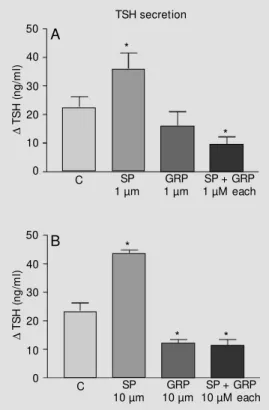
interaction with gastrin-releasing peptide (GRP) at equimolar concen-trations (1 µM and 10 µM). TSH release was measured under basal conditions and 30 min after incubation in the absence or presence of SP, GRP or both peptides. Pituitary TSH content was also measured in the pituitary homogenate after incubation. SP at both concentrations caused a significant (P<0.05) increase in TSH secretion compared with all other groups, which was approximately 60% (1 µM) and 85% (10 µM) higher than that of the control group (23.3 ± 3.0 ng/ml). GRP at the lower concentration did not produce a statistically significant change in TSH secretion, whereas at the concentration of 10 µM it produced a 50% reduction in TSH. GRP co-incubated with substance P completely blocked the stimulatory effect of SP at both concentra-tions. Pituitary TSH content decreased in the SP-treated group com-pared to controls (0.75 ± 0.03 µg/hemipituitary) at the same proportion as the increase in TSH secretion, and this effect was also blocked when GRP and SP were co-incubated. In conclusion, in an in vitro system,
SP increased TSH secretion acting directly at the pituitary level and this effect was blocked by GRP, suggesting that GRP is more potent than SP on TSH secretion, and that this inhibitory effect could be the predominant effect in vivo.
Co rre spo nde nce
E.G. Moura
Departamento de Ciências Fisiológicas
Instituto de Biologia, UERJ Av. 28 de Setembro, 87 20550-030 Rio de Janeiro, RJ Brasil
Fax: + 55-21-587-6129
E-mail: egmoura@ uerj.br
Research supported by CNPq (No. 520967/94-1), CAPES, SR-2 UERJ, FUJB and CEPG-UFRJ.
Received December 9, 1998 Accepted June 7, 1999
Ke y wo rds
·Substance P ·Thyrotropin
·Gastrin-releasing peptide
Intro ductio n
Substance P (SP) is a tachykinin peptide with 11 amino acids which is expressed in numerous neural and endocrine tissues (1). The highest SP concentration is found in rat and primate hypothalamic extracts (2-5). A high density of immunoreactive SP is
of substance P in the paraventricular nucleus (PVN) and also in the median eminence of rats (6). Furthermore, in the median emi-nence, SP-like-immunoreactive fibers are present in abundance, and nerve terminals of SP fibers contact the basal lamina of capil-laries in the hypophyseal portal circulation (7). These data support the view that sub-stance P plays a role in the regulation of the anterior pituitary, acting as a hypothalamic neurohormone and reaching the pituitary through the portal circulation (4,7).
However, SP has also been detected by immunocytochemistry within thyrotrophs, lactotrophs and somatotrophs of the rat ante-rior pituitary (8,9) as well as within a subset of thyrotrophs in the human pituitary (10). The presence of preprotachykinin A mRNA in the anterior pituitary gland (11) suggests that SP is synthesized in the gland. There-fore, it is likely that, in addition to hypotha-lamic SP, pituitary hormone secretion may be regulated by SP produced within the gland in an autocrine/paracrine manner.
In addition, a direct effect of SP is sup-ported by the finding of specific high affinity binding sites for SP in the pituitary gland (12,13) that have been characterized as type 1 neurokinin receptors, whose endogenous ligand is SP (13). These receptors, similar to those of hypothalamic hormones, such as TRH (thyrotropin-releasing hormone), stimu-late phosphatidylinositol 4,5-biphosphate-specific phospholipase C activity (14).
SP isolated from hypothalamic extracts has been shown to have several effects on anterior pituitary secretion (1). Substance P injected into the lateral ventricle of female Rhesus monkey increased prolactin and de-creased growth hormone concentrations in serum (15), while in the rat these effects were variable, perhaps depending on the concentration employed (16-20). The effect on LH is controversial and depends on the species studied, the route of administration and sex-steroid hormonal status (16-18,21). SP decreased ACTH secretion and
stimulat-ed arginine-vasopressin secretion in rats (22). The action of SP upon thyrotropin (TSH) secretion is also controversial. While Mitsuma and Nogimori (23) found a de-crease in serum TSH and a blockade of TRH- or cold exposure-induced TSH-release when SP was injected intravenously into male rats, Arisawa et al. (24,25) found no effect in vivo when SP was injected either
intravenously or into the third cerebral ventricule, or in vitro whenthe peptide was
added to the medium for dispersed anterior pituitary cells.
We have shown that two bombesin-like peptides, neuromedin B (NB) (26) and gas-trin-releasing peptide (GRP) (27), inhibit TSH secretion. NB content (28,29) and ac-tion (26,30) at the pituitary gland level are influenced by thyroid status. Hypothyroid-ism decreases, while thyroid hormone in-creases pituitary NB and its mRNA content (28,29). Also, SP concentration in the ante-rior pituitary is modified by thyroid status. Thyroidectomy increases, while hyperthy-roidism decreases the content of the peptide and its prohormone-encoding mRNA (11, 31,32), and the same occurs in the central nervous system of hypo- and hyperthyroid rats (33). Taken together, these data raise the possibility that bombesin-like peptides and SP interact to modulate TSH secretion. There are some SP analogs that function as SP and GRP or bombesin antagonists in several biological systems (34,35). In the present study we tested the effect of SP and its interaction with GRP on TSH secretion in vitro.
Mate rial and Me tho ds
Anim als
Three-month-old male Wistar rats (250-280 g) were housed under controlled condi-tions of temperature (24 ± 1oC) and light (12
D
T
S
H
(
n
g
/m
l)
50
40
30
20
10
0 A
TSH secretion
*
C SP
1 µm GRP 1 µm
SP + GRP 1 µM each
C SP
10 µm GRP 10 µm
SP + GRP 10 µM each
*
* *
B
D
T
S
H
(
n
g
/m
l)
50
40
30
20
10
0 In vitro e xpe rim e nt
The animals were sacrificed by decapita-tion. Pituitaries were quickly dissected out, the anterior pituitary was separated from the posterior pituitary, and each anterior hemipituitary was immediately transferred to a tube containing 1.0 ml of 199 medium (Sigma Chemical Co., St. Louis, MO, USA) plus 0.1% bacitracin and 10 mM HEPES (Sigma), pH 7.4, and incubated at 37oC in a
Dubnoff metabolic shaker. In two sets of experiments, the glands were divided into four groups of 10 hemipituitaries each: 1) control, 2) SP, 3) GRP and 4) SP + GRP. Both peptides (purchased from Peninsula Laboratories, Palo Alto, CA, USA) were added to a final concentration of 1 µM or 10 µM. After 30 min of pre-incubation the me-dium was removed, the hemipituitaries were resuspended in 1 ml of fresh medium and after 30 min an aliquot was collected for measurement of basal TSH. Then, 10 µl of medium alone or the peptide(s) correspond-ing to each group was added to each tube. After 30 min another aliquot was collected to measure post-stimulus TSH. The values are reported as the difference between stim-ulated TSH and basal TSH (D TSH). Each hemipituitary was homogenized in phos-phate-buffered saline containing 1% bovine serum albumin (Sigma), pH 7.6, for meas-urement of intrapituitary TSH.
Radio im m uno assay
TSH concentrations in the incubation medium and homogenates were determined by radioimmunoassay using kits supplied by the National Institute of Diabetes, Digestive and Kidney Diseases and are reported in terms of the reference preparation provided (RP2).
Statistical analysis
Data are reported as means ± SEM.
One-way analysis of variance (ANOVA) followed by the Newman-Keuls multiple comparison test was used for data analysis, with the level of significance set at P<0.05.
Re sults
As expected, there was no difference in basal TSH secretion amongst the groups stud-ied (data not shown). The incubation with 1 µM substance P caused a significant (P<0.05) increase in TSH secretion compared with all other groups studied, causing approximately a 59% higher TSH release than the control group (Figure 1, panel A). GRP at the same concentration produced a smaller nonsig-nificant decrease in TSH secretion, but when co-incubated with substance P, GRP com-pletely blocked the stimulatory effect of sub-stance P (Figure 1, panel A). Incubation with the peptides at the ten-fold higher concentra-tion (10 µM) produced a greater release of TSH by the pituitaries incubated with SP (87%, P<0.001), while GRP-incubated
pitu-Figure 1 - Thyrotropin (TSH) re-lease from hemipituitaries incu-bated in the presence of medi-um alone (control, C) or 1 µM (Panel A) or 10 µM (Panel B) gas-t rin-releasing pepgas-t ide (GRP), substance P (SP) or both. D = Difference in medium TSH be-fore and after peptide addition. Data are reported as means ± SEM f or 3 experim ent s. * P< 0.05 compared to control (ANOVA follow ed by New man-Keuls multiple comparison test).
itaries had a 50% lower TSH concentration in the medium (P<0.001). Again, GRP co-incubated with SP blocked the stimulatory effect of the peptide (Figure 1, panel B).
The TSH content in the pituitaries incu-bated with both peptides at the concentra-tions of 1 µM and 10 µM was lower in the SP group and inversely proportional to the ob-served increase in TSH secretion (63% at 1 µM and 85% at 10 µM), an effect which was also inhibited by co-incubation with GRP (Figure 2, panels A and B). GRP alone did not affect pituitary TSH concentration at 1 µM, but TSH concentration was 25% higher when GRP was added at 10 µM.
D iscussio n
We studied the effect of substance P on TSH secretion and its interaction with GRP, a bombesin-like peptide, which we have pre-viously shown to inhibit TSH secretion in vitro at the concentration of 10 µM (27). In
the present study, we also used a 10-times lower GRP concentration. At this concentra-tion GRP did not affect TSH secreconcentra-tion by
isolated pituitaries. The concentration of 1 µM substance P was chosen because in ini-tial experiments (data not shown) we showed that 1 µM was the minimum SP concentra-tion able to increase TSH secreconcentra-tion. The other concentrations studied were 1, 10 and 100 nM.
The inhibitory effect of 10 µM GRP on TSH secretion by isolated pituitaries was maintained even when SP was co-incubated at the concentration that caused an 87% higher TSH release into the medium, when SP was incubated alone. Even at the lower molarity, at which GRP did not change TSH secretion and SP-incubated pituitaries pre-sented a 59% higher TSH secretion, this effect was blocked by GRP co-incubation. These data suggest that GRP can function as an SP antagonist in the control of TSH secre-tion and in this case it is more potent than SP. It is unlikely that this blockade could be due to a summation of opposite effects since at both concentrations studied pituitaries co-incubated with both peptides showed lower TSH secretion than the control group. More experiments are needed to elucidate the mechanisms of this antagonism.
There are reports of interaction of SP and bombesin-like peptides, but none was re-lated to TSH secretion. The contractile ef-fect of bombesin on the guinea-pig isolated taenia coli (35) was antagonized by SP an-tagonists. This observation raised the possi-bility that bombesin and SP interact with each others receptors (35). This also may be the case for GRP in view of the structural homology between bombesin and GRP. How-ever, it is also possible that GRP and SP have opposite and independent effects on TSH release, GRP being more potent than SP.
Intraventricular or intravenous adminis-tration of SP failed to alter TSH release in male rats, but stimulated TSH secretion in estrogen-primed ovariectomized rats (25). However, Mitsuma and Nogimori (23) found a suppressive effect of SP injected iv on TSH
release in male rats. The discrepancy
be-T
S
H
(
µ
g
/h
e
m
ip
it
u
it
a
ry
)
1.5
1.0
0.5
0.0 A
Pituitary TSH
C SP
1 µm GRP 1 µm
SP + GRP 1 µM each
C SP
10 µm GRP 10 µm
SP + GRP 10 µM each
* *
B
T
S
H
(
µ
g
/h
e
m
ip
it
u
it
a
ry
) 1.5
1.0
0.5
0.0
*
tween the results of those experiments might be related to the different SP doses em-ployed and to the fact that their results were obtained in vivo, while ours were obtained in vitro. Our study establishes that substance P
has a direct stimulatory effect at the pituitary level. The fact that Arisawa et al. (18) did not find any effect of SP on pituitary cells cul-tured overnight might be related to differ-ences in the in vitro systems utilized or to
different times of incubation. Vijayan and McCann (16) also did not find any effect of SP on TSH secretion using a methodological approach similar to ours, however, they stud-ied ovariectomized female rats. Therefore, it appears that the sex and sex-hormone status of the animal influence the TSH response to SP. In support of this hypothesis, it has been demonstrated that the distribution of sub-stance P in different pituitary cell popula-tions is sexually dimorphic (36).
The observed direct effect of exogenous SP on TSH secretion agrees with the pres-ence of SP receptors in the pituitary gland
(12-14), which, physiologically, might be activated by hypothalamic SP or the locally produced peptide, which has been localized within the thyrotroph by immunocytochem-istry (8,10).
Several lines of evidence suggest an in-terplay between SP and NB/GRP in TSH secretion. Both peptides have been shown to be present in the thyrotrophs, and they have opposite effects on TSH secretion, with SP increasing it while NB and GRP decrease it (26,27,30). Their pituitary levels are modi-fied in opposite directions by thyroid hor-mone. Pituitary SP content decreases, while NB content increases with thyroxine admin-istration (28,29,31,32) and in hypothyroid-ism the reverse occurs for both peptides (30,31). We have shown in the present paper that GRP antagonized the effect of SP on TSH secretion. Therefore, it is tempting to propose that these peptides could play a role as local regulators in the inhibition of TSH secretion caused by thyroid hormones, mod-ulating each others effects.
Re fe re nce s
1. Aronin N, Coslovsky R & Leeman SE (1986). Substance P and neurotensin. An-nual Review of Physiology, 48: 537-549. 2. Ljungdahl A, Hökfelt T & Nilsson G (1978).
Distribution of substance P-like immu-noreactivity in the central nervous system of the rat cell bodies and nerve terminals.
Neuroscience, 3: 861-880.
3. Panula P, Yang H-T & Costa E (1984). Comparative distribution of bombesin/ GRP- and substance P-like immunoreac-tive in rat hypothalamus. Journal of Com-parative Neurology, 224: 606-617. 4. Hökf elt T, Pernow B, Nilsson G,
Weterburg L, Goldstein M & Jeffcoate S (1978). Dense plexus of substance P im-munoreactive nerve terminals in eminen-tia medials of the primate hypothalamus.
Proceedings of the National Academy of Sciences, USA, 75: 1013-1015.
5. M ai J, Stephens P, Hope A & Cuello A (1986). Substance P in the human brain.
Neuroscience, 17: 709-739.
6. Jessop DS, Chow drey HS & Lightman SL
(1990). Substance P and substance K in the median eminence and paraventricular nucleus of the rat. Neuropeptides, 17: 135-140.
7. Tsuruo Y, Kaw ano H, Nishiyama T, Hisano S & Daikoku S (1983). Substance P-like immunoreactive neurons in the tuberoin-fundibular area of rat hypothalamus. Light and electron microscopy. Brain Research, 289: 1-9.
8. De Palatis LR, Fiorindo RP & Ho RH (1981). Substance P immunoreactivity in the anterior pituitary gland of the guinea pig. Endocrinology, 110: 282-284. 9. M orel G, Chayvialle JA, Kerdelhue B &
Dubois PM (1982). Ultrastructural evi-dence for endogenous substance P-like immunoreactivity in the rat pituitary gland.
Neuroendocrinology, 35: 86-92. 10. Roth K & Krause J (1990). Substance P is
present in a subset of thyrotrophs in the human pituitary. Journal of Clinical Endo-crinology and M etabolism, 71: 1089-1095. 11. Jonassen JA, M ullikin-Kilpat rick D,
M cAdam A & Leeman SE (1987). Thyroid hormone status regulates preprotachyki-nin: a gene expression in the male rat anterior pituitary. Endocrinology, 121: 1555-1561.
12. Kedelhue B, Tartar A, Lenoir V, El Abded A, Hublau P & M illar R (1985). Binding studies of substance P anterior pituitary binding sites - changes in substance P binding sites during the rat estrous cycle.
Regulatory Peptides, 10: 133-143. 13. Larsen PJ, M ikkelsen JD & Sæmark T
(1989). Binding of an iodinated substance P analog to a NK-1 receptor on isolated cell membranes from rat anterior pituitary.
Endocrinology, 124: 2548-2557. 14. M au SE, Larsen PJ, M ikkelsen JA &
Sæmark T (1990). Substance P and re-lated tachykinins induce receptor-medi-ated hydrolysis of polyphosphoinositides in the rat anterior pituitary. M olecular and Cellular Endocrinology, 69: 69-78. 15. Eckstein N, Wehrenberg WB, Louis K,
Ferin M (1980). Effects of substance P on anterior pituitary secretion in the female Rhesus monkey. Neuroendocrinology, 31: 338-342.
16. Vijayan E & M cCann SM (1979). Effect of substance P and neurotensin on grow th hormone and thyrotropin release in vivo
and in vitro. Life Sciences, 26: 321-327. 17. Picanço-Diniz DLW, Valença M , Franci CR
& Antunes-Rodrigues J (1990). Role of substance P in the medial preoptic area in the regulation of gonadotropin and prolac-tin secretion in normal or orchidectomized rats. Neuroendocrinology, 51: 675-682. 18. Arisaw a M , Snyder GD & M cCann SM
(1990). Stimulatory role of substance P on gonadotropin release in ovariectomized rats. Neuroendocrinology, 51: 523-529. 19. Arisaw a M , Snyder GD, Yu W, De Palatis
LR, Ho RH, Xu R & M cCann SM (1990). Physiologically significant inhibitory hypo-thalamic action of substance P in prolactin release in the male rat. Neuroendocrinol-ogy, 52: 22-27.
20. Kato Y, Chihara K, Ohgo S, Iw asaki Y, Abe H & Imura H (1976). Grow th hormone and prolactin release by substance P in rats.
Life Sciences, 19: 441-446.
21. Wormald P, M illar R & Kerdelhue B (1989). Substance P receptors in human pituitary, a potential inhibitor of luteinizing hormone secretion. Journal of Clinical Endocrinol-ogy and M etabolism, 69: 612-615. 22. Chow drey H, Jessop D & Lightman S
(1990). Substance P stimulates arginine vasopressin and inhibits adrenocorticotro-pin release in the rat. Neuroendocrinol-ogy, 52: 90-93.
23. M itsuma T & Nogimori T (1984). Effects of substance P, angiotensin II,
oxotremo-rine and prostaglandin D2 on thyrotropin
secretion in rats. Hormone Research, 19: 176-184.
24. Arisaw a M , Snyder GD & M cCann SM (1989). Effect of substance P on thyrotro-pin secretion from the pituitary gland in the rat. Peptides, 10: 763-766.
25. Arisaw a M , M akino T, M cCann SM & Izuka R (1989). Effect of estrogen on the response of thyroid stimulating hormone to substance P in rats. Endocrinologia Japonica, 36: 899-903.
26. Rettori V, Pazos-M oura CC, M oura EG, Polak J & M cCann SM (1992). Role of neuromedin B in the control of the re-lease of thyrotropin in hypothyroid and hyperthyroid rats. Proceedings of the Na-tional Academy of Sciences, USA, 89: 3035-3039.
27. Santos CV, Pazos-M oura CC & M oura EG (1995). Effect of gastrin-releasing peptide (GRP) and GRP antagonists on TSH secre-tion from rat isolated pituitaries. Life Sci-ences, 57: 911-915.
28. Steel JH, Van Noorden S, Ballesta J, Gibson SJ, Ghatei M A, Burrin J, Leonhardt U, Domin J, Bloom SR & Polak JM (1988). Localization of 7-B2, neuromedin B and
neuromedin U in specific cell types of rat, mouse and human pituitary and extrapitu-itary tumors. Endocrinology, 122: 270-282.
29. Jones PM , Withers DJ, Ghatei M A & Bloom SR (1992). Evidence for neurome-din B synthesis in the rat anterior pituitary gland. Endocrinology, 130: 1829-1836. 30. Pazos M oura CC, M oura EG, Rettori V,
Polak J & M cCann SM (1996). Role of neuromedin B in the in vitro thyrotropin release in response to
thyrotropin-releas-ing hormone (TRH) from anterior pituitar-ies of eu, hypo and hyperthyroid rats. Pro-ceedings of the Society for Experimental Biology and M edicine, 211: 353-358. 31. Jones PM , Ghatei M A, Steel J, O’Halloran
D, Gon G, Legon S, Burrin JM , Leonhardt U, Polak JM & Bloom SR (1989). Evidence for neuropeptide Y synthesis in the rat anterior pituitary and the influence of thy-roid hormone status: comparison w ith va-soactive intestinal peptide, substance P and neurotensin. Endocrinology, 125: 334-341.
32. Aronin N, M orency K, Leem an SE, Braverman LE & Coslovsky R (1984). Regulation by thyroid hormone of the con-centration of substance P in the rat ante-rior pituitary. Endocrinology, 114: 2138-2141.
33. Savard P, M erand Y, Dipaolo T & Dupont A (1983). Effects of thyroid state on sero-tonin, 5-hydroxyindoloacetic acid and sub-stance P contents in discrete brain nuclei of adults rats. Neuroscience, 10: 1399-1404.
34. Jensen RT, Jones SW, Lu Y-A, Xu J-C, Folkers K & Gardner JD (1984). A syn-thetic peptide that is a bombesin receptor antagonist. Biochimica et Biophysica Acta, 804: 181-191.
35. Folkers K, Häkanson R, Hörig J, Xu J-C & Leander S (1984). Biological evaluation of substance P antagonists. British Journal of Pharmacology, 83: 449-456.