Partial purification of tightly bound
mitochondrial hexokinase from maize
(
Zea mays
L.) root membranes
1Instituto de Bioquímica Médica, Centro de Ciências da Saúde,
Universidade Federal do Rio de Janeiro, RJ, Brasil
2Laboratório de Química e Função de Proteínas e Peptídeos, CBB,
Universidade Estadual do Norte Fluminense, Campos dos Goytacazes, RJ, Brasil
3Departamento de Bioquímica y Biologia Molecular, Universidad de Barcelona,
Barcelona, Spain G.L. Rezende1, C. Logullo2,
L. Meyer1, L.B. Machado1,
A.L. Oliveira-Carvalho1,
R.B. Zingali1, D. Cifuentes3
and A. Galina1
Abstract
In mammals, hexokinase (HK) is strategically located at the outer membrane of mitochondria bound to the porin protein. The mitochon-drial HK is a crucial modulator of apoptosis and reactive oxygen species generation. In plants, these properties related to HK are unknown. In order to better understand the physiological role of non-cytosolic hex-okinase (NC-HK) in plants, we developed a purification strategy here described. Crude extract of 400 g of maize roots (230 mg protein) contained a specific activity of 0.042 µmol G6P min-1 mg PTN-1. After
solubilization with detergent two fractions were obtained by DEAE column chromatography, NC-HK 1 (specific activity = 3.6 µmol G6P min-1 mg PTN-1 and protein recovered = 0.7 mg) and NC-HK 2. A major
purification (yield = 500-fold) was obtained after passage of NC-HK 1 through the hydrophobic phenyl-Sepharose column. The total amount of protein and activity recovered were 0.04 and 18%, respectively. The NC-HK 1 binds to the hydrophobic phenyl-Sepharose matrix, as observed for rat brain HK. Mild chymotrypsin digestion did not affect adsorption of NC-HK 1 to the hydrophobic column as it does for rat HK I. In contrast to mammal mitochondrial HK, glucose-6-phosphate, clotrimazole or thiopental did not dissociate NC-HK from maize (Zea mays) or rice (Oryza sativa) mitochondrial membranes. These data show that the interaction between maize or rice NC-HK to mitochondria differs from that reported in mammals, where the mitochondrial enzyme can be displaced by modulators or pharmacological agents known to inter-fere with the enzyme binding properties with the mitochondrial porin protein.
Correspondence
A. Galina Av. Bauhinia, 400
Instituto de Bioquímica Médica UFRJ, CCS, Bl. D, sub-solo, Sala 13 21941.590 Rio de Janeiro, RJ Brasil
Fax: +55-21-2270-8647 E-mail: [email protected] The present address of G.L. Rezende is Laboratório de Fisiologia e Controle de Artrópodes Vetores, Departamento de Entomologia, Instituto Oswaldo Cruz, FIOCRUZ, Manguinhos, Rio de Janeiro, RJ, Brasil.
Research supported by CNPq (No. E-26/170.630/2004) and FAPERJ (No. 480378/2005-5).
Received December 14, 2005 Accepted May 18, 2006
Key words
•Hydrophobic interaction
chromatography
•Maize
•Mitochondrial hexokinase •Non-cytosolic hexokinase •Purification
Introduction
Hexokinase (HK) [EC 2.7.1.1] catalyzes the crucial step in hexose metabolism which converts free hexose to hexose-6-phosphate, using ATP. Since the 1950’s, the existence of particulate HK isoforms has been observed in
plants (1-4). The association of HK with the outer mitochondrial membrane (5-11), the outer envelope membrane of plastids (12,13) or with the Golgi apparatus (14) has been reported.
Maize (Zea mays) root has a non-cytosolic
are inhibited by micromolar concentrations of ADP and the hexose analogues glucosa-mine, mannoheptulose and N-acetylglucos-amine, which are markers of HKs involved in the sugar sensing signaling cascade in plants or in uridine diphosphoglucose for-mation in maize roots (11,14-17). Sugar sens-ing is an important event in plant metabo-lism, in which the pattern of genetic expres-sion of a tissue is altered by the presence of free hexoses (18). Interestingly, in maize roots the cytosolic hexokinase and fructoki-nase isoforms are not inhibited by ADP or hexose analogues, suggesting that NC-HKs are the main isoforms involved in this spe-cific hexose signaling pathway (14). The sugar sensing pathways have not been estab-lished. However, glucose-insensitive and glucose-oversensitive mutants have revealed extensive and intimate connections between glucose and plant hormone signaling path-ways such as ethylene and abscisic acid (18,
19). Accordingly, in Arabidopsis thaliana,
AtHK 1 activity is found associated with
mitochondria, similarly to the NC-HK
activ-ity found in maize (Zea mays) or rice (Oryza
sativa) roots that also exhibit the sugar sens-ing response (14-16,18,19). The HK senssens-ing function may depend on its subcellular lo-calization, translocation and/or interactions with downstream effectors, but these prop-erties are still unknown. It has been
sug-gested that in castor bean (Ricinus
commu-nis) HK and mitochondria interact in a way
similar to that described for rat brain (6,20). In the rat brain, HK is associated with mito-chondria through the porin protein, also called voltage-dependent anion channel (21). The rat HK dissociates from the mitochondrial porin in a reversible manner depending on the levels of glucose-6-phosphate (22-24). Additionally, pharmacological drugs such as the fungicide clotrimazole and the anes-thetic thiopental can also dissociate mam-malian HK from the porin, releasing the enzyme from mitochondria (25,26). The abil-ity of these drugs to dissociate HK from
plant mitochondria has not been tested. It was shown that the first 10 N-terminal resi-dues of rat HK are responsible for its asso-ciation with porin (21). Mild chymotrypsin digestion removes the first 10 N-terminal residues from the rat brain HK which, with-out these N-terminal residues, loses the abil-ity to reattach to its mitochondrial receptor and also to be adsorbed to hydrophobic res-ins such as phenyl-Sepharose (27). On the other hand, it was shown that in spinach (Spinacia oleracea) leaves, SoHK 1 inter-acts with the outer envelope membrane of chloroplasts by its 24 N-terminal residues, and has been suggested to function as a membrane anchor. This observation is
sup-ported by the fact that truncated spinach SoHK
1 without 24 N-terminal residues does not associate with the outer chloroplast envelope membrane (13). Wiese et al. (13) suggested that this hydrophobic N-terminal is immersed directly into the membrane independently of the presence of any receptor protein. Similar
to spinach SoHK 1, it was found that the rice
OsHK 1 gene product is associated with the
mitochondrial membrane and also presents the first 24 hydrophobic N-terminal residues
(28). The DNA sequence of rice OsHK 1
(GenBank accession No. AF372831) is very closely related to the maize HK sequence found in GenBank (accession No. AY125979), suggesting that maize HK may bind to mito-chondria in a way similar to that observed for
rice HK. Apart from an R. communis study (6),
no further investigation concerning the prop-erties of interaction of HK with mitochondria was performed so far in plants. In an attempt to gain insights about the nature of NC-HK asso-ciation with maize mitochondria, the separa-tion of this enzyme from plant organelles is essential.
mito-chondrial membrane-bound HK. In addi-tion, to study the sensitivity of plant HKs to modulators of the binding of HK to mito-chondria used in mammals.
Material and Methods
Isolation of mitochondria from rice, maize root, and rat brain
In order to isolate rice root mitochondria containing large amounts of NC-HK (named
OsHK 1), we used essentially the same
pro-tocol as described for maize mitochondria isolation. Maize roots (400 g) were obtained as described before (14) and were homog-enized in two volumes of cold buffer A (0.1 M Tris-HCl, pH 8.0, 10% glycerol, 0.5% PVP-40, 3.3 mM DTT, 10 mM glucose, 1.3 mg/mL BSA, 0.15 M KCl, 1 mM PMSF, and 5 mM EDTA). The crude mitochondrial
pel-let was obtained from the 10,000 g
differen-tial centrifugation. The mitochondria were isolated as described before (11) and were re-suspended in 35 mL of cold buffer B (20 mM HEPES-Tris, pH 8.0, 0.3 M mannitol, 4 mM EGTA, 4 mM EDTA, 0.2 mM PMSF, 4 mM ß-mercaptoethanol, 0.1 M KCl, and 10 mM glucose). Briefly, the pellet was washed three times with 40 mL of buffer B and
centrifuged at 7000 g for 15 min at 4ºC. The
final pellet was re-suspended in buffer B to a final concentration of 10 to 20 mg protein/ mL and stored in liquid nitrogen.
Rat brain mitochondria were isolated as described (22) in a buffer containing 10 mM Tris-HCl, pH 7.4, 0.25 M sucrose, 0.2 mM PMSF, 0.2 mM EDTA, and 10 mM glucose. The mitochondrial pellet was re-suspended to a final concentration of 20 mg protein/mL and used immediately.
Hexokinase activity assay
Each fraction was assayed for HK activ-ity as previously described (29) in 20 mM
Tris-HCl, pH 7.5, 6 mM MgCl2, 2 mM
glu-cose, 1 mM ATP, 2 mM PEP, 0.1% (v/v) Triton X-100, 10 mM NaN3, 6 units/mL pyruvate kinase, and protein to a final con-centration of 5 to 50 µg/mL. The reaction was started by adding protein fractions and was stopped after 5 to 10 min at 35ºC by heating for 1 min at 100ºC. The glucose-6-phosphate formed was measured by adding an equal volume of a solution containing 20 mM Tris-HCl, pH 7.5, 6 mM MgCl2, 1 unit/
mL glucose-6-phosphate dehydrogenase (
Leu-conostoc mesenteroides; Sigma, St. Louis,
MO, USA), and 0.3 mM ß-NAD+.
Absorb-ance was read at 340 nm using a molar
extinction coefficient of 6.22 M-1. In all
cases, activities were linear up to 30 min and linear with the amount of extract added. Alternatively, the HK activity was measured in a 96-well microplate reader in a final volume of 0.15 mL. The yeast and rat HK activities were determined with the micro-plate reader, as described above but in a
medium containing 0.6 mM ß NADP+
in-stead of ß-NAD+. The reactions were started
with ATP at a final concentration of 1 mM.
Solubilization of hexokinase from rice, maize, or rat mitochondria
at 4ºC in a medium containing 15 mM Tris-HCl, pH 7.5, 4 mM ß-mercaptoethanol, 10 mM glucose, 1 mM EDTA, 1 mM PMSF, 0.2 M KCl, and 1% Triton X-100 (v/v). Alterna-tively, maize NC-HK was solubilized with CHAPS at different final concentrations rang-ing from 0 to 6% (w/v). Mitochondria from maize, rice or rat were then centrifuged at
105,000 g for 45 min at 4ºC. The supernatants
were collected and the mitochondrial pellets were re-suspended in the same medium but without the solubilizing compounds. A 10-µL aliquot from each supernatant and pellet was used to assay HK activity in the microplate
reader system, but with 1.5 mM ß-NAD+ or
ß-NADP+ in the glucose-6-phosphate
experi-ments. The percentage of solubilized (released) HK activity was calculated as the ratio (activ-ity in supernatant)/(activ(activ-ity in supernatant + activity in pellet).
DEAE-Toyopearl chromatography
The mitochondrial pellet from maize roots was incubated with 4% CHAPS as described above in a total volume of 13 mL. The solubilized HK activity was diluted five times in buffer D (10 mM Tris-HCl, pH 8.4, 10 mM glucose, 4 mM ß-mercaptoethanol, 0.2 mM EDTA, and 0.2 mM PMSF) or 20 units of yeast HK (Sigma type C-300) were added to the buffer D, when necessary for the
binding studies (Figure 3),andwas applied
to a DEAE-Toyopearl column (1.7 x 8.2 cm) pre-equilibrated with buffer D. The column was washed with buffer D until effluent protein reached near zero and a 100-mL linear gradient of 0 to 0.4 M NaCl in the same buffer was then applied to the column. Fractions of 7.5 mL/tube were collected be-fore the gradient was applied and fractions of 2.5 mL/tube were collected during the gradient. Protein elution was monitored at 280 nm. The HK activity in each fraction was assayed in the microplate reader. Two activity peaks, named NC-HK 1 and NC-HK 2, were observed. The fractions containing
activity from NC-HK 1 or NC-HK 2 were pooled together in three tubes of 2.5 mL each and stored at -80ºC. The run was per-formed at 4ºC at a flow rate of 2 mL/min.
Chromatography on phenyl-Sepharose
that, after the gradient, the column was washed with 48 mL of buffer G. The HK activity in the fractions of each run was assayed with the microplate reader. All runs were performed at 4ºC at a flow rate of 1 mL/min.
Mild chymotrypsin digestion of hexokinases
Samples from maize or rat HKs eluted from the DEAE column were incubated in a digestion medium adapted from Kurokawa et al. (27), containing 20 mM Tris/HCl, pH 7.5, 2 mM EDTA, 5 mM ß-mercaptoethanol, 10 mM glucose and chymotrypsin at a concentra-tion ranging from 0.5 to 1.2 µg/mL, depending on the HK utilized. The digestions were per-formed at 30ºC for 20 min and were stopped by adding 2.2 mM PMSF. The treated samples were then loaded onto the phenyl-Sepharose column as described above. Mild chymotryp-sin digestion resulted in a 25 to 33% loss of the initial HK activities measured.
Superose 12 chromatography
Samples of NC-HK 1 eluted from the phenyl-Sepharose column were concentrated in a Speed Vac apparatus and loaded onto a Superose 12 H/R column (Amersham, Phar-macia Biotech, Waukesha, WI, USA) equili-brated with a buffer containing 15 mM Tris-HCl, pH 7.5, 8 mM glucose, and 0.5 M NaCl, at a flow rate of 0.5 mL/min. Forty-two fractions of 0.5 mL were collected. The HK activity of each fraction was assayed with the microplate reader and protein elu-tion was monitored at 214 nm. The standard
proteins used for Mr calibration were bovine
serum albumin (66,000), ovalbumin (45,000)
and cytochrome c (12,000).
Thermal stability of non-cytosolic hexokinase 1
Samples of NC-HK 1 eluted from the DEAE column were incubated at 50ºC for 85 min or at -80ºC for 13 days and aliquots
were taken at different times for HK activity determination with the microplate reader, as described earlier.
Protein determination
Protein determination was performed by the method of Lowry et al. (30). When the protein concentration was too low, or when there was buffer interference, the samples were precipitated with 7% TCA (w/v) on ice for 5 min, followed by centrifugation at
20,000 g for 15 min at 4ºC and the proteins
were re-suspended in 0.08 mL with 0.1% SDS (w/v) before carrying out the protein determination according to the method of Lowry et al. (30). Bovine serum albumin was used as standard.
Results
Solubilization of mitochondrial hexokinases
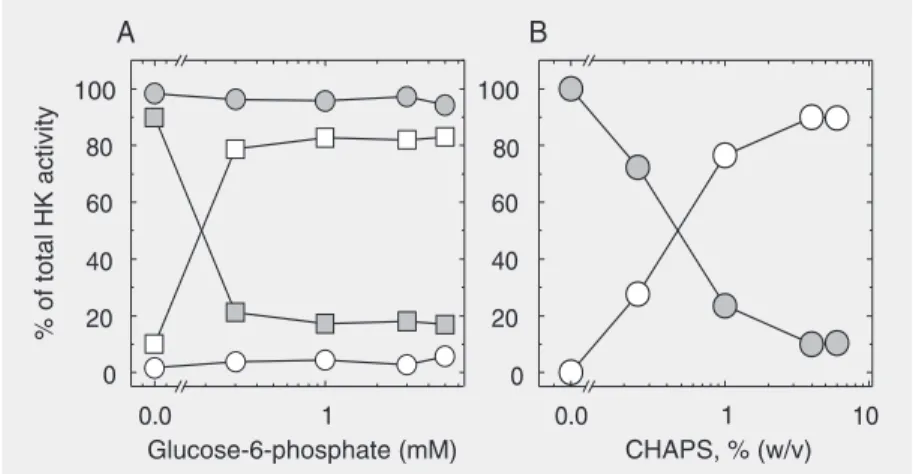
Glucose-6-phosphate, at 5 mM, was effi-cient to dissociate HK from rat brain (85%) and R. communis developing seed (100%)
(6) mitochondria but not from O. sativa or Z.
mays root mitochondria (data not shown).
Non-cytosolic hexokinase purification
A summary of NC-HK purification from maize root mitochondria is presented in Table 1. Since the enzymatic activity is most stable in 10 mM glucose (Table 2), all buffers used during the purification contained 10 mM glucose. After passage through DEAE-To-yopearl, the NC-HK activity was separated into two components designated NC-HK 1 and NC-HK 2 (Figure 2A), as reported pre-viously (29). The first three steps increased the specific activity of NC-HK 1 by 18.5-fold, but the phenyl-Sepharose hydrophobic interaction chromatography step (Figure 2B) resulted in a 488-fold increase in the specific activity of NC-HK 1 in an 18% yield com-pared to the crude extract pool (Table 1). However, the purification factor and yield observed for NC-HK 2 after phenyl-Sepha-rose chromatography were much lower, i.e., 21.6 and 2.2%, respectively (Table 1).
Since the NC-HK 2 activity could not be isolated in sufficient quantity, only the NC-HK 1 activity was used for further experi-ments. An attempt was made to further pu-rify NC-HK 1 by gel filtration on a Superose 12 column. Although it was possible to sepa-Figure 1. Solubilization of mitochondrial hexokinase (HK) activity with glucose-6-phosphate
and CHAPS. A, Rat brain HK (squares) and maize roots HK (circles) from mitochondria incubated with glucose-6-phosphate. B, Maize root mitochondria incubated with CHAPS (% as w/v). The total HK activity is the sum of the supernatant (open symbols) and the pellet (filled symbols). The figure presents representative experiments from six mitochondrial preparations.
(data not shown). Solubilization of mitochon-drial HK activity from all species was attained only with 1% (v/v) Triton X-100 detergent. CHAPS at 4% (w/v) (Figure 1B) was also effective in solubilizing the maize enzyme by 90% and this detergent was used for NC-HK isolation in order to avoid interference with further purification steps (31, 32).
Table 1. Purification of non-cytosolic hexokinases from maize roots.
Step Volume Protein Activity Purification Recovery
(mL) (mg) activity (%)
Total Specific+
Crude extract 282 231 9.71 ± 0.85 0.042 ± 0.06 1 100
Mitochondrial pellet++ 0.86 12.6 6.46 ± 0.58 0.514 ± 0.05 12.2 66.5
CHAPS solubilization 12.4 5.33 6.32 ± 0.42 1.185 ± 0.4 28.2 65
NC-HK 1 after DEAE 18.5 0.73 2.64 ± 1.1 3.6 ± 0.5 85.7 27.2
NC-HK 1 after phenyl-Sepharose column chromatography 31.4 0.09 1.77 ± 0.3 20.5 ± 2.5 488 18.2
NC-HK 2 after DEAE 20.5 1.04 0.70 ± 0.4 0.674 ± 0.6 16.0 7.3
NC-HK 2 after phenyl-Sepharose column chromatography 23.5 0.24 0.22 ± 0.1 0.909 ± 0.3 21.6 2.2
Enzyme activity was measured at 35ºC as described in the first assay system in the Material and Methods section. The protein of each step was measured by the method of Lowry et al. (30).
+Specific activity was calculated dividing the total activity recovered in the fraction by the total amount of protein recovered in that fraction. The
specific activity is reported as µmol G6P min-1 mg PTN-1. Data are reported as means ± SEM. The NC-HK activity of the total homogenate was calculated as the difference between the specific activity of the total homogenate and the specific activity of the supernatant of the 10,000 g
Figure 2. A, Anion exchange chromatography on a DEAE-Toyopearl column of the CHAPS-solubilized ac-tivity of NC-HK from mitochondrial maize roots. HK activity (circles). The profile of protein elution was moni-tored at 280 nm (lozenges), and an NaCl gradient from 0 to 0.4 M (broken line) was used. The presence of the two isoforms of NC-HK (NC-HK 1 and NC-HK 2) is indicated. The figure illustrates a representative experi-ment of nine mitochondrial preparations. The recov-ered NC-HK 2 activity corresponded to 33.6 ± 5.1% (mean ± SEM) of the total NC-HK activity. B, Hydro-phobic interaction of NC-HK 1 chromatography on a phenyl-Sepharose column. NC-HK 1 (circles) was eluted from the DEAE column, the order of elution was monitored at 280 nm (lozenges), and an NaCl gradient from 1.5 to zero M (broken line) was used. The figure shows a representative experiment of six mitochondrial preparations. C, Superose 12 gel filtration chromatog-raphy of NC-HK 1 activity after elution from the phenyl-Sepharose column. NC-HK 1 activity (circles) was measured as described in Material and Methods. The profile of protein elution was monitored at 214 nm (loz-enges). The arrows indicate the standards of native molecular weight markers of bovine serum albumin (66 kDa), NC-HK 1 (38 kDa) and cytochrome C (12 kDa). The figure shows a representative experiment of four mitochondrial preparations. NC-HK = non-cytosolic hexokinase.
rate NC-HK 1 from other contaminating pro-teins of higher and lower molecular weight (Figure 2C), it was not possible to calculate the yield and purification fold of this step due to very small protein recovery at this stage. In addition, due to the small quantity of the protein, SDS-PAGE analysis was not possible. According to elution position, NC-HK 1 has an apparent molecular weight of 38,000 (Figure 2C).
Sensitivity to inhibitors and thermal stability of non-cytosolic hexokinase 1
NC-HK from maize is non-competitively inhibited by its reaction product ADP and competitively inhibited by the sugar
ana-logue mannoheptulose (11,14,29). The IC50
for the inhibition of purified NC-HK 1 (after phenyl-Sepharose chromatography) was es-sentially the same as for ADP (70 ± 21 µM, mean ± SEM) and mannoheptulose (450 ±
Table 2. Thermal and storage stability of NC-HK 1 activity from the DEAE column.
% remaining NC-HK 1 activity
+Glucose -Glucose
Thermal stability at 50ºC
35 min 100 35
85 min 89 13
Storage stability at -80ºC
4 days 100 75
13 days 99 32
Aliquots were removed at the different times and hexokinase activity was measured with a micro-plate reader. The table shows representative ex-periments of three DEAE preparations. The glu-cose concentration was 10 mM. NC-HK = non-cytosolic hexokinase.
90% of total activity was eluted after the gradient achieved 0 M NaCl concentration (fractions 25 to 33, Figure 3A). Chymotryp-sin hydrolysis did not modify the interaction with the resin (Figure 3A, open circles). Rat brain HK was also adsorbed to this column (Figure 3B, filled squares), but after chymo-trypsin hydrolysis (Figure 3B, open squares) the enzyme was not retained by the resin. Yeast HK was not adsorbed to the phenyl-Sepharose column (Figure 3C, triangles), as expected for a cytosolic HK (27).
Discussion
Purification of non-cytosolic hexokinase from maize roots
NC-HK 1 was purified 488-fold from maize roots by a 4-step method with 18.2% recovery (Table 1). The extent of purifica-tion achieved for this NC-HK was higher than that reported for other HKs from differ-ent plant species and differdiffer-ent tissues (33-36). Different from studies on cytosolic en-zymes, phenyl-Sepharose step was 50 times more efficient in purifying maize NC-HK 1 with similar yields (Table 1), indicating that this is a suitable step for the purification of NC-HKs. Several studies have been per-formed with non-cytosolic HKs from differ-ent plants (1-3,5-13,28,37). However, since these studies focused on the sub-cellular localization or the determination of the ki-netic properties of these enzymes, the cur-rent study presents for the first time a proce-dure for the purification of particulate HKs from plants.
The apparent molecular weight of NC-HK 1, estimated to be 38,000 by gel filtra-tion chromatography (Figure 2C), is similar to those of other hexose kinases found in prokaryotes (38), also determined by gel filtration chromatography, cytosolic HK iso-forms of castor bean, barley leaves, maize endosperm, and potatoes (6,8,33,34) and two particulate HK activities detected, but not Figure 3. Effect of limited
cmotrypsin hydrolysis on hy-drophobic interaction chroma-tographic behavior of maize, rat and yeast hexokinases. A, NC-HK 1 eluted from the DEAE column (Figure 2A) with (open circles) and with-out (filled circles) chymotryp-sin digestion; B, rat brain HK activity eluted from the DEAE column with (open squares) and without (filled squares) chymotrypsin digestion; C, yeast HK activity not exposed to chymotrypsin hydrolysis eluted from the DEAE column (triangles). NaCl gradient from 1.5 to 0 M (broken lines). The figure shows a representative experiment of four mitochon-drial preparations. NC-HK = non-cytosolic hexokinase.
85 min and at -80ºC for 13 days (Table 2). After phenyl-Sepharose chromatography, similar stability characteristics were found for NC-HK 1 (data not shown). The pres-ence of 10 mM glucose was essential to stabilize the enzyme (Table 2).
Effect of limited chymotrypsin hydrolysis on hydrophobic interactions of maize with cytosolic yeast and rat brain mitochondrial hexokinases
purified, in castor bean (6).
Additional chemical characterization of NC-HK 1 is difficult due to the large amount of maize seedlings (more than 400 g) re-quired to obtain less than 90 µg of protein in the phenyl-Sepharose step (Table 1). The NC-HK 2 was partially purified but the method used was ineffective for the purifi-cation of activity, which was enriched only 21.6-fold (Table 1).
Association between hexokinase and mitochondria in plants and mammals. Are there two distinct types of interaction?
The present results indicate that NC-HKs from maize and rice roots have unique char-acteristics regarding the nature of their inter-action with mitochondria when compared to the mechanism described for castor bean and rat brain. For NC-HK from maize and rice, it is suggested a stronger hydrophobic character and this property may be poten-tially important to promote a tight associa-tion between HK and mitochondria in maize. The rat brain HK possesses a site of cleavage for chymotrypsin on its hydrophobic N-ter-minal (20,21,23,24,27,38). Mild chymotryp-sin digestion effectively removes the N-ter-minal from rat HK, preventing the enzyme from associating with mitochondria or ad-hering to the phenyl-Sepharose column (27). However, this digestion did not alter the elution profile of NC-HK 1 on the phenyl-Sepharose column (Figure 3A and B, open symbols), showing that maize NC-HK 1 is not able to detach from the column under the same conditions of treatment. The mild di-gestion effectively reduced NC-HK 1 activ-ity, with a 25% reduction in total activity (Figure 3A, filled and open circles). This indicates that chymotrypsin digestion did in fact hydrolyze NC-HK 1, but was unable to remove any essential hydrophobic domains involved in the binding of NC-HK 1 to the hydrophobic resin. In contrast, as expected, this treatment effectively altered the elution
profile (and hydrophobic character) of the rat enzyme in the column (Figure 3B, open squares) (27). This suggests that maize NC-HK 1 does not have the domain for chymo-trypsin cleavage present in rat HK (27).
In fact, the first 24 N-terminal residues of
the spinach chloroplast SoHK 1 protein
de-duced from the cDNA gene are extremely hydrophobic (13), conferring to this plant HK a longer and more hydrophobic N-ter-minal region than the one found in rat brain HK. Analysis by a hydropathy plot (39) of
spinach and rice HK cDNA genes (SoHK 1
and OsHK 1, respectively) and a putative
maize NC-HK (ZmHK 1) cDNA gene
re-vealed the presence of a similar hydrophobic N-terminal sequence in these enzymes
(Fig-ure 4). The rice NC-HK (OsHK 1) is
kineti-Figure 4. Kyte-Doolittle hy-dropathy plot of the first 60 N-terminal amino acids of mem-brane-bound hexokinases found in spinach, rice, maize, and rat brain. The thick hori-zontal line shows the hy-dropathy score limit at which the sequence presented a highly hydrophobic character. In plants the first 20 amino acids are mostly above the line.
Hydropathy score
4 Spinach
Kyte-Doolitle hydropathy plot
3 2 1 0 -1 -2 -3 -4
Rice
Maize
Rat
10 20 30 40 50 60
Window position
Hydropathy score
4 3 2 1 0 -1 -2 -3 -4
Hydropathy score
4 3 2 1 0 -1 -2 -3 -4
Hydropathy score
into the membrane. There is an HK cDNA
gene in maize (ZmHK 1) whose deduced
protein also has a transmembrane helix. Therefore, it may be possible to suggest that the maize NC-HK proteins studied here be-long to this group of membrane-bound plant HKs. However, we cannot exclude the pos-sibility that maize NC-HK is interacting with porin in a manner that is insensitive to solu-bilization via glucose-6-phosphate, clotri-mazole or thiopental. Our data provide ex-perimental evidence (23) that HK from plants is unable to bind to mitochondria in the same manner as mammalian HK. Further studies are needed to evaluate how the tight associa-tion of the NC-HK with the mitochondrial outer membrane may interfere with the prop-erties of apoptosis and reactive oxygen spe-cies generation (40) in plants.
References
1. Saltman P. Hexokinase in higher plants. J Biol Chem 1953; 200: 145-154.
2. Marré E, Cornaggia MP, Bianchetti R. The effects of sugars on the development of hexose phosphorylating enzymes in the castor bean cotyledons. Phytochemistry 1968; 7: 1115-1123.
3. Baldus B, Kelly GJ, Latzko E. Hexokinases of spinach leaves.
Phytochemistry 1981; 20: 1811-1814.
4. Krook J, Vreugdenhil D, van der Plas LHW. Uptake and phosphory-lation of glucose and fructose in Dacus carota cell suspension are differently regulated. Plant Physiol Biochem 2000; 38: 603-612. 5. Baijal M, Sanwal GG. Intracellular localization of hexokinase in
Cuscuta reflexa. Phytochemistry 1977; 16: 329-332.
6. Miernyk JA, Dennis DT. Mitochondrial, plastid, and cytosolic iso-zymes of hexokinase from developing endosperm of Ricinus com-munis. Arch Biochem Biophys 1983; 226: 458-468.
7. Cosio E, Bustamante E. Subcellular localization of hexokinase in pea leaves. Evidence for the predominance of a mitochondrially bound form. J Biol Chem 1984; 259: 7688-7692.
8. Baysdorfer C, Kremer DF, Sicher RC. Partial purification of fructokinase activity from barley leaves. J Plant Physiol 1989; 134: 156-161.
9. Schnarrenberger C. Characterization and compartmentation, in green leaves, of hexokinases with different specificities for glucose, fructose, and mannose and for nucleoside triphosphates. Planta
1990; 181: 249-255.
10. Stewart DC, Copeland L. Mitochondrial hexokinase of avocado mesocarp. Phytochemistry 1993; 32: 27-30.
11. Galina A, Reis M, Albuquerque MC, Puyou AG, Puyou MT, de Meis L. Different properties of the mitochondrial and cytosolic hexoki-nases in maize roots. Biochem J 1995; 309 (Pt 1): 105-112. 12. Singh KK, Chen C, Epstein DK, Gibbs M. Respiration of sugars in
spinach (Spinacia oleracea), maize (Zea mays), and Chlamydomo-nas reinhardtii F-60 chloroplasts with emphasis on the hexose ki-nases. Plant Physiol 1993; 102: 587-593.
13. Wiese A, Groner F, Sonnewald U, Deppner H, Lerchl J, Hebbeker U, et al. Spinach hexokinase I is located in the outer envelope mem-brane of plastids. FEBS Lett 1999; 461: 13-18.
14. da-Silva WS, Rezende GL, Galina A. Subcellular distribution and kinetic properties of cytosolic and non-cytosolic hexokinases in maize seedling roots: implications for hexose phosphorylation. J Exp Bot 2001; 52: 1191-1201.
15. Jang JC, Sheen J. Sugar sensing in higher plants. Plant Cell 1994; 6: 1665-1679.
16. Umemura T, Perata P, Futsuhara Y, Yamaguchi J. Sugar sensing and alpha-amylase gene repression in rice embryos. Planta 1998; 204: 420-428.
17. Galina A, da-Silva WS. Hexokinase activity alters sugar-nucleotide formation in maize root homogenates. Phytochemistry 2000; 53: 29-37.
18. Rolland F, Moore B, Sheen J. Sugar sensing and signaling in plants.
Plant Cell 2002; 14 (Suppl): S185-S205.
19. Moore B, Zhou L, Rolland F, Hall Q, Cheng WH, Liu YX, et al. Role of the Arabidopsis glucose sensor HXK1 in nutrient, light, and hormo-nal sighormo-naling. Science 2003; 300: 332-336.
20. Wilson JE. Brain hexokinase. A proposed relation between soluble-particulate distribution and activity in vivo. J Biol Chem 1968; 243: 3640-3647.
21. Adams V, Griffin L, Towbin J, Gelb B, Worley K, McCabe ER. Porin interaction with hexokinase and glycerol kinase: metabolic micro-compartmentation at the outer mitochondrial membrane. Biochem Med Metab Biol 1991; 45: 271-291.
22. Kabir F, Wilson JE. Mitochondrial hexokinase in brain of various cally very closely related to the NC-HK
found in maize roots (11,14,28) and it is not solubilized by glucose-6-phosphate, clotri-mazole or thiopental treatment in a similar manner as that observed for maize NC-HK. One possibility is that maize NC-HK and rice
OsHK 1 cDNA genes are homologous and
have the same anchor hydrophobic domain. The prediction of transmembrane helices was made using the program TMHMM, version 2.0, at www.cbs.dtu.dk/services/ TMHMM/. The HKs from tobacco and
spin-ach (NtHK 1 and SoHK 1) that are located on
the outer envelope membrane of chloroplasts
(13) and the HKs from Arabidopsis and rice
(AtHK 1 and OsHK 1), that were found to be
species: differences in sensitivity to solubilization by glucose 6-phosphate. Arch Biochem Biophys 1993; 300: 641-650.
23. Wilson JE. Homologous and heterologous interactions between hexokinase and mitochondrial porin: evolutionary implications. J Bioenerg Biomembr 1997; 29: 97-102.
24. Hashimoto M, Wilson JE. Membrane potential-dependent conforma-tional changes in mitochondrially bound hexokinase of brain. Arch Biochem Biophys 2000; 384: 163-173.
25. Krieglstein J, Schachtschabel DO, Wever K, Wickop G. Influence of thiopental on intracellular distribution of hexokinase activity in vari-ous tumor cells. Arzneimittelforschung 1981; 31: 121-123. 26. Penso J, Beitner R. Clotrimazole and bifonazole detach hexokinase
from mitochondria of melanoma cells. Eur J Pharmacol 1998; 342: 113-117.
27. Kurokawa M, Yokoyama K, Kaneko M, Ishibashi S. Difference in hydrophobicity between mitochondria-bindable and non-bindable forms of hexokinase purified from rat brain. Biochem Biophys Res Commun 1983; 115: 1101-1107.
28. Sunako T, Morita A, Yamaguchi J. Subcellular localization of rice hexosekinase, OsHxK1. Rice Genet Newsl 1999; 16: 120-122. 29. Galina A, Logullo C, Souza EF, Rezende GL, da-Silva W. Sugar
phosphorylation modulates ADP inhibition of maize mitochondrial hexokinase. Physiol Plant 1999; 105: 17-23.
30. Lowry OH, Rosebrough NJ, Farr AL, Randall RJ. Protein measure-ment with the Folin phenol reagent. J Biol Chem 1951; 193: 265-275.
31. Hjelmeland LM. A nondenaturing zwitterionic detergent for mem-brane biochemistry: design and synthesis. Proc Natl Acad Sci USA
1980; 77: 6368-6370.
32. Hjelmeland LM, Chrambach A. Solubilization of functional mem-brane proteins. Methods Enzymol 1984; 104: 305-318.
33. Doehlert DC. Separation and characterization of four hexose ki-nases from developing maize kernels. Plant Physiol 1989; 89: 1042-1048.
34. Gardner A, Davies HV, Burch LR. Purification and properties of fructokinase from developing tubers of potato (Solanum tuberosum
L.). Plant Physiol 1992; 100: 178-183.
35. Renz A, Merlo L, Stitt M. Partial purification from potato tubers of three fructokinases and three hexokinases which show differing organ and developmental specificity. Planta 1993; 190: 156-165. 36. Martinez-Barajas E, Randall DD. Purification and characterization of
a glucokinase from young tomato (Lycopersicon esculentum L. Mill.) fruit. Planta 1998; 205: 567-573.
37. Yamamoto YT, Prata RTN, Williamson JD, Weddington M, Pharr DM. Formation of a hexokinase complex is associated with changes in energy utilization in celery organ and cells. Physiol Plant 2000; 110: 28-37.
38. Cardenas ML, Cornish-Bowden A, Ureta T. Evolution and regulatory role of the hexokinases. Biochim Biophys Acta 1998; 1401: 242-264.
39. Kyte J, Doolittle RF. A simple method for displaying the hydropathic character of a protein. J Mol Biol 1982; 157: 105-132.