High baseline serum total and LDL
cholesterol levels are associated with
MDR1
haplotypes in Brazilian
hypercholesterolemic individuals
of European descent
1Departamento de Análises Clínicas e Toxicológicas,
Faculdade de Ciências Farmacêuticas, Universidade de São Paulo, São Paulo, SP, Brasil
2Instituto Dante Pazzanese de Cardiologia, São Paulo, SP, Brasil A.C. Rodrigues1,
I.M.M. Rebecchi1, M.C. Bertolami2, A.A. Faludi2, M.H. Hirata1 and R.D.C. Hirata1
Abstract
The MDR1 gene encodes the P-glycoprotein, an efflux transporter
with broad substrate specificity. P-glycoprotein has raised great inter-est in pharmacogenetics because it transports a variety of structurally divergent drugs, including lipid-lowering drugs. The synonymous single-nucleotide polymorphism C3435T and the nonsynonymous single-nucleotide polymorphism G2677T/A in MDR1 have been
indi-cated as potential determinants of variability in drug disposition and efficacy. In order to evaluate the effect of G2677T/A and C3435T
MDR1 polymorphisms on serum levels of lipids before and after
atorvastatin administration, 69 unrelated hypercholesterolemic indi-viduals from São Paulo city, Brazil, were selected and treated with 10 mg atorvastatin orally once daily for four weeks. MDR1
phisms were analyzed by PCR-RFLP. C3435T and G2677T polymor-phisms were found to be linked. The allelic frequencies for C3435T polymorphism were 0.536 and 0.464 for the 3435C and 3435T alleles, respectively, while for G2677T/A polymorphism allele frequencies were 0.580 for the 2677G allele, 0.384 for the 2677T allele and 0.036 for the 2677A allele. There was no significant relation between atorvastatin response and MDR1 polymorphisms (repeated measures
ANOVA; P > 0.05). However, haplotype analysis revealed an associa-tion between T/T carriers and higher basal serum total (TC) and LDL cholesterol levels (TC: 303 ± 56, LDL-C: 216 ± 57 mg/dl, respective-ly) compared with non-T/T carriers (TC: 278 ± 28, LDL-C: 189 ± 24 mg/dl; repeated measures ANOVA/Tukey test; P < 0.05). These data indicate that MDR1 polymorphism may have an important
contribu-tion to the control of basal serum cholesterol levels in Brazilian hypercholesterolemic individuals of European descent.
Correspondence
R.D.C. Hirata
Faculdade de Ciências Farmacêuticas Universidade de São Paulo Av. Prof. Lineu Prestes, 580, B17 05508-900 São Paulo, SP Brasil
Fax: +55-11-3813-2197 E-mail: [email protected]
Research supported by FAPESP (No. 03/02086-8) and CNPq (No. 473694/03-4).
Received June 18, 2004 Accepted May 20, 2005
Key words
•MDR1 gene
•Hypercholesterolemia
•Statins
Introduction
Statins are 3-hydroxy-3-methylglutaryl co-enzyme A (CoA) reductase (HMGR) in-hibitors that have an effective cholesterol lowering effect. Atorvastatin is an active hydroxy acid statin that reduces low-density lipoprotein (LDL) cholesterol by 40 to 60% at single daily doses of 10 to 80 mg (1). Atorvastatin undergoes varying degrees of
metabolism in both animals and humans,
catalyzed primarily by CYP3A4, an isoform of cytochrome P450, in the liver and gut (2). Other reported biotransformation pathways include lactonization of statin hydroxy acid and ß-oxidation at the common dihydroxy heptanoic or heptanoic acid side chain (3). The statin acids are converted to the corre-sponding lactones by the acyl glucuronide intermediate, as demonstrated by Prueksari-tanont et al. (4). Both acyl glucuronide and acyl CoA derivatives may revert to the statin acids by hydrolysis. Similar considerations apply to oxidative metabolites of the statins. The statin lactones are hydrolyzed to their open acids chemically or enzymatically by esterases or the recently identified paraoxo-nases. Atorvastatin and its metabolites are excreted primarily into the bile (1) by trans-porters, represented especially by the ATP-binding cassette (ABC) family (5).
ABC transporters are a superfamily of in-tegral transmembrane proteins that uses en-ergy of ATP hydrolysis to translocate a broad spectrum of molecules across the cell mem-brane. ABC proteins have transmembrane domains, intracellular ATP-binding domains, and a substrate-binding domain (6).
ABCB1 is a 170-kDa transporter protein named P-glycoprotein (P-gp) that has been associated with the transport of cellular lip-ids and drugs (6). P-gp is involved in the elimination of atorvastatin, which has been described as an inhibitor of P-gp (7). Consti-tutive expression of P-gp transporter in nor-mal tissues has been shown to play an im-portant role in drug disposition and response
(reviewed in Ref. 8). The co-localization of P-gp with the drug-metabolizing enzyme CYP3A4 in the small intestine and liver suggests its role in the oral bioavailability, distribution, and excretion of drugs (9).
Expression of P-gp is regulated by the pregnane X receptor (PXR), a ligand-acti-vated transcription factor that coordinately stimulates the expression of a large program of genes involved in the solubilization and excretion of xenobiotics from the body. Among them are those encoding P450 en-zymes, UDP-glucuronosyltransferases, glu-tathione-S-transferase and various transport-ers, such as multidrug resistance-associated protein 2 and organic anion transporter pep-tide 2 (10). It has been reported that statins may be ligands for PXR since lovastatin was characterized as a PXR activator (11).
P-gp is encoded by a polymorphic gene
named multidrug resistance 1 (MDR1)
lo-cated on chromosome 7. The MDR1 gene
has more than 20 polymorphisms, some of which have been associated with altered P-gp expression and activity in vivo (8).
The silent C3435T (exon 26) and the G2677T/A (exon 21), that lead to the amino acid exchanges G2677T (Ala893Ser) and
G2677A (Ala893Thr), are common MDR1
polymorphisms. The frequencies of MDR1
3435T and 2677T alleles are influenced by ethnicity. Caucasian and Asian individuals have a higher frequency of the 3435T allele (37 to 66%) than African individuals (10 to 27%) (8,12,13). The frequency of the 2677T allele is also higher in Asians and Cauca-sians (38 to 62%) than in African Americans (15%) (8,14-16). On the other hand, the 2677A allele frequency is higher in Japanese (15 to 22%) (14,17) than in Caucasians (2 to 4%) (15,18,19).
It has been reported that C3435T and G2677T/A polymorphisms influence the duodenal expression of P-gp and alter the absorption and/or disposition of many drugs (20,21).
associated with variation in intestinal P-gp levels, influencing the uptake of orally ad-ministered P-gp substrates such as digoxin (22), fexofenadine (16) and cyclosporine (23). Subjects carrying the 3435TT geno-type have remarkably lower duodenal P-gp expression and higher plasma digoxin levels in comparison to subjects with CC or CT genotypes (22,24,25). In contrast to these observations, lower plasma digoxin levels after orally administered digoxin and higher
MDR1 expression in duodenal enterocytes
were found in Japanese individuals carrying the 3435T allele (20,26).
The MDR1 G2677T/A polymorphism has
also been associated with variations of P-gp
activity. In vitro experiments have shown
that cells expressing the 2677T variant have an enhanced efflux of digoxin when com-pared to those expressing the 2677G allele (16). Moreover, individuals carrying the
2677T allele had higher P-gp activity in
vivo, measured by plasma fexofenadine
lev-els, than those with the 2677G allele (16).
MDR1 mRNA expression relative to villin
mRNA in duodenal enterocytes was higher in subjects carrying the 2677T or 2677A polymorphic alleles (14).
Since it has been proposed that atorvas-tatin alters P-gp activity, it is possible that
variations in MDR1 may also affect lipid
response to atorvastatin. The present study was designed to evaluate the effects of
hu-man MDR1 polymorphisms, specifically
G2677T/A and C3435T, on serum levels of lipids before and after atorvastatin adminis-tration to unrelated Brazilian individuals with hypercholesterolemia.
Material and Methods
Subjects and study protocol
Sixty-nine unrelated individuals (28 men, 41 women, mean age: 59 years) were stud-ied. They were admitted to the Dante Pazzanese Institute of Cardiology (São Paulo,
SP, Brazil) from 2001 to 2003, with primary hypercholesterolemia, according to NCEP (27). Individuals with plasma triglycerides above 400 mg/dl, with hypothyroidism or diabetes mellitus or treated with oral contra-ceptives were not included in the study. The characteristics of the subjects are presented in Table 1.
Four weeks before the study all subjects met with a dietitian and were instructed to consume a low cholesterol diet. One week before the start of atorvastatin treatment, all subjects were evaluated for fasting serum levels of glucose, lipids and hepatic enzymes. Individuals with LDL cholesterol higher than 160 mg/dl were started on atorvastatin thera-py, 10 mg orally once daily for four weeks. After treatment, subjects underwent another
Table 1. Characteristics of Brazilian hypercholes-terolemic individuals of European descent.
Hypercholesterolemic individuals
Sex
Female 59.4% (41)
Male 40.6% (28)
Age (years)
Mean ± SD 59 ± 12
Range 32-79
Risk factors
Arterial hypertensiona 62.7% (42/67*)
Tobacco smoking 16.0% (11)
Menopauseb 92.7% (38)
Men ≥45 years 75.0% (21)
Women ≥55 years 75.6% (31) Family history of coronary 32.6% (22/68*)
artery diseasec Concomitant medication
Antihypertensived 59.4% (41)
Data regarding sex, risk factors and concomitant medication are reported as percent with the num-ber of individuals given in parentheses. aArterial pressure ≥140/90 mmHg; bno hormonal replace-ment therapy; cfirst-degree relationship for men below 55 years and for women below 65 years; dangiotensin-converting enzyme inhibitors, beta
evaluation of fasting serum levels of glu-cose, lipids and hepatic enzymes. The study protocol was approved by Dante Pazzanese Institute of Cardiology Ethics Committee and informed consent was obtained from each patient.
Lipid and lipoprotein measurements
Blood samples were collected from the individuals after an overnight fast, before and after atorvastatin administration. Serum total cholesterol, high-density lipoprotein (HDL) cholesterol, and triglyceride concen-trations were measured using standard enzy-matic methods with an automated analyzer (Hitachi 912, Hitachi Ltd., Tokyo, Japan). HDL cholesterol was measured after phos-photungstic acid and magnesium precipita-tion. LDL and very low-density lipoprotein (VLDL) cholesterol concentrations were cal-culated using the Friedwald formula (28).
Genomic DNA analysis
Genomic DNA was extracted from EDTA-anticoagulated blood by a salting-out procedure optimized in our laboratory
(29). G2677T, G2677A, and C3435T MDR1
polymorphic regions were amplified by the polymerase chain reaction (PCR). PCR as-says were performed with 50 ng genomic DNA, amplification buffer (50 mM KCl, 20
mM (NH4)2SO4, 2 mM MgCl2, 75 mM
Tris-HCl, pH 9.0), 200 µM primers, and 0.5 U DNA polymerase (Biotools B&M Labs., S.A., Madrid, Spain). For both G2677T and G2677A genotyping, the forward primer 5'-TTGTTTTGCAGGCTATAGGTTCC-3' and the reverse were used as described previ-ously (15). For C3435T polymorphism, we designed the forward and reverse primers 5'-TCCTTAATCTCACAGTAACTTGGCA-3' and 5'-ATGAAGGCATGTATGTTGGCCT-3', respectively. The thermal cycler protocol consisted of initial denaturation at 98ºC for 3 min followed by 35 cycles of denaturation at
94ºC for 1 min, annealing at 60ºC for 2 min and extension at 72ºC for 2 min. Amplifica-tion was carried out in a thermal cycler, PTC-200 (MJ Research Inc., Walthan, MA, USA). PCR products were analyzed by 1.5% agarose gel electrophoresis after ethidium bromide staining.
G2677T, G2677A and C3435T polymor-phisms were detected by digestion of PCR-amplified products using the restriction en-zymes BshNI, RsaI and MboI, respectively. Enzymatic digestions were performed at 37ºC for 1 h in a total volume of 10 µl using 1 U restriction endonuclease and 1x restriction buffer (33 mM Tris-acetate, 10 mM magne-sium acetate, 66 mM potasmagne-sium acetate, 0.1 mg/ml BSA, pH 7.9). Restriction fragments were identified by 8% polyacrylamide gel electrophoresis after silver staining.
Statistical analysis
levels before and after atorvastatin adminis-tration (10 mg/day) was evaluated by re-peated measures ANOVA followed by the Tukey test. Serum lipid and lipoprotein data before and after treatment were compared using the profile test by contrast. All vari-ables were log transformed (log10) for
analy-sis due to lack of normal distribution. Signif-icance was defined as P < 0.05.
Results
MDR1 polymorphisms
The allelic frequencies and genotype
dis-tribution of the MDR1 polymorphisms for
the Brazilian individuals of European de-scent studied here are summarized in Table
2. The genotype frequencies of the MDR1
polymorphisms were in Hardy-Weinberg equilibrium. The relative frequency of the
MDR1 2677T allele was 0.384, while the
frequency of the 2677A allele was much lower (0.036). For C3435T polymorphism, the relative frequency of the 3435T allele was 0.464. A strong linkage disequilibrium was observed between the G2677T/A and
C3435T polymorphisms (χ2 = 34.88, P <
0.0001, 2 d.f.). Association between
geno-types from the MDR1 polymorphisms
re-sulted in 18 possible haplotypes, 10 of which were found in the Brazilian subjects of Euro-pean descent. The most frequent haplotype
was 2677GT/3435CT (36.2%), followed by GG/CC (15.9%), GG/CT (11.5%) and TT/ TT (10.1%), whereas the frequency of the GT/TT (7.3%), GT/CC (7.2%), GA/CC (4.4%), GG/TT and TA/CT (2.9%), and TT/ CT (1.5%) haplotypes was lower.
Effects of MDR1 polymorphisms
The relationships between genotypes and categorical variables (cigarette smoking, age, sex, menopause, hypertension) were evalu-ated by the chi-square test. There was no significant influence of the variables on geno-type distribution (data not shown).
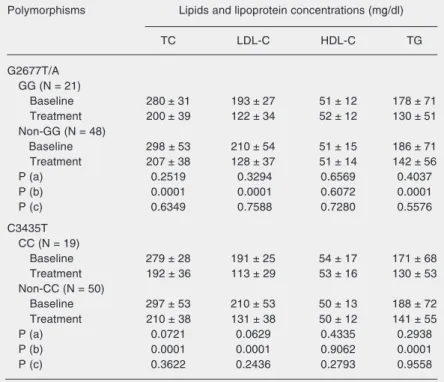
The results of repeated measures ANOVA
regarding the effect of MDR1 C3435T and
G2677T/A polymorphisms on serum lipid and lipoprotein concentrations before and after treatment with atorvastatin are pre-sented in Table 3. The serum lipid levels of individuals carrying the 2677G allele (GG genotype) were similar to those found in GG non-carriers (GT, GA, TT, AA, TA geno-types) after atorvastatin treatment (P > 0.05). For C3435T polymorphism, 3435C carriers (CC genotype) had a lipid profile similar to that of CC non-carriers (CT and TT geno-types; P > 0.05).
No significant interaction between
G2677T/A and C3435T MDR1
polymor-phisms and atorvastatin treatment was ob-served regarding treatment-induced changes
Table 2. Genotype distribution and relative allele frequency of MDR1 C3435T and G2677T/A polymorphisms in Brazilian hypercholesterolemic individuals of European descent.
Polymorphism Genotype distribution Relative allele frequencies
G2677T/Aa GG GT TT GA TA AA G T A
30.4 (21) 50.7 (35) 11.6 (8) 4.3 (3) 2.9 (2) 0 0.580 0.384 0.036
C3435Tb CC CT TT C T
27.5 (19) 52.2 (36) 20.3 (14) 0.536 0.464
Figure 1. Concentrations of se-rum total cholesterol (A) and low-density lipoprotein (LDL) choles-terol (B) according to MDR1 hap-lotype in Brazilian hypercholes-terolemic individuals of European descent before (baseline) and af-ter atorvastatin treatment (10 mg/ day). T/T carriers: GT/CT, GT/TT, TT/CT, TT/TT, TA/CT haplo-types; non-TT carriers: GG/CC, GG/CT, GG/TT, GT/CC, GA/CC haplotypes. Horizontal lines in box plots represent the mean concentration of total cholesterol or LDL cholesterol. Repeated measures ANOVA/Tukey test.
A
B
500
Total cholesterol (mg/dl)
P < 0.05
400
300
200
100
0
Before After Before After
non-T/T T/T
P < 0.05
Before After Before After 400
LDL cholesterol (mg/dl)
300
200
100
0
non-T/T T/T
Table 3. Serum lipid levels at baseline and after atorvastatin of Brazilian hypercholes-terolemic individuals of European descent according to MDR1 genotype.
Polymorphisms Lipids and lipoprotein concentrations (mg/dl)
TC LDL-C HDL-C TG
G2677T/A GG (N = 21)
Baseline 280 ± 31 193 ± 27 51 ± 12 178 ± 71
Treatment 200 ± 39 122 ± 34 52 ± 12 130 ± 51
Non-GG (N = 48)
Baseline 298 ± 53 210 ± 54 51 ± 15 186 ± 71
Treatment 207 ± 38 128 ± 37 51 ± 14 142 ± 56
P (a) 0.2519 0.3294 0.6569 0.4037
P (b) 0.0001 0.0001 0.6072 0.0001
P (c) 0.6349 0.7588 0.7280 0.5576
C3435T CC (N = 19)
Baseline 279 ± 28 191 ± 25 54 ± 17 171 ± 68
Treatment 192 ± 36 113 ± 29 53 ± 16 130 ± 53
Non-CC (N = 50)
Baseline 297 ± 53 210 ± 53 50 ± 13 188 ± 72
Treatment 210 ± 38 131 ± 38 50 ± 12 141 ± 55
P (a) 0.0721 0.0629 0.4335 0.2938
P (b) 0.0001 0.0001 0.9062 0.0001
P (c) 0.3622 0.2436 0.2793 0.9558
Data are reported as mean ± SD. TC = total cholesterol; LDL-C = low-density lipopro-tein cholesterol; HDL-C = high-density lipoprolipopro-tein cholesterol; TG = triglyceride; N = number of individuals. Baseline: measurement before atorvastatin treatment (10 mg/ day); Treatment: measurement after atorvastatin treatment (10 mg/day).
P values from repeated measures ANOVA studying the effect of: a) polymorphism (between group comparisons), b) atorvastatin treatment (within group comparisons), and c) interaction between polymorphism and atorvastatin treatment.
in lipids or lipoproteins (P > 0.05).
We also evaluated the effect of MDR1
haplotypes between baseline and atorvastatin treatment on serum concentrations of lipids
and lipoproteins. The individuals were grouped as T/T haplotype carriers (GT/CT, GT/TT, TT/CT, TT/TT, and TA/CT haplo-types) and non-T/T haplotype carriers (GG/ CC, GG/CT, GT/CC, GG/TT, and GA/CC haplotypes). As shown in Figure 1, baseline serum levels of total (Figure 1A) and LDL (Figure 1B) cholesterol were significantly higher in Brazilian individuals of European descent carrying the T/T haplotype (total cholesterol: 303 ± 56, LDL: 216 ± 57 mg/dl) than in those carrying the non-T/T haplotype (total cholesterol: 278 ± 28, LDL: 189 ± 24 mg/dl) (Tukey test: P < 0.05). However, after atorvastatin treatment, serum lipid and lipoprotein levels were similar for TT haplo-type carriers and non-carriers.
As shown in Figure 2, there was no sig-nificant interaction between T/T and non-T/ T haplotype carriers and atorvastatin treat-ment-induced changes in total and LDL cho-lesterol in Brazilian subjects of European descent.
Discussion
Significant ethnic differences in allele frequency and genotype distribution of the
MDR1 C3435T and G2677T/A
simi-lar to that found in other Caucasian popula-tions (8,12,15,16,22,32).
Analysis of the MDR1 G2677T/A
poly-morphism showed that the relative frequen-cies of the 2677G (0.580), 2677T (0.384) and G2677A (0.036) alleles for Brazilians of European descent did not differ from those observed in other Caucasian populations (8,15,16,18).
In our population we observed linkage disequilibrium between C3435T and G2677T/ A polymorphisms, as demonstrated for Eu-ropean American and Asian populations (16, 26,30,33).
High baseline levels of total and LDL cholesterol were found in Brazilian indi-viduals of European descent carrying the 3435T allele compared to those with the 3435CC genotype, but the results failed to reach statistical significance. Kajinami et al. (34) have reported that hypercholesterole-mic white women carrying at least one 2677nonG (2677T or 2677A) allele showed significantly higher LDL cholesterol levels than non-carriers, but this was not seen in men.
Haplotype analysis revealed that the Bra-zilians of European descent carrying the T/T haplotype had higher levels of total and LDL cholesterol. This observation suggests that the functional effects of P-gp may be haplo-type-dependent and do not necessary need to be defined by a single polymorphism.
Increased MDR1 mRNA and protein
ex-pression has been demonstrated (16,20,26) by in vitro and in vivo studies. Nakamura et
al. (20) described higher mRNA expression levels in duodenal enterocytes of healthy Japanese volunteers with the 3435TT geno-type. Therefore, it is reasonable that the high levels of serum total and LDL cholesterol found in T/T haplotype carriers may be due
to an increased MDR1 mRNA and protein
P-gp expression.
P-gp is involved in the transport of free cholesterol from the plasma membrane to the endoplasmic reticulum (ER), the site of cholesterol esterification by acyl-CoA: cholesteryl acyltransferase (ACAT) (35). In addition, the positive correlation between
MDR1 and ACAT mRNA expression levels
found in atherosclerotic lesions suggests that P-gp may be involved in the accumulation of intracellular cholesterol ester and in the ac-celeration of cell proliferation rate in vessel sites prone to atherosclerosis (36).
The increased P-gp activity associated
with the MDR1 variants may result in
in-creased intracellular content of cholesterol esters that induces a reduction of cholesterol synthesis and LDL uptake mediated by HMGR and LDL receptor, respectively. Therefore, the lower number of LDL recep-tors on the cell membrane reduces the rate of removal of LDL particles, enhancing the cholesterolemia. Although this mechanism
Figure 2. Serum concentration of total (A) and low-density lipo-protein (LDL) cholesterol (B) in Brazilian hypercholesterolemic individuals of European descent according to MDR1 haplotype, before (baseline) and after ator-vastatin therapy (10 mg/day). Non-T/T carriers: GG/CC, GG/ CT, GG/TT, GT/CC, GA/CC haplotypes; T/T carriers: GT/CT, GT/TT, TT/CT, TT/TT, TA/CT haplotypes. Repeated meas-ures ANOVA: P > 0.05 for differ-ences between non-TT and TT carriers.
Total cholesterol (mg/dl)
400
300
200
100 LDL cholesterol (mg/dl) 300
200
100
0
Baseline Treatment Baseline Treatment
T/T carriers Non-T/T carriers
would explain the higher levels of total and LDL cholesterol found in Brazilian indi-viduals of European descent who are T/T haplotype carriers, other molecules that regu-late the intracellular cholesterol trafficking may also be involved.
Recently, it has been shown that caveolin-1, a component of caveolae, mediates the efflux of intracellular free cholesterol by transporting cholesterol from the ER to the plasma membrane (37). Therefore, the avail-ability of a cholesterol substrate in the ER, which is the major determinant of ACAT activity, may be regulated by both P-gp and caveolin-1 (37). These findings would ex-plain the lack of correlation between P-gp activity and intracellular cholesterol esterifi-cation found in HepG2 cells (38).
The C3435T and G2677T/A polymor-phisms were associated with drug responses in patients treated with atorvastatin (34), nelfinavir (39), digoxin (22), and tacrolimus (40). We did not find a significant effect of these polymorphisms on the response to atorvastatin in hypercholesterolemic patients. Recently, Kajinami et al. (34) detected an association between 3435CC genotype and smaller reductions in LDL cholesterol, but larger increases in HDL cholesterol, relative to variant allele carriers among hypercholes-terolemic white women after treatment with
atorvastatin (10 mg/day). This effect was not found in men, suggesting a gender-specific effect. Also, haplotype analysis showed that women carrying the homozygous GC haplo-type (2677GG and 3435CC genohaplo-types) have a smaller response regarding reduction of LDL cholesterol than women with the non-GC haplotype.
The lack of association between lipid
response to atorvastatin and MDR1
geno-types and haplogeno-types may be due to the size of our sample since we could not stratify our population by gender. In addition, this caused the statistical power of the test performed to be below the desired level. Therefore, other
studies on P-gp expression and MDR1
poly-morphisms involving larger samples (at least two to three times larger) are necessary to
determine whether MDR1 variants in fact
influence P-gp expression and consequently atorvastatin disposition. In addition, the posi-tive association between our T/T haplotype carriers and higher basal total and LDL cho-lesterol would be greatly strengthened if the sample were larger.
We conclude that MDR1 polymorphism
may have an important contribution to basal total and LDL cholesterol serum levels in Brazilian individuals of European descent with primary hypercholesterolemia.
References
1. Malinowski JM (1998). Atorvastatin: a hydroxymethylglutaryl-coen-zyme A reductase inhibitor. American Journal of Health-System Pharmacy, 55: 2253-2267.
2. Igel M, Sudhop T & Von Bergmann K (2001). Metabolism and drug interactions of 3-hydroxy-3-methylglutaryl coenzyme-A-reductase inhibitors (statins). European Journal of Clinical Pharmacology, 264: 11693-11698.
3. Jacobson W, Kuhn B, Soldner A et al. (2000). Lactonization is the critical first step in the disposition of the 3-hydroxy-3-methylglutaryl-CoA reductase inhibitor atorvastatin. Drug Metabolism and Disposi-tion, 28: 1369-1378.
4. Prueksaritanont T, Subramanian R, Fang X et al. (2002). Glucuroni-dation of statins in animals and humans: a novel mechanism of statin lactonization. Drug Metabolism and Disposition, 30: 505-512. 5. Siest G, Ferrari L, Accaoui MJ et al. (2003). Pharmacogenomics of
drugs affecting the cardiovascular system. Clinical Chemistry and Laboratory Medicine, 41: 590-599.
6. Klein I, Sarkadi B & Varadi A (1999). An inventory of the human ABC proteins. Biochimica et Biophysica Acta, 1461: 237-262.
7. Bogman K, Peyer AK, Török M et al. (2001). HMG-CoA reductase inhibitors and P-glycoprotein modulation. British Journal of Pharma-cology, 132: 1183-1192.
8. Marzolini C, Paus E, Buclin T et al. (2004). Polymorphisms in human
MDR1 (P-glycoprotein): Recent advances and clinical relevance.
Clinical Pharmacology and Therapeutics, 75: 13-33.
9. Gottesman MM & Pastan I (1993). Biochemistry of multidrug resis-tance mediated by the multidrug transporter. Annual Review of Biochemistry, 62: 385-427.
11. Lehmann JM, McKee DD, Watson MA et al. (1998). The human orphan nuclear receptor PXR is activated by compounds that regu-late CYP3A4 gene expression and cause drug interactions. Journal of Clinical Investigation, 102: 1016-1023.
12. Ameyaw MM, Regateiro F, Li T et al. (2001). MDR1 pharmacogenet-ics: frequency of the C3435T mutation in exon 26 is significantly influenced by ethnicity. Pharmacogenetics, 11: 217-221.
13. Schaeffeler E, Eichelbaum M, Brinkmann U et al. (2001). Frequency of C3435T polymorphism of MDR1 gene in African people. Lancet, 358: 383-384.
14. Moriya Y, Nakamura T, Horinouchi M et al. (2002). Effects of poly-morphisms of MDR1, MRP1, and MRP2 genes on their mRNA expression levels in duodenal enterocytes of healthy Japanese subjects. Biological and Pharmaceutical Bulletin, 25: 1356-1359. 15. Cascorbi I, Gerloff T, Johne A et al. (2001). Frequency of single
nucleotide polymorphisms in the nucleotide in the P-glycoprotein drug transporter MDR1 gene in white subjects. Clinical Pharmacolo-gy and Therapeutics, 69: 169-174.
16. Kim RB, Leake BF, Choo EF et al. (2001). Identification of function-ally variant MDR1 alleles among European Americans and African Americans. Clinical Pharmacology and Therapeutics, 70: 189-199. 17. Tanabe M, Ieri I, Nagata N et al. (2001). Expression of
P-glycopro-tein in human placenta: relation to genetic polymorphism of the multidrug resistance (MDR1) gene. Journal of Pharmacology and Experimental Therapeutics, 297: 1137-1143.
18. Furuno T, Landi MT, Ceroni M et al. (2002). Expression polymor-phism of the blood-brain barrier component P-glycoprotein (MDR1) in relation to Parkinson’s disease. Pharmacogenetics, 12: 529-534. 19. Gaikovitch EA, Cascorbi I, Mrozikiewicz PM et al. (2003). Polymor-phisms of drug-metabolizing enzymes CYP2C9, CYP2C19, CYP2D6, CYP1A1, NAT2 and P-glycoprotein in a Russian popula-tion. European Journal of Clinical Pharmacology, 59: 303-312. 20. Nakamura T, Sakaeda T, Horinouchi M et al. (2002). Effect of the
mutation (C3435T) at exon 26 of the MDR1 gene on expression level of MDR1 messenger ribonucleic acid in duodenal enterocytes of healthy Japanese subjects. Clinical Pharmacology and Thera-peutics, 71: 297-303.
21. Johne A, Kopke K, Gerloff T et al. (2002). Modulation of steady-state kinetics of digoxin by haplotypes of the P-glycoprotein MDR1 gene.
Clinical Pharmacology and Therapeutics, 72: 584-594.
22. Hoffmeyer S, Burk O, Von Richter O et al. (2000). Functional poly-morphisms of the human multidrug-resistance gene: multiple se-quence variations and correlation of one allele with P-glycoprotein expression and activity in vivo. Proceedings of the National Acade-my of Sciences, USA, 97: 3473-3478.
23. von Ahsen N, Richter M, Grupp C et al. (2001). No influence of the MDR-1 C3435T polymorphism or a CYP3A4 promoter polymor-phism (CYP3A4-V allele) on dose-adjusted cyclosporin A trough concentrations or rejection incidence in stable renal transplant re-cipients. Clinical Chemistry, 47: 1048-1052.
24. Brinkmann U, Roots I & Eichelbaum M (2001). Pharmacogenetics of the human drug-transporter gene MDR1: impact of polymorphisms on pharmacotherapy. Drug Discovery Today, 6: 835-839.
25. Kurata Y, Ieiri I, Kimura M et al. (2002). Role of human MDR1 gene polymorphism in bioavailability and interaction of digoxin, a
sub-strate of P-glycoprotein. Clinical Pharmacology and Therapeutics, 72: 209-219.
26. Sakaeda T, Nakamura T & Okumura K (2002). MDR1 genotype-related pharmacokinetics and pharmacodynamics. Biological and Pharmaceutical Bulletin, 25: 1391-1400.
27. Expert Panel on Detection, Evaluation, and Treatment of High Blood Cholesterol in Adults (2001). Executive Summary of the Third Re-port of the National Cholesterol Education Program (NCEP) Expert Panel on Detection, Evaluation, and Treatment of High Blood Cho-lesterol in Adults (Adult Treatment Panel III). Journal of the Ameri-can Medical Association, 285: 2486-2497.
28. Friedwald WT, Levy RI & Fredrickson DS (1967). Estimation of the concentrations of low-density lipoprotein - an integral approach to mechanisms and disorders. New England Journal of Medicine, 276: 32.
29. Salazar LA, Hirata MH, Cavalli SA et al. (1998). Optimized proce-dure for DNA isolation from fresh and cryopreserved clotted human blood useful in clinical molecular testing. Clinical Chemistry, 44: 1748-1750.
30. Tang K, Ngoi SM, Gwee PC et al. (2002). Distinct haplotype profiles and strong linkage disequilibrium at the MDR1 multidrug transporter gene locus in three ethnic Asian populations. Pharmacogenetics, 12: 437-450.
31. Arlequin software. Arlequin’s home on the web. [http://lgb.unige.ch/ arlequin/]. Accessed January 2004.
32. Bernal ML, Sinues B, Fanlo A et al. (2003). Frequency distribution of C3435T mutation in exon 26 of the MDR1 gene in a Spanish popula-tion. Therapeutic Drug Monitoring, 25: 107-111.
33. Evans WE & McLeod HL (2003). Pharmacogenomics - drug disposi-tion, drug targets, and side effects. New England Journal of Medi-cine, 348: 538-549.
34. Kajinami K, Brousseau ME, Ordovas JM et al. (2004). Polymor-phisms in the multidrug resistance-1 (MDR1) gene influence the response to atorvastatin treatment in a gender-specific manner.
American Journal of Cardiology, 93: 1046-1050.
35. Debry P, Nash EA, Neklason DW et al. (1997). Role of multidrug resistance P-glycoproteins in cholesterol esterification. Journal of Biological Chemistry, 272: 1026-1030.
36. Petruzzo P, Cappai A, Brotzu G et al. (2001). Lipid metabolism and molecular changes in normal and atherosclerotic vessels. European Journal of Vascular and Endovascular Surgery, 22: 31-36. 37. Batetta B, Mulas MF, Sanna F et al. (2003). Role of cholesterol ester
pathway in the control of cell cycle in human aortic smooth muscle cells. FASEB Journal, 17: 746-748.
38. Issandou M & Grand-Perret T (2000). Multidrug resistance P-glyco-protein is not involved in cholesterol esterification. Biochemical and Biophysical Research Communications, 279: 369-377.
39. Fellay J, Marzolini C, Meaden ER et al. (2002). Response to anti-retroviral treatment in IIIV-I-infected individuals with allelic variants of the multidrug resistance transporter I: a pharmacogenetic study.
Lancet, 3359: 30-36.
40. Anglicheau D, Verstuyft C, Laurent-Puig P et al. (2003). Association of the multidrug resistance-1 gene single-nucleotide polymorphisms with the tacrolimus dose requirements in renal transplant recipients.